Domain-Specific Computational, Functional and Structural Methods Enable Interpretation of BRCA1 BRCT Variants of Uncertain Significance


 ,
,
Simple Summary
Abstract
1. Introduction
2. Materials and Methods
2.1. BRCA1 Variant Distribution Graphing
2.2. Model Building and Application
2.3. DNA Fragment Design, Cloning and Ligation
2.4. Cell Culture and Transfection
2.5. Co-Immunoprecipitation and Immunoblotting
2.6. Flow Cytometry
2.7. Anti-BRCA1 Co-Immunoprecipitation and Immunoblotting
2.8. Computational Structural Modeling
3. Results
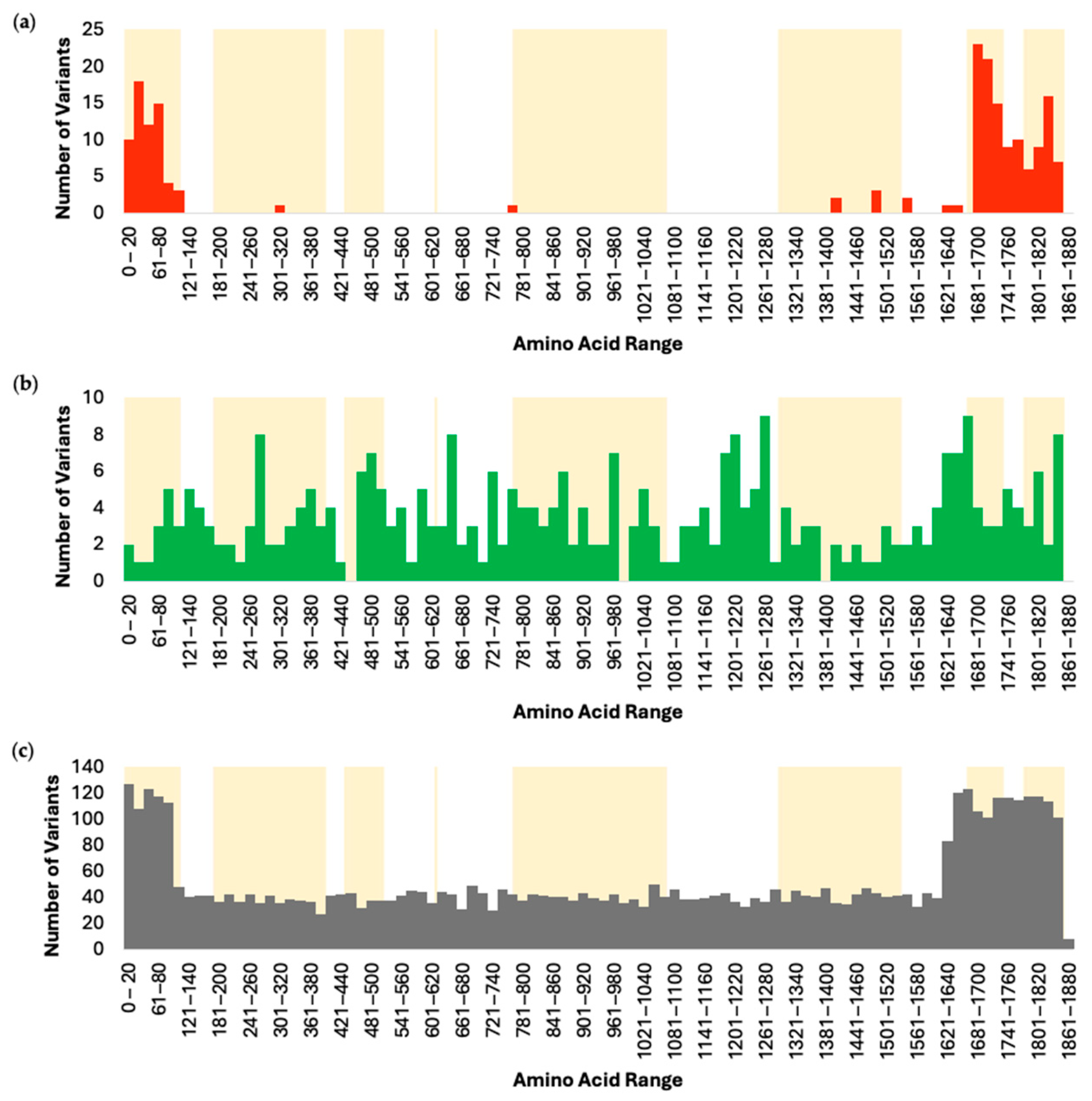
3.1. The RING and BRCT Domains Are Hotspots for Missense Pathogenic Variants and VUS
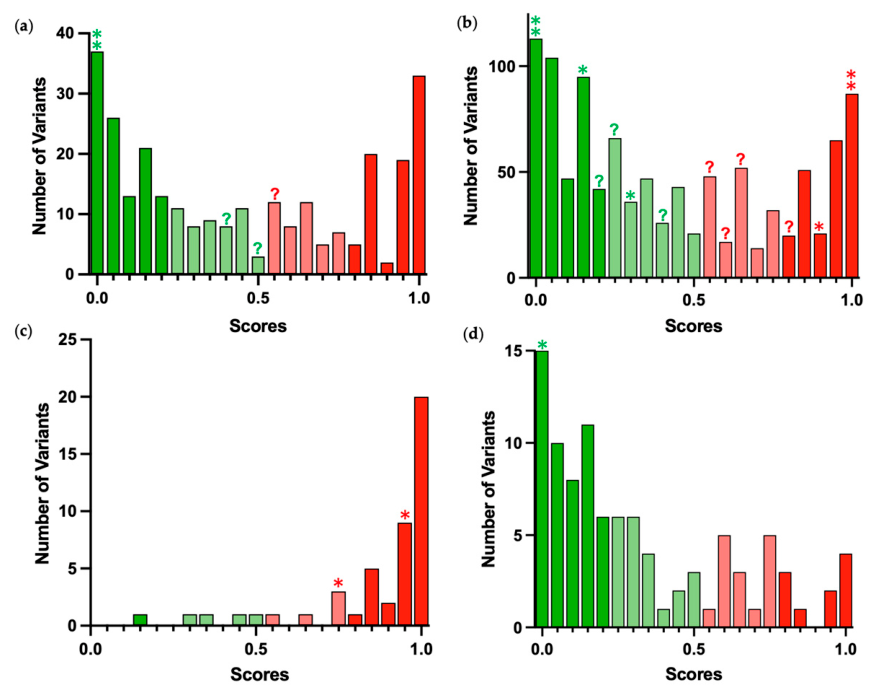
3.2. Nine In Silico Tools Define BRCT-Specific Missense Variant Pathogenicity Predictor Tool
3.3. Twenty-Two VUS Ranging in Classifier Scores Selected for Functional Analysis
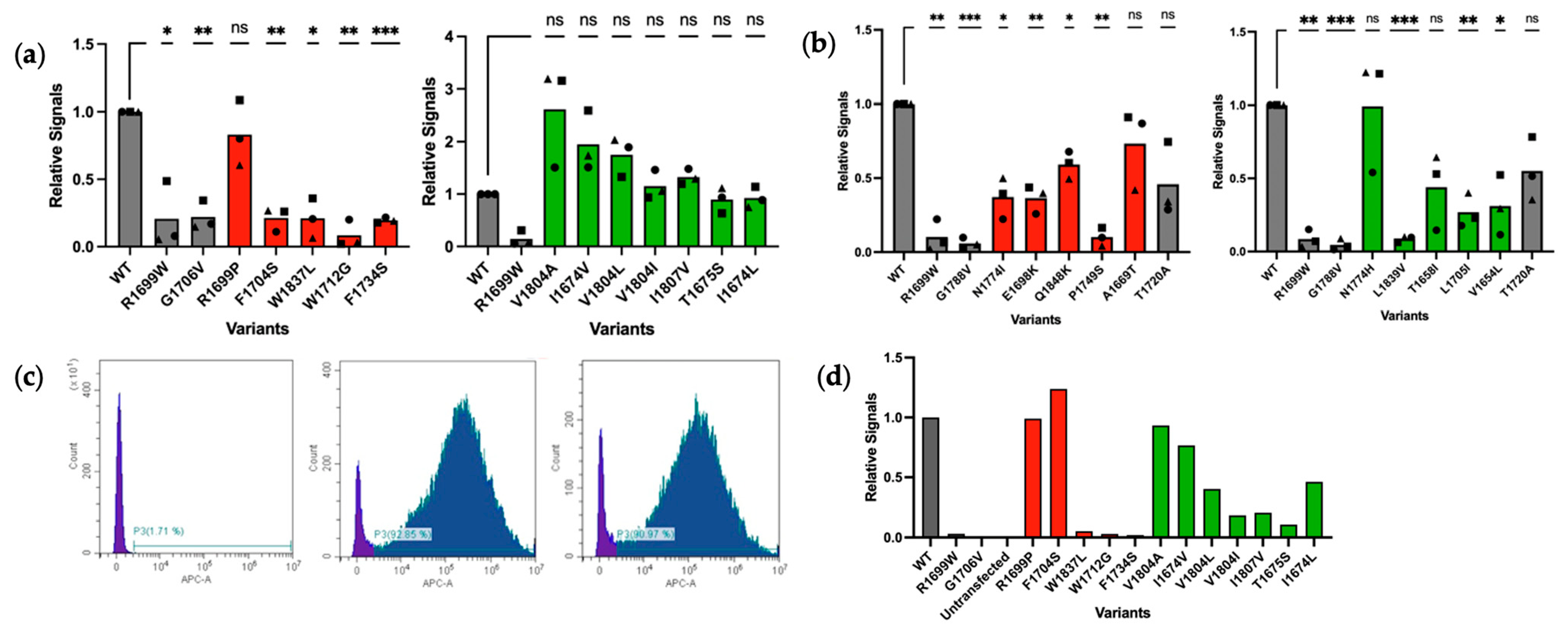
3.4. Pathogenic Controls, Benign Reference and VUS Demonstrate Varying FLAG and Phosphopeptide Signals Relative to Wildtype Control
3.5. FLAG Signal Variability Assessed Using Flow Cytometry and Anti-BRCA1 Co-Immunoprecipitation
3.6. VUS Structural Contexts and Interactions with Phosphopeptides Visualized Through Computational Structural Modeling
4. Discussion
5. Conclusions
Supplementary Materials
Author Contributions
Funding
Institutional Review Board Statement
Informed Consent Statement
Data Availability Statement
Conflicts of Interest
Abbreviations
| AI | Artificial intelligence |
| ACMG | American College of Medical Genetics and Genomics |
| AMP | Association for Molecular Pathology |
| APC | Allophycocyanin |
| BME | β-mercaptoethanol |
| FBS | Fetal bovine serum |
| HBOC | Hereditary Breast and Ovarian Cancer |
| HDR | Homology-directed repair |
| HEK293T | Human Embryonic Kidney 293T |
| kNN | k-nearest neighbors |
| LB | Lysogeny broth |
| LOF | Loss-of-function |
| PBS-T | Phosphate-buffered saline + 0.1% Tween-20 |
| SDS | Sodium dodecyl sulfate |
| VEP | Variant Effect Predictor |
| VUS | Variant of uncertain significance |
References
- Yoshida, R. Hereditary breast and ovarian cancer (HBOC): Review of its molecular characteristics, screening, treatment, and prognosis. Breast Cancer 2020, 28, 1167–1180. [Google Scholar] [CrossRef] [PubMed]
- Toss, A.; Tomasello, C.; Razzaboni, E.; Contu, G.; Grandi, G.; Cagnacci, A.; Schilder, R.J.; Cortesi, L. Hereditary Ovarian Cancer: Not OnlyBRCA1 and 2 Genes. BioMed Res. Int. 2015, 2015, 341723. [Google Scholar] [CrossRef]
- Bouras, A.; Guidara, S.; Leone, M.; Buisson, A.; Martin-Denavit, T.; Dussart, S.; Lasset, C.; Giraud, S.; Bonnet-Dupeyron, M.-N.; Kherraf, Z.-E.; et al. Overview of the Genetic Causes of Hereditary Breast and Ovarian Cancer Syndrome in a Large French Patient Cohort. Cancers 2023, 15, 3420. [Google Scholar] [CrossRef] [PubMed]
- Vidal, R.d.S.; Hawrysh, A.; Walia, J.S.; Davey, S.; Feilotter, H. Eligibility Criteria and Genetic Testing Results from a High-Risk Cohort for Hereditary Breast and Ovarian Cancer Syndrome in Southeastern Ontario. J. Mol. Diagn. 2016, 18, 362–369. [Google Scholar] [CrossRef]
- Hurst, J.H. Pioneering geneticist Mary-Claire King receives the 2014 Lasker~Koshland Special Achievement Award in Medical Science. J. Clin. Investig. 2014, 124, 4148–4151. [Google Scholar] [CrossRef]
- Petrova, D.; Cruz, M.; Sánchez, M.-J. BRCA1/2 testing for genetic susceptibility to cancer after 25 years: A scoping review and a primer on ethical implications. Breast 2021, 61, 66–76. [Google Scholar] [CrossRef]
- Petrucelli, N.; Daly, M.B.; Pal, T. BRCA1- and BRCA2-Associated Hereditary Breast and Ovarian Cancer. In GeneReviews; University of Washington: Seattle, WA, USA, 1998. [Google Scholar]
- Dossa, F.; Cusimano, M.C.; Sutradhar, R.; Metcalfe, K.; Little, T.; Lerner-Ellis, J.; Eisen, A.; Meschino, W.S.; Baxter, N.N. Real-world health services utilisation and outcomes after BRCA1 and BRCA2 testing in Ontario, Canada: The What Comes Next Cohort Study protocol. BMJ Open 2018, 8, e025317. [Google Scholar] [CrossRef]
- Bertozzi, S.; Londero, A.P.; Xholli, A.; Azioni, G.; Di Vora, R.; Paudice, M.; Bucimazza, I.; Cedolini, C.; Cagnacci, A. Risk-Reducing Breast and Gynecological Surgery for BRCA Mutation Carriers: A Narrative Review. J. Clin. Med. 2023, 12, 1422. [Google Scholar] [CrossRef]
- Ragupathi, A.; Singh, M.; Perez, A.M.; Zhang, D. Targeting the BRCA1/2 deficient cancer with PARP inhibitors: Clinical outcomes and mechanistic insights. Front. Cell Dev. Biol. 2023, 11, 1133472. [Google Scholar] [CrossRef]
- Bramanti, S.M.; Trumello, C.; Lombardi, L.; Cavallo, A.; Stuppia, L.; Antonucci, I.; Babore, A. Uncertainty following an inconclusive result from the BRCA1/2 genetic test: A review about psychological outcomes. World J. Psychiatry 2021, 11, 189–200. [Google Scholar] [CrossRef] [PubMed]
- Toland, A.E.; Forman, A.; Couch, F.J.; Culver, J.O.; Eccles, D.M.; Foulkes, W.D.; Hogervorst, F.B.L.; Houdayer, C.; Levy-Lahad, E.; Monteiro, A.N.; et al. Clinical testing of BRCA1 and BRCA2: A worldwide snapshot of technological practices. npj Genom. Med. 2018, 3, 7. [Google Scholar] [CrossRef]
- Lindor, N.M.; Goldgar, D.E.; Tavtigian, S.V.; Plon, S.E.; Couch, F.J. BRCA1/2 Sequence Variants of Uncertain Significance: A Primer for Providers to Assist in Discussions and in Medical Management. Oncologist 2013, 18, 518–524. [Google Scholar] [CrossRef] [PubMed]
- Jimenez-Sainz, J.; Jensen, R.B. Imprecise Medicine: BRCA2 Variants of Uncertain Significance (VUS), the Challenges and Benefits to Integrate a Functional Assay Workflow with Clinical Decision Rules. Genes 2021, 12, 780. [Google Scholar] [CrossRef]
- Yoshida, R.; Hagio, T.; Kaneyasu, T.; Gotoh, O.; Osako, T.; Tanaka, N.; Amino, S.; Yaguchi, N.; Nakashima, E.; Kitagawa, D.; et al. Pathogenicity assessment of variants for breast cancer susceptibility genes based on BRCAness of tumor sample. Cancer Sci. 2021, 112, 1310–1319. [Google Scholar] [CrossRef]
- Clark, S.L.; Rodriguez, A.M.; Snyder, R.R.; Hankins, G.D.; Boehning, D. Structure-Function Of The Tumor Suppressor BRCA1. Comput. Struct. Biotechnol. J. 2012, 1, e201204005. [Google Scholar] [CrossRef]
- Coquelle, N.; Green, R.; Glover, J.N.M. Impact of BRCA1 BRCT Domain Missense Substitutions on Phosphopeptide Recognition. Biochemistry 2011, 50, 4579–4589. [Google Scholar] [CrossRef]
- Wu, Q.; Jubb, H.; Blundell, T.L. Phosphopeptide interactions with BRCA1 BRCT domains: More than just a motif. Prog. Biophys. Mol. Biol. 2015, 117, 143–148. [Google Scholar] [CrossRef]
- Houge, G.; Bratland, E.; Aukrust, I.; Tveten, K.; Žukauskaitė, G.; Sansovic, I.; Brea-Fernández, A.J.; Mayer, K.; Paakkola, T.; McKenna, C.; et al. Comparison of the ABC and ACMG systems for variant classification. Eur. J. Hum. Genet. 2024, 32, 858–863. [Google Scholar] [CrossRef]
- Richards, S.; Aziz, N.; Bale, S.; Bick, D.; Das, S.; Gastier-Foster, J.; Grody, W.W.; Hegde, M.; Lyon, E.; Spector, E.; et al. Standards and guidelines for the interpretation of sequence variants: A joint consensus recommendation of the American College of Medical Genetics and Genomics and the Association for Molecular Pathology. Genet. Med. 2015, 17, 405–424. [Google Scholar] [CrossRef] [PubMed]
- Fayer, S.; Horton, C.; Dines, J.N.; Rubin, A.F.; Richardson, M.E.; McGoldrick, K.; Hernandez, F.; Pesaran, T.; Karam, R.; Shirts, B.H.; et al. Closing the gap: Systematic integration of multiplexed functional data resolves variants of uncertain significance in BRCA1, TP53, and PTEN. Am. J. Hum. Genet. 2021, 108, 2248–2258. [Google Scholar] [CrossRef] [PubMed]
- De Paolis, E.; Paris, I.; Tilocca, B.; Roncada, P.; Foca, L.; Tiberi, G.; D’Angelo, T.; Pavese, F.; Muratore, M.; Carbognin, L.; et al. Assessing the pathogenicity of BRCA1/2 variants of unknown significance: Relevance and challenges for breast cancer precision medicine. Front. Oncol. 2023, 12, 1053035. [Google Scholar] [CrossRef] [PubMed]
- Azmi, M.B.; Qureshi, S.; Wasi, R.; Niaz, S.K.; Ahmed, S.D.H. Computational identification of rare pathogenic genomic variants in esophageal cancer markers: Transcript-level analysis, sequence-based insights, and structural-functional impacts of non-synonymous SNPs. Biochem. Biophys. Rep. 2026, 45, 102503. [Google Scholar] [CrossRef]
- Millot, G.A.; Carvalho, M.A.; Caputo, S.M.; Vreeswijk, M.P.; Brown, M.A.; Webb, M.; Rouleau, E.; Neuhausen, S.L.; Hansen, T.V.O.; Galli, A.; et al. A guide for functional analysis of BRCA1 variants of uncertain significance. Hum. Mutat. 2012, 33, 1526–1537. [Google Scholar] [CrossRef] [PubMed]
- Ransburgh, D.J.R.; Chiba, N.; Ishioka, C.; Toland, A.E.; Parvin, J.D. Identification of breast tumor mutations in BRCA1 that abolish its function in homologous DNA recombination. Cancer Res. 2010, 70, 988–995. [Google Scholar] [CrossRef]
- Landrum, M.J.; Lee, J.M.; Riley, G.R.; Jang, W.; Rubinstein, W.S.; Church, D.M.; Maglott, D.R. ClinVar: Public archive of relationships among sequence variation and human phenotype. Nucleic Acids Res. 2014, 42, D980–D985. [Google Scholar] [CrossRef]
- Gerolami, J.; Wong, J.J.M.; Zhang, R.; Chen, T.; Imtiaz, T.; Smith, M.; Jamaspishvili, T.; Koti, M.; Glasgow, J.I.; Mousavi, P.; et al. A Computational Approach to Identification of Candidate Biomarkers in High-Dimensional Molecular Data. Diagnostics 2022, 12, 1997. [Google Scholar] [CrossRef]
- Berman, H.M.; Westbrook, J.; Feng, Z.; Gilliland, G.; Bhat, T.N.; Weissig, H.; Shindyalov, I.N.; Bourne, P.E. The Protein Data Bank. Nucleic Acids Res. 2000, 28, 235–242. [Google Scholar] [CrossRef] [PubMed]
- The PyMOL Molecular Graphics System, version 3.9; Schrodinger, LLC: New York, NY, USA, 2017.
- Liu, X.; Jian, X.; Boerwinkle, E. dbNSFP: A lightweight database of human nonsynonymous SNPs and their functional predictions. Hum. Mutat. 2011, 32, 894–899. [Google Scholar] [CrossRef]
- McLaren, W.; Gil, L.; Hunt, S.E.; Riat, H.S.; Ritchie, G.R.S.; Thormann, A.; Flicek, P.; Cunningham, F. The Ensembl Variant Effect Predictor. Genome Biol. 2016, 17, 122. [Google Scholar] [CrossRef]
- Williams, R.S.; Lee, M.S.; Hau, D.D.; Glover, J.N.M. Structural basis of phosphopeptide recognition by the BRCT domain of BRCA1. Nat. Struct. Mol. Biol. 2004, 11, 519–525. [Google Scholar] [CrossRef]
- Lee, M.S.; Green, R.; Marsillac, S.M.; Coquelle, N.; Williams, R.S.; Yeung, T.; Foo, D.; Hau, D.D.; Hui, B.; Monteiro, A.N.; et al. Comprehensive Analysis of Missense Variations in the BRCT Domain of BRCA1 by Structural and Functional Assays. Cancer Res. 2010, 70, 4880–4890. [Google Scholar] [CrossRef]
- Karchin, R.; Monteiro, A.N.A.; Tavtigian, S.V.; Carvalho, M.A.; Sali, A. Functional Impact of Missense Variants in BRCA1 Predicted by Supervised Learning. PLoS Comput. Biol. 2007, 3, e26. [Google Scholar] [CrossRef]
- Ismail, T.; Alzneika, S.; Riguene, E.; Al-Maraghi, S.; Alabdulrazzak, A.; Al-Khal, N.; Fetais, S.; Thanassoulas, A.; AlFarsi, H.; Nomikos, M. BRCA1 and Its Vulnerable C-Terminal BRCT Domain: Structure, Function, Genetic Mutations and Links to Diagnosis and Treatment of Breast and Ovarian Cancer. Pharmaceuticals 2024, 17, 333. [Google Scholar] [CrossRef]
- Li, S.C.; Goto, N.K.; Williams, K.A.; Deber, C.M. Alpha-helical, but not beta-sheet, propensity of proline is determined by peptide environment. Proc. Natl. Acad. Sci. USA 1996, 93, 6676–6681. [Google Scholar] [CrossRef]
- Yadegari, F.; Farahmand, L.; Esmaeili, R.; Zarinfam, S.; Majidzadeh-A, K. Inter-BRCT linker is probably the most intolerant region of the BRCA1 BRCT domain. J. Biomol. Struct. Dyn. 2023, 42, 5734–5746. [Google Scholar] [CrossRef] [PubMed]
- Adzhubei, I.A.; Schmidt, S.; Peshkin, L.; Ramensky, V.E.; Gerasimova, A.; Bork, P.; Kondrashov, A.S.; Sunyaev, S.R. A method and server for predicting damaging missense mutations. Nat. Methods 2010, 7, 248–249. [Google Scholar] [CrossRef]
- Carter, H.; Douville, C.; Stenson, P.D.; Cooper, D.N.; Karchin, R. Identifying Mendelian disease genes with the Variant Effect Scoring Tool. BMC Genom. 2013, 14, S3. [Google Scholar] [CrossRef] [PubMed]
- Frazer, J.; Notin, P.; Dias, M.; Gomez, A.; Min, J.K.; Brock, K.; Gal, Y.; Marks, D.S. Disease variant prediction with deep generative models of evolutionary data. Nature 2021, 599, 91–95. [Google Scholar] [CrossRef]
- Li, C.; Zhi, D.; Wang, K.; Liu, X. MetaRNN: Differentiating rare pathogenic and rare benign missense SNVs and InDels using deep learning. Genome Med. 2022, 14, 115. [Google Scholar] [CrossRef]
- Zhang, H.; Xu, M.S.; Fan, X.; Chung, W.K.; Shen, Y. Predicting functional effect of missense variants using graph attention neural networks. Nat. Mach. Intell. 2022, 4, 1017–1028. [Google Scholar] [CrossRef] [PubMed]
- Rentzsch, P.; Witten, D.; Cooper, G.M.; Shendure, J.; Kircher, M. CADD: Predicting the deleteriousness of variants throughout the human genome. Nucleic Acids Res. 2019, 47, D886–D894. [Google Scholar] [CrossRef]
- Feng, B.-J. PERCH: A Unified Framework for Disease Gene Prioritization. Hum. Mutat. 2016, 38, 243–251. [Google Scholar] [CrossRef]
- Alirezaie, N.; Kernohan, K.D.; Hartley, T.; Majewski, J.; Hocking, T.D. ClinPred: Prediction Tool to Identify Disease-Relevant Nonsynonymous Single-Nucleotide Variants. Am. J. Hum. Genet. 2018, 103, 474–483. [Google Scholar] [CrossRef]
- Ionita-Laza, I.; McCallum, K.; Xu, B.; Buxbaum, J.D. A spectral approach integrating functional genomic annotations for coding and noncoding variants. Nat. Genet. 2016, 48, 214–220. [Google Scholar] [CrossRef]
- Peña-Guerrero, J.; Fernández-Rubio, C.; García-Sosa, A.T.; Nguewa, P.A. BRCT Domains: Structure, Functions, and Implications in Disease—New Therapeutic Targets for Innovative Drug Discovery against Infections. Pharmaceutics 2023, 15, 1839. [Google Scholar] [CrossRef]
- Brown, G. Ensemble Learning. In Encyclopedia of Machine Learning [Internet]; Springer: Boston, MA, USA, 2011; pp. 312–320. [Google Scholar]
- Sutojo, T.; Rustad, S.; Akrom, M.; Syukur, A.; Shidik, G.F.; Dipojono, H.K. A machine learning approach for corrosion small datasets. npj Mater. Degrad. 2023, 7, 18. [Google Scholar] [CrossRef]
- Kiyak, E.O.; Ghasemkhani, B.; Birant, D. High-Level K-Nearest Neighbors (HLKNN): A Supervised Machine Learning Model for Classification Analysis. Electronics 2023, 12, 3828. [Google Scholar] [CrossRef]
- Cheng, J.; Novati, G.; Pan, J.; Bycroft, C.; Žemgulytė, A.; Applebaum, T.; Pritzel, A.; Wong, L.H.; Zielinski, M.; Sargeant, T.; et al. Accurate proteome-wide missense variant effect prediction with AlphaMissense. Science 2023, 381, eadg7492. [Google Scholar] [CrossRef]
- Yazaki, S.; Pei, X.; Powell, S.; Khan, A.; Setton, J.; Riaz, N. AlphaMissense for Identifying Pathogenic Missense Mutations in DNA Damage Repair Genes in Cancer. JCO Precis Oncol. 2025, 9, e2400908. [Google Scholar] [CrossRef] [PubMed]
- Brandes, N.; Goldman, G.; Wang, C.H.; Ye, C.J.; Ntranos, V. Genome-wide prediction of disease variant effects with a deep protein language model. Nat. Genet. 2023, 55, 1512–1522. [Google Scholar] [CrossRef] [PubMed]
- Jagota, M.; Ye, C.; Albors, C.; Rastogi, R.; Koehl, A.; Ioannidis, N.; Song, Y.S. Cross-protein transfer learning substantially improves disease variant prediction. Genome Biol. 2023, 24, 182. [Google Scholar] [CrossRef]
- Wei, Q.; Dunbrack, R.L., Jr. The Role of Balanced Training and Testing Data Sets for Binary Classifiers in Bioinformatics. PLoS ONE 2013, 8, e67863. [Google Scholar] [CrossRef]
- Li, C.; Luo, Y.; Xie, Y.; Zhang, Z.; Liu, Y.; Zou, L.; Xiao, F. Structural and functional prediction, evaluation, and validation in the post-sequencing era. Comput. Struct. Biotechnol. J. 2023, 23, 446–451. [Google Scholar] [CrossRef]
- Ahmad, S.; Jose da Costa Gonzales, L.; Bowler-Barnett, E.H.; Rice, D.L.; Kim, M.; Wijerathne, S.; Luciani, A.; Kandasaamy, S.; Luo, J.; Watkins, X.; et al. UniProt Consortium. The UniProt website API: Facilitating programmatic access to protein knowledge. Nucleic Acids Res. 2025, 53, W547–W553. [Google Scholar] [CrossRef]
- Mesquita, R.D.; Woods, N.T.; Seabra-Junior, E.S.; Monteiro, A.N. Tandem BRCT Domains: DNA’s Praetorian Guard. Genes Cancer 2010, 1, 1140–1146. [Google Scholar] [CrossRef]
- Williams, R.S.; Chasman, D.I.; Hau, D.D.; Hui, B.; Lau, A.Y.; Glover, J.N.M. Detection of Protein Folding Defects Caused by BRCA1-BRCT Truncation and Missense Mutations. J. Biol. Chem. 2003, 278, 53007–53016. [Google Scholar] [CrossRef]
- Barua, S.A.; Goswami, N.; Mishra, N.; Sawant, U.U.; Varma, A.K. In Silico and Structure-Based Assessment of Similar Variants Discovered in Tandem Repeats of BRCT Domains of BRCA1 and BARD1 To Characterize the Folding Pattern. ACS Omega 2022, 7, 44772–44785. [Google Scholar] [CrossRef]
- Bross, P.; Corydon, T.J.; Andresen, B.S.; Jørgensen, M.M.; Bolund, L.; Gregersen, N. Protein misfolding and degradation in genetic diseases. Hum. Mutat. 1999, 14, 186–198. [Google Scholar] [CrossRef]
- Pal, T.; Mundt, E.; Richardson, M.E.; Chao, E.; Pesaran, T.; Slavin, T.P.; Couch, F.J.; Monteiro, A.N.A. Reduced penetrance BRCA1 and BRCA2 pathogenic variants in clinical germline genetic testing. npj Precis. Oncol. 2024, 8, 247. [Google Scholar] [CrossRef]
- Miao, Y.; Du, Q.; Zhang, H.G.; Yuan, Y.; Zuo, Y.; Zheng, H. Cycloheximide (CHX) Chase Assay to Examine Protein Half-life. Bio-Protocol 2023, 13, e4690. [Google Scholar] [CrossRef]
- Elgendy, M. Assessment of Modulation of Protein Stability Using Pulse-chase Method. Bio-Protocol 2017, 7, e2443. [Google Scholar] [CrossRef]
- Huynh, K.; Partch, C.L. Analysis of protein stability and ligand interactions by thermal shift assay. Curr. Protoc. Protein Sci. 2015, 79, 28.9.1–28.9.14. [Google Scholar] [CrossRef]
- Madern, M.F.; Haselbach, D.; Tanenbaum, M.E. In vivo kinetics of protein degradation by individual proteasomes. bioRxiv 2026. [Google Scholar] [CrossRef]
- Adamovich, A.I.; Diabate, M.; Banerjee, T.; Nagy, G.; Smith, N.; Duncan, K.; Mendoza Mendoza, E.; Prida, G.; Freitas, M.A.; Starita, L.M.; et al. The functional impact of BRCA1 BRCT domain variants using multiplexed DNA double-strand break repair assays. Am. J. Hum. Genet. 2022, 109, 618–630. [Google Scholar] [CrossRef]
- Findlay, G.M.; Daza, R.M.; Martin, B.; Zhang, M.D.; Leith, A.P.; Gasperini, M.; Janizek, J.D.; Huang, X.; Starita, L.M.; Shendure, J. Accurate classification of BRCA1 variants with saturation genome editing. Nature 2018, 562, 217–222. [Google Scholar] [CrossRef]
 Functional domain and binding site regions.
Functional domain and binding site regions.
Functional domain and binding site regions.
 Q1 (0–0.2333);
  Q2 (0.2667–0.5);
  Q3 (0.5333–0.7333);
  Q4 (0.7667–1); ∗ = Score locations of predicted pathogenic (red) and benign (green) variants from Q1 + Q4, with multiple ∗ in the same column denoting different variants with identical classifier scores; ? = Score locations of predicted pathogenic (red) or benign (green) variants from Q2 + Q3.
Q1 (0–0.2333); Q2 (0.2667–0.5); Q3 (0.5333–0.7333); Q4 (0.7667–1); ∗ = Score locations of predicted pathogenic (red) and benign (green) variants from Q1 + Q4, with multiple ∗ in the same column denoting different variants with identical classifier scores; ? = Score locations of predicted pathogenic (red) or benign (green) variants from Q2 + Q3.
Q4 (0.7667–1); ∗ = Score locations of predicted pathogenic (red) and benign (green) variants from Q1 + Q4, with multiple ∗ in the same column denoting different variants with identical classifier scores; ? = Score locations of predicted pathogenic (red) or benign (green) variants from Q2 + Q3.
Q1 (0–0.2333); Q2 (0.2667–0.5); Q3 (0.5333–0.7333); Q4 (0.7667–1); ∗ = Score locations of predicted pathogenic (red) and benign (green) variants from Q1 + Q4, with multiple ∗ in the same column denoting different variants with identical classifier scores; ? = Score locations of predicted pathogenic (red) or benign (green) variants from Q2 + Q3.
 Wildtype + pathogenic controls;
  predicted pathogenic VUS;
  predicted benign VUS; ns = not significant; ∗ = p < 0.05; ∗∗ = p < 0.01; ∗∗∗ = p < 0.001; ∗∗∗∗ = p < 0.0001; ● = biological replicate 1; ■ = biological replicate 2; ▲ = biological replicate 3.
Wildtype + pathogenic controls; predicted pathogenic VUS; predicted benign VUS; ns = not significant; ∗ = p < 0.05; ∗∗ = p < 0.01; ∗∗∗ = p < 0.001; ∗∗∗∗ = p < 0.0001; ● = biological replicate 1; ■ = biological replicate 2; ▲ = biological replicate 3.
predicted benign VUS; ns = not significant; ∗ = p < 0.05; ∗∗ = p < 0.01; ∗∗∗ = p < 0.001; ∗∗∗∗ = p < 0.0001; ● = biological replicate 1; ■ = biological replicate 2; ▲ = biological replicate 3.
Wildtype + pathogenic controls; predicted pathogenic VUS; predicted benign VUS; ns = not significant; ∗ = p < 0.05; ∗∗ = p < 0.01; ∗∗∗ = p < 0.001; ∗∗∗∗ = p < 0.0001; ● = biological replicate 1; ■ = biological replicate 2; ▲ = biological replicate 3.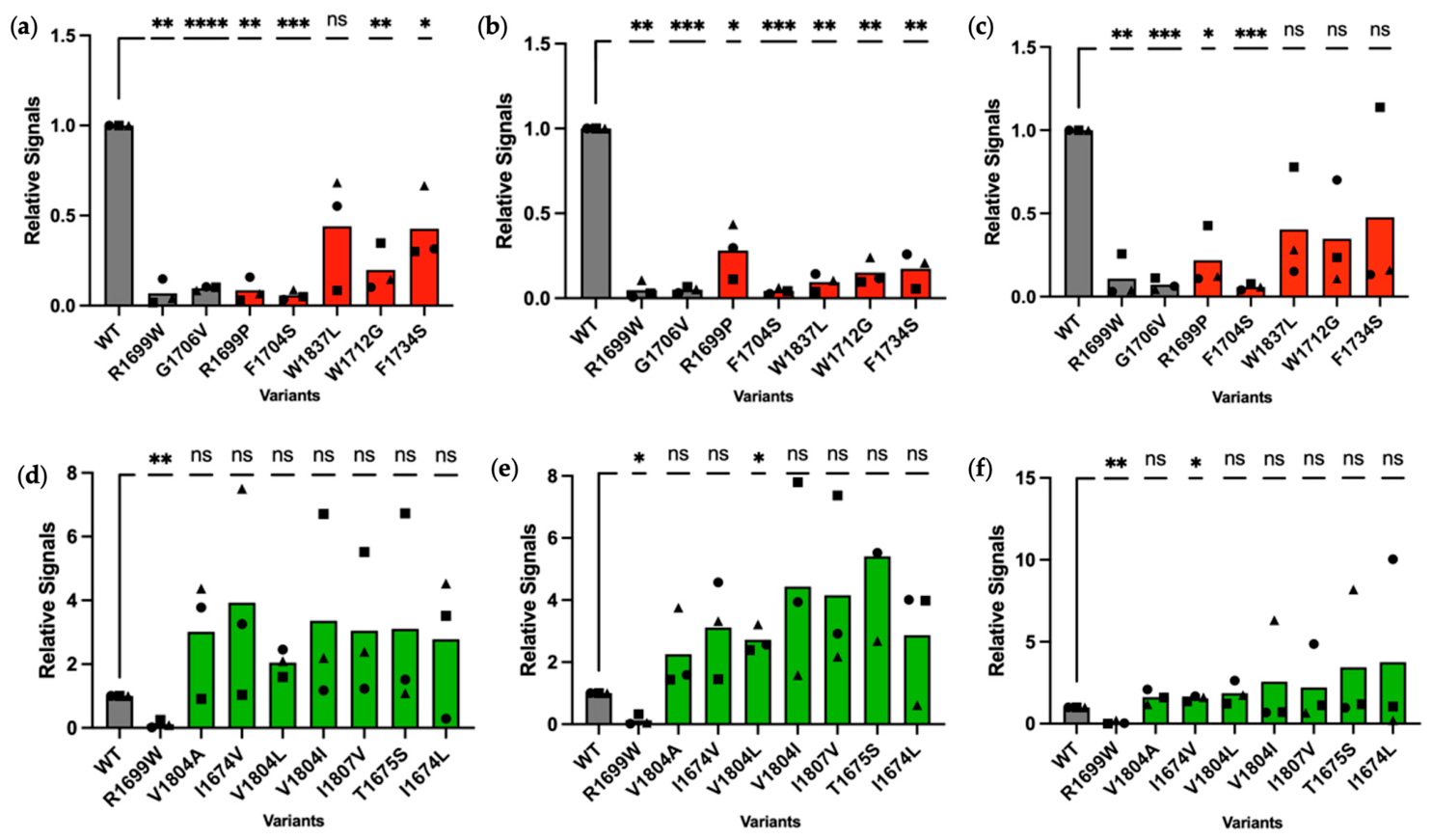 Wildtype, pathogenic controls and benign reference; predicted pathogenic VUS; predicted benign VUS; ns = not significant; ∗ = p < 0.05; ∗∗ = p < 0.01; ∗∗∗ = p < 0.001; ∗∗∗∗ = p < 0.0001; ● = biological replicate 1; ■ = biological replicate 2; ▲ = biological replicate 3.
Wildtype, pathogenic controls and benign reference; predicted pathogenic VUS; predicted benign VUS; ns = not significant; ∗ = p < 0.05; ∗∗ = p < 0.01; ∗∗∗ = p < 0.001; ∗∗∗∗ = p < 0.0001; ● = biological replicate 1; ■ = biological replicate 2; ▲ = biological replicate 3.
Wildtype, pathogenic controls and benign reference; predicted pathogenic VUS; predicted benign VUS; ns = not significant; ∗ = p < 0.05; ∗∗ = p < 0.01; ∗∗∗ = p < 0.001; ∗∗∗∗ = p < 0.0001; ● = biological replicate 1; ■ = biological replicate 2; ▲ = biological replicate 3.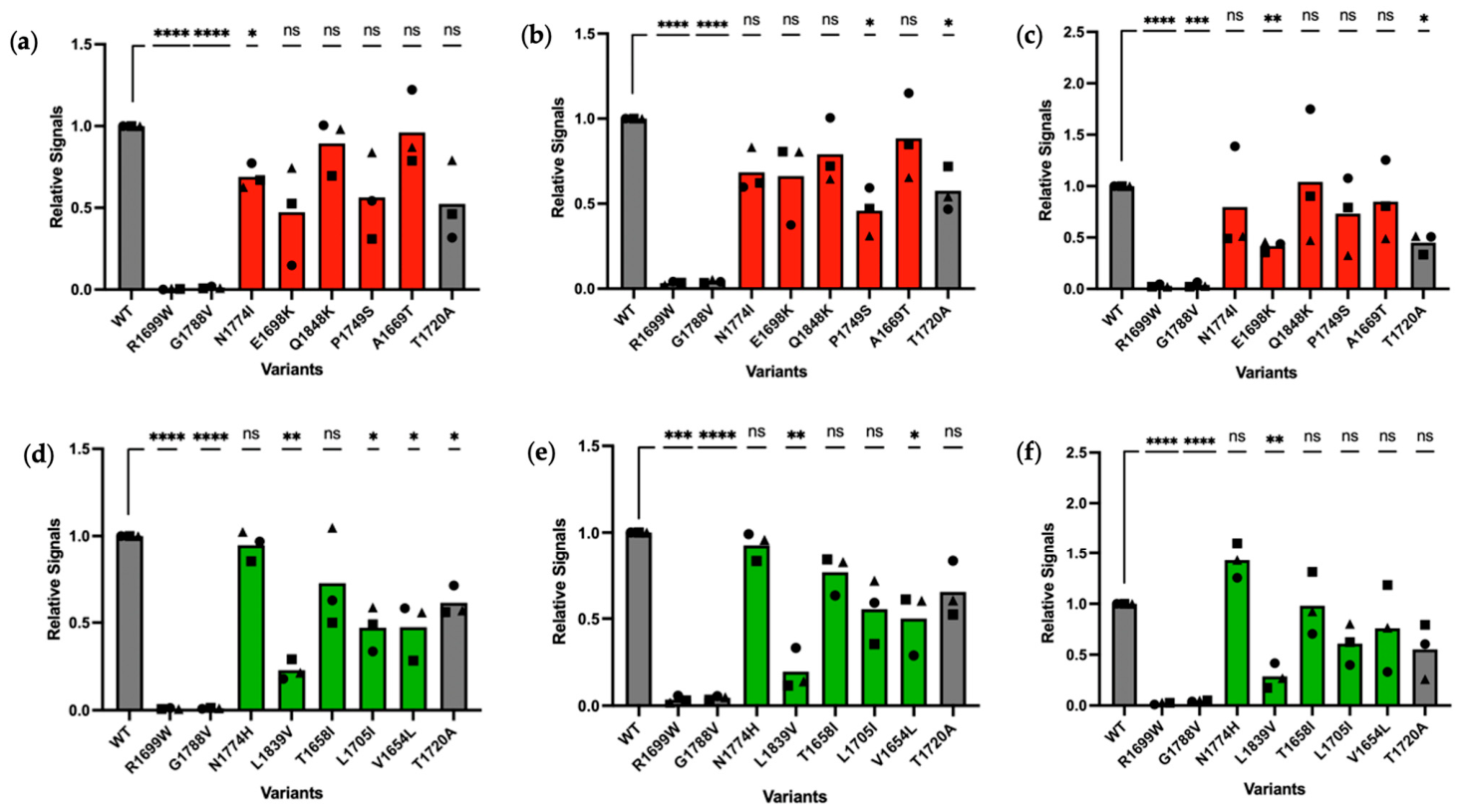 Wildtype, pathogenic controls and benign reference; predicted pathogenic VUS; predicted benign VUS; ns = not significant; ∗ = p < 0.05; ∗∗ = p < 0.01; ∗∗∗ = p < 0.001; ● = biological replicate 1; ■ = biological replicate 2; ▲ = biological replicate 3.
Wildtype, pathogenic controls and benign reference; predicted pathogenic VUS; predicted benign VUS; ns = not significant; ∗ = p < 0.05; ∗∗ = p < 0.01; ∗∗∗ = p < 0.001; ● = biological replicate 1; ■ = biological replicate 2; ▲ = biological replicate 3.
Wildtype, pathogenic controls and benign reference; predicted pathogenic VUS; predicted benign VUS; ns = not significant; ∗ = p < 0.05; ∗∗ = p < 0.01; ∗∗∗ = p < 0.001; ● = biological replicate 1; ■ = biological replicate 2; ▲ = biological replicate 3.

| Variant | Classifier Score | Abraxas | CtIP | BACH1 | Protein Levels | Functional Effect |
|---|---|---|---|---|---|---|
| W1712G | 1 | ∗∗ | ∗∗ | ∗∗ | LOF | |
| F1734S | 1 | ∗ | ∗∗ | ∗∗∗ | LOF | |
| R1699P | 0.9667 | ∗∗ | ∗ | ∗ | LOF | |
| W1837L | 0.9 | ∗∗ | ∗ | LOF | ||
| Q1848K | 0.7667 | ∗ | Uncertain | |||
| F1704S | 0.7333 | ∗∗∗ | ∗∗∗ | ∗∗∗ | ? | LOF |
| P1749S | 0.6333 | ∗ | ∗∗ | Uncertain | ||
| N1774I | 0.6 | ∗ | ∗ | Uncertain | ||
| E1698K | 0.5667 | ∗∗ | ∗∗ | LOF | ||
| A1669T | 0.5667 | Functional | ||||
| N1774H | 0.5 | Functional | ||||
| T1658I | 0.4333 | Functional | ||||
| L1839V | 0.4 | ∗∗ | ∗∗ | ∗∗ | ∗∗∗ | LOF |
| V1804L | 0.3333 | Functional | ||||
| L1705I | 0.2667 | ∗ | ∗∗ | Uncertain | ||
| V1654L | 0.2333 | ∗ | ∗ | ∗ | Uncertain | |
| I1674L | 0.1333 | Functional | ||||
| V1804A | 0 | Functional | ||||
| I1674V | 0 | Functional | ||||
| V1804I | 0 | Functional | ||||
| I1807V | 0 | Functional | ||||
| T1675S | 0 | Functional |
Disclaimer/Publisher’s Note: The statements, opinions and data contained in all publications are solely those of the individual author(s) and contributor(s) and not of MDPI and/or the editor(s). MDPI and/or the editor(s) disclaim responsibility for any injury to people or property resulting from any ideas, methods, instructions or products referred to in the content. |
© 2026 by the authors. Licensee MDPI, Basel, Switzerland. This article is an open access article distributed under the terms and conditions of the Creative Commons Attribution (CC BY) license.
Share and Cite
Torretto, G.C.; Martin, M.D.; Islam, K.; Archer, N.E.; Feilotter, H.E.; Davey, S.K. Domain-Specific Computational, Functional and Structural Methods Enable Interpretation of BRCA1 BRCT Variants of Uncertain Significance. Curr. Oncol. 2026, 33, 354. https://doi.org/10.3390/curroncol33060354
Torretto GC, Martin MD, Islam K, Archer NE, Feilotter HE, Davey SK. Domain-Specific Computational, Functional and Structural Methods Enable Interpretation of BRCA1 BRCT Variants of Uncertain Significance. Current Oncology. 2026; 33(6):354. https://doi.org/10.3390/curroncol33060354
Chicago/Turabian StyleTorretto, Gabriella C., Matthew D. Martin, Kaamraan Islam, Nicole E. Archer, Harriet E. Feilotter, and Scott K. Davey. 2026. "Domain-Specific Computational, Functional and Structural Methods Enable Interpretation of BRCA1 BRCT Variants of Uncertain Significance" Current Oncology 33, no. 6: 354. https://doi.org/10.3390/curroncol33060354
APA StyleTorretto, G. C., Martin, M. D., Islam, K., Archer, N. E., Feilotter, H. E., & Davey, S. K. (2026). Domain-Specific Computational, Functional and Structural Methods Enable Interpretation of BRCA1 BRCT Variants of Uncertain Significance. Current Oncology, 33(6), 354. https://doi.org/10.3390/curroncol33060354