Gestational Trophoblastic Neoplasia Following Hydatidiform Mole and Non-Molar Pregnancy: Clinical and Prognostic Features from a 40-Year Cohort Study at a Reference Center in Southern Brazil

 , , ,
, , ,
Simple Summary
Abstract
1. Introduction
2. Methods
2.1. Study Design and Setting
- type of GTN (molar vs. non-molar); and
- site of initial treatment (RC vs. outside RC).
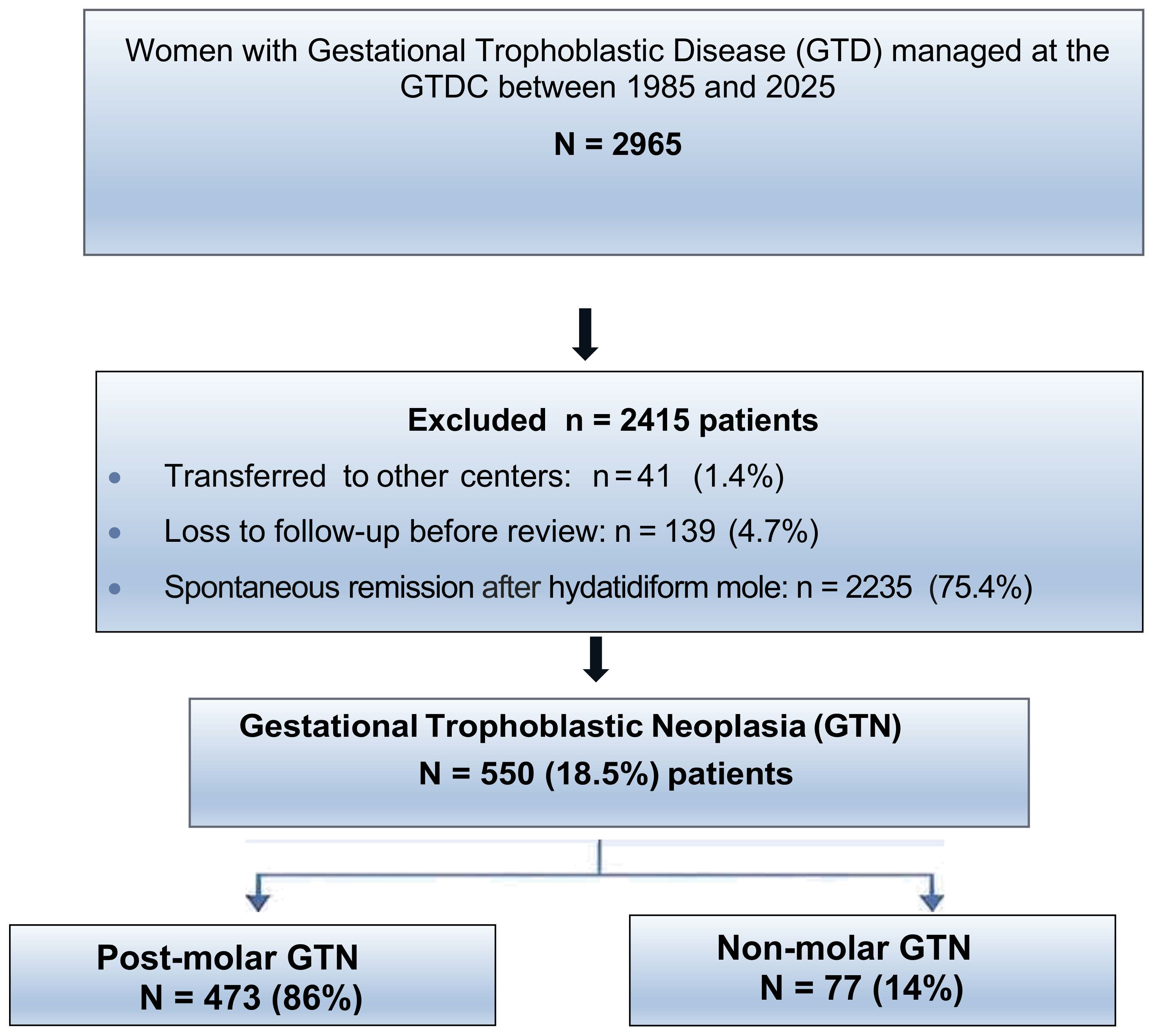
2.2. Study Population
- •
- Molar GTN (G1; n = 473)
- •
- Non-molar GTN (G2; n = 77)
- •
- Confirmed diagnosis of GTN
- •
- Available clinical and treatment data
- •
- Minimum follow-up of 12 months
- •
- Incomplete medical records preventing outcome evaluation
- •
- Diagnosis revised to non-GTN condition
2.3. GTD Management and Patient Follow-Up
2.4. Data Collection
- •
- Demographic and obstetric characteristics
- •
- Antecedent pregnancy
- •
- Pretreatment hCG
- •
- Histopathological diagnosis
- •
- FIGO 2002 stage and WHO prognostic score
- •
- Interval between antecedent pregnancy and treatment initiation
- •
- Site of initial management (specialized reference center [RC] versus non-reference center [non-RC])
- •
- Initial chemotherapy regimen and indication
- •
- Response to first-line treatment
- •
- Time to hCG normalization (<5 IU/L)
- •
- Need for second-line therapy
- •
- Surgical procedures
- •
- Treatment-related complications
- •
- Reproductive outcomes
- •
- Disease-specific survival (DSS)
- •
- Progression-free survival (PFS)
- •
- Time to hCG normalization
- •
- Treatment response rates
- •
- Recurrence
- •
- Need for second-line therapy
- •
- Treatment-related complications
- •
- Reproductive outcomes
- •
- Impact of initial treatment site
- •
- Impact of a choriocarcinoma diagnosis
2.5. Bias
2.6. Study Size
2.7. Statistical Analysis
- •
- Student’s t-test or Mann–Whitney U test for continuous variables
- •
- Chi-square test or Fisher’s exact test for categorical variables
- •
- Adjusted residual analysis for contingency tables
2.8. Ethical Considerations
3. Results
3.1. Patient Characteristics
3.2. Clinical Characteristics of GTN
3.3. Treatment Characteristics
3.4. Metastatic Disease and Complications
3.5. Second-Line Treatment and Recurrence
3.6. Reproductive Outcomes
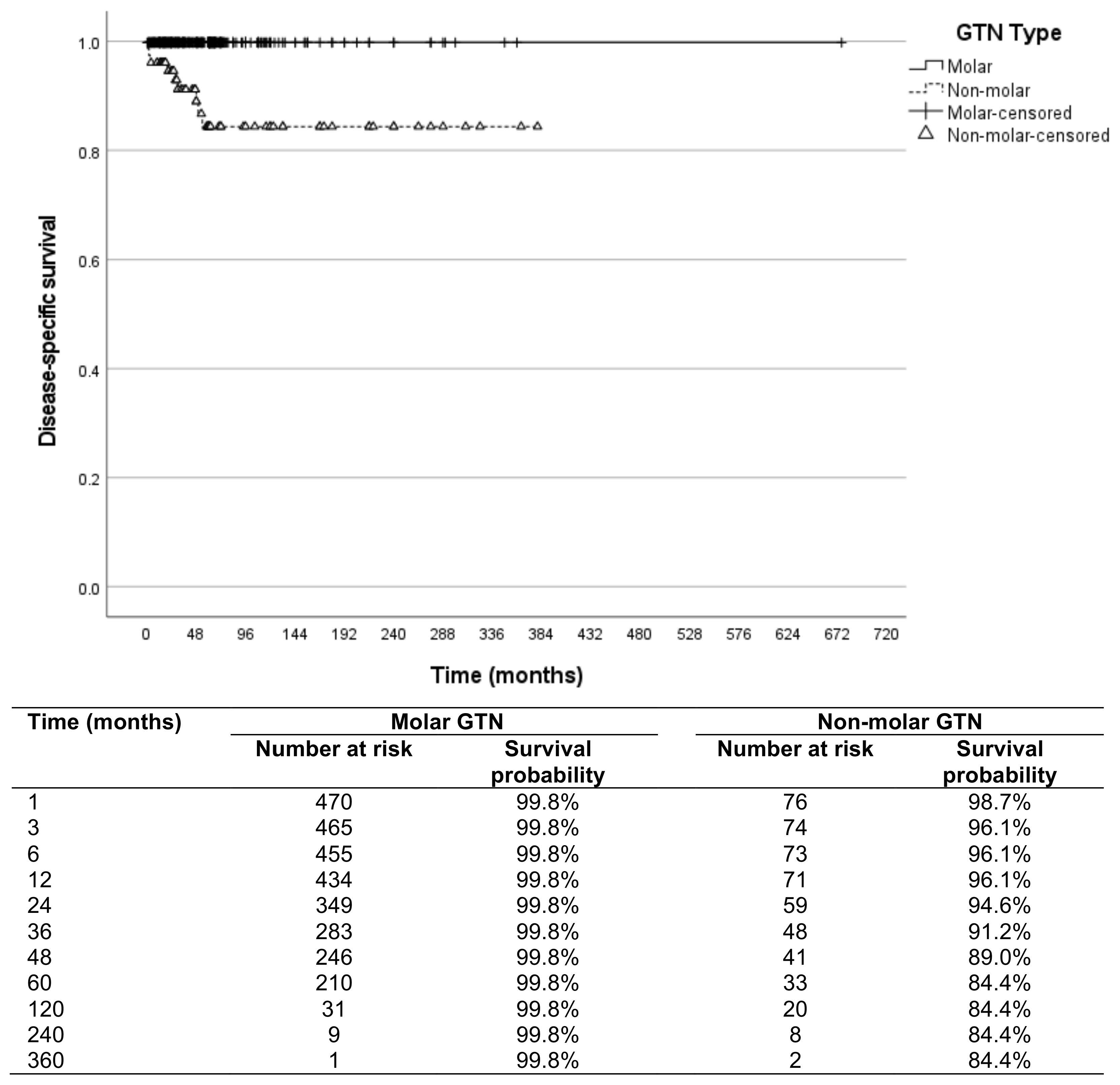
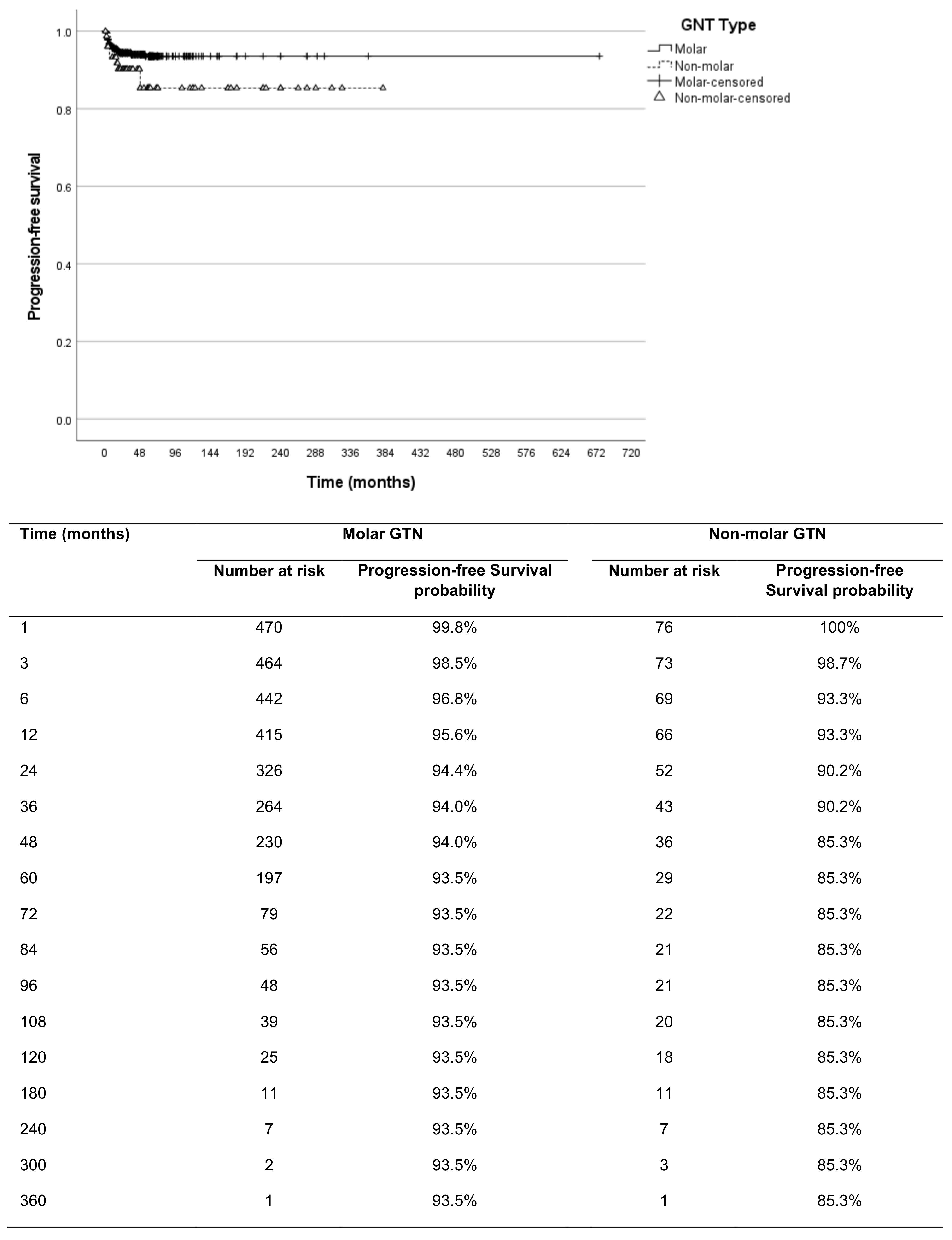
3.7. Disease-Specific Survival and Progression-Free Survival According to GTN Type


3.8. Impact of Initial Treatment Site
3.9. Choriocarcinoma Subgroup
3.10. Analysis of Survival Outcomes (DSS and PFS) in the Overall Cohort
4. Discussion
5. Conclusions
Supplementary Materials
Author Contributions
Funding
Institutional Review Board Statement
Informed Consent Statement
Data Availability Statement
Acknowledgments
Conflicts of Interest
References
- Ngan, H.Y.S.; Seckl, M.J.; Berkowitz, R.S.; Xiang, Y.; Golfier, F.; Sekharan, P.K.; Braga, A.; Garrett, A. Diagnosis and management of gestational trophoblastic disease: 2025 update. Int. J. Gynecol. Obstet. 2025, 171, 78–86. [Google Scholar] [CrossRef] [PubMed]
- Horowitz, N.S.; Elias, K.M.; Berkowitz, R. Presentation and Management of Gestational Trophoblastic Neoplasia in the USA; Handcock, B.W., Seckel, M.J., Berkowitz, R.E., Eds.; ISSTD: Arlington, VA, USA, 2022; Available online: https://isstd.org/uploadedfiles/10gtnusjs.pdf (accessed on 3 August 2024).
- Lok, C.; van Trommel, N.; Braicu, E.I.; Planchamp, F.; Berkowitz, R.; Seckl, M.; EOTTD-ESGO-GCIG-ISSTD Guideline Committee. Practical Guidelines for the Treatment of Gestational Trophoblastic Disease: Collaboration of the European Organisation for the Treatment of Trophoblastic Disease (EOTTD)-European Society of Gynaecologic Oncology (ESGO)-Gynecologic Cancer InterGroup (GCIG)-International Society for the Study of Trophoblastic Diseases (ISSTD). J. Clin. Oncol. 2025, 43, 2119–2128. [Google Scholar] [CrossRef] [PubMed]
- Osborne, R.; Dodge, J. Gestational trophoblastic neoplasia. Obstet. Gynecol. Clin. N. Am. 2012, 39, 195–212. [Google Scholar] [CrossRef] [PubMed]
- Joneborg, U. Epidemiology of gestational trophoblastic disease. Hematol. Oncol. Clin. N. Am. 2024, 38, 1173–1190. [Google Scholar] [CrossRef] [PubMed]
- Soteras, M.G.; Pozo, D. Enfermedad trofoblástica gestacional:introducción, epidemiologia, factores riesgo/protectores, clínica y diagnóstico. In Ginecologia Oncológica; Iserte, P.P., Beltrán, A.S., Pozo, S.D., Eds.; Editorial Médica Panamericana: Madrid, Spain, 2019; pp. 463–466. [Google Scholar]
- Horowitz, N.S.; Eskander, R.N.; Adelman, M.R.; Burke, W. Epidemiology, diagnosis, and treatment of gestational trophoblastic disease: A Society of Gynecologic Oncology evidence-based review and recomendation. Gynecol. Oncol. 2021, 163, 605–613. [Google Scholar] [CrossRef] [PubMed]
- Braga, A.; Mora, P.; de Melo, A.C.; Nogueira-Rodrigues, A.; Amim-Junior, J.; Rezende-Filho, J.; Seckl, M.J. Challenges in the diagnosis and treatment of gestational trophoblastic neoplasia worldwide. World J. Clin. Oncol. 2019, 10, 28–37. [Google Scholar] [CrossRef] [PubMed]
- FIGO Oncology Committee. FIGO staging for gestacional trophoblastic neoplasia 2000. Int. J. Gynecol. Obstet. 2002, 77, 285–287. [Google Scholar] [CrossRef] [PubMed]
- Berkowitz, R.S.; Goldstein, D.P.; DuBeshter, B.; Bernstein, M.R. Management of complete molar pregnancy. J. Reprod. Med. 1987, 32, 634–639. [Google Scholar] [PubMed]
- Berkowitz, R.S.; Goldstein, D.P.; Horowitz, N.S. Presentation and Management of Molar Pregnancy; Handcock, B.W., Seckel, M.J., Berkowitz, R.E., Eds.; ISSTD: Arlington, VA, USA, 2022; Available online: https://isstd.org/uploadedfiles/chapter-9-presentation.pdf (accessed on 3 March 2026).
- Parker, V.L.; Seckl, M.J.; Hancock, B.W. Global Differences in Management and Treatment: A Critical Appraisal from a UK Perspective; Handcock, B.W., Seckel, M.J., Berkowitz, R.E., Eds.; ISSTD: Arlington, VA, USA, 2022; Available online: https://isstd.org/uploadedfiles/21diffinmanagementjs.pdf (accessed on 3 August 2024).
- von Elm, E.; Altman, D.G.; Egger, M.; Pocock, S.J.; Gøtzsche, P.C.; Vandenbroucke, J.P.; STROBE Initiative. The Strengthening the Reporting of Observational Studies in Epidemiology (STROBE) statement: Guidelines for reporting observational studies. J. Clin. Epidemiol. 2008, 61, 344–349. [Google Scholar] [CrossRef] [PubMed]
- França, A.C.G.; Uberti, E.M.H.; Muller, K.P.; Cardoso, R.B.; Giguer, F.; El Beitune, P.; Braga, A. Emotional and Clinical Aspects Observed in Women with Gestational Trophoblastic Disease: A Multidisciplinary Action. Bras. Ginecol. Obstet. 2022, 44, 343–351. [Google Scholar] [CrossRef] [PubMed]
- Schlaerth, J.B.; Morrow, C.P.; Kletzky, O.A.; Nalick, R.H.; D’Ablaing, G.A. Prognostic characteristics of serum human chorionic gonadotropin titer regression following molar pregnancy. Obstet. Gynecol. 1981, 58, 478–482. [Google Scholar] [PubMed]
- IBM Corp. IBM SPSS Statistics for Windows, IBM Corp.: Armonk, NY, USA, 2020; Version 27.0.
- Uberti, E.M.; Fajardo Mdo, C.; da Cunha, A.G.; Frota, S.S.; Braga, A.; Ayub, A.C. Treatment of low-risk gestational trophoblastic neoplasia comparing biweekly eight-day Methotrexate with folinic acid versus bolus-dose Actinomycin-D, among Brazilian women. Rev. Bras. Ginecol. Obstetb. 2015, 37, 258–265. [Google Scholar] [CrossRef] [PubMed]
- Coopmans, L.T.; van Trommel, N.E.; Balduzzi, S.; Aguiar, X.; Charfare, F.; Ghorani, E.; Caldwell, R.; Kaur, B.; Sarwar, N.; Lok, C.A.; et al. Comparison of efficacy and toxicity of two dactinomycin (ACTD) regimens in the second-line treatment of low-risk gestational trophoblastic neoplasia: A retrospective study. Int. J. Gynecol. Cancer 2026, 36, 104655. [Google Scholar] [CrossRef] [PubMed]
- Alazzam, M.; Tidy, J.; Osborne, R.; Coleman, R.; Hancock, B.W.; Lawrie, T.A. Chemotherapy for resistant or recurrent gestational trophoblastic neoplasia. Cochrane Database Syst. Rev. 2016, 2016, CD008891. [Google Scholar] [CrossRef] [PubMed]
- Madi, J.M.; Paganella, M.P.; Litvin, I.E.; Viggiano, M.; Wendland, E.M.; Elias, K.M.; Horowitz, N.S.; Braga, A.; Berkowitz, R.S. Perinatal outcomes of pregnancies after remission from gestational trophoblastic neoplasia: Systematic review and meta-analysis. Am. J. Obstet. Gynecol. 2022, 226, 633–645.e8. [Google Scholar] [CrossRef] [PubMed]
- Braga, A.; Coutinho, L.; Chagas, M.; Soares, J.P.; Callado, G.Y.; Alevato, R.; Lozoya, C.; Sun, S.Y.; Júnior, E.A.; Rezende-Filho, J. Molar Pregnancy: Early Diagnosis, Clinical Management, and the Role of Referral Centers. Diagnostics 2025, 15, 1953. [Google Scholar] [CrossRef] [PubMed]
- Pires, L.V.; Uberti, E.M.H.; Fajardo, M.D.C.; Da Cunha, A.G.V.; Rosa, M.W.; Ayub, A.C.K.; El Beitume, P. Role of hysterectomy in the management of patients with gestational trophoblastic neoplasia: Importance of receiving treatment in reference centers. J. Reprod. Med. 2012, 57, 359–368. [Google Scholar] [PubMed]
- Freitas, F.; Braga, A.; Viggiano, M.; Velarde, L.G.C.; Maesta, I.; Uberti, E.; Madi, J.M.; Yela, D.; Fernandes, K.; Silveira, E.; et al. Gestational trophoblastic neoplasia lethality among Brazilian women: A retrospective national cohort study. Gynecol. Oncol. 2020, 158, 452–459. [Google Scholar] [CrossRef] [PubMed]
- Braga, A.; Burlá, M.; Freitas, F.; Uberti, E.; Viggiano, M.; Sun, S.Y.; Maestá, I.; Elias, K.M.; Berkowitz, R.S. Brazilian Network for Gestational Trophoblastic Disease Study Group. Centralized Coordination of Decentralized Assistance for Patients with Gestational Trophoblastic Disease in Brazil: A Viable Strategy for Developing Countries. J. Reprod. Med. 2016, 61, 224–229. [Google Scholar] [PubMed]


| Variable | Total (n = 550) | Molar GTN (n = 473) | Non-Molar GTN (n = 77) | p-Value |
|---|---|---|---|---|
| n (%) | n (%) | n (%) | ||
| Age (years, mean ± SD) | 31.2 ± 9.3 | 31.2 ± 9.4 | 31.2 ± 8.7 | 0.985 a |
| Age group | 0.072 b | |||
| ≤19 years | 54 (9.8) | 51 (10.8) | 3 (3.9) | |
| 20–39 years | 395 (71.8) | 332 (70.2) | 63 (81.8) | |
| ≥40 years | 101 (18.4) | 90 (19.0) | 11 (14.3) | |
| Place of initial treatment | <0.001b | |||
| Reference GTDC | 273 (49.6) | 259 (54.8) | 14 (18.2) | |
| Outside GTDC | 277 (50.4) | 214 (45.2) | 63 (81.8) | |
| Pretreatment hCG (IU/L), median (IQR) | 8442 (1740–32,163) | 7026 (1605–26,740) | 27770 (3358–1,300,022) | <0.001 c |
| Time from last pregnancy to initial treatment (weeks), median (IQR) | 8 (5–12) | 7 (5–11) | 14 (6–25) | <0.001 c |
| Follow-up time (months), median (IQR) | 49.5 (23–66) | 49 (23–66) | 50 (25.5–121.5) | 0.095 c |
| Pregnancy of origin | <0.001 b | |||
| Complete mole | 392 (71.3) | 391 (82.7) * | 1 (1.3) | |
| Partial mole | 75 (13.6) | 73 (15.4) * | 2 (2.6) | |
| Abortion | 47 (8.5) | 5 (1.1) | 42 (54.5) * | |
| Delivery | 27 (4.9) | 0 (0.0) | 27 (35.1) * | |
| Ectopic | 5 (0.9) | 1 (0.2) | 4 (5.2) * | |
| Unknown | 4 (0.7) | 3 (0.6) | 1 (1.3) | |
| Clinical outcomes at discharge | <0.001 d | |||
| Discharged (persistent remission) | 510 (92.7) | 444 (93.9) * | 66 (85.7) | |
| Post-remission loss to follow-up | 24 (4.4) | 22 (4.6) | 2 (2.6) | |
| Health insurance coverage | 0.967 c | |||
| Public health system | 426 (77.5) | 367 (77.6) | 59 (76.6) | |
| Private/other insurance | 124 (22.5) | 106 (22.4) | 18 (23.4) |
| Variable | Total (n = 550) | Molar GTN (n = 473) | Non-Molar GTN (n = 77) | p-Value a |
|---|---|---|---|---|
| n (%) | n (%) | n (%) | ||
| FIGO stage (2002) | <0.001 | |||
| I | 455 (82.7) | 413 (87.3) * | 42 (54.5) | |
| II | 12 (2.2) | 6 (1.3) | 6 (7.8) * | |
| III | 66 (12.0) | 48 (10.1) | 18 (23.4) * | |
| IV | 17 (3.1) | 6 (1.3) | 11 (14.3) * | |
| WHO risk score (2002) | <0.001 | |||
| Low (0–4) | 453 (82.4) | 423 (89.4) * | 30 (39.0) | |
| Low (5–6) | 38 (6.9) | 29 (6.1) | 9 (11.7) | |
| High (7–12) | 52 (9.5) | 20 (4.2) | 32 (41.6) * | |
| Ultra-high | 7 (1.3) | 1 (0.2) | 6 (7.8) * | |
| Metastasis | <0.001 | |||
| No | 451 (82.0) | 411 (86.9) * | 40 (51.9) | |
| Yes | 99 (18.0) | 62 (13.1) | 37 (48.1) | |
| Lung | 60 (10.9) | 45 (9.5) | 15 (19.5) * | |
| Vagina | 5 (0.9) | 3 (0.6) | 2 (2.6) | |
| Multiple | 31 (5.6) | 12 (2.5) | 19 (24.7) * | |
| Other site | 3 (0.5) | 2 (0.4) | 1 (1.3) | |
| Surgery | 203 (36.9) | 153 (32.3) | 50 (66.9) | <0.001 |
| Type of surgery | 0.003 | |||
| Hysterectomy | 82 (40.4) | 56 (36.6) | 26 (52.0) | |
| Repeat uterine evacuation | 68 (33.5) | 60 (39.2) * | 8 (16.0) | |
| Hysteroscopy | 8 (3.9) | 7 (4.6) | 1 (2.0) | |
| Laparotomy (other indication) | 17 (8.4) | 7 (4.6) | 10 (20.0) * | |
| Embolization | 4 (2.0) | 4 (2.6) | 0 (0.0) | |
| Pulmonary resection | 1 (0.5) | 1 (0.7) | 0 (0.0) | |
| Neurosurgery | 2 (1.0) | 2 (1.3) | 0 (0.0) | |
| Final histopathological diagnosis | <0.001 | |||
| Invasive mole | 458 (83.3) | 441 (93.2) * | 17 (22.1) | |
| CCA | 71 (12.9) | 23 (4.9) | 48 (62.3) * | |
| PSTT | 6 (1.1) | 3 (0.6) | 3 (3.9) * | |
| ETT | 3 (0.5) | 0 (0.0) | 3 (3.9) * | |
| Same as initial histology | 2 (0.4) | 0 (0.9) | 2 (2.6) * | |
| Other | 10 (1.8) | 6 (1.3) | 4 (5.2) * |
| Variable | Total (n = 550) | Molar GTN (n = 473) | Non-Molar GTN (n = 77) | p-Value |
|---|---|---|---|---|
| Initial CTx regimen | <0.001 a | |||
| MTX/FA | 294 (53.5) | 276 (58.4) * | 18 (23.4) | |
| Actinomycin D (pulse) | 169 (30.7) | 149 (31.5) | 20 (26.0) | |
| Actinomycin D (5-day) | 2 (0.4) | 2 (0.4) | 0 (0.0) | |
| EMA-CO | 34 (6.2) | 12 (2.5) | 22 (28.6) * | |
| MAC III (MTX + Act-D + cyclophosphamide) | 5 (0.9) | 5 (1.1) | 0 (0.0) | |
| Other MTX regimen | 9 (1.6) | 8 (1.7) | 1 (1.3) | |
| Low-dose EP | 6 (1.1) | 1 (0.2) | 5 (6.5) * | |
| EMA-EP | 3 (0.5) | 0 (0.0) | 3 (3.9) * | |
| EMA | 3 (0.5) | 2 (0.4) | 1 (1.3) | |
| No chemotherapy | 23 (4.2) | 17 (3.6) | 6 (7.8) | |
| Other | 2 (0.4) | 1 (0.2) | 1 (1.3) | |
| Indication for chemotherapy | <0.001 a | |||
| No CTx | 11 (2.0) | 8 (1.7) | 3 (3.9) | |
| Standard MTX/FA | 281 (51.1) | 265 (56.0) * | 16 (20.8) | |
| Act-D bolus | 113 (20.5) | 102 (21.6) | 11 (14.3) | |
| Perioperative | 20 (3.6) | 18 (3.8) | 2 (2.6) | |
| High-risk (multiagent chemotherapy) | 48 (8.7) | 21 (4.4) | 27 (35.1) * | |
| Emergency (bleeding) | 44 (8.0) | 37 (7.8) | 7 (9.1) | |
| Ultra-high risk | 8 (1.5) | 1 (0.2) | 7 (9.1) * | |
| Other | 25 (4.5) | 21 (4.4) | 4 (5.2) | |
| Response to first-line treatment | 0.495 a | |||
| No | 136 (24.7) | 113 (23.9) | 23 (29.9) | |
| Yes | 402 (73.1) | 350 (74.0) | 52 (67.5) | |
| No chemotherapy | 12 (2.2) | 10 (2.1) | 2 (2.6) | |
| Time to hCG normalization (weeks), median (IQR) | 9 (6–14) | 8 (5–14) | 10 (6–14) | 0.200 b |
| Number of CTx cycles to remission, median (IQR) | 4 (2–6) | 4 (2–6) | 4 (3–6) | 0.437 b |
| Number of consolidation cycles, median (IQR) | 2 (1–3) | 2 (1–3) | 2 (2–3) | 0.294 b |
| Variable | Total (n = 550) | Molar GTN (n = 473) | Non-Molar GTN (n = 77) | p-Value |
|---|---|---|---|---|
| Pretreatment hCG (second-line) | 366 (31–4035) | 307 (30–3881) | 870 (95–5210) | 0.388 a |
| Second-line CTx regimen | <0.001 b | |||
| Actinomycin D (pulse) | 70 (46.4) | 66 (52.8) * | 4 (15.4) | |
| Actinomycin D (5-day) | 7 (4.6) | 5 (4.0) | 2 (7.7) | |
| MTX/FA | 37 (24.5) | 30 (24.0) | 7 (26.9) | |
| Hysterectomy + CTx | 11 (7.3) | 9 (7.2) | 2 (7.7) | |
| EMA-CO | 8 (5.3) | 7 (5.6) | 1 (3.8) | |
| EMA-EP | 5 (3.3) | 2 (1.6) | 3 (11.5) * | |
| TE/TP | 5 (3.3) | 1 (0.8) | 4 (15.4) * | |
| Other MTX regimen | 6 (4.0) | 3 (2.4) | 3 (11.5) * | |
| Unknown | 2 (1.3) | 2 (1.6) | 0 (0.0) | |
| Indication for treatment | 0.818 b | |||
| Resistance | 99 (67.8) | 87 (69.0) | 12 (60.0) | |
| Toxicity | 11 (7.5) | 10 (7.9) | 1 (5.0) | |
| Lack of prior CTx | 4 (2.7) | 3 (2.4) | 1 (5.0) | |
| No longer urgent | 22 (15.1) | 18 (14.3) | 4 (20.0) | |
| Other | 10 (6.8) | 8 (6.3) | 2 (10.0) | |
| Response to second-line treatment | 0.260 b | |||
| No | 49 (27.2) | 40 (26.1) | 9 (33.3) | |
| Yes | 129 (71.7) | 112 (73.2) | 17 (63.0) | |
| Unknown | 2 (1.1) | 1 (0.7) | 1 (3.7) | |
| hCG at recurrence | 27 (11–206) | 26 (10–163) | 45 (17–228.5) | 0.349 a |
| Recurrence | 36 (6.5) | 27 (5.7) | 9 (11.7) | 0.116 b |
| Treatment for recurrence | 0.204 b | |||
| Hysterectomy | 4 (11.1) | 3 (11.1) | 1 (11.1) | |
| Hysterectomy + CTx | 11 (30.6) | 9 (33.3) | 2 (22.2) | |
| Single-agent CTx | 7 (19.4) | 7 (25.9) | 0 (0.0) | |
| Multiagent CTx | 10 (27.8) | 5 (18.5) | 5 (55.6) | |
| Other | 4 (11.1) | 3 (11.1) | 1 (11.1) | |
| Death | <0.001 c | |||
| No | 535 (97.3) | 468 (98.9) | 67 (87.0) | |
| Yes | 15 (2.7) | 9 (1.9) | 6 (13.0) | |
| GTN-related death | <0.001 c | |||
| No | 540 (98.2) | 472 (99.8) | 68 (88.3) | |
| Yes | 7 (1.3) | 1 (0.2) | 6 (7.8) | |
| Age at death (years) | 38.8 ± 9.4 | 40.4 ± 11.3 | 38.0 ± 8.9 | 0.659 d |
| Cause of death | 0.646 b | |||
| Respiratory failure | 4 (26.7) | 1 (20.0) | 3 (30.0) | |
| Sepsis | 2 (13.3) | 1 (20.0) | 1 (10.0) | |
| Treatment resistance | 2 (13.3) | 0 (0.0) | 2 (20.0) | |
| Other causes | 7 (46.7) | 3 (60.0) | 4 (40.0) |
| Outcomes | b (95% CI) | badjusted (95% CI) * | p |
|---|---|---|---|
| Time to hCG normalization (weeks) | 0.47 (−1.34 to 2.27) | 0.26 (−1.92 to 2.44) | 0.814 |
| RR (95% CI) | RRadjusted (95% CI) * | p | |
| Response to first-line treatment | 0.92 (0.78–1.08) | 0.83 (0.68–1.01) | 0.065 |
| Surgery | 2.01 (1.63–2.48) | 1.04 (0.95–1.14) | 0.366 |
| Later pregnancy | 0.36 (0.21–0.61) | 0.60 (0.36–1.00) | 0.049 |
| HR (95% CI) | HRadjusted (95% CI) * | p | |
| Disease-specific survival | 54.0 (6.85–426) | 9.41 (0.70–127) | 0.092 |
| Progression-free survival | 2.10 (1.00–4.46) | 1.61 (0.57–4.60) | 0.372 |
Disclaimer/Publisher’s Note: The statements, opinions and data contained in all publications are solely those of the individual author(s) and contributor(s) and not of MDPI and/or the editor(s). MDPI and/or the editor(s) disclaim responsibility for any injury to people or property resulting from any ideas, methods, instructions or products referred to in the content. |
© 2026 by the authors. Licensee MDPI, Basel, Switzerland. This article is an open access article distributed under the terms and conditions of the Creative Commons Attribution (CC BY) license.
Share and Cite
Uberti, E.M.H.; Medeiros, L.R.d.F.; Cardoso, R.B.; Silveira, E.; Patias, C.B.; Santos Filho, C.E.d.; Reis, R.J.; Copetti, J.M.B.; Furtado, J.P. Gestational Trophoblastic Neoplasia Following Hydatidiform Mole and Non-Molar Pregnancy: Clinical and Prognostic Features from a 40-Year Cohort Study at a Reference Center in Southern Brazil. Curr. Oncol. 2026, 33, 352. https://doi.org/10.3390/curroncol33060352
Uberti EMH, Medeiros LRdF, Cardoso RB, Silveira E, Patias CB, Santos Filho CEd, Reis RJ, Copetti JMB, Furtado JP. Gestational Trophoblastic Neoplasia Following Hydatidiform Mole and Non-Molar Pregnancy: Clinical and Prognostic Features from a 40-Year Cohort Study at a Reference Center in Southern Brazil. Current Oncology. 2026; 33(6):352. https://doi.org/10.3390/curroncol33060352
Chicago/Turabian StyleUberti, Elza Maria Hartmann, Lidia Rosi de Freitas Medeiros, Rodrigo Bernardes Cardoso, Eduardo Silveira, Cassiano Burman Patias, Carlos Eduardo dos Santos Filho, Rosilene Jara Reis, Josenel Maria Barcelos Copetti, and Jose Pio Furtado. 2026. "Gestational Trophoblastic Neoplasia Following Hydatidiform Mole and Non-Molar Pregnancy: Clinical and Prognostic Features from a 40-Year Cohort Study at a Reference Center in Southern Brazil" Current Oncology 33, no. 6: 352. https://doi.org/10.3390/curroncol33060352
APA StyleUberti, E. M. H., Medeiros, L. R. d. F., Cardoso, R. B., Silveira, E., Patias, C. B., Santos Filho, C. E. d., Reis, R. J., Copetti, J. M. B., & Furtado, J. P. (2026). Gestational Trophoblastic Neoplasia Following Hydatidiform Mole and Non-Molar Pregnancy: Clinical and Prognostic Features from a 40-Year Cohort Study at a Reference Center in Southern Brazil. Current Oncology, 33(6), 352. https://doi.org/10.3390/curroncol33060352