Implementation Benchmark of Tumor-Agnostic Eligibility Signals Across Routine Comprehensive Genomic Profiling Platforms in Japan: A Nationwide C-CAT Analysis



Simple Summary
Abstract
1. Introduction
2. Materials and Methods
2.1. Study Design and Data Source
2.2. Study Population and Organ Group Classification
2.3. Biomarker Definitions and Endpoint Framework
2.4. CGP Platform Classification
2.5. Statistical Analysis
2.6. Ethics and Informed Consent
3. Results
3.1. Overall Cohort and Primary Any Positive Rate with Secondary Expanded Set Context
3.2. Platform-Specific Observed Any Positive Rates
3.3. Organ Group-Specific Patterns
3.4. Biomarker Domain Context for the Observed Landscape
3.5. Overlap and Supplementary Descriptive Context
4. Discussion
Supplementary Materials
Author Contributions
Funding
Institutional Review Board Statement
Informed Consent Statement
Data Availability Statement
Acknowledgments
Conflicts of Interest
References
- Bhamidipati, D.; Schram, A.M. Emerging Tumor-Agnostic Molecular Targets. Mol. Cancer Ther. 2024, 23, 1544–1554. [Google Scholar] [CrossRef] [Scilit] [PubMed]
- Drilon, A.; Laetsch, T.W.; Kummar, S.; DuBois, S.G.; Lassen, U.N.; Demetri, G.D.; Nathenson, M.; Doebele, R.C.; Farago, A.F.; Pappo, A.S.; et al. Efficacy of Larotrectinib in TRK Fusion-Positive Cancers in Adults and Children. N. Engl. J. Med. 2018, 378, 731–739. [Google Scholar] [CrossRef] [Scilit] [PubMed]
- Duke, E.S.; Bradford, D.; Marcovitz, M.; Amatya, A.K.; Mishra-Kalyani, P.S.; Nguyen, E.; Price, L.S.L.; Fourie Zirkelbach, J.; Li, Y.; Bi, Y.; et al. FDA Approval Summary: Selpercatinib for the Treatment of Advanced RET Fusion-Positive Solid Tumors. Clin. Cancer Res. 2023, 29, 3573–3578. [Google Scholar] [CrossRef] [Scilit] [PubMed]
- Mano, H. Cancer genomic medicine in Japan. Proc. Jpn. Acad. Ser. B Phys. Biol. Sci. 2020, 96, 316–321. [Google Scholar] [CrossRef] [Scilit] [PubMed]
- Kohno, T.; Kato, M.; Kohsaka, S.; Sudo, T.; Tamai, I.; Shiraishi, Y.; Okuma, Y.; Ogasawara, D.; Suzuki, T.; Yoshida, T.; et al. C-CAT: The National Datacenter for Cancer Genomic Medicine in Japan. Cancer Discov. 2022, 12, 2509–2515. [Google Scholar] [CrossRef] [Scilit] [PubMed]
- Yoshii, Y.; Okazaki, S.; Takeda, M. Current Status of Next-Generation Sequencing-Based Cancer Genome Profiling Tests in Japan and Prospects for Liquid Biopsy. Life 2021, 11, 796. [Google Scholar] [CrossRef] [Scilit] [PubMed]
- Yatabe, Y.; Watanabe, R.; Kotera, Y.; Yasuoka, S.; Ennishi, D. Nationwide Real-World Usage of Blood-Based (Liquid) Biomarker Testing in Japan. Cancer Sci. 2025, 116, 3113–3124. [Google Scholar] [CrossRef] [Scilit] [PubMed]
- Marchiò, C.; Scaltriti, M.; Ladanyi, M.; Iafrate, A.J.; Bibeau, F.; Dietel, M.; Hechtman, J.F.; Troiani, T.; López-Rios, F.; Douillard, J.Y.; et al. ESMO recommendations on the standard methods to detect NTRK fusions in daily practice and clinical research. Ann. Oncol. 2019, 30, 1417–1427. [Google Scholar] [CrossRef] [Scilit] [PubMed]
- Belli, C.; Penault-Llorca, F.; Ladanyi, M.; Normanno, N.; Scoazec, J.Y.; Lacroix, L.; Reis-Filho, J.S.; Subbiah, V.; Gainor, J.F.; Endris, V.; et al. ESMO recommendations on the standard methods to detect RET fusions and mutations in daily practice and clinical research. Ann. Oncol. 2021, 32, 337–350. [Google Scholar] [CrossRef] [Scilit] [PubMed]
- Chan, H.T.; Chin, Y.M.; Low, S.K. Circulating Tumor DNA-Based Genomic Profiling Assays in Adult Solid Tumors for Precision Oncology: Recent Advancements and Future Challenges. Cancers 2022, 14, 3275. [Google Scholar] [CrossRef] [Scilit] [PubMed]
- Yamaguchi, T.; Ikegami, M.; Aruga, T.; Kanemasa, Y.; Horiguchi, S.I.; Kawai, K.; Takao, M.; Yamada, T.; Ishida, H. Correction to: Genomic landscape of comprehensive genomic profiling in patients with malignant solid tumors in Japan. Int. J. Clin. Oncol. 2024, 29, 1432–1434. [Google Scholar] [CrossRef] [Scilit] [PubMed]
- Hatanaka, Y.; Sasano, J.; Takizawa, O. Tumor-Agnostic Landscape with HER2 Amplification in Japan: Real-World Prevalence and Implications for Targeting HER2. Curr. Oncol. 2026, 33, 195. [Google Scholar] [CrossRef] [Scilit]
- Krebs, M.G.; Malapelle, U.; André, F.; Paz-Ares, L.; Schuler, M.; Thomas, D.M.; Vainer, G.; Yoshino, T.; Rolfo, C. Practical Considerations for the Use of Circulating Tumor DNA in the Treatment of Patients With Cancer: A Narrative Review. JAMA Oncol. 2022, 8, 1830–1839. [Google Scholar] [CrossRef] [Scilit] [PubMed]
- Kasi, P.M.; Lee, J.K.; Pasquina, L.W.; Decker, B.; Vanden Borre, P.; Pavlick, D.C.; Allen, J.M.; Parachoniak, C.; Quintanilha, J.C.F.; Graf, R.P.; et al. Circulating Tumor DNA Enables Sensitive Detection of Actionable Gene Fusions and Rearrangements Across Cancer Types. Clin. Cancer Res. 2024, 30, 836–848. [Google Scholar] [CrossRef] [Scilit] [PubMed]
- Naito, Y.; Aburatani, H.; Amano, T.; Baba, E.; Furukawa, T.; Hayashida, T.; Hiyama, E.; Ikeda, S.; Kanai, M.; Kato, M.; et al. Clinical practice guidance for next-generation sequencing in cancer diagnosis and treatment (edition 2.1). Int. J. Clin. Oncol. 2021, 26, 233–283. [Google Scholar] [CrossRef] [Scilit] [PubMed]
- Ida, H.; Koyama, T.; Mizuno, T.; Sunami, K.; Kubo, T.; Sudo, K.; Tao, K.; Hirata, M.; Yonemori, K.; Kato, K.; et al. Clinical utility of comprehensive genomic profiling tests for advanced or metastatic solid tumor in clinical practice. Cancer Sci. 2022, 113, 4300–4310. [Google Scholar] [CrossRef] [Scilit] [PubMed]



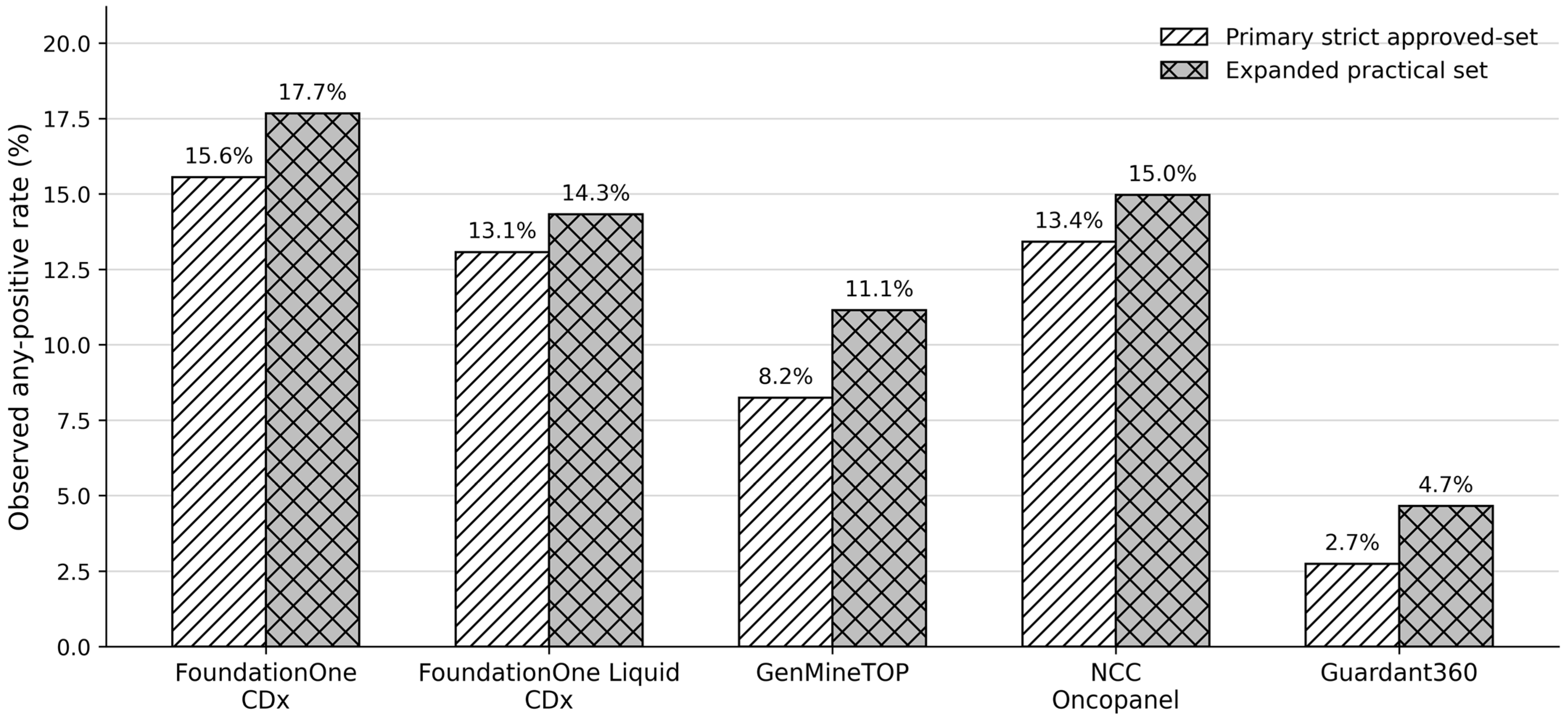
| Group | Cases | Primary n/N (%) | Primary 95% CI | Expanded n/N (%) | Expanded 95% CI | Added Cases | Added pp |
|---|---|---|---|---|---|---|---|
| Overall cohort | 97,343 | 14,005/97,343 (14.4%) | 14.2–14.6% | 15,911/97,343 (16.3%) | 16.1–16.6% | 1906 | 2.0 pp |
| FoundationOne CDx | 66,992 | 10,421/66,992 (15.6%) | 15.3–15.8% | 11,837/66,992 (17.7%) | 17.4–18.0% | 1416 | 2.1 pp |
| FoundationOne Liquid CDx | 14,878 | 1945/14,878 (13.1%) | 12.5–13.6% | 2131/14,878 (14.3%) | 13.8–14.9% | 186 | 1.3 pp |
| GenMineTOP | 4235 | 349/4235 (8.2%) | 7.4–9.1% | 472/4235 (11.1%) | 10.2–12.1% | 123 | 2.9 pp |
| NCC Oncopanel | 9196 | 1234/9196 (13.4%) | 12.7–14.1% | 1376/9196 (15.0%) | 14.2–15.7% | 142 | 1.5 pp |
| Guardant360 | 2042 | 56/2042 (2.7%) | 2.1–3.5% | 95/2042 (4.7%) | 3.8–5.7% | 39 | 1.9 pp |
| Liquid-based pooled | 16,920 | 2001/16,920 (11.8%) | 11.3–12.3% | 2226/16,920 (13.2%) | 12.7–13.7% | 225 | 1.3 pp |
| Tissue-based pooled | 80,423 | 12,004/80,423 (14.9%) | 14.7–15.2% | 13,685/80,423 (17.0%) | 16.8–17.3% | 1681 | 2.1 pp |
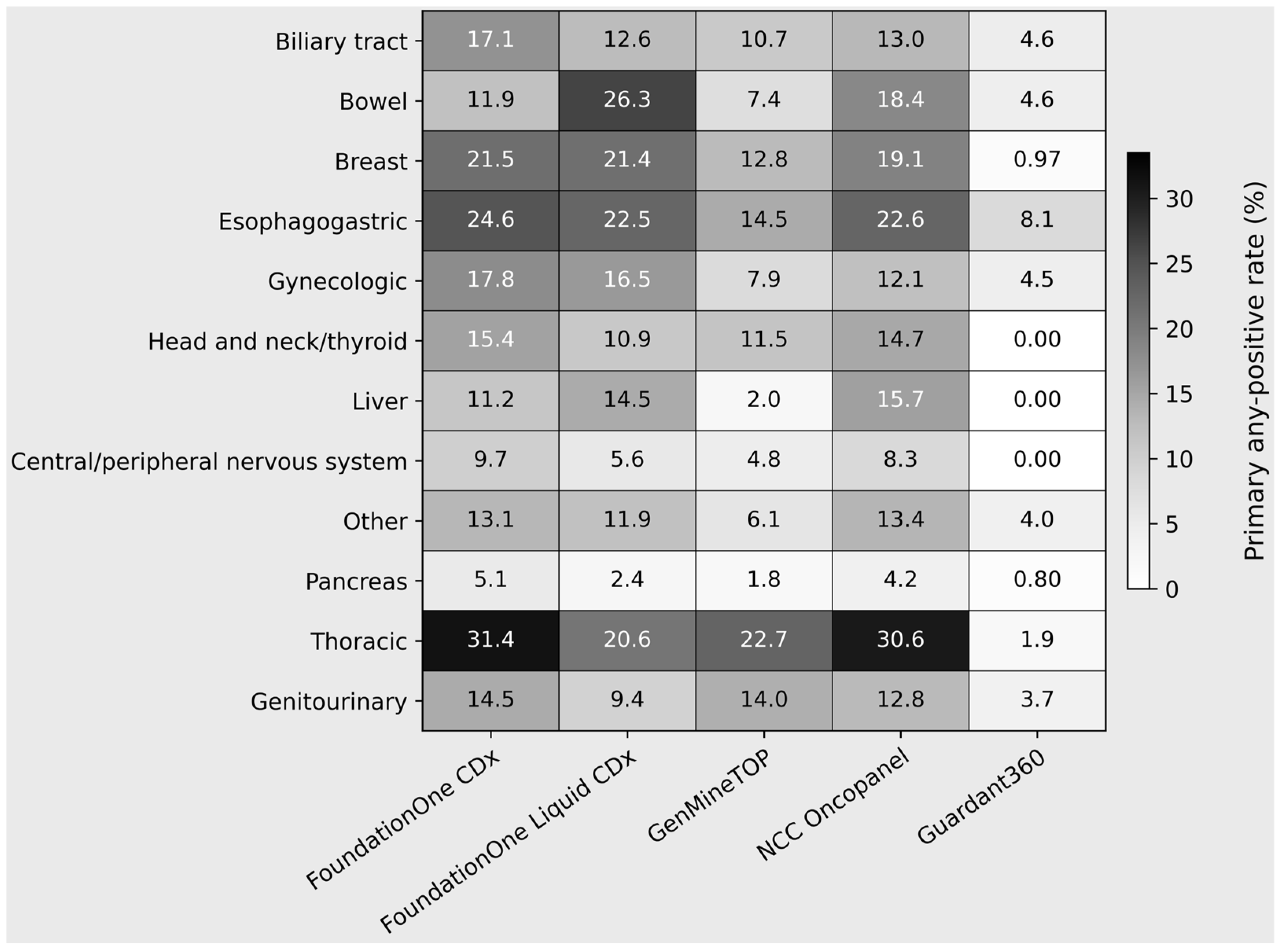
| Organ Group | Cases | Liquid Share | Primary n/N (%) | Expanded n/N (%) | Added Cases | Added pp |
|---|---|---|---|---|---|---|
| Biliary tract | 9103 | 21.8% | 1394/9103 (15.3%) | 1464/9103 (16.1%) | 70 | 0.8 pp |
| Bowel | 15,791 | 12.0% | 2130/15,791 (13.5%) | 2820/15,791 (17.9%) | 690 | 4.4 pp |
| Breast | 7498 | 19.4% | 1562/7498 (20.8%) | 1586/7498 (21.2%) | 24 | 0.3 pp |
| Esophagogastric | 5823 | 12.9% | 1372/5823 (23.6%) | 1384/5823 (23.8%) | 12 | 0.2 pp |
| Gynecologic | 10,963 | 6.3% | 1846/10,963 (16.8%) | 1881/10,963 (17.2%) | 35 | 0.3 pp |
| Head and neck/thyroid | 4030 | 7.8% | 590/4030 (14.6%) | 1059/4030 (26.3%) | 469 | 11.6 pp |
| Liver | 897 | 17.8% | 103/897 (11.5%) | 107/897 (11.9%) | 4 | 0.4 pp |
| Central/peripheral nervous system | 3357 | 2.8% | 288/3357 (8.6%) | 459/3357 (13.7%) | 171 | 5.1 pp |
| Other | 9369 | 7.7% | 1158/9369 (12.4%) | 1367/9369 (14.6%) | 209 | 2.2 pp |
| Pancreas | 15,270 | 29.2% | 616/15,270 (4.0%) | 664/15,270 (4.3%) | 48 | 0.3 pp |
| Thoracic | 6740 | 25.6% | 1868/6740 (27.7%) | 2022/6740 (30.0%) | 154 | 2.3 pp |
| Genitourinary | 8502 | 31.5% | 1078/8502 (12.7%) | 1098/8502 (12.9%) | 20 | 0.2 pp |
Disclaimer/Publisher’s Note: The statements, opinions and data contained in all publications are solely those of the individual author(s) and contributor(s) and not of MDPI and/or the editor(s). MDPI and/or the editor(s) disclaim responsibility for any injury to people or property resulting from any ideas, methods, instructions or products referred to in the content. |
© 2026 by the authors. Licensee MDPI, Basel, Switzerland. This article is an open access article distributed under the terms and conditions of the Creative Commons Attribution (CC BY) license.
Share and Cite
Kajiura, S.; Nakamura, N.; Hayashi, R. Implementation Benchmark of Tumor-Agnostic Eligibility Signals Across Routine Comprehensive Genomic Profiling Platforms in Japan: A Nationwide C-CAT Analysis. Curr. Oncol. 2026, 33, 324. https://doi.org/10.3390/curroncol33060324
Kajiura S, Nakamura N, Hayashi R. Implementation Benchmark of Tumor-Agnostic Eligibility Signals Across Routine Comprehensive Genomic Profiling Platforms in Japan: A Nationwide C-CAT Analysis. Current Oncology. 2026; 33(6):324. https://doi.org/10.3390/curroncol33060324
Chicago/Turabian StyleKajiura, Shinya, Naohiko Nakamura, and Ryuji Hayashi. 2026. "Implementation Benchmark of Tumor-Agnostic Eligibility Signals Across Routine Comprehensive Genomic Profiling Platforms in Japan: A Nationwide C-CAT Analysis" Current Oncology 33, no. 6: 324. https://doi.org/10.3390/curroncol33060324
APA StyleKajiura, S., Nakamura, N., & Hayashi, R. (2026). Implementation Benchmark of Tumor-Agnostic Eligibility Signals Across Routine Comprehensive Genomic Profiling Platforms in Japan: A Nationwide C-CAT Analysis. Current Oncology, 33(6), 324. https://doi.org/10.3390/curroncol33060324