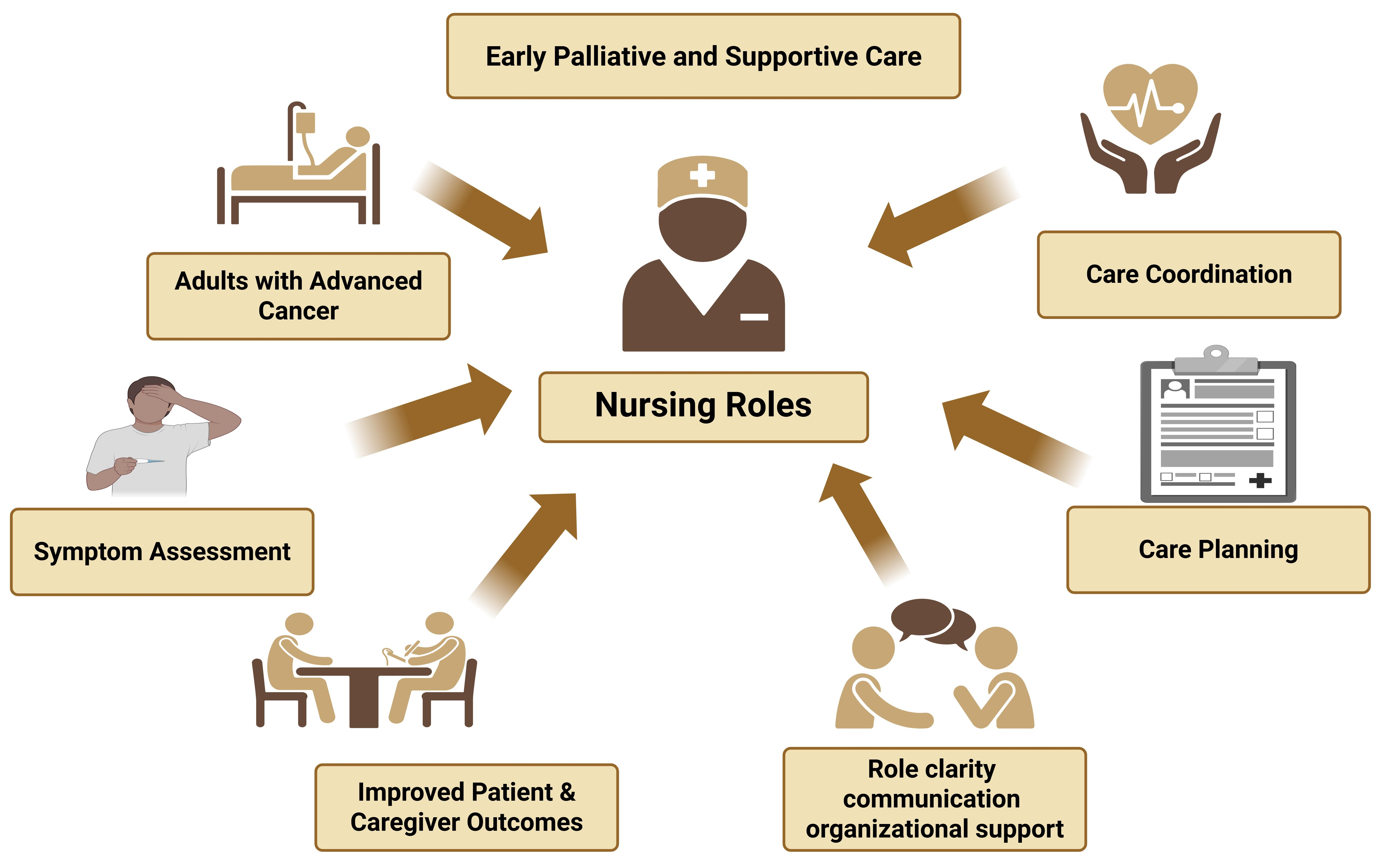
Nursing Roles in Early Integration of Palliative and Supportive Care for Adults with Advanced Cancer: A Scoping Review

 ,
, 
 , and
, and
Simple Summary
Abstract
1. Introduction
2. Materials and Methods
2.1. Study Design
2.2. Conceptual Focus and Eligibility Criteria
2.3. Study Selection
2.4. Data Charting
2.5. Synthesis of Results
3. Results
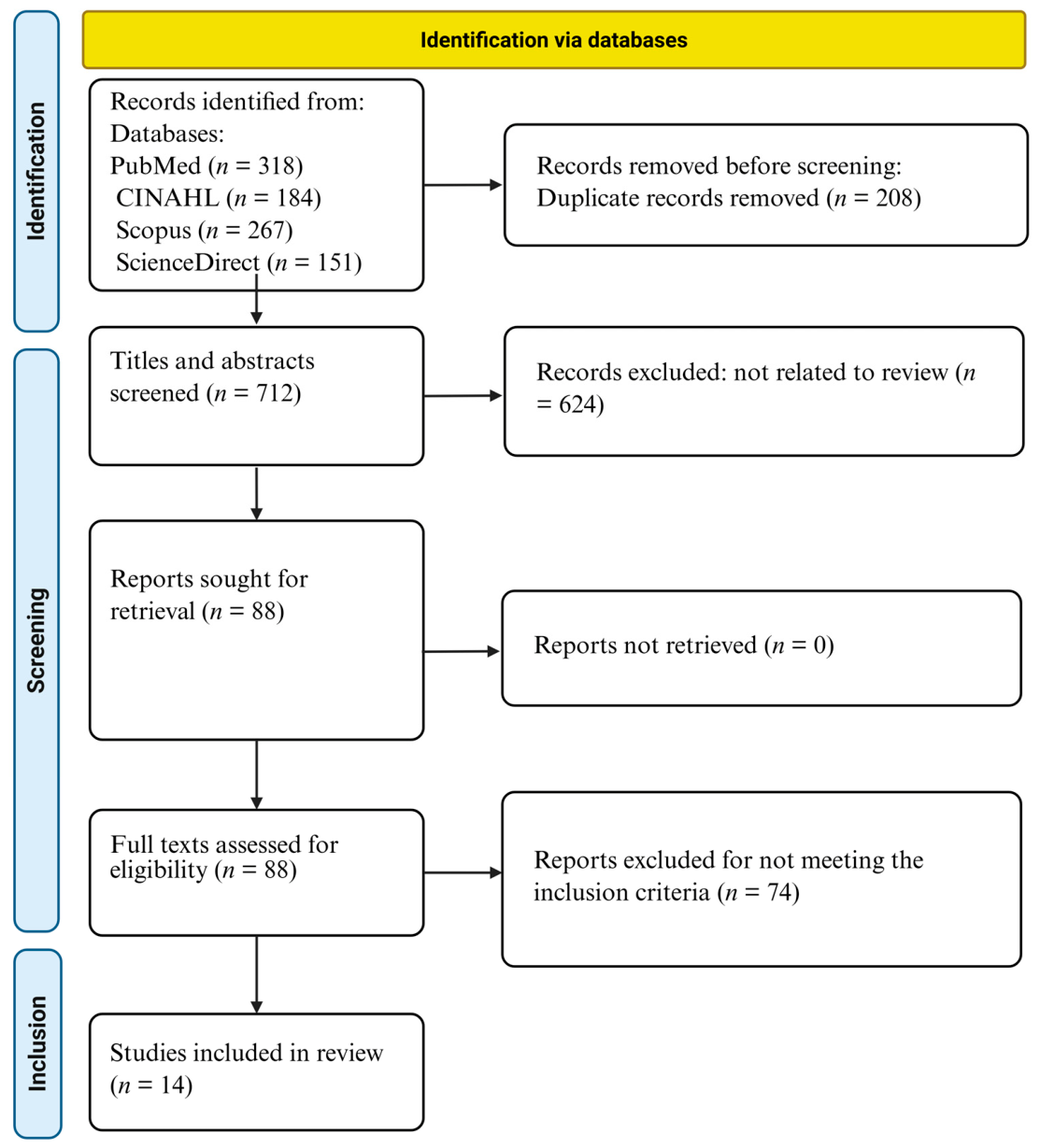
3.1. Study Selection and Characteristics
3.2. Early Palliative Care Integration and Patient Outcomes
3.3. Nurse-Led Advance Care Planning Interventions
3.4. Telephone-Based Symptom Management
3.5. Nursing Competencies and Practice Gaps
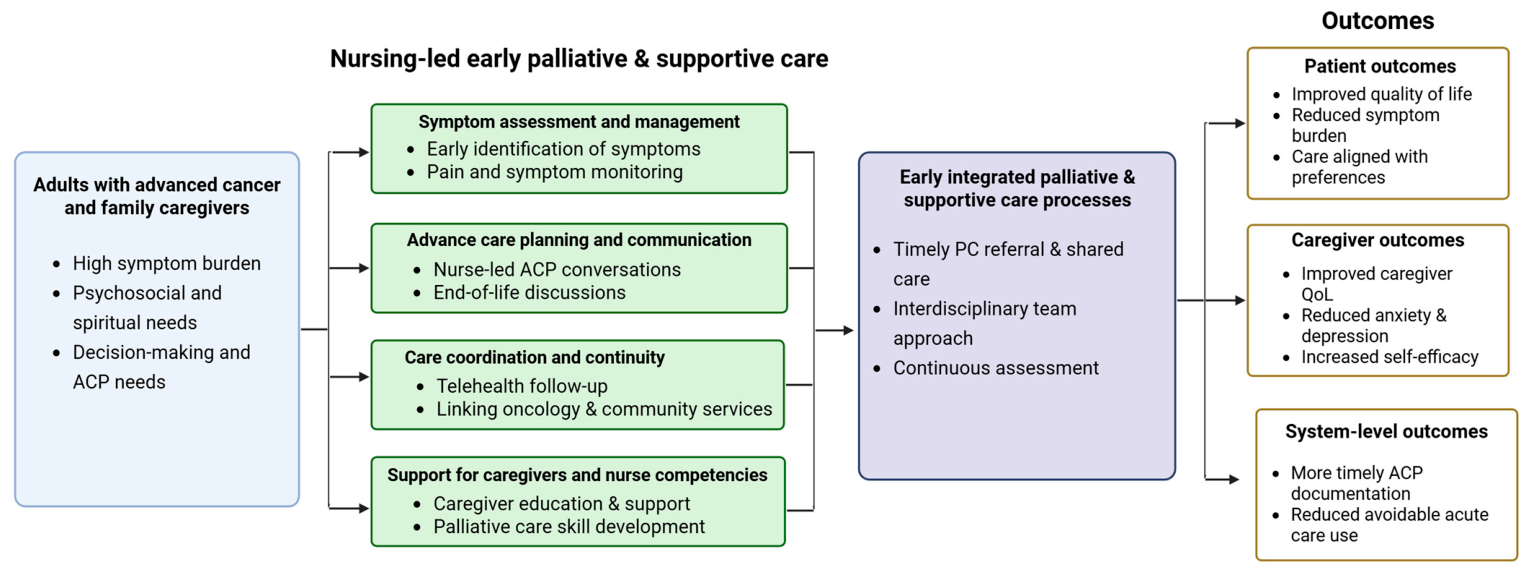
3.6. Conceptual Frameworks and Models of Care
3.7. Caregiver Outcomes
4. Discussion
5. Conclusions
Supplementary Materials
Author Contributions
Funding
Institutional Review Board Statement
Informed Consent Statement
Data Availability Statement
Conflicts of Interest
Abbreviations
| ACP | advanced care planning |
| AD | advanced directive |
| adj. OR | adjusted odds ratio |
| ASCO | American Society of Clinical Oncology |
| ASD | antiseizure drug |
| CCMB | Cancer Care Manitoba |
| CI | confidence interval |
| CNS | clinical nurse specialist |
| EANO | European Association of Neuro-Oncology |
| EHR | electronic health records |
| EOLC | end-of-life conversation |
| EORTCQLQ-C30 | European organization for research and treatment of cancer quality of life questionnaire |
| EPC | early palliative care |
| EPCS | end-of-life professional caregiver survey |
| ESAS | Edmonton symptom assessment scale |
| ESMO | European Society of Medical Oncology |
| FACT-G | Functional Assessment of Cancer Therapy—General Measure |
| ICU | intensive care unit |
| OR | odds ratio |
| PC | palliative care |
| PCPS | Palliative Care Self-Reports Practices Scale |
| PHQ-9 | Patient Health Questionnaire-9 |
| POS | palliative outcome scale |
| QoL | quality of life |
| RCT | randomized controlled trial |
| Self-PAC | Self-Perceived Pain Assessment Knowledge and Confidence Scale |
| SMD | Standardized mean difference |
References
- Bray, F.; Laversanne, M.; Sung, H.; Ferlay, J.; Siegel, R.L.; Soerjomataram, I.; Jemal, A. Global cancer statistics 2022: GLOBOCAN estimates of incidence and mortality worldwide for 36 cancers in 185 countries. CA Cancer J. Clin. 2024, 74, 229–263. [Google Scholar] [CrossRef] [Scilit]
- Alzoubi, M.M.; Al-Ghabeesh, S.; Qutami, B. The effect of educational intervention on knowledge, attitude, and practices regarding colorectal cancer screening practices among nursing students in Jordan. Cureus 2024, 16, e66111. [Google Scholar] [CrossRef] [Scilit]
- Sherwen, O.; Baron, M.K.; Murray, N.S.; Heaton, P.A.; Gamble, J.; Paul, S.P. The recognition and nursing management of common oncological emergencies in children. Br. J. Nurs. 2022, 31, 20–27. [Google Scholar] [CrossRef] [Scilit] [PubMed]
- Rivera, D.R.; Gallicchio, L.; Brown, J.; Liu, B.; Kyriacou, D.N.; Shelburne, N. Trends in adult cancer-related emergency department utilization: An analysis of data from the nationwide emergency department sample. JAMA Oncol. 2017, 3, e172450. [Google Scholar] [CrossRef] [Scilit]
- Alishahi Tabriz, A.; Turner, K.; Hong, Y.; Gheytasvand, S.; Powers, B.D.; Elston Lafata, J. Trends and characteristics of potentially preventable emergency department visits among patients with cancer in the US. JAMA Netw. Open 2023, 6, e2250423. [Google Scholar] [CrossRef] [Scilit] [PubMed]
- Al-Ghabeesh, S.H.; Bashayreh, I.H.; Saifan, A.R.; Rayan, A.; Alshraifeen, A.A. Barriers to effective pain management in cancer patients from the perspective of patients and family caregivers: A qualitative study. Pain Manag. Nurs. 2020, 21, 238–244. [Google Scholar] [CrossRef] [Scilit]
- McLouth, L.E.; Borger, T.; Bursac, V.; Hoerger, M.; McFarlin, J.; Shelton, S.; Shearer, A.; Kiviniemi, M.T.; Stapleton, J.L.; Mullett, T.; et al. Palliative care use and utilization determinants among patients treated for advanced stage lung cancer in the community and academic medical setting. Support. Care Cancer 2023, 31, 190. [Google Scholar] [CrossRef] [Scilit]
- Alsharawneh, A.; Al-Hadi Hasan, A. Subtle oncological emergencies: Nature of illness, clinical characteristics, and outcomes. Int. Emerg. Nurs. 2022, 61, 101127. [Google Scholar] [CrossRef] [Scilit] [PubMed]
- Alzoubi, M.M.; Al-Ghabeesh, S.H. Knowledge, attitude, practice, and perceived barriers regarding colorectal cancer screening practices among healthcare practitioners: A systematic review. Cureus 2024, 16, e54381. [Google Scholar] [CrossRef] [Scilit]
- Temel, J.S.; Greer, J.A.; Muzikansky, A.; Gallagher, E.R.; Admane, S.; Jackson, V.A.; Dahlin, C.M.; Blinderman, C.D.; Jacobsen, J.; Pirl, W.F.; et al. Early palliative care for patients with metastatic non-small-cell lung cancer. N. Engl. J. Med. 2010, 363, 733–742. [Google Scholar] [CrossRef] [Scilit]
- Higdon, M.L.; Atkinson, C.J.; Lawrence, K.V. Oncologic emergencies: Recognition and initial management. Am. Fam. Physician 2018, 97, 741–748. [Google Scholar]
- Yilmaz, S.; Aryal, K.; King, J.; Bischof, J.J.; Hong, A.S.; Wood, N.; Gould Rothberg, B.E.; Hudson, M.F.; Heinert, S.W.; Wattana, M.K.; et al. Understanding oncologic emergencies and related emergency department visits and hospitalizations: A systematic review. BMC Emerg. Med. 2025, 25, 40. [Google Scholar] [CrossRef] [Scilit] [PubMed]
- Jia, S.; Lelond, S.; Daeninck, P.; Kim, C.A. Assessment of a clinical nurse specialist-led early palliative care initiative for patients with advanced pancreatic cancer. Support. Care Cancer 2026, 34, 287. [Google Scholar] [CrossRef] [Scilit]
- Ferrell, B.R.; Temel, J.S.; Temin, S.; Alesi, E.R.; Balboni, T.A.; Basch, E.M.; Firn, J.I.; Paice, J.A.; Peppercorn, J.M.; Phillips, T.; et al. Integration of palliative care into standard oncology care: American Society of Clinical Oncology Clinical Practice Guideline update. J. Clin. Oncol. 2017, 35, 96–112. [Google Scholar] [CrossRef] [Scilit]
- Jordan, K.; Aapro, M.; Kaasa, S.; Ripamonti, C.I.; Scotté, F.; Strasser, F.; Young, A.; Bruera, E.; Herrstedt, J.; Keefe, D.; et al. European Society for Medical Oncology (ESMO) position paper on supportive and palliative care. Ann. Oncol. 2018, 29, 36–43. [Google Scholar] [CrossRef] [Scilit]
- Choi, Y.Y.; Hong, B.; Rha, S.Y.; Cho, S.; Lee, H.S.; Lee, J. The effect of nurse-led enhanced supportive care as an early primary palliative care approach for patients with advanced cancer: A randomized controlled trial. Int. J. Nurs. Stud. 2025, 168, 104969. [Google Scholar] [CrossRef] [Scilit]
- Wattana, M.K.; Davenport, M.; Bischof, J.J.; Lindsay, A.B.; Pettit, N.R.; Menendez, J.R.; Harper, K.; Lipe, D.N.; Qdaisat, A. Perceived gaps in oncologic emergency care for patients with cancer: A qualitative comparison of emergency medicine and oncologist physician perspectives. Cancers 2025, 17, 828. [Google Scholar] [CrossRef] [Scilit] [PubMed]
- Rosenzweig, M.; Belcher, S.M.; Braithwaite, L.E.; Cuaron, L.; Fischer-Cartlidge, E.; Lally, R.M.; Linder, L.A.; Meyeraan, T.; Ogunkunle, R.; Springer, N.G.; et al. Research priorities of the Oncology Nursing Society: 2024–2027. Oncol. Nurs. Forum 2024, 51, 502–515. [Google Scholar] [CrossRef] [Scilit]
- Arksey, H.; O’Malley, L. Scoping studies: Towards a methodological framework. Int. J. Soc. Res. Methodol. 2005, 8, 19–32. [Google Scholar] [CrossRef] [Scilit]
- Tricco, A.C.; Lillie, E.; Zarin, W.; O’Brien, K.K.; Colquhoun, H.; Levac, D.; Moher, D.; Peters, M.D.J.; Horsley, T.; Weeks, L.; et al. PRISMA Extension for Scoping Reviews (PRISMA-ScR): Checklist and explanation. Ann. Intern. Med. 2018, 169, 467–473. [Google Scholar] [CrossRef] [Scilit]
- Bansal, V.V.; Kim, D.; Reddy, B.S.; Hunter, D.; Dhiman, A.; Godley, F.A.; Ong, C.T.; Clark, S.; Ulrich, L.; Polite, B.; et al. Early integrated palliative care within a surgical oncology clinic. JAMA Netw. Open 2023, 6, e2341928. [Google Scholar] [CrossRef] [Scilit]
- Nie, X.; Lv, F.; Li, L.; Jia, J. Current situation and influencing factors of palliative care practice ability among oncology nurses: A multicenter cross-sectional study. Int. J. Nurs. Sci. 2025, 12, 35–41. [Google Scholar] [CrossRef] [Scilit]
- Chow, R.; Mathews, J.J.; Cheng, E.Y.; Lo, S.; Wong, J.; Alam, S.; Hannon, B.; Rodin, G.; Nissim, R.; Hales, S.; et al. Interventions to improve outcomes for caregivers of patients with advanced cancer: A meta-analysis. J. Natl. Cancer Inst. 2023, 115, 896–908. [Google Scholar] [CrossRef] [Scilit]
- Cohen, M.G.; Althouse, A.D.; Arnold, R.M.; White, D.; Chu, E.; Rosenzweig, M.; Smith, K.J.; Schenker, Y. Primary palliative care improves uptake of advance care planning among patients with advanced cancers. J. Natl. Compr. Cancer Netw. 2023, 21, 383–390. [Google Scholar] [CrossRef] [Scilit]
- Kilgour, H.M.; Lambert, L.K.; Howard, A.F.; McKenzie, M.; Thorne, S. Advance care planning in oncology nursing: An interpretive description study. J. Adv. Nurs. 2025, 81, 6867–6879. [Google Scholar] [CrossRef] [Scilit]
- Valenti, V.; Rossi, R.; Scarpi, E.; Ricci, M.; Pallotti, M.C.; Dall’Agata, M.; Montalti, S.; Maltoni, M. Nurse-led telephone follow-up for early palliative care patients with advanced cancer. J. Clin. Nurs. 2023, 32, 2846–2853. [Google Scholar] [CrossRef] [Scilit]
- Grudzen, C.R.; Richardson, L.D.; Johnson, P.N.; Hu, M.; Wang, B.; Ortiz, J.M.; Kistler, E.A.; Chen, A.; Morrison, R.S. Emergency department–initiated palliative care in advanced cancer. JAMA Oncol. 2016, 2, 591–597. [Google Scholar] [CrossRef] [Scilit] [PubMed]
- Hui, D.; Hannon, B.L.; Zimmermann, C.; Bruera, E. Improving patient and caregiver outcomes in oncology: Team-based, timely, and targeted palliative care. CA Cancer J. Clin. 2018, 68, 356–376. [Google Scholar] [CrossRef] [Scilit] [PubMed]
- Creangă-Murariu, I.; Froicu, E.M.; Scripcariu, D.V.; Bacoanu, G.; Poroch, M.; Moscalu, M.; Tarniceriu, C.C.; Alexa-Stratulat, T.; Poroch, V. Timing matters: A systematic review of early versus delayed palliative care in advanced cancer. Cancers 2025, 17, 2598. [Google Scholar] [CrossRef] [Scilit] [PubMed]
- Shaulov, A.; Aviv, A.; Alcalde, J.; Zimmermann, C. Early integration of palliative care for patients with haematological malignancies. Br. J. Haematol. 2022, 199, 14–30. [Google Scholar] [CrossRef] [Scilit]
- Koekkoek, J.A.F.; van der Meer, P.B.; Pace, A.; Hertler, C.; Harrison, R.; Leeper, H.E.; Forst, D.A.; Jalali, R.; Oliver, K.; Philip, J.; et al. Palliative care and end-of-life care in adults with malignant brain tumors. Neuro-Oncology 2023, 25, 447–456. [Google Scholar] [CrossRef] [Scilit] [PubMed]
- Lelond, S.; Kim, C.A. Advanced practice nurse-led early palliative care: A novel model for improved access to care. Support. Care Cancer 2025, 33, 168. [Google Scholar] [CrossRef] [Scilit] [PubMed]
- Abdel-Aziz, H.R.; Zaghamir, D.E.F.; Ibrahim, A.M. Enhancing nursing’s role in community-based palliative care: Closing gaps to improve patient outcomes. BMC Nurs. 2025, 24, 326. [Google Scholar] [CrossRef] [Scilit]
- Vanbutsele, G.; Pardon, K.; Van Belle, S.; Surmont, V.; De Laat, M.; Colman, R.; Eecloo, K.; Cocquyt, V.; Geboes, K.; Deliens, L. Effect of early and systematic integration of palliative care in patients with advanced cancer: A randomised controlled trial. Lancet Oncol. 2018, 19, 394–404. [Google Scholar] [CrossRef] [Scilit] [PubMed]



| Conceptual Name | Definition |
|---|---|
| Population | Adults (≥18 years) diagnosed with cancer, with particular focus on studies involving advanced, metastatic, or incurable disease. |
| Concept | Early integration of palliative and/or supportive care, with an explicit nursing component. This included nurse-led or nursing-relevant interventions, roles, competencies, or models that addressed early symptom assessment and management, advance care planning, psychosocial or spiritual support, care coordination, or caregiver support within a palliative or supportive care framework. |
| Context | Any healthcare setting where early palliative or supportive care was delivered, including emergency departments, oncology inpatient units and outpatient clinics, palliative care units, surgical oncology services, community-based and home-care services, and telehealth or telephone follow-up programs. |
| Author | Country | Study Design | Sample Size | Cancer Type | Nursing Role/Component | Main Findings |
|---|---|---|---|---|---|---|
| Bansal (2023) [21] | USA | Retrospective | 326 patients | Advanced abdominal and soft tissue malignancies | Palliative care nurse involvement in workflow integration; surgical oncology nursing care coordination | AD designation increased from 72.0% to 85.4% (p = 0.004). AD designation associated with palliative care consultation (OR 41.48, p < 0.001) and workflow integration (OR 2.05, p = 0.048). Documentation rates did not significantly increase (48.9% vs. 56.3%, p = 0.19). |
| Nie (2025) [22] | China | Multicenter cross-sectional study | 1198 nurses | Oncology department | Direct nursing role: assessment of palliative care practice ability, competencies, communication skills | Total PCPS score: 67.17 ± 12.57. Positive correlations between practice ability and core competence (r = 0.77, p < 0.01) and pain assessment ability (r = 0.56, p < 0.01). Female gender, higher education, interest in palliative care, pain assessment, and core competence were positive predictors (Adjusted R2 = 0.668, p < 0.05). |
| Chow (2023) [23] | Canada | Meta-analysis | 8554 caregiver (49 trials) | Advanced cancer | Nurses involved in delivering caregiver-targeted psychoeducational and supportive interventions across contributing trials | Significant improvements in overall QoL (SMD = 0.24, 95% CI 0.10–0.39), mental well-being (SMD = 0.14), anxiety (SMD = 0.27), and depression (SMD = 0.34, p < 0.001). Narrative synthesis showed improvements in self-efficacy and grief. Included to map caregiver-targeted evidence relevant to nursing practice; many contributing trials involved nurse-delivered or nurse-co-delivered supportive interventions for caregivers. |
| Cohen (2023) [24] | USA | Secondary analysis of cluster RCT | 672 patients | Advanced cancer | Nurse-led primary palliative care delivered within community cancer centers | EOLC: 45.1% intervention vs. 14.8% control (adjusted OR 5.28, 95% CI 3.10–8.97, p < 0.001). AD completion: 43.2% intervention vs. 18.1% control (adjusted OR 3.68, 95% CI 1.89–7.16, p < 0.001). |
| Kilgour (2025) [25] | Canada | Qualitative interpretive descriptive study | 19 oncology nurses | Various oncology settings | Oncology nurses leading or participating in advance care planning conversations | Identified three themes: (1) uncertainties related to the nursing role in ACP, (2) educational and training environment gaps, and (3) structural barriers, including lack of time, space, privacy, and team dynamics affecting interdisciplinary collaboration. |
| Valenti (2023) [26] | Italy | Observational retrospective study | 171 patients | Advanced cancer (early palliative care) | Nurse-led telephone follow-up as primary contact point; nursing case manager managing calls independently | 323 total phone calls. Most common requests: pain management (38.4%), clinical updates (23.8%), medication management (18.9%), and scheduling (18.3%). 87.6% effectiveness in telephone management. 210/323 calls handled by a nurse alone. |
| Grudzen (2016) [27] | USA | Single blind RCT | 136 patients | Advanced cancer presenting to emergency department | Palliative care team including nurse practitioner and social worker; nurse assessment on ED presentation | QoL improved significantly in the intervention group (mean increase 5.91 vs. 1.08, p = 0.03). Median survival: 289 days intervention vs. 132 days control (p = 0.20, not significant). No significant differences in depression or ICU admission. |
| Hui (2018) [28] | USA/Canada | Narrative review | N/A (review articles) | Advanced cancer | Nurses as integral members of team-based palliative care; APN-delivered components; nursing within interdisciplinary model | Proposed conceptual frameworks for integrating palliative care: a team-based approach addresses multidimensional needs, timely care is preventive, and targeted care identifies patients most likely to benefit. Emphasized the need for personalized palliative care delivery. |
| Creangă-Murariu (2025) [29] | Romania | Systematic review | 14 RCTs | Advanced, incurable or metastatic cancer | APNs and RNs co-delivered EPC in multiple contributing trials (e.g., ENABLE trials, Temel trials) | 32/41 trials demonstrated significant clinical benefit. EPC consistently improved QOL and reduced symptom burden. Nursing professionals (APNs, RNs, nurse practitioners) delivered or co-delivered EPC in a substantial proportion of the included trials; the review was included to map the broader EPC evidence base within which nursing roles operate, in line with the PCC framework’s ‘nursing-relevant components’ criterion. |
| Shaulov (2022) [30] | Canada | Narrative review | N/A (review articles) | Hematological malignancies | Nursing at primary and secondary levels of three-tier PC model; nurse-led symptom management in haemato-oncology units | Patients with hematological malignancies have a comparable symptom burden to solid tumors but face barriers to early palliative care. Proposed three-level care model: primary (community), secondary (hospital specialists), tertiary (specialized PC consultants). Emphasized the need for early integration despite prognostic uncertainty. |
| Koekkoek (2023) [31] | The Netherlands, Italy, Switzerland, Canada, USA, India, UK, Australia (international panel) | Systematic review | 140 articles included (search yielded 5262 articles) | Adults with malignant brain tumors (gliomas and brain metastases) | Nursing program (cognitive behavioral interventions) reduced fatigue/anxiety; nursing within five-phase palliative framework | A comprehensive framework of palliative and supportive care for high-grade glioma patients and caregivers was proposed with five disease trajectory phases. No pharmacological agent significantly improved fatigue or neurocognition in RCTs. Early palliative care interventions and advanced care planning should be part of each disease phase. |
| Lelond & Kim (2025) [32] | Canada (Manitoba) | Descriptive model care (with implementation data) | 269 referrals received; 235 consults completed in 18 months | Advanced pancreatic cancer, cholangiocarcinoma, and hepatocellular carcinoma | Clinical nurse specialist (CNS)-led model; CNS conducts symptom assessment, goals of care, and referral—often pre-biopsy | Of 235 consults, 157 were for symptom management and 61 for goals of care discussion. 124 patients were seen before biopsy confirmation. At initial consult: 100 had goals aligned with chemotherapy, 90 with palliative care alone, and 45 were unsure. 136 went on to see the medical oncologist; 76 received chemotherapy. Key barriers: lack of understanding of CNS role, confusion between EPC and end-of-life care, limited resources. Facilitators: stakeholder buy-in, alignment with national palliative care frameworks, leveraging existing referral systems. |
| Abdel-Aziz, Zaghamir, & Ibrahim (2025) [33] | Egypt | Quasi-experimental design (pre- and post-test) | 140 adult patients | Cancer and other life-limiting illnesses | Structured nurse-led community palliative care program; nurses delivering holistic assessment and care | Significant reduction in symptom severity: physical symptoms (mean score 3.5 → 1.0), psychological symptoms (5.3 → 2.5), and emotional and spiritual needs (4.0 → 1.5), all p < 0.001. EORTC QLQ-C30 showed improved QoL: physical functioning (60.0 → 80.0) and emotional functioning (55.0 → 75.0). Participants reported improved perceptions of social support and general well-being. Highlights the feasibility and positive impact of structured nurse-led community palliative care in a low- and middle-income country setting. |
| Vanbutsele et al. (2018) [34] | Belgium | RCT | 186 patients | Incurable solid tumors (prognosis ≤ 1 year) | Specialized palliative care nurse as primary care provider; physician referral only for complex cases | Early and systematic palliative care integration, delivered by a specialized palliative care nurse with physician backup, significantly improved QoL at 3 months (p = 0.02) compared to standard multidisciplinary care. No significant differences in survival, anxiety, depression, or symptom scores. Nursing role was explicit: the intervention was nurse-led with physician referral for complex cases. |
| Analytical Domain | Author (Year) | Study Design | Key Outcome Measures | Principal Findings |
|---|---|---|---|---|
| EPC and Patient Outcomes | Creangă-Murariu et al. (2025) [29] | Systematic review (41 RCTs) | QoL, symptom burden, disease progression | 32/41 (78%) trials showed significant clinical benefit; EPC improved QoL and reduced symptom burden |
| Grudzen et al. (2016) [27] | Single-blind RCT (n = 136) | FACT-G, survival, depression | QoL mean increase of 5.91 vs. 1.08 (p = 0.03); median survival 289 vs. 132 days (p = 0.20) | |
| Abdel-Aziz et al. (2025) [33] | Quasi-experimental (n = 140) | POS, ESAS, EORTC QLQ-C30 | Physical symptoms 3.5 → 1.0; emotional/spiritual 4.0 → 1.5; physical functioning 60.0 → 80.0 (all p < 0.001) | |
| Vanbutsele et al. (2018) [34] | RCT (n = 186) | QoL (EORTC QLQ-C30) | QoL significantly improved at 3 months (p = 0.02); the nurse-led model demonstrated the feasibility of CNS as the primary EPC provider | |
| Nurse-Led ACP Interventions | Cohen et al. (2023) [24] | Secondary analysis of cluster RCT (n = 672) | EOLC, AD completion | EOLC: 45.1% vs. 14.8% (adj. OR = 5.28, p < 0.001); AD: 43.2% vs. 18.1% (adj. OR = 3.68, p < 0.001) |
| Bansal et al. (2023) [21] | Retrospective cohort (n = 326) | AD designation, AD documentation | AD designation 72.0% → 85.4% (p = 0.004); PC consultation OR = 41.48 (p < 0.001) | |
| Telephone Symptom Management | Valenti et al. (2023) [26] | Retrospective observational (n = 171) | Call reasons, nurse management rate, effectiveness | 87.6% effectiveness; pain (38.4%) most common; 65% calls managed by nurse alone |
| Nursing Competencies and Gaps | Nie et al. (2025) [22] | Multicenter cross-sectional (n = 1198) | PCPS, EPCS, Self-PAC | PCPS = 67.17 ± 12.57; communication lowest; core competence r = 0.77; Adj. R2 = 0.668 |
| Kilgour et al. (2025) [25] | Qualitative interpretive descriptive (n = 19) | Thematic analysis | Three barriers: role uncertainty, training gaps, structural barriers (time, space, privacy) | |
| Frameworks and Models | Hui & Bruera (2018) [28] | Narrative review | Conceptual framework | Team-based, timely, targeted palliative care; interdisciplinary approach; personalized delivery |
| Koekkoek et al. (2023) [31] | Systematic review (140 articles) | Framework development | Five-phase palliative care framework for glioma; ACP across all disease phases | |
| Shaulov et al. (2022) [30] | Narrative review | Model of care | Three-level model (primary, secondary, tertiary) for hematological malignancies | |
| Lelond & Kim (2025) [32] | Descriptive model of care (n = 235 consults) | Referral data, consult outcomes | 269 referrals; 157 for symptom management; 124 seen pre-biopsy; CNS-led feasibility demonstrated | |
| Caregiver Outcomes | Chow et al. (2023) [23] | Meta-analysis (49 trials, n = 8554) | QoL, anxiety, depression, self-efficacy | QOL SMD = 0.24; depression SMD = 0.34; anxiety SMD = 0.27 (p < 0.001); improved self-efficacy and grief |
Disclaimer/Publisher’s Note: The statements, opinions and data contained in all publications are solely those of the individual author(s) and contributor(s) and not of MDPI and/or the editor(s). MDPI and/or the editor(s) disclaim responsibility for any injury to people or property resulting from any ideas, methods, instructions or products referred to in the content. |
© 2026 by the authors. Licensee MDPI, Basel, Switzerland. This article is an open access article distributed under the terms and conditions of the Creative Commons Attribution (CC BY) license.
Share and Cite
Alqaisi, O.; Al-Ghabeesh, S.; Masalha, H.; Thachuthara, A.J.; Joseph, K.; Tai, P.; Yu, E.; Koul, R. Nursing Roles in Early Integration of Palliative and Supportive Care for Adults with Advanced Cancer: A Scoping Review. Curr. Oncol. 2026, 33, 312. https://doi.org/10.3390/curroncol33060312
Alqaisi O, Al-Ghabeesh S, Masalha H, Thachuthara AJ, Joseph K, Tai P, Yu E, Koul R. Nursing Roles in Early Integration of Palliative and Supportive Care for Adults with Advanced Cancer: A Scoping Review. Current Oncology. 2026; 33(6):312. https://doi.org/10.3390/curroncol33060312
Chicago/Turabian StyleAlqaisi, Omar, Suhair Al-Ghabeesh, Hanin Masalha, Aoife Jones Thachuthara, Kurian Joseph, Patricia Tai, Edward Yu, and Rashmi Koul. 2026. "Nursing Roles in Early Integration of Palliative and Supportive Care for Adults with Advanced Cancer: A Scoping Review" Current Oncology 33, no. 6: 312. https://doi.org/10.3390/curroncol33060312
APA StyleAlqaisi, O., Al-Ghabeesh, S., Masalha, H., Thachuthara, A. J., Joseph, K., Tai, P., Yu, E., & Koul, R. (2026). Nursing Roles in Early Integration of Palliative and Supportive Care for Adults with Advanced Cancer: A Scoping Review. Current Oncology, 33(6), 312. https://doi.org/10.3390/curroncol33060312