Combining External Beam Radiotherapy and Immunotherapy for the Treatment of Hepatocellular Carcinoma

 , , and
Simple Summary
Abstract
1. Introduction
2. Radiotherapy for Hepatocellular Carcinoma
3. Immunotherapy for Hepatocellular Carcinoma
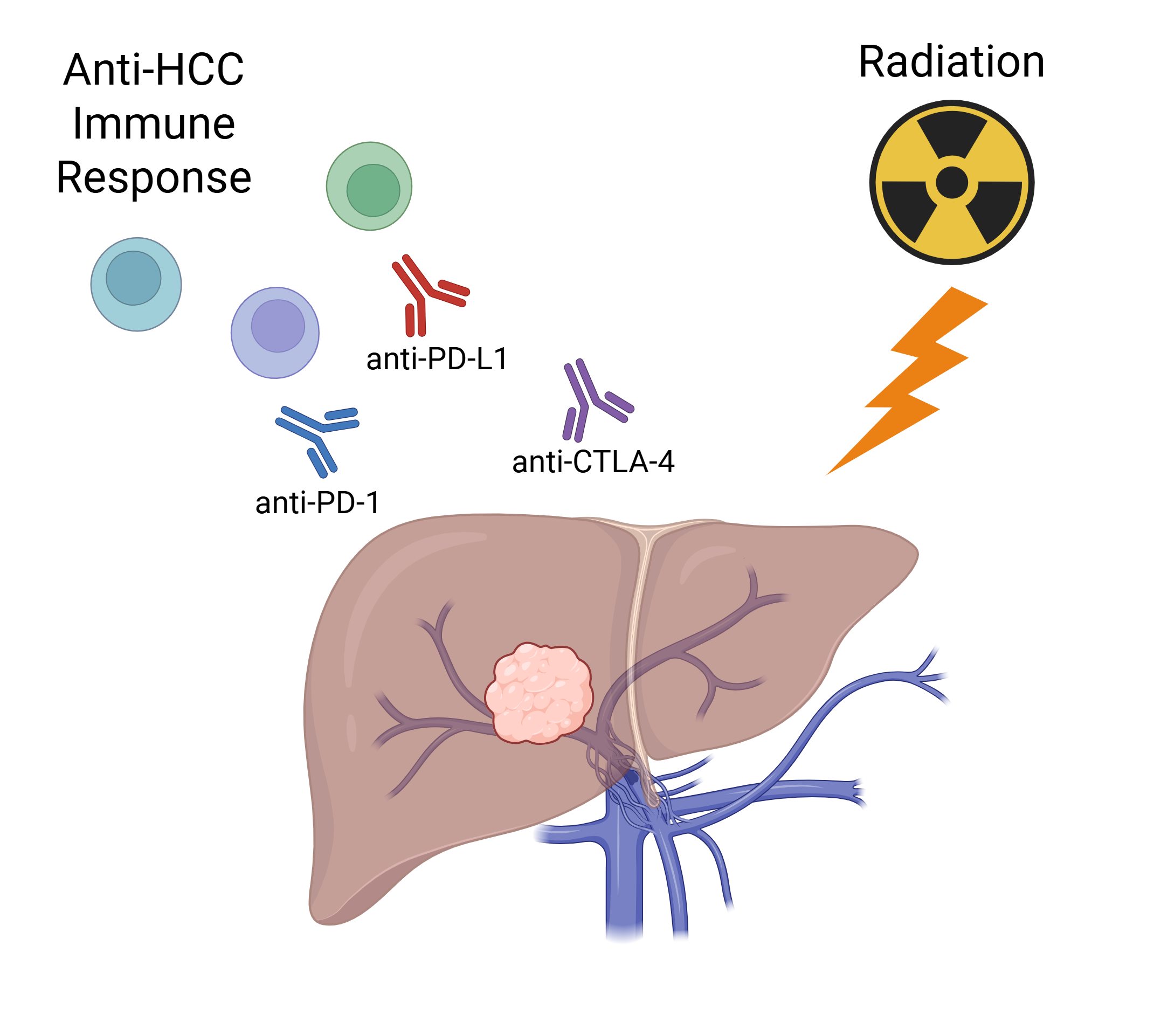
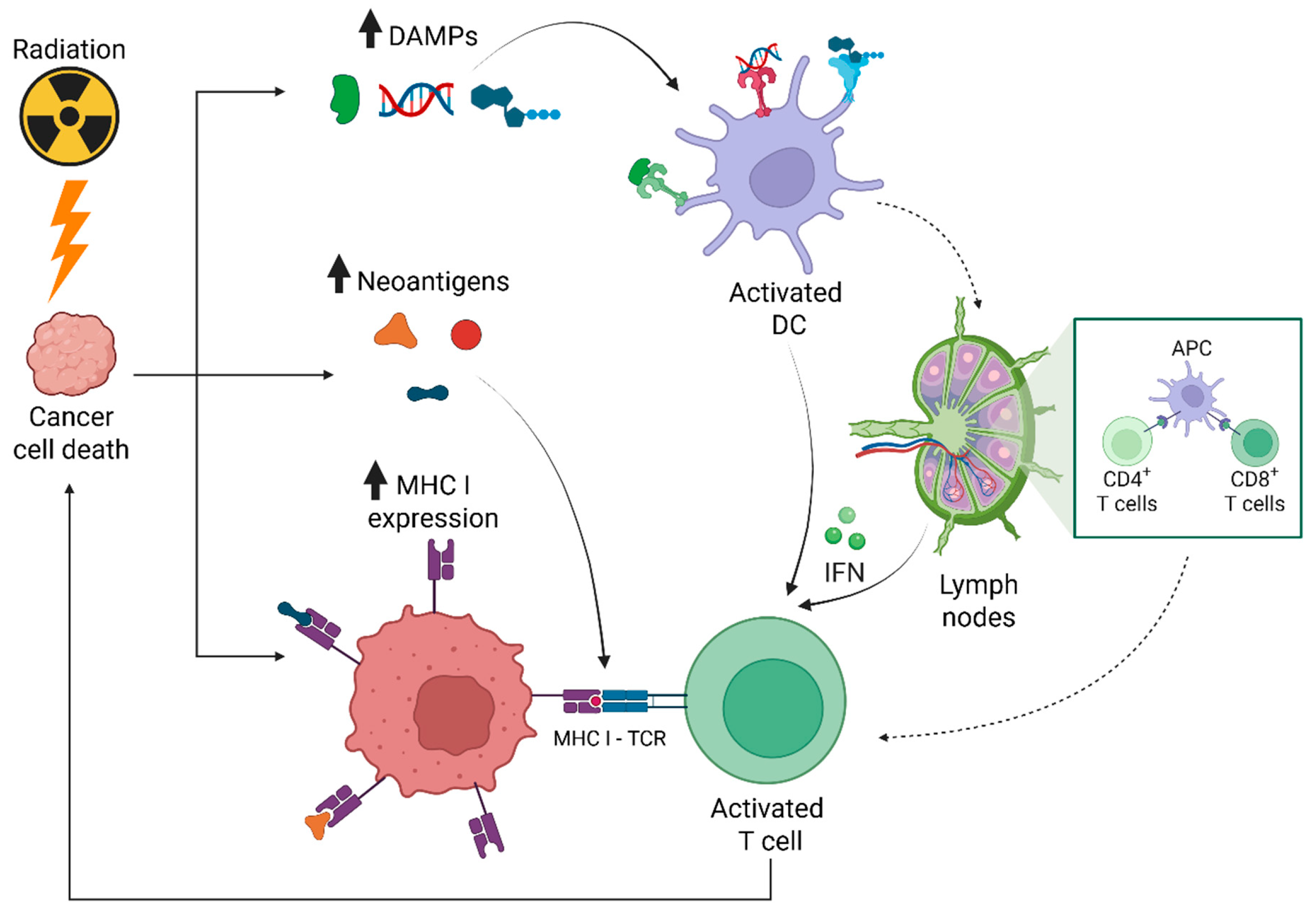
4. Combining Radiotherapy and Immunotherapy for Hepatocellular Carcinoma
4.1. Radiotherapy and Immunotherapy in Combination Improves Treatment of HCC with MVI (Table 3)

| Study | Population and Treatment | Design | n | RT Dose | Outcomes | Safety | ||
|---|---|---|---|---|---|---|---|---|
| mOS | mPFS | ORR | Grade ≥ 3 AEs | |||||
| Chen et al., IJROBP, 2025 [88] | First branch or main trunk PV MVI; 1st line toripalimab + RT vs. sorafenib | Phase III RCT | 25 vs. 11 | 40–60 Gy in 10 fractions | NR vs. 10.9 mo * | 44.0% vs. 9.1% * | 24.0% vs. 36.4% | |
| Hu, Clin Cancer Res, 2023 [89] | PV MVI; 1st line SBRT + camrel-apa vs. camrel-apa | Phase II RCT | 40 vs. 20 | 36–40 Gy in 5–6 fractions | 12.7 vs. 8.6 mo | 4.6 vs. 2.5 mo | 47.5% vs. 20% | 21.7% |
| Kim et al., JHEP, 2024 [91] | MVI; 1st or 2nd line RT + nivo | Phase II | 50 | 43–50 Gy in 10 fractions | 15.2 mo | 36% | (TRAEs) 12% | |
| Zhu et al., Hepatology, 2024 [92] | PV MVI; 1st line RT + sintilimab + bevacizumab | Phase II | 46 | 30–50 Gy in 10 fractions | 24.0 mo | 13.8 mo | 58.7% | 65.2% |
| Pan et al., Nat Comm, 2024 [93] | MVI; 1st line tislelizumab + RT → surgery → tislelizumab | Phase II | 15 | 45 Gy in 15 fractions | 18.7 mo | 30% | 13.3% | |
| Su et al., Oncologist, 2024 [94] | PV MVI or tumors > 50% liver volume; 1st or 2nd line atezo-bev + RT vs. atezo-bev | Retro | 14 vs. 34 | 72.6 GyE in 22 fractions | NR vs. 5.5 mo * | 5.2 vs. 2.9 mo | 50% vs. 11.8% * | (TRAEs) 14.3 vs. 14.7% |
| Krishnamurthy et al., Adv Radiat Oncol, 2025 [95] | PV MVI; any line RT + ICI | Retro | 62 | 40 Gy in 5 fractions or 45 Gy in 15 fractions | 7.7 mo | 3.7 mo | 1.6% | |
4.2. Radiotherapy and Immunotherapy in Combination Improves Treatment of Unresectable or Advanced HCC (Table 4)
| Study | Population and Treatment | Design | n | RT Dose | Outcomes | Safety | ||
|---|---|---|---|---|---|---|---|---|
| mOS | mPFS | ORR | Grade ≥ 3 AEs | |||||
| Li et al., Hepatol Int, 2022 [96] | Unresectable; ≥2nd line SBRT + camrelizumab | Phase II | 21 | 30–50 Gy in 10 fractions | 14.2 mo | 5.8 mo | 52.4% | (TRAEs) 23.8% |
| O’Kane et al., JHEP 2026 [97] | After progression on sorafenib; SBRT + pembrolizumab | Phase II | 18 | 25–50 Gy in 5 fractions | 12.6 mo | 5.4 mo | 41% | (TRAEs) 28% |
| Juloori et al., IJROBP, 2023 [98] | Unresectable; 1st or 2nd line SBRT + nivo + ipi vs. SBRT + nivo | Phase I | 7 vs. 6 | 40 Gy in 5 fractions | 41.6 vs. 4.7 mo * | 11.6 vs. 2.7 mo * | 57% vs. 0% * | 71.4% vs. 50% |
| Chiang et al., Lancet Gastro Hepatol, 2023 [99] | Locally advanced; 1st line TACE + SBRT + avelumab | Phase II | 33 | 27.5–40 Gy in 5 fractions | 42% rCR | 33% | ||
| Chiang et al., JAMA Oncol, 2024 [100] | Advanced; 1st line TACE + SBRT + avelumab achieved rCR | Secondary analysis | 29 | 27.5–45 Gy in 5 fractions | 3 year OS: 75.5% | 23.8% | ||
| Chiang et al., Liver Cancer, 2023 [101] | Unresectable; 1st line SBRT + ICI vs. SBRT | Retro with PSM | 30 vs. 70 | 25–45 Gy in 5 fractions | 1 year OS: 92% vs. 74% | 88% vs. 50% * | (TRAEs) 35% vs. 22.5% | |
| Chiang et al., Front Oncol, 2021 [102] | Unresectable; 1st line SBRT + ICI vs. TACE | Retro with PSM | 16 vs. 48 | 25–37.5 Gy in 5 fractions | 1 year OS: 93.8% vs. 80.4% * | 1 year PFS: 93.3% vs. 77.8% * | 87.5% vs. 16.7% * | 18.8% vs. 60.4% * |
| Hsu et al., Chin Med J, 2024 [103] | Advanced; any line RT + ICI vs. ICI | Retro with PSM | 71 vs. 71 | 20–60 Gy at 1.8–10 Gy per fraction | 20.9 vs. 11.2 mo * | 5.7 vs. 2.9 mo * | 40.8% vs. 19.7% * | 9.5% vs. 9.1% |
| Su et al., Front Immunol, 2022 [104] | Advanced; any line RT + ICI + AA vs. ICI + AA | Retro with PSM | 40 vs. 40 | 48 Gy in 16 fractions | 18.5 vs. 12.6 mo * | 8.7 vs. 5.4 mo * | 40% vs. 25% | Not stat different |
| Ning et al., IJROBP, 2024 [105] | BCLC C; 1st line ICI + AA + RT vs. ICI + AA | Retro with PSM | 29 vs. 29 | 30–60 Gy in 8–30 fractions | NR vs. 9.7 mo * | 8.3 vs. 4.2 mo * | 75.9% vs. 24.1% * | 36.2% in entire cohort |
| Nakabori et al., Curr Oncol, 2024 [106] | Advanced; Atezo-bev + locoregional therapy vs. atezo-bev | Retro | 10 vs. 19 | 40–50 Gy in 10 fractions | NR vs. 19.8 mo * | NR vs. 7.4 mo * | 80.0% vs. 21.1% * | 40% vs. 37% |
| Manzar et al., Cancers, 2022 [107] | Advanced; any line Atezo-bev + RT | Retro | 21 | 20–75 Gy in 5–25 fractions | 16.1 mo | |||
| Wang et al., IJROBP, 2024 [108] | Unresectable; 1st line SBRT + Lenvatinib + ICI vs. SBRT + lenvatinib | Retro | 146 vs. 68 | 40–52.5 Gy in 5–10 fractions | 31.2 vs. 17.4 mo * | 15.6 vs. 8.8 mo * | 63% vs. 39.7% * | Not stat different |
| Zhai et al., Front Immunol, 2025 [109] | Stage IV or recurrent; any line RT + ICI | Retro | 108 | 50–65 Gy in 20–30 fractions | 17.0 mo | 12.6 mo | 75.0% | 30.6% |
| Ning et al., Hepatobil Surg Nutr, 2023 [110] | Advanced; RT after progression on ICI | Retro | 36 | 30–70 Gy in 5–30 fractions | 18.8 mo | 7.4 mo | 38.9% | 38.9% |
| Zhong et al., Front Oncol, 2021 [111] | BCLC C; any line RT + ICI + AA | Retro | 16 | 30–60 Gy at 1.8–4 Gy per fraction | 20.9 mo | 4.6 mo | 40% | 25% |
5. Ongoing Trials Combining Radiotherapy and Immunotherapy for Hepatocellular Carcinoma (Table 5)
| Study, Clinicaltrials.gov ID | Patient Population | Design | Estimated Enrollment | Treatment | Primary Outcome |
|---|---|---|---|---|---|
| NRG-GI012, HELIO-RT, NCT07166406 | Macrovascular invasion | Phase III, Randomized control trial | 252 | Arm 1: ICI (atezo-bev, durva-treme, or ipi-nivo) Arm 2: SBRT with ICI (atezo-bev, durva-treme, or ipi-nivo) | OS |
| NCT07293468 | Unresectable | Phase II/III | 106 | TACE then SBRT followed by atezo-bev vs. Y90 radioembolization followed by atezo-bev | PFS |
| HSBRT2402, NCT06313190 | Unresectable | Phase II, Randomized control trial | 140 | SBRT vs. SBRT with adjuvant sintilimab (anti-PD-1) | PFS |
| NCT06828380 | Advanced with vascular invasion | Phase II, Randomized control trial | 120 | ICI vs. ICI and proton radiation | PFS |
| NCT06592612 | Oligo-progression after first-line systemic therapy | Phase II, Randomized control trial | 70 | Second-line systemic therapy vs. SBRT with second-line systemic therapy | PFS |
| NCT07179900 | Unresectable | Phase II, Randomized control trial | 60 | Sintilimab with bev vs. EBRT with bev and QL1706 (anti-PD-1 and anti-CTLA-4 bispecific antibody) | ORR and R0 resection rate |
| HSBRT2401, NCT06261125 | Abdominal metastatic lymph nodes without other sites of extrahepatic metastases | Phase II | 60 | SBRT followed by adebrelimab (anti-PD-L1) and lenvatinib. Arm A: patients that did not previously receive PD-1/PD-L1 antibodies. Arm B: patients that progressed on PD-1/PD-L1 antibodies. | PFS |
| NCT07062055 | BCLC C with portal vein tumor thrombus or oligo-metastasis | Phase II, Single arm | 46 | SBRT with bev and QL1706 | PFS |
| NCT06999707 | BCLC B or C | Phase II, Single arm | 45 | EBRT (conventional or stereotactic doses) with durva-treme | PFS |
| NCT06605664 | Unresectable, BCLC B or C | Phase II, Diagnostic | 45 | Hyperpolarized 13C pyruvate MRI before and 2–5 weeks after radiotherapy combined with atezo-bev | Dynamic Nuclear Polarization |
| NCT05917431 | Unresectable or oligo-metastatic | Phase II, Single arm | 39 | SBRT with tislelizumab (anti-PD-1) and regorafenib (TKI) | PFS |
| NCT06524466 | Resectable with macrovascular invasion | Phase II, Single arm | 35 | Neoadjuvant SBRT with lenvatinib and pucotenlimab (anti-PD-1) then surgical resection | ORR and treatment complete rate |
| NCT04988945 | Unresectable | Phase II, Single arm | 33 | TACE and SBRT followed by durva-treme | Downstaging for resection |
| NCT06434480 | Oligo-progression on atezo-bev | Phase II, Single arm | 30 | SBRT then continuing atezo-bev | PFS |
| IMMULAB, NCT03753659 | Advanced | Phase II | 30 | Peri-ablation pembrolizumab (anti-PD-1) with either RFA, MWA, or brachytherapy, with or without TACE | ORR |
| NCT04430452 | Advanced | Phase II | 21 | Arm I: hypofractionated RT with durva Arm II: after progression on prior PD-L1 therapy, hypofractionated RT with durva-treme Arm III: No prior PD-L1 therapy, hypofractionated RT with durva-treme | ORR |
| NCT03942328 | Unresectable HCC or intrahepatic cholangio-carcinoma | Phase I/II, Single arm | 85 | SBRT followed by autologous dendritic cells, pneumococcal vaccine, and atezo-bev | Toxicity and PFS |
| NCT06725121 | Advanced with macrovascular invasion | Phase I/II, Single arm | 48 | SBRT followed by atezo-bev | Downstaging efficacy for liver transplant |
| NCT05286320 | Advanced with portal vein tumor thrombus | Phase I/II, Single arm | 27 | SBRT followed by pembrolizumab and lenvatinib | Safety rate and ORR |
| NCT07305428 | Unresectable | Pilot, Single arm | 30 | SBRT followed by ICI | Rate of successive tumor downstaging |
| NCT07091942 | Unresectable that achieve partial response to atezo-bev | Observational | 1600 | Cohort 1: loco-regional treatment (including definitive RT, surgical resection, or RFA) Cohort 2: no further treatment | Recurrence-free survival |
| NCT06408753 | Unresectable | Observational | 50 | ICI vs. ICI with SBRT | Exosomal serum PD-L1 level and immune profile of peripheral blood mononuclear cells |
| NCT07230080 | Unresectable | Observational | 17 | TACE followed by SBRT and ICI | ORR |
| NCT06639971 | Advanced, unresectable | Retrospective cohort | 500 | RT with ICI and targeted therapy vs. ICI and targeted therapy alone | PFS |
6. Concluding Remarks and Future Perspectives
Author Contributions
Funding
Data Availability Statement
Conflicts of Interest
References
- Bray, F.; Laversanne, M.; Sung, H.; Ferlay, J.; Siegel, R.L.; Soerjomataram, I.; Jemal, A. Global cancer statistics 2022: GLOBOCAN estimates of incidence and mortality worldwide for 36 cancers in 185 countries. CA A Cancer J. Clin. 2024, 74, 229–263. [Google Scholar] [CrossRef] [PubMed]
- Kamangar, F.; Dores, G.M.; Anderson, W.F. Patterns of Cancer Incidence, Mortality, and Prevalence Across Five Continents: Defining Priorities to Reduce Cancer Disparities in Different Geographic Regions of the World. J. Clin. Oncol. 2023, 41, 5209–5224. [Google Scholar] [CrossRef] [PubMed]
- Singal, A.G.; Lampertico, P.; Nahon, P. Epidemiology and surveillance for hepatocellular carcinoma: New trends. J. Hepatol. 2020, 72, 250–261. [Google Scholar] [CrossRef] [PubMed]
- Devarbhavi, H.; Asrani, S.K.; Arab, J.P.; Nartey, Y.A.; Pose, E.; Kamath, P.S. Global burden of liver disease: 2023 update. J. Hepatol. 2023, 79, 516–537. [Google Scholar] [CrossRef]
- De, P.; Dryer, D.; Otterstatter, M.; Semenciw, R. Canadian Trends in Liver Cancer: A Brief Clinical and Epidemiologic Overview. Curr. Oncol. 2013, 20, 40–43. [Google Scholar] [CrossRef]
- Abboud, Y.; Ismail, M.; Khan, H.; Medina-Morales, E.; Alsakarneh, S.; Jaber, F.; Pyrsopoulos, N.T. Hepatocellular Carcinoma Incidence and Mortality in the USA by Sex, Age, and Race: A Nationwide Analysis of Two Decades. J. Clin. Transl. Hepatol. 2024, 12, 172–181. [Google Scholar] [CrossRef]
- Qiu, S.; Cai, J.; Yang, Z.; He, X.; Xing, Z.; Zu, J.; Xie, E.; Henry, L.; Chong, C.R.; John, E.M.; et al. Trends in Hepatocellular Carcinoma Mortality Rates in the US and Projections Through 2040. JAMA Netw. Open 2024, 7, e2445525. [Google Scholar] [CrossRef]
- Reig, M.; Forner, A.; Rimola, J.; Ferrer-Fàbrega, J.; Burrel, M.; Garcia-Criado, Á.; Kelley, R.K.; Galle, P.R.; Mazzaferro, V.; Salem, R.; et al. BCLC strategy for prognosis prediction and treatment recommendation: The 2022 update. J. Hepatol. 2021, 76, 681–693. [Google Scholar] [CrossRef]
- Reig, M.; Sanduzzi-Zamparelli, M.; Forner, A.; Rimola, J.; Ferrer-Fàbrega, J.; Burrel, M.; Garcia-Criado, Á.; Díaz, A.; Llarch, N.; Iserte, G.; et al. BCLC strategy for prognosis prediction and treatment recommendations: The 2026 update. J. Hepatol. 2025, 84, 631–654. [Google Scholar] [CrossRef]
- Llovet, J.M.; Ricci, S.; Mazzaferro, V.; Hilgard, P.; Gane, E.; Blanc, J.-F.; De Oliveira, A.C.; Santoro, A.; Raoul, J.-L.; Forner, A.; et al. Sorafenib in Advanced Hepatocellular Carcinoma. N. Engl. J. Med. 2008, 359, 378–390. [Google Scholar] [CrossRef]
- Dawson, L.; Tenhaken, R. Partial Volume Tolerance of the Liver to Radiation. Semin. Radiat. Oncol. 2005, 15, 279–283. [Google Scholar] [CrossRef]
- Yang, J.-F.; Lo, C.-H.; Lee, M.-S.; Lin, C.-S.; Dai, Y.-H.; Shen, P.-C.; Chao, H.-L.; Huang, W.-Y. Stereotactic ablative radiotherapy versus conventionally fractionated radiotherapy in the treatment of hepatocellular carcinoma with portal vein invasion: A retrospective analysis. Radiat. Oncol. 2019, 14, 180. [Google Scholar] [CrossRef]
- Japanese Radiological Society Multi-Institutional SBRT Study Group (JRS-SBRTSG); Yamashita, H.; Onishi, H.; Matsumoto, Y.; Murakami, N.; Matsuo, Y.; Nomiya, T.; Nakagawa, K. Local effect of stereotactic body radiotherapy for primary and metastatic liver tumors in 130 Japanese patients. Radiat. Oncol. 2014, 9, 112. [Google Scholar] [CrossRef]
- Bujold, A.; Massey, C.A.; Kim, J.J.; Brierley, J.; Cho, C.; Wong, R.K.; Dinniwell, R.E.; Kassam, Z.; Ringash, J.; Cummings, B.; et al. Sequential Phase I and II Trials of Stereotactic Body Radiotherapy for Locally Advanced Hepatocellular Carcinoma. J. Clin. Oncol. 2013, 31, 1631–1639. [Google Scholar] [CrossRef]
- Yanagihara, T.K.; Tepper, J.E.; Moon, A.M.; Barry, A.; Molla, M.; Seong, J.; Torres, F.; Apisarnthanarax, S.; Buckstein, M.; Cardenes, H.; et al. Defining Minimum Treatment Parameters of Ablative Radiation Therapy in Patients with Hepatocellular Carcinoma: An Expert Consensus. Pract. Radiat. Oncol. 2024, 14, 134–145. [Google Scholar] [CrossRef]
- Xi, M.; Yang, Z.; Hu, L.; Fu, Y.; Hu, D.; Zhou, Z.; Liu, M.; Zhao, J.; Shen, J.; Li, Q.; et al. Radiofrequency Ablation Versus Stereotactic Body Radiotherapy for Recurrent Small Hepatocellular Carcinoma: A Randomized, Open-Label, Controlled Trial. J. Clin. Oncol. 2025, 43, 1073–1082. [Google Scholar] [CrossRef]
- Kim, T.H.; Koh, Y.H.; Kim, B.H.; Kim, M.J.; Lee, J.H.; Park, B.; Park, J.-W. Proton beam radiotherapy vs. radiofrequency ablation for recurrent hepatocellular carcinoma: A randomized phase III trial. J. Hepatol. 2021, 74, 603–612. [Google Scholar] [CrossRef]
- Bush, D.A.; Volk, M.; Smith, J.C.; Reeves, M.E.; Sanghvi, S.; Slater, J.D.; Devera, M. Proton beam radiotherapy versus transarterial chemoembolization for hepatocellular carcinoma: Results of a randomized clinical trial. Cancer 2023, 129, 3554–3563. [Google Scholar] [CrossRef]
- Comito, T.; Loi, M.; Franzese, C.; Clerici, E.; Franceschini, D.; Badalamenti, M.; Teriaca, M.A.; Rimassa, L.; Pedicini, V.; Poretti, D.; et al. Stereotactic Radiotherapy after Incomplete Transarterial (Chemo-) Embolization (TAE\TACE) versus Exclusive TAE or TACE for Treatment of Inoperable HCC: A Phase III Trial (NCT02323360). Curr. Oncol. 2022, 29, 8802–8813. [Google Scholar] [CrossRef]
- Romero, A.M.; van der Holt, B.; Willemssen, F.E.; de Man, R.A.; Heijmen, B.J.; Habraken, S.; Westerveld, H.; van Delden, O.M.; Klümpen, H.-J.; Tjwa, E.T.; et al. Transarterial Chemoembolization with Drug-Eluting Beads Versus Stereotactic Body Radiation Therapy for Hepatocellular Carcinoma: Outcomes from a Multicenter, Randomized, Phase 2 Trial (the TRENDY Trial). Int. J. Radiat. Oncol. 2023, 117, 45–52. [Google Scholar] [CrossRef]
- Chen, Y.; Hu, Y.; Shen, J.; Du, S.; Yan, J.; Zhou, L.; Wang, Z.; Lu, H.; Xiao, L.; Yang, P.; et al. External Beam Radiation therapy After Transarterial Chemoembolization Versus Transarterial Chemoembolization Alone for Treatment of Inoperable Hepatocellular Carcinoma: A Randomized Phase 3 Trial. Int. J. Radiat. Oncol. 2024, 121, 414–422. [Google Scholar] [CrossRef]
- Kang, J.; Kim, M.; Cho, C.K.; Yang, K.M.; Yoo, H.J.; Kim, J.H.; Bae, S.H.; Jung, D.H.; Kim, K.B.; Lee, D.H.; et al. Stereotactic body radiation therapy for inoperable hepatocellular carcinoma as a local salvage treatment after incomplete transarterial chemoembolization. Cancer 2012, 118, 5424–5431. [Google Scholar] [CrossRef]
- Lee, J.; Shin, I.-S.; Yoon, W.S.; Koom, W.S.; Rim, C.H. Comparisons between radiofrequency ablation and stereotactic body radiotherapy for liver malignancies: Meta-analyses and a systematic review. Radiother. Oncol. 2020, 145, 63–70. [Google Scholar] [CrossRef] [PubMed]
- Eriguchi, T.; Takeda, A.; Tateishi, Y.; Tsurugai, Y.; Sanuki, N.; Ebinuma, H.; Horita, N. Comparison of stereotactic body radiotherapy and radiofrequency ablation for hepatocellular carcinoma: Systematic review and meta-analysis of propensity score studies. Hepatol. Res. 2021, 51, 813–822. [Google Scholar] [CrossRef]
- Rim, C.H.; Lee, J.S.; Kim, S.Y.; Seong, J. Comparison of radiofrequency ablation and ablative external radiotherapy for the treatment of intrahepatic malignancies: A hybrid meta-analysis. JHEP Rep. 2022, 5, 100594. [Google Scholar] [CrossRef]
- Li, L.-Q.; Su, T.-S.; Wu, Q.-Y.; Lin, Z.-T.; Liang, S.-X. Therapeutic Outcome of Stereotactic Body Radiotherapy for Small Hepatocellular Carcinoma Lesions—A Systematic Review and Network Meta-analysis. Clin. Oncol. 2023, 35, 652–664. [Google Scholar] [CrossRef]
- Pan, Y.-X.; Fu, Y.-Z.; Hu, D.-D.; Long, Q.; Wang, J.-C.; Xi, M.; Liu, S.-L.; Xu, L.; Liu, M.-Z.; Chen, M.-S.; et al. Stereotactic Body Radiotherapy vs. Radiofrequency Ablation in the Treatment of Hepatocellular Carcinoma: A Meta-Analysis. Front. Oncol. 2020, 10, 1639. [Google Scholar] [CrossRef]
- Kim, N.; Kim, H.J.; Won, J.Y.; Kim, D.Y.; Han, K.-H.; Jung, I.; Seong, J. Retrospective analysis of stereotactic body radiation therapy efficacy over radiofrequency ablation for hepatocellular carcinoma. Radiother. Oncol. 2019, 131, 81–87. [Google Scholar] [CrossRef]
- Kim, N.; Cheng, J.; Jung, I.; Der Liang, J.; Shih, Y.L.; Huang, W.-Y.; Kimura, T.; Lee, V.H.; Zeng, Z.C.; Ren, Z.; et al. Stereotactic body radiation therapy vs. radiofrequency ablation in Asian patients with hepatocellular carcinoma. J. Hepatol. 2020, 73, 121–129. [Google Scholar] [CrossRef]
- Wahl, D.R.; Stenmark, M.H.; Tao, Y.; Pollom, E.L.; Caoili, E.M.; Lawrence, T.S.; Schipper, M.J.; Feng, M. Outcomes After Stereotactic Body Radiotherapy or Radiofrequency Ablation for Hepatocellular Carcinoma. J. Clin. Oncol. 2016, 34, 452–459. [Google Scholar] [CrossRef]
- Sun, J.; Li, W.; He, W.; Yang, Y.; Duan, L.; Su, T.; Zhang, A.; Zhang, T.; Zhao, X.; Chang, X.; et al. Radiofrequency Ablation Therapy versus Stereotactic Body Radiation Therapy for Naive Hepatocellular Carcinoma (≤5cm): A Retrospective Multi-Center Study. J. Hepatocell. Carcinoma 2024, 11, 2199–2210. [Google Scholar] [CrossRef]
- Kuehnle, R.A.; Tchelebi, L.T.; Ludmir, E.B.; Escorcia, F.E.; Shrestha, S.; Sanford, N.; Court, C.M.; Ryckman, J.M.; Arora, S.P.; Lehrer, E.J.; et al. Meta-analysis of randomized controlled trials of external-beam radiation versus transarterial chemoembolization for hepatocellular carcinoma. Cancer 2025, 131, e35720. [Google Scholar] [CrossRef]
- Shen, P.-C.; Chang, W.-C.; Lo, C.-H.; Yang, J.-F.; Lee, M.-S.; Dai, Y.-H.; Lin, C.-S.; Fan, C.-Y.; Huang, W.-Y. Comparison of Stereotactic Body Radiation Therapy and Transarterial Chemoembolization for Unresectable Medium-Sized Hepatocellular Carcinoma. Int. J. Radiat. Oncol. 2019, 105, 307–318. [Google Scholar] [CrossRef]
- Sapir, E.; Tao, Y.; Schipper, M.J.; Bazzi, L.; Novelli, P.M.; Devlin, P.; Owen, D.; Cuneo, K.C.; Lawrence, T.S.; Parikh, N.D.; et al. Stereotactic Body Radiation Therapy as an Alternative to Transarterial Chemoembolization for Hepatocellular Carcinoma. Int. J. Radiat. Oncol. 2018, 100, 122–130. [Google Scholar] [CrossRef]
- Huo, Y.R.; Eslick, G.D. Transcatheter Arterial Chemoembolization Plus Radiotherapy Compared with Chemoembolization Alone for Hepatocellular Carcinoma. JAMA Oncol. 2015, 1, 756–765. [Google Scholar] [CrossRef]
- Bai, H.; Gao, P.; Gao, H.; Sun, G.; Dong, C.; Han, J.; Jiang, G. Improvement of Survival Rate for Patients with Hepatocellular Carcinoma Using Transarterial Chemoembolization in Combination with Three-Dimensional Conformal Radiation Therapy: A Meta-Analysis. Med. Sci. Monit. 2016, 22, 1773–1781. [Google Scholar] [CrossRef]
- Lee, H.I.; Jung, J.; Kim, S.Y.; Choi, J.; Lee, D.; Shim, J.H.; Kim, K.M.; Lim, Y.-S.; Lee, H.C.; Yoon, S.M. Transarterial Chemoembolization Alone Versus Combined with Radiation Therapy as First-Line Therapy for Early-Stage Single Hepatocellular Carcinoma. Int. J. Radiat. Oncol. 2025; in press.
- Su, T.-S.; Lu, H.-Z.; Cheng, T.; Zhou, Y.; Huang, Y.; Gao, Y.-C.; Tang, M.-Y.; Jiang, H.-Y.; Lian, Z.-P.; Hou, E.-C.; et al. Long-term survival analysis in combined transarterial embolization and stereotactic body radiation therapy versus stereotactic body radiation monotherapy for unresectable hepatocellular carcinoma >5 cm. BMC Cancer 2016, 16, 834. [Google Scholar] [CrossRef]
- Kibe, Y.; Takeda, A.; Tsurugai, Y.; Eriguchi, T. Local control by salvage stereotactic body radiotherapy for recurrent/residual hepatocellular carcinoma after other local therapies. Acta Oncol. 2020, 59, 888–894. [Google Scholar] [CrossRef]
- Lou, J.; Li, Y.; Liang, K.; Guo, Y.; Song, C.; Chen, L.; Wang, L.; Wang, F.; Zhang, L.; Chen, X.; et al. Hypofractionated radiotherapy as a salvage treatment for recurrent hepatocellular carcinoma with inferior vena cava/right atrium tumor thrombus: A multi-center analysis. BMC Cancer 2019, 19, 668. [Google Scholar] [CrossRef]
- Chan, S.L.; Chong, C.C.; Chan, A.W.; MC Poon, D.; Chok, K.S. Management of hepatocellular carcinoma with portal vein tumor thrombosis: Review and update at 2016. World J. Gastroenterol. 2016, 22, 7289–7300. [Google Scholar] [CrossRef]
- Gerard, I.; Glynn, A.; Faye, M.D.; Yan, M.; Mesci, A.; Kim, T.; Vanner, R.; Dawson, L. The role of stereotactic body radiotherapy in the management of hepatocellular carcinoma with macroscopic vascular invasion: A narrative review. ESMO Gastrointest. Oncol. 2026, 11, 100298. [Google Scholar] [CrossRef]
- Yoon, S.M.; Ryoo, B.-Y.; Lee, S.J.; Kim, J.H.; Shin, J.H.; An, J.; Lee, H.C.; Lim, Y.-S. Efficacy and Safety of Transarterial Chemoembolization Plus External Beam Radiotherapy vs Sorafenib in Hepatocellular Carcinoma with Macroscopic Vascular Invasion: A randomized clinical trial. JAMA Oncol. 2018, 4, 661–669. [Google Scholar] [CrossRef] [PubMed] [PubMed Central]
- Wei, X.; Jiang, Y.; Zhang, X.; Feng, S.; Zhou, B.; Ye, X.; Xing, H.; Xu, Y.; Shi, J.; Guo, W.; et al. Neoadjuvant Three-Dimensional Conformal Radiotherapy for Resectable Hepatocellular Carcinoma with Portal Vein Tumor Thrombus: A Randomized, Open-Label, Multicenter Controlled Study. J. Clin. Oncol. 2019, 37, 2141–2151. [Google Scholar] [CrossRef]
- Munoz-Schuffenegger, P.; Barry, A.; Atenafu, E.G.; Kim, J.; Brierley, J.; Ringash, J.; Brade, A.; Dinniwell, R.; Wong, R.K.; Cho, C.; et al. Stereotactic body radiation therapy for hepatocellular carcinoma with Macrovascular invasion. Radiother. Oncol. 2021, 156, 120–126. [Google Scholar] [CrossRef]
- Zhang, D.; Li, Q.; Li, D.; Jia, J.; Ding, J.; Sun, J.; Duan, X. Stereotactic body radiation therapy as an effective local treatment for advanced hepatocellular carcinoma patients with inferior vena cava and right atrial tumor thrombus. BMC Gastroenterol. 2022, 22, 451. [Google Scholar] [CrossRef]
- Sharma, D.; Thaper, D.; Kamal, R.; Yadav, H.P. Role of stereotactic body radiotherapy for inferior vena cava tumour thrombus in hepatocellular carcinoma. J. Med. Imaging Radiat. Oncol. 2023, 67, 444–449. [Google Scholar] [CrossRef]
- Sharma, D.; Thaper, D.; Kamal, R.; Yadav, H.P. Role of palliative SBRT in barcelona clinic liver cancer-stage C hepatocellular carcinoma patients. Strahlenther. Onkol. 2023, 199, 838–846. [Google Scholar] [CrossRef]
- Yan, M.; Li, Z.; Claasen, M.P.A.W.; Santiago, A.T.; Rajendran, L.; Munoz-Schuffenegger, P.; Lee, C.; Magyar, C.T.J.; McGilvray, I.; Shwaartz, C.; et al. Outcomes of Stereotactic Body Radiotherapy Compared with Surgical Resection in Patients with Hepatocellular Carcinoma and Macrovascular Invasion: A Propensity Score-Matched Analysis. Ann. Surg. Oncol. 2024, 32, 1771–1783. [Google Scholar] [CrossRef]
- Mohamed, M.; Katz, A.W.; Tejani, M.A.; Sharma, A.K.; Kashyap, R.; Noel, M.S.; Qiu, H.; Hezel, A.F.; Ramaraju, G.A.; Dokus, M.K.; et al. Comparison of outcomes between SBRT, yttrium-90 radioembolization, transarterial chemoembolization, and radiofrequency ablation as bridge to transplant for hepatocellular carcinoma. Adv. Radiat. Oncol. 2016, 1, 35–42. [Google Scholar] [CrossRef]
- Mourad, M.; Mabrut, J.-Y.; Chellakhi, M.; Lesurtel, M.; Prevost, C.; Ducerf, C.; Rode, A.; Merle, P.; Mornex, F.; Mohkam, K. Neoadjuvant Conformal Radiotherapy Before Liver Transplantation for Hepatocellular Carcinoma: A Propensity Score Matched Analysis of Postoperative Morbidity and Oncological Results. Future Oncol. 2019, 15, 2517–2530. [Google Scholar] [CrossRef]
- Li, N.; Feng, S.; Xue, J.; Wei, X.-B.; Shi, J.; Guo, W.-X.; Lau, W.-Y.; Wu, M.-C.; Cheng, S.-Q.; Meng, Y. Hepatocellular carcinoma with main portal vein tumor thrombus: A comparative study comparing hepatectomy with or without neoadjuvant radiotherapy. HPB 2016, 18, 549–556. [Google Scholar] [CrossRef]
- Sapisochin, G.; Barry, A.; Doherty, M.; Fischer, S.; Goldaracena, N.; Rosales, R.; Russo, M.; Beecroft, R.; Ghanekar, A.; Bhat, M.; et al. Stereotactic body radiotherapy vs. TACE or RFA as a bridge to transplant in patients with hepatocellular carcinoma. An intention-to-treat analysis. J. Hepatol. 2017, 67, 92–99. [Google Scholar] [CrossRef]
- Li, Z.; Yan, M.; Claasen, M.P.; Rajendran, L.; Magyar, C.T.; Saha, S.; Lee, C.; Selzner, N.; Jaeckel, E.; Ghanekar, A.; et al. SBRT for bridging and downstaging HCC before transplant. JHEP Rep. 2025, 7, 101451. [Google Scholar] [CrossRef]
- Dawson, L.; Winter, K.; Knox, J.; Zhu, A.; Krishnan, S.; Guha, C.; Kachnic, L.; Gillin, M.; Hong, T.; Craig, T.; et al. NRG/RTOG 1112: Randomized Phase III Study of Sorafenib vs. Stereotactic Body Radiation Therapy (SBRT) Followed by Sorafenib in Hepatocellular Carcinoma (HCC) (NCT01730937). Int. J. Radiat. Oncol. 2022, 114, 1057. [Google Scholar] [CrossRef]
- Dawson, L.A.; Winter, K.A.; Knox, J.J.; Zhu, A.X.; Krishnan, S.; Guha, C.; Kachnic, L.A.; Gillin, M.; Hong, T.S.; Craig, T.; et al. NRG/RTOG 1112: Randomized phase III study of sorafenib vs. stereotactic body radiation therapy (SBRT) followed by sorafenib in hepatocellular carcinoma (HCC). J. Clin. Oncol. 2023, 41, 489. [Google Scholar] [CrossRef]
- Sherry, A.D.; Kaseb, A.O.; Ludmir, E.B. Local Control and Extended Survival in Locally Advanced Hepatocellular Carcinoma. JAMA Oncol. 2025, 11, 670. [Google Scholar] [CrossRef]
- Singal, A.G.; Llovet, J.M.; Yarchoan, M.; Mehta, N.; Heimbach, J.K.; Dawson, L.A.; Jou, J.H.; Kulik, L.M.; Agopian, V.G.; Marrero, J.A.; et al. AASLD Practice Guidance on prevention, diagnosis, and treatment of hepatocellular carcinoma. Hepatology 2023, 78, 1922–1965. [Google Scholar] [CrossRef]
- Apisarnthanarax, S.; Barry, A.; Cao, M.; Czito, B.; DeMatteo, R.; Drinane, M.; Hallemeier, C.L.; Koay, E.J.; Lasley, F.; Meyer, J.; et al. External Beam Radiation Therapy for Primary Liver Cancers: An ASTRO Clinical Practice Guideline. Pract. Radiat. Oncol. 2022, 12, 28–51. [Google Scholar] [CrossRef]
- Sangro, B.; Argemi, J.; Ronot, M.; Paradis, V.; Meyer, T.; Mazzaferro, V.; Jepsen, P.; Golfieri, R.; Galle, P.; Dawson, L.; et al. EASL Clinical Practice Guidelines on the management of hepatocellular carcinoma. J. Hepatol. 2024, 82, 315–374. [Google Scholar] [CrossRef]
- Buckstein, M.; Dawson, L.A. External beam radiation for HCC: Ready for incorporation into guidelines? JHEP Rep. 2025, 8, 101683. [Google Scholar] [CrossRef] [PubMed]
- Yang, X.; Wang, D.; Lin, J.; Yang, X.; Zhao, H. Atezolizumab plus bevacizumab for unresectable hepatocellular carcinoma. Lancet Oncol. 2020, 21, E412. [Google Scholar] [CrossRef]
- Finn, R.S.; Qin, S.; Ikeda, M.; Galle, P.R.; Ducreux, M.; Kim, T.-Y.; Kudo, M.; Breder, V.; Merle, P.; Kaseb, A.O.; et al. Atezolizumab plus Bevacizumab in Unresectable Hepatocellular Carcinoma. N. Engl. J. Med. 2020, 382, 1894–1905. [Google Scholar] [CrossRef]
- Cheng, A.-L.; Qin, S.; Ikeda, M.; Galle, P.R.; Ducreux, M.; Kim, T.-Y.; Lim, H.Y.; Kudo, M.; Breder, V.; Merle, P.; et al. Updated efficacy and safety data from IMbrave150: Atezolizumab plus bevacizumab vs. sorafenib for unresectable hepatocellular carcinoma. J. Hepatol. 2022, 76, 862–873. [Google Scholar] [CrossRef]
- Abou-Alfa, G.K.; Lau, G.; Kudo, M.; Chan, S.L.; Kelley, R.K.; Furuse, J.; Sukeepaisarnjaroen, W.; Kang, Y.-K.; Van Dao, T.; De Toni, E.N.; et al. Tremelimumab plus Durvalumab in Unresectable Hepatocellular Carcinoma. NEJM Évid. 2022, 1, EVIDoa2100070. [Google Scholar] [CrossRef]
- Rimassa, L.; Chan, S.L.; Sangro, B.; Lau, G.; Kudo, M.; Reig, M.; Breder, V.; Ryu, M.-H.; Ostapenko, Y.; Sukeepaisarnjaroen, W.; et al. Five-year overall survival update from the HIMALAYA study of tremelimumab plus durvalumab in unresectable HCC. J. Hepatol. 2025, 83, 899–908. [Google Scholar] [CrossRef]
- Yau, T.; Galle, P.R.; Decaens, T.; Sangro, B.; Qin, S.; da Fonseca, L.G.; Karachiwala, H.; Blanc, J.-F.; Park, J.-W.; Gane, E.; et al. Nivolumab plus ipilimumab versus lenvatinib or sorafenib as first-line treatment for unresectable hepatocellular carcinoma (CheckMate 9DW): An open-label, randomised, phase 3 trial. Lancet 2025, 405, 1851–1864. [Google Scholar] [CrossRef]
- Finn, R.S.; Galle, P.R.; Ducreux, M.; Cheng, A.-L.; Reilly, N.; Nicholas, A.; Hernandez, S.; Ma, N.; Merle, P.; Salem, R.; et al. Efficacy and Safety of Atezolizumab plus Bevacizumab versus Sorafenib in Hepatocellular Carcinoma with Main Trunk and/or Contralateral Portal Vein Invasion in IMbrave150. Liver Cancer 2024, 13, 655–668. [Google Scholar] [CrossRef] [PubMed]
- Lau-Min, K.S.; Tramontano, A.C.; Iheanacho, F.; Abrams, T.A.; Manz, C.R. Treatment Patterns and Survival Outcomes Among Patients with Hepatocellular Carcinoma. JAMA Netw. Open 2025, 8, e2551665. [Google Scholar] [CrossRef] [PubMed]
- Lee, Y.H.; Tai, D.; Yip, C.; Choo, S.P.; Chew, V. Combinational Immunotherapy for Hepatocellular Carcinoma: Radiotherapy, Immune Checkpoint Blockade and Beyond. Front. Immunol. 2020, 11, 568759. [Google Scholar] [CrossRef]
- Reits, E.A.; Hodge, J.W.; Herberts, C.A.; Groothuis, T.A.; Chakraborty, M.; Wansley, E.K.; Camphausen, K.; Luiten, R.M.; De Ru, A.H.; Neijssen, J.; et al. Radiation modulates the peptide repertoire, enhances MHC class I expression, and induces successful antitumor immunotherapy. J. Exp. Med. 2006, 203, 1259–1271. [Google Scholar] [CrossRef]
- Tailor, A.; Estephan, H.; Parker, R.; Woodhouse, I.; Abdulghani, M.; Nicastri, A.; Jones, K.; Salatino, S.; Muschel, R.; Humphrey, T.; et al. Ionizing Radiation Drives Key Regulators of Antigen Presentation and a Global Expansion of the Immunopeptidome. Mol. Cell. Proteom. 2022, 21, 100410. [Google Scholar] [CrossRef]
- Gameiro, S.R.; Malamas, A.S.; Bernstein, M.B.; Tsang, K.Y.; Vassantachart, A.; Sahoo, N.; Tailor, R.; Pidikiti, R.; Guha, C.P.; Hahn, S.M.; et al. Tumor Cells Surviving Exposure to Proton or Photon Radiation Share a Common Immunogenic Modulation Signature, Rendering Them More Sensitive to T Cell–Mediated Killing. Int. J. Radiat. Oncol. 2016, 95, 120–130. [Google Scholar] [CrossRef] [PubMed]
- Lugade, A.A.; Moran, J.P.; Gerber, S.A.; Rose, R.C.; Frelinger, J.G.; Lord, E.M. Local Radiation Therapy of B16 Melanoma Tumors Increases the Generation of Tumor Antigen-Specific Effector Cells That Traffic to the Tumor. J. Immunol. 2005, 174, 7516–7523. [Google Scholar] [CrossRef] [PubMed]
- Garnett, C.T.; Palena, C.; Chakarborty, M.; Tsang, K.-Y.; Schlom, J.; Hodge, J.W. Sublethal irradiation of human tumor cells modulates phenotype resulting in enhanced killing by cytotoxic T lymphocytes. Cancer Res. 2004, 64, 7985–7994. [Google Scholar] [CrossRef] [PubMed]
- Liu, R.; Xiong, S.; Zhang, L.; Chu, Y. Enhancement of antitumor immunity by low-dose total body irradiationis associated with selectively decreasing the proportion and number of T regulatorycells. Cell. Mol. Immunol. 2010, 7, 157–162. [Google Scholar] [CrossRef]
- Chino, F.; Pollis, K.E.; Choi, S.; Salama, J.K.; Palta, M. Stereotactic Body Radiation Therapy–Induced Abscopal Effect on Hepatocellular Carcinoma After Treatment for Lung Cancer: A Case Report. Hepatology 2018, 68, 1653–1655. [Google Scholar] [CrossRef]
- Kim, K.-J.; Kim, J.-H.; Lee, S.J.; Lee, E.-J.; Shin, E.-C.; Seong, J. Radiation improves antitumor effect of immune checkpoint inhibitor in murine hepatocellular carcinoma model. Oncotarget 2017, 8, 41242–41255. [Google Scholar] [CrossRef] [PubMed]
- Gupta, A.; Probst, H.C.; Vuong, V.; Landshammer, A.; Muth, S.; Yagita, H.; Schwendener, R.; Pruschy, M.; Knuth, A.; van den Broek, M. Radiotherapy Promotes Tumor-Specific Effector CD8+ T Cells via Dendritic Cell Activation. J. Immunol. 2012, 189, 558–566. [Google Scholar] [CrossRef]
- Sharabi, A.B.; Nirschl, C.J.; Kochel, C.M.; Nirschl, T.R.; Francica, B.J.; Velarde, E.; Deweese, T.L.; Drake, C.G. Stereotactic Radiation Therapy Augments Antigen-Specific PD-1–Mediated Antitumor Immune Responses via Cross-Presentation of Tumor Antigen. Cancer Immunol. Res. 2015, 3, 345–355. [Google Scholar] [CrossRef]
- Formenti, S.C.; Demaria, S. Systemic effects of local radiotherapy. Lancet Oncol. 2009, 10, 718–726. [Google Scholar] [CrossRef]
- Deng, L.; Liang, H.; Burnette, B.; Beckett, M.; Darga, T.; Weichselbaum, R.R.; Fu, Y.-X. Irradiation and anti–PD-L1 treatment synergistically promote antitumor immunity in mice. J. Clin. Investig. 2014, 124, 687–695. [Google Scholar] [CrossRef]
- Kapoor, V.; Collins, A.; Griffith, K.; Ghosh, S.; Wong, N.; Wang, X.; Challen, G.A.; Krambs, J.; Link, D.; Hallahan, D.E.; et al. Radiation induces iatrogenic immunosuppression by indirectly affecting hematopoiesis in bone marrow. Oncotarget 2020, 11, 1681–1690. [Google Scholar] [CrossRef] [PubMed]
- Kachikwu, E.L.; Iwamoto, K.S.; Liao, Y.-P.; DeMarco, J.J.; Agazaryan, N.; Economou, J.S.; McBride, W.H.; Schaue, D. Radiation Enhances Regulatory T Cell Representation. Int. J. Radiat. Oncol. 2011, 81, 1128–1135. [Google Scholar] [CrossRef] [PubMed]
- Wunderlich, R.; Ernst, A.; Rödel, F.; Fietkau, R.; Ott, O.; Lauber, K.; Frey, B.; Gaipl, U.S. Low and moderate doses of ionizing radiation up to 2 Gy modulate transmigration and chemotaxis of activated macrophages, provoke an anti-inflammatory cytokine milieu, but do not impact upon viability and phagocytic function. Clin. Exp. Immunol. 2014, 179, 50–61. [Google Scholar] [CrossRef]
- Filatenkov, A.; Baker, J.; Mueller, A.M.; Kenkel, J.; Ahn, G.-O.; Dutt, S.; Zhang, N.; Kohrt, H.; Jensen, K.; Dejbakhsh-Jones, S.; et al. Ablative Tumor Radiation Can Change the Tumor Immune Cell Microenvironment to Induce Durable Complete Remissions. Clin. Cancer Res. 2015, 21, 3727–3739. [Google Scholar] [CrossRef]
- Malone, C.D.; Bajaj, S.; He, A.; Mody, K.; Hickey, R.M.; Sarwar, A.; Krishnan, S.; Patel, T.C.; Toskich, B.B. Combining Radioembolization and Immune Checkpoint Inhibitors for the Treatment of Hepatocellular Carcinoma: The Quest for Synergy. J. Vasc. Interv. Radiol. 2024, 36, 414–424.e2. [Google Scholar] [CrossRef]
- Chen, B.; Zhai, Y.; Zhang, Y.; Wu, F.; Wang, L.; Li, Z.; Ye, F.; Wang, S.; Zong, Y.; Yang, Z.; et al. Toripalimab Combined with Radiotherapy vs. Sorafenib in Advanced Hepatocellular Carcinoma with First Branch (Vp3) or Main Trunk (Vp4) Portal Vein Thrombosis: A Prospective, Open-Label, Randomized Trial. Int. J. Radiat. Oncol. 2025, 123, S139. [Google Scholar] [CrossRef]
- Hu, Y.; Qin, T.; Li, S.; Zhang, T.; Xue, J. Efficacy and Safety of SBRT Combined with Camrelizumab and Apatinib in HCC Patients with PVTT: Study Protocol of a Randomized Controlled Trial. Front. Oncol. 2020, 10, 1589. [Google Scholar] [CrossRef] [PubMed]
- Hu, Y.; Zhou, M.; Tang, J.; Li, S.; Liu, H.; Hu, J.; Ma, H.; Liu, J.; Qin, T.; Yu, X.; et al. Efficacy and Safety of Stereotactic Body Radiotherapy Combined with Camrelizumab and Apatinib in Patients with Hepatocellular Carcinoma with Portal Vein Tumor Thrombus. Clin. Cancer Res. 2023, 29, 4088–4097. [Google Scholar] [CrossRef]
- Kim, B.H.; Park, H.C.; Kim, T.H.; Koh, Y.-H.; Hong, J.Y.; Cho, Y.; Sinn, D.H.; Park, B.; Park, J.-W. Concurrent nivolumab and external beam radiation therapy for hepatocellular carcinoma with macrovascular invasion: A phase II study. JHEP Rep. 2023, 6, 100991. [Google Scholar] [CrossRef] [PubMed]
- Zhu, M.; Liu, Z.; Chen, S.; Luo, Z.; Tu, J.; Qiao, L.; Wu, J.; Fan, W.; Peng, Z. Sintilimab plus bevacizumab combined with radiotherapy as first-line treatment for hepatocellular carcinoma with portal vein tumor thrombus: A multicenter, single-arm, phase 2 study. Hepatology 2024, 80, 807–815. [Google Scholar] [CrossRef] [PubMed]
- Pan, H.; Zhou, L.; Cheng, Z.; Zhang, J.; Shen, N.; Ma, H.; Li, Y.; Jin, R.; Zhou, W.; Wu, D.; et al. Perioperative Tislelizumab plus intensity modulated radiotherapy in resectable hepatocellular carcinoma with macrovascular invasion: A phase II trial. Nat. Commun. 2024, 15, 9350. [Google Scholar] [CrossRef]
- Su, C.-W.; Teng, W.; Shen, E.Y.-L.; Huang, B.-S.; Lin, P.-T.; Hou, M.-M.; Wu, T.-H.; Tsan, D.-L.; Hsieh, C.-H.; Wang, C.-T.; et al. Concurrent Atezolizumab Plus Bevacizumab and High-Dose External Beam Radiotherapy for Highly Advanced Hepatocellular Carcinoma. Oncologist 2024, 29, e922–e931. [Google Scholar] [CrossRef] [PubMed]
- Krishnamurthy, N.; Cherry, D.; Rodriguez-Russo, C.; Buckstein, M. Concurrent Radiation and Immunotherapy for Unresectable Hepatocellular Carcinoma with Extensive Portal Vein Tumor Thrombus. Adv. Radiat. Oncol. 2025, 10, 101856. [Google Scholar] [CrossRef]
- Li, J.-X.; Su, T.-S.; Gong, W.-F.; Zhong, J.-H.; Yan, L.-Y.; Zhang, J.; Li, L.-Q.; He, M.-L.; Zhang, R.-J.; Du, Y.-Q.; et al. Combining stereotactic body radiotherapy with camrelizumab for unresectable hepatocellular carcinoma: A single-arm trial. Hepatol. Int. 2022, 16, 1179–1187. [Google Scholar] [CrossRef]
- O’KAne, G.M.; Mesci, A.; Jang, R.W.; Barry, A.; Bocaya, C.M.; Boukhaled, G.M.; Acton, H.; Doddington, D.; Rodrigo, R.; Chan, L.M.; et al. Pembrolizumab and stereotactic body radiotherapy combined in advanced hepatocellular carcinoma post sorafenib—A phase II trial (PEMRAD). JHEP Rep. 2025, 8, 101658. [Google Scholar] [CrossRef]
- Juloori, A.; Katipally, R.R.; Lemons, J.M.; Singh, A.K.; Iyer, R.; Robbins, J.R.; George, B.; Hall, W.A.; Pitroda, S.P.; Arif, F.; et al. Phase 1 Randomized Trial of Stereotactic Body Radiation Therapy Followed by Nivolumab plus Ipilimumab or Nivolumab Alone in Advanced/Unresectable Hepatocellular Carcinoma. Int. J. Radiat. Oncol. 2022, 115, 202–213. [Google Scholar] [CrossRef]
- Chiang, C.L.; Chiu, K.W.H.; Chan, K.S.K.; Lee, F.A.S.; Li, J.C.B.; Wan, C.W.S.; Dai, W.C.; Lam, T.C.; Chen, W.; Wong, N.S.M.; et al. Sequential transarterial chemoembolisation and stereotactic body radiotherapy followed by immunotherapy as conversion therapy for patients with locally advanced, unresectable hepatocellular carcinoma (START-FIT): A single-arm, phase 2 trial. Lancet Gastroenterol. Hepatol. 2022, 8, 169–178. [Google Scholar] [CrossRef]
- Chiang, C.L.; Chan, K.S.K.; Chiu, K.W.H.; Lee, F.A.S.; Chen, W.; Wong, N.S.M.; Ho, R.L.M.; Lee, V.W.Y.; Man, K.; Kong, F.M.; et al. Complete Response to Locoregional Therapy Plus Immunotherapy for Hepatocellular Carcinoma. JAMA Oncol. 2024, 10, 1548–1553. [Google Scholar] [CrossRef]
- Chiang, C.L.; Lee, F.A.S.; Chan, K.S.K.; Lee, V.W.Y.; Chiu, K.W.H.; Ho, R.L.M.; Fong, J.K.S.; Wong, N.S.M.; Yip, W.W.L.; Yeung, C.S.Y.; et al. Survival Outcome Analysis of Stereotactic Body Radiotherapy and Immunotherapy (SBRT-IO) versus SBRT-Alone in Unresectable Hepatocellular Carcinoma. Liver Cancer 2023, 13, 273–284. [Google Scholar] [CrossRef]
- Chiang, C.-L.; Chiu, K.W.-H.; Lee, F.A.-S.; Kong, F.-M.S.; Chan, A.C.-Y. Combined Stereotactic Body Radiotherapy and Immunotherapy Versus Transarterial Chemoembolization in Locally Advanced Hepatocellular Carcinoma: A Propensity Score Matching Analysis. Front. Oncol. 2021, 11, 798832. [Google Scholar] [CrossRef]
- Hsu, S.; Chao, Y.; Hu, Y.; Zhang, Y.; Hong, W.; Chen, Y.; Chen, R.; Zeng, Z.; Du, S. Radiotherapy enhances efficacy of PD-1 inhibitors in advanced hepatocellular carcinoma: A propensity-matched real-world study. Chin. Med. J. 2024, 137, 1332–1342. [Google Scholar] [CrossRef]
- Su, K.; Guo, L.; Ma, W.; Wang, J.; Xie, Y.; Rao, M.; Zhang, J.; Li, X.; Wen, L.; Li, B.; et al. PD-1 inhibitors plus anti-angiogenic therapy with or without intensity-modulated radiotherapy for advanced hepatocellular carcinoma: A propensity score matching study. Front. Immunol. 2022, 13, 972503. [Google Scholar] [CrossRef]
- Ning, C.; Zhang, X.; Wang, Y.; Yang, X.; Yang, X.; Chao, J.; Xun, Z.; Xue, J.; Wang, Y.; Sun, H.; et al. Radiation Therapy with Combination Therapy of Immune Checkpoint Inhibitors and Antiangiogenic Therapy for Hepatocellular Carcinoma. Int. J. Radiat. Oncol. 2023, 118, 1461–1471. [Google Scholar] [CrossRef]
- Nakabori, T.; Higashi, S.; Abe, Y.; Mukai, K.; Ikawa, T.; Konishi, K.; Maeda, N.; Nakanishi, K.; Hasegawa, S.; Wada, H.; et al. Safety and Feasibility of Combining On-Demand Selective Locoregional Treatment with First-Line Atezolizumab Plus Bevacizumab for Patients with Unresectable Hepatocellular Carcinoma. Curr. Oncol. 2024, 31, 1543–1555. [Google Scholar] [CrossRef]
- Manzar, G.S.; De, B.S.; Abana, C.O.; Lee, S.S.; Javle, M.; Kaseb, A.O.; Vauthey, J.-N.; Cao, H.S.T.; Koong, A.C.; Smith, G.L.; et al. Outcomes and Toxicities of Modern Combined Modality Therapy with Atezolizumab Plus Bevacizumab and Radiation Therapy for Hepatocellular Carcinoma. Cancers 2022, 14, 1901. [Google Scholar] [CrossRef]
- Wang, Q.; Ji, X.; Sun, J.; Zhang, A.; Jia, J.; Zhang, T.; Li, W.; Duan, X. Stereotactic Body Radiotherapy Combined with Lenvatinib With or Without PD-1 Inhibitors as Initial Treatment for Unresectable Hepatocellular Carcinoma. Int. J. Radiat. Oncol. 2024, 120, 1363–1376. [Google Scholar] [CrossRef] [PubMed]
- Zhai, Y.; Zhang, Y.; Wu, F.; Zhou, J.; Xin, L.; Ye, F.; Sun, W.; Zeng, H.; Song, Y.; Sun, Y.; et al. Combined radiation and immune checkpoint inhibitor therapy for metastatic or recurrent hepatocellular carcinoma: A real-world study of 108 patients. Front. Immunol. 2025, 16, 1594577. [Google Scholar] [CrossRef] [PubMed]
- Ning, C.; Jia, J.; Zhang, X.; Sun, J.; Wang, Y.; Xue, J.; Zhang, L.; Hou, X.; Yang, X.; Sang, X.; et al. Efficacy and safety of subsequent radiotherapy in patients with advanced-stage hepatocellular carcinoma treated with immune checkpoint inhibitors. HepatoBiliary Surg. Nutr. 2023, 12, 882–897. [Google Scholar] [CrossRef] [PubMed]
- Zhong, L.; Wu, D.; Peng, W.; Sheng, H.; Xiao, Y.; Zhang, X.; Wang, Y. Safety of PD-1/PD-L1 Inhibitors Combined with Palliative Radiotherapy and Anti-Angiogenic Therapy in Advanced Hepatocellular Carcinoma. Front. Oncol. 2021, 11, 686621. [Google Scholar] [CrossRef] [PubMed]
- Wang, C.; Rimner, A.; Gelblum, D.Y.; Flynn, J.; Jackson, A.; Yorke, E.; Wu, A.J. Analysis of Toxic Effects with Antiangiogenic Agents Plus Stereotactic Body Radiation in Ultracentral Lung Tumors. JAMA Oncol. 2019, 5, 737–739. [Google Scholar] [CrossRef]
- Barney, B.M.; Markovic, S.N.; Laack, N.N.; Miller, R.C.; Sarkaria, J.N.; Macdonald, O.K.; Bauer, H.J.; Olivier, K.R. Increased Bowel Toxicity in Patients Treated with a Vascular Endothelial Growth Factor Inhibitor (VEGFI) After Stereotactic Body Radiation Therapy (SBRT). Int. J. Radiat. Oncol. 2013, 87, 73–80. [Google Scholar] [CrossRef]
- Pollom, E.L.; Deng, L.; Pai, R.K.; Brown, J.M.; Giaccia, A.; Loo, B.W.; Shultz, D.B.; Le, Q.T.; Koong, A.C.; Chang, D.T. Gastrointestinal Toxicities with Combined Antiangiogenic and Stereotactic Body Radiation Therapy. Int. J. Radiat. Oncol. 2015, 92, 568–576. [Google Scholar] [CrossRef]
- Schuffenegger, P.M.; Ko, Y.; Milot, L.; Chu, W.; Czarnota, G.; Chung, H. Combined Stereotactic Body Radiation Treatment and Bevacizumab as a Radiosensitizer for Colorectal Liver Metastases. Int. J. Radiat. Oncol. 2016, 96, E212. [Google Scholar] [CrossRef]
- van Aken, E.; Devnani, B.; Prelaj, A.; Castelo-Branco, L.; Marijnen, C.; Martins-Branco, D.; Gambacorta, M.; Lamarca, A.; Harrington, K.; Minniti, G.; et al. ESMO–ESTRO consensus statements on the safety of combining radiotherapy with immune checkpoint inhibitors, VEGF(R) inhibitors, or multitargeted tyrosine kinase inhibitors. Ann. Oncol. 2025, 37, 17–32. [Google Scholar] [CrossRef]
- Dawson, L.A.; Winter, K.A.; Knox, J.J.; Zhu, A.X.; Krishnan, S.; Guha, C.; Kachnic, L.A.; Gillin, M.T.; Hong, T.S.; Craig, T.D.; et al. Stereotactic Body Radiotherapy vs Sorafenib Alone in Hepatocellular Carcinoma. JAMA Oncol. 2025, 11, 136. [Google Scholar] [CrossRef] [PubMed]
- Friedman, D.; Baird, J.R.; Young, K.H.; Cottam, B.; Crittenden, M.R.; Friedman, S.; Gough, M.J.; Newell, P. Programmed cell death-1 blockade enhances response to stereotactic radiation in an orthotopic murine model of hepatocellular carcinoma. Hepatol. Res. 2016, 47, 702–714. [Google Scholar] [CrossRef]
- Young, K.H.; Baird, J.R.; Savage, T.; Cottam, B.; Friedman, D.; Bambina, S.; Messenheimer, D.J.; Fox, B.; Newell, P.; Bahjat, K.S.; et al. Optimizing Timing of Immunotherapy Improves Control of Tumors by Hypofractionated Radiation Therapy. PLoS ONE 2016, 11, e0157164. [Google Scholar] [CrossRef] [PubMed]
- Yoshimoto, Y.; Suzuki, Y.; Mimura, K.; Ando, K.; Oike, T.; Sato, H.; Okonogi, N.; Maruyama, T.; Izawa, S.; Noda, S.-E.; et al. Radiotherapy-Induced Anti-Tumor Immunity Contributes to the Therapeutic Efficacy of Irradiation and Can Be Augmented by CTLA-4 Blockade in a Mouse Model. PLoS ONE 2014, 9, e92572. [Google Scholar] [CrossRef]
- Lorusso, D.; Xiang, Y.; Hasegawa, K.; Scambia, G.; Leiva, M.; Ramos-Elias, P.; Acevedo, A.; Sukhin, V.; Cloven, N.; Gomes, A.J.P.d.S.; et al. Pembrolizumab or placebo with chemoradiotherapy followed by pembrolizumab or placebo for newly diagnosed, high-risk, locally advanced cervical cancer (ENGOT-cx11/GOG-3047/KEYNOTE-A18): A randomised, double-blind, phase 3 clinical trial. Lancet 2024, 403, 1341–1350. [Google Scholar] [CrossRef]
- Bradley, J.D.; Sugawara, S.; Lee, K.H.; Ostoros, G.; Demirkazik, A.; Zemanova, M.; Sriuranpong, V.; Gelatti, A.C.Z.; de Menezes, J.J.; Zurawski, B.; et al. Simultaneous Durvalumab and Platinum-Based Chemoradiotherapy in Unresectable Stage III Non–Small Cell Lung Cancer: The Phase III PACIFIC-2 Study. J. Clin. Oncol. 2025, 43, 3610–3621. [Google Scholar] [CrossRef]
- Higgins, K.A.; Hu, C.; Ross, H.J.; Jabbour, S.K.; Kozono, D.E.; Owonikoko, T.K.; Ritter, T.A.; Williams, T.M.; Welsh, J.; Simko, J.P.; et al. Chemoradiation ± Atezolizumab in Limited-Stage Small Cell Lung Cancer: Results of NRG Oncology/Alliance LU005. J. Clin. Oncol. 2026, 44, 630–640. [Google Scholar] [CrossRef]
- Lee, N.Y.; Ferris, R.L.; Psyrri, A.; Haddad, R.I.; Tahara, M.; Bourhis, J.; Harrington, K.; Chang, P.M.-H.; Lin, J.-C.; Razaq, M.A.; et al. Avelumab plus standard-of-care chemoradiotherapy versus chemoradiotherapy alone in patients with locally advanced squamous cell carcinoma of the head and neck: A randomised, double-blind, placebo-controlled, multicentre, phase 3 trial. Lancet Oncol. 2021, 22, 450–462. [Google Scholar] [CrossRef]
- Yom, S.; Harris, J.; Caudell, J.; Geiger, J.; Waldron, J.; Gillison, M.; Subramaniam, R.; Yao, M.; Xiao, C.; Kovalchuk, N.; et al. Interim Futility Results of NRG-HN005, A Randomized, Phase II/III Non-Inferiority Trial for Non-Smoking p16+ Oropharyngeal Cancer Patients. Int. J. Radiat. Oncol. 2024, 120, S2–S3. [Google Scholar] [CrossRef]
- Machiels, J.-P.; Tao, Y.; Licitra, L.; Burtness, B.; Tahara, M.; Rischin, D.; Alves, G.; Lima, I.P.F.; Hughes, B.G.M.; Pointreau, Y.; et al. Pembrolizumab plus concurrent chemoradiotherapy versus placebo plus concurrent chemoradiotherapy in patients with locally advanced squamous cell carcinoma of the head and neck (KEYNOTE-412): A randomised, double-blind, phase 3 trial. Lancet Oncol. 2024, 25, 572–587. [Google Scholar] [CrossRef]
- Mell, L.K.; Torres-Saavedra, P.A.; Wong, S.J.; Kish, J.A.; Chang, S.S.; Jordan, R.C.; Liu, T.; Truong, M.T.; Winquist, E.W.; Takiar, V.; et al. Radiotherapy with cetuximab or durvalumab for locoregionally advanced head and neck cancer in patients with a contraindication to cisplatin (NRG-HN004): An open-label, multicentre, parallel-group, randomised, phase 2/3 trial. Lancet Oncol. 2024, 25, 1576–1588. [Google Scholar] [CrossRef]
- Monk, B.J.; Toita, T.; Wu, X.; Limón, J.C.V.; Tarnawski, R.; Mandai, M.; Shapira-Frommer, R.; Mahantshetty, U.; Estevez-Diz, M.d.P.; Zhou, Q.; et al. Durvalumab versus placebo with chemoradiotherapy for locally advanced cervical cancer (CALLA): A randomised, double-blind, phase 3 trial. Lancet Oncol. 2023, 24, 1334–1348. [Google Scholar] [CrossRef]
- Spigel, D.R.; Faivre-Finn, C.; Gray, J.E.; Vicente, D.; Planchard, D.; Paz-Ares, L.; Vansteenkiste, J.F.; Garassino, M.C.; Hui, R.; Quantin, X.; et al. Five-Year Survival Outcomes from the PACIFIC Trial: Durvalumab After Chemoradiotherapy in Stage III Non–Small-Cell Lung Cancer. J. Clin. Oncol. 2022, 40, 1301–1311. [Google Scholar] [CrossRef]
- Liang, Y.-L.; Liu, X.; Shen, L.-F.; Hu, G.-Y.; Zou, G.-R.; Zhang, N.; Chen, C.-B.; Chen, X.-Z.; Zhu, X.-D.; Yuan, Y.-W.; et al. Adjuvant PD-1 Blockade with Camrelizumab for Nasopharyngeal Carcinoma. JAMA 2025, 333, 1589. [Google Scholar] [CrossRef]
- Lin, Z.; Zhang, P.; Chi, P.; Xiao, Y.; Xu, X.; Zhang, A.; Qiu, X.; Wu, J.; Yuan, Y.; Wang, Z.; et al. Neoadjuvant short-course radiotherapy followed by camrelizumab and chemotherapy in locally advanced rectal cancer (UNION): Early outcomes of a multicenter randomized phase III trial. Ann. Oncol. 2024, 35, 882–891. [Google Scholar] [CrossRef]
- Chang, J.Y.; Lin, S.H.; Dong, W.; Liao, Z.; Gandhi, S.J.; Gay, C.M.; Zhang, J.; Chun, S.G.; Elamin, Y.Y.; Fossella, F.V.; et al. Stereotactic ablative radiotherapy with or without immunotherapy for early-stage or isolated lung parenchymal recurrent node-negative non-small-cell lung cancer: An open-label, randomised, phase 2 trial. Lancet 2023, 402, 871–881. [Google Scholar] [CrossRef]
- Wu, T.C.; Stube, A.; Felix, C.; Oseguera, D.; Romero, T.; Goldman, J.; Garon, E.B.; Lee, J.M.; Glaspy, J.; Lisberg, A.E.; et al. Safety and Efficacy Results from iSABR, a Phase 1 Study of Stereotactic ABlative Radiotherapy in Combination with Durvalumab for Early-Stage Medically Inoperable Non-Small Cell Lung Cancer. Int. J. Radiat. Oncol. 2023, 117, 118–122. [Google Scholar] [CrossRef]
- Monjazeb, A.M.; Daly, M.E.; Luxardi, G.; Maverakis, E.; Merleev, A.A.; Marusina, A.I.; Borowsky, A.; Mirhadi, A.; Shiao, S.L.; Beckett, L.; et al. Atezolizumab plus stereotactic ablative radiotherapy for medically inoperable patients with early-stage non-small cell lung cancer: A multi-institutional phase I trial. Nat. Commun. 2023, 14, 5332. [Google Scholar] [CrossRef] [PubMed]
- Harding, J.J.; Nandakumar, S.; Armenia, J.; Khalil, D.N.; Albano, M.; Ly, M.; Shia, J.; Hechtman, J.F.; Kundra, R.; El Dika, I.; et al. Prospective Genotyping of Hepatocellular Carcinoma: Clinical Implications of Next-Generation Sequencing for Matching Patients to Targeted and Immune Therapies. Clin. Cancer Res. 2018, 25, 2116–2126. [Google Scholar] [CrossRef] [PubMed]
- Zeng, Q.; Klein, C.; Caruso, S.; Maille, P.; Allende, D.S.; Mínguez, B.; Iavarone, M.; Ningarhari, M.; Casadei-Gardini, A.; Pedica, F.; et al. Artificial intelligence-based pathology as a biomarker of sensitivity to atezolizumab–bevacizumab in patients with hepatocellular carcinoma: A multicentre retrospective study. Lancet Oncol. 2023, 24, 1411–1422. [Google Scholar] [CrossRef] [PubMed]
- Zhu, A.X.; Abbas, A.R.; de Galarreta, M.R.; Guan, Y.; Lu, S.; Koeppen, H.; Zhang, W.; Hsu, C.-H.; He, A.R.; Ryoo, B.-Y.; et al. Molecular correlates of clinical response and resistance to atezolizumab in combination with bevacizumab in advanced hepatocellular carcinoma. Nat. Med. 2022, 28, 1599–1611. [Google Scholar] [CrossRef]
- Sangro, B.; Melero, I.; Wadhawan, S.; Finn, R.S.; Abou-Alfa, G.K.; Cheng, A.-L.; Yau, T.; Furuse, J.; Park, J.-W.; Boyd, Z.; et al. Association of inflammatory biomarkers with clinical outcomes in nivolumab-treated patients with advanced hepatocellular carcinoma. J. Hepatol. 2020, 73, 1460–1469. [Google Scholar] [CrossRef]

| Immune Checkpoint Proteins | Immune Checkpoint Inhibitors (ICIs) |
|---|---|
| PD-L1 | Atezolizumab (atezo), Durvalumab (durva), Avelumab |
| PD-1 | Nivolumab (nivo), Pembrolizumab (pembro), Toripalimab, Sintilimab, Camrelizumab, Tislelizumab |
| CTLA-4 | Ipilimumab (ipi), Tremelimumab (treme) |
| Angiogenesis Proteins | Angiogenesis Inhibitors |
|---|---|
| VEGF-A | Bevacizumab (bev) |
| VEGFR2 | Apatinib |
| Tyrosine Kinases | Tyrosine Kinase Inhibitors (TKIs) |
| Tyrosine kinases | Sorafenib, Lenvatinib, Cabozantinib |
Disclaimer/Publisher’s Note: The statements, opinions and data contained in all publications are solely those of the individual author(s) and contributor(s) and not of MDPI and/or the editor(s). MDPI and/or the editor(s) disclaim responsibility for any injury to people or property resulting from any ideas, methods, instructions or products referred to in the content. |
© 2026 by the authors. Licensee MDPI, Basel, Switzerland. This article is an open access article distributed under the terms and conditions of the Creative Commons Attribution (CC BY) license.
Share and Cite
Le, C.; Abraham, A.G.; Tankel, K.; Usmani, N.; Joseph, K.; Severin, D.; AlFaraj, F.; Dawson, L.A. Combining External Beam Radiotherapy and Immunotherapy for the Treatment of Hepatocellular Carcinoma. Curr. Oncol. 2026, 33, 226. https://doi.org/10.3390/curroncol33040226
Le C, Abraham AG, Tankel K, Usmani N, Joseph K, Severin D, AlFaraj F, Dawson LA. Combining External Beam Radiotherapy and Immunotherapy for the Treatment of Hepatocellular Carcinoma. Current Oncology. 2026; 33(4):226. https://doi.org/10.3390/curroncol33040226
Chicago/Turabian StyleLe, Connie, Aswin G. Abraham, Keith Tankel, Nawaid Usmani, Kurian Joseph, Diane Severin, Fatimah AlFaraj, and Laura A. Dawson. 2026. "Combining External Beam Radiotherapy and Immunotherapy for the Treatment of Hepatocellular Carcinoma" Current Oncology 33, no. 4: 226. https://doi.org/10.3390/curroncol33040226
APA StyleLe, C., Abraham, A. G., Tankel, K., Usmani, N., Joseph, K., Severin, D., AlFaraj, F., & Dawson, L. A. (2026). Combining External Beam Radiotherapy and Immunotherapy for the Treatment of Hepatocellular Carcinoma. Current Oncology, 33(4), 226. https://doi.org/10.3390/curroncol33040226