1. Introduction
Breast cancer (BC) is the most frequently diagnosed cancer and the leading cause of cancer-related mortality among women worldwide [
1]. Tumors are classified by histological features and immunohistochemistry (IHC) to guide treatment and prognosis [
2,
3]. Morphologically, invasive ductal carcinoma (IDC) accounts for 70–75% of cases, invasive lobular carcinoma (ILC) accounts for 12–15%, and rare subtypes account for 0.5–5% [
2]. Perou et al. [
4] first linked tumor transcriptomes with molecular subtypes. Based on the IHC for estrogen receptor (ER), progesterone receptor (PR), human epidermal growth factor receptor 2 (HER2), and Ki67, four intrinsic molecular subtypes have been defined: Luminal A (ER-positive/HER2-negative with high PR and low Ki67), Luminal B (ER-positive with high Ki67 and/or low PR; HER2 may be overexpressed), HER2-positive (HER2-positive, ER-negative/PR-negative), and basal-like/triple-negative (ER-negative/PR-negative/HER2-negative, variable Ki67) [
2,
3].
HER2-positive tumors overexpress the HER2 protein, a cell membrane tyrosine kinase that activates proliferative signaling pathways via receptor dimerization [
5,
6]. This confers a more aggressive behavior, whilst also enabling HER2-targeted therapy [
6,
7,
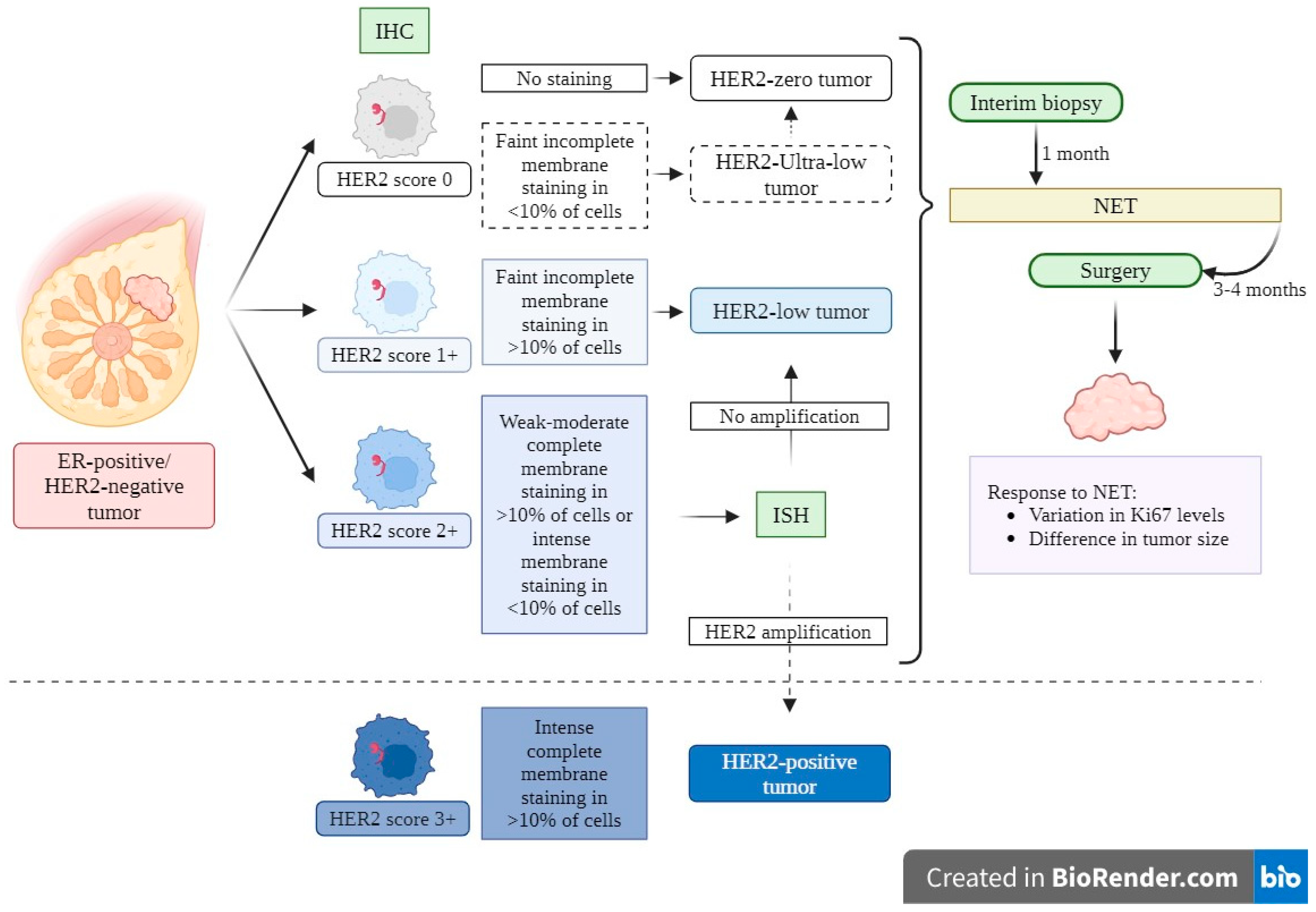
8]. HER2-positivity is defined as IHC 3+ (intense complete membrane staining in >10% of cells) or gene amplification on in situ hybridization (ISH). Tumors with IHC scores of 0 (no staining or faint incomplete membrane staining in <10% of cells), 1+ (faint incomplete membrane staining in >10% of cells), or 2+ (weak-moderate complete membrane staining in >10% of cells or intense membrane staining in <10% of cells), and negative ISH are considered HER2-negative [
6,
7,
9]. Recently, tumors with IHC-score 1+ or 2+ and no ISH amplification have been termed “HER2-low”, while IHC-score 0 tumors are “HER2-zero”; though both currently remain categorized as HER2-negative [
7,
10]. Some authors propose an additional “HER2-ultra-low” category for tumors with minimal staining in <10% of cells [
6] (
Figure 1).
Neoadjuvant treatment (NAT) has gained importance in BC, offering benefits such as tumor downsizing to allow for surgery and enabling breast-conserving procedures [
2,
3,
11]. Based on tumor biology, NAT may include chemotherapy (CT), endocrine therapy (ET), or anti-HER2 agents. It also provides prognostic value by evaluating clinical and histopathological response [
12]. Namely, proliferation marker Ki67 is used to guide NAT and assess prognosis. A Ki67 index ≤ 5% indicates low proliferation (CT not recommended), while ≥30% suggests high proliferation (CT advised), and intermediate values warrant further testing (e.g., gene-expression assays) [
11,
13].
Luminal tumors constitute around three-quarters of BC subtypes [
8]. Among these, about 15% overexpress HER2 (ER-positive/HER2-positive) [
14]. Accordingly, roughly two-thirds of all BC are ER-positive/HER2-negative tumors [
12]. In recent years, neoadjuvant endocrine therapy (NET) has gained significant recognition and is now endorsed by current clinical practice guidelines. Nonetheless, indications for its use remain limited and are restricted to postmenopausal women with low-grade ER+/HER2-negative tumors [
2,
11]. Aromatase inhibitors are preferred, with treatment lasting at least 3–4 months [
2,
11,
12,
15]. NET response can be assessed by tumor size reduction and changes in Ki67 expression [
12,
16]. Notably, Ki67 levels after two weeks of NET better predicted outcomes than baseline values, combining prognostic and treatment-response information [
13,
17]. The Preoperative Endocrine Prognostic Index (PEPI) score uses tumor size, node status, ER status, and Ki67 levels in the surgical specimen to stratify recurrence risk [
12,
18,
19,
20].
Given their ER-positive/HER2-negative classification, luminal HER2-low tumors are currently treated with NET. However, new evidence supports the distinct biological behavior of HER2-low tumors, and trials are exploring and establishing novel therapies for this new emerging subtype. Treatment with anti-HER2 agents is already being administered in the metastatic setting for these tumors [
21]. This study aimed to assess whether low HER2 expression (IHC-score 1+/2+ and negative ISH) impacts the response to NET in luminal BC, compared to HER2-zero tumors (IHC-score 0).
2. Materials and Methods
2.1. Study Design
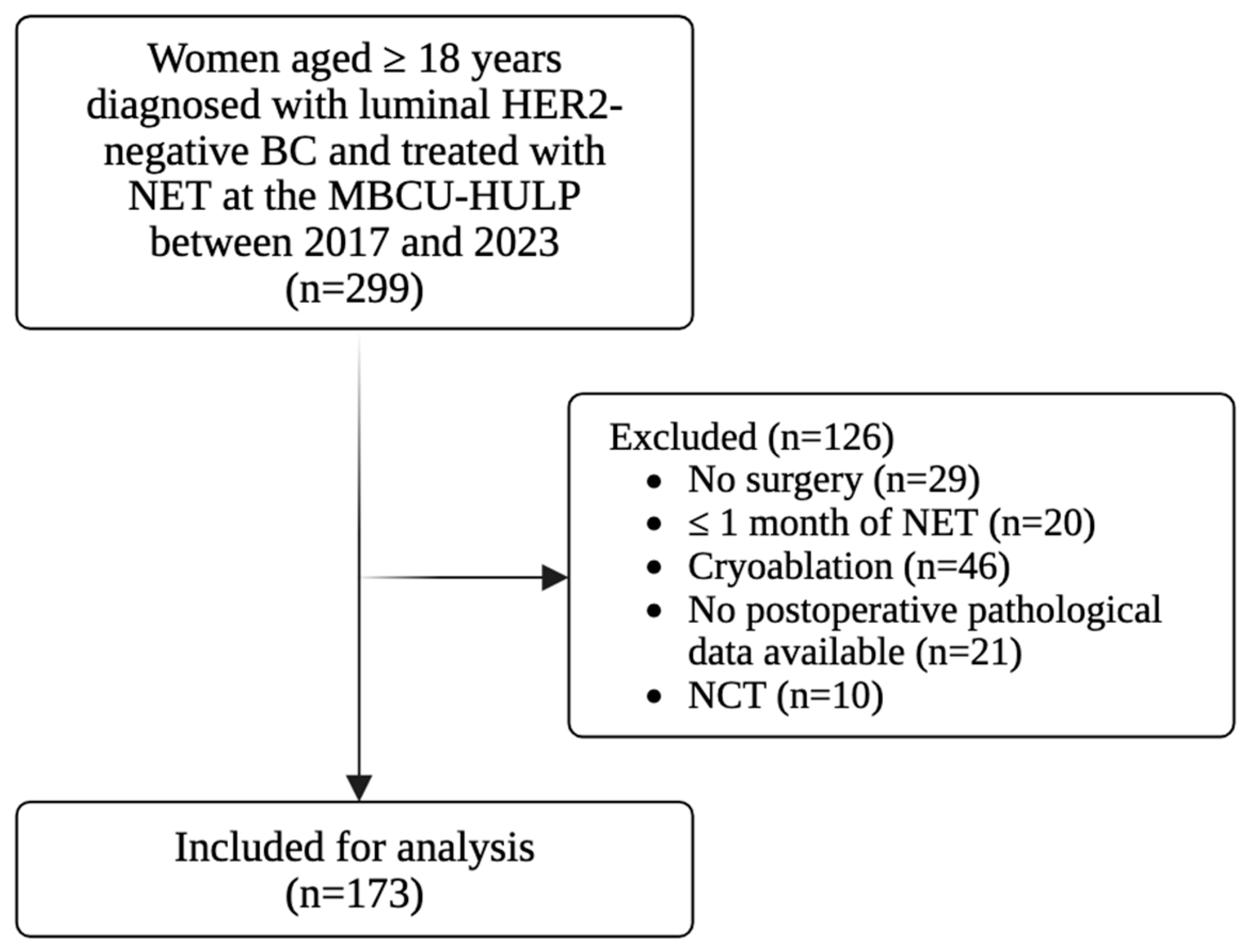
The study is a single-centered, retrospective, and observational investigation. Data were collected from the medical records of patients diagnosed with luminal HER2-negative breast tumors and treated with neoadjuvant hormonal therapy from 2017 to 2023. Inclusion criteria were as follows: (1) women aged 18 years and older; (2) diagnosed with luminal HER2-negative BC and treated with NET, as per evidence-based recommendations; (3) patients treated at the Multidisciplinary Breast Pathology Unit of the HULP between 2017 and 2023. Exclusion criteria included the following: (1) patients who did not undergo surgery, as postoperative pathological data were essential for the study endpoints, and neoadjuvant endocrine therapy inherently implies subsequent surgery; (2) patients who received less than one month of NET, typically due to institutional protocol (small tumor size warranting early surgery), patient preference for prompt operation, or recent enrollment before completing four weeks of therapy; (3) patients who underwent cryoablation procedure instead of surgery; (4) patients who had missing postoperative pathological data available (more than one measured variable); (5) patients who received neoadjuvant chemotherapy (NCT) (
Figure 2).
2.2. Variables
The variables collected in this study included clinical, radiological, histopathological, therapeutic, and outcome-related data. Clinical features at diagnosis comprised the patient’s age (years). Radiological tumor characteristics included tumor size (mm) and clinical nodal status (cN; negative or positive). Histopathological features at diagnosis encompassed histological subtype (IDC, ILC, or other), ER levels (%), PR levels (%), Ki67 index (%), HER2 expression (0, 1+, or 2+), and histological grade (G1, G2, or G3). At interim, core needle biopsy (CNB), ER, PR, and Ki67 levels (%) as well as histological grade were reassessed. Therapeutic variables included duration of NET (months), BCS (yes/no), sentinel lymph node biopsy (SLNB; yes/no), axillary lymph node dissection (ALND; yes/no), CT (yes/no), and radiotherapy (RT; yes/no). Post-resection histopathological parameters included tumor size (mm), ER, PR, and Ki67 levels (%), and histological grade. Axillary involvement was characterized by the number of sentinel lymph nodes removed, the number of positive sentinel nodes, total lymph nodes removed, and total positive lymph nodes. Follow-up data included recurrence (yes/no) and mortality (yes/no).
This study followed the current classification and treatment strategy for ER-positive/HER2-negative tumors [
2,
3,
7,
9] (
Figure 1). The PEPI score was calculated as described by Ellis et al. [
19] (
Table A1).
2.3. Statistical Analysis
The statistical analysis was carried out using the IBM SPSS Statistics 29.0 software. Initially, a preliminary analysis of the variables was conducted. Measures of central tendency and dispersion were determined based on the nature of the distribution of each quantitative variable. The mean and standard deviation (SD) were calculated for variables with homogeneous distribution, whereas the median and interquartile range (IQR) were estimated for those with an asymmetric distribution. Categorical variables were provided using frequencies and percentages.
Further analysis was carried out to establish the association between variables. The chi-square test was used for categorical variables, with Fisher’s exact test correction when needed. Association between qualitative and quantitative variables was measured using either Student’s t-test or ANOVA, depending on the nature of the categorical variable (dichotomous or ordinal, respectively). The Pearson correlation test was applied for quantitative variables. For those that were considered statistically significant, the magnitude of the association was studied using a single linear regression or a multiple linear regression, determined by the number of independent variables that affect the studied variable (one, two, or more, respectively). Progression-free survival (PFS) and overall survival (OS) were analyzed using Kaplan–Meier analysis and log-rank test. Additionally, Cox regression analysis was also conducted for statistically significant variables.
Statistical associations with a p-value < 0.05 were considered significant in the statistical analysis.
4. Discussion
In recent years, concerns have been raised regarding tumors that express low levels of HER2 and are currently classified as HER2-negative, leading to a significant shift away from the traditional HER2-positive versus HER2-negative stratification. Nevertheless, HER2 testing is highly variable, despite the College of American Pathologists (CAP) guidelines [
9]. A few studies have found that HER2 expression fluctuates substantially over time, with HER2-zero tumors converting to HER2-low tumors (15–44%) and vice versa (14–22%) [
22,
23]. Miglietta et al. [
22] noted that HER2 discordance between baseline and relapse samples was increased in ER-positive/HER2-negative tumors when compared to ER-negative/HER2-negative tumors. However, whether this oscillation is due to an actual change in tumor HER2 expression or to acknowledged observer- and methodology-dependent differences remains unknown. Moreover, studies have revealed that HER2-low 1+ and HER2-zero are frequently misdiagnosed, as evidenced by the low agreement between pathologists [
24]. This hints at the need for HER2-testing standardization to ensure reliable results and coherent treatment decisions.
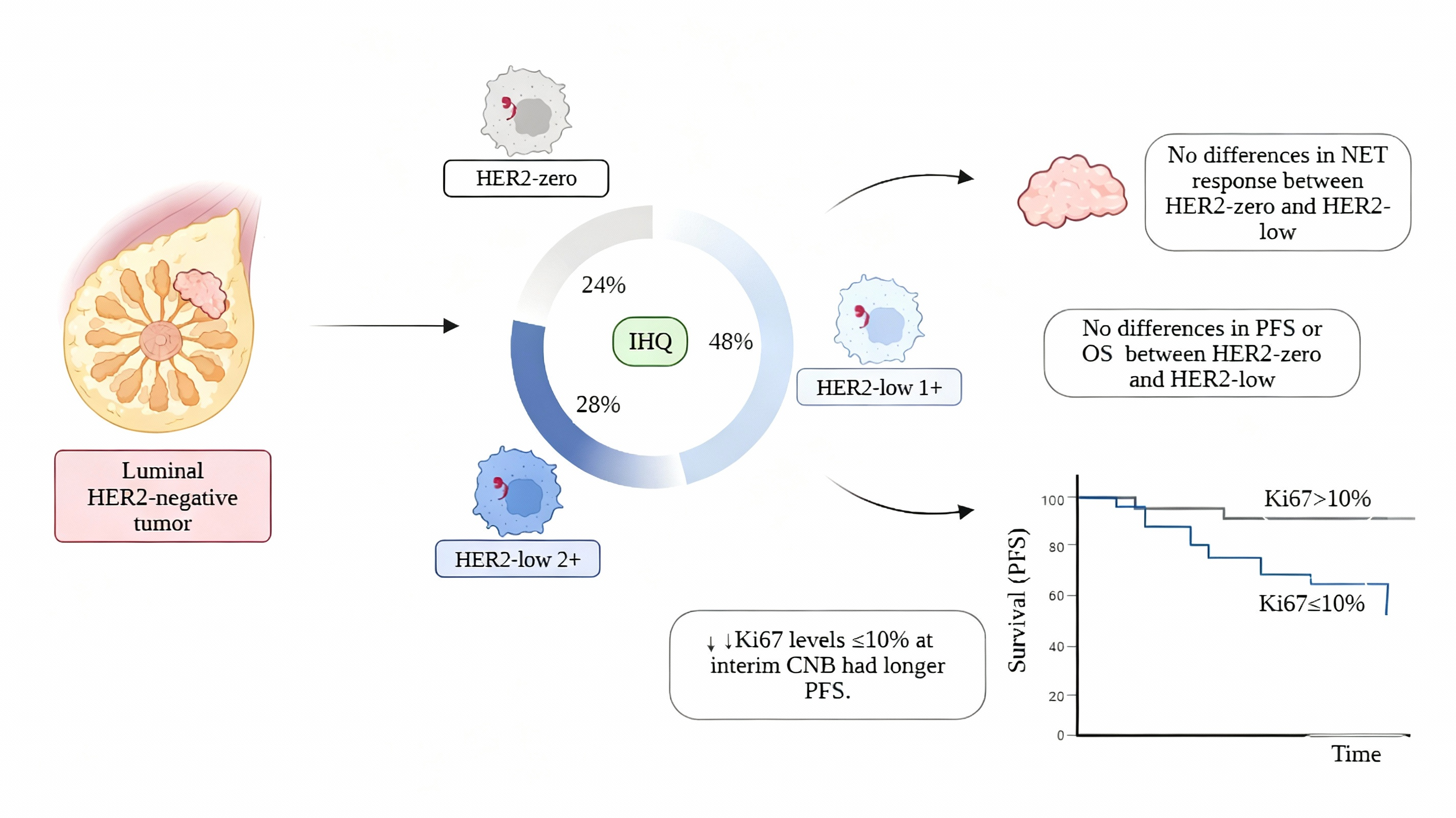
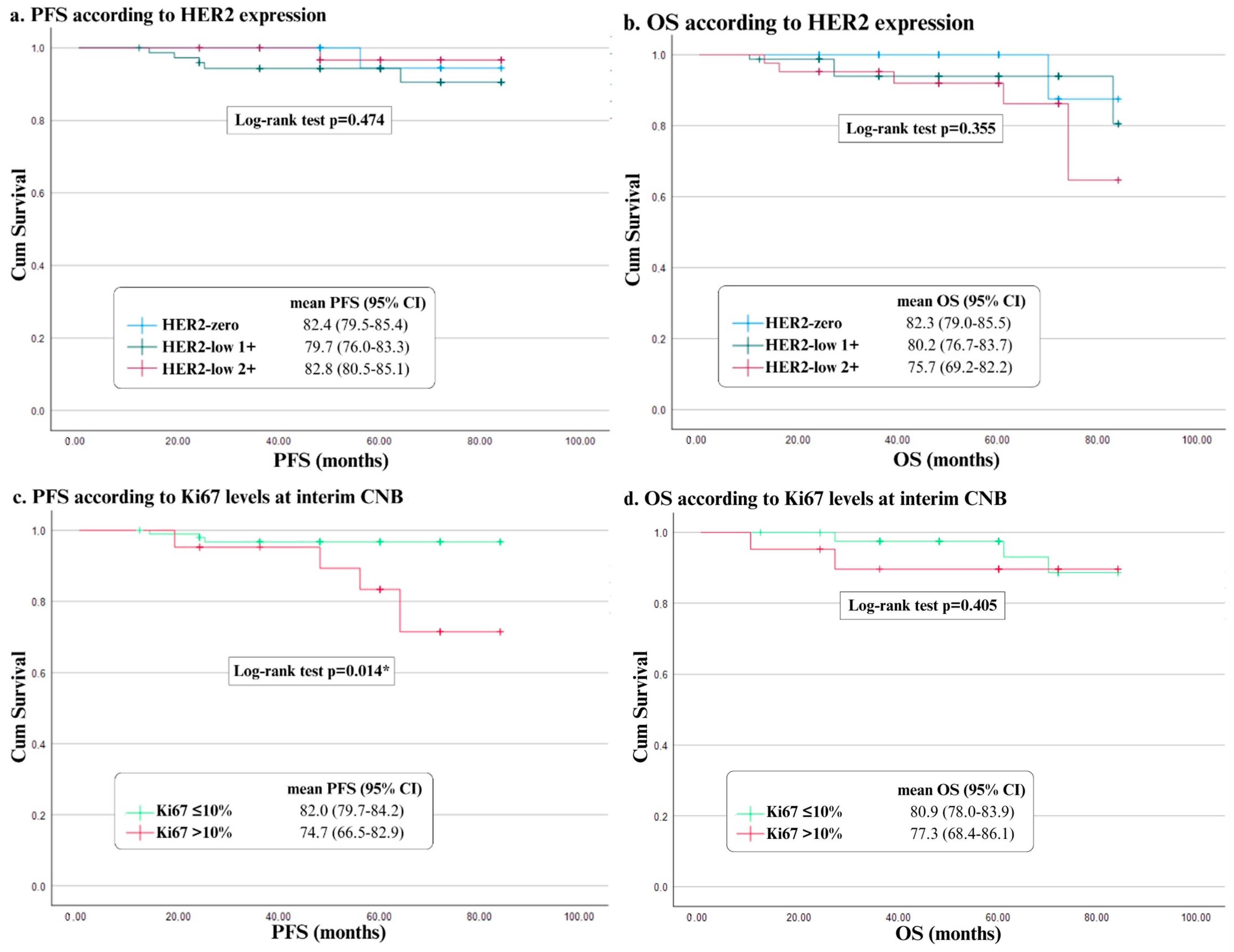
In this study, when evaluating clinical and histopathological features of the tumor and comparing HER2-zero, HER2-low 1+, and HER2-low 2+ tumors, no significant differences were observed. There were also no differences in NET response when comparing the three groups. In line with these findings, Wei et al. [
24] found no significant differences between HER2-zero and the HER2-low groups in terms of clinical and histopathological characteristics of the tumors. In contrast, some authors have found that HER2-low tumors (including 1+ and 2+) were associated with increased Ki67 values (90.8% versus 62.7%,
p < 0.001), axillary node positivity (66.5% versus 50.2%,
p < 0.05), and a lower pathological complete response (pCR) (17.5% versus 23.6%,
p < 0.05) when compared to HER2-zero tumors [
14,
25]. Follow-up survival data in this study found no significant differences between the HER2-zero, the HER2-low 1+, and the HER2-low 2+ groups in terms of PFS or OS. In accordance with the mentioned results, similar PFS and OS were observed for the HER2-zero and the HER2-low groups [
24]. Gamrani et al. [
14] found that HER2-low had shorter PFS than HER2-zero tumors (66% versus 80%,
p < 0.001). In contrast, Denkert et al. [
25] revealed that patients with HER2-low tumors remained disease-free for longer than HER2-zero patients (83.4% vs. 76.1%,
p < 0.05). Both studies revealed no significant differences between groups in terms of OS [
14,
25]. A meta-analysis study displayed that HER2-low tumors had longer PFS and OS than the HER2-zero group [
26]. These scattered results involving HER2-zero and HER2-low tumors could be explained by HER2 inter-observer and inter-institution testing. More studies with HER2-standardized testing and larger cohorts should be conducted in order to reach reliable conclusions.
The HER2 protein is an important therapeutic target in BC treatment [
6,
8], and anti-HER2-directed therapy comprises one of the four main pillars of pharmacological BC treatment, alongside endocrine therapy, chemotherapy, and immunotherapy. At present, patients with HER2-enriched tumors (ER-positive/HER2-positive or ER-negative/HER2-positive) are treated with anti-HER2 targeted therapies, such as trastuzumab or pertuzumab, that are often administered in combination with CT [
8]. However, tumors classified as HER2-negative in the early-stage setting are treated with either endocrine therapy or CT alone according to the presence or absence of hormone receptors, respectively, but not anti-HER2-directed therapies [
2,
11]. It is therefore reasonable to suppose that low levels of HER2 expression could be used as a target, even if not the main one. Recently developed antibody–drug conjugates (ADCs) have proved to be a useful tool in the treatment of HER2-low tumors. Trastuzumab-Deruxtecan (T-DXd) is a humanized HER2 monoclonal antibody bound to a topoisomerase I inhibitor, an ensemble that allows for the chemotherapeutic agent to reach specific HER2-enriched cells. It also has an off-target effect that enhances efficacy by attacking neighboring tumor cells. The DESTINY-Breast04 trial revealed longer PFS for the T-DXd ER-positive/HER2-low group (10.1 months) than for the physician’s choice of therapy (5.4 months), as well as greater OS (23.9 months vs. 17.5 months, respectively), in the metastatic setting [
21]. There are other ongoing clinical trials researching different treatment options for HER2-low BC, such as other monoclonal antibodies, ADCs, tumor vaccines, bi/tri-specific antibodies, and tyrosine kinase inhibitors [
6].
On a related note, NET is a very attractive treatment alternative for postmenopausal women with low-grade luminal HER2-negative tumors [
2]. Unfortunately, no definitive endpoints have been approved for NET response [
12]. The most commonly used biomarker is Ki67 levels at interim biopsy (2–4 weeks after initiating NET), where a decrease in Ki67 levels below 10% is regarded as an appropriate response to endocrine therapy [
17]. The PEPI score and tumor size are also employed to establish prognosis for luminal tumors after NET [
12,
19,
20]. In accordance with this data, the differences in Ki67 expression between diagnosis, interim CNB, and surgical specimen, as well as tumor size variation, were all found to be statistically significant in this study. These findings suggest that these parameters serve as valid endpoints for assessing NET response. In search for other biomarkers that could be useful to determine NET response, residual cancer burden, and pCR are frequently used endpoints for NCT, although luminal tumors have shown low pCR rates for both NCT (when compared to ER-negative tumors) and NET [
12,
20]. Further studies are needed to determine additional specific biomarkers to aid in predicting NET response and prognosis.
In this study, significant differences were found across the four studied variables for NET response and different clinical and histopathological tumor features. Higher ER levels at diagnosis were linked to a greater difference in Ki67 levels between diagnosis, interim CNB, and surgical specimen. In line with these results, lower ER levels were associated with a higher PEPI score. A higher histological grade at diagnosis was linked to increased variation in Ki67 levels between diagnosis and surgical specimen. High Ki67 levels at interim CNB were linked to a higher PEPI score. A clinically positive axilla was also linked to a higher PEPI score, although this could be attributed both to the low rates of axillary downstaging typically associated with neoadjuvant therapy and to the substantial weight that nodal involvement carries in the PEPI scoring system. These results are all in accordance with previously known features that contribute to NET response [
16,
19,
27]. Longer NET duration was also associated with greater variation in tumor size, suggesting that prolonging this therapy may achieve better results [
16]. When evaluating Ki67 levels at interim CNB, the group with Ki67 levels that dropped to ≤10% had a significantly longer PFS than the group whose levels did not decrease to said mark. PFS was also associated with a wider variation in Ki67 levels between diagnosis, interim CNB, and surgical specimen, and a lower PEPI score. These findings remain in line with conclusions from other studies [
17,
19]. No significant differences were found when evaluating overall survival, which could be explained by the short follow-up duration of the study. To confirm this, another study should be conducted with a longer tracking period.
To our knowledge, this is the first study to analyze NET response according to HER2 expression. Given that low levels of HER2 expression do not seem to meaningfully affect the response to NET in ER-positive/HER2-negative BC when compared to HER2-zero tumors, our findings do not support a change in the current clinical practice for patients with HER2-low tumors (be it 1+ or 2+) in the NET setting. These results raise the question of whether higher levels of HER2 expression may similarly have a limited impact on NET response in ER-positive/HER2-positive tumors. However, the relationship between HER2 expression and NET response remains unclear. Many authors have discussed an existing bidirectional crosstalk between the ER and HER2 intracellular signaling pathways. HER2 overexpression leads to inhibition of ER expression and cell proliferation. On the other hand, ER activation results in an upregulation of HER2 expression, both through genomic and non-genomic pathways [
28,
29]. Congruent with these findings, HER2-low tumors are consistently more frequent in luminal tumors than ER-negative tumors [
22,
23]. This crosstalk could further explain HER2 variation over time. Moreover, resistance to endocrine therapy has also been considered as a consequence of the overlap between these signaling pathways for HER2-positive and HER2-low tumors [
8,
10,
28]. Some authors have suggested that targeting HER2 may induce a compensatory increase in ER signaling, potentially promoting tumor proliferation and treatment resistance [
29]. Building upon this idea, Park et al. [
30] combined NET and neoadjuvant anti-HER2 targeted therapy in luminal HER2-positive breast cancer, with controversial results. Further studies with larger cohorts should be conducted to establish whether this could be a form of treatment for patients with luminal BC that overexpress HER2 protein to any extent, including HER2-low and HER2-positive tumors.
This real-world, single-centered study ensured sample homogeneity, enhancing the reliability of comparisons and minimizing confounding. However, limitations include its retrospective design, small sample size, and short follow-up, which warrant cautious interpretation—particularly of PFS and OS outcomes. Additionally, complete staging data (ypT and ypN) were not available for all 173 patients, as some final surgical pathology reports did not specify tumor size or the exact number of affected lymph nodes. This missing data may slightly limit the granularity of our outcome analysis.
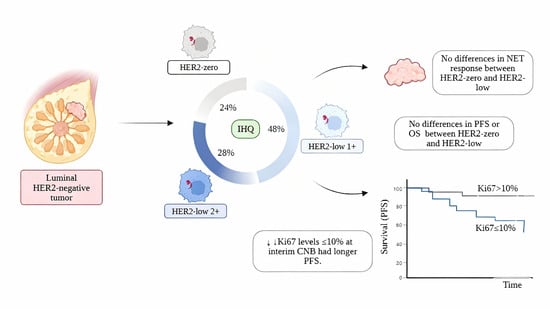
Our findings suggest that low HER2 expression does not significantly influence response to neoadjuvant endocrine therapy (NET) in luminal tumors compared to HER2-zero cases, nor does it impact other clinical or histopathological features. Instead, NET response may be influenced by factors such as ER levels, histological subtype and grade, and early Ki67 changes. A decrease in Ki67 after short-term NET may be associated with longer PFS. Larger prospective studies with extended follow-up are needed to validate these findings and better understand predictors of response.



 ,
,