Transitioning from Cytology to HPV Test-Based Primary Cervical Screening in Canada: A Population-Based Survey of Women’s Screening and Information Preferences

 , , , ,
  , and
, and
Simple Summary
Abstract
1. Introduction
2. Materials and Methods
2.1. Study Design and Participants
2.2. Measures
2.3. Statistical Analyses
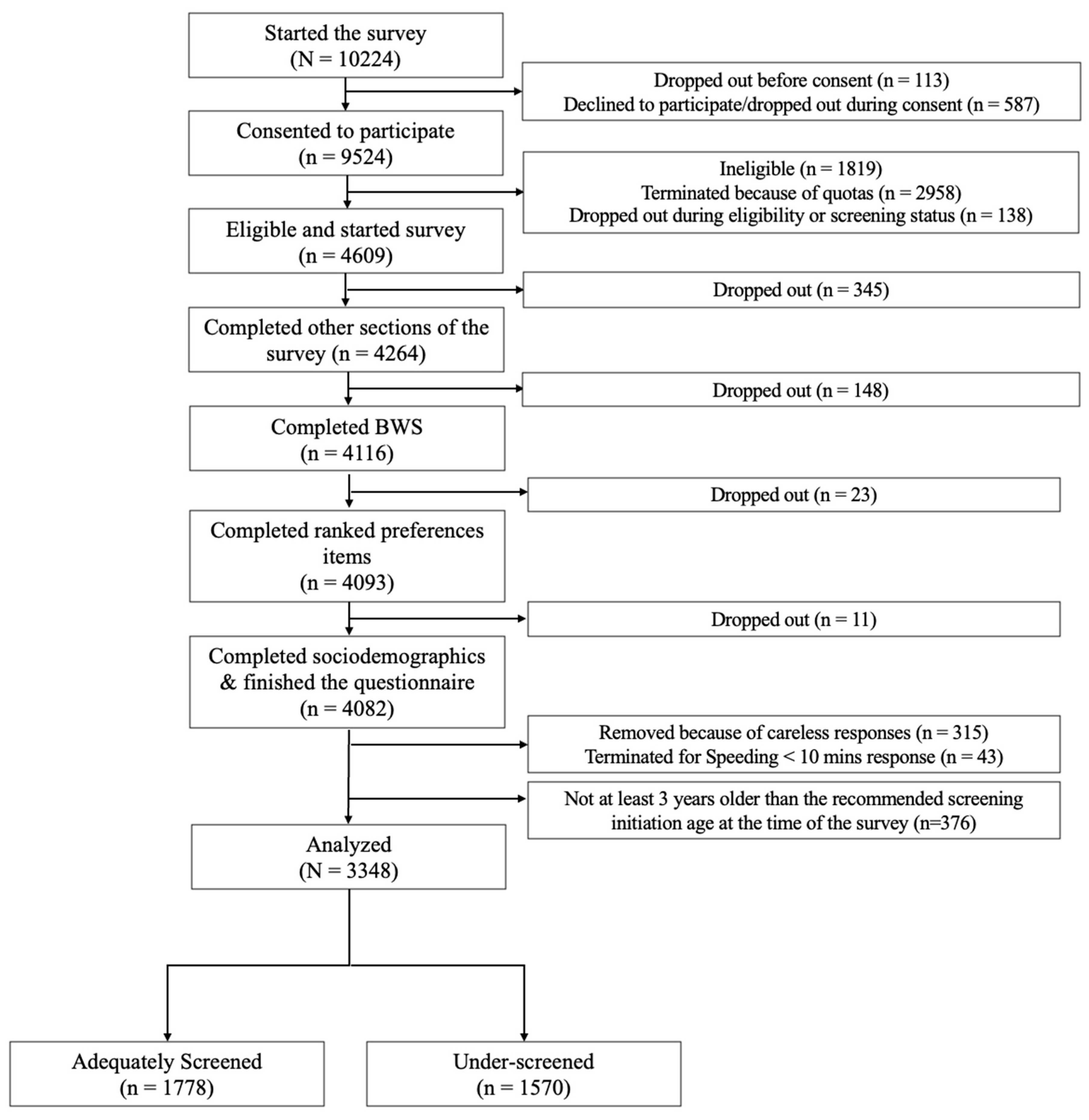
3. Results
3.1. Main Analyses
3.1.1. Preferences for Cervical Screening Intervals
3.1.2. Preferences for Age of Screening Initiation
3.1.3. Information, Sample Collection, and Communication Preferences
3.2. Additional Analyses
4. Discussion
4.1. Preferences for Screening Modality, Interval, and Initiation Age
4.2. Preferences for Information Sources, Providers, and Communication Methods
4.3. Strengths and Limitations
5. Conclusions
Author Contributions
Funding
Institutional Review Board Statement
Informed Consent Statement
Data Availability Statement
Acknowledgments
Conflicts of Interest
Abbreviations
| BC | British Columbia |
| BWS | Best–Worst Scaling |
| BWs | Best-Minus-Worst Score |
| CAD | Canadian Dollar |
| CI | Confidence Intervals |
| CPAC | Canadian Partnership Against Cancer |
| HCP | Healthcare Professional |
| HPV | Human Papillomavirus |
| PEI | Prince Edward Island |
| NWT | Northwest Territories |
| OR | Odds Ratios |
| stdBWs | Standardized Best-Minus-Worst Score |
| w | Worth |
Appendix A
| Item No | Recommendation | Page No | |
|---|---|---|---|
| Title and abstract | 1 | (a) Indicate the study’s design with a commonly used term in the title or the abstract | 1 |
| (b) Provide in the abstract an informative and balanced summary of what was done and what was found | 1–2 | ||
| Introduction | |||
| Background/rationale | 2 | Explain the scientific background and rationale for the investigation being reported | 2–4 |
| Objectives | 3 | State specific objectives, including any prespecified hypotheses | 4 |
| Methods | |||
| Study design | 4 | Present key elements of study design early in the paper | 4–5 |
| Setting | 5 | Describe the setting, locations, and relevant dates, including periods of recruitment, exposure, follow-up, and data collection | 4–5 |
| Participants | 6 | (a) Give the eligibility criteria, and the sources and methods of selection of participants | 4–5 |
| Variables | 7 | Clearly define all outcomes, exposures, predictors, potential confounders, and effect modifiers. Give diagnostic criteria, if applicable | 5–6 |
| Data sources/measurement | 8 * | For each variable of interest, give sources of data and details of methods of assessment (measurement). Describe comparability of assessment methods if there is more than one group | 5–6 |
| Bias | 9 | Describe any efforts to address potential sources of bias | 5 |
| Study size | 10 | Explain how the study size was arrived at | 5 |
| Quantitative variables | 11 | Explain how quantitative variables were handled in the analyses. If applicable, describe which groupings were chosen and why | 6 |
| Statistical methods | 12 | (a) Describe all statistical methods, including those used to control for confounding | 6–7 |
| (b) Describe any methods used to examine subgroups and interactions | 6–7 | ||
| (c) Explain how missing data were addressed | 5 | ||
| (d) If applicable, describe analytical methods taking account of sampling strategy | N/A | ||
| (e) Describe any sensitivity analyses | N/A | ||
| Results | |||
| Participants | 13 * | (a) Report numbers of individuals at each stage of study—e.g., numbers potentially eligible, examined for eligibility, confirmed eligible, included in the study, completing follow-up, and analyzed | 7 |
| (b) Give reasons for non-participation at each stage | 7 | ||
| (c) Consider use of a flow diagram | 7 | ||
| Descriptive data | 14 * | (a) Give characteristics of study participants (e.g., demographic, clinical, social) and information on exposures and potential confounders | 7–8 |
| (b) Indicate number of participants with missing data for each variable of interest | 7 | ||
| Outcome data | 15 * | Report numbers of outcome events or summary measures | 8–12 |
| Main results | 16 | (a) Give unadjusted estimates and, if applicable, confounder-adjusted estimates and their precision (e.g., 95% confidence interval). Make clear which confounders were adjusted for and why they were included | N/A |
| (b) Report category boundaries when continuous variables were categorized | N/A | ||
| (c) If relevant, consider translating estimates of relative risk into absolute risk for a meaningful time period | N/A | ||
| Other analyses | 17 | Report other analyses conducted—e.g., analyses of subgroups and interactions, and sensitivity analyses | 12–13 |
| Discussion | |||
| Key results | 18 | Summarize key results with reference to study objectives | 13 |
| Limitations | 19 | Discuss limitations of the study, taking into account sources of potential bias or imprecision. Discuss both direction and magnitude of any potential bias | 14–15 |
| Interpretation | 20 | Give a cautious overall interpretation of results considering objectives, limitations, multiplicity of analyses, results from similar studies, and other relevant evidence | 13–15 |
| Generalizability | 21 | Discuss the generalizability (external validity) of the study results | 14 |
| Other information | |||
| Funding | 22 | Give the source of funding and the role of the funders for the present study and, if applicable, for the original study on which the present article is based | 15 |
| * Give information separately for exposed and unexposed groups. | |||
Appendix B

| Item | Primary Language | Age | Ethnicity | |||||||||||
|---|---|---|---|---|---|---|---|---|---|---|---|---|---|---|
| EN (n = 2570) | FR (n = 631) | Other (n = 147) | ≤30 (n = 408) | 31–60 (n = 2161) | ≥61 (n = 779) | North American Indigenous (n = 96) | North American Other (n = 1526) | European (n = 1029) | Asian (n = 446) | Other (n = 251) | ||||
| Attributes | ||||||||||||||
| Pap test | Ref | |||||||||||||
| HPV test | 1.30 | 1.30 | 1.19 ** | 1.15 | 1.30 | 1.37 | 1.34 | 1.29 | 1.34 | 1.27 | 1.17 ** | |||
| Pap and HPV test | 2.04 | 1.68 | 1.80 | 1.68 | 2.06 | 1.85 | 2.28 | 1.96 | 2.04 | 1.86 | 1.68 | |||
| Self-sampling | 1.45 | 1.50 | 1.13 * | 1.34 | 1.47 | 1.41 | 1.81 | 1.43 | 1.61 | 1.31 | 1.03 + | |||
| Attribute levels for Pap test | ||||||||||||||
| Every 3 years | 1.85 | 1.93 | 2.24 | 1.61 | 1.90 | 2.00 | 1.64 | 1.96 | 1.77 | 1.68 | 2.55 | |||
| Every 5 years | Ref | |||||||||||||
| Every 10 years | 0.46 | 0.43 | 0.40 | 0.55 | 0.45 | 0.42 | 0.54 | 0.43 | 0.47 | 0.53 | 0.36 | |||
| Attribute levels for HPV test | ||||||||||||||
| Every 3 years | 1.79 | 1.81 | 1.88 | 1.43 | 1.84 | 1.89 | 1.78 | 1.81 | 1.78 | 1.66 | 2.10 | |||
| Every 5 years | Ref | |||||||||||||
| Every 10 years | 0.50 | 0.48 | 0.45 | 0.61 | 0.49 | 0.45 | 0.54 | 0.48 | 0.49 | 0.56 | 0.42 | |||
| Attribute levels for Pap and HPV test (co-test) | ||||||||||||||
| Every 3 years | 2.46 | 2.34 | 3.29 | 1.80 | 2.53 | 2.73 | 2.12 | 2.53 | 2.33 | 2.27 | 3.31 | |||
| Every 5 years | Ref | |||||||||||||
| Every 10 years | 0.32 | 0.34 | 0.23 | 0.40 | 0.32 | 0.28 | 0.38 | 0.30 | 0.32 | 0.37 | 0.28 | |||
| Attribute levels for self-sampling | ||||||||||||||
| Every 3 years | 2.00 | 2.00 | 2.38 | 1.77 | 2.01 | 2.16 | 1.71 | 2.08 | 1.97 | 1.83 | 2.29 | |||
| Every 5 years | Ref | |||||||||||||
| Every 10 years | 0.39 | 0.37 | 0.33 | 0.46 | 0.38 | 0.35 | 0.49 | 0.37 | 0.39 | 0.45 | 0.33 | |||
| Item | Living in Canada >10 years | Gender Identity | Income | |||||||||||
| Yes (n = 3135) | No (n = 213) | Woman (n = 3315) | Gender diverse (n = 33) | CAD ≤39,999 (n = 836) | CAD 40,000–79,999 (n = 1119) | CAD ≥80,000 (n = 1393) | ||||||||
| Attributes | ||||||||||||||
| Pap test | Ref | |||||||||||||
| HPV test | 1.30 | 1.24 | 1.29 | 1.32 * | 1.28 | 1.23 | 1.36 | |||||||
| Pap and HPV test | 1.96 | 1.90 | 1.95 | 2.23 | 1.80 | 1.90 | 2.11 | |||||||
| Self-sampling | 1.46 | 1.15 ** | 1.44 | 1.55 | 1.34 | 1.44 | 1.51 | |||||||
| Attribute levels for Pap test | ||||||||||||||
| Every 3 years | 1.86 | 2.16 | 1.89 | 1.50 ** | 1.68 | 1.87 | 2.04 | |||||||
| Every 5 years | Ref | |||||||||||||
| Every 10 years | 0.46 | 0.40 | 0.45 | 0.54 | 0.51 | 0.46 | 0.42 | |||||||
| Attribute levels for HPV test | ||||||||||||||
| Every 3 years | 1.78 | 2.11 | 1.80 | 1.48 ** | 1.65 | 1.77 | 1.91 | |||||||
| Every 5 years | Ref | |||||||||||||
| Every 10 years | 0.50 | 0.44 | 0.49 | 0.61 | 0.54 | 0.50 | 0.46 | |||||||
| Attribute levels for Pap and HPV test (co-test) | ||||||||||||||
| Every 3 years | 2.43 | 3.01 | 2.47 | 1.84 | 2.20 | 2.39 | 2.72 | |||||||
| Every 5 years | Ref | |||||||||||||
| Every 10 years | 0.32 | 0.27 | 0.32 | 0.47 | 0.37 | 0.31 | 0.30 | |||||||
| Attribute levels for self-sampling | ||||||||||||||
| Every 3 years | 1.98 | 2.46 | 2.02 | 1.58 ** | 1.87 | 1.96 | 2.15 | |||||||
| Every 5 years | Ref | |||||||||||||
| Every 10 years | 0.39 | 0.34 | 0.38 | 0.56 | 0.43 | 0.39 | 0.35 | |||||||
Appendix C
| Item | Primary Language | Age | Ethnicity | |||||||||||
|---|---|---|---|---|---|---|---|---|---|---|---|---|---|---|
| EN (n = 2570) | FR (n = 631) | Other (n = 147) | ≤30 (n = 408) | 31–60 (n = 2161) | ≥61 (n = 779) | North American Indigenous (n = 96) | North American-Other (n = 1526) | European (n = 1029) | Asian (n = 446) | Other (n = 251) | ||||
| Attributes | ||||||||||||||
| Pap test | Ref | |||||||||||||
| HPV test | 1.33 | 1.34 | 1.16 ** | 1.12 ** | 1.34 | 1.39 | 1.17 * | 1.35 | 1.40 | 1.22 | 1.09 + | |||
| Pap and HPV test | 2.24 | 1.93 | 2.00 | 1.68 | 2.29 | 2.11 | 2.06 | 2.26 | 2.28 | 1.85 | 1.91 | |||
| Self-sampling | 1.41 | 1.49 | 0.99 + | 1.19 | 1.45 | 1.40 | 1.60 | 1.44 | 1.59 | 1.18 | 0.94+ | |||
| Attribute levels for Pap test | ||||||||||||||
| 21 years | 1.73 | 1.57 | 1.51 | 1.53 | 1.71 | 1.73 | 1.59 | 1.79 | 1.79 | 1.25 | 1.74 | |||
| 25 years | Ref | |||||||||||||
| 30 years | 0.52 | 0.59 | 0.58 | 0.58 | 0.53 | 0.52 | 0.58 | 0.51 | 0.50 | 0.69 | 0.54 | |||
| Attribute levels for HPV test | ||||||||||||||
| 21 years | 1.73 | 1.61 | 1.47 | 1.44 | 1.71 | 1.81 | 1.49 | 1.80 | 1.78 | 1.26 | 1.77 | |||
| 25 years | 1.09 | 1.07 * | 1.06 + | 1.14 ** | 1.08 | 1.06 + | 1.07 + | 1.07 ** | 1.10 | 1.13 ** | 1.02 + | |||
| 30 years | Ref | |||||||||||||
| Attribute levels for Pap and HPV test (co-test) | ||||||||||||||
| 21 years | 2.12 | 1.86 | 2.15 | 1.74 | 2.07 | 2.25 | 1.75 | 2.24 | 2.15 | 1.44 | 2.33 | |||
| 25 years | 1.16 | 1.11 ** | 1.21 ** | 1.28 | 1.14 | 1.14 | 1.13 + | 1.11 | 1.21 | 1.19 | 1.11 * | |||
| 30 years | Ref | |||||||||||||
| Attribute levels for self-sampling | ||||||||||||||
| 21 years | 1.65 | 1.56 | 1.33 | 1.42 | 1.63 | 1.70 | 1.38 | 1.73 | 1.70 | 1.18 | 1.74 | |||
| 25 years | 1.24 | 1.19 | 1.39 | 1.29 | 1.22 | 1.26 | 1.11 + | 1.22 | 1.26 | 1.25 | 1.27 | |||
| 30 years | Ref | |||||||||||||
| Item | Living in Canada >10 Years | Gender Identity | Income | |||||||||||
| Yes (n = 3135) | No (n = 213) | Woman (n = 3315) | Gender diverse (n = 33) | CAD ≤39,999 (n = 836) | CAD 40,000–79,999 (n = 1119) | CAD ≥80,000 (n = 1393) | ||||||||
| Attributes | ||||||||||||||
| Pap test | Ref | |||||||||||||
| HPV test | 1.33 | 1.21 | 1.32 | 1.41 ** | 1.31 | 1.27 | 1.37 | |||||||
| Pap and HPV test | 2.17 | 2.09 | 2.16 | 1.94 | 2.04 | 2.07 | 2.32 | |||||||
| Self-sampling | 1.43 | 1.07 + | 1.40 | 1.56 | 1.30 | 1.41 | 1.46 | |||||||
| Attribute levels for Pap test | ||||||||||||||
| 21 years | 1.70 | 1.55 | 1.69 | 1.24 + | 1.52 | 1.66 | 1.84 | |||||||
| 25 years | Ref | |||||||||||||
| 30 years | 0.53 | 0.55 | 0.53 | 0.60 | 0.61 | 0.55 | 0.48 | |||||||
| Attribute levels for HPV test | ||||||||||||||
| 21 years | 1.71 | 1.50 | 1.70 | 1.39 * | 1.55 | 1.71 | 1.77 | |||||||
| 25 years | 1.09 | 1.06 + | 1.08 | 1.10 + | 1.07 * | 1.08 ** | 1.10 | |||||||
| 30 years | Ref | |||||||||||||
| Attribute levels for Pap and HPV test (co-test) | ||||||||||||||
| 21 years | 2.07 | 1.97 | 2.08 | 1.31 + | 1.91 | 2.01 | 2.22 | |||||||
| 25 years | 1.16 | 1.12 * | 1.15 | 1.23 + | 1.10 ** | 1.18 | 1.17 | |||||||
| 30 years | Ref | |||||||||||||
| Attribute levels for self-sampling | ||||||||||||||
| 21 years | 1.64 | 1.37 | 1.62 | 1.44 ** | 1.46 | 1.61 | 1.73 | |||||||
| 25 years | 1.23 | 1.26 | 1.23 | 1.18 + | 1.17 | 1.23 | 1.28 | |||||||
| 30 years | Ref | |||||||||||||
Appendix D
| Item | Primary Language | Age | Ethnicity | ||||||||||||||||
|---|---|---|---|---|---|---|---|---|---|---|---|---|---|---|---|---|---|---|---|
| EN | FR | Other | ≤30 | 31–60 | ≥61 | North American Indigenous | North American-Other | European | Asian | Other | |||||||||
| (Q1) prefer to receive information about cervical cancer and screening from | |||||||||||||||||||
| International public health agency | 0.96 § | 1.99 | 1.18 § | 1.25 | 1.07 ** | 0.98 § | 0.95 § | 1.18 | 0.91 ** | 1.16 ** | 1.10 § | ||||||||
| National public health agency | 1.97 | 0.14 | 1.74 | 1.35 | 1.22 | 1.04 § | 1.43 ** | 0.80 | 1.75 | 2.09 | 1.23 ** | ||||||||
| Provincial public health agency | 2.60 | 5.29 | 2.45 | 2.13 | 2.51 | 3.02 | 2.01 | 2.66 | 2.80 | 2.38 | 2.47 | ||||||||
| Charities and non-profit organizations | 0.51 | 0.85 | 0.50 | 0.57 | 0.61 | 0.68 | 0.57 | 0.71 | 0.55 | 0.47 | 0.57 | ||||||||
| Social media | 0.13 | 1.31 | 0.20 | 0.27 | 0.24 | 0.22 | 0.26 | 0.35 | 0.14 | 0.17 | 0.26 | ||||||||
| A healthcare professional | 3.19 | 0.63 | 1.96 | 1.81 | 2.04 | 2.18 | 2.48 | 1.61 | 2.93 | 2.20 | 2.01 | ||||||||
| (Q2) prefer to get the HPV test for my routine screening to prevent cervical cancer from | |||||||||||||||||||
| Family physician | 2.15 | 2.30 | 1.82 | 1.67 | 2.18 | 2.43 § | 2.04 | 2.34 | 2.05 | 2.19 | 1.71 | ||||||||
| Gynaecologist | 2.13 | 2.12 | 3.85 | 3.06 | 2.30 | 1.63 § | 1.99 | 1.99 | 2.00 | 3.06 | 3.58 | ||||||||
| Nurse or nurse practitioner | 0.82 | 0.82 | 0.52 | 0.70 | 0.81 | 0.84 | 0.81 § | 0.85 | 0.87 | 0.60 | 0.63 | ||||||||
| Physician’s assistant | 0.27 | 0.25 | 0.28 | 0.28 | 0.25 | 0.30 | 0.30 | 0.25 | 0.28 | 0.25 | 0.26 | ||||||||
| (Q3) prefer to receive the invitation to my routine screening to prevent cervical cancer by | |||||||||||||||||||
| Postal mail | 1.49 | 1.43 | 1.03 § | 0.91 § | 1.36 | 2.55 | 1.18 § | 1.59 | 1.66 | 1.15 ** | 0.90 § | ||||||||
| 2.79 | 2.42 | 3.29 | 3.12 | 2.73 | 2.61 | 2.18 | 2.51 | 2.88 | 3.34 | 3.01 | |||||||||
| Text message | 0.88 | 0.66 | 1.08 § | 1.21 | 0.90 | 0.55 | 0.89 § | 0.78 | 0.81 | 0.98 § | 1.07 § | ||||||||
| Phone call | 0.70 | 1.01 | 0.60 | 0.63 | 0.72 | 0.82 | 0.95 § | 0.82 | 0.66 | 0.62 | 0.82 ** | ||||||||
| Online portal | 0.39 | 0.44 | 0.45 | 0.46 | 0.41 | 0.33 | 0.46 | 0.40 | 0.39 | 0.43 | 0.42 | ||||||||
| (Q4) prefer to receive reminders about my routine screening to prevent cervical cancer by | |||||||||||||||||||
| Postal mail | 1.26 | 1.33 | 0.81 * | 0.81 | 1.18 | 2.01 | 1.10 § | 1.38 | 1.35 | 1.01 § | 0.82 ** | ||||||||
| 2.79 | 2.47 | 3.35 | 2.92 | 2.74 | 2.69 | 2.13 | 2.52 | 3.00 | 3.06 | 3.00 | |||||||||
| Text message | 1.04 § | 0.71 | 1.37 | 1.57 | 1.05 * | 0.64 | 1.00 § | 0.90 | 0.95 § | 1.25 | 1.17 * | ||||||||
| Phone call | 0.72 | 1.01 § | 0.64 | 0.64 | 0.75 | 0.87 | 0.95 § | 0.84 | 0.68 | 0.63 | 0.86 * | ||||||||
| Online portal | 0.38 | 0.42 | 0.42 | 0.42 | 0.40 | 0.33 | 0.45 | 0.38 | 0.38 | 0.41 | 0.41 | ||||||||
| (Q5) prefer to receive the results of the HPV test by | |||||||||||||||||||
| Postal mail | 1.18 | 1.26 | 0.99 § | 0.85 ** | 1.11 | 1.85 | 1.09 § | 1.22 | 1.27 | 1.07 § | 0.92 § | ||||||||
| 2.37 | 2.11 | 3.66 | 2.63 | 2.41 | 2.12 | 1.96 | 2.13 | 2.42 | 3.16 | 2.77 | |||||||||
| Text message | 0.76 | 0.58 | 0.92 § | 0.98 § | 0.76 | 0.56 | 0.83 § | 0.69 | 0.68 | 0.88 * | 0.88 § | ||||||||
| Phone call | 0.95 * | 1.39 | 0.61 | 0.90 § | 0.96 § | 1.13 ** | 1.24 § | 1.19 | 0.92 * | 0.69 | 0.90 § | ||||||||
| Online portal | 0.49 | 0.46 | 0.49 | 0.50 | 0.51 | 0.40 | 0.45 | 0.47 | 0.52 | 0.49 | 0.49 | ||||||||
| Item | Living in Canada >10 Years | Gender Identity | Income | ||||||||||||||||
| Yes | No | Woman | Gender diverse | CAD ≤39,999 | CAD 40,000–79,999 | CAD ≥80,000 | |||||||||||||
| (Q1) prefer to receive information about cervical cancer and screening from | |||||||||||||||||||
| International public health agency | 1.05 * | 1.45 | 1.07 | 1.33 § | 1.05 § | 1.08 * | 1.08 * | ||||||||||||
| National public health agency | 1.16 | 1.68 | 1.19 | 2.06 | 1.12 ** | 1.08 * | 1.34 | ||||||||||||
| Provincial public health agency | 2.59 | 2.13 | 2.55 | 3.33 | 2.40 | 2.50 | 2.71 | ||||||||||||
| Charities and non-profit organizations | 0.63 | 0.49 | 0.62 | 0.51 ** | 0.64 | 0.68 | 0.57 | ||||||||||||
| Social media | 0.24 | 0.24 | 0.24 | 0.18 | 0.25 | 0.28 | 0.21 | ||||||||||||
| A healthcare professional | 2.07 | 1.68 | 2.05 | 1.19 § | 2.20 | 1.81 | 2.16 | ||||||||||||
| (Q2) prefer to get the HPV test for my routine screening to prevent cervical cancer from | |||||||||||||||||||
| Family physician | 2.22 | 1.48 | 2.18 | 0.99 § | 2.13 | 2.06 | 2.26 | ||||||||||||
| Gynaecologist | 2.09 | 5.01 | 2.16 | 4.06 | 2.31 | 2.14 | 2.12 | ||||||||||||
| Nurse or nurse practitioner | 0.82 | 0.52 | 0.80 | 1.18 § | 0.74 | 0.84 | 0.81 | ||||||||||||
| Physician’s assistant | 0.26 | 0.26 | 0.27 | 0.21 | 0.27 | 0.27 | 0.26 | ||||||||||||
| (Q3) prefer to receive the invitation to my routine screening to prevent cervical cancer by | |||||||||||||||||||
| Postal mail | 1.53 | 0.77 | 1.45 | 1.30 § | 1.56 | 1.43 | 1.40 | ||||||||||||
| 2.68 | 3.59 | 2.73 | 2.90 | 2.50 | 2.76 | 2.86 | |||||||||||||
| Text message | 0.81 | 1.31 | 0.84 | 0.90 § | 0.73 | 0.83 | 0.92 ** | ||||||||||||
| Phone call | 0.74 | 0.68 | 0.74 | 0.63 * | 0.87 | 0.74 | 0.68 | ||||||||||||
| Online portal | 0.40 | 0.41 | 0.41 | 0.47 | 0.41 | 0.41 | 0.40 | ||||||||||||
| (Q4) prefer to receive reminders about my routine screening to prevent cervical cancer by | |||||||||||||||||||
| Postal mail | 1.31 | 0.69 | 1.25 | 0.81 § | 1.37 | 1.28 | 1.16 | ||||||||||||
| 2.70 | 3.38 | 2.74 | 2.56 | 2.39 | 2.80 | 2.94 | |||||||||||||
| Text message | 0.95 ** | 1.65 | 0.98 § | 1.22 § | 0.82 | 0.97 § | 1.10 ** | ||||||||||||
| Phone call | 0.76 | 0.71 | 0.76 | 0.66 § | 0.93§ | 0.74 | 0.70 | ||||||||||||
| Online portal | 0.39 | 0.37 | 0.39 | 0.60 * | 0.40 | 0.39 | 0.38 | ||||||||||||
| (Q5) prefer to receive the results of the HPV test by | |||||||||||||||||||
| Postal mail | 1.22 | 0.77 | 1.19 | 0.98 § | 1.31 | 1.17 | 1.14 | ||||||||||||
| 2.30 | 3.64 | 2.35 | 2.54 | 2.10 | 2.41 | 2.48 | |||||||||||||
| Text message | 0.71 | 1.12 § | 0.73 | 0.66 * | 0.69 | 0.74 | 0.75 | ||||||||||||
| Phone call | 1.02 § | 0.73 | 0.99 § | 0.93 § | 1.21 | 0.98 § | 0.90 | ||||||||||||
| Online portal | 0.49 | 0.44 | 0.49 | 0.65 § | 0.43 | 0.49 | 0.53 | ||||||||||||
References
- Son, Y.; Hong, S.; Jang, W.; Kim, S.; Lee, H.; Lee, S.; Kang, J.; Smith, L.; Yon, D.K. Global, regional, and national burden of cervical cancer in 2022 and projections to 2050: A population-based analysis of GLOBOCAN. Int. J. Gynecol. Cancer 2025, 36, 102751. [Google Scholar] [CrossRef] [PubMed]
- World Health Organization. Cervical Cancer Elimination Initiative. Available online: https://www.who.int/initiatives/cervical-cancer-elimination-initiative (accessed on 23 January 2026).
- Canadian Partnership Against Cancer. Action Plan for the Elimination of Cervical Cancer in Canada, 2020–2030. Available online: https://www.partnershipagainstcancer.ca/topics/elimination-cervical-cancer-action-plan/ (accessed on 23 January 2026).
- Statistics Canada. Progress Against Cervical Cancer in Canada. Available online: https://health-infobase.canada.ca/cancer/progress-against-cancers/reports.html?type=1#Rates_of_new_cervical_cancer_casesP (accessed on 23 January 2026).
- Salvador, S. HPV Testing, Self-Collection, and Vaccination: A Comprehensive Approach to Cervical Cancer Prevention. Curr. Oncol. 2025, 32, 594. [Google Scholar] [CrossRef]
- Perez, S. Cervical Cancer Elimination Requires Systems, Trust, and Action. Curr. Oncol. 2025, 32, 565. [Google Scholar] [CrossRef] [PubMed]
- Ronco, G.; Dillner, J.; Elfström, K.M.; Tunesi, S.; Snijders, P.J.F.; Arbyn, M.; Kitchener, H.; Segnan, N.; Gilham, C.; Giorgi-Rossi, P.; et al. Efficacy of HPV-based screening for prevention of invasive cervical cancer: Follow-up of four European randomised controlled trials. Lancet 2014, 383, 524–532. [Google Scholar] [CrossRef]
- Bouvard, V.; Wentzensen, N.; Mackie, A.; Berkhof, J.; Brotherton, J.; Giorgi-Rossi, P.; Kupets, R.; Smith, R.; Arrossi, S.; Bendahhou, K.; et al. The IARC Perspective on Cervical Cancer Screening. N. Engl. J. Med. 2021, 385, 1908–1918. [Google Scholar] [CrossRef]
- Perkins, R.B.; Wentzensen, N.; Guido, R.S.; Schiffman, M. Cervical Cancer Screening: A Review. JAMA 2023, 330, 547–558. [Google Scholar] [CrossRef] [PubMed]
- Arbyn, M.; Castle, P.E.; Schiffman, M.; Wentzensen, N.; Heckman-Stoddard, B.; Sahasrabuddhe, V.V. Meta-analysis of agreement/concordance statistics in studies comparing self- vs clinician-collected samples for HPV testing in cervical cancer screening. Int. J. Cancer 2022, 151, 308–312. [Google Scholar] [CrossRef]
- Ault, K.A. Epidemiology and natural history of human papillomavirus infections in the female genital tract. Infect. Dis. Obstet. Gynecol. 2006, 2006, 40470. [Google Scholar] [CrossRef]
- National Institute for Public Health and the Environment. Information About Cervical Cancer Screening. Available online: https://www.rivm.nl/en/cervical-cancer-screening-programme/information-materials (accessed on 23 January 2026).
- National Health Service. Cervical Screening. Available online: https://www.nhs.uk/tests-and-treatments/cervical-screening/ (accessed on 23 January 2026).
- Cancer Council. Cervical Screening. Available online: https://www.cancercouncil.com.au/cancer-prevention/screening/cervical-screening/ (accessed on 23 January 2026).
- European Commission. European Guidelines on Cervical Cancer Screening and Diagnosis. Available online: https://cancer-screening-and-care.jrc.ec.europa.eu/en/ec-cvc/european-cervical-cancer-guidelines?topic=328&usertype=336&updatef2=1&filter_1=329&filter_2=332&filter_2_selected=332&updatef2=1&updatef20=0&updatef200=0 (accessed on 23 January 2026).
- US Preventive Services Task Force. Cervical Cancer: Screening. Available online: https://www.uspreventiveservicestaskforce.org/uspstf/draft-recommendation/cervical-cancer-screening-adults-adolescents (accessed on 23 January 2026).
- Li, M.; Li, J.; Li, X.; Wang, X.; Kong, L.; Chen, F.; Cong, Q.; Wu, P.; Huang, X.; Zhao, F.; et al. Guidelines for cervical cancer screening in China II. Gynecol. Obstet. Clin. Med. 2025, 5, e000205. [Google Scholar] [CrossRef]
- Perez, S. Progress and Challenges in Canada’s Path Toward the Elimination of Cervical Cancer. Curr. Oncol. 2024, 31, 5850–5861. [Google Scholar] [CrossRef]
- Nova Scotia Health. Cervical Cancer Prevention Program. Available online: https://www.nshealth.ca/clinics-programs-and-services/cervical-cancer-prevention-program (accessed on 23 January 2026).
- Eastern Health. Cervical Screening Program. Available online: https://cancercare.easternhealth.ca/prevention-and-screening/cervical-screening-program/ (accessed on 23 January 2026).
- Cancer Care Manitoba. CervixCheck. Available online: https://www.cancercare.mb.ca/screening/info/cervix (accessed on 23 January 2026).
- Nunavut Department of Health. Cervical Cancer Screening Guidelines; Nunavut Department of Health: Iqaluit, NU, Canada, 2021.
- Primary Care Alberta. Cervical: Get Screened. Available online: https://screeningforlife.ca/cervical/get-screened/ (accessed on 23 January 2026).
- Sask Cancer Agency. Screening Program for Cervical Cancer: CervixCheck. Available online: https://saskcancer.ca/CervixCheck (accessed on 23 January 2026).
- New Brunswick Cancer Network. New Brunswick Cervical Cancer Screening Program: Clinical Practice Guidelines; New Brunswick Cancer Network: Fredericton, NB, Canada, 2024. [Google Scholar]
- Government of Yukon. Get Screened for Cancer: Cervix Screening (Pap Test). Available online: https://yukon.ca/en/cancer-screening#nav-cervix-screening-pap-test (accessed on 23 January 2026).
- Health PEI. Cervical Cancer Screening. Available online: https://src.healthpei.ca/cervical-cancer-screening (accessed on 23 January 2026).
- BC Cancer. Cervix Screening. Available online: https://www.bccancer.bc.ca/screening/health-professionals/cervix (accessed on 23 January 2025).
- Northwest Territories Health and Social Services Authority. Cervical Cancer Screening. Available online: https://www.nthssa.ca/en/services/cancer-screening-programs/cervical-cancer-screening (accessed on 23 January 2026).
- Government of Quebec. Cervical Cancer Screening. Available online: https://www.quebec.ca/en/health/advice-and-prevention/screening-and-carrier-testing-offer/cervical-cancer-screening (accessed on 23 January 2026).
- Institut National D’excellence en Santé et en Services Sociaux. Dépistage du Cancer du col de L’utérus et Prise en Charge des Lésions Précancéreuses. Available online: https://www.inesss.qc.ca/en/publications/publications/publication/depistage-du-cancer-du-col-de-luterus-et-prise-en-charge-des-lesions-precancereuses.html (accessed on 23 January 2026).
- Falcaro, M.; Castañon, A.; Ndlela, B.; Checchi, M.; Soldan, K.; Lopez-Bernal, J.; Elliss-Brookes, L.; Sasieni, P. The effects of the national HPV vaccination programme in England, UK, on cervical cancer and grade 3 cervical intraepithelial neoplasia incidence: A register-based observational study. Lancet 2021, 398, 2084–2092. [Google Scholar] [CrossRef]
- Lei, J.; Ploner, A.; Elfström, K.M.; Wang, J.; Roth, A.; Fang, F.; Sundström, K.; Dillner, J.; Sparén, P. HPV vaccination and the risk of invasive cervical cancer. N. Engl. J. Med. 2020, 383, 1340–1348. [Google Scholar] [CrossRef]
- Falcaro, M.; Soldan, K.; Ndlela, B.; Sasieni, P. Effect of the HPV vaccination programme on incidence of cervical cancer and grade 3 cervical intraepithelial neoplasia by socioeconomic deprivation in England: Population based observational study. BMJ 2024, 385, e077341. [Google Scholar] [CrossRef]
- Palmer, T.J.; Kavanagh, K.; Cuschieri, K.; Cameron, R.; Graham, C.; Wilson, A.; Roy, K. Invasive cervical cancer incidence following bivalent human papillomavirus vaccination: A population-based observational study of age at immunization, dose, and deprivation. J. Natl. Cancer. Inst. 2024, 116, 857–865. [Google Scholar] [CrossRef]
- Foran, T. Five Myths About the New Cervical Screening Program That Refuse to Die. Available online: https://theconversation.com/five-myths-about-the-new-cervical-screening-program-that-refuse-to-die-74077 (accessed on 23 January 2026).
- Cerys, N. HPV & Cervical Cancer: New Screenings Will Save Lives-Top Doctor. BBC News 2022. Available online: https://www.bbc.com/news/uk-wales-59995279 (accessed on 23 January 2026).
- Waller, J.; Waite, F.; Marlow, L. Awareness and knowledge about HPV and primary HPV screening among women in Great Britain: An online population-based survey. J. Med. Screen 2024, 31, 91–98. [Google Scholar] [CrossRef]
- Nemec, M.; Waller, J.; Barnes, J.; Marlow, L.A.V. Acceptability of extending HPV-based cervical screening intervals from 3 to 5 years: An interview study with women in England. BMJ Open 2022, 12, e058635. [Google Scholar] [CrossRef] [PubMed]
- Dodd, R.H.; Obermair, H.M.; McCaffery, K.J. A Thematic Analysis of Attitudes Toward Changes to Cervical Screening in Australia. JMIR Cancer 2019, 5, e12307. [Google Scholar] [CrossRef]
- Nygård, M.; Engesæter, B.; Castle, P.E.; Berland, J.M.; Eide, M.L.; Iversen, O.E.; Jonassen, C.M.; Christiansen, I.K.; Vintermyr, O.K.; Tropé, A. Randomized Implementation of a Primary Human Papillomavirus Testing-based Cervical Cancer Screening Protocol for Women 34 to 69 Years in Norway. Cancer Epidemiol. Biomark. Prev. 2022, 31, 1812–1822. [Google Scholar] [CrossRef] [PubMed]
- Bjørge, T.; Engesæter, B.; Skare, G.B.; Tropé, A. CervicalScreen Norway–A screening programme in transition. Norsk. Epidemiol. 2022, 30, 1–2. [Google Scholar] [CrossRef]
- Hashim, D.; Engesæter, B.; Baadstrand Skare, G.; Castle, P.E.; Bjørge, T.; Tropé, A.; Nygård, M. Real-world data on cervical cancer risk stratification by cytology and HPV genotype to inform the management of HPV-positive women in routine cervical screening. Br. J. Cancer 2020, 122, 1715–1723. [Google Scholar] [CrossRef]
- Ogilvie, M. Canada Was on Track to Eliminate Cervical Cancer. Now Doctors are Alarmed by What They Are Seeing. Toronto Star 2025. Available online: https://www.thestar.com/news/canada/canada-was-on-track-to-eliminate-cervical-cancer-now-doctors-are-alarmed-by-what-they/article_6e49060e-44d4-49cc-bd68-9d9701db3647.html (accessed on 23 January 2026).
- Canadian Partnership Against Cancer. Canadian Strategy for Cancer Control 2019–2029. Available online: https://www.partnershipagainstcancer.ca/cancer-strategy/what-is-the-strategy/ (accessed on 23 January 2026).
- Lofters, A.K.; Ng, R.; Lobb, R. Primary care physician characteristics associated with cancer screening: A retrospective cohort study in Ontario, Canada. Cancer Med. 2015, 4, 212–223. [Google Scholar] [CrossRef]
- Drolet, M.; Boily, M.C.; Greenaway, C.; Deeks, S.L.; Blanchette, C.; Laprise, J.F.; Brisson, M. Sociodemographic inequalities in sexual activity and cervical cancer screening: Implications for the success of human papillomavirus vaccination. Cancer Epidemiol. Biomark. Prev. 2013, 22, 641–652. [Google Scholar] [CrossRef]
- Haward, B.; Tatar, O.; Zhu, P.; Griffin-Mathieu, G.; McBride, E.; Waller, J.; Brotherton, J.; Lofters, A.; Mayrand, M.H.; Perez, S.; et al. Are Canadian Women Prepared for the Transition to Primary HPV Testing in Cervical Screening? A National Survey of Knowledge, Attitudes, and Beliefs. Curr. Oncol. 2023, 30, 7055–7072. [Google Scholar] [CrossRef] [PubMed]
- Bukowski, A.; Smith, J.S.; Wheeler, S.B.; Sanusi, B.; McGuire, F.H.; Zeno, E.; Des Marais, A.C.; Barclay, L.; Hudgens, M.G.; Jackson, S.; et al. Cervical Cancer Screening Knowledge, Perceptions, and Behaviors in a Multiracial Cohort of Low-Income, Underscreened Women in North Carolina. J. Womens. Health. 2023, 32, 970–981. [Google Scholar] [CrossRef] [PubMed]
- Liebermann, E.; Fontenot, H.B.; Lim, E.; Matsunaga, M.; Zimet, G.; Allen, J.D. Preferred Location for Human Papillomavirus Self-Sampling for Cervical Cancer Screening. J. Obstet. Gynecol. Neonatal Nurs. 2023, 52, 364–373. [Google Scholar] [CrossRef] [PubMed]
- Devotta, K.; Vahabi, M.; Prakash, V.; Lofters, A. Reach and effectiveness of an HPV self-sampling intervention for cervical screening amongst under- or never-screened women in Toronto, Ontario Canada. BMC Women’s Health 2023, 23, 36. [Google Scholar] [CrossRef]
- Tatar, O.; Haward, B.; Perez, S.; Zhu, P.; Brotherton, J.; Decker, K.; Lofters, A.K.; Mayrand, M.-H.; McBride, E.; Ogilvie, G.; et al. On the path toward cervical cancer elimination in Canada: A national survey of factors influencing women’s intentions to participate in human papillomavirus test-based primary cervical screening. Lancet Reg. Health–Am. 2024, 39, 100901. [Google Scholar] [CrossRef]
- Berner, A.M.; Connolly, D.J.; Pinnell, I.; Wolton, A.; MacNaughton, A.; Challen, C.; Nambiar, K.; Bayliss, J.; Barrett, J.; Richards, C. Attitudes of transgender men and non-binary people to cervical screening: A cross-sectional mixed-methods study in the UK. Br. J. Gen. Pract. 2021, 71, e614. [Google Scholar] [CrossRef]
- Mulcahy Symmons, S.; Waller, J.; McBride, E. Testing positive for Human Papillomavirus (HPV) at primary HPV cervical screening: A qualitative exploration of women’s information needs and preferences for communication of results. Prev. Med. Rep. 2021, 24, 101529. [Google Scholar] [CrossRef]
- Wearn, A.; Shepherd, L. Determinants of routine cervical screening participation in underserved women: A qualitative systematic review. Psychol. Health 2024, 39, 145–170. [Google Scholar] [CrossRef]
- Bennett, K.F.; Waller, J.; Ryan, M.; Bailey, J.V.; Marlow, L.A. Concerns about disclosing a high-risk cervical human papillomavirus (HPV) infection to a sexual partner: A systematic review and thematic synthesis. BMJ Sex. Reprod. Health 2021, 47, 17–26. [Google Scholar] [CrossRef] [PubMed]
- Zolnierek, K.B.; Dimatteo, M.R. Physician communication and patient adherence to treatment: A meta-analysis. Med. Care 2009, 47, 826–834. [Google Scholar] [CrossRef] [PubMed]
- Peterson, E.B.; Ostroff, J.S.; DuHamel, K.N.; D’Agostino, T.A.; Hernandez, M.; Canzona, M.R.; Bylund, C.L. Impact of provider-patient communication on cancer screening adherence: A systematic review. Prev. Med. 2016, 93, 96–105. [Google Scholar] [CrossRef] [PubMed]
- Crossnohere, N.L.; Weiss, B.; Hyman, S.; Bridges, J.F.P. Patient preferences for health information technologies: A systematic review. J. Hosp. Manag. Health Policy 2021, 5, 6597. [Google Scholar] [CrossRef]
- Kindratt, T.B.; Allicock, M.; Atem, F.; Dallo, F.J.; Balasubramanian, B.A. Email Patient-Provider Communication and Cancer Screenings Among US Adults: Cross-sectional Study. JMIR Cancer 2021, 7, e23790. [Google Scholar] [CrossRef]
- Pozzar, R.A.; Xiong, N.; Hong, F.; Wright, A.A.; Goff, B.A.; Underhill-Blazey, M.L.; Tulsky, J.A.; Hammer, M.J.; Berry, D.L. Perceived patient-centered communication, quality of life, and symptom burden in individuals with ovarian cancer. Gynecol. Oncol. 2021, 163, 408–418. [Google Scholar] [CrossRef]
- Mack, J.W.; Fasciano, K.M.; Block, S.D. Communication About Prognosis with Adolescent and Young Adult Patients with Cancer: Information Needs, Prognostic Awareness, and Outcomes of Disclosure. J. Clin. Oncol. 2018, 36, 1861–1867. [Google Scholar] [CrossRef]
- Zhu, P.; Tatar, O.; Haward, B.; Griffin-Mathieu, G.; Perez, S.; Smith, L.; Brotherton, J.; Ogilvie, G.; Rosberger, Z. Assessing Canadian women’s preferences for cervical cancer screening: A brief report. Front. Public Health 2022, 10, 962039. [Google Scholar] [CrossRef]
- Griffin-Mathieu, G.; Haward, B.; Tatar, O.; Zhu, P.; Perez, S.; Shapiro, G.K.; McBride, E.; Thompson, E.L.; Smith, L.W.; Lofters, A.K.; et al. Ensuring a successful transition from Cytology to HPV-based primary cervical cancer screening in Canada by investigating the psychosocial correlates of women’s intentions: Protocol for an observational study. JMIR Res. Protoc. 2022, 11, e38917. [Google Scholar] [CrossRef]
- Canadian Partnership Against Cancer. Cervical Screening in Canada: 2021/2022 Environmental Scan. Available online: https://www.partnershipagainstcancer.ca/topics/cervical-cancer-screening-in-canada-2021-2022/summary/ (accessed on 23 January 2026).
- Yangui, A.; Akaichi, F.; Costa-Font, M.; Gil, J.M. Comparing results of ranking conjoint analyses, best–worst scaling and discrete choice experiments in a nonhypothetical context. Aust. J. Agric. Resour. Econ. 2019, 63, 221–246. [Google Scholar] [CrossRef]
- Aizaki, H.; Fogarty, J. An R package and tutorial for case 2 best–worst scaling. J. Choice Model. 2019, 32, 100171. [Google Scholar] [CrossRef]
- Finch, H. An introduction to the analysis of ranked response data. Pract. Assess. Res. Eval. 2022, 27. Available online: https://scholarworks.umass.edu/pare/vol27/iss1/7 (accessed on 23 January 2026).
- R Core Team. R: A Language and Environment for Statistical Computing; R Foundation for Statistical Computing: Vienna, Austria, 2024; Available online: https://www.R-project.org/ (accessed on 23 January 2026).
- Groemping, U. DoE.base: Full Factorials, Orthogonal Arrays and Base Utilities for DoE Packages. 2017. Available online: https://cran.r-project.org/web/packages/DoE.base/index.html (accessed on 23 January 2026).
- Aizaki, H. Support.BWS2: Basic Functions for Supporting an Implementation of Case 2 Best-Worst Scaling. 2019. Available online: https://CRAN.R-project.org/package=support.BWS2 (accessed on 23 January 2026).
- Therneau, T.M. A Package for Survival Analysis in R. 2024. Available online: https://CRAN.R-project.org/package=survival (accessed on 23 January 2026).
- Turner, H.; Kosmidis, I.; Firth, D.; van Etten, J. Modelling Rankings in R: The PlackettLuce Package. 2025. Available online: https://CRAN.R-project.org/package=PlackettLuce (accessed on 23 January 2026).
- Hill, E.; Nemec, M.; Marlow, L.; Sherman, S.M.; Waller, J. Maximising the acceptability of extended time intervals between screens in the NHS Cervical Screening Programme: An online experimental study. J. Med. Screen 2021, 28, 333–340. [Google Scholar] [CrossRef]
- Rickford, R.; Rogers, M.; Halliday, A.; Lamptey, P.; Kola-Palmer, S. Attitudes to reducing cervical screening frequency among UK women: A qualitative analysis. Psycho-Oncology 2023, 32, 721–729. [Google Scholar] [CrossRef]
- Marlow, L.; Nemec, M.; Barnes, J.; Waller, J. Testing key messages about extending cervical screening intervals. Patient Educ. Couns. 2022, 105, 2757–2762. [Google Scholar] [CrossRef]
- Nishimura, H.; Yeh, P.T.; Oguntade, H.; Kennedy, C.E.; Narasimhan, M. HPV self-sampling for cervical cancer screening: A systematic review of values and preferences. BMJ Glob. Health 2021, 6, e003743. [Google Scholar] [CrossRef]
- MacLaughlin, K.L.; Jenkins, G.D.; St Sauver, J.; Fan, C.; Miller, N.E.; Meyer, A.F.; Jacobson, R.M.; Finney Rutten, L.J. Primary human papillomavirus testing by clinician- versus self-collection: Awareness and acceptance among cervical cancer screening-eligible women. J. Med. Screen. 2024, 31, 223–231. [Google Scholar] [CrossRef]
- Morgan, K.; Azzani, M.; Khaing, S.L.; Wong, Y.L.; Su, T.T. Acceptability of Women Self-Sampling versus Clinician-Collected Samples for HPV DNA Testing: A Systematic Review. J. Low. Genit. Tract. Dis. 2019, 23, 193–199. [Google Scholar] [CrossRef] [PubMed]
- Zehbe, I.; Jackson, R.; Wood, B.; Weaver, B.; Escott, N.; Severini, A.; Krajden, M.; Bishop, L.; Morrisseau, K.; Ogilvie, G.; et al. Community-randomised controlled trial embedded in the Anishinaabek Cervical Cancer Screening Study: Human papillomavirus self-sampling versus Papanicolaou cytology. BMJ Open 2016, 6, e011754. [Google Scholar] [CrossRef]
- Costa, S.; Verberckmoes, B.; Castle, P.E.; Arbyn, M. Offering HPV self-sampling kits: An updated meta-analysis of the effectiveness of strategies to increase participation in cervical cancer screening. Br. J. Cancer 2023, 128, 805–813. [Google Scholar] [CrossRef] [PubMed]
- Ezeigwe, O.J.; Tundealao, S.; Abasilim, O.R.; Oladoyin, O.O.; Desai, M.; Malgave, D.; Ajijola, L.; Du, X.L. Impact of patient-physician communication on cervical cancer screening among women aged 25–65. J. Med. Surg. Public Health 2025, 5, 100182. [Google Scholar] [CrossRef]
- Musa, J.; Achenbach, C.J.; O’Dwyer, L.C.; Evans, C.T.; McHugh, M.; Hou, L.; Simon, M.A.; Murphy, R.L.; Jordan, N. Effect of cervical cancer education and provider recommendation for screening on screening rates: A systematic review and meta-analysis. PLoS ONE 2017, 12, e0183924. [Google Scholar] [CrossRef] [PubMed]
- Tatar, O.; Wade, K.; McBride, E.; Thompson, E.; Head, K.J.; Perez, S.; Shapiro, G.K.; Waller, J.; Zimet, G.; Rosberger, Z. Are Health Care Professionals Prepared to Implement Human Papillomavirus Testing? A Review of Psychosocial Determinants of Human Papillomavirus Test Acceptability in Primary Cervical Cancer Screening. J. Women’s Health 2020, 29, 390–405. [Google Scholar] [CrossRef]
- Michel, A.D.; Fontenot, H.B.; Fuzzell, L.; Brownstein, N.C.; Lake, P.; Vadaparampil, S.T.; Perkins, R.B. Attitudes toward the American Cancer Society’s 2020 cervical cancer screening guidelines: A qualitative study of a national sample of US clinicians. Cancer 2024, 130, 2325–2338. [Google Scholar] [CrossRef]
- Dick, A.; Holyk, T.; Taylor, D.; Wenninger, C.; Sandford, J.; Smith, L.; Ogilvie, G.; Thomlinson, A.; Mitchell-Foster, S. Highlighting strengths and resources that increase ownership of cervical cancer screening for Indigenous communities in Northern British Columbia: Community-driven approaches. Int. J. Gynaecol. Obstet. 2021, 155, 211–219. [Google Scholar] [CrossRef]
- OurCare. Primary Care Needs OurCare: The Final Report of the Largest Pan-Canadian Conversation About Primary Care. Available online: https://maphealth.ca/wp-content/uploads/Primary-Care-Needs-OurCare_The-final-report-of-the-largest-pan-Canadian-conversation-about-primary-care.pdf (accessed on 23 January 2026).
- Ordre des Infirmières et Infirmiers du Québec. Cancer du Col de l’Utérus: Dépistage Initié par les Infirmières et Infirmiers. Available online: https://www.oiiq.org/cancer-du-col-de-l-uterus-depistage-initie-par-les-infirmieres-et-infirmiers#:~:text=Cancer%20du%20col%20de%20l,les%20infirmi%C3%A8res%20et%20infirmiers%20%7C%20OIIQ (accessed on 23 January 2026).
- Huf, S.; Kerrison, R.S.; King, D.; Chadborn, T.; Richmond, A.; Cunningham, D.; Friedman, E.; Shukla, H.; Tseng, F.-M.; Judah, G.; et al. Behavioral economics informed message content in text message reminders to improve cervical screening participation: Two pragmatic randomized controlled trials. Prev. Med. 2020, 139, 106170. [Google Scholar] [CrossRef] [PubMed]
- Statista. PercentageT of Population Using the Internet in Canada from 2015 to 2025. Available online: www.statista.com/statistics/209104/internet-penetration-canada/ (accessed on 23 January 2026).

| Question Two (Out of Nine) for Domain A (Screening Intervals) | ||
|---|---|---|
| LEAST preferred | MOST preferred | |
| Cervical cancer screening with the Pap test every 3 years | ||
| X | Cervical cancer screening with the HPV test every 5 years | |
| Cervical cancer screening with both the Pap test and the HPV test every 10 years | ||
| Cervical cancer screening with the HPV test using HPV self-sampling every 5 years | X | |
| Question three (out of nine) for Domain B (screening initiation) | ||
| LEAST preferred | MOST preferred | |
| X | Cervical cancer screening with the Pap test starting at age 21 years old | |
| Cervical cancer screening with both the Pap test and the HPV test starting at age 25 years old | ||
| Cervical cancer screening with the HPV test starting at age 30 years old | X | |
| Cervical cancer screening with the HPV test using HPV self-sampling starting at age 30 years old | ||
| Full Sample (N = 3348) | |
|---|---|
| Screening status | |
| Adequately screened | 1778 (53.1) |
| Underscreened | 1570 (46.9) |
| Primary Language, n (%) | |
| English | 2570 (76.8) |
| French | 631 (18.8) |
| Other | 147 (4.4) |
| Age (years) | |
| ≤30 | 408 (12.2) |
| 31–60 | 2161 (64.5) |
| ≥61 | 779 (23.3) |
| Ethnicity, n (%) | |
| North American Indigenous 1 | 96 (2.9) |
| North American–Other 2 | 1526 (45.6) |
| European 3 | 1029 (30.7) |
| Asian 4 | 446 (13.3) |
| Other 5 | 251 (7.5) |
| Living in Canada >10 years, n (%) | |
| Yes | 3135 (93.6) |
| No | 213 (6.4) |
| Gender identity, n (%) | |
| Female/woman | 3315 (99.0) |
| Gender diverse | 33 (1.0) |
| Household income, n (%) | |
| CAD ≤ 39,999 6 | 836 (25.0) |
| CAD 40,000–79,999 | 1119 (33.4) |
| CAD ≥ 80,000 | 1393 (41.6) |
| Adequately Screened (N = 1778) | Underscreened (N = 1570) | |||||
|---|---|---|---|---|---|---|
| BWs | Std BWs | OR (95%CI) | BWs | Std BWs | OR (95%CI) | |
| Attributes | ||||||
| Pap test | −1908 | −0.12 | Ref | −2553 | −0.18 | Ref |
| HPV test | −431 | −0.03 | 1.25 (1.21; 1.30) | −551 | −0.04 | 1.35 (1.30; 1.40) |
| Pap and HPV test | 3534 | 0.22 | 2.29 (2.21; 2.37) | 1114 | 0.08 | 1.73 (1.67; 1.79) |
| Self-sampling | −1195 | −0.07 | 1.06 † (1.02; 1.09) | 1990 | 0.14 | 1.97 (1.90; 2.03) |
| Attribute levels for Pap test | ||||||
| Every 3 years | 988 | 0.19 | 2.67 (2.57; 2.78) | −367 | −0.08 | 1.35 (1.29; 1.40) |
| Every 5 years | −481 | −0.09 | Ref | −501 | −0.11 | Ref |
| Every 10 years | −2415 | −0.45 | 0.33 (0.31; 0.34) | −1685 | −0.36 | 0.60 (0.58; 0.63) |
| Attribute levels for HPV test | ||||||
| Every 3 years | 1355 | 0.25 | 2.37 (2.28; 2.46) | 388 | 0.08 | 1.39 (1.33; 1.44) |
| Every 5 years | −72 | −0.01 | Ref | 44 | 0.01 | Ref |
| Every 10 years | −1714 | −0.32 | 0.37 (0.36; 0.39) | −983 | −0.21 | 0.62 (0.60; 0.65) |
| Attribute levels for Pap and HPV test (co-test) | ||||||
| Every 3 years | 3391 | 0.64 | 3.75 (3.59; 3.91) | 1251 | 0.27 | 1.69 (1.63; 1.76) |
| Every 5 years | 1569 | 0.29 | Ref | 877 | 0.19 | Ref |
| Every 10 years | −1426 | −0.27 | 0.22 (0.21; 0.23) | −1014 | −0.22 | 0.44 (0.42; 0.46) |
| Attribute levels for self-sampling | ||||||
| Every 3 years | 1187 | 0.22 | 2.60 (2.50; 2.70) | 1468 | 0.31 | 1.61 (1.55; 1.68) |
| Every 5 years | 31 | 0.01 | Ref | 1060 | 0.23 | Ref |
| Every 10 years | −2413 | −0.45 | 0.29 (0.28; 0.30) | −538 | −0.11 | 0.49 (0.47; 0.51) |
| Adequately Screened (N = 1778) | Underscreened (N = 1570) | |||||
|---|---|---|---|---|---|---|
| BWs | Std BWs | OR (95%CI) | BWs | Std BWs | OR (95%CI) | |
| Attributes | ||||||
| Pap test | −2179 | −0.14 | Ref | −2692 | −0.19 | Ref |
| HPV test | −441 | −0.03 | 1.28 (1.24; 1.33) | −556 | −0.04 | 1.37 (1.32; 1.41) |
| Pap and HPV test | 4112 | 0.26 | 2.46 (2.38; 2.55) | 1773 | 0.13 | 1.93 (1.87; 2.00) |
| Self-sampling | −1492 | −0.09 | 1.07 (1.04; 1.11) | 1475 | 0.10 | 1.85 (1.78; 1.91) |
| Attribute levels for Pap test | ||||||
| 21 years | 584 | 0.11 | 2.13 (2.05; 2.22) | −411 | −0.09 | 1.34 (1.29; 1.39) |
| 25 years | −585 | −0.11 | Ref | −673 | −0.14 | Ref |
| 30 years | −2178 | −0.41 | 0.43 (0.41; 0.44) | −1608 | −0.34 | 0.66 (0.63; 0.68) |
| Attribute levels for HPV test | ||||||
| 21 years | 1180 | 0.22 | 2.07 (2.00; 2.16) | 382 | 0.08 | 1.39 (1.33; 1.44) |
| 25 years | −94 | −0.02 | 1.09 (1.05; 1.14) | −48 | −0.01 | 1.09 (1.05; 1.14) |
| 30 years | −1527 | −0.29 | Ref | −890 | −0.19 | Ref |
| Attribute levels for Pap and HPV test (co-test) | ||||||
| 21 years | 3146 | 0.59 | 2.76 (2.65; 2.88) | 1355 | 0.29 | 1.57 (1.51; 1.63) |
| 25 years | 1641 | 0.31 | 1.14 (1.09; 1.18) | 880 | 0.19 | 1.18 (1.13; 1.22) |
| 30 years | −675 | −0.13 | Ref | −462 | −0.10 | Ref |
| Attribute levels for self-sampling | ||||||
| 21 years | 694 | 0.13 | 1.98 (1.90; 2.05) | 995 | 0.21 | 1.34 (1.29; 1.39) |
| 25 years | −100 | −0.02 | 1.28 (1.23; 1.33) | 789 | 0.17 | 1.20 (1.15; 1.25) |
| 30 years | −2086 | −0.39 | Ref | −309 | −0.07 | Ref |
| Item | Descriptive Statistics | Plackett–Luce Model Estimates | ||
|---|---|---|---|---|
| Item Ranked First (%) | Mean Rank | Item Worth Compared to the Average Worth (w) (95% CI) | Probability of Highest Rank (%) | |
| (Q1) prefer to receive information about cervical cancer and screening from § | ||||
| International public health agency | 11.9 | 3.49 | 1.03 (0.97; 1.08) | 12.8 |
| National public health agency | 12.9 | 3.28 | 1.27 (1.20; 1.33) | 15.8 |
| Provincial public health agency | 26.4 | 2.31 | 2.68 (2.54; 2.83) | 33.4 |
| Charities and non-profit organizations | 1.3 | 4.40 | 0.60 (0.57; 0.63) | 7.5 |
| Social media | 2.4 | 5.07 | 0.21 (0.20; 0.23) | 2.7 |
| A healthcare professional | 45.1 | 2.45 | 2.24 (2.12; 2.37) | 27.9 |
| (Q2) prefer to get the HPV test for my routine screening to prevent cervical cancer from § | ||||
| Family physician | 47.6 | 1.72 | 2.70 (2.55; 2.87) | 46.6 |
| Gynaecologist | 41.5 | 1.89 | 2.11 (1.99; 2.23) | 36.3 |
| Nurse or nurse practitioner | 10.4 | 2.75 | 0.75 (0.71; 0.80) | 13.0 |
| Physician’s assistant | 0.5 | 3.64 | 0.23 (0.22; 0.25) | 4.0 |
| (Q3) prefer to receive the invitation to my routine screening to prevent cervical cancer by § | ||||
| Postal mail | 34.9 | 2.53 | 1.39 (1.32; 1.47) | 22.6 |
| 38.5 | 1.95 | 2.68 (2.54; 2.84) | 43.7 | |
| Text message | 7.8 | 3.24 | 0.86 (0.82; 0.90) | 14.0 |
| Phone call | 13.3 | 3.22 | 0.83 (0.78; 0.87) | 13.5 |
| Online portal | 5.5 | 4.06 | 0.38 (0.36; 0.40) | 6.2 |
| (Q4) prefer to receive reminders about my routine screening to prevent cervical cancer by § | ||||
| Postal mail | 30.0 | 2.71 | 1.19 (1.13; 1.26) | 19.4 |
| 39.1 | 1.94 | 2.74 (2.59; 2.90) | 44.6 | |
| Text message | 13.8 | 3.01 | 1.01 (0.96; 1.07) | 16.5 |
| Phone call | 12.1 | 3.22 | 0.84 (0.80; 0.89) | 13.7 |
| Online portal | 4.9 | 4.13 | 0.36 (0.34; 0.38) | 5.8 |
| (Q5) prefer to receive the results of the HPV test by § | ||||
| Postal mail | 26.3 | 2.73 | 1.22 (1.16; 1.29) | 21.2 |
| 31.6 | 2.10 | 2.30 (2.19; 2.43) | 40.0 | |
| Text message | 6.2 | 3.48 | 0.74 (0.70; 0.78) | 12.8 |
| Phone call | 24.8 | 2.90 | 1.03 (0.98; 1.09) | 17.9 |
| Online portal | 11.2 | 3.79 | 0.47 (0.44; 0.49) | 8.1 |
| Item | Descriptive Statistics | Plackett–Luce Model Estimates | ||
|---|---|---|---|---|
| Item Ranked First (%) | Mean Rank | Item Worth Compared to the Average Worth (w) (95% CI) | Probability of Highest Rank (%) | |
| (Q1) prefer to receive information about cervical cancer and screening from § | ||||
| International public health agency | 14.9 | 3.37 | 1.12 (1.06; 1.18) | 15.1 |
| National public health agency | 16.0 | 3.36 | 1.11 (1.05; 1.18) | 14.9 |
| Provincial public health agency | 25.9 | 2.39 | 2.42 (2.29; 2.57) | 32.6 |
| Charities and non-profit organizations | 2.7 | 4.33 | 0.65 (0.61; 0.69) | 8.7 |
| Social media | 3.1 | 4.90 | 0.28 (0.26; 0.30) | 3.7 |
| A healthcare professional | 37.5 | 2.66 | 1.85 (1.75; 1.96) | 24.9 |
| (Q2) prefer to get the HPV test for my routine screening to prevent cervical cancer from § | ||||
| Family physician | 35.0 | 2.02 | 1.73 (1.63; 1.83) | 33.6 |
| Gynaecologist | 48.1 | 1.80 | 2.26 (2.13; 2.40) | 43.9 |
| Nurse or nurse practitioner | 15.5 | 2.62 | 0.85 (0.81; 0.90) | 16.6 |
| Physician’s assistant | 1.4 | 3.55 | 0.30 (0.28; 0.32) | 5.8 |
| (Q3) prefer to receive the invitation to my routine screening to prevent cervical cancer by § | ||||
| Postal mail | 34.7 | 2.44 | 1.53 (1.44; 1.62) | 24.5 |
| 39.6 | 1.92 | 2.78 (2.62; 2.95) | 44.7 | |
| Text message | 7.4 | 3.29 | 0.82 (0.77; 0.86) | 13.1 |
| Phone call | 11.9 | 3.45 | 0.66 (0.62; 0.69) | 10.5 |
| Online portal | 6.4 | 3.90 | 0.44 (0.41; 0.47) | 7.1 |
| (Q4) prefer to receive reminders about my routine screening to prevent cervical cancer by § | ||||
| Postal mail | 30.6 | 2.61 | 1.32 (1.25; 1.39) | 21.6 |
| 39.8 | 1.94 | 2.74 (2.58; 2.90) | 44.8 | |
| Text message | 12.9 | 3.08 | 0.94 (0.89; 1.00) * | 15.4 |
| Phone call | 10.6 | 3.44 | 0.68 (0.65; 0.72) | 11.2 |
| Online portal | 6.1 | 3.94 | 0.43 (0.40; 0.46) | 7.0 |
| (Q5) prefer to receive the results of the HPV test by § | ||||
| Postal mail | 22.3 | 2.82 | 1.15 (1.09; 1.22) | 20.0 |
| 34.6 | 2.05 | 2.41 (2.28; 2.55) | 41.8 | |
| Text message | 5.8 | 3.49 | 0.73 (0.69; 0.77) | 12.6 |
| Phone call | 25.9 | 2.95 | 0.95 (0.90; 1.01) | 16.5 |
| Online portal | 11.5 | 3.70 | 0.52 (0.49; 0.55) | 9.0 |
Disclaimer/Publisher’s Note: The statements, opinions and data contained in all publications are solely those of the individual author(s) and contributor(s) and not of MDPI and/or the editor(s). MDPI and/or the editor(s) disclaim responsibility for any injury to people or property resulting from any ideas, methods, instructions or products referred to in the content. |
© 2026 by the authors. Licensee MDPI, Basel, Switzerland. This article is an open access article distributed under the terms and conditions of the Creative Commons Attribution (CC BY) license.
Share and Cite
Tatar, O.; Zhu, P.; Salvador, S.; Lau, S.; Ruel-Laliberté, J.; Perez, S.; McBride, E.; Rosberger, Z. Transitioning from Cytology to HPV Test-Based Primary Cervical Screening in Canada: A Population-Based Survey of Women’s Screening and Information Preferences. Curr. Oncol. 2026, 33, 95. https://doi.org/10.3390/curroncol33020095
Tatar O, Zhu P, Salvador S, Lau S, Ruel-Laliberté J, Perez S, McBride E, Rosberger Z. Transitioning from Cytology to HPV Test-Based Primary Cervical Screening in Canada: A Population-Based Survey of Women’s Screening and Information Preferences. Current Oncology. 2026; 33(2):95. https://doi.org/10.3390/curroncol33020095
Chicago/Turabian StyleTatar, Ovidiu, Patricia Zhu, Shannon Salvador, Susie Lau, Jessica Ruel-Laliberté, Samara Perez, Emily McBride, and Zeev Rosberger. 2026. "Transitioning from Cytology to HPV Test-Based Primary Cervical Screening in Canada: A Population-Based Survey of Women’s Screening and Information Preferences" Current Oncology 33, no. 2: 95. https://doi.org/10.3390/curroncol33020095
APA StyleTatar, O., Zhu, P., Salvador, S., Lau, S., Ruel-Laliberté, J., Perez, S., McBride, E., & Rosberger, Z. (2026). Transitioning from Cytology to HPV Test-Based Primary Cervical Screening in Canada: A Population-Based Survey of Women’s Screening and Information Preferences. Current Oncology, 33(2), 95. https://doi.org/10.3390/curroncol33020095