1. Introduction
Lung cancer remains the leading cause of cancer-related mortality worldwide, reflecting both its high incidence and the typically advanced stage at diagnosis. Within the broad spectrum of pulmonary neoplasms, salivary gland-type tumors represent a distinctly uncommon subgroup that includes mucoepidermoid carcinoma (MEC), adenoid cystic carcinoma, and epithelial–myoepithelial carcinoma [
1,
2,
3,
4]. Pulmonary MEC accounts for only 0.1–0.2% of all primary lung neoplasms [
1,
5] and is believed to arise from the submucosal glands of the tracheobronchial tree. Histologically, these tumors consist of varying proportions of mucous, intermediate, and squamous cells. Molecularly, the presence of CRTC1-MAML2 or, less commonly, CRTC3-MAML2 fusions is a hallmark feature shared with salivary gland tumors [
1,
2,
3,
5], providing additional support for a common biological origin across anatomical sites. However, MAML2 rearrangements, while characteristic, are not required for diagnosis and may be unavailable in routine clinical practice.
Although pulmonary MEC is frequently low- to intermediate-grade, high-grade variants may exhibit aggressive behavior, with potential for rapid growth, local invasion, and metastasis [
1,
4,
5,
6]. Common metastatic sites include the brain, liver, bone, and adrenal glands, whereas breast involvement is exceptional and accounts for less than 2% of all breast malignancies [
2,
3,
7]. In male patients, this presentation is even rarer, making accurate diagnosis particularly challenging and demanding a meticulous diagnostic approach.
Differentiating between primary breast MEC and metastatic pulmonary MEC can be difficult because of overlapping morphological and immunophenotypic features [
7,
8]. Even advanced imaging can yield ambiguous findings, especially when lesions display morphologic similarities to primary breast carcinomas. Comprehensive integration of clinical context, imaging, pathology, and molecular diagnostics—particularly demonstration of identical MAML2 rearrangements in both lesions has been reported to support metastatic origin in selected cases, when interpreted within the appropriate clinical context [
8,
9,
10]. However, molecular confirmation may not always be available in routine clinical practice. An accurate diagnosis is essential, as management strategies differ significantly between primary and metastatic salivary gland-type lesions of the breast.
Herein, we report the case of a 79-year-old man with primary pulmonary MEC and synchronous metastatic involvement of the left breast. This case highlights the diagnostic complexities associated with such a rare presentation and emphasizes the critical role of molecular characterization in distinguishing primary from metastatic disease. Additionally, it underscores the importance of recognizing atypical metastatic routes, which can have important implications for prognosis and clinical management.
2. Case Presentation
A 79-year-old man presented with new-onset hemoptysis and a palpable mass in the upper quadrants of the left breast. His past medical history was unremarkable for thoracic malignancies or breast disease. The patient reported progressive enlargement of the breast mass over several weeks, accompanied by localized discomfort and erythema, raising initial concern for an inflammatory or malignant process.
A contrast-enhanced chest CT scan revealed a solid intraparenchymal lesion measuring 42 × 35 mm in the upper lobe of the left lung. A second lesion, measuring 62 mm, was visualized in the upper quadrants of the left breast, with radiological evidence of infiltration into the pectoralis major muscle. Targeted breast ultrasound confirmed the solid nature and deep extension of the mass, further supporting suspicion for malignancy.
An EBUS-guided cryobiopsy of the pulmonary lesion revealed no malignant cells. EBUS-guided TBNA of a lymph node at station 11 L also showed no evidence of malignancy. Despite the absence of diagnostic tissue from the pulmonary biopsies, the radiologic findings remained concerning for a high-grade primary lung tumor.
Ultrasound-guided core biopsy of the breast lesion showed a salivary gland-type MEC with glandular and squamous differentiation. Immunohistochemistry demonstrated positivity for CK7 and p63, focal expression of CK5/6, and weak expression of E-cadherin. CK20, GATA-3, ER, PR, HER2, CDX2, TTF-1, Napsin-A, GCDFP-15, p40, and SOX10 were negative. Molecular testing revealed a PIK3CA mutation and low PD-L1 expression.
Staging with brain and abdominal CT scans revealed no distant metastases. PET/CT demonstrated intense FDG uptake in both the lung lesion (SUVmax 23.1) and breast mass (SUVmax 25), strongly suggestive of metabolically active malignancy in both locations.
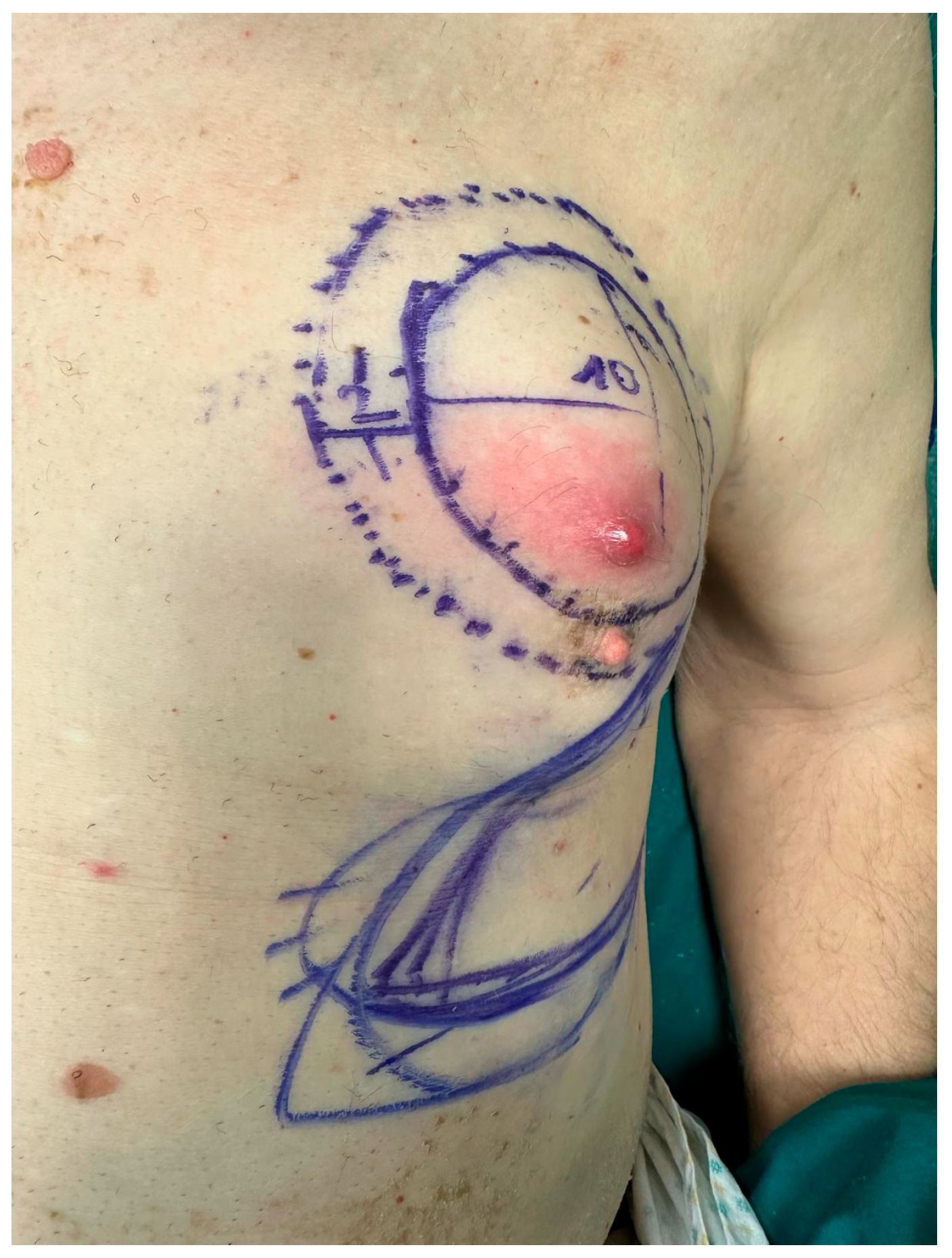
Given signs of imminent ulceration of the breast lesion, palliative surgical debulking was indicated (
Figure 1). The patient underwent resection of the nipple–areolar complex and partial excision of the pectoralis major muscle. Reconstruction was performed using a thoracoepigastric fasciocutaneous flap, selected to achieve rapid and reliable wound closure and to allow early postoperative recovery and timely initiation of adjuvant therapy [
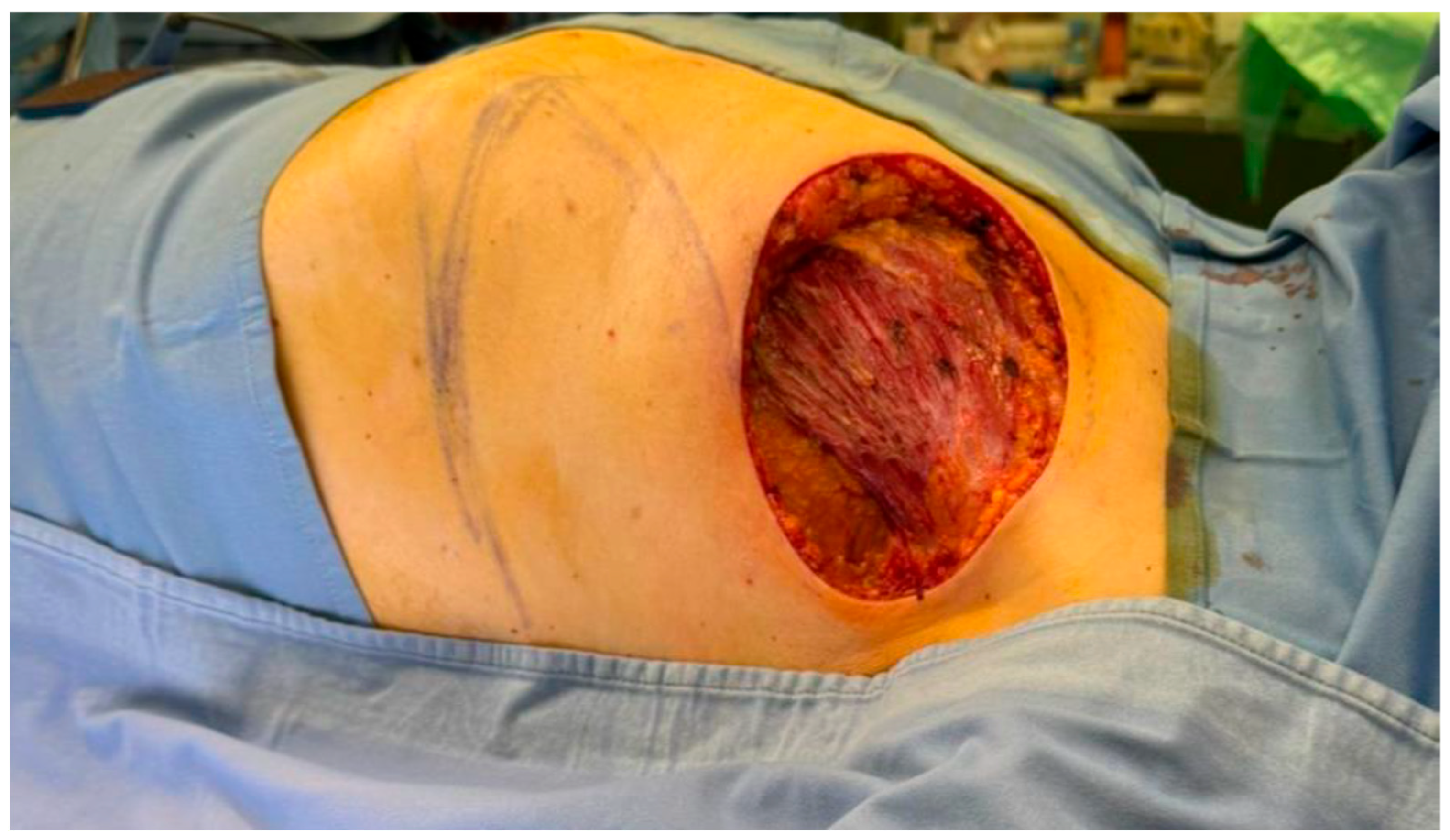
11]. Following tumor resection, the flap was planned according to the size of the surgical defect and designed with a lateral pedicle (
Figure 2).
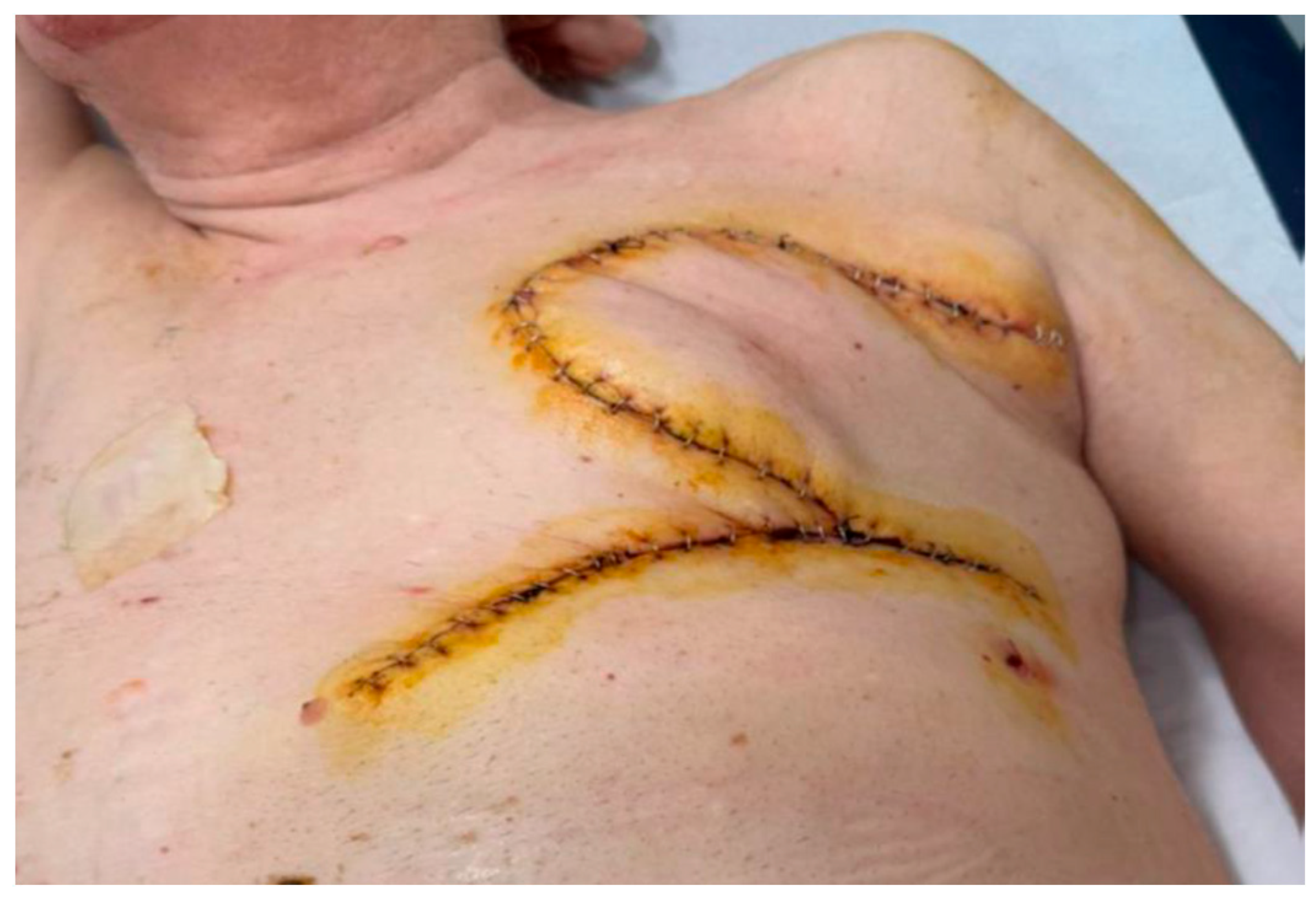
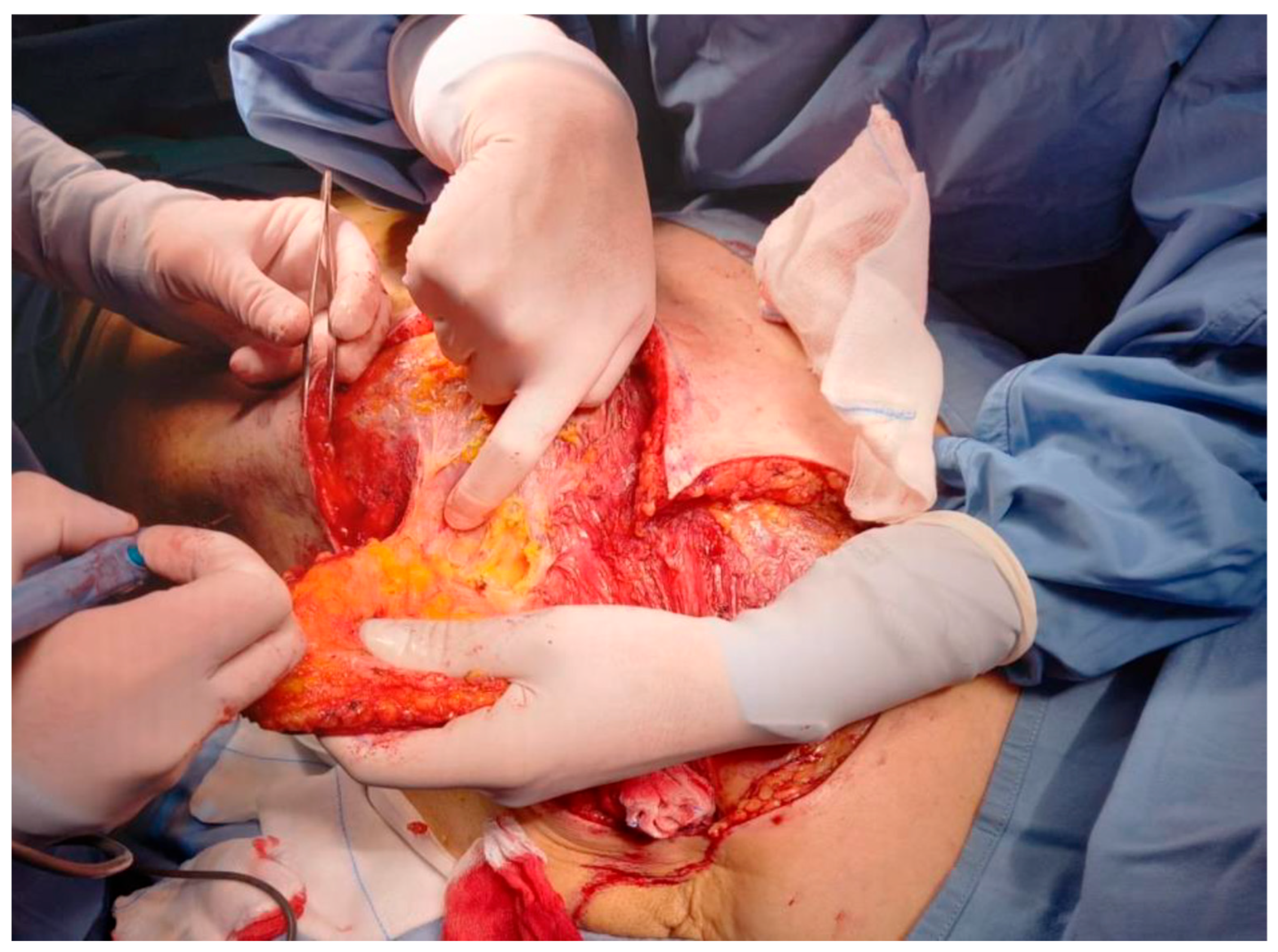
Elevation of the flap was performed in the subfascial plane, with careful identification and preservation of the perforating vessels to ensure adequate vascularization (
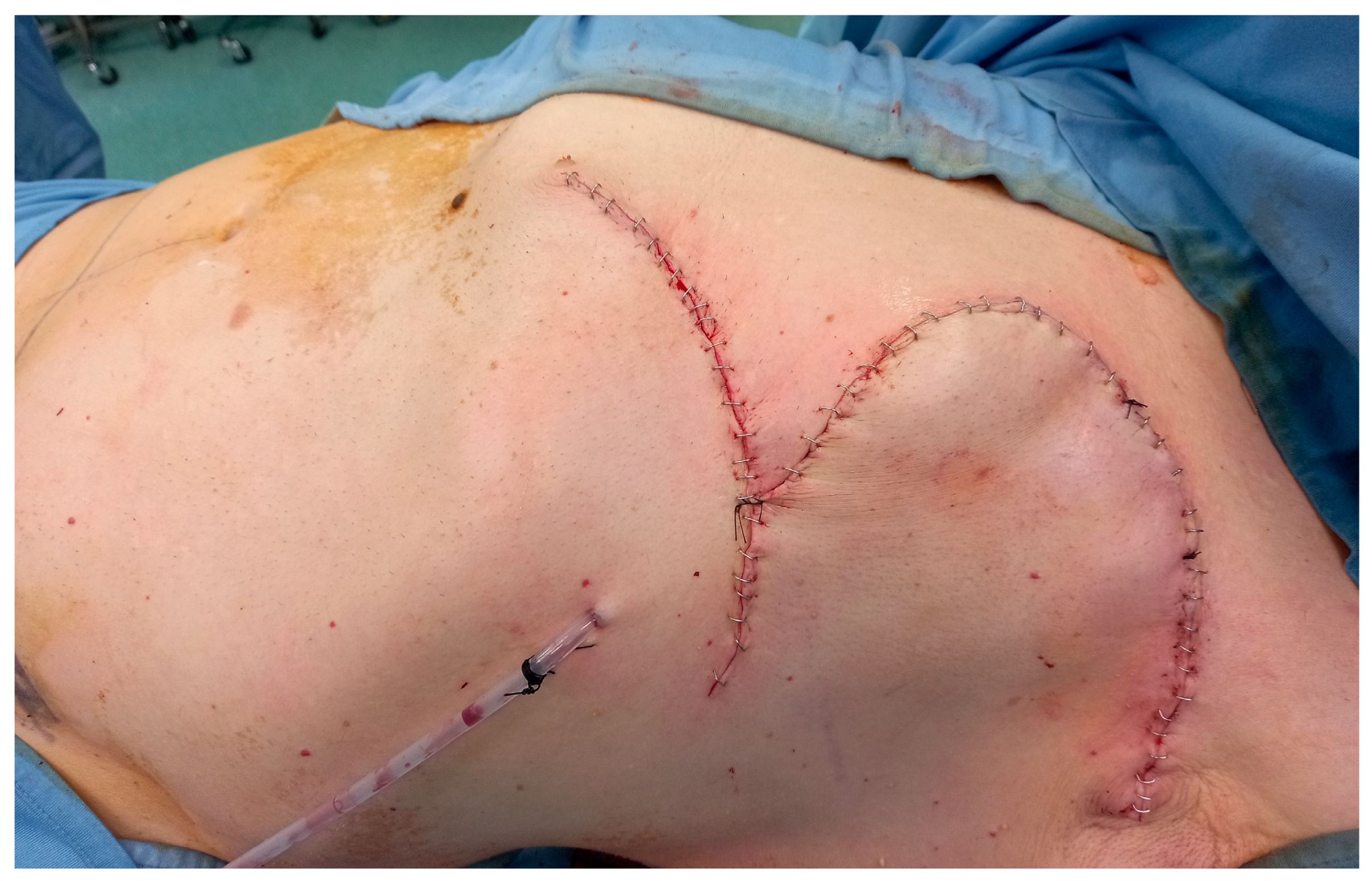
Figure 3). The flap was then transposed to the defect and inset with minimal tension, achieving satisfactory coverage (
Figure 4). The donor site was closed directly, and the postoperative course was uneventful, with good wound healing and no reconstructive complications observed at early follow-up (
Figure 5). This technique provides well-vascularized tissue coverage with shorter healing times and lower morbidity compared with skin grafts, particularly in patients requiring early systemic therapy [
12,
13].
The postoperative course was uneventful. The patient was discharged on postoperative day 2, and the drain was removed on postoperative day 6. Final histology confirmed high-grade salivary gland-type MEC. Based on the overall clinical and radiological context, the lung was considered the most likely primary site. Margins were negative, and no additional actionable mutations were identified.
During outpatient wound checks, the patient developed a small wound dehiscence, which was successfully managed with conservative treatment.
The patient is currently in good general condition, with complete wound healing. He is receiving gemcitabine on days 1 and 8 of a 21-day cycle and continues to be followed clinically and radiologically at regular intervals. Single-agent gemcitabine was selected in consideration of the patient’s advanced age, comorbidities, and palliative treatment intent, with the aim of balancing disease control and treatment tolerability.
All the important examinations, diagnoses, and therapies are summarized in a timeline (
Table 1).
3. Discussion
Breast metastases originating from extramammary malignancies are rare and represent less than 2% of all breast tumors. Among pulmonary neoplasms, adenocarcinoma and small-cell carcinoma are the most frequent histotypes associated with breast metastases, while mucoepidermoid carcinoma is extraordinarily uncommon in this context. The rarity is even more pronounced in male patients, making this case clinically exceptional. Pulmonary MEC, although accounting for only 0.1–0.2% of lung neoplasms, is characterized by a mixture of mucous, intermediate, and squamous cells and by recurrent CRTC1-MAML2 fusions [
1,
2,
3,
4,
5]. High-grade MEC may pursue an aggressive trajectory with potential for local invasion and distant spread, as observed in the present case.
Distinguishing metastatic pulmonary MEC from primary breast MEC can be challenging because of overlapping cytoarchitectural and immunophenotypic characteristics [
2,
3,
4,
7,
8]. Histology alone is often insufficient, as both primary and metastatic variants may show similar patterns of squamous and mucinous differentiation. Immunohistochemistry can help narrow the diagnostic possibilities but does not provide a definitive distinction, given the shared expression of markers such as p63, CK7, and CK5/6. Therefore, histology and immunohistochemistry alone cannot reliably distinguish primary breast MEC from metastatic pulmonary MEC. For this reason, the interpretation of such cases requires careful integration of pathological findings with clinical presentation and imaging features.
In this context, molecular testing represents a valuable complementary diagnostic tool. The presence of MAML2 rearrangements has been widely described in MEC across different anatomical sites [
9,
10]. While demonstration of molecular identity between two lesions may support a metastatic relationship, MAML2 rearrangements are not site-specific and may occur in both pulmonary and breast MEC. Accordingly, molecular findings should be interpreted in conjunction with clinical, radiological, and pathological features, and no single modality is sufficient to establish tumor origin with certainty.
The management of metastatic MEC remains largely empirical due to its rarity and the absence of standardized therapeutic algorithms. Systemic therapy choices often rely on extrapolation from salivary gland MEC or general principles applied to high-grade thoracic tumors. The identification of a PIK3CA mutation in our patient is noteworthy, as alterations in the PI3K/AKT/mTOR pathway are increasingly recognized in salivary gland-type tumors and may theoretically offer opportunities for targeted therapy. However, evidence supporting PI3K inhibitors in pulmonary MEC is limited to anecdotal reports, and no approved targeted agents currently exist for this disease. Similarly, the relevance of immunotherapy remains uncertain. PD-L1 expression in MEC is generally low, and these tumors often display a “cold” immune microenvironment, which correlates with poorer responses to immune checkpoint inhibitors compared to other non-small-cell lung cancer subtypes. In this patient, low PD-L1 levels reinforced the expectation of limited benefit from immunotherapy.
The rarity of breast metastasis from pulmonary MEC also has important implications for clinical evaluation. Misinterpretation as a primary breast carcinoma is a recognized risk, particularly when evaluating lesions that share morphological similarities with high-grade triple-negative breast cancers. This risk is further amplified in male patients, in whom primary breast malignancies are themselves infrequent. Such scenarios underscore the importance of integrating clinical history, imaging, pathology, and molecular diagnostics to avoid misclassification, which would significantly alter therapeutic planning. Additionally, given the potential for misleading radiologic and pathologic findings, multidisciplinary input is crucial to ensure accurate diagnosis and optimal treatment selection. A summary of published studies on MEC involving the breast or the lung is shown in
Table 2.
In our case, the decision to proceed with palliative surgical debulking was driven by local symptoms and the imminent risk of ulceration. Surgical management allowed for rapid symptom relief, prevented complications, and facilitated subsequent systemic therapy. Gemcitabine was selected as palliative treatment based on available clinical experience in high-grade salivary gland-type tumors, although robust evidence remains lacking [
1,
6]. As with many rare malignancies, management must be individualized, considering molecular findings, tumor burden, patient comorbidities, and symptom control.
Overall, this case highlights the need for multidisciplinary decision-making and individualized treatment strategies in the management of rare metastatic patterns associated with pulmonary MEC. It also contributes to the limited but growing body of literature on unusual metastatic behaviors of salivary gland-type lung tumors, reinforcing the essential role of molecular diagnostics in contemporary oncologic practice.
4. Conclusions
Breast metastasis from pulmonary MEC is exceedingly rare, particularly in male patients. Accurate diagnosis requires careful integration of clinical, radiologic, histopathologic, and molecular data. Although molecular alterations such as MAML2 rearrangements may support a metastatic relationship, they are not site-specific and must be interpreted in conjunction with clinical and radiological findings. In this case, the diagnosis relied on integrated clinicopathologic evaluation rather than definitive molecular proof.
Given the absence of standardized treatment, management should be individualized. Palliative surgery may be appropriate for symptomatic lesions, and systemic therapy should be tailored to tumor biology. This case underscores the importance of maintaining suspicion for metastatic disease when evaluating atypical breast lesions—even in male patients—and highlights the crucial role of molecular diagnostics in challenging oncologic scenarios.
Author Contributions
Conceptualization, R.D., L.C., I.B., E.B. and P.F.; methodology, R.D., L.C., I.B., E.B., G.R. and P.F.; data curation, R.D., L.C., R.A., F.M., C.C., F.D., C.M., C.B., M.G., S.F., M.P., A.S., U.M., F.M.S., S.P., G.R. and G.P.; writing—original draft preparation, R.D., L.C., R.A., F.M., C.C., F.D., A.S., U.M., F.M.S. and S.P.; writing—review and editing, R.D., L.C., I.B., C.M., C.B., M.G., S.F., M.P., G.P., E.B., G.R. and P.F.; supervision, E.B. and P.F. All authors have read and agreed to the published version of the manuscript.
Funding
This research received no external funding.
Institutional Review Board Statement
As this work represents a retrospective description of a single clinical case managed according to routine practice, it does not constitute a clinical trial or experimental study and therefore did not require prior approval from the local ethics committee.
Informed Consent Statement
Informed consent was obtained from all subjects involved in the study. Written informed consent has been obtained from the patient to publish this paper.
Data Availability Statement
The data presented in this study are available in this article.
Conflicts of Interest
The authors declare no conflicts of interest.
References
- Hu, S.; Gong, J.; Zhu, X.; Lu, H. Pulmonary salivary gland tumor, mucoepidermoid carcinoma: A literature review. J. Oncol. 2022, 2022, 9742091. [Google Scholar] [CrossRef] [PubMed]
- Horio, Y.; Kuroda, H.; Masago, K.; Matsushita, H.; Sasaki, E.; Fujiwara, Y. Current diagnosis and treatment of salivary gland-type tumors of the lung. Jpn. J. Clin. Oncol. 2024, 54, 229–247. [Google Scholar] [CrossRef] [PubMed]
- Roden, A.C. Recent updates in salivary gland tumors of the lung. Semin. Diagn. Pathol. 2021, 38, 98–108. [Google Scholar] [CrossRef] [PubMed]
- Naso, J.R.; Roden, A.C. Recent developments in the pathology of primary pulmonary salivary gland-type tumours. Histopathology 2024, 84, 102–123. [Google Scholar] [CrossRef]
- Huo, Z.; Wu, H.; Li, J.; Li, S.; Wu, S.; Liu, Y.; Luo, Y.; Cao, J.; Zeng, X.; Liang, Z. Primary pulmonary mucoepidermoid carcinoma: Histopathological and molecular genetic studies of 26 cases. PLoS ONE 2015, 10, e0143169. [Google Scholar] [CrossRef]
- Takamori, S.; Yatabe, Y.; Osoegawa, A.; Aokage, K.; Yoshioka, H.; Miyoshi, T.; Mimae, T.; Endo, M.; Hattori, A.; Yotsukura, M.; et al. Rare but clinically important salivary gland-type tumor of the lung: A review. Jpn. J. Clin. Oncol. 2024, 54, 121–128. [Google Scholar] [CrossRef]
- Bennett, A.K.; Mills, S.E.; Wick, M.R. Salivary-type neoplasms of the breast and lung. Semin. Diagn. Pathol. 2003, 20, 279–304. [Google Scholar] [CrossRef]
- Bean, G.R.; Krings, G.; Otis, C.N.; Solomon, D.A.; García, J.J.; van Zante, A.; Camelo-Piragua, S.; van Ziffle, J.; Chen, Y. CRTC1-MAML2 fusion in mucoepidermoid carcinoma of the breast. Histopathology 2019, 74, 463–473. [Google Scholar] [CrossRef]
- Thierauf, J.C.; Farahani, A.A.; Indave, B.I.; Bard, A.Z.; White, V.A.; Smith, C.R.; Marble, H.; Hyrcza, M.D.; Chan, J.K.C.; Bishop, J.; et al. Diagnostic value of MAML2 rearrangements in mucoepidermoid carcinoma. Int. J. Mol. Sci. 2022, 23, 4322. [Google Scholar] [CrossRef]
- Camelo-Piragua, S.I.; Habib, C.; Kanumuri, P.; Lago, C.E.; Mason, H.S.; Otis, C.N. Mucoepidermoid carcinoma of the breast shares cytogenetic abnormality with mucoepidermoid carcinoma of the salivary gland: A case report with molecular analysis and review of the literature. Hum. Pathol. 2009, 40, 887–892. [Google Scholar] [CrossRef]
- Suryanarayana Deo, S.V.; Mishra, A.; Shukla, N.K.; Sandeep, B. Thoracoabdominal Flap: A Simple Flap for Covering Large Post-mastectomy Soft Tissue Defects in Locally Advanced Breast Cancer. Indian J. Surg. Oncol. 2019, 10, 494–498. [Google Scholar] [CrossRef]
- McCraw, J.B.; Bostwick, J., 3rd; Horton, C.E. Methods of soft tissue coverage for the mastectomy defect. Clin. Plast. Surg. 1979, 6, 57–69. [Google Scholar] [CrossRef] [PubMed]
- Persichetti, P.; Tenna, S.; Cagli, B.; Scuderi, N. Extended cutaneous ‘thoracoabdominal’ flap for large chest wall reconstruction. Ann. Plast. Surg. 2006, 57, 177–183. [Google Scholar] [CrossRef] [PubMed]
- He, X.; You, J.; Chen, Y.; Tang, H.; Ran, J.; Guo, D. Mucoepidermoid carcinoma of the breast, 3 cases report and literature review. Medicine 2023, 102, e33707. [Google Scholar] [CrossRef] [PubMed]
- Akbulut, S.; Dalda, Y.; Ivanova, M.; Fusco, N. Mucoepidermoid carcinoma of the breast: A systematic review of clinicopathologic, immunohistochemical, and molecular features. World J. Surg. 2025, 49, 2630–2643. [Google Scholar] [CrossRef]
- Bak, S.; Choi, H.Y.; Lee, J.H.; Na, J.B.; Choi, D.S.; Cho, J.M.; Choi, H.C.; Park, M.J.; Kim, J.E.; Shin, H.S.; et al. Mucoepidermoid carcinoma of the breast: A case report and literature review focused on radiological findings. Medicine 2022, 101, e29745. [Google Scholar] [CrossRef]
- Li, Q.; Wei, X.; Wang, Y.; Liu, C.; Fan, B.; Lv, C.; Si, W.; Li, M. Pulmonary mucoepidermoid carcinoma in the Chinese population: A clinical characteristic and prognostic analysis. Front. Oncol. 2022, 12, 916906. [Google Scholar] [CrossRef]
- Cheng, M.; Geng, C.; Tang, T.; Song, Z. Mucoepidermoid carcinoma of the breast: Four case reports and review of the literature. Medicine 2017, 96, e9385. [Google Scholar] [CrossRef]
- Shen, C.; Che, G. Clinicopathological analysis of pulmonary mucoepidermoid carcinoma. World J. Surg. Oncol. 2014, 12, 33. [Google Scholar] [CrossRef]
- Wang, L.; Cheng, D.; Wang, H.; Cheng, L.; Zhang, X. A high-grade breast mucoepidermoid carcinoma without MAML2 rearrangement: A case report and literature review. Medicine 2024, 103, e37163. [Google Scholar] [CrossRef]
- Hsieh, C.C.; Sun, Y.H.; Lin, S.W.; Yeh, Y.C.; Chan, M.L. Surgical outcomes of pulmonary mucoepidermoid carcinoma: A review of 41 cases. PLoS ONE 2017, 12, e0176918. [Google Scholar] [CrossRef]
| Disclaimer/Publisher’s Note: The statements, opinions and data contained in all publications are solely those of the individual author(s) and contributor(s) and not of MDPI and/or the editor(s). MDPI and/or the editor(s) disclaim responsibility for any injury to people or property resulting from any ideas, methods, instructions or products referred to in the content. |



 ,
,