Oral Environment of Esophageal Cancer Patients, the Incidence of Complications, and Long-Term Prognoses
by
 , and
, and
Yusuke Sato
1,2,* ,
,
Hiroki Nikawa
3,
Akiyuki Wakita
1,2,
Yushi Nagaki
1,2,
Hiroshi Takano
4 and
Kazuhiro Imai
1,2 1
Department of Esophageal Surgery, Akita University Hospital, Akita 010-8543, Japan
2
Department of Thoracic Surgery, Akita University Graduate School of Medicine, Akita 010-8543, Japan
3
Department of Dentistry and Oral Surgery, Hiroshima University Graduate School of Medicine, Hiroshima 734-8553, Japan
4
Department of Dentistry and Oral Surgery, Akita University Graduate School of Medicine, Akita 010-8543, Japan
*
Author to whom correspondence should be addressed.
Curr. Oncol. 2026, 33(2), 86; https://doi.org/10.3390/curroncol33020086
Submission received: 3 December 2025
/
Revised: 13 January 2026
/
Accepted: 27 January 2026
/
Published: 1 February 2026
(This article belongs to the Topic Recent Advances in Anticancer Strategies, 2nd Edition)
Simple Summary
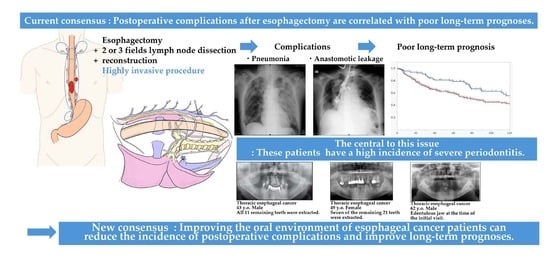
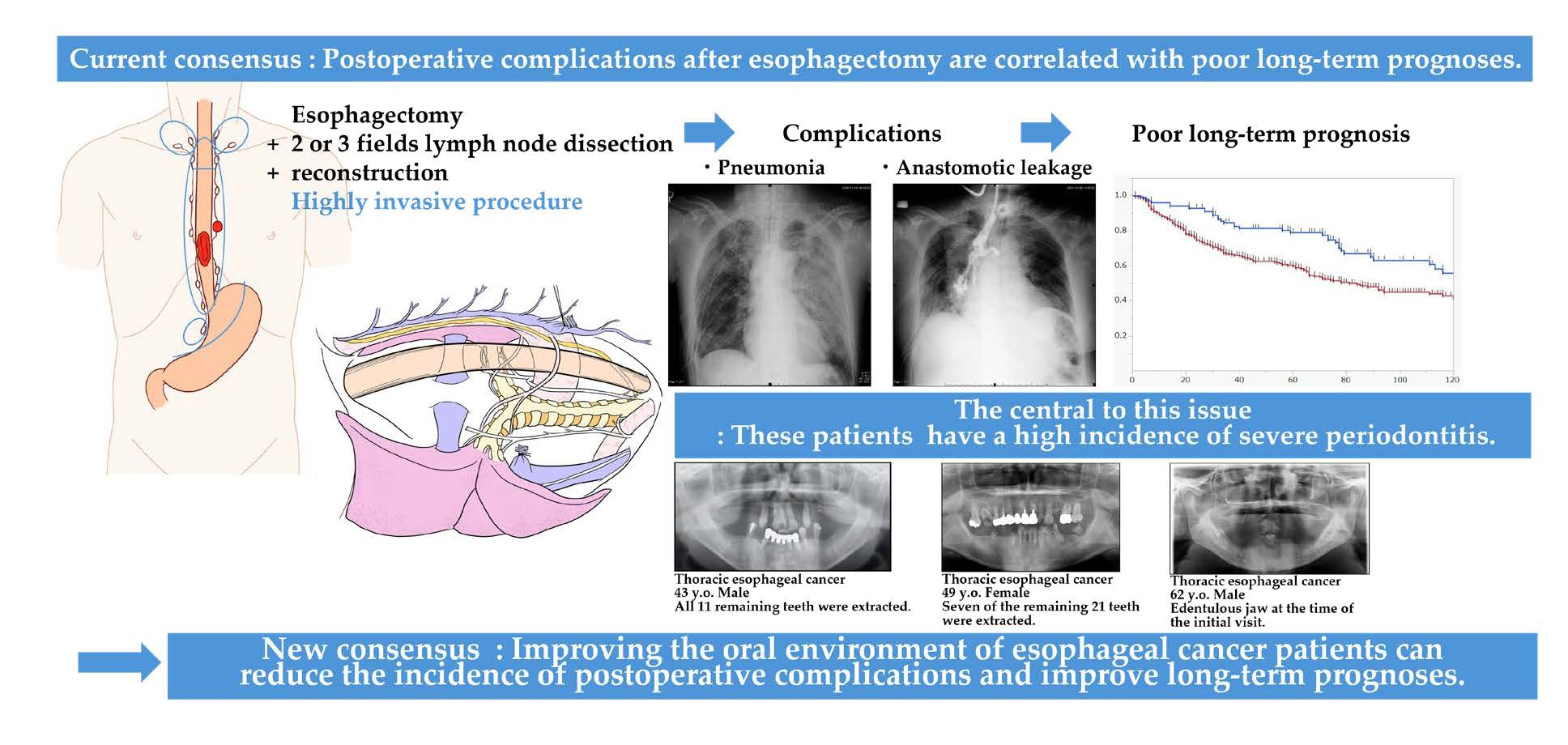
We believe that the current consensus that “postoperative complications after esophagectomy are correlated with poor long-term prognoses” is related to the fact that many esophageal cancer patients have poor oral environments. We hope the new consensus “improving the oral environment of esophageal cancer patients can reduce the incidence of postoperative complications and improve long-term prognoses”, will gain consensus and lead to safer esophageal cancer surgery.
Abstract
Recent studies have increasingly indicated that postoperative complications after esophagectomy are correlated with poor long-term prognoses, making it crucial to prevent such complications. Based on our studies, we believe that central to this issue is the finding that among esophageal cancer patients who experience postoperative complications and have poor long-term prognoses there is a high incidence of poor oral environments. Here we review the results of our basic and clinical research studies, as well as evidence from other institutions, on the oral environment of esophageal cancer patients and its association with the incidence of complications and long-term prognoses. We hope these findings, which suggest “improving the oral environment of esophageal cancer patients can reduce the incidence of postoperative complications and improve long-term prognoses”, will gain consensus and lead to safer esophageal cancer surgery.