Skip to Content
Current OncologyCurrent Oncology
  • Article
  • Open Access

24 December 2025

Patient Concerns Inventory for Arabic Patients with Head and Neck Cancer: A Cross-Cultural Adaptation and Preliminary Validation


,
,
,
and
1
Department of Oral Medicine and Diagnostic Sciences, College of Dentistry, King Saud University, Riyadh 12372, Saudi Arabia
2
College of Medicine, King Saud University, Riyadh 12372, Saudi Arabia
3
Oral and Maxillofacial Department, Wirral University Teaching Hospital, Arrowe Park, Liverpool CH49 5PE, UK
4
Radiation Oncology Unit, College of Medicine, King Saud University, Riyadh 12372, Saudi Arabia

Simple Summary

Individuals with head and neck cancer usually experience many concerns related to their diagnosis and care needs. Examples could include the treatment of undesired effects on physical, psychological and social aspects. There is no available instrument to investigate the problems associated with this condition for Arabic patients. The present study translated a commonly used patient concern inventory tailored to this condition and its treatment. It tested its precision and accuracy to measure individual preferences and needs. There were varying cultural views on topics such as social and religious issues between the original English and its Arabic translation. Recommendations were presented for further testing with large patient populations and multiple hospitals across the Arabic countries.

Abstract

Introduction: Head and neck cancer (HNC) treatments often lead to significant post-treatment side effects that affect patients’ quality of life. This study aimed to translate and validate the post-treatment Patient Concerns Inventory for head and neck (PCI-HN) into Arabic among HNC survivors. Methods: This study employed a cross-sectional design, where PCI-HN was translated and assessed for content and face validity by clinical experts and patients, respectively. Revisions to multiple items related to ‘social and religious welfare’. Patients’ responses were then analysed to assess internal consistency (Cronbach’s alpha) and test–retest reliability (Cohen’s Kappa). Results: Thirty-eight participants (19 males, 19 females, mean age 50.68 ± 16.13 years) were included. The Arabic PCI-HN demonstrated good overall internal consistency (α = 0.723) but fair test–retest agreement (κ = 0.22), likely reflecting dynamic changes in HNC post-treatment experiences. Conclusion: The Ar-PCI-HN can be a helpful instrument for capturing distinct aspects of the survivorship experience among Arabic-speaking HNC survivors. Determining the clinical interpretability and ability to detect changes over time requires further multi-centre and multi-country clinical studies. This would be necessary to ensure its integration into routine outpatient consultations for Arabic-speaking patients in Arab countries and globally.

1. Introduction

Head and neck cancers (HNC) constitute a heterogeneous group of malignancies that significantly affect basic human functions, including speech, taste, swallowing, breathing, and appearance. Globally, HNC accounts for more than 890,000 new cases and over 450,000 deaths annually, making it the seventh most common cancer type [1]. The oral and oropharyngeal cancer figures, based on 448 million individuals living in 23 countries of the Middle East and North Africa region, showed an age-standardised incidence rate of 2.6 and 1.1 per 100,000 population for males and females, respectively [2]. Incidence rates for HNCs are increasing and expected to double or increase by 2–4 times by 2040 in the Gulf Cooperation Council countries, including Saudi Arabia, Bahrain, Oman, Kuwait, Qatar, and the United Arab Emirates [3]. It is also notable that variations exist between regions within the same country, where sometimes younger adults and females are unexpectedly at higher risk [3,4].
Survivors of HNC frequently report late and long-term effects and concerns, such as xerostomia, dysphagia, pain, fatigue, anxiety, and body image [5]. These can have a profound impact on physical health, emotional stability, social interactions and overall health-related quality of life [6]. Such concerns are often underreported or missed in routine consultations, as clinical care often focuses on tumour control and survival metrics.
Given the physical and functional impairment combined with the psychosocial impact of HNC and its treatment, a shift toward holistic and patient-centred clinical care has become essential. To help achieve this, patient-clinician consultations benefit from tailored information based on patients’ concerns. This can enhance patient satisfaction and potentially improve care outcomes [7]. Previous work on patients with oral precancerous lesions demonstrated that a somewhat discordance concerning patient-clinician agreement on important topics is essential to identify what exactly a patient would like to know about their disease, address their concerns (e.g., fear of cancer recurrence or progression) and determine which aspects of their disease they prioritise over others [5].
The Patient Concerns Inventory for Head and Neck (PCI-HN) is a patient-reported outcome measure tool that facilitates patient-focused consultations for various diseases, including HNC [5]. This tool simply asks the patient to choose one or more of the 56 topics they wish to discuss during clinical consultations across four domains: physical and functional well-being; social care and social well-being; psychological, emotional, and spiritual well-being; and treatment-related issues [5]. This enables patients to identify issues they wish to discuss with the clinician during routine clinical consultations.
Furthermore, PCI-HN demonstrated excellent content validity compared to other instruments addressing HNC-related unmet needs, including physical and psychological needs, daily activities, and other needs related to information, social, spiritual, dental, communication, sexual, financial aspects, and access to care [8]. Furthermore, its contribution to value-based healthcare for patients with HNC has been demonstrated through a randomised clinical trial in the UK, showing it to be a low-cost intervention that can improve patient satisfaction, multidisciplinary referrals, and the detection of otherwise overlooked issues [7]. The University of Washington Quality of Life questionnaire (UW-QOL) was used in conjunction with PCI to measure various aspects of health-related quality of life over the past week [9,10]. The UW-QOL has been translated and validated across several languages, including Turkish, Chinese, and Portuguese, demonstrating its adaptability and cross-cultural relevance [11,12,13]. Also, its Arabic version demonstrated adequate reliability (test–retest and internal consistency) and construct validity among a cohort of HNC patients in Morocco [9].
There remains little known about patient-reported needs and concerns in Arabic-speaking patients with HNC. PCI-HN was previously translated into Chinese, Dutch, French, German, Greek, Hindi, Malay, Mandarin, Serbian, Spanish, Polish, Portuguese, Tamil, and Urdu. However, no valid Arabic translation is currently available. Addressing cultural and linguistic differences among patient populations globally can improve the understanding of how patients perceive symptoms and express their concerns [14]. It is also mandatory to maintain personalised patient-clinician communication and education [7,14]. The present work aimed to translate and assess the reliability (test–retest and internal consistency) and validity (content, face, and construct) of the Arabic versions of the PCI for patients with HNC.

2. Materials and Methods

Patients attending the outpatient oncology clinics at King Saud University Medical City between March 2022 and January 2024 were enrolled in the study. A convenience non-random sampling method was used to identify potential participants aged 18 years or older with pathologically confirmed HNC diagnoses, who had received HNC treatment, and who were native Arabic-speaking patients [15,16]. Exclusion criteria included those younger than 18 years of age and who did not receive HNC treatment, had severely debilitating diseases, and could not read and understand the Arabic language.
The study investigators included an oral medicine consultant involved in the multidisciplinary HNC team (A.M.A.), a medical oncologist with a focus on head and neck cancers and provided care for these patients (S.A.F), two medical interns who were involved in oncology rotations (A.F.A. and B.A.A.) and a maxillofacial surgeon who had experience in patient concerns related to HNC (S.N.R.). Each participant was recruited after their routine care visits to a medical oncology clinic. At the end of the consultation, two study investigators (A.F.A. and B.A.A.) provided the patients with written information about the study. Those who agreed were recruited in the same or next care visit per their wishes. Potential participants received information about completing the electronic version of the questionnaires. After signing the informed consent form, the recruited participants completed the tablet-based information independently and reported no difficulties or technical issues.

2.1. Translation and Cross-Cultural Adaptation

The Arabic PCI (Ar-PCI-HN) was adapted from the original English versions using the forward-backwards translation method, in line with the principles of good practice for translating and culturally adapting patient-reported outcome measures (PROMs) [13,17]. Two bilingual study investigators conducted forward translation, two performed translation reconciliation, two addressed synthesis and modifications, and then two independent translators performed back translation into English. A panel of study investigators reviewed all versions for conceptual equivalence, harmonisation, and cultural appropriateness, as well as proofreading (Table 1) [17,18].
Table 1. Forward-backwards translations of the PCI-HN by the study investigators.

2.2. Content and Face Validity

The content validity was assessed by six clinicians, comprising three oral medicine specialists and three medical oncologists, all with more than 10 years of relevant experience in HNC care. Questions to ensure that all Ar-PCI-HN items are relevant to the patient population, the area of interest [e.g., the concerns of patients that they would like to discuss during their consultation], the context of interest [e.g., to address a wide variety of problems, assist direct outpatient appointments, and advance interdisciplinary therapy], and whether each response option is appropriate. Clinicians were also asked about comprehensiveness by asking, ‘Are all key concepts related to patient concerns included?’ (Supplementary File S1) [19,20,21]. All six clinicians viewed the items as comprehensive, appropriate, and relevant to the patient population and the area/context of interest. However, they had demonstrated specific comments and suggestions for the initial version (Table 2).
Table 2. The clinicians’ responses to questions about Ar-PCI-HN items (content validity).
Additionally, cognitive debriefing and face validity were initially assessed through semi-structured interviews with six patients to evaluate relevance, comprehensiveness, and comprehensibility [17,20,21]. After reading the electronic version of Ar-PCI-HN using touch-screen technology [22], all noted that items were related and comprehensive. Although five of them noted a low understanding of the meaning of physical and functional well-being, attractiveness to a romantic partner, and were unsure about the roles of social workers and financial counsellors. After revisions, another group of eight patients found all revised items were indeed relevant and easy to comprehend (Table 3).
Table 3. The patient’s responses to questions about Ar-PCI-HN items (face validity).

2.3. Construct Validity

Construct validity was examined using Spearman’s rank correlation coefficient (ρ) to assess associations between Ar-PCI-HN and the Ar-UW-QOL questionnaire (v 4.0) [9]. Based 4 or 5-point scale, this version included (1) items related to activity, anxiety, appearance, chewing, mood, speech, shoulder, recreation, saliva, swallowing, taste and pain; (2) a question to indicate up to 3 important symptoms to the patient of the previous items; and (3) global questions to rate the health-related quality of life over the past month, past week and overall [23]. Its Arabic translation was validated in a head and neck cancer patient cohort and demonstrated a good internal consistency (Cronbach’s α = 0.82) and excellent test–retest reliability (Intraclass correlation coefficient = 0.098) [22].

2.4. Statistical Analysis

Data were analysed using IBM SPSS (v.25). Internal consistency, which measures the interrelatedness within a multi-item instrument, was assessed using Cronbach’s alpha (α), with values ≥0.70 indicating acceptable reliability [19,24]. Assessments by Cohen’s Kappa (κ) for nominal variables were performed to assess the test–retest reliability of Ar-PCI-HN between the first and second completions by participants over 7–14 days [19]. These were interpreted based on the level of agreement as slight (<0.20), fair (<0.40), moderate (<0.60), substantial (<0.80), and almost perfect (>0.80) [25].
For the ordinal variables, the intraclass correlation coefficients (ICCs) were used to assess the test–retest reliability of the Ar-UW-QOL [19]. ICCs were interpreted as poor (<0.5–0.75), moderate (<0.75), or good-excellent (>0.75) [26]. Statistical significance was set at a p-value of 0.05 or less.
Ethical approval was prospectively approved by the Institutional Review Board of King Saud University [Ref: 23/0221/IRB, date: 14 February 2023]. All study participants read the study information sheet and signed the informed consent form, indicating their participation and consent for publication.

3. Results

The records of 113 patients were initially screened for eligibility. After excluding 75 records for patients awaiting HNC treatment and those in palliative care, 38 patients (males = 19, females = 19) with a mean age of 50 ± 16.13 years (range, 18–90 years) were invited and agreed to participate following their routine clinical care visits. Regarding their educational attainment, 22 had a high school education or less, 14 had a bachelor’s degree, and 2 had postgraduate degrees. They were mainly retired or unemployed (n = 24), with the remaining being either employed (n = 12) or students (n = 2). Regarding tobacco use and alcohol drinking, 29 of them (76%) indicated that they never smoked, 9 were previous tobacco users, and none indicated present or previous alcohol drinking.
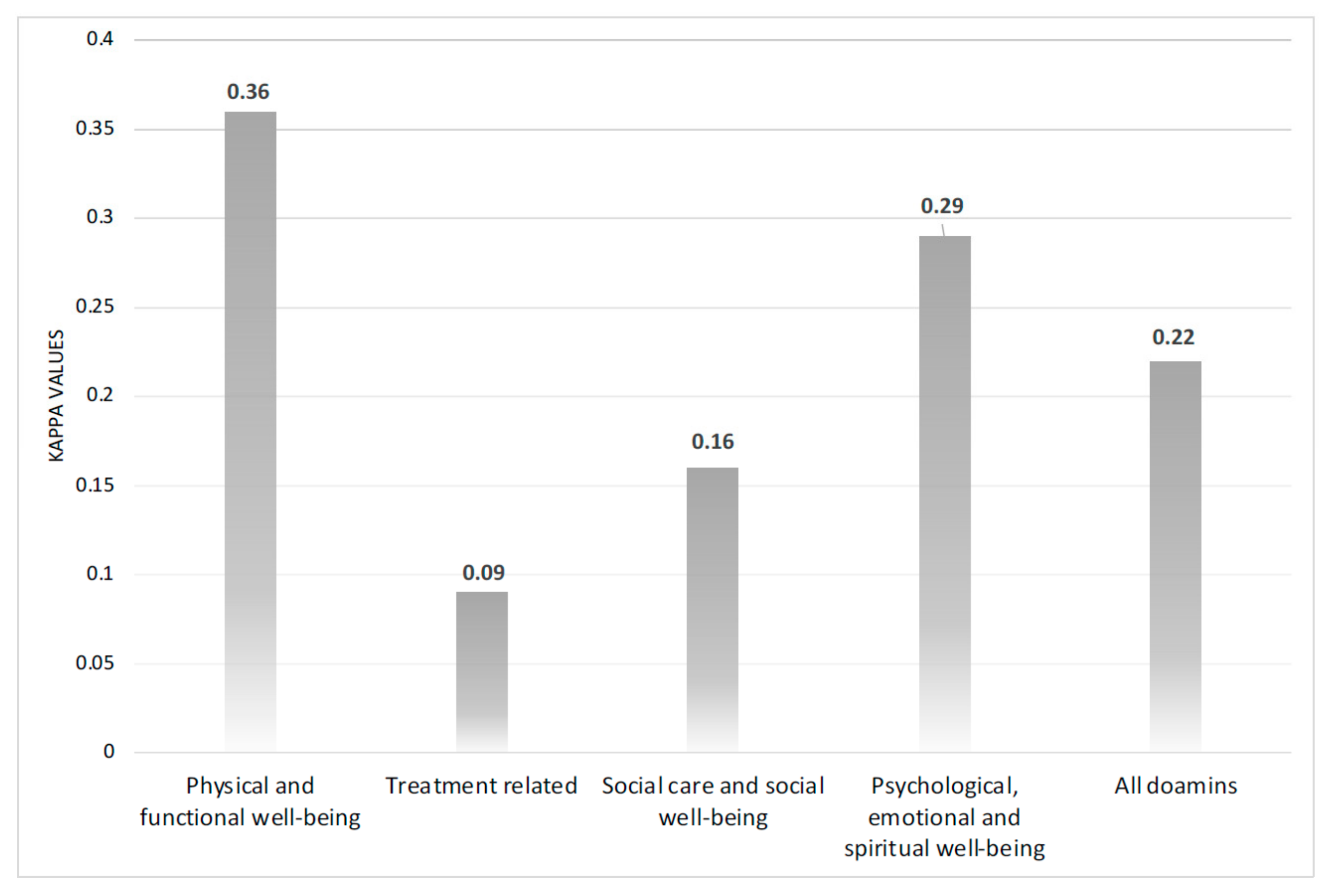
The Ar-PCI-HN demonstrated acceptable internal consistency, with a Cronbach’s α of 0.723; all items exceeded the cut-off for acceptable internal consistency reliability (α = 0.71). These included physical and functional well-being (α = 0.72), treatment-related (α = 0.72), social care and social well-being (α = 0.72), and psychological, emotional, and spiritual well-being (α = 0.72). Its test–retest reliability between the first and second completions by 31 of the 38 patients was fair (average κ = 0.22). Notably, the highest and lowest agreement was observed for physical and functional well-being (κ = 0.36) and treatment-related items (κ = 0.09), respectively (Figure 1).
Figure 1. The Cohen’s κ coefficients (test–retest) for Ar-PCI-HN domains.
The Ar-UW-QOL demonstrated strong internal consistency, with a Cronbach’s alpha of 0.753 and good test–retest reliability, as indicated by an ICC of 0.753. Domain-level analysis revealed that the most affected areas were saliva, swallowing, and appearance. Approximately 48% of participants reported dysfunction in at least one UW-QOL domain, 24% in two or more domains, and 9% in four or more. Mean composite UW-QOL scores indicated moderate impairment across most domains. Construct validity analysis revealed a weak, non-significant positive correlation between Ar-PCI-HN and Ar-UW-QOL total scores (ρ = 0.296, p = 0.119), suggesting these instruments capture overlapping but distinct constructs. The final version of the Ar-PCI-HN is available online (Supplementary File S2).

4. Discussion

This study represents the first attempt to translate, culturally adapt, and preliminarily test the internal consistency of Ar-PCI-HN in a cohort of patients with HNC. The results demonstrated that Ar-PCI-HN is a helpful tool for Arabic-speaking HNC populations. The internal consistency of the Ar-PCI-HN (α = 0.723) aligns with its English version (α = 0.76) [5], while the Brazilian Portuguese version demonstrated an alpha of 0.78 [6]. Similarly, the Ar-UW-QOL’s internal consistency (α = 0.753) is comparable to other versions, including the Turkish (α = 0.74) [13], Chinese (α = 0.79) [12], and Hindi (α = 0.75) [27], confirming its acceptable psychometric properties across different patient populations. Furthermore, the overall fair agreement between both completions by participants might be explained by the over-time changes in perceived needs and concerns in cancer care.
Clinically, the Ar-UW-QOL revealed that saliva, swallowing, and appearance were the most affected domains, as observed in another clinical cohort of post-radiotherapy HNC survivors [28]. Similar findings were noted in a Brazilian patient cohort, emphasising the tool’s sensitivity in detecting common treatment-related sequelae [29].
The relatively weak correlation between Ar-PCI-HN and Ar-UW-QOL (ρ = 0.296) confirms their complementary roles. While the UW-QOL quantifies functional impairment, the PCI identifies broader and more subjective concerns, such as emotional distress and family impact. A large UK randomised trial demonstrated that routine use of the PCI in outpatient consultations enhanced communication and identified concerns not typically captured by structured instruments [7]. Similarly, a study in Brazil confirmed that the PCI identified unmet psychosocial and practical needs in patients that would have otherwise gone unaddressed.
A significant negative correlation was found between the Ar-UW-QOL and the Xerostomia Inventory (ρ = –0.434), underscoring the burden of xerostomia on post-treatment quality of life. These findings are consistent with validation work in China and Turkey, where xerostomia and swallowing dysfunction were among the top concerns affecting quality of life (QOL) [12,13].
The results underscore the importance of implementing culturally adapted PROMs in Arabic-speaking clinical settings. In the Middle Eastern countries, where cancer incidence is projected to increase substantially [2,3], the need for patient-centred, culturally competent care is urgent. It also highlights the importance of considering diverse cultural and social interpretations across different patient populations (e.g., items related to social and religious welfare and financial counselling). The perceived importance of such topics might be less desirable to discuss with clinicians in a Western population but rather considered essential among those in the Arabic world [30,31]. For instance, decisions to own health in cancer care (e.g., palliative and end-of-life care) in Arabic countries are often affected by religious beliefs where a disease might be seen as a natural fate or indeed faith/patience testing and penance for sins [32]. Therefore, addressing these spiritual/cultural underpinnings with appropriate counselling might facilitate HNC diagnosis acceptance and early management [32,33]. This also explains why the related AR-PCI-HN followed cultural and religious views compared to its original version, while the measured construct in both versions remains similar (e.g., ‘Spiritual/religious aspects’ was adapted as ‘religion’).
PROMs, such as the PCI and UW-QOL, support early symptom detection, improved multidisciplinary referrals, and patient empowerment, all of which contribute to better treatment experiences and outcomes. Furthermore, integrating the PCI into routine care supports multidisciplinary communication, enhances psychological screening, and improves consultation quality without extending visit time [7,21]. The PCI has also been shown to enhance the quality of life when used consistently across follow-ups.
There remain little known related to access healthcare services in the Arabic countries due to sometime limited resources, increased out-of-pocket healthcare cost and insufficient expenditure for clinical services concerning cancer screening, surgical and chemoradiotherapy interventions and rehabilitation [34,35]. The is also a notable lack of clinical research that ascertaining the patient experiences and needs through the cancer journey, including what they wish to discuss with their care providers in short and perhaps overwhelming cancer services [36,37,38]. The cultural, religious, and social underpinnings are profound determinants of patient concerns in the Middle East and North Africa, where around half a billion Arabic speakers live [39]. Thus, Ar-PCI can be incorporated as a web-based tool as a hospital visit diary to help patients determine what they wish to address during their clinical visits with relevance. This can be available as a pre-visit checklist sent via phone text or email along with the appointment reminder. Then responses could be linked to the patient’s electronic medical records to support informed decisions about their care and to maintain tailored, patient-centred discussions. The Ar-PCI may also support an accurate referral process and resource allocation that addresses the patient’s care needs and maintains value-based healthcare services [5].
This study addresses a key gap in global oncology literature: the underrepresentation of Arabic-speaking patients in PROM validation. By offering validated instruments in a language patients can understand, this work provides a foundation for inclusive, high-quality care, enabling cross-cultural comparisons in survivorship research [40]. Additionally, using touch-screen/computerised questionnaires may be burdensome for individuals with low digital literacy or visual limitations [22]. However, this was not observed in the present study, which employed standardised settings and training for the study investigators (e.g., a quiet clinical waiting area, sufficient explanation of the study activities, appropriate timing for completing the questionnaires, and clarification of any unclear items). The relatively small sample size and single-centre design may limit the generalizability of the findings.
Further multicentre studies with larger and more diverse patient populations and clinical settings are needed to assess the over-time changes in perceived needs further to ensure that the presently limited test–retest (κ = 0.22) of Arabic PCI-HN is rather a reflection of clinical changes during the 7–14-day period of perceived needs than a structural limitation of the instrument. Additionally, further assessments are necessary to determine the criterion/construct validity (comparisons with the gold standard/instruments using similar constructs), responsiveness, and clinical interpretability of Ar-PCI-HN in different Arabic-speaking countries.

5. Conclusions

The Ar-PCI-HN is a culturally appropriate instrument with acceptable content and face validity, as well as internal consistency reliability, for assessing the multifaceted experiences of HNC survivors in Arabic-speaking countries. These assessments highlighted the essence and practical value of cross-cultural adjustments. There is, however, a need for further testing of other measurement properties to ensure their suitability for clinical practice, including identifying unmet needs, guiding individualised care, and enhancing survivorship outcomes.

Supplementary Materials

The following supporting information can be downloaded at https://www.mdpi.com/article/10.3390/curroncol33010012/s1: Supplementary File S1: The content validity assessment by clinicians (n = 6), Supplementary File S2. The Arabic Patient Concern Inventory for Head and Neck [Ar-PCI-HN].

Author Contributions

Conceptualization, A.M.A., B.A.A., A.F.A. and S.A.A.; methodology, A.M.A., B.A.A., A.F.A. and S.A.A.; software, B.A.A. and A.F.A.; validation, A.M.A., B.A.A., A.F.A. and S.A.A.; formal analysis, B.A.A. and A.F.A.; investigation, B.A.A. and A.F.A.; resources, S.A.A.; data curation, B.A.A. and A.F.A.; writing—original draft preparation, B.A.A. and A.F.A.; writing—review and editing, A.M.A., S.A.A. and S.N.R.; visualisation, A.M.A., S.A.A. and S.N.R.; supervision, A.M.A. and S.A.A.; project administration, A.M.A. and S.A.A.; funding acquisition, A.M.A. All authors have read and agreed to the published version of the manuscript.

Funding

Ongoing Research Funding programme, (ORF-2025-1305), King Saud University, Riyadh, Saudi Arabia.

Institutional Review Board Statement

The study was conducted in accordance with the Declaration of Helsinki and approved by the King Saud University Medical City’ Institutional Review Board [Ref: 23/0221/IRB, date: 16 March 2023).

Data Availability Statement

Data is contained within the article or Supplementary Materials. The permission to use and translate the PCI-HN was obtained from the copyright holder.

Acknowledgments

Ongoing Research Funding programme, (ORF-2025-1305), King Saud University, Riyadh, Saudi Arabia. Authors would also like to thank Aljoud Algazlan and Rema Alkahtani for their help in eligibility screening and data collection.

Conflicts of Interest

The authors declare no conflicts of interest.

Abbreviations

Ar-UW-QOLUniversity of Washington Quality of Life Questionnaire
HNCHead and neck cancer
PROMsPatient-reported outcome measures
PCI-HNPost-treatment Patient Concerns Inventory for head and neck
Ar-PCI-HNArabic PCI-HN

References

  1. Sung, H.; Ferlay, J.; Siegel, R.L.; Laversanne, M.; Soerjomataram, I.; Jemal, A.; Bray, F. Global Cancer Statistics 2020: GLOBOCAN Estimates of Incidence and Mortality Worldwide for 36 Cancers in 185 Countries. CA Cancer J. Clin. 2021, 71, 209–249. [Google Scholar] [CrossRef]
  2. Alsharif, A.; Alsharif, M.T.; Samman, M.; Binmadi, N.; Kassim, S.; Mourad, S.; Warnakulasuriya, S. Forecasting Head and Neck Cancer Trends in GCC Countries: Implications for Public Health Policy and Strategy. Risk Manag. Healthc. Policy 2023, 16, 2943–2952. [Google Scholar] [CrossRef] [PubMed]
  3. Alqahtani, W.S.; Almufareh, N.A.; Al-Johani, H.A.; Alotaibi, R.K.; Juliana, C.I.; Aljarba, N.H.; Alqahtani, A.S.; Almarshedy, B.; Elasbali, A.M.; Ahmed, H.G. Oral and oropharyngeal cancers and possible risk factors across Gulf Cooperation Council countries: A systematic review. World J. Oncol. 2020, 11, 173. [Google Scholar] [CrossRef]
  4. Alhazzazi, T.Y.; Alghamdi, F.T. Head and Neck Cancer in Saudi Arabia: A Systematic Review. Asian Pac. J. Cancer Prev. 2016, 17, 4043–4048. [Google Scholar] [CrossRef] [PubMed]
  5. Rogers, S.N.; El-Sheikha, J.; Lowe, D. The development of a Patients Concerns Inventory (PCI) to help reveal patients concerns in the head and neck clinic. Oral. Oncol. 2009, 45, 555–561. [Google Scholar] [CrossRef] [PubMed]
  6. Jungerman, I.; Toyota, J.; Montoni, N.P.; Azevedo, E.H.M.; Guedes, R.L.V.; Damascena, A.; Lowe, D.; Vartanian, J.G.; Rogers, S.N.; Kowalski, L.P. Patient Concerns Inventory for head and neck cancer: Brazilian cultural adaptation. Rev. Assoc. Médica Bras. 2017, 63, 311–319. [Google Scholar] [CrossRef]
  7. Rogers, S.N.; Allmark, C.; Bekiroglu, F.; Edwards, R.T.; Fabbroni, G.; Flavel, R.; Highet, V.; Ho, M.W.S.; Humphris, G.M.; Jones, T.M. Improving quality of life through the routine use of the patient concerns inventory for head and neck cancer patients: Main results of a cluster preference randomised controlled trial. Eur. Arch. Oto-Rhino-Laryngol. 2021, 278, 3435–3449. [Google Scholar] [CrossRef]
  8. Shunmugasundaram, C.; Rutherford, C.; Butow, P.N.; Sundaresan, P.; Dhillon, H.M. Content comparison of unmet needs self-report measures used in patients with head and neck cancer: A systematic review. Psychooncology 2019, 28, 2295–2306. [Google Scholar] [CrossRef]
  9. Adnane, C.; Oubahmane, T.; Adouly, T.; Elhani, L.; Rouadi, S.; Abada, R.L.; Roubal, M.; Mahtar, M. Cross-cultural and Moroccan validation of the University of Washington quality of life questionnaire for patients with head and neck cancer. Ann. Otol. Rhinol. Laryngol. 2016, 125, 151–159. [Google Scholar] [CrossRef]
  10. Ghazali, N.; Cadwallader, E.; Lowe, D.; Humphris, G.; Ozakinci, G.; Rogers, S.N. Fear of recurrence among head and neck cancer survivors: Longitudinal trends. Psycho-Oncol. 2013, 22, 807–813. [Google Scholar] [CrossRef]
  11. Kang, R.; Nimmons, G.L.; Drennan, W.; Longnion, J.; Ruffin, C.; Nie, K.; Won, J.H.; Worman, T.; Yueh, B.; Rubinstein, J. Development and validation of the University of Washington Clinical Assessment of Music Perception test. Ear Hear. 2009, 30, 411–418. [Google Scholar] [CrossRef]
  12. Lee, Y.H.; Lai, Y.H.; Yueh, B.; Chu, P.Y.; Chen, Y.J.; Chen, S.C.; Wang, C.P. Validation of the University of Washington Quality of Life Chinese Version (UWQOL-C) for head and neck cancer patients in Taiwan. J. Formos. Med. Assoc. 2017, 116, 249–256. [Google Scholar] [CrossRef] [PubMed]
  13. Senkal, H.A.; Hayran, M.; Karakaya, E.; Yueh, B.; Weymuller, E.A., Jr.; Hosal, A.S. The validity and reliability of the Turkish version of the University of Washington Quality of Life Questionnaire for patients with head and neck cancer. Am. J. Otolaryngol. 2012, 33, 417–426. [Google Scholar] [CrossRef] [PubMed]
  14. Aguilar, M.L.; Sandow, P.; Werning, J.W.; Brenneman, L.; Psoter, W.J. The head and neck cancer patient concern inventory©: Patient concerns’ prevalence, dental concerns’ impact, and relationships of concerns with quality of life measures. J. Prosthodont. 2017, 26, 186–195. [Google Scholar] [CrossRef]
  15. Sharour, L.A. Translation and Validation of the Arabic Version of the Cancer Needs Questionnaire-Short Form. Asia Pac. J. Oncol. Nurs. 2021, 8, 74–80. [Google Scholar] [CrossRef] [PubMed]
  16. Aljabab, S.A.; Alwhaibi, B.A.; Alnuwaybit, A.F.; Algazlan, A.S.; Alkahtani, R.S.; Alayed, Y.M.; Alsogheir, A.M. Arabic patient-reported outcome measures for xerostomia and oral mucositis: Translation and cross-cultural adaptation. Saudi J. Oral. Sci. 2025, 12, 46–51. [Google Scholar] [CrossRef]
  17. Wild, D.; Grove, A.; Martin, M.; Eremenco, S.; McElroy, S.; Verjee-Lorenz, A.; Erikson, P. Principles of good practice for the translation and cultural adaptation process for patient-reported outcomes (PRO) measures: Report of the ISPOR task force for translation and cultural adaptation. Value Health 2005, 8, 94–104. [Google Scholar] [CrossRef]
  18. Dwipa, L.; Wardhani, R.; Setiani, T.; Sufiawati, I.; Pratiwi, Y.S.; Susandi, E.; Huang, I.; Moenardi, V.N.; Thomson, W.M. Summated Xerostomia Inventory to detect both xerostomia and salivary gland hypofunction. Eur. Rev. Med. Pharmacol. Sci. 2023, 27, 517–523. [Google Scholar]
  19. De Vet, H.C.W.; Terwee, C.B.; Mokkink, L.B.; Knol, D.L. Measurement in Medicine: A Practical Guide; Cambridge University Press: Cambridge, UK, 2011. [Google Scholar]
  20. Terwee, C.B.; Prinsen, C.A.C.; Chiarotto, A.; Westerman, M.J.; Patrick, D.L.; Alonso, J.; Bouter, L.M.; De Vet, H.C.W.; Mokkink, L.B. COSMIN methodology for evaluating the content validity of patient-reported outcome measures: A Delphi study. Qual. Life Res. 2018, 27, 1159–1170. [Google Scholar] [CrossRef]
  21. Holländer-Mieritz, C.; Elsborg, A.M.J.; Kristensen, C.A.; Rogers, S.N.; Pappot, H.; Piil, K. Recommendations for a Patient Concerns Inventory specific to patients with head and neck cancer receiving palliative treatment. Support. Care Cancer 2023, 31, 54. [Google Scholar] [CrossRef]
  22. Kanatas, A.; Lowe, D.; Rogers, S.N. The Patient Concerns Inventory in head and neck oncology: A structured review of its development, validation and clinical implications. Eur. Arch. Otorhinolaryngol. 2022, 279, 5097–5111. [Google Scholar] [CrossRef]
  23. Rogers, S.N.; Gwanne, S.; Lowe, D.; Humphris, G.; Yueh, B.; Weymuller, E.A., Jr. The addition of mood and anxiety domains to the University of Washington quality of life scale. Head Neck J. Sci. Spec. Head Neck 2002, 24, 521–529. [Google Scholar] [CrossRef] [PubMed]
  24. Mokkink, L.B.; Terwee, C.B.; Patrick, D.L.; Alonso, J.; Stratford, P.W.; Knol, D.L.; Bouter, L.M.; de Vet, H.C. The COSMIN checklist for assessing the methodological quality of studies on measurement properties of health status measurement instruments: An international Delphi study. Qual. Life Res. 2010, 19, 539–549. [Google Scholar] [CrossRef] [PubMed]
  25. Landis, J.R.; Koch, G.G. The measurement of observer agreement for categorical data. Biometrics 1977, 33, 159–174. [Google Scholar] [CrossRef] [PubMed]
  26. Fleiss, J.L. Reliability of Measurement. In The Design and Analysis of Clinical Experiments; Wiley Online Library: Hoboken, NJ, USA, 1999; pp. 1–32. [Google Scholar]
  27. D’Cruz, A.K.; Yueh, B.; Das, A.K.; McDowell, J.A.; Chaukar, D.A.; Ernest, A.W. Validation of the University of Washington quality of life questionnaires for head and neck cancer patients in India. Indian J. Cancer 2007, 44, 147–154. [Google Scholar] [CrossRef]
  28. Wijers, O.B.; Levendag, P.C.; Braaksma, M.M.; Boonzaaijer, M.; Visch, L.L.; Schmitz, P.I. Patients with head and neck cancer cured by radiation therapy: A survey of the dry mouth syndrome in long-term survivors. Head Neck 2002, 24, 737–747. [Google Scholar] [CrossRef]
  29. Vartanian, J.G.; Carvalho, A.L.; Yueh, B.; Priante, A.V.; de Melo, R.L.; Correia, L.M.; Kohler, H.F.; Toyota, J.; Kowalski, I.S.; Kowalski, L.P. Long-term quality-of-life evaluation after head and neck cancer treatment in a developing country. Arch. Otolaryngol. Head Neck Surg. 2004, 130, 1209–1213. [Google Scholar] [CrossRef]
  30. Rogers, S.N.; Thomson, F.; Lowe, D. The Patient Concerns Inventory integrated as part of routine head and neck cancer follow-up consultations: Frequency, case-mix, and items initiated by the patient. Ann. R. Coll. Surg. Engl. 2018, 100, 209–215. [Google Scholar] [CrossRef]
  31. Martina, D.; Kustanti, C.Y.; Dewantari, R.; Sutandyo, N.; Putranto, R.; Shatri, H.; Effendy, C.; van der Heide, A.; Rietjens, J.A.C.; van der Rijt, C. Opportunities and challenges for advance care planning in strongly religious family-centric societies: A Focus group study of Indonesian cancer-care professionals. BMC Palliat. Care 2022, 21, 110. [Google Scholar] [CrossRef]
  32. Silbermann, M.; Hassan, E.A. Cultural perspectives in cancer care: Impact of Islamic traditions and practices in Middle Eastern countries. J. Pediatr. Hematol. Oncol. 2011, 33, S81–S86. [Google Scholar] [CrossRef]
  33. Benidir, A.; Levert, M.J.; Bilodeau, K. The Role of Islamic Beliefs in Facilitating Acceptance of Cancer Diagnosis. Curr. Oncol. 2023, 30, 7789–7801. [Google Scholar] [CrossRef]
  34. Mansour, R.; Abdel-Razeq, H.; Al-Hussaini, M.; Shamieh, O.; Al-Ibraheem, A.; Al-Omari, A.; Mansour, A.H. Systemic barriers to optimal cancer care in resource-limited countries: Jordanian healthcare as an example. Cancers 2024, 16, 1117. [Google Scholar] [CrossRef] [PubMed]
  35. World Health Organization. WHO Global Survey on the Inclusion of Cancer Care in Health-Benefit Packages, 2020–2021; World Health Organization: Geneva, Switzerland, 2024. [Google Scholar]
  36. Abdul-Sater, Z.; Menassa, M.; El Achi, N.; Abdul-Khalek, R.A.; Abu-Sittah, G.; Mukherji, D. Strengthening capacity for cancer research in conflict settings: Key informant insights from the Middle East. Ecancermedicalscience 2020, 14, 1153. [Google Scholar] [CrossRef] [PubMed]
  37. Fearon, D.; Hughes, S.; Brearley, S.G. Experiences of breast cancer in Arab countries. A thematic synthesis. Qual. Life Res. 2020, 29, 313–324. [Google Scholar] [CrossRef] [PubMed]
  38. Tolba, M.; Skelton, M.; Abdul Sater, Z.; Fadhil, I.; Al-Zahrani, A.; Kutluk, T.; Akbarov, K.; Taher, A.; Sullivan, R.; Mula-Hussain, L. Cancer Research in Vulnerable Populations: A Call for Collaboration and Sustainability from MENAT Countries. JCO Glob. Oncol. 2023, 9, e2300201. [Google Scholar] [CrossRef]
  39. Kujan, O.; Farah, C.S.; Johnson, N.W. Oral and oropharyngeal cancer in the Middle East and North Africa: Incidence, mortality, trends, and gaps in public databases as presented to the Global Oral Cancer Forum. Transl. Res. Oral. Oncol. 2017, 2, 2057178X17698480. [Google Scholar] [CrossRef]
  40. Langendijk, J.A.; Doornaert, P.; Verdonck-de Leeuw, I.M.; Leemans, C.R.; Aaronson, N.K.; Slotman, B.J. Impact of late treatment-related toxicity on quality of life among patients with head and neck cancer treated with radiotherapy. J. Clin. Oncol. 2008, 26, 3770–3776. [Google Scholar] [CrossRef]
Disclaimer/Publisher’s Note: The statements, opinions and data contained in all publications are solely those of the individual author(s) and contributor(s) and not of MDPI and/or the editor(s). MDPI and/or the editor(s) disclaim responsibility for any injury to people or property resulting from any ideas, methods, instructions or products referred to in the content.

Article Metrics

Citations

Article Access Statistics

Multiple requests from the same IP address are counted as one view.