Building Better Website Resources: What People Diagnosed with Sarcoma and Their Carers Want to Know

 , , , , , , , , , and
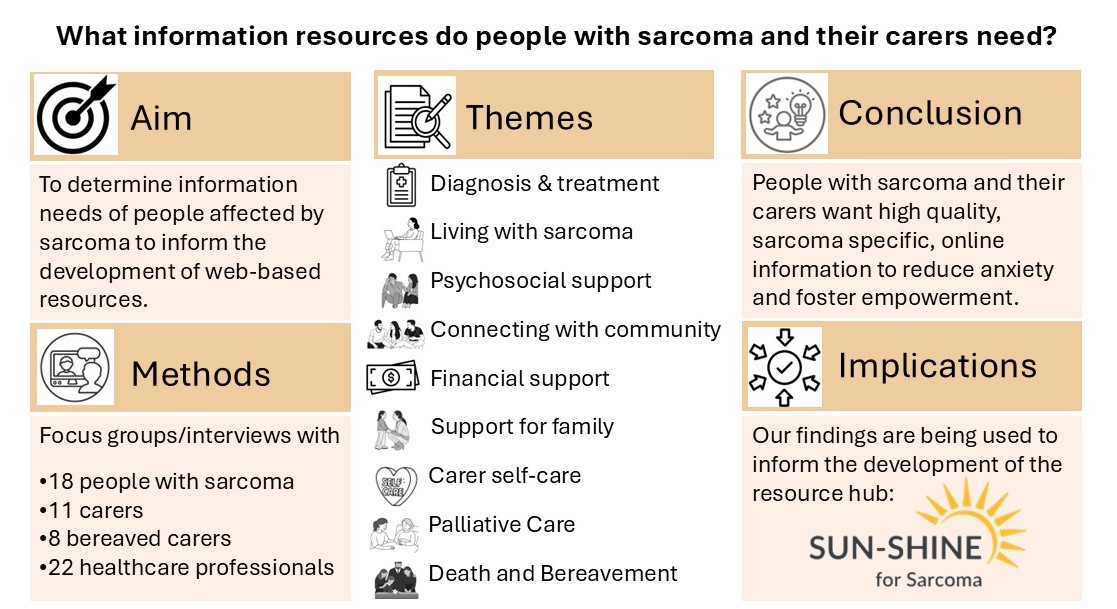
Simple Summary
Abstract
1. Introduction
2. Materials and Methods
2.1. Study Design
2.2. Participants
- •
- People diagnosed and/or treated for sarcoma in the last 20 years.
- •
- Carers, who have provided informal care to someone diagnosed with sarcoma in the last 20 years and included bereaved carers.
- •
- HCPs who provide care to people with sarcoma.
2.3. Recruitment and Data Collection
2.4. Data Analysis
2.5. Quality and Rigor
3. Results
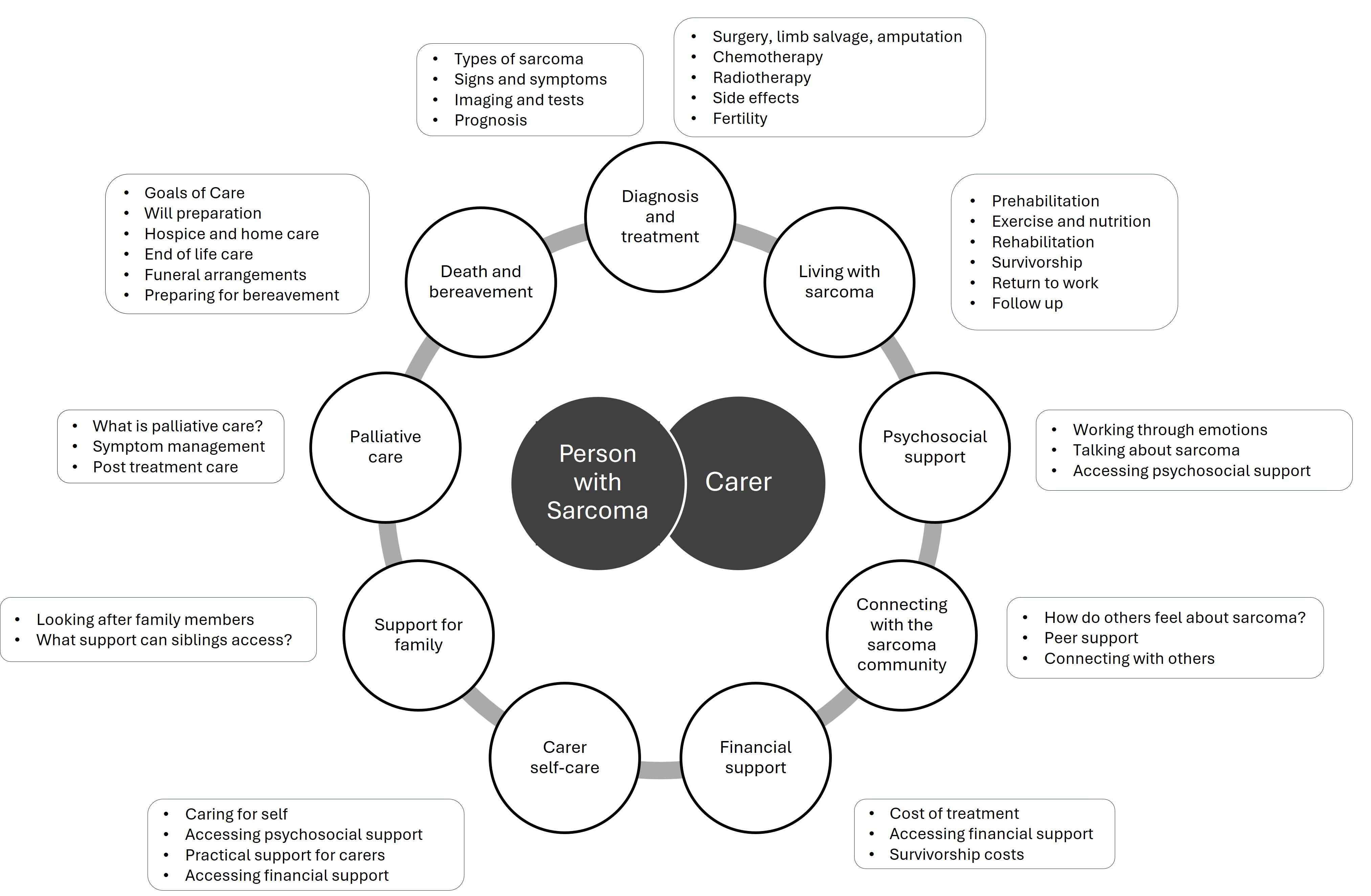
3.1. Accessing Useful Information About Diagnosis and Treatment
“Lots of information is very negative … for example, even if you put in Google and said how long does an amputee survive for? They’ve only got the five years …, you know, 5 years. Does that mean every amputee drops off?”[PwS15]
“Like the ones that my husband was Googling with international … They are available because they have a bigger population. There is obviously more people, but it’s very American centric and they have a lot more clinical trials and things going on over there.”[C2]
“I’d search up Ewing sarcoma and it would just come up with American websites. And there just wasn’t anything in the online space.”[BC2]
“I was a patient so I’m thinking more information for patients … what is a sarcoma, types of sarcomas. The treatments that you can have, you’ve got your limb salvage surgery, you’ve got, the various, chemo and radiotherapy, possible drugs.”[PwS1]
“You feel like you get on this hamster wheel called ‘cancer’, and you just have to keep going. There was no time to explore options or to even understand what the word ‘sarcoma’ meant. Most people who are diagnosed with sarcoma have never heard of it before. Your world’s turned upside down, and you’re on this hamster wheel and just … trust the surgeons and the oncologists, the clinical people in front of you and you go with it. And that feels very disorientating and very disempowering.”[C9]
“I really had a lot of fear when I was first diagnosed. No-one really kind of sat down with us and said this is what it is. We found everything from Google … And it was really hard to find what I wanted to know.”[PwS21]
“I’ve got no qualms with how the medical team sort of provided us with information, but I feel like there is a big gap in that middle area, in between the sort of one-page summary of rhabdo [rhabdomyosarcoma] to the peer-reviewed academic articles, there’s nothing there.”[BC2]
“Sarcoma patients need additional help and professionals aren’t adequate …. and anyone with a cancer diagnosis is, is fearful for their lives.”[HCP8]
“If they get on Google and the internet, then they can get a whole realm of information that they might not necessarily be able to interpret or understand, and then that gives them anxiety.”[HCP2]
“I was told if you go ahead with freezing your eggs, it could be the difference between you seeing another sunrise or not.”[PwS8]
“I’ve Googled PubMed, for research and things like that for different treatments and what trials are out there and that kind of thing. And at the moment I’m on a trial.”[PwS21]
3.2. Learning to Live with Sarcoma
“It’s frightening. It’s sort of like saying to someone, I’m going to chop your hand off (or leg off) in 10 days. And you think, what do I do now? How do you mentally deal with that? Where? For me. Someone who loved to wear clothing, loved to wear high heels, makeup. And, do all that sort of stuff. I loved walking. I did it all the time. I had two dogs. I did that. I had to get my head around what was happening and sort it out.”[PwS15]
“Sometimes you feel like you’re on a train and instead of being in the seat next to the driver, you’re the passenger in the back and they’ve got the directions.”[PwS8]
“I think she (the treating doctor) would answer every question I had and she was very responsive to what I wanted, but I think as a patient, you don’t know what information you want or need and your just feeling overwhelmed.”[BC2]
“If I had access to more what I can and can’t do.”[PwS21]
“It’s all about when you do find information, it will be about physical, psychosocial. But it’s not the boring, practical **** that you still have to get through.”[PwS9]
“ And again, age-appropriate lists. Do you know what I mean? We don’t need any coloring-in books and pencils because she’s not going to do that … Just put a list of things for teenage kids, they’re so forgotten about.”[C6]
“What? How do I get help? I don’t know anybody or I can’t stay with family. And travel is expensive. What do I access? Who do I go to for help? So even though we had family, we were not always convenient to stay. And particularly with some of the tests.”[C8]
3.3. Gaining Access to Psychosocial Support
“Certainly, in those early days when you, you just leave the hospital, you leave all your support network, and it’s all just medical support. There wasn’t a lot of emotional support, certainly not for me. Or for [family member with sarcoma] … you feel very vulnerable and isolated when you leave [the hospital].”[C9]
“I feel like some of the main [support needs], a lot of them are psychosocial because I think because of the way that sarcoma is treated, which is predominantly surgery, that’s not something you can really prepare yourself for with a diagnosis of sarcoma so something like psychosocial needs are really, really important when you get a diagnosis of sarcoma.”[PwS1]
“What’s their [patients’] psychosocial, world looking like. And the support network. What’s that look like?”.[PwS2]
“In terms of the medical information and medical support and side effects, I think a lot of it is covered, maybe what’s not covered is what’s locally available in terms of psychosocial support.”[HCP1]
3.4. Connecting with the Sarcoma Community
“… I was afraid of death. But I got through that fear and the fear that the doctors put on you like you’ve got to do this, and we’ve got to start it next week. And I think a lot of the Facebook groups that I like … they’re real people who have lived with this, some people lived with it for 20 years and you know, that gives me hope.”[PwS5]
“I feel like if you’re linking with other people in that same space or going through the same thing, it can be a bit easier. But that’s a catch-22 because, I went on some random Facebook pages in that initial diagnosis, and I had to get off it because it was just rest in peace … Rest in peace …”.[PwS3]
“So, I got in contact with her. And you know what? She was the one who’s told me that I’ll be fine … I needed to hear that. And she checked in with me … after the surgery and everything. And it was all through Instagram. Funny enough, it was all through [community organization]. And we have met now.”[PwS15]
“… being able to call on people in the UK or Italy or in the [USA] is hugely important, certainly for more unique sarcoma types, to tap into those other networks and bring those other opinions into the multidisciplinary discussion as well and not just necessarily rely on sarcoma centres in Australia.”[PwS1]
“They’ve discussed it with their team, but they’re not sure, I wanna bounce it off another patient.”[PwS17]
“It feels like you become part of a different tribe and there’s something about connecting with that tribe that can be really helpful and supportive but I also know that you get a bit stuck in that cycle of trauma. I’ve done a lot of my own work in terms of navigating my own trauma. But certainly in those early days when you just leave hospital, you leave all your support network, and it’s all just medical support. There wasn’t a lot of emotional support … You feel very vulnerable and isolated when you leave.”[C9]
3.5. Obtaining Financial Support
“In respect for financial support for people in our situation [working part-time]. But while studying and looking out for the kids and looking after my husband and trying to get him to all of his appointments, it’s just … full on.”[BC3]
“And then adults unfortunately do get cancer and I think the most vulnerable time for our patients is between 25 and 50 to tell you the truth because that’s when patients are trying to work and trying to make money and having to be independent and so that’s probably the biggest gap, for me is that additional support and for most part that’s financial.”[HCP8]
“… I’m on my daughter’s bedside. She’s literally like taking four forms of nausea medication. I can’t leave her for one second to go and, register at Centrelink… Otherwise, we can’t help you. So, I still to this day, we’ve never received a cent …”[C4]
“So, check your Super (annuation). Do you have options within that financially or these are some of the things you might consider, I had not considered any of them. All I had thought in terms of finances was I’ll go public because I can’t afford to go private … I can’t work, so even if it’s that checklist of not necessarily, here’s the person that you call …”[PwS9]
“Financial things are probably the most important things and what government support is available for them. And also, for the longer-term sarcoma patients, how they access the NDIS and other services if they’re left with a significant disability.”[HCP6]
“… A lot of those guys that are diagnosed in their fifties, and if it’s a big resection, are probably going to have to change careers or retire early and so that can be a struggle for them.”[HCP6]
3.6. Carer Self-Care
“The parent ignores themselves completely and just puts the child first and everything else and they push themselves and push themselves and push themselves and then they fall off the precipice.”[C1]
“We were sent off for more scans and more scans … constantly on the phone having to rattle cages about … Do you really need this scan? or, What about his prosthetic? or NDIS takes six months, and two ministerial complaints and an ombudsman complaint to even give him any money for rehab, or having to follow up with Centrelink to try and get him some financial support. All of those things on top of having a child that could be dead in a couple of months, it’s too much.”[C2]
“I think carers need carer support in the way of having a bit of a reprieve themselves … and also, education on their well-being, personal mental health well-being. I think carers don’t have a good sense that I need to make sure I’m okay in order to do my job well.”[HCP3]
“I just needed somebody who understood what we’re going through as parents.”[C4]
“Let them know it’s okay that they might need to have some time for themselves and that it’s not being selfish to do that; it is helping the person they’re looking after because they’re in a better space to do that.”[C9]
3.7. Facilitating Support for Family
“I often referred to him [sibling] as my forgotten child, because that was around the guilt that I felt.”[C2]
“But I think, from the moment, someone in the family is diagnosed with cancer, the whole family need to be taken care of as a whole; not just the patient, but the family.”[C3]
“… we were never offered anything for any of them … my other two little ones take after me, so they have anxiety as well. And so, we see a counsellor for them anyway.”[C4]
3.8. Understanding Palliative Care
“I think when people get referred to palliative care, they freak out because they think hospitals think they’re dying—it’d be good if there was a clear definition of what palliative care is and that you know if you get referred to palliative care services, it doesn’t actually mean that you’re gonna die.”[BC2]
“ But just what palliative care looks like, we didn’t really get information on. Maybe my dad did. But, as adult siblings, we would have probably liked to aswell.”[BC5]
“You’re studying palliative care or you’re studying end-of-life for a patient, how do you tell a patient they’re going to die and what are you going to have in place to support them, as a doctor? I don’t even reckon that’s probably ever studied.”[C13]
3.9. Preparing for Bereavement and Coping After Death
“And then, bereavement support for those families whose children don’t survive. I think there needs to be quite a broad spectrum of support.”[C10]
“… once you move out of the system with a bereavement there is a huge gap and people feel very unsupported.”[BC7]
“I know that (psychological support) would have been a real benefit and I think it would have helped them [family members] with some of their grieving.”[BC6]
“Her experience is something that I really would have benefited from. I really wanted to talk to other parents of kids going through rhabdo [rhabdomyosarcoma].”[BC2]
“It’s like a one step at a time thing and to see how to plan a funeral when you’ve just been diagnosed is just like a step, way, way, way, too far. So, you do need to be careful. I think as to where you place that information.”[BC4]
4. Discussion
4.1. Limitations
4.2. Implications for Practice
5. Conclusions
Author Contributions
Funding
Institutional Review Board Statement
Informed Consent Statement
Data Availability Statement
Acknowledgments
Conflicts of Interest
Abbreviations
| PwS | Person with sarcoma |
| C | Informal carer of person with sarcoma |
| BC | Bereaved Carer of person with sarcoma |
| HCP | Healthcare professional |
References
- Cancer Australia. Sarcoma; Australian Government, Cancer Australia: Sydney, Australia, 2024. Available online: https://www.canceraustralia.gov.au/cancer-types/sarcoma (accessed on 2 December 2025).
- Australian Institute of Health and Welfare. Cancer Data in Australia; AIHW: Canberra, Australia, 2023. [Google Scholar]
- Weaver, R.; O’Connor, M.; Sobhi, S.; Carey Smith, R.; Halkett, G. The unmet needs of patients with sarcoma. Psychooncology 2020, 29, 1209–1216. [Google Scholar] [CrossRef] [PubMed]
- Reed, D.R.; Hayashi, M.; Wagner, L.; Binitie, O.; Steppan, D.A.; Brohl, A.S.; Shinohara, E.T.; Bridge, J.A.; Loeb, D.M.; Borinstein, S.C. Treatment pathway of bone sarcoma in children, adolescents, and young adults. Cancer 2017, 123, 2206–2218. [Google Scholar] [CrossRef] [PubMed]
- Linch, M.; Miah, A.B.; Thway, K.; Judson, I.R.; Benson, C. Systemic treatment of soft-tissue sarcoma—Gold standard and novel therapies. Nat. Rev. Clin. Oncol. 2014, 11, 187–202. [Google Scholar] [CrossRef]
- Franzoi, I.G.; Granieri, A.; Sauta, M.D.; Agnesone, M.; Gonella, M.; Grimaldi, C.; Vallauri, I.; Boglione, A.; Vana, F.; Bergnolo, P. The psychological impact of sarcoma on affected patients. Psychooncology 2023, 32, 1787–1797. [Google Scholar] [CrossRef] [PubMed]
- McDonough, J.; Eliott, J.; Neuhaus, S.; Reid, J.; Butow, P. Health-related quality of life, psychosocial functioning, and unmet health needs in patients with sarcoma: A systematic review. Psychooncology 2019, 28, 653–664. [Google Scholar] [CrossRef]
- Weaver, R.; O’Connor, M.; Halkett, G.K.; Carey Smith, R. The unmet needs of carers of patients diagnosed with sarcoma: A qualitative study. Psychooncology 2021, 30, 1095–1103. [Google Scholar] [CrossRef]
- Newnham, G.M.; Burns, W.I.; Snyder, R.D.; Dowling, A.J.; Ranieri, N.F.; Gray, E.L.; McLachlan, S.A. Information from the Internet: Attitudes of Australian oncology patients. Int. Med. J. 2006, 36, 718–723. [Google Scholar] [CrossRef]
- Ploeg, J.; Markle-Reid, M.; Valaitis, R.; McAiney, C.; Duggleby, W.; Bartholomew, A.; Sherifali, D. Web-Based Interventions to Improve Mental Health, General Caregiving Outcomes, and General Health for Informal Caregivers of Adults With Chronic Conditions Living in the Community: Rapid Evidence Review. J. Med. Internet Res. 2017, 19, e263. [Google Scholar] [CrossRef]
- Maxwell-Smith, C.; Smith, S.; Nicholson, L.; O’Connor, M.; Davies, J.; Basson, M.; Dhillon, H.; Halkett, G.K.B. SUN-SHINE Sarcoma Systematic Environmental Scan: Evaluation of the Readability, Understandability, and Actionability of Websites Supporting Patients Diagnosed With Sarcoma and Their Caregivers. Psycho-Oncology 2025, 34, e70349. [Google Scholar] [CrossRef]
- Blumer, H. Symbolic Interactionism: Perspective and Method; Prentice-Hall: Englewood Cliffs, NJ, USA, 1969. [Google Scholar]
- Howson, A. Symbolic Interactionist Analysis of Health and Medicine. Available online: https://www.ebsco.com/research-starters/health-and-medicine/symbolic-interactionist-analysis-health-and-medicine (accessed on 15 August 2025).
- O’Connor, M.; Smith, G.; Pantaleo, A.; Haywood, D.; Weaver, R.; Halkett, G.K. “It’s Always Been a Second Class Cancer”: An Exploration of the Experiences and Journeys of Bereaved Family Carers of People with Sarcoma. Cancers 2021, 13, 2670. [Google Scholar] [CrossRef]
- Halkett, G.K.B.; Farnell, C.; Berg, M.; Basson, M.; O’Connor, M. Exploring the Role That a Helpline Could Play for People Diagnosed With Sarcoma and Their Carers. Eur. J. Cancer Care 2025, 2025, 5633734. [Google Scholar] [CrossRef]
- Weaver, R.; O’Connor, M.; Carey Smith, R.; Halkett, G.K. The complexity of diagnosing sarcoma in a timely manner: Perspectives of health professionals, patients, and carers in Australia. BMC Health Serv. Res. 2020, 20, 711. [Google Scholar] [CrossRef] [PubMed]
- Malterud, K.; Siersma, V.D.; Guassora, A.D. Sample Size in Qualitative Interview Studies: Guided by Information Power. Qual. Health Res. 2016, 26, 1753–1760. [Google Scholar] [CrossRef]
- Braun, V.; Clarke, V. To saturate or not to saturate? Questioning data saturation as a useful concept for thematic analysis and sample-size rationales. Qual. Res. Sport Exerc. Health 2021, 13, 201–216. [Google Scholar]
- Braun, V.; Clarke, V. Can I use TA? Should I use TA? Should I not use TA? Comparing reflexive thematic analysis and other pattern-based qualitative analytic approaches. Couns. Psychother. Res. 2021, 21, 37–47. [Google Scholar] [CrossRef]
- Johnson, J.L.; Adkins, D.; Chauvin, S. A Review of the Quality Indicators of Rigor in Qualitative Research. Am. J. Pharm. Educ. 2020, 84, 7120. [Google Scholar] [CrossRef]
- Berger, R. Now I see it, now I don’t: Researcher’s position and reflexivity in qualitative research. Qual. Res. 2015, 15, 219–234. [Google Scholar] [CrossRef]
- Tong, A.; Sainsbury, P.; Craig, J. Consolidated criteria for reporting qualitative research (COREQ): A 32-item checklist for interviews and focus groups. Int. J. Qual. Health Care 2007, 19, 349–357. [Google Scholar] [CrossRef]
- Ladd, D.L. Information Needs and Information Sources of Patients Diagnosed with Rare Cancers. Ph.D. Thesis, Virginia Commonwealth University, Richmond, VA, USA, 2016. [Google Scholar]
- Sarcoma, U.K. Impact of Sarcoma: National Sarcoma Survey 2020; Sarcoma UK: London, UK, 2020; pp. 1–114. [Google Scholar]
- Kain, J.; Carlson, A.; Kahler, J.; Bemboom, J.; McDonald, K.; Miller, B. Lessons and advice from our patients: A focus group of sarcoma survivors. Iowa Orthop. J. 2017, 37, 139. [Google Scholar]
- Hewitt, L.; Powell, R.; Zenginer, K.; Coyle, C.; Murray, H.; Cooper, L.; Gregory, J. Patient perceptions of the impact of treatment (surgery and radiotherapy) for soft tissue sarcoma. Sarcoma 2019, 2019, 9581781. [Google Scholar] [CrossRef] [PubMed]
- Tranberg, M.; Andersson, M.; Nilbert, M.; Rasmussen, B.H. Co-afflicted but invisible: A qualitative study of perceptions among informal caregivers in cancer care. J. Health Psychol. 2021, 26, 1850–1859. [Google Scholar] [CrossRef] [PubMed]
- Hughes, N.; Locock, L.; Ziebland, S. Personal identity and the role of ‘carer’among relatives and friends of people with multiple sclerosis. Soc. Sci. Med. 2013, 96, 78–85. [Google Scholar] [CrossRef] [PubMed]
- Yuen, E.Y.; Wilson, C.J. The relationship between cancer caregiver burden and psychological outcomes: The moderating role of social connectedness. Curr. Oncol. 2021, 29, 14–26. [Google Scholar] [CrossRef] [PubMed]
- Thomsen, K.T.; Guldin, M.-B.; Nielsen, M.K.; Ollars, C.L.; Jensen, A.B. A process evaluation of systematic risk and needs assessment for caregivers in specialised palliative care. BMC Palliat. Care 2017, 16, 23. [Google Scholar] [CrossRef] [PubMed]


| People with Sarcoma (n = 18) | Carers (n = 11) | Bereaved Carers (n = 8) | |
|---|---|---|---|
| Age at interview (years) | |||
| Mdn (IQR) | 46.4 (15.3) | 53.0 (7.0) | 48.8 (13.8) |
| Min.-Max. | 18–70 | 43–65 | 22–64 |
| Age at diagnosis (years) for person with sarcoma who was participating or being cared for | n (%) | n (%) | n (%) |
| Adolescent (10–19) | 3 (16.7) | 9 (81.8) | 6 (75) |
| Young adult (20–24) | 0 (0) | 0 (0) | 1 (12.5) |
| Adult (25–40) | 4 (22.2) | 0 (0) | 1 (12.5) |
| Adult (>40) | 11 (61.1) | 2 (18.2) | 0 (0) |
| Sex | |||
| Female | 13 (72.2) | 10 (90.9) | 8 (100) |
| Male | 5 (27.8) | 1 (9.1) | 0 (0) |
| State | |||
| WA | 8 (44.4) | 6 (54.5) | 1 (12.5) |
| QLD | 4 (22.2) | 1 (9.1) | 0 (0) |
| NSW | 3 (16.7) | 4 (36.4) | 1 (12.5) |
| VIC | 1 (5.6) | 0 (0) | 4 (50) |
| SA | 1 (5.6) | 0 (0) | 0 (0) |
| TAS | 1 (5.6) | 0 (0) | 0 (0) |
| ACT | 0 (0) | 0 (0) | 2 (25) |
| Location | |||
| Major city | 11 (61.1) | 8 (72.7) | 7 (87.5) |
| Regional/rural | 7 (38.9) | 3 (27.3) | 1 (12.5) |
| Sarcoma type | |||
| Bone | 5 (27.8) | 7 (63.6) | 6 (75) |
| Soft tissue | 12 (66.7) | 3 (27.3) | 2 (25) |
| Unspecified/unknown | 1 (5.6) | 1 (9.1) | 0 (0) |
| Carer role | |||
| Parent | - | 9 (81.8) | 5 (62.5) |
| Spouse | - | 2 (18.2) | 1 (12.5) |
| Sister | - | 0 (0) | 1 (12.5) |
| Family friend | - | 0 (0) | 1 (12.5) |
| HCPs (n = 22) | n (%) |
|---|---|
| Sex | |
| Female | 16 (72.7) |
| Male | 6 (27.3) |
| State | |
| WA | 12 (54.5) |
| NSW | 3 (13.6) |
| ACT | 2 (9.1) |
| SA | 2 (9.1) |
| VIC | 2 (9.1) |
| QLD | 1 (4.5) |
| Location | |
| Major city | 22 (100) |
| Profession | |
| Nurse | 7 (31.8) |
| Psychologist/Counsellor/Youth Worker | 4 (18.2) |
| Oncologist | 3 (13.6) |
| Care Coordinator | 2 (9.1) |
| Exercise Physiologist | 2 (9.1) |
| Occupational Therapist | 1 (4.5) |
| Physiotherapist | 1 (4.5) |
| Surgeon | 1 (4.5) |
| Sarcoma researcher | 1 (4.5) |
| Oncologist | 3 (13.6) |
| Care Coordinator | 2 (9.1) |
Disclaimer/Publisher’s Note: The statements, opinions and data contained in all publications are solely those of the individual author(s) and contributor(s) and not of MDPI and/or the editor(s). MDPI and/or the editor(s) disclaim responsibility for any injury to people or property resulting from any ideas, methods, instructions or products referred to in the content. |
© 2025 by the authors. Licensee MDPI, Basel, Switzerland. This article is an open access article distributed under the terms and conditions of the Creative Commons Attribution (CC BY) license (https://creativecommons.org/licenses/by/4.0/).
Share and Cite
Halkett, G.K.B.; Davies, J.; Maxwell-Smith, C.; Farnell, C.; Basson, M.; Rice-Brading, T.; Sousa, M.S.; Sproul, J.; De Jong, H.M.; Dhillon, H.M.; et al. Building Better Website Resources: What People Diagnosed with Sarcoma and Their Carers Want to Know. Curr. Oncol. 2025, 32, 691. https://doi.org/10.3390/curroncol32120691
Halkett GKB, Davies J, Maxwell-Smith C, Farnell C, Basson M, Rice-Brading T, Sousa MS, Sproul J, De Jong HM, Dhillon HM, et al. Building Better Website Resources: What People Diagnosed with Sarcoma and Their Carers Want to Know. Current Oncology. 2025; 32(12):691. https://doi.org/10.3390/curroncol32120691
Chicago/Turabian StyleHalkett, Georgia K. B., Jenny Davies, Chloe Maxwell-Smith, Connor Farnell, Mandy Basson, Tania Rice-Brading, Mariana S. Sousa, Janene Sproul, Helen M. De Jong, Haryana M. Dhillon, and et al. 2025. "Building Better Website Resources: What People Diagnosed with Sarcoma and Their Carers Want to Know" Current Oncology 32, no. 12: 691. https://doi.org/10.3390/curroncol32120691
APA StyleHalkett, G. K. B., Davies, J., Maxwell-Smith, C., Farnell, C., Basson, M., Rice-Brading, T., Sousa, M. S., Sproul, J., De Jong, H. M., Dhillon, H. M., Fardell, J. E., & O’Connor, M. (2025). Building Better Website Resources: What People Diagnosed with Sarcoma and Their Carers Want to Know. Current Oncology, 32(12), 691. https://doi.org/10.3390/curroncol32120691