


Abstract
Background: Atrial fibrillation (AF) is frequently encountered in patients presenting with acute coronary syndrome (ACS); however, its clinical significance beyond being a simple rhythm disturbance remains debated. We hypothesized that AF at presentation may be associated with a high-risk clinical profile characterized by hemodynamic instability and increased inflammatory and ischemic activity. Methods: This single-center, retrospective observational study included consecutive adult patients with acute coronary syndrome admitted to a tertiary cardiology center between January 2022 and December 2024. Patients were classified into two groups according to cardiac rhythm at presentation: AF and sinus rhythm. Baseline demographic characteristics, hemodynamic parameters, laboratory biomarkers, validated risk scores, and revascularization strategies were compared between groups. Multivariable logistic regression analysis was performed to evaluate whether AF was independently associated with a high-risk presentation, primarily defined by elevated GRACE risk score, reduced left ventricular ejection fraction, and increased inflammatory markers. Results: A total of 158 patients were included, of whom 50 (31.6%) presented with atrial fibrillation (mean age 71.2 ± 11.4 years, 46% female). Compared with patients in sinus rhythm, those with AF had significantly higher GRACE risk scores, lower left ventricular ejection fraction, faster heart rate, and higher white blood cell counts and peak high-sensitivity troponin levels. These associations remained significant after multivariable adjustment. Patients with AF also showed a numerically higher prevalence of severe angina at presentation. Conclusions: In patients presenting with ACS, atrial fibrillation is associated with a high-risk hemodynamic profile accompanied by increased inflammatory and ischemic activity. Rather than being an incidental finding, AF may represent a clinically relevant marker of acute cardiovascular stress and may contribute to early risk stratification in this setting.
1. Introduction
Atrial fibrillation (AF) is one of the most frequent arrhythmias encountered in patients with acute coronary syndrome (ACS), with a reported prevalence ranging between 6% and 22% depending on age, comorbidity profile, and ACS subtype [1]. Although AF has traditionally been regarded as an epiphenomenon caused by ischemia-related atrial pressure overload or metabolic stress, accumulating evidence suggests that AF may represent a distinct high-risk phenotype rather than a coincidental finding in ACS patients [2]. This perspective has gained attention as several observational studies demonstrated that ACS patients with AF have worse short- and long-term outcomes, higher rates of heart failure, and increased in-hospital mortality compared with those in sinus rhythm [3].
The mechanisms linking AF to a more severe ACS presentation are likely multifactorial. AF contributes to impaired coronary perfusion through loss of atrial systole, rapid ventricular response, and increased myocardial oxygen demand [4]. In addition, AF is closely associated with systemic inflammation, endothelial dysfunction, and heightened thrombotic activity, all of which worsen ischemic burden during ACS [5]. Patients with AF also tend to be older and have more comorbidities such as hypertension, diabetes, and chronic kidney disease, which further complicate clinical management [6]. However, whether AF itself is simply a marker of advanced cardiovascular disease or an independent modifier of hemodynamic and inflammatory risk in ACS remains uncertain.
Risk assessment tools such as the Global Registry of Acute Coronary Events (GRACE) and the Thrombolysis in Myocardial Infarction (TIMI) scores are widely used to stratify patients and guide revascularization strategies in ACS [7]. Yet, these scoring systems do not explicitly integrate AF as an independent component, despite mounting data that AF may influence both the severity of presentation and clinical trajectory [8]. Understanding whether AF identifies ACS patients with a more adverse hemodynamic and inflammatory profile beyond traditional scoring systems could provide clinically actionable insight, potentially refining early risk stratification and management pathways.
Emerging research has highlighted associations between AF and higher inflammatory markers, larger infarct size, more severe left ventricular systolic dysfunction, and elevated cardiac biomarker levels during ACS episodes [9]. Still, existing studies are heterogeneous in design, often include mixed ACS populations, and seldom evaluate the interplay between AF and established risk scores or revascularization decisions. Moreover, data from real-world clinical settings remain limited, particularly in populations without long-term follow-up but with detailed baseline hemodynamic and biochemical profiling.
Given these gaps, the present study aimed to evaluate whether AF identifies a distinct high-risk phenotype characterized by adverse hemodynamic markers, increased inflammatory burden, and more severe ischemic presentation in patients with ACS. By examining clinical, laboratory, echocardiographic, and risk-score parameters, our objective was to determine whether AF serves as an independent indicator of higher-risk ACS physiology in a contemporary patient cohort.
2. Methods
This retrospective, observational study was conducted in one tertiary cardiology center in Türkiye, Gazi Yaşargil Training and Research Hospital (Diyarbakır). Consecutive patients who were admitted with a diagnosis of acute coronary syndrome (ACS) between January 2022 and December 2024 were screened for eligibility. The study protocol complied with the principles of the Declaration of Helsinki, and institutional ethical approval was obtained from the Gazi Yaşargil Training and Research Hospital Clinical Research Ethics Committee.
Patients aged ≥ 18 years with a confirmed diagnosis of ACS, including ST-segment elevation myocardial infarction (STEMI) and non-ST-segment elevation myocardial infarction (NSTEMI), were included. The diagnosis of ACS was established based on typical symptoms, characteristic electrocardiographic findings, and elevated high-sensitivity cardiac troponin levels according to contemporary guidelines. Exclusion criteria were advanced valvular heart disease, severe baseline electrolyte abnormalities, known congenital channelopathies, pacemaker rhythm, pre-excitation, bundle branch block, incomplete medical files, chronic inflammatory or autoimmune diseases, active infection, malignancy, or missing electrocardiographic or laboratory data at admission. Patients with hemodynamic collapse requiring immediate mechanical circulatory support were also excluded. The source population consisted of consecutive adult patients admitted with a confirmed diagnosis of acute coronary syndrome during the predefined study period. For the purpose of the present analysis, only patients with complete admission electrocardiography, laboratory measurements, and transthoracic echocardiographic data were included. Only patients who met the predefined inclusion criteria and had complete electrocardiographic, laboratory, and transthoracic echocardiographic data at admission were included in the final analysis; therefore, no patients were excluded after initial eligibility assessment.
Atrial fibrillation (AF) was defined as an irregular rhythm without discrete P waves lasting ≥30 s on a 12-lead ECG or cardiac monitoring at presentation. Only AF present at admission was evaluated; patients with a prior history of paroxysmal AF who were in sinus rhythm at presentation were categorized in the non-AF group. All included ECGs were obtained at a paper speed of 25 mm/s and an amplitude of 10 mm/mV, and were analyzed by two independent cardiologists blinded to clinical data. Heart rate, PR interval, QRS duration, QT interval, corrected QT interval (QTc), and the presence of ST-segment deviation or ischemic morphology were recorded. Discrepancies between readers were resolved by consensus. Atrial fibrillation classification was based exclusively on the cardiac rhythm documented on the admission electrocardiogram. Due to the retrospective design of the study, systematic differentiation between new-onset atrial fibrillation related to the index ACS event and pre-existing or chronic atrial fibrillation was not feasible. Patients who developed atrial fibrillation during hospitalization were not included, as the primary objective of the study was to characterize the clinical and hemodynamic phenotype associated with atrial fibrillation present at initial ACS presentation.
Comprehensive demographic, clinical, and laboratory variables were extracted from electronic medical records, including age, sex, hypertension, diabetes mellitus, hyperlipidemia, smoking status, Killip class on admission, systolic and diastolic blood pressure, serum creatinine, fasting glucose, urea, white blood cell count (WBC), lipid profile, and peak cardiac troponin. Transthoracic echocardiography performed during hospitalization was used to determine left ventricular ejection fraction (LVEF), following Simpson’s biplane method. Transthoracic echocardiographic assessment was performed during the index hospitalization, prior to hospital discharge. Coronary angiography results, revascularization strategy (percutaneous coronary intervention or coronary artery bypass grafting), and medical treatments were documented. Information regarding baseline medical therapy at admission, thyroid function status, and detailed characterization of concomitant cardiovascular comorbidities was not consistently available for all patients and was therefore not included in the comparative analyses.
Diabetes mellitus was recorded as a categorical variable based on prior diagnosis or use of glucose-lowering therapy; detailed information regarding disease duration, glycemic control, or diabetes-related complications was not consistently available. Coronary artery disease severity was assessed clinically and angiographically; however, the SYNTAX score was not systematically calculated in this retrospective cohort.
Global Registry of Acute Coronary Events (GRACE) scores both in-hospital and post-discharge, and Thrombolysis in Myocardial Infarction (TIMI) risk scores were calculated for all patients using validated scoring systems. These scores were used to examine whether AF at presentation was associated with a more adverse hemodynamic and inflammatory profile, independent of classical cardiovascular risk factors.
- Data Protection
All patient data used in this study were fully anonymized prior to analysis. No identifiable personal information was available to the investigators.
- Artificial Intelligence Statement
No artificial intelligence tools were used in the design, data collection, statistical analysis, or interpretation of this study.
3. Statistical Analysis
All statistical analyses were performed using IBM SPSS Statistics version 26.0 (IBM Corp., Armonk, NY, USA). The distribution of continuous variables was assessed using the Kolmogorov–Smirnov test and visual inspection of histograms. Normally distributed variables were expressed as mean ± standard deviation, whereas non-normally distributed variables were presented as median with interquartile range. Comparisons between groups (AF vs. non-AF) were conducted using the independent samples t-test or Mann–Whitney U test, depending on distributional characteristics. Categorical variables were expressed as counts and percentages and compared using Pearson’s chi-square test or Fisher’s exact test when appropriate.
To identify independent predictors of high-risk presentation, two multivariable logistic regression models were constructed. In the first model, the dependent variable was a high GRACE score (≥140), and in the second model, reduced LVEF (≤45%). Variables with p < 0.10 in univariable analysis, and clinically relevant parameters such as age, sex, hypertension, diabetes mellitus, serum creatinine, troponin level, WBC, ACS subtype (STEMI or NSTEMI), and Killip class were entered into the multivariable model. The presence of atrial fibrillation at admission was the primary explanatory variable of interest. Odds ratios (ORs) with 95% confidence intervals (CIs) were reported.
4. Results
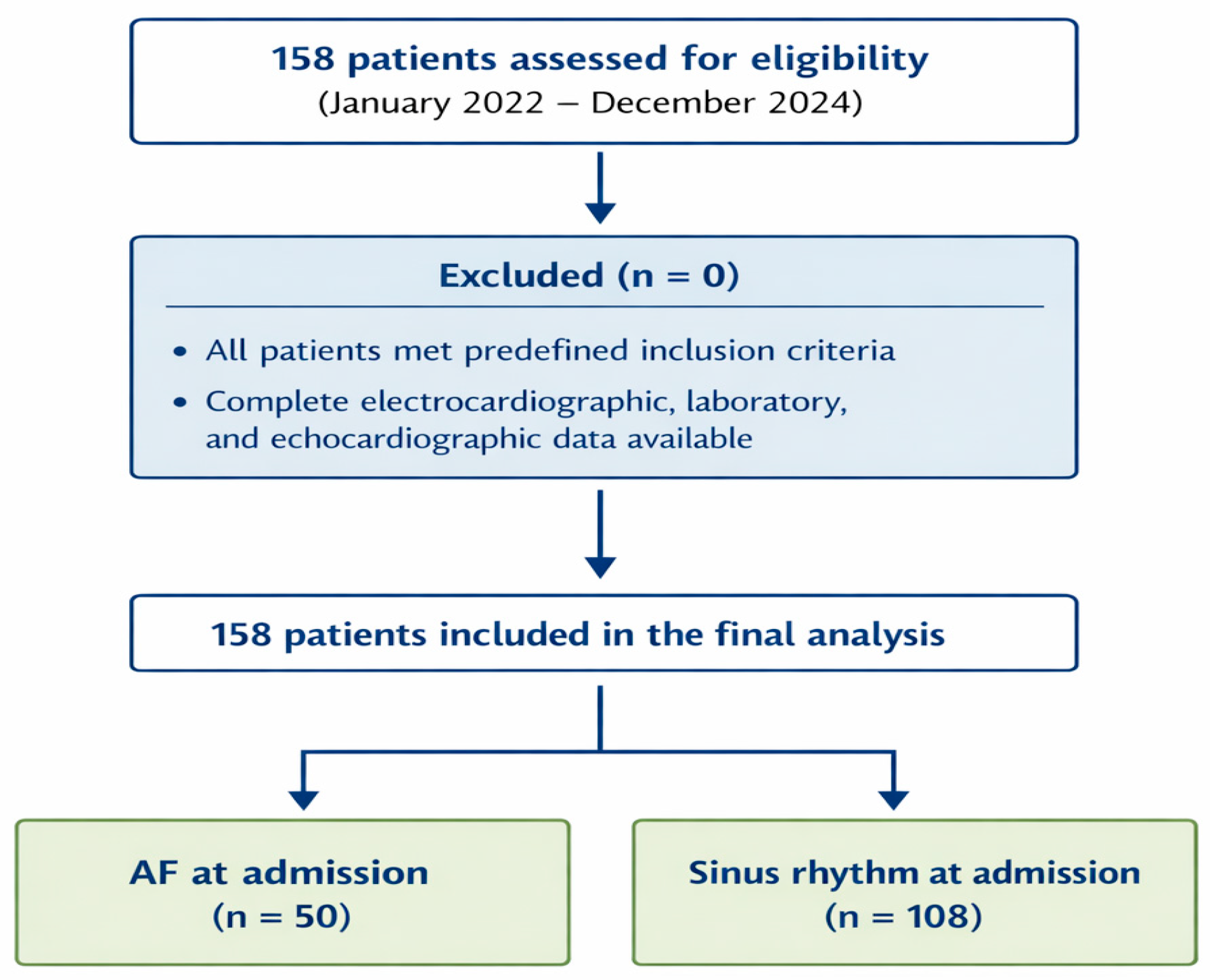
A total of 158 patients diagnosed with acute coronary syndrome between January 2022 and December 2024 were included. The study population consisted of 50 patients with atrial fibrillation (AF group) and 108 patients in sinus rhythm (non-AF group). The study flow diagram is presented in Figure 1. Baseline demographic, clinical, laboratory, and echocardiographic characteristics according to AF status are shown in Table 1.
Figure 1.
Study flow diagram.
Table 1.
Baseline demographic and clinical characteristics of the study population.
Patients with AF were significantly older than those in sinus rhythm (71.2 ± 11.4 vs. 60.7 ± 10.3 years, p < 0.001). Hypertension was significantly more prevalent in the AF group, whereas the prevalence of diabetes mellitus did not differ significantly between groups. Resting heart rate on admission was markedly higher in the AF group (102 ± 21 vs. 84 ± 17 bpm, p < 0.001). Systolic blood pressure values were similar between groups, whereas diastolic blood pressure tended to be lower in patients with AF.
A more pronounced hemodynamic compromise was observed among patients with AF. The proportion of patients presenting with Killip class ≥ II was significantly higher in the AF group compared with the non-AF group (36% vs. 18%, p = 0.02). In addition, left ventricular ejection fraction was significantly lower in AF patients (44.8 ± 6.9% vs. 49.6 ± 6.3%, p < 0.001).
Laboratory analyses demonstrated higher inflammatory and myocardial injury markers in the AF group. White blood cell counts were significantly higher in patients with AF (12.8 ± 4.1 vs. 10.9 ± 3.7 × 10³/µL, p = 0.01). Peak high-sensitivity troponin levels were also higher in the AF group (9870 ± 5230 ng/L vs. 7140 ± 4820 ng/L, p = 0.02), indicating greater myocardial injury (Table 2).
Table 2.
Laboratory values and risk scores.
Risk stratification scores differed significantly between groups. Both in-hospital and post-discharge GRACE scores were higher in patients with AF (157 ± 28 vs. 131 ± 24, p < 0.001, and 176 ± 26 vs. 148 ± 23, p < 0.001, respectively). Similarly, NSTEMI-TIMI scores were significantly elevated in the AF group (4.2 ± 1.2 vs. 3.4 ± 1.0, p = 0.02).
With respect to revascularization strategies, percutaneous coronary intervention was performed in 62% of AF patients and 74% of non-AF patients, with no statistically significant difference between groups (p = 0.11). Referral for coronary artery bypass grafting was numerically more frequent in the AF group, although this difference did not reach statistical significance (14% vs. 7%, p = 0.18). The prevalence of severe angina at presentation was numerically higher among patients with AF compared with those in sinus rhythm, although this difference did not reach statistical significance (44% vs. 29%, p = 0.07) (Table 3).
Table 3.
Treatment strategies and echocardiographic outcomes.
In multivariable logistic regression analysis, atrial fibrillation at presentation was independently associated with a high GRACE score (≥140) after adjustment for age, sex, hypertension, diabetes mellitus, peak troponin level, white blood cell count, left ventricular ejection fraction, and ACS subtype. AF remained a significant determinant of high-risk presentation (adjusted OR: 2.31; 95% CI: 1.18–4.53; p = 0.014).
Flowchart illustrating patient screening and cohort selection in this single-center retrospective study of consecutive adult patients admitted with acute coronary syndrome between January 2022 and December 2024. All 158 assessed patients met the predefined inclusion criteria and had complete electrocardiographic, laboratory, and transthoracic echocardiographic data; therefore, no patients were excluded after eligibility assessment (excluded, n = 0). Patients were categorized according to cardiac rhythm at presentation as atrial fibrillation (AF, n = 50) or sinus rhythm (n = 108).
5. Discussion
In this retrospective cohort of patients with acute coronary syndrome (ACS), the presence of atrial fibrillation (AF) was strongly associated with a high-risk hemodynamic profile accompanied by increased inflammatory activity characterized by higher heart rate, reduced left ventricular systolic function, elevated inflammatory markers, and significantly higher GRACE scores. These findings reinforce the growing evidence that AF in the setting of ACS is more than an accompanying rhythm disturbance; rather, it signals a vulnerable clinical state with amplified hemodynamic stress and systemic inflammatory activation. Previous studies have similarly shown that AF identifies patients with increased metabolic and ischemic burden, and our results extend these observations to a contemporary real-world cohort treated between 2022 and 2024 [10]. Given the retrospective and observational design of the present study, these findings should be interpreted as associations rather than evidence of a causal relationship between atrial fibrillation and adverse hemodynamic or inflammatory profiles.
The association between AF and higher GRACE scores in our population is particularly noteworthy. GRACE scoring incorporates hemodynamic instability, renal function, age, and biomarker elevation parameters that are frequently accentuated in AF patients, as demonstrated in our dataset. Prior investigations have reported that AF independently predicts higher GRACE and TIMI scores in ACS, even after adjusting for age and comorbidities. Our results confirm this relationship and suggest that AF may serve as an early clinical marker of global ischemic severity rather than simply a byproduct of adrenergic activation. It should also be emphasized that age and heart rate, both of which were significantly higher in patients with atrial fibrillation, are integral components of the GRACE risk score. Accordingly, the higher GRACE values observed in the AF group should be interpreted as reflecting a clustering of adverse clinical features rather than a direct causal effect of atrial fibrillation on GRACE score elevation.
The impaired ejection fraction observed in the AF group provides further mechanistic insight. Experimental and clinical studies indicate that AF induces loss of atrial contribution to ventricular filling, promotes tachycardia-induced cardiomyopathy, and precipitates subendocardial ischemia by shortening diastolic perfusion time [11]. These adverse hemodynamic effects of atrial fibrillation on left ventricular function have been consistently demonstrated in both experimental and clinical studies, supporting its role as a marker of impaired cardiac performance during acute ischemic states [12]. In ACS, this vulnerable state is exacerbated by microvascular dysfunction, increased left ventricular end-diastolic pressure, and catecholamine surge. Our findings, therefore, support the hypothesis that AF magnifies ischemic stress at both the microvascular and chamber-function levels. Emerging evidence suggests that early rhythm control strategies may improve cardiovascular outcomes in high-risk atrial fibrillation populations; however, data specifically addressing rhythm control during the acute phase of ACS remain limited [13]. In the setting of acute coronary syndrome, these hemodynamic effects raise the question of whether early rhythm control strategies may provide clinical benefit in selected patients with atrial fibrillation. Recent evidence suggests that early rhythm control may improve cardiovascular outcomes in high-risk AF populations; however, data specifically addressing rhythm control strategies during the acute phase of ACS remain limited and warrant further investigation.
However, it should be acknowledged that atrial fibrillation was classified based on the rhythm documented at hospital admission, and detailed information regarding the duration of AF or differentiation between new-onset and pre-existing AF was not systematically available due to the retrospective design. The distinction between new-onset atrial fibrillation occurring as a consequence of the index ACS event and pre-existing atrial fibrillation is clinically meaningful, as these phenotypes may differ with respect to underlying mechanisms, inflammatory activation, and prognostic implications. New-onset AF may reflect acute ischemic stress, catecholamine surge, and transient hemodynamic deterioration, whereas chronic AF is more likely to represent advanced atrial remodeling and long-standing cardiovascular disease. The inability to distinguish between these entities in the present study should therefore be considered when interpreting the observed associations.
The inflammatory profile of AF patients in our cohort, reflected by higher leukocyte counts, also aligns with well-established biological pathways. AF is known to be intertwined with systemic inflammation, endothelial dysfunction, and a pro-thrombotic milieu, all of which are already heightened in ACS. Inflammation-driven electrophysiological remodeling may further perpetuate AF episodes, creating a vicious cycle that accelerates clinical deterioration. Although inflammatory assessment was limited to routine laboratory parameters, our findings emphasize that identifying and treating modifiable inflammatory contributors may hold prognostic relevance.
With respect to treatment strategies, although revascularization rates did not differ significantly between groups, AF patients frequently presented with greater clinical instability. Similar observations have been described in earlier registries and meta-analyses, suggesting that clinicians may perceive AF as a marker of higher ischemic risk and lower tolerance to medical therapy alone [6]. Whether AF independently influences revascularization decisions remains debated; however, our real-world data indicate that AF often coexists with broader clinical vulnerability rather than directly dictating invasive management.
Taken together, the present study bridges pathophysiological, clinical, and risk-stratification perspectives by demonstrating that AF conveys a multi-dimensional risk signal in ACS. This reinforces the need for early rhythm assessment, tailored hemodynamic optimization, adequate rate or rhythm control strategies, and potentially closer follow-up after hospital discharge. Future studies incorporating long-term outcomes, advanced imaging markers (such as myocardial strain or microvascular dysfunction indices), and inflammatory biomarkers beyond routine parameters may further clarify the causal pathways underlying AF–ACS interactions. Importantly, we acknowledge that age and heart rate are integral components of the GRACE score; therefore, the higher GRACE values observed in AF patients should be interpreted as a reflection of their overall clinical severity rather than as a novel independent prognostic construct.
6. Limitations
This study has several limitations. First, its retrospective nature introduces unavoidable selection and information biases. Atrial fibrillation was classified based on the electrocardiographic rhythm documented at hospital admission, and detailed information regarding the exact timing and duration of AF episodes prior to admission, including differentiation between new-onset and pre-existing AF, was not systematically available. The relatively limited sample size and number of atrial fibrillation cases may increase the risk of model overfitting; therefore, regression results should be interpreted with caution and viewed as hypothesis-generating. Because only patients with complete electrocardiographic, laboratory, and echocardiographic datasets were included in the final analytic cohort, selection bias cannot be fully excluded and should be considered when interpreting the findings.
Although all clinical and laboratory variables were extracted from standardized electronic medical records, unmeasured confounders such as duration of AF episodes, prior paroxysmal AF history, exact timing of AF onset during ACS presentation, and detailed medication adjustments could not be fully assessed. Second, the study included only a single tertiary referral center, which may limit the generalizability of the findings to broader populations with different demographic or treatment characteristics. Third, long-term outcomes such as mortality, recurrent myocardial infarction, stroke, rehospitalization, and arrhythmia recurrence were not available; therefore, the prognostic implications of the identified AF-associated risk profile could not be evaluated. Fourth, inflammatory markers such as CRP, IL-6, or neutrophil-to-lymphocyte ratio were not uniformly available, restricting our ability to investigate more refined inflammatory pathways. Additionally, diabetes mellitus severity parameters and standardized angiographic complexity scores such as the SYNTAX score were not systematically available or calculated in this retrospective cohort, which may have limited a more granular assessment of metabolic burden and coronary anatomy severity. Finally, although multivariable models were adjusted for clinically relevant covariates, the relatively limited number of patients with atrial fibrillation raises the possibility of model instability and overfitting. Therefore, the regression findings should be interpreted as exploratory and hypothesis-generating.
7. Conclusions
In patients presenting with acute coronary syndrome, atrial fibrillation at admission is associated with a more adverse hemodynamic and inflammatory profile. Rather than implying causality, atrial fibrillation appears to function as a readily identifiable clinical marker of heightened vulnerability that may assist early risk stratification in acute coronary syndrome.
Author Contributions
Conceptualization: G.Y.A. and E.B.; Methodology: G.Y.A.; Data Collection: G.Y.A.; Formal Analysis: G.Y.A.; Writing—Original Draft: G.Y.A.; Writing—Review and Editing: E.B.; Supervision: E.B. All authors have read and agreed to the published version of the manuscript.
Funding
This research received no external funding.
Institutional Review Board Statement
The study was conducted in accordance with the Declaration of Helsinki. Ethical approval was obtained from the Gazi Yaşargil Training and Research Hospital Clinical Research Ethics Committee (approval code 729 and date of approval on 7 November 2025).
Informed Consent Statement
Written informed consent was waived due to the retrospective nature of the study and the use of anonymized patient data, in accordance with the approval of the local Clinical Research Ethics Committee.
Data Availability Statement
The data supporting the findings of this study are available upon reasonable request.
Conflicts of Interest
The authors declare no conflicts of interest.
References
- Freedman, B.; Potpara, T.S.; Lip, G.Y.H. Stroke prevention in atrial fibrillation. Lancet 2016, 388, 806–817. [Google Scholar] [CrossRef] [Scilit] [PubMed]
- Boriani, G.; Vitolo, M.; Diemberger, I.; Proietti, M.; Valenti, A.C.; Malavasi, V.L.; Lip, G.Y.H. Optimizing indices of atrial fibrillation susceptibility and burden to evaluate atrial fibrillation severity, risk and outcomes. Cardiovasc. Res. 2021, 117, 1–21. [Google Scholar] [CrossRef] [Scilit] [PubMed]
- January, C.T.; Wann, L.S.; Calkins, H.; Chen, L.Y.; Cigarroa, J.E.; Cleveland, J.C., Jr.; Ellinor, P.T., Jr.; Ezekowitz, M.D.; Field, M.E.; Furie, K.L.; et al. 2019 AHA/ACC/HRS guideline for atrial fibrillation management. Circulation 2019, 140, e125–e151. [Google Scholar] [CrossRef] [Scilit] [PubMed]
- Zhang, S.; Diao, J.; Qi, C.; Jin, J.; Li, L.; Gao, X.; Gong, L.; Wu, W. Predictive value of neutrophil to lymphocyte ratio in patients with acute ST segment elevation myocardial infarction after percutaneous coronary intervention: A meta-analysis. BMC Cardiovasc. Disord. 2018, 18, 1–8. [Google Scholar] [CrossRef] [Scilit] [PubMed]
- Gudnadottir, G.S.; James, S.K.; Andersen, K.; Lagerqvist, B.; Thrainsdottir, I.S.; Ravn-Fischer, A.; Varenhorst, C.; Gudnason, T. Outcomes after STEMI in old multimorbid patients with complex health needs and the effect of invasive management. Am. Hear. J. 2019, 211, 11–21. [Google Scholar] [CrossRef] [Scilit] [PubMed]
- Lopes, R.D.; Pieper, K.S.; Horton, J.R.; Al-Khatib, S.M.; Newby, L.K.; Mehta, R.H.; Van de Werf, F.; Armstrong, P.W.; Mahaffey, K.W.; A Harrington, R.; et al. Short- and long-term outcomes following atrial fibrillation in patients with acute coronary syndromes with or without ST-segment elevation. Heart 2008, 94, 867–873. [Google Scholar] [CrossRef] [Scilit] [PubMed]
- Fox, K.A.A.; Dabbous, O.H.; Goldberg, R.J.; Pieper, K.S.; Eagle, K.A.; Van de Werf, F.; Avezum, Á.; Goodman, S.G.; Flather, M.D.; Anderson, F.A.; et al. Prediction of risk of death and myocardial infarction in the six months after presentation with acute coronary syndrome: Prospective multinational observational study (GRACE). BMJ 2006, 333, 1091. [Google Scholar] [CrossRef] [Scilit] [PubMed]
- Fontoura, D.; Oliveira-Pinto, J.; Tavares-Silva, M.; Leite, S.; Vasques-Nóvoa, F.; Mendes-Ferreira, P.; Lourenço, A.P.; Leite-Moreira, A.F. Myocardial and anti-inflammatory effects of chronic bosentan therapy in monocrotaline-induced pulmonary hypertension. Rev. Port. Cardiol. 2014, 33, 213–222. [Google Scholar] [CrossRef] [Scilit] [PubMed]
- Reinstadler, S.J.; Stiermaier, T.; Eitel, C.; Fuernau, G.; Saad, M.; Pöss, J.; de Waha, S.; Mende, M.; Desch, S.; Metzler, B.; et al. Impact of Atrial Fibrillation During ST-Segment–Elevation Myocardial Infarction on Infarct Characteristics and Prognosis. Circ. Cardiovasc. Imaging 2018, 11, e006955. [Google Scholar] [CrossRef] [Scilit] [PubMed]
- Ibanez, B.; James, S.; Agewall, S.; Antunes, M.J.; Bucciarelli-Ducci, C.; Bueno, H.; Caforio, A.L.P.; Crea, F.; Goudevenos, J.A.; Halvorsen, S.; et al. 2017 ESC Guidelines for the management of acute myocardial infarction in patients presenting with ST-segment elevation. Eur. Heart J. 2018, 39, 119–177. [Google Scholar] [CrossRef] [Scilit]
- Collet, J.-P.; Thiele, H.; Barbato, E.; Barthélémy, O.; Bauersachs, J.; Bhatt, D.L.; Dendale, P.; Dorobantu, M.; Edvardsen, T.; Folliguet, T.; et al. 2020 ESC Guidelines for the management of acute coronary syndromes in patients presenting without persistent ST-segment elevation. Eur. Heart J. 2021, 42, 1289–1367. [Google Scholar] [CrossRef] [Scilit] [PubMed]
- Stojadinović, P.; Deshraju, A.; Wichterle, D.; Fukunaga, M.; Peichl, P.; Kautzner, J.; Šramko, M. The hemodynamic effect of simulated atrial fibrillation on left ventricular function. J. Cardiovasc. Electrophysiol. 2022, 33, 2569–2577. [Google Scholar] [CrossRef] [Scilit] [PubMed]
- Kirchhof, P.; Camm, A.J.; Goette, A.; Brandes, A.; Eckardt, L.; Elvan, A.; Fetsch, T.; van Gelder, I.C.; Haase, D.; Haegeli, L.M.; et al. Early Rhythm-Control Therapy in Patients with Atrial Fibrillation. N. Engl. J. Med. 2020, 383, 1305–1316. [Google Scholar] [CrossRef] [Scilit] [PubMed]

Disclaimer/Publisher’s Note: The statements, opinions and data contained in all publications are solely those of the individual author(s) and contributor(s) and not of MDPI and/or the editor(s). MDPI and/or the editor(s) disclaim responsibility for any injury to people or property resulting from any ideas, methods, instructions or products referred to in the content. |
© 2026 by the authors. Licensee MDPI, Basel, Switzerland. This article is an open access article distributed under the terms and conditions of the Creative Commons Attribution (CC BY) license.