


Abstract
Background: Sortilin (SORT1), linked to the 1p13.3 coronary risk locus, is implicated in lipid trafficking and atherogenesis; however, clinical studies of circulating SORT1 have produced inconsistent results. We evaluated whether circulating SORT1 is associated with angiographic burden and lesion localization in patients with premature or early clinical debut coronary atherosclerosis. Methods: This single-center, cross-sectional study analyzed a dataset collected from January to May 2023. Participants were classified as coronary atherosclerosis cases if the dataset contained an age of clinical debut of clinically significant atherosclerosis (n = 101). Controls had no recorded debut age and 0% stenosis in all assessed coronary segments (n = 27). Blood was collected in clot activator tubes; serum was stored at −40 °C until analysis. SORT1 (ng/mL) was measured using an Aviscera Bioscience ELISA. Coronary stenoses were recorded as percent diameter stenosis for left main (LM), proximal/mid/distal LAD, proximal/mid/distal LCx, and proximal/mid/distal RCA. Burden metrics included the number of segments with any stenosis (>0%), the number of obstructive segments (≥50%), the number of diseased vessels, and maximum stenosis. The prespecified primary endpoint was obstructive proximal LAD stenosis (≥50%). Nonparametric tests and Spearman correlations were used. Logistic regression evaluated the association between log2-transformed SORT1 and proximal LAD obstruction, adjusted for age, sex, LDL-C, statin use, and smoking/diabetes/hypertension durations. Results: SORT1 was higher in cases than controls (8.60 [2.60–17.10] vs. 2.30 [1.25–10.65] ng/mL; p = 0.0058). Within cases, SORT1 did not correlate with global angiographic burden (any-stenosis segments: ρ = −0.066, p = 0.513; obstructive segments: ρ = −0.060, p = 0.552; diseased vessels: ρ = −0.045, p = 0.652; maximum stenosis: ρ = −0.084, p = 0.403). Obstructive proximal LAD stenosis occurred in 44/101 (43.6%) and was associated with higher SORT1 (12.25 [4.18–17.45] vs. 4.10 [2.20–11.60] ng/mL; p = 0.0093). Each doubling of SORT1 was independently associated with proximal LAD obstruction (adjusted OR 1.48, 95% CI 1.12–1.95; p = 0.005). Conclusions: In this cross-sectional cohort, circulating SORT1 was associated with obstructive proximal LAD stenosis but not with global angiographic burden metrics. These findings are hypothesis-generating and warrant validation in independent cohorts with standardized preanalytics and prospective designs to assess temporal relationships and clinical utility.
1. Introduction
Premature or early clinical debut of coronary artery disease (CAD) remains a high-impact clinical phenotype, associated with a long lifetime exposure to risk and a high probability of recurrent events. In such patients, classical lipid indices and traditional risk factors do not always capture biological heterogeneity, and there is continued interest in biomarkers that reflect upstream pathways and may improve phenotyping beyond “presence/absence” or crude burden metrics.
Sortilin (SORT1) emerged as a compelling candidate after large-scale genetic studies highlighted the chromosome 1p13.3 locus as one of the most reproducible signals associated with LDL-cholesterol and coronary risk. Subsequent functional work nominated SORT1 as the causal gene at this locus and provided mechanistic links between regulatory variation at 1p13.3 and lipoprotein metabolism—placing SORT1 at the intersection of genetics, lipid biology, and myocardial infarction risk [1,2,3].
At the molecular level, SORT1 is an intracellular sorting receptor involved in cargo trafficking. Experimental studies demonstrated that SORT1 can interact with apoB-containing lipoprotein pathways and modulate hepatic lipoprotein secretion and LDL handling in vivo, offering a biologically plausible route from SORT1 variation to altered circulating atherogenic lipoproteins [2,4]. Importantly, even within mechanistic literature, the field has debated the directionality and context of SORT1’s effects, and early commentaries and integrative reviews emphasized that differences in experimental models, expression levels, and cellular context can yield apparently discrepant findings [5,6].
Over the last decade, interest in SORT1 has broadened beyond hepatic lipid trafficking. Reviews have summarized roles for SORT1 across cardiovascular and metabolic disease pathways, including potential links to vascular inflammation, calcification, and extracellular vesicle biology—features that could connect SORT1 not only to lipid levels but also to plaque-related processes [7]. Together, these data have supported a growing perception of SORT1 as a multifunctional protein relevant to atherosclerosis biology, making it an attractive candidate biomarker and potential therapeutic target [7,8].
In parallel, numerous clinical studies have examined whether circulating (soluble) SORT1 could serve as a biomarker for CAD and related phenotypes. Several reports found higher circulating SORT1 in CAD cohorts and/or associations with metabolic risk traits, raising the possibility that soluble SORT1 may provide clinically useful information [9]. However, clinical evidence has remained inconsistent. A prominent re-evaluation in a well-characterized cohort undergoing coronary CT angiography measured plasma SORT1 using two different platforms (an in-house ELISA and OLINK) and concluded that effect sizes and discrimination were insufficient for meaningful clinical risk stratification in that setting [10]. Narrative synthesis articles similarly highlighted variability across studies and generally small sample sizes, reinforcing that “circulating SORT1” is not yet a settled biomarker [8,10].
A key reason for heterogeneity may be that soluble SORT1 reflects multiple biological sources and is sensitive to preanalytical and therapeutic factors. Notably, soluble SORT1 has been shown to be released by activated platelets, and circulating levels may relate to platelet activation biology—introducing potential confounding by antiplatelet therapy and by clinical context (e.g., symptomatic CAD) [10]. In addition, differences in sample matrix (serum vs. plasma), processing and storage conditions, and assay epitope specificity can further complicate cross-study comparability and interpretation—an issue repeatedly emphasized in biomarker reassessments and reviews [10].
Another underexplored dimension is anatomical phenotyping. CAD “severity” is often summarized by global metrics such as the number of diseased vessels or the count of stenotic segments, yet these measures may not capture clinically meaningful disease patterns. Obstructive disease in the proximal left anterior descending artery (proximal LAD) represents a high-consequence localization and may reflect distinct hemodynamic and biological conditions compared with distal or non-LAD territories. If soluble SORT1 is partly driven by plaque activity, vascular signaling, or platelet activation rather than accumulated plaque burden, it may relate more strongly to specific anatomical patterns than to global stenosis counts. This perspective may help reconcile why some cohorts show associations while others do not when only global endpoints are used [10,11].
Therefore, in a cohort defined by premature or early clinical debut coronary atherosclerosis, we evaluated whether circulating SORT1 is associated with (1) the presence of angiographic coronary atherosclerosis and (2) angiographic burden and lesion localization, with a prespecified focus on obstructive proximal LAD stenosis (≥50%) as an anatomically and clinically meaningful endpoint.
Objective: We aimed to evaluate whether circulating SORT1 is associated with global angiographic burden measures and with a prespecified anatomy-specific phenotype (obstructive proximal LAD stenosis) in patients with premature/early clinical debut coronary atherosclerosis.
2. Materials and Methods
This cross-sectional observational study used a dataset collected between January and May 2023 at the Scientific Research Institute—Regional Clinical Hospital No. 1 named after Prof. S.V. Ochapovsky (Krasnodar, Russia). The study is reported in accordance with the Strengthening the Reporting of Observational Studies in Epidemiology (STROBE) guidelines [12].
The study protocol was approved by the Local Ethics Committee (protocol No. 150, approved 27 October 2022). The study was conducted in accordance with ethical principles for medical research involving human participants.
Participants were classified into two groups using dataset fields:
- Coronary atherosclerosis group (cases): recorded age of clinical debut of clinically significant atherosclerosis (n = 101).
- Controls: no recorded debut age and 0% stenosis in all recorded coronary segments (n = 27).
This single-center cross-sectional study used consecutive sampling from routine clinical practice during the prespecified study period. No a priori sample size calculation was performed. The control group size reflects the availability of patients undergoing clinically indicated coronary angiography who were found to have angiographically normal coronary arteries and met eligibility criteria.
Inclusion criteria were the availability of complete segment-level stenosis values for all recorded segments and a measured sortilin value. Analyses were conducted as complete-case analyses; participants with missing values for variables required in a given analysis were excluded from that analysis.
Premature/early clinical debut CAD was defined as the first clinically significant coronary atherosclerosis documented at age ≤ 55 years in our clinical dataset.
Venous blood was collected in clot activator tubes. Samples were allowed to clot for 30 min before centrifugation for 15 min at 1000× g. The serum was aliquoted and stored at −40 °C for later use, avoiding repeated freeze–thaw cycles. The sample aliquots were thawed once at room temperature immediately before assay. All samples were assayed in duplicate. In all assays, intra-assay and inter-assay coefficients of variation did not exceed 6% and 9%, respectively.
Sortilin levels were measured by ELISA using the SK00472-01 kit from Aviscera Bioscience, Sunnyvale, CA, USA. The reaction was performed according to the manufacturer’s instructions. Results were read by determining optical density using an INFINITE 200 PRO M NANO (Tecan Austria GmbH, Salzburg, Austria) automated microplate reader.
Coronary angiography findings were recorded as percent diameter stenosis for 10 pre-defined segments based on the angiographic report. Segments included the left main coronary artery; proximal, mid and distal left anterior descending artery; proximal, mid and distal left circumflex artery; and proximal, mid and distal right coronary artery.
Percent diameter stenosis for each coronary segment was extracted from the angiography report and was assessed by visual estimation by two independent experienced experts. Readers were blinded to SORT1 results. In cases of disagreement, readings were resolved by consensus. Stenosis grading reflects luminal narrowing and does not quantify plaque composition or non-obstructive plaque burden.
Burden metrics (secondary endpoints):
- Any-stenosis segment count: number of segments with stenosis > 0% (range 0–10).
- Obstructive segment count: number of segments with stenosis ≥ 50% (range 0–10).
- Number of diseased vessels: dataset variable (range 0–3).
- Maximum stenosis: maximum percent stenosis across all segments.
Localization phenotype (primary endpoint, prespecified).
- Obstructive proximal LAD stenosis: LAD_prox ≥ 50%.
Statistical Analysis
Continuous variables are reported as median [IQR] and categorical variables as n (%).
Between-group comparisons used Mann–Whitney U tests for continuous variables and Fisher’s exact tests for categorical variables. Within-case associations were assessed using Spearman’s rank correlation. Logistic regression modeled obstructive proximal left anterior descending artery stenosis using log2-transformed sortilin; effect sizes are reported as odds ratios per doubling of sortilin concentration. The multivariable model adjusted for age, sex, low-density lipoprotein cholesterol, statin use, and durations of smoking, diabetes mellitus, and hypertension. In an additional sensitivity model, we further adjusted for HDL-C, triglycerides, and fibrinogen (available laboratory covariates reflecting lipid fractions and systemic inflammation/coagulation). Model discrimination was assessed using the area under the ROC curve (AUC); correlated AUCs were compared using the DeLong test. Bootstrap resampling (2000 iterations) was used to obtain 95% confidence intervals for AUC estimates and ΔAUC. To evaluate the incremental value of SORT1 beyond conventional clinical variables within this cohort, we compared a clinical covariate model (age, sex, LDL-C, statin use, and durations of smoking, diabetes, and hypertension) with and without log2-transformed SORT1. Discrimination was quantified using the area under the ROC curve (AUC), and correlated AUCs were compared using the DeLong test. Improvement in model fit after adding SORT1 was assessed using the likelihood ratio test and Akaike information criterion (AIC). As exploratory within-cohort classification metrics, continuous NRI and IDI were additionally calculated; 95% confidence intervals were obtained by bootstrap resampling.
In an additional sensitivity model, we further adjusted the primary regression for antiplatelet therapy (aspirin and P2Y12 inhibitor use). We also performed stratified age-adjusted analyses by statin use and by any antiplatelet therapy to explore robustness to treatment-related confounding.
Exploratory segment-wise analyses applied Benjamini–Hochberg false discovery rate correction across 10 segments.
Analyses were performed using Python (version 3.11) with pandas, SciPy, and statsmodels.
Two-sided p-values < 0.05 were considered statistically significant for the prespecified primary endpoint.
The authors used the assistance of an artificial intelligence language model (ChatGPT v. 5.2, OpenAI, San Francisco, CA, USA) in refining the English language, improving the structure of the manuscript, and suggesting relevant literature sources.
3. Results
A total of 128 participants met the inclusion criteria: 101 cases and 27 controls.
Within cases, the recorded age of clinical debut had a median of 47.0 [43.0–51.0] years (range 33–55).
Baseline clinical and laboratory characteristics are summarized in Table 1. Compared with controls, cases were older, more commonly male, and more frequently had hypertension and smoking exposure. Medication use (statins, aspirin, P2Y12 inhibitors) was markedly higher among cases, reflecting standard-of-care treatment in CAD.
Table 1.
Baseline characteristics by group.
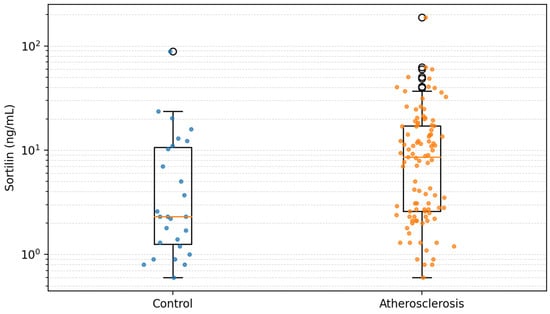
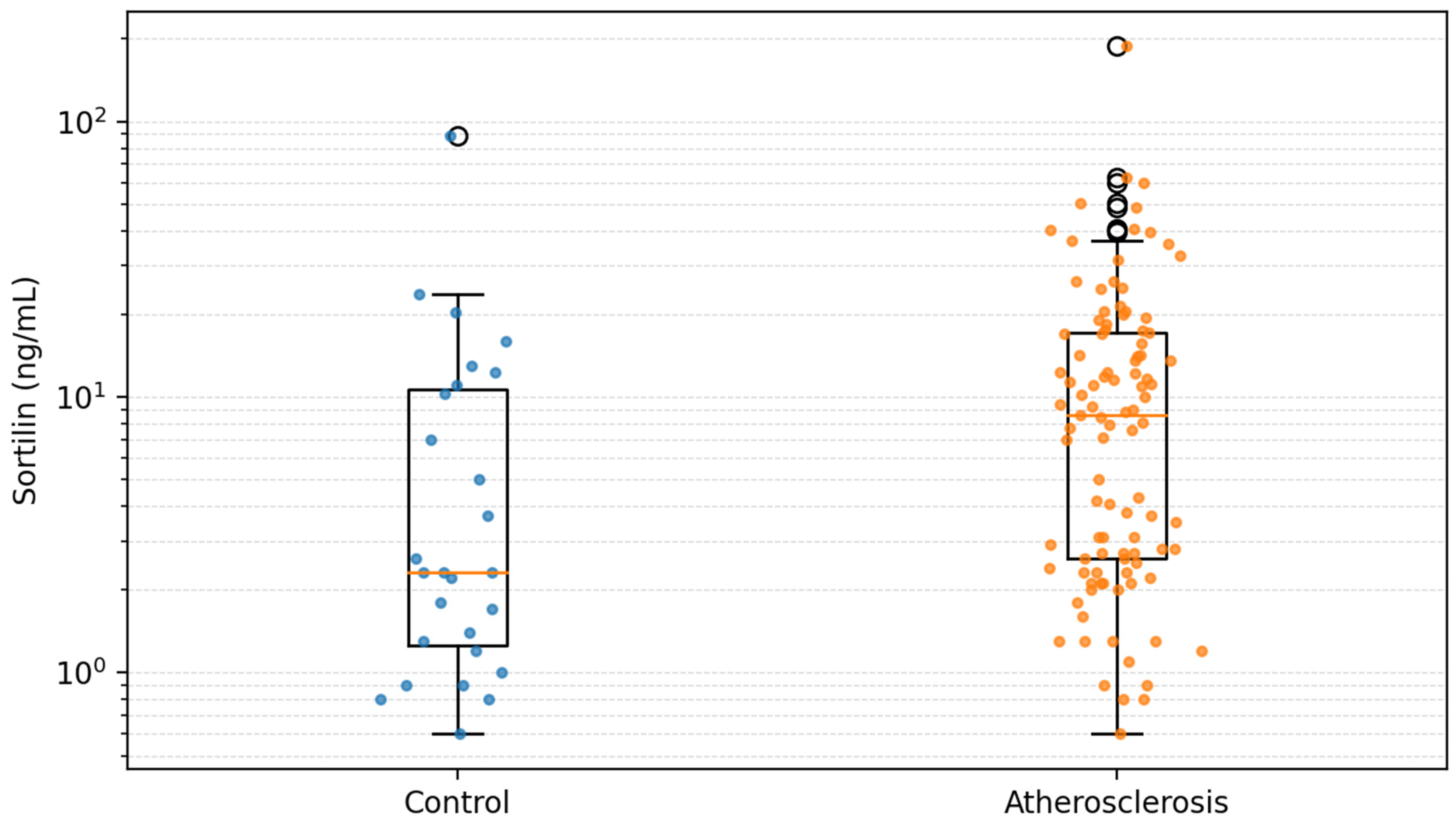
SORT1 was significantly higher in cases than controls: 8.60 [2.60–17.10] vs. 2.30 [1.25–10.65] ng/mL; p = 0.0058 (Figure 1).
Figure 1.
Distribution of circulating SORT1 in controls vs. the coronary atherosclerosis group. Box/violin plot with individual data points; values in ng/mL (log-scaled y-axis optional).
Within cases (n = 101), SORT1 did not correlate with global burden measures (Table 2):
Table 2.
SORT1 and angiographic burden within cases (Spearman).
- Any stenosis segment count: ρ = −0.066, p = 0.513;
- Obstructive segment count: ρ = −0.060, p = 0.552;
- Number of diseased vessels: ρ = −0.045, p = 0.652;
- Maximum stenosis: ρ = −0.084, p = 0.403.
These data suggest that circulating SORT1 does not function as a linear marker of angiographic “extent” in this cohort.
Obstructive proximal LAD stenosis (≥50%) was present in 44/101 (43.6%) cases.
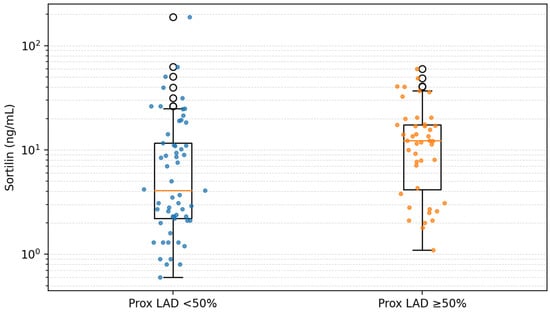
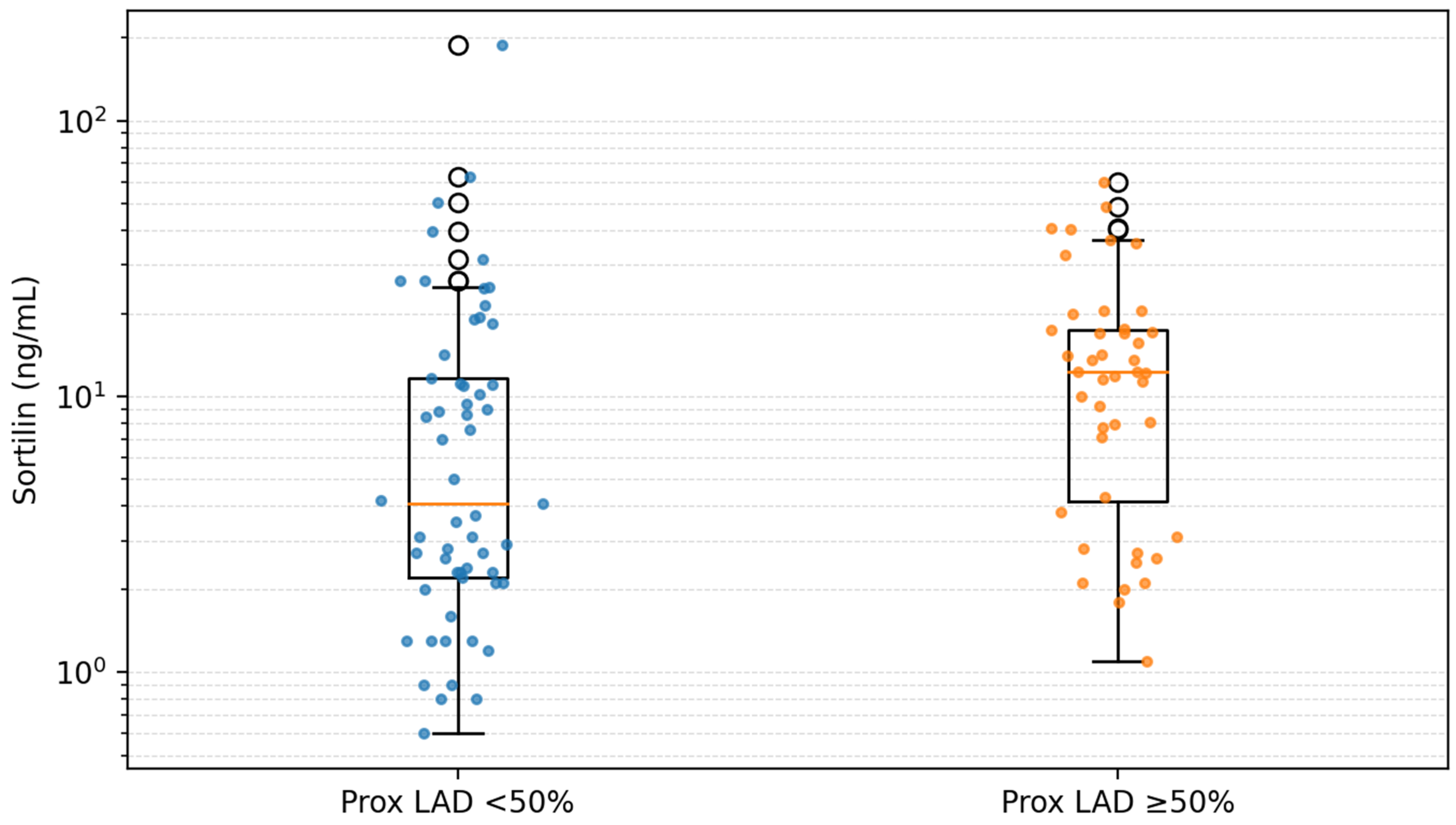
SORT1 was higher in patients with proximal LAD obstruction (Figure 2):
Figure 2.
SORT1 concentrations by proximal LAD obstruction status (LAD_prox ≥ 50% vs. <50%) among cases. Box/violin plot with individual points; annotation includes Mann–Whitney p-value and the adjusted OR from Model 1 (Table 3).
- Proximal LAD ≥ 50%: 12.25 [4.18–17.45] ng/mL;
- Proximal LAD < 50%: 4.10 [2.20–11.60] ng/mL;
- p = 0.0093.
In logistic regression, SORT1 remained independently associated with proximal LAD obstruction (Table 3). Each doubling of SORT1 concentration was associated with increased odds of obstructive proximal LAD stenosis:
Table 3.
Multivariable logistic regression models for obstructive proximal LAD stenosis (≥50%) among cases (n = 101, events = 44). Model 1 adjusted for age, sex, LDL-C, statin use, and durations of smoking, diabetes mellitus, and hypertension. Model 2 additionally adjusted for aspirin and P2Y12 inhibitor use. Model 3 additionally adjusted for HDL-C, triglycerides, and fibrinogen. SORT1 is reported per doubling (log2 scale).
- Univariable OR 1.36 (95% CI 1.07–1.74), p = 0.0137;
- Multivariable OR 1.48 (95% CI 1.12–1.95), p = 0.005.
Model discrimination for the multivariable model (Model 1) was AUC = 0.75.
In a therapy-adjusted sensitivity model additionally accounting for aspirin and P2Y12 inhibitor use (Model 2), SORT1 remained independently associated with obstructive proximal LAD stenosis (adjusted OR 1.55 per doubling; 95% CI 1.16–2.07; p = 0.003; Table 3).
In stratified age-adjusted analyses, the association between SORT1 and proximal LAD obstruction was more apparent among statin-treated patients and among those receiving any antiplatelet therapy; however, subgroup sizes were modest and these results should be interpreted cautiously (Supplementary Table S1).
In a sensitivity model additionally adjusting for HDL-C, triglycerides, and fibrinogen (Model 3), the association between SORT1 and obstructive proximal LAD stenosis remained consistent (adjusted OR 1.49 per doubling; 95% CI 1.12–1.99; p = 0.0059; Table 3). Discrimination was essentially unchanged (AUC 0.751 vs. 0.750 for Model 1; ΔAUC +0.0004, DeLong p = 0.971; bootstrap 95% CI for ΔAUC −0.0215 to +0.0239). To assess whether SORT1 provides information beyond conventional clinical covariates, we further compared clinical models with and without SORT1.
We evaluated the incremental informational value of SORT1 beyond conventional clinical covariates within this cross-sectional cohort by comparing a clinical model with and without SORT1. Inclusion of SORT1 improved overall model fit (likelihood ratio test p = 0.0034; ΔAIC −6.6) and increased discrimination numerically (AUC 0.702 to 0.750; ΔAUC +0.049), although the AUC change did not reach statistical significance by the DeLong test (p = 0.162), likely reflecting limited sample size and event count. Exploratory classification-improvement metrics (continuous NRI and IDI) are provided in Table 4 and should be interpreted cautiously.
Table 4.
Incremental value of circulating SORT1 when added to the clinical model for obstructive proximal LAD stenosis (≥50%) among cases (n = 101; events = 44).
Exploratory segment-wise screening across 10 segments suggested the smallest p-value for LAD; after FDR correction, non-prespecified segment-wise associations were attenuated (supporting interpretation as hypothesis-generating).
Sensitivity analyses:
Excluding extremely high SORT1 values (above Tukey’s upper fence, ≈36 ng/mL; n ≈ 10) did not materially change the direction of the proximal LAD association and tended to strengthen the adjusted effect (adjusted OR per doubling ≈ 1.7; p ≈ 0.003).
Restricting cases to those with any recorded stenosis (>0% in at least one segment; n ≈ 94) preserved the proximal LAD association (adjusted OR per doubling ≈ 1.6; p ≈ 0.003).
4. Discussion
In this single-center cohort characterized by premature or early clinical debut coronary atherosclerosis, circulating SORT1 measured in serum samples and stored at −40 °C demonstrated two consistent patterns: it was elevated in angiographically diseased participants compared with stenosis-free controls, and it was associated with obstructive proximal LAD stenosis but not with global angiographic burden metrics.
Importantly, the cross-sectional design precludes conclusions regarding causality or temporal directionality; elevated circulating SORT1 may reflect disease presence, associated inflammatory/platelet activity, or treatment patterns rather than a causal role.
The elevation of circulating SORT1 in cases supports the notion that SORT1-related biology may be enriched in CAD phenotypes. However, the lack of association with “extent” (segments, vessels, maximal stenosis) suggests that circulating SORT1 is unlikely to be a simple proxy for the cumulative angiographic burden in premature/early debut CAD. This finding aligns with the broader clinical literature reporting heterogeneous associations between soluble SORT1 and CAD severity.
The anatomy-specific association with proximal LAD obstruction is a clinically important observation. Proximal LAD lesions carry high clinical relevance and often inform management decisions. The present data therefore support a working hypothesis that circulating SORT1 may be anatomy-informative rather than burden-informative in early/premature disease.
The biological basis of an anatomy-specific association between circulating SORT1 and proximal LAD obstruction remains uncertain. Prior experimental and clinical studies suggest roles of SORT1 in lipoprotein trafficking and platelet-related biology; therefore, the observed signal is consistent with several plausible pathways linking SORT1 to atherosclerosis and thrombosis. However, in the present study, we did not measure platelet activation markers, inflammatory cytokines, or tissue expression of SORT1, and thus, mechanistic interpretations should be considered speculative.
Several non-mutually exclusive hypotheses may underlie this pattern:
- Compartmental biology and soluble SORT1 sources. Soluble SORT1 may reflect not only hepatic lipid trafficking pathways but also vascular/immune signaling and platelet activation biology. If a portion of measured circulating SORT1 is platelet-derived, associations may align more with clinically relevant anatomical disease patterns than with total stenosis counts. In addition, because serum was analyzed, clotting-related platelet activation may influence soluble protein measurements; thus, part of the association may reflect platelet-related processes and/or treatment patterns rather than a direct causal role of SORT1.
- Therapy confounding and clinical context. Statin and antiplatelet therapy were substantially more prevalent in cases. Therapy may influence circulating biomarkers directly and also indicate disease severity and clinical decision pathways (confounding by indication). Although we adjusted for statin use and other clinical covariates available in the dataset, residual confounding remains likely.
- Phenotype resolution. Burden metrics (segment counts) may be too coarse to capture biological heterogeneity. Localization phenotypes such as proximal LAD obstruction might reflect distinct plaque biology or hemodynamic environments compared with other territories.
4.1. Clinical and Research Implications
If replicated, circulating SORT1 could contribute to refined phenotyping of premature/early debut CAD, potentially pointing toward high-consequence anatomical disease. Although AUC improvement did not reach statistical significance by the DeLong test (likely reflecting limited sample size), adding SORT1 significantly improved model fit, supporting its potential incremental informational value within this cohort.
The present work should be viewed as a hypothesis-supporting clinical association study. Future directions include:
- Prospective validation in independent cohorts;
- Standardized sample handling (including matrix type, clotting/processing time, and Freeze–thaw control);
- Explicit consideration of antiplatelet exposure and platelet activation markers;
- Comparison with plaque imaging phenotypes (CTA plaque burden, calcium score, IVUS/OCT).
From a clinical modeling perspective, SORT1 provided a robust independent association with obstructive proximal LAD disease and significantly improved model fit when added to conventional covariates. However, the improvement in discrimination as quantified by AUC was modest and did not reach statistical significance, which is not unexpected in a cohort of this size and with a limited number of events. Because AUC is relatively insensitive to moderate improvements from a single biomarker, especially when baseline clinical information already offers discrimination, these findings support SORT1 as a candidate marker associated with a high-risk anatomical phenotype rather than establishing definitive clinical utility. Larger prospective cohorts with external validation are needed to determine whether SORT1 yields reproducible incremental classification benefit and whether it can contribute meaningfully to clinical decision-making.
4.2. Limitations
This study has several limitations. First, its cross-sectional design precludes causal inference and does not allow assessment of prospective clinical outcomes; therefore, the observed associations should be considered hypothesis-generating. Second, this was a single-center cohort derived from routine clinical practice with a modest sample size and a relatively small angiographically normal control group, which may limit the precision of case–control contrasts and generalizability to other populations and settings. Although we performed multivariable adjustment and therapy-aware sensitivity analyses, residual confounding—particularly confounding by indication related to lipid-lowering and antiplatelet therapies—cannot be excluded.
Angiography-based stenosis grading captures luminal narrowing but does not provide information on plaque composition, vulnerability, or non-obstructive plaque burden. Finally, because serum was analyzed, clotting-related platelet activation and other preanalytical factors may influence the measured soluble SORT1. While all samples were processed using a uniform protocol, we cannot fully exclude residual preanalytical variability; therefore, independent replication with standardized sample handling (including explicit control of clotting/processing time) and prospective validation are warranted.
5. Conclusions
Circulating SORT1 measured using an Aviscera Bioscience ELISA in serum samples stored at −40 °C was elevated in premature or early clinical debut coronary atherosclerosis compared with stenosis-free controls. Within affected patients, SORT1 was not associated with global angiographic burden but was independently associated with obstructive proximal LAD stenosis, with approximately 48% higher odds per doubling of SORT1 concentration after multivariable adjustment. These findings warrant validation in larger, standardized cohorts and support further investigation into the biological sources and clinical utility of circulating SORT1. External replication and prospective validation are required to determine generalizability and to clarify whether SORT1 provides clinically useful incremental information beyond established risk factors.
Key Home Messages
- Circulating SORT1 is higher in patients with premature/early clinical debut coronary atherosclerosis than in stenosis-free controls.
- SORT1 does not correlate with global angiographic burden metrics within cases.
- SORT1 is independently associated with obstructive proximal LAD stenosis, suggesting an anatomy-specific signal.
- Preanalytical standardization and therapy-aware interpretation are essential for future validation.
Supplementary Materials
The supporting information can be downloaded at https://www.mdpi.com/article/10.3390/cardiovascmed29020013/s1, Table S1: Stratified age-adjusted association between SORT1 and obstructive proximal LAD stenosis (≥50%) among cases.
Author Contributions
A.N. and I.G. were responsible for the conceptualization, study design, and writing of the manuscript. K.K., O.M. and D.N. contributed to patient recruitment for the study. N.I. and I.G. conducted laboratory measurements for the research objectives. All authors have read and agreed to the published version of the manuscript.
Funding
This research received no external funding.
Institutional Review Board Statement
The study was conducted in accordance with the Declaration of Helsinki and approved by the local ethics committee of the Scientific Research Institute—Regional Clinical Hospital No. 1, named after Prof. S.V. Ochapovsky (protocol #150 dated 27 October 2022) for research involving humans.
Informed Consent Statement
Informed consent was obtained from all subjects involved in the study.
Data Availability Statement
The data presented in this study are available on reasonable request from the corresponding author.
Acknowledgments
The authors acknowledge the assistance of an artificial intelligence language model (ChatGPT v. 5.2, OpenAI, San Francisco, CA, USA) in refining the English language, improving the structure of the manuscript, and suggesting relevant literature sources. The authors verified all AI-generated content, confirmed the accuracy of the scientific statements, and take full responsibility for the final version of the manuscript.
Conflicts of Interest
The authors declare no conflicts of interest.
Abbreviations
The following abbreviations are used in this manuscript:
| AUC | Area under the receiver operating characteristic curve |
| CAD | Coronary artery disease |
| ELISA | Enzyme-linked immunosorbent assay |
| FDR | False discovery rate |
| HDL-C | High-density lipoprotein cholesterol |
| IQR | Interquartile range |
| LCx | Left circumflex artery |
| LDL-C | Low-density lipoprotein cholesterol |
| LAD | Left anterior descending artery |
| OR | Odds ratio |
| RCA | Right coronary artery |
| SORT1 | Sortilin |
| STROBE | Strengthening the Reporting of Observational Studies in Epidemiology |
References
- Musunuru, K.; Strong, A.; Frank-Kamenetsky, M.; Lee, N.E.; Ahfeldt, T.; Sachs, K.V.; Li, X.; Li, H.; Kuperwasser, N.; Ruda, V.M.; et al. From noncoding variant to phenotype via SORT1 at the 1p13 cholesterol locus. Nature 2010, 466, 714–719. [Google Scholar] [CrossRef] [Scilit] [PubMed]
- Kjolby, M.; Andersen, O.M.; Breiderhoff, T.; Fjorback, A.W.; Pedersen, K.M.; Madsen, P.; Jansen, P.; Heeren, J.; Willnow, T.E.; Nykjaer, A. Sort1, encoded by the cardiovascular risk locus 1p13.3, is a regulator of hepatic lipoprotein export. Cell Metab. 2010, 12, 213–223. [Google Scholar] [CrossRef] [Scilit] [PubMed]
- Linsel-Nitschke, P.; Heeren, J.; Aherrahrou, Z.; Bruse, P.; Gieger, C.; Illig, T.; Prokisch, H.; Heim, K.; Doering, A.; Peters, A.; et al. Genetic variation at chromosome 1p13.3 affects sortilin mRNA expression, cellular LDL-uptake and serum LDL levels which translates to the risk of coronary artery disease. Atherosclerosis 2010, 208, 183–189. [Google Scholar] [CrossRef] [Scilit] [PubMed]
- Strong, A.; Ding, Q.; Edmondson, A.C.; Millar, J.S.; Sachs, K.V.; Li, X.; Kumaravel, A.; Wang, M.Y.; Ai, D.; Guo, L.; et al. Hepatic sortilin regulates both apolipoprotein B secretion and LDL catabolism. J. Clin. Investig. 2012, 122, 2807–2816. [Google Scholar] [CrossRef] [Scilit] [PubMed]
- Tall, A.R.; Ai, D. Sorting out sortilin. Circ. Res. 2011, 108, 158–160. [Google Scholar] [CrossRef] [Scilit] [PubMed]
- Strong, A.; Patel, K.; Rader, D.J. Sortilin and lipoprotein metabolism: Making sense out of complexity. Curr. Opin. Lipidol. 2014, 25, 350–357. [Google Scholar] [CrossRef] [Scilit] [PubMed]
- Goettsch, C.; Kjolby, M.; Aikawa, E. Sortilin and Its Multiple Roles in Cardiovascular and Metabolic Diseases. Arterioscler. Thromb. Vasc. Biol. 2018, 38, 19–25. [Google Scholar] [CrossRef] [Scilit] [PubMed]
- Coutinho, M.F.; Bourbon, M.; Prata, M.J.; Alves, S. Sortilin and the risk of cardiovascular disease. Rev. Port. Cardiol. 2013, 32, 793–799. [Google Scholar] [CrossRef] [Scilit] [PubMed]
- Oh, T.J.; Ahn, C.H.; Kim, B.R.; Kim, K.M.; Moon, J.H.; Lim, S.; Park, K.S.; Lim, C.; Jang, H.; Choi, S.H. Circulating sortilin level as a potential biomarker for coronary atherosclerosis and diabetes mellitus. Cardiovasc. Diabetol. 2017, 16, 92. [Google Scholar] [CrossRef] [Scilit] [PubMed]
- Møller, P.L.; Rohde, P.D.; Winther, S.; Breining, P.; Nissen, L.; Nykjaer, A.; Bøttcher, M.; Nyegaard, M.; Kjolby, M. Sortilin as a Biomarker for Cardiovascular Disease Revisited. Front. Cardiovasc. Med. 2021, 8, 652584. [Google Scholar] [CrossRef] [Scilit] [PubMed]
- Ogawa, K.; Ueno, T.; Iwasaki, T.; Kujiraoka, T.; Ishihara, M.; Kunimoto, S.; Takayama, T.; Kanai, T.; Hirayama, A.; Hattori, H. Soluble sortilin is released by activated platelets and its circulating levels are associated with cardiovascular risk factors. Atherosclerosis 2016, 249, 110–115. [Google Scholar] [CrossRef] [Scilit] [PubMed]
- von Elm, E.; Altman, D.G.; Egger, M.; Pocock, S.J.; Gøtzsche, P.C.; Vandenbroucke, J.P. The Strengthening the Reporting of Observational Studies in Epidemiology (STROBE) statement: Guidelines for reporting observational studies. PLoS Med. 2007, 4, e296. [Google Scholar] [CrossRef] [Scilit] [PubMed]

Disclaimer/Publisher’s Note: The statements, opinions and data contained in all publications are solely those of the individual author(s) and contributor(s) and not of MDPI and/or the editor(s). MDPI and/or the editor(s) disclaim responsibility for any injury to people or property resulting from any ideas, methods, instructions or products referred to in the content. |
© 2026 by the authors. Licensee MDPI, Basel, Switzerland. This article is an open access article distributed under the terms and conditions of the Creative Commons Attribution (CC BY) license.