Case Report

OCT Findings from a Spontaneously Recanalized Coronary Thrombus Treated with a Drug-Coated Balloon


1
Cardiology Division, Heart Center, Luzerner Kantonsspital, 6000 Lucerne, Switzerland
2
Faculty of Health Sciences and Medicine, University of Lucerne, 6005 Lucerne, Switzerland
*
Author to whom correspondence should be addressed.
These authors contributed equally to this work.
Cardiovasc. Med. 2026, 29(1), 11; https://doi.org/10.3390/cardiovascmed29010011

Submission received: 29 December 2025 / Revised: 6 February 2026 / Accepted: 25 February 2026 / Published: 2 March 2026

Abstract

Background: Spontaneous recanalized coronary thrombus (SRCT) is an uncommon and often underrecognized coronary pathology that may be angiographically subtle despite having functional significance. Optical coherence tomography (OCT) enables accurate diagnosis and treatment planning. However, optimal treatment strategies remain incompletely defined. Materials and Methods: A 55-year-old man presenting with severe exertional dyspnea, atypical chest pain episodes, and abnormal stress echocardiography underwent invasive coronary assessment with angiography, fractional flow reserve (FFR), and OCT. An SRCT of the left anterior descending artery (LAD) was identified and treated using OCT-guided lesion preparation followed by sirolimus-coated drug-coated-balloon (DCB) angioplasty. Results: Although there was only moderate angiographic disease, a functional assessment confirmed significant ischemia. OCT revealed a characteristic honeycomb morphology. Post-procedural OCT demonstrated satisfactory lumen gain, with preserved vessel integrity. Follow-up imaging showed vessel-healing and late lumen enlargement, and the patient remained asymptomatic. Conclusion: OCT-guided drug-coated-balloon angioplasty may be an effective “leave-nothing-behind” strategy for selected SRCT lesions, highlighting the importance of intracoronary imaging beyond angiography.

1. Introduction

SRCT represents a distinct and frequently underrecognized coronary pathology which results from organization and partial recanalization of an intracoronary thrombus [1]. SRCT was first discovered in postmortem studies which revealed multiple channels separated by thin septa that connect with each other and with the normal coronary lumen both proximally and distally [2,3]. These structural abnormalities may result from atherosclerosis-related complications, such as dissection and inflammation, or from thrombus recanalization and neovascularization processes [4]. The development of vascular channels within recanalized thrombi occurs gradually over several weeks or months, underscoring the dynamic nature of thrombus organization and recanalization within coronary arteries [3].

1.1. Angiographic Assessment and OCT Guidance

Angiographically, SRCT often appears as a hazy, braid-like, or irregular lesion with preserved distal flow (TIMI 3), with lesion complexity and hemodynamic relevance being frequently underestimated. Consequently, conventional coronary angiography alone may be insufficient for accurate diagnosis [5].
OCT has emerged as an important diagnostic modality for SRCT, characteristically revealing a “honeycomb” or “lotus-root” morphology composed of multiple intraluminal microchannels separated by thin fibrous septa, corresponding to organized thrombus with endothelialized partitions [5]. Therefore, it enables precise delineation of lesion architecture, lumen compromise, and residual thrombotic material, thereby bridging the gap between ambiguous angiographic findings and true lesion severity [5,6].

1.2. Treatment of SRCT

Regarding treatment, there is no standardized strategy for SRCT, and management is largely guided by symptoms, ischemic burden, and intracoronary imaging findings, rather than by angiographic stenosis alone. Percutaneous coronary intervention is commonly performed in symptomatic or ischemia-producing lesions. While drug-eluting stent implantation has traditionally been used, concerns remain regarding permanent metal implantation in lesions characterized by complex intraluminal channels and relatively preserved vessel architecture.
DCB angioplasty has emerged as an attractive alternative, offering effective drug delivery while avoiding permanent scaffolding. Favorable long-term outcomes following paclitaxel-coated-balloon treatment of SRCT have been reported, with OCT confirming sustained luminal patency and favorable vessel-healing at follow-up [7].
Beyond SRCT, indications for DCB therapy have expanded from in-stent restenosis to selected de novo coronary lesions. The SELUTION DeNovo randomized trial demonstrated non-inferiority of a sirolimus-eluting-balloon-based strategy compared with drug-eluting stent implantation for target vessel failure at 1 year, supporting a broader application of DCBs and reinforcing the concept of a “leave-nothing-behind” strategy in appropriately selected patients [8].
We present a case of OCT-guided treatment of SRCT using a sirolimus-coated balloon, highlighting the diagnostic value of intracoronary imaging and the evolving role of DCB therapy in complex coronary thrombotic lesions.

2. Case Presentation

2.1. Clinical Presentation

A 55-year-old man was referred for invasive coronary angiography after an abnormal stress echocardiogram. Nine years earlier, he underwent LCX stenting for myocardial infarction. He was an active smoker. As a railroad worker, his routine occupational physician follow-up included non-invasive stress-testing. He had lately noted severe exertional dyspnea (NYHA III) and atypical chest pain episodes. The dobutamine stress echocardiogram indicated relevant antero-apical wall-motion abnormalities (hypo- to akinesia), prompting further invasive evaluation. Before the initial angiography, the patient was receiving medical therapy, including aspirin (100 mg once daily), candesartan (16 mg twice daily), nebivolol (2.5 mg once daily), lercanidipine (10 mg twice daily), and statin therapy with atorvastatin (80 mg once daily).

2.2. Interventional Treatment

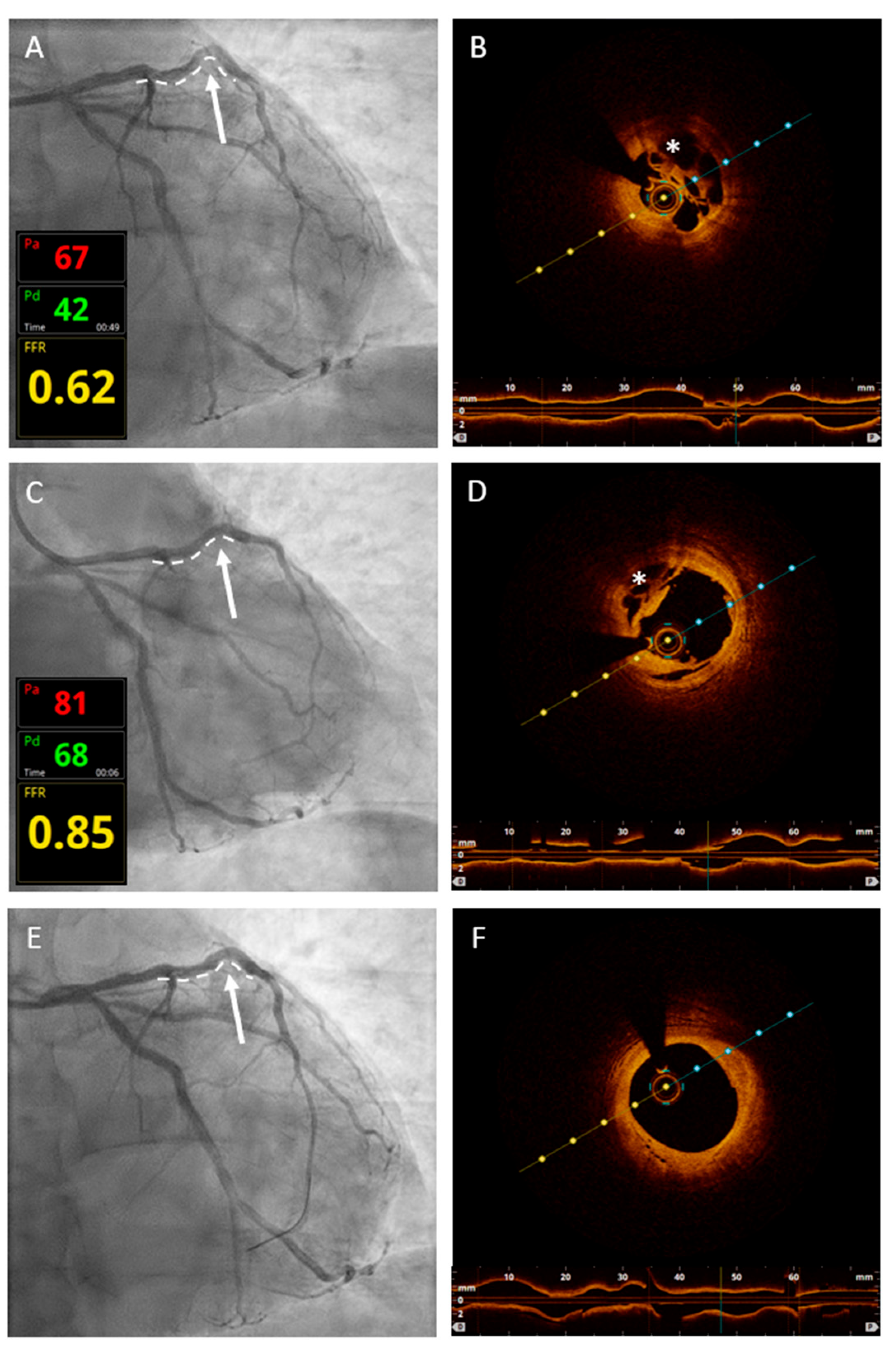
Invasive angiography showed a good long-term result after LCX stenting but revealed moderate LAD disease (Figure 1A and Supplementary Figure S1A,B, white arrow). Regarding the anterior wall-motion abnormalities, LAD FFR was performed (PressureWire™ X, Abbott, Plymouth, MN, USA), showing 0.83 at baseline and 0.63 after adenosine, below the ischemic threshold of 0.80. For percutaneous coronary intervention (PCI) planning, we obtained an OCT run (Dragonfly Opstar™ catheter, Abbott, Plymouth, MN, USA) of the LAD; this revealed a honeycomb pattern indicating SRCT (Figure 1B, asterisks) reaching from proximal to mid LAD.
Therefore, we performed pre-dilatation using a cutting balloon (Wolverine™, Boston Scientific, Marlborough, MA, USA) and a non-compliant balloon (Easy T, SIS Medical AG, Frauenfeld, Switzerland). The lesion was treated using two sirolimus-coated balloons (Selution™ SLR drug-coated balloon, 3.5 mm each, Cordis, Miami Lakes, FL, USA) inflated at 2 and 4 atm for 120 s per balloon (Supplementary Figure S1C). Final OCT demonstrated satisfactory lumen gain (minimal lumen area 3.75 mm2, residual stenosis 20%) (Figure 1C,D). The post-procedural FFR assessment of the LAD indicated a successful restoration of coronary flow.

2.3. Follow-Up

The patient remained asymptomatic during 9-month follow-up. At 3-month follow-up, angiography did not indicate late lumen loss (Figure 1E), and OCT revealed healed LAD segments with evidence of late lumen gain (MLA 4.93 mm2, residual stenosis 15%) (Figure 1F and Supplementary Figure S1D, white arrow). Following treatment of the SRCT, dual antiplatelet therapy was intensified by adding prasugrel (10 mg once daily) for a planned duration of 12 months (Table 1). At follow-up angiography, medical therapy remained unchanged except for further statin intensification aiming for an LDL-C value ≤1.40 mmol/L (≤54 mg/dL).

3. Discussion

Spontaneous recanalized coronary thrombus (SRCT) remains an underrecognized coronary pathology that may be angiographically subtle yet clinically and hemodynamically significant. This case illustrates several key aspects emphasized in prior studies, including the diagnostic limitations of angiography, the central role of optical coherence tomography (OCT), and the evolution of interventional treatment strategies [9].
Conventional coronary angiography frequently underestimates the severity and complexity of SRCT due to its inability to resolve intraluminal microstructures. As previously described in the French “Lotus Root” Registry, SRCT lesions often present as hazy or braided angiographic patterns with preserved distal flow, leading to delayed or missed diagnosis [5]. In the present case, the patient was clinically symptomatic, with severe exertional dyspnea (NYHA III) and atypical chest pain episodes; however, angiography suggesting only moderate LAD disease. This discordance between angiographic appearance and physiological relevance has been repeatedly reported, and underscores the need for adjunctive imaging when clinical findings and angiography are incongruent [5,10].
OCT has emerged as the reference imaging modality for in vivo diagnosis of coronary lesions. Characteristic findings of SRCT include a honeycomb or lotus-root morphology with multiple intraluminal microchannels separated by thin fibrous septa, corresponding histologically to organized thrombus with endothelialized partitions. Kang et al. demonstrated that these channels develop gradually over weeks to months, reflecting dynamic thrombus organization and recanalization rather than acute thrombotic events [3]. In our case, OCT not only confirmed the diagnosis of SRCT but also delineated lesion length, septal burden, and residual lumen area, directly influencing procedural planning.
Regarding treatment, there is currently no standardized strategy for SRCT, and management is largely guided by symptoms, ischemic burden, and intracoronary imaging, rather than angiographic stenosis alone. In the Lotus Root Registry, percutaneous coronary intervention was frequently performed when SRCT lesions were associated with ischemia, most commonly using drug-eluting stents [5]. However, concerns have been raised regarding permanent metal implantation in lesions with preserved vessel architecture, complex channel networks, and potential side-branch involvement [4].
Watanabe et al. reported favorable long-term outcomes following paclitaxel-coated-balloon treatment of SRCT, with OCT demonstrating sustained luminal patency, vessel healing, and an absence of late adverse remodeling [7]. These findings support the feasibility of a “leave-nothing-behind” strategy in selected SRCT cases, particularly when adequate lesion preparation is achieved. Our case also summarizes some important technical aspects which should be considered when performing DCB-PCI. Firstly, vigorous lesion preparation is key. Here, we performed lesion preparation using cutting balloons, followed by use of a non-compliant balloon to achieve optimal lumen gain. This approach is also endorsed by recent expert recommendations, and it facilitates effective drug delivery to the vessel wall, a critical determinant in DCB therapy to prevent acute vessel recoil [8]. In addition, a prolonged inflation duration of 120 s was applied to maximize sirolimus transfer to the vessel wall. Secondly, and as highlighted in this case, we rarely inflate DCBs beyond their nominal pressure; this is due to their semi-compliant design, and also because of concerns for the dog-boning effect which ultimately leads to a higher risk for flow-limiting dissections, hampering the DCB PCI result.
The interventional treatment resulted in significant lumen gain, normalization of coronary physiology, and late lumen enlargement on follow-up OCT. These observations are consistent with previous reports suggesting that disruption of fibrous septa and optimized drug delivery are critical determinants of procedural success in SRCT [7].
Despite continuous technological advances, coronary stent implantation remains associated with an approximately 2–4% rate of adverse events within the first year after implantation [8]. Beyond SRCT, the indications for DCB therapy have expanded substantially over the past decade. While initially confined to in-stent restenosis and small-vessel disease, randomized data from the SELUTION DeNovo trial demonstrated non-inferiority of a sirolimus-coated-balloon-based strategy compared with drug-eluting stents for de novo coronary lesions at 1-year follow-up [8]. These results support broader application of DCB therapy and provide a contemporary rationale for considering DCBs in complex native coronary lesions such as SRCT, where avoidance of permanent implants may be advantageous.
In summary, this case reinforces the limitations of angiography alone in diagnosing SRCT, highlights OCT as a crucial tool for diagnosis and procedural guidance, and contributes to the growing evidence supporting DCB-based intervention as a safe and effective treatment option.

Limitations

This case report is limited by its single-patient design and relatively short follow-up duration; these limitations restrict the generalizability of the findings and preclude assessment of long-term outcomes after OCT-guided drug-coated-balloon treatment of SRCT. Nonetheless, we do not foresee any reason why OCT-guided DCB angioplasty should not represent a vessel-preserving and physiologically effective strategy for management of selected patients presenting with SRCT.

4. Conclusions

This case underscores the diagnostic limitations of coronary angiography alone in spontaneous recanalized coronary thrombus, and it underscores the pivotal role of optical coherence tomography in identifying complex intraluminal architecture, assessing functional relevance, and guiding interventional strategy. OCT enabled accurate diagnosis, optimized lesion preparation, and enabled an objective evaluation of procedural success and vessel healing. In this context, drug-coated-balloon angioplasty proved to be an effective “leave-nothing-behind” treatment strategy, achieving sustained lumen gain and favorable vessel remodeling without permanent metal implantation. OCT-guided DCB therapy may therefore represent a valuable and vessel-preserving option for selected patients with SRCT.

Supplementary Materials

The following supporting information can be downloaded at: https://www.mdpi.com/article/10.3390/cardiovascmed29010011/s1, Figure S1: Identification, treatment, and healing of a spontaneously recanalized thrombus of the LAD; Video S1: Pre-procedural Cranial angiography of the LAD (RAO view); Video S2: Pre-procedural OCT of the LAD; Video S3: Cranial angiography of the LAD following PCI (RAO view); Video S4: OCT of the LAD at follow-up.

Author Contributions

Conceptualization, F.E. and L.V.; methodology, F.E. and N.v.R.; software, F.E.; validation, M.M., F.C. and M.B.; formal analysis, F.E., F.C. and M.B.; investigation, M.B.; resources, F.C. and M.B.; data curation, F.E., L.V. and N.v.R.; writing—original draft preparation, F.E. and L.V.; writing—review and editing, F.E. and M.B.; visualization, F.E.; supervision, F.C. and M.B.; project administration, F.E. and L.V. All authors have read and agreed to the published version of the manuscript.

Funding

This research received no external funding.

Institutional Review Board Statement

The study was conducted in accordance with the Declaration of Helsinki, and the protocol was approved by the Ethics Committee “Ethikkommission Norwest- und Zentralschweiz” (NCT04988685, 17 May 2021).

Informed Consent Statement

Informed consent was obtained from the patient. Data collection and analysis have been approved by the regional ethics board.

Data Availability Statement

The original contributions presented in this study are included in the article and the Supplementary Material. Further inquiries can be directed to the corresponding author.

Acknowledgments

We thank the patient for granting permission for this case vignette.

Conflicts of Interest

M.B. has received consulting and speaker fees from Abbott Vascular, Abiomed, Amarin, Amgen, Astra Zeneca, Bayer, Boehringer Ingelheim Boston Scientific, Daichii, MedAlliance, Novartis, OM Pharma, SIS Medical and Shockwave by J&J Medtech. F.C. has received consulting and speaker fees from Abbott Vascular, Abiomed and SIS Medical. All other authors declare no conflicts of interest.

Abbreviations

ACSAcute coronary syndrome
ASSAcetylsalicylic acid
CVDCardiovascular disease
DCBDrug-coated balloon
FFRFractional flow reserve
LADLeft anterior descending artery
LCXLeft circumflex artery
NYHANew York Heart Association
OCTOptical coherence tomography
PCIPercutaneous coronary intervention
RCARight coronary artery
SRCTSpontaneously recanalized coronary thrombus
TIMIThrombolysis in myocardial infarction

References

  1. Spring, D.A.; Thomsen, J.H. Recanalization in a coronary artery thrombus. Case report with cineangiographic and hemodynamic findings. JAMA 1973, 224, 1152–1155. [Google Scholar] [CrossRef] [PubMed]
  2. Souteyrand, G.; Valladier, M.; Amabile, N.; Derimay, F.; Harbaoui, B.; Leddet, P.; Barnay, P.; Malcles, G.; Mulliez, A.; Berry, C.; et al. Diagnosis and Management of Spontaneously Recanalized Coronary Thrombus Guided by Optical Coherence Tomography- Lessons From the French “Lotus Root” Registry. Circ. J. 2018, 82, 783–790. [Google Scholar] [CrossRef] [PubMed]
  3. Kang, S.J.; Nakano, M.; Virmani, R.; Song, H.G.; Ahn, J.M.; Kim, W.J.; Lee, J.Y.; Park, D.W.; Lee, S.W.; Kim, Y.H.; et al. OCT findings in patients with recanalization of organized thrombi in coronary arteries. JACC Cardiovasc. Imaging 2012, 5, 725–732. [Google Scholar] [CrossRef] [PubMed]
  4. Spinu, M.; Homorodean, C.; Ober, M.C.; Olinic, M.; Mircea, P.A.; Olinic, D.M. Optical Coherence Tomography for In Vivo Identification, Characterization and Optimal Treatment of Spontaneous Recanalization of Coronary Thrombus. In Vivo 2020, 34, 745–756. [Google Scholar] [CrossRef] [PubMed]
  5. Quevedo, F.; Farjat-Pasos, J.; Bertrand, O.; Poulin, A.; Déry, J.P.; Garcia-Labbé, D.; Nguyen, C.; Paradis, J.M.; Pinilla, N.; Cieza, T. Honeycomb or Lotus Root-Like Intracoronary Pattern: Insights From Optical Coherence Tomography of a Recanalized Thrombus. Catheter. Cardiovasc. Interv. 2025, 106, 2511–2518. [Google Scholar] [CrossRef] [PubMed]
  6. Kume, T.; Akasaka, T.; Kawamoto, T.; Ogasawara, Y.; Watanabe, N.; Toyota, E.; Neishi, Y.; Sukmawan, R.; Sadahira, Y.; Yoshida, K. Assessment of coronary arterial thrombus by optical coherence tomography. Am. J. Cardiol. 2006, 97, 1713–1717. [Google Scholar] [CrossRef] [PubMed]
  7. Watanabe, Y.; Fujino, Y.; Ishiguro, H.; Nakamura, S. Long-term outcomes of a recanalized thrombus treated with a paclitaxel-coated balloon: Insights from optical coherence tomography. Coron. Artery Dis. 2018, 29, 530–532. [Google Scholar] [CrossRef] [PubMed]
  8. Fezzi, S.; Serruys, P.W.; Cortese, B.; Scheller, B.; Alfonso, F.; Jeger, R.; Colombo, A.; Joner, M.; Shin, E.S.; Kleber, F.; et al. Indications for Use of Drug-Coated Balloons in Coronary Intervention: Academic Research Consortium Position Statement. J. Am. Coll. Cardiol. 2025, 86, 1170–1202. [Google Scholar] [CrossRef] [PubMed]
  9. Gupta, A.; Rao, K.R.; Reddy, S.S.; Kashyap, J.R.; Kadiyala, V.; Kaur, J.; Dash, D.; Kumar, S.; Dev, M. Optical coherence tomography characterization of spontaneous recanalized coronary thrombus—Single center experience. J. Cardiovasc. Thorac. Res. 2022, 14, 220–227. [Google Scholar] [CrossRef] [PubMed]
  10. Carrillo Mora, L.M.; Arrastio López, X.; Pérez Martínez, M.T.; Gimeno Blanes, J.R.; Lacunza Ruiz, F.J. Functional Significance in Spontaneous Recanalization of a Coronary Thrombus. JACC Case Rep. 2024, 29, 102471. [Google Scholar] [CrossRef] [PubMed]
Figure 1. Identification, treatment, and healing of a spontaneously recanalized thrombus of the LAD. Coronary angiography of the left coronary arteries: (A) Moderate coronary lesion of the left anterior descending artery (arrow), fractional flow reserve (FFR) measurement of 0.62; (B) OCT imaging with honeycomb pattern suggestive of an SRCT (asterisks*); (C) LAD angiography and FFR measurement following PCI with DCB; (D) OCT following PCI indicating good luminal gain and no flow-limiting dissection; (E) follow-up angiography of the LAD; and (F) follow-up OCT after 3 months illustrating good vessel healing.
Cardiovascmed 29 00011 g001
Table 1. Summary of Clinical Presentation and Baseline Characteristics.
Sex/AgeClinical Presentation at AdmissioinNoninvasive TestsCardiovascular Risk FactorsMedication
55/mDyspnea (NYHA III), atypical chest pain, history of ACS (LCX stented in 2014)Echo: antero-apical hypo- to akinesia
ECG: normal sinusrhythm, vertical QRS axis
Active smoker, adipositas, dyslipidemia, family history of CVD, arterial hypertensionASS (100 mg)
Candesartan 2 × 16 mg)
Nebivolol (2.5 mg)
Lercanidipine (2 × 10 mg)
Atorvastatin (80 mg)
ACS—Acute Coronary Syndrome, ASS—Acetylsalicylic acid, CVD—Cardiovascular Disease, LCX—Left circumflex artery.
Disclaimer/Publisher’s Note: The statements, opinions and data contained in all publications are solely those of the individual author(s) and contributor(s) and not of MDPI and/or the editor(s). MDPI and/or the editor(s) disclaim responsibility for any injury to people or property resulting from any ideas, methods, instructions or products referred to in the content.