New trends in drug therapy
The four fundamental piles which treatment of coronary artery disease is built upon are outlined in
Table 1. Treatment strategies utilising
anti-ischaemic drugs have been validated extensively. They will not be included in this essay, except for the following innovation. The well known anti-ischaemic classes of drugs are nitrates, calcium channel blockers and beta-blockers. While these compounds have been known for years, a new generation of compounds, the potassium channel openers, have recently been introduced into clinical practice. They seem to confer an equivalent anti-ischaemic potency as compared to the above mentioned classes, thus enabling the clinician to further individualise and customise drug therapy aimed at reducing the ischaemic burden of the myocardium in patients with coronary artery disease.
One of the cornerstones of coronary artery disease is
antiplatelet therapy. A recent overview by the “Antiplatelet Trialists Collaboration” comprised as much as 142 randomised trials, in which various antiplatelet regimens, mostly low-dose aspirin or ticlopidine, were compared to placebo [
1]. As a result of this meta-analysis, a one-year 29% reduction in the occurrence of myocardial infarction in patients with known coronary artery disease was documented, with sustained beneficial outcome over the following 5–10 years. These data settle the issue of the appropriateness of lifelong antiplatelet therapy, confirming this approach to be an unequivocal requirement in coronary artery disease. However, since the commonly used antiplatelet agent, aspirin, is stigmatised by potentially serious adverse effects and frequent gastrointestinal discomfort, attempts have been made to introduce alternative medications conferring the same protective effect at a higher safety and tolerability level. A recently published trial compared the new antiplatelet drug clopidogrel with aspirin in over 19 000 patients with a followup of almost 2 years [
2]. As a result, a slight but significant reduction of a combined end point of ischaemic stroke, myocardial infarction or vascular death was documented in patients receiving clopidogrel as compared to the aspirin group (relative risk reduction, 8.7%, p = 0.043) at an overall safety profile of clopidogrel at least as good as that of aspirin. Very similar trends can be expected from yet another group of platelet inhibitors, the socalled fibans (e.g., xemilofiban, tirofiban etc.). This shows that new trends are under way aiming at enhancing the quality of secondary prevention at the level of antiplatelet therapy. The other major medicine-based approach is outlined as the first item in
Table 1: risk factor modification. While only few years ago the risk factor issue evoked reflections on proposing healthy diets to the patients or advocating smoking cessation, very robust data to date indicate that
lipid lowering drug therapy is a powerful means to counteract the progression of coronary artery disease, leading to a clearcut reduction of clinical events. Specifically, in the 4S-study on secondary prevention of coronary artery disease, more than 4000 patients with average cholesterol levels of 6.8 mmol/L and LDL-cholesterol levels of 4.8 mmol/L were given simvastatin
versus placebo and followed for 6 years [
3]. As a result, an overall mortality reduction of 30% (p = 0.0003) was documented, particularly with highly significant prevention of recurrent cardiac events. Similarly, the CARE (Cholesterol And Recurrent Events [
4] study demonstrated a relative risk reduction of 24% for myocardial infarction and cardiac death in a population with only moderately elevated cholesterol levels, i.e., 5.4 mmol/L total cholesterol and 3.6 mmol/L LDL-cholesterol, treated with pravastatin versus placebo. These data lend convincing evidence to the decisive requirement of appropriate lipid lowering drug therapy in patients with coronary artery disease.
Finally, one more aspect of medicine-based trends shall be mentioned. One of the crucial issues in the treatment of coronary artery disease is the management of acute myocardial infarction, since this syndrome is immediately life threatening and, moreover, a frightening experience for our patients. In-hospital mortality of patients with acute myocardial infarction has been gradually decreasing during the last decades: while the introduction of continuous rhythm monitoring in the early sixties allowed for antiarrhythmic intervention, thus reducing early mortality from 30% to about 20%, the advent of thrombolytic therapy and/or acute catheter revascularisation procedures conferred an additional strong benefit on early mortality. To date, acute myocardial infarction treated with state-of-the-art strategies has an in-hospital mortality fairly below 10%, i.e., typically 6.5% [
5]. In this respect, pharmacological thrombolysis has truly revolutionised our approach to treatment of acute myocardial infarction in the late eighties and early nineties. In contrast to these achievements, late mortality after myocardial infarction has been as high as 30% after 5 years, with only slow progress in terms of improvement during the last decades. The reason for this is that, as a result of infarcted myocardium, a dynamic pathophysiological process of left ventricular enlargement, known as left ventricular remodelling, occurs, ultimately leading to congestive heart failure. In fact, the syndrome of heart failure is one of the greatest challenges to the cardiovascular community today, with a yearly mortality rate of 15–30% [
6]. Fortunately, powerful drugs, i.e.,
angiotensin-converting-enzyme inhibitors, have been introduced in the late eighties which are capable of preventing left ventricular remodelling. This has been investigated in a host of survival studies after myocardial infarction to document the beneficial effects of these drugs, having included more than 100 000 patients in a placebocontrolled, blinded fashion. Collectively, these investigations published under the acronyms of SAVE, CONSENSUS 11, AIRE, GISS1-3, ISIS-4, SMILE and TRACE represent one of the most exhaustive evaluations of a medical treatment strategy ever done, confirming the long-term advantage of post-infarction treatment regarding myocardial function and, most importantly, survival. In this context, the concept emerged that the deleterious pathophysiological sequence conferred through the reninangiotensin system could not only be blocked by angiotensin-converting-enzyme inhibition, but by angiotensin-receptor blockage as well. This newest type of drugs has recently been evaluated in the ELITE-trial, in which more than 700 patients with congestive heart failure and an average left ventricular ejection fraction of 30% were randomly assigned to either captopril or losartan [
7]. Examination of the baseline characteristics of these patients reveals that approximately two thirds of the overall population had ischaemic heart disease as underlying cause for heart failure, making this study a pertinent piece of evidence in the context of coronary artery disease. Surprisingly, all-cause one-year mortality in losartan-treated patients was only 3.7% as compared to a 8.5% mortality rate in captopril-treated patients, representing a highly significant relative risk reduction of 57%. Obviously, further studies are required to solidify this tremendous finding. Nevertheless, this fact demonstrates that the cardiovascular community in its strive for more secure and potent therapeutic approaches can, at times, anticipate true rewards to the benefit of patients with coronary artery disease.
Taken together, drug therapy in coronary artery disease remains a hallmark both in terms of risk factor modification, modulation of platelet aggregability and symptomatic as well as prognostic anti-ischaemic treatment.
Interventional approaches
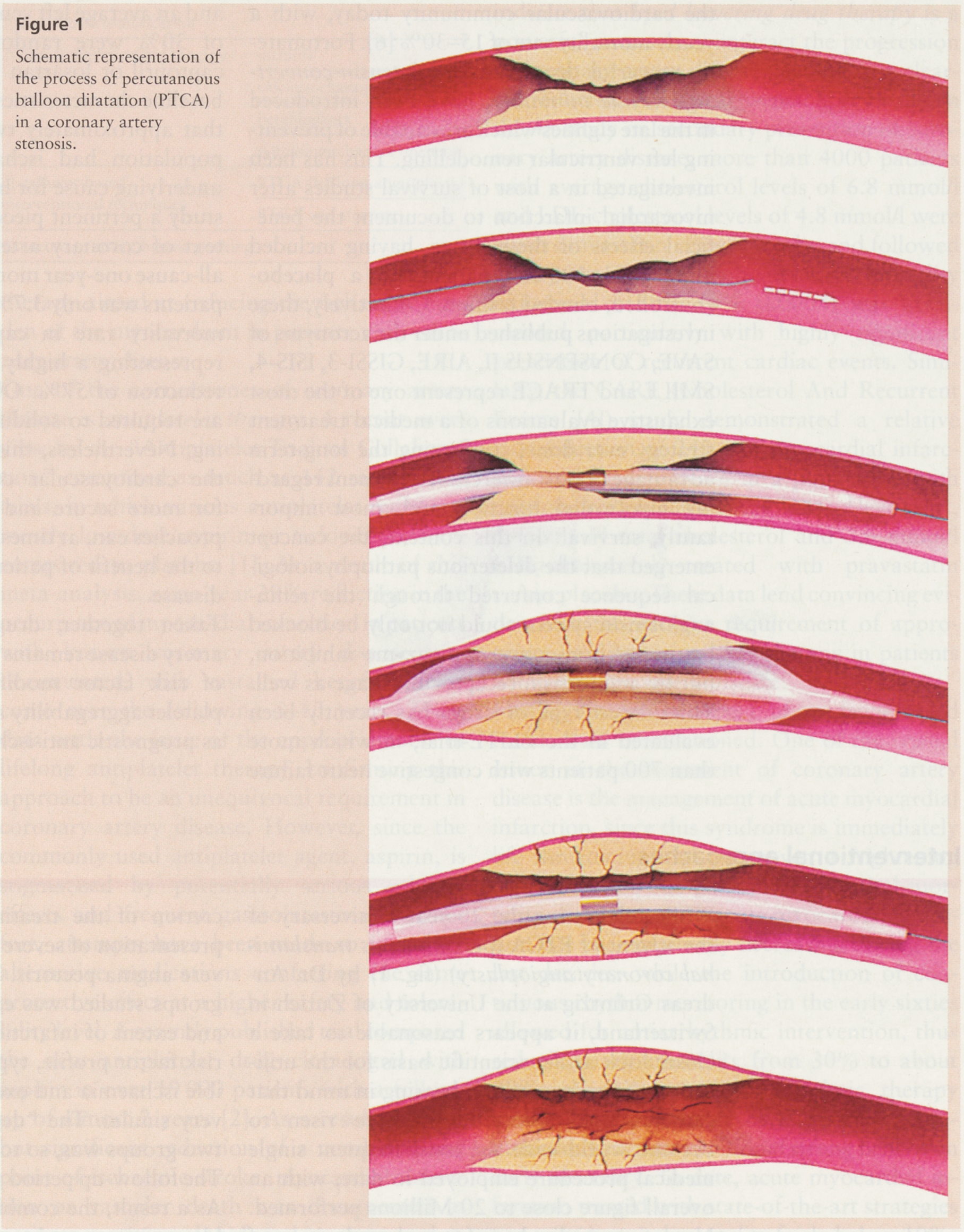
While celebrating the 20-year anniversary of the advent of PTCA (
percutaneous transluminal coronary angioplasty) (
Figure 1) by Dr. Andreas Grüntzig at the University of Zurich in Switzerland, it appears reasonable to take a closer look at the scientific basis for the utilisation of this procedure, bearing in mind that catheter-based interventions have risen to become world-wide the most frequent single medical procedure employed to date, with an overall figure close to 20 Millions performed. Numerous studies have focused on the issue of outcome after PTCA. In one very recent study, the DANAMI trial [
8], more than 1000 patients suffering from a first-time acute myocardial infarction and with signs or symptoms of residual ischaemia during exercise testing were randomly allocated to a conservative versus invasive strategy upon discharge from hospital. The invasive group was to receive an angiogram within two weeks, and subsequent balloon angioplasty or surgical revascularisation where appropriate. One of the strong points of this study was that the conservative group, intended to be treated by state-of-the-art anti-ischaemic medication, was allowed to be crossed-over to invasive management at the discretion of the treating physician, i.e., upon presentation of severe signs of ischaemia or severe angina pectoris. The homogeneity of the groups studied was excellent, in that severity and extent of infarction, previous history and risk factor profile, type and severity of inducible ischaemia and exercise test variables were very similar. The “degree of sickness” of the two groups was, so to say, highly comparable. The follow-up period was two and a half years. As a result, the combined end point of unstable angina pectoris, reinfarction or death was significantly reduced in the invasively treated group as compared to the medically treated group with a relative risk reduction of 33% (p = 0.00001). Patients in the invasive group also suffered from a lesser degree of stable angina pectoris than their controls on drug therapy. These data lend strong evidence towards a more aggressive approach in patients with signs or symptoms of myocardial ischaemia, with invasive treatment conferring both a symptomatic as well as prognostic benefit.
It is noteworthy that in the above mentioned trial, many patients, i.e., 50%, had single-vessel coronary artery disease, while only 20% had two-vessel disease and 18% had three-vessel disease. This legitimately raises the issue, to what extent PTCA can be employed in multivessel coronary artery disease as well. There is a strong drive among interventional cardiologists to broaden the spectrum of indications amenable to treatment with catheter-based techniques: surveying the numbers of the proportional distribution of PTCA in various coronary artery disease patterns based on the University of Zurich experience confirms this trend: while in the early eighties, 86% of the procedures were single-vessel, 12% were twovessel and 2% were three-vessel PTCA’s, the figures changed substantially by the beginning of the nineties, with only 56% being single vessel PTCA’s, 30% being two-vessel and 14% three-vessel PTCA’s (
Table 2 [
9]). Hence, the priority question here is whether balloonangioplasty in multivessel coronary artery disease can stand up to standard therapy, which is surgical
coronary artery bypass grafting, given the exhaustive documentation for the convincing short- and long-term efficacy of bypass surgery in the treatment of multivessel coronary artery disease. A recent meta-analysis of five trials comparing PTCA to bypass surgery puts this issue at rest [
10]. With a follow-up period of up to 3 years including such important trials as the EAST, GABI and RITA trials, both mortality and occurrence of myocardial infarction were equally reduced with PTCA or with bypass surgery, based on a population of 3000 patients treated. Not surprisingly, repeat procedures such as repeat PTCA and cross-over to surgery were significantly more frequent in PTCA-treated patients, given the well-known restenosis rate of 25–50%. This raised concerns about the overall health-care costs involved in these two approaches. Looking at the cumulative costs of PTCA versus bypass surgery in the BARI-study, there was virtually no difference during a follow-up of 5 years [
11]. Taken together, these data further strengthen the importance of revascularisation in patients with coronary artery disease, either by catheter-based or surgical approaches.
Finally, the issue of
coronary artery stenting shall be addressed. Again reviewing the University of Zurich experience during the last 4 years, stents have been utilised on top of conventional balloon angioplasty in only 3% of all cases in 1993. There has been a constant increase in stent employment ever since, such that, in the beginning of 1996, 59% of all PTCA procedures were combined with stent implantations [
12]. These are very representative figures for most cardiac catheter laboratories throughout the world, underscoring the tremendous impact of new techniques and devices in the field of interventional cardiology. Interestingly, the breakthrough of coronary stenting was tightly linked to the development of novel antiplatelet strategies, as discussed earlier in this review, particularly to the platelet inhibitor ticlopidine. The scientific basis for this frequent utilisation of stents, again, was brought upon by various studies, one of which randomly assigned more than 400 patients suffering from stable angina pectoris, having stenoses in native coronary arteries of at least 3 mm in diameter, to PTCA versus PTCA with stent [
13]. Follow-up was provided at 7 months after the intervention. As a result, both occurrence of death and myocardial infarction, need for bypass surgery and need for repeat PTCA were almost equal in both groups, albeit with a slight trend towards less repeat-revascularisations in the stented group. Restenosis rate, however, was significantly reduced in the stented group (31.6%) as compared to the non-stented patients (42.1%), suggesting a procedural benefit which was sustained. Thus, it appears that stenting is here to stay, being an important adjunction in the cardiac catheterisation laboratory, although there are no data on long- or even middle-term follow-up inherent to this very young but exciting technique. What is even more important: it has to be recognised that an extraordinarily large number of previous studies involving PTCA, for example investigations comparing PTCA with various drug regimen or with surgical procedures, need to be revisited in the wake of even more favourable outcomes that can be expected based on the use of stents in the cardiac catheterisation laboratory. The trend is obvious: while there was an overall of 2300 PTCA procedures in Switzerland in the year of 1990 as compared to 3500 surgical revascularisations, more than 7000 catheter interventions were performed in 1996, along with 4500 surgical revascularisations [
14], figures that are representative for all countries in the western hemisphere. The field is changing at a fast pace…