Long-Term Trends and Prognosis in Cardiovascular Mortality in the Kazakhstani Population Living Around the Semipalatinsk Nuclear Test Site

 , , , ,
Highlights
- Nuclear tests at the former Semipalatinsk Nuclear Test Site were conducted over a period of 40 years, resulting in significant radioactive contamination of surrounding territories and affecting the population.
- Cardiovascular diseases remain a major cause of mortality in affected populations, highlighting the importance of evaluating their long-term health consequences.
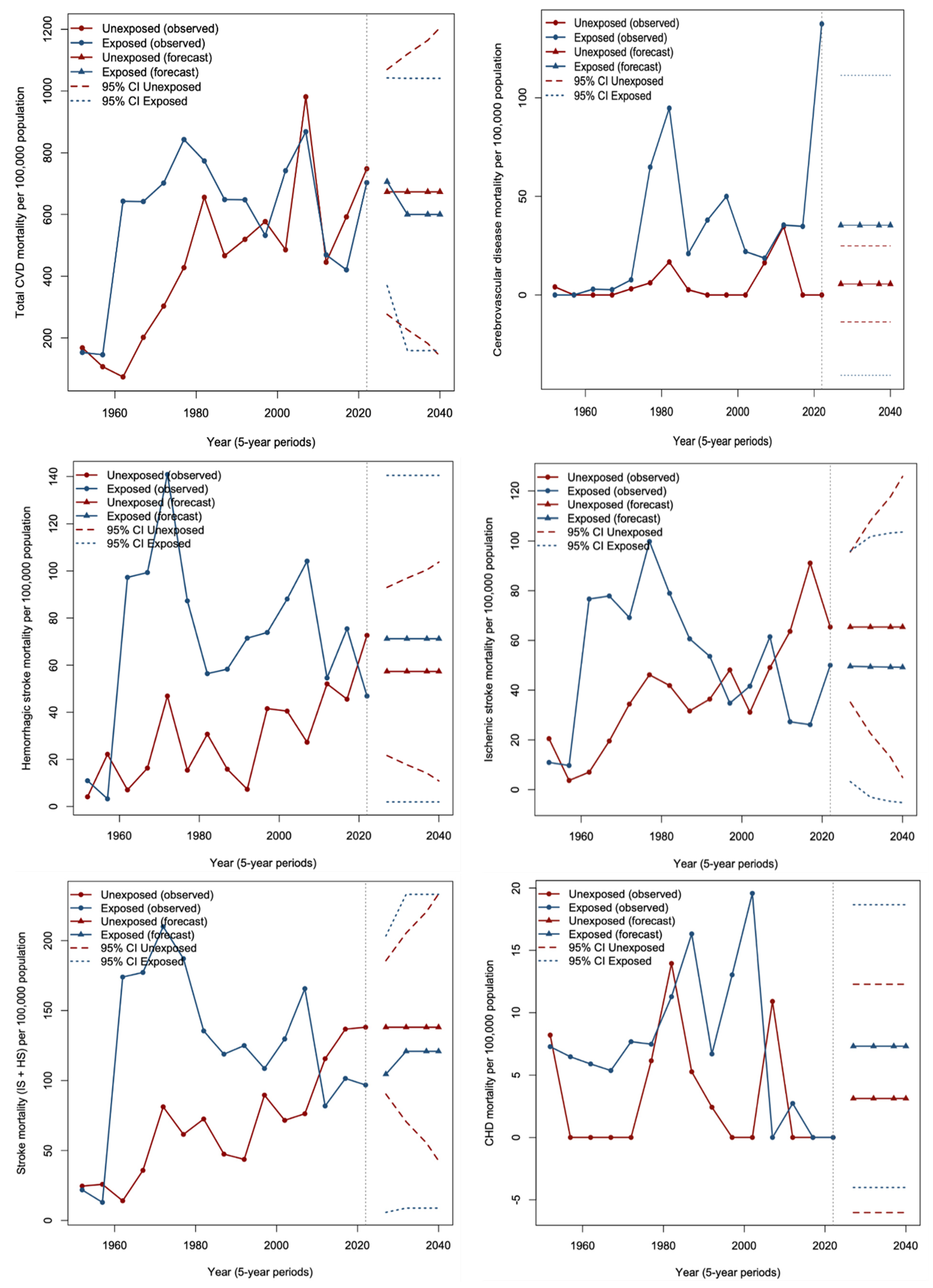
- Forecasting of cardiovascular disease indicators demonstrates a continuing upward trend among the exposed population.
- The study identified a significant association between radiation dose and cardiovascular mortality, with elevated years of life lost for several major cardiovascular conditions.
- The results confirm the need for further research aimed at studying the effects of ionizing radiation on the descendants of directly exposed individuals.
- The findings support the need for continued public health surveillance and further research on the long-term cardiovascular consequences of environmental radiation exposure.
Abstract
1. Introduction
2. Materials and Methods
2.1. Information About the State Scientific Automated Medical Registry
2.2. Characteristics of the Studied Population
2.3. Assessment of Radiation Doses for Individuals Included in the Study
2.4. Methods of Statistical Analysis
3. Results
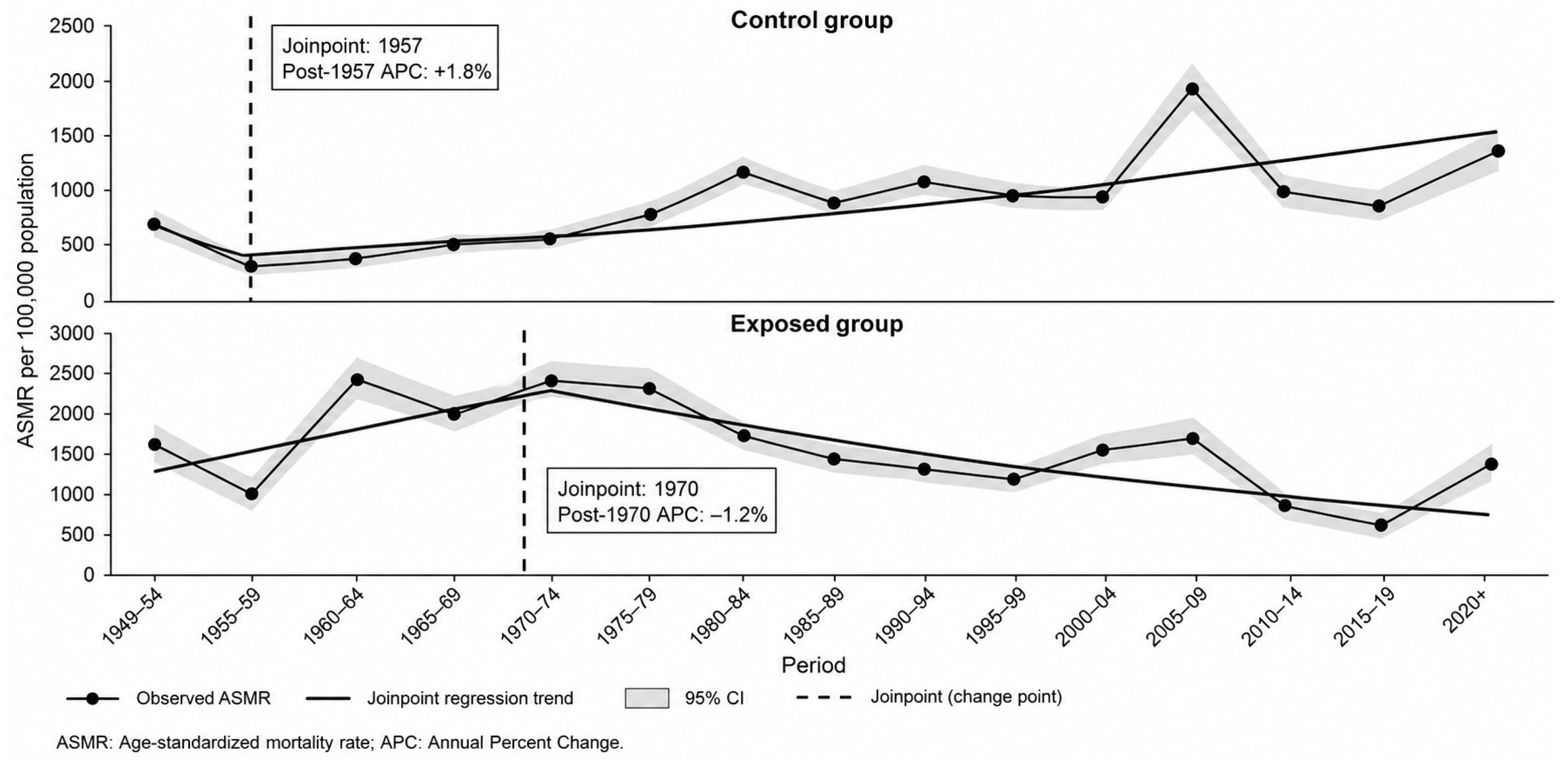
3.1. Age-Standardized Mortality Rates from CVDs in Study Groups by Periods
3.2. Overall Mortality Rates Due to CVDs and Separate Diseases During the Study Period
3.3. Indicators of YLL Due to Mortality from Separate Types of CVDs in the Study Groups
3.4. Dynamics of Mortality Rates from CVDs and Their Separate Forms During the Study Period
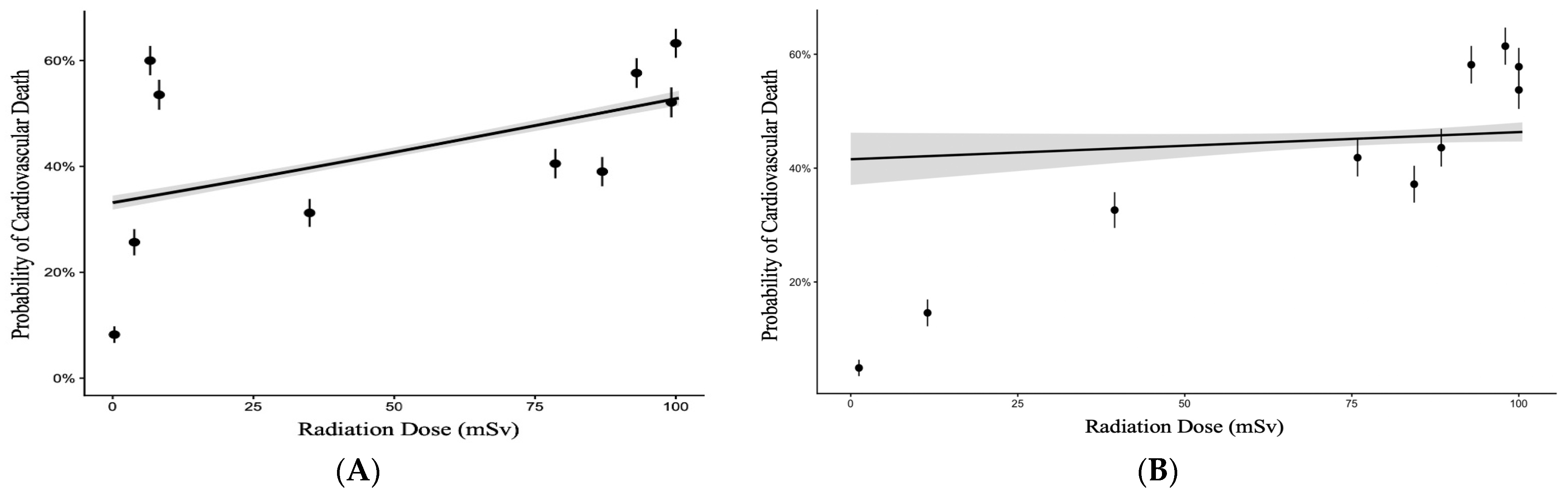
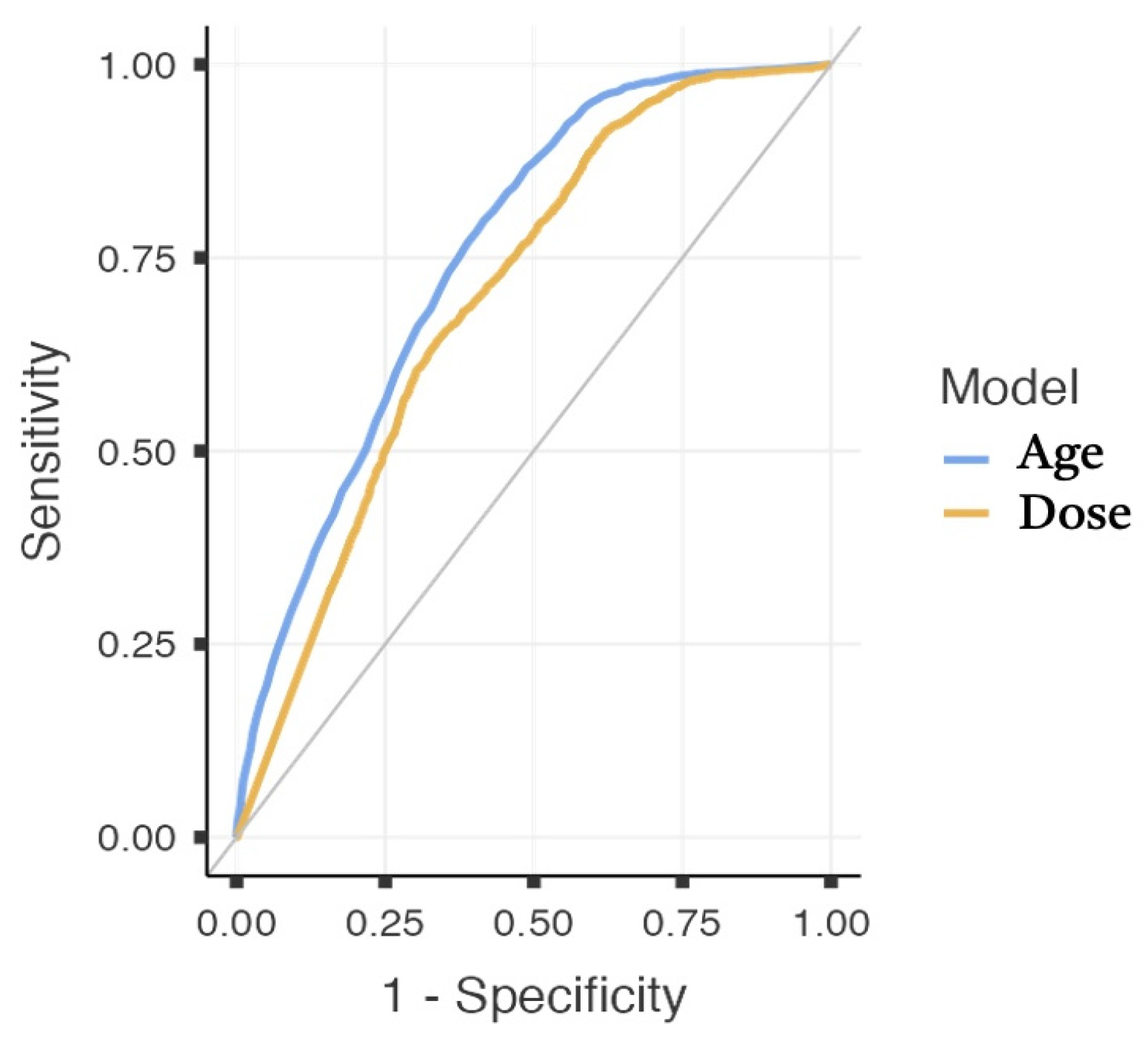
3.5. Evaluation of the Dose–Response Relationship for CVD Mortality in Study Groups
4. Discussion
Limitations of the Study
5. Conclusions
Supplementary Materials
Author Contributions
Funding
Institutional Review Board Statement
Informed Consent Statement
Data Availability Statement
Conflicts of Interest
References
- Chong, B.; Jayabaskaran, J.; Jauhari, S.M.; Chan, S.P.; Goh, R.; Kueh, M.T.W.; Li, H.; Chin, Y.H.; Kong, G.; Anand, V.V.; et al. Global burden of cardiovascular diseases: Projections from 2025 to 2050. Eur. J. Prev. Cardiol. 2025, 32, 1001–1015. [Google Scholar] [CrossRef] [PubMed]
- Nedkoff, L.; Briffa, T.; Zemedikun, D.; Herrington, S.; Wright, F.L. Global Trends in Atherosclerotic Cardiovascular Disease. Clin. Ther. 2023, 45, 1087–1091. [Google Scholar] [CrossRef] [PubMed]
- Little, M.P.; Boerma, M.; Bernier, M.O.; Azizova, T.V.; Zablotska, L.B.; Einstein, A.J.; Hamada, N. Effects of confounding and effect-modifying lifestyle, environmental and medical factors on risk of radiation-associated cardiovascular disease. BMC Public Health 2024, 24, 1601. [Google Scholar] [CrossRef] [PubMed]
- Jahng, J.W.S.; Little, M.P.; No, H.J.; Loo, B.W., Jr.; Wu, J.C. Consequences of ionizing radiation exposure to the cardiovascular system. Nat. Rev. Cardiol. 2024, 21, 880–898. [Google Scholar] [CrossRef] [PubMed]
- Talapko, J.; Talapko, D.; Katalinić, D.; Kotris, I.; Erić, I.; Belić, D.; Vasilj Mihaljević, M.; Vasilj, A.; Erić, S.; Flam, J.; et al. Health Effects of Ionizing Radiation on the Human Body. Medicina 2024, 60, 653. [Google Scholar] [CrossRef] [PubMed]
- Little, M.P. Cancer and non-cancer effects in Japanese atomic bomb survivors. J. Radiol. Prot. 2009, 29, A43–A59. [Google Scholar] [CrossRef] [PubMed]
- Ozasa, K.; Shimizu, Y.; Sakata, R.; Sugiyama, H.; Grant, E.J.; Soda, M.; Kasagi, F.; Suyama, A. Risk of cancer and non-cancer diseases in the atomic bomb survivors. Radiat. Prot. Dosim. 2011, 146, 272–275. [Google Scholar] [CrossRef]
- Takahashi, I.; Ohishi, W.; Mettler, F.A.M., Jr.; Ozasa, K.; Jacob, P.; Ban, N.; Lipshultz, S.E.; Stewart, F.A.; Nabika, T.; Niwa, Y.; et al. A report from the 2013 international workshop: Radiation and cardiovascular disease, Hiroshima, Japan. J. Radiol. Prot. 2013, 33, 869–880. [Google Scholar] [CrossRef] [PubMed]
- Takahashi, I.; Shimizu, Y.; Grant, E.J.; Cologne, J.; Ozasa, K.; Kodama, K. Heart Disease Mortality in the Life Span Study, 1950–2008. Radiat. Res. 2017, 187, 319–332. [Google Scholar] [CrossRef] [PubMed]
- Zielinski, J.; Ashmore, P.; Band, P.; Jiang, H.; Shilnikova, N.; Tait, V.; Krewski, D. Low dose ionizing radiation exposure and cardiovascular disease mortality: Cohort study based on Canadian national dose registry of radiation workers. Int. J. Occup. Med. Environ. Health 2009, 22, 27–33. [Google Scholar] [CrossRef] [PubMed]
- Azizova, T.V.; Grigoryeva, E.S.; Hunter, N.; Pikulina, M.V.; Moseeva, M.B. Risk smerti ot bolezney sistemy krovoobrashcheniia v kogorte rabotnikov, podvergshikhsia khronicheskomu obluche-niiu. [Risk of death from circulatory diseases in a cohort of patients exposed to chronic radiation]. Ter. Arkh. 2017, 89, 18–27. [Google Scholar] [CrossRef] [PubMed]
- Nugent, R.W.; Zhumadilov, Z.S.; Gusev, B.I.; Hoshi, M. Health effects of radiation associated with nuclear weapons testing at the Semipalatinsk nuclear weapons test site. In New York: Semipalatinsk/Hiroshima (PDF) The Legacies of Soviet Nu-Clear Testing in Kazakhstan. Fallout, Public Health and Societal Issues; Nakamoto Sogo Printing Co., Ltd.: Chiba, Japan, 2000. [Google Scholar]
- Chaizhunussova, N.; Pivina, L.; Shabdarbayeva, D.; Orekhov, A.; Dosmagambetova, R.; Alibayeva, G.; Massabayeva, M.; Lipikhina, A.; Abildinova, G.; Kassymov, A.; et al. Global trends in research on Semipalatinsk nuclear testing health effects: A bibliometric analysis and short review. J. Environ. Radioact. 2025, 290, 107793. [Google Scholar] [CrossRef] [PubMed]
- Gusev, B.I.; Abylkassimova, Z.N.; Apsalikov, K.N. The Semipalatinsk nuclear test site: A first assessment of the radiological situation and the test-related radiation doses in the surrounding territories. Radiat. Environ. Biophys. 1997, 36, 201–204. [Google Scholar] [CrossRef] [PubMed]
- Apsalikov, K.; Rozenson, R.; Madiyeva, M. Registry for radiation exposed near the SNTS. In Proceedings of the 3rd Dosimetry Workshop on the Semipalatinsk Nuclear Test Site Area 10th Hiroshima Internetional Symposium, Hiroshima, Japan, 3 November 2005; Hiroshima University Research Institute for Radiation Biology and Medicine (RIRBM): Hiroshima, Japan, 2005; p. 40. [Google Scholar]
- Katayama, H.; Apsalikov, K.N.; Gusev, B.I.; Galich, B.; Madieva, M.; Koshpessova, G.; Abdikarimova, A.; Hoshi, M. An attempt to develop a database for epidemiological research in Semipalatinsk. J. Radiat. Res. 2006, 47, A189–A197. [Google Scholar] [CrossRef] [PubMed]
- Apsalikov, K.; Muldagaliev, T.; Apsalikov, R.; Serikkankyzy, S.; Zholambaeva, Z. Radiation risk factors in incidence and mortality among exposed individuals of East Kazakhstan. Cent. Asian J. Glob. Health 2014, 2, 105. [Google Scholar] [CrossRef] [PubMed]
- Dyussenova, L.; Pivina, L.; Semenova, Y.; Bjørklund, G.; Glushkova, N.; Chirumbolo, S.; Belikhina, T. Associations between depression, anxiety and medication adherence among patients with arterial hypertension: Comparison between persons exposed and non-exposed to radiation from the Semipalatinsk Nuclear Test Site. J. Environ. Radioact. 2018, 195, 33–39. [Google Scholar] [CrossRef] [PubMed]
- Grosche, B.; Lackland, D.T.; Land, C.E.; Simon, S.L.; Apsalikov, K.N.; Pivina, L.M.; Bauer, S.; Gusev, B.I. Mortality from cardiovascular diseases in the Semipalatinsk historical cohort, 1960–1999, and its relationship to radiation exposure. Radiat. Res. 2011, 176, 660–669. [Google Scholar] [CrossRef] [PubMed]
- Dyussupov, A.; Shabdarbayeva, D.; Chaizhunussova, N.; Orekhov, A.; Alibayeva, G.; Baibussinova, A.; Abenova, M.; Massabayeva, M.; Lipikhina, A.; Abdildinova, G.; et al. Long-Term Exposure to Ionizing Radiation from the Semipalatinsk Nuclear Test Site and Risk of Cardiovascular Mortality. Int. J. Environ. Res. Public Health 2025, 22, 1781. [Google Scholar] [CrossRef] [PubMed]
- Apsalikov, K.N.; Lipikhina, A.; Grosche, B.; Belikhina, T.; Ostroumova, E.; Shinkarev, S.; Stepanenko, V.; Muldagaliev, T.; Yoshinaga, S.; Zhunussova, T.; et al. The State Scientific Automated Medical Registry, Kazakhstan: An important resource for low-dose radiation health research. Radiat. Environ. Biophys. 2019, 58, 1–11. [Google Scholar] [CrossRef] [PubMed]
- Apsalikov, K.; Gusev, B.I. Methodological recommendations. In Assessment of Effective Equivalent Doses of Ionizing Radiation in the Population Living in Areas Contaminated During Tests at the Semipalatinsk Nuclear Test Site; Approved and recommended for publication by the Republican Center for Innovative Technologies of Medical Education and Science of the Ministry of Health of the Republic of Kazakhstan (protocol dated 19. November 2010, No. 12); Semey Medical University: Semey, Kazakhstan, 2010; Chapter 1; p. 23. [Google Scholar]
- Stepanenko, V.F.; Hoshi, M.; Bailiff, I.K.; Ivannikov, A.I.; Toyoda, S.; Yamamoto, M.; Simon, S.L.; Matsuo, M.; Kawano, N.; Zhumadilov, Z.; et al. Around Semipalatinsk nuclear test site: Progress of dose estimations relevant to the consequences of nuclear tests (a summary of 3rd Dosimetry Workshop on the Semipalatinsk nuclear test site area, RIRBM, Hiroshima University, Hiroshima, 9–11 March 2005). J. Radiat. Res. 2006, 47, A1–A13. [Google Scholar] [CrossRef] [PubMed]
- Beck, H.L.; Anspaugh, L.R.; Bouville, A.; Simon, S.L. Review of methods of dose estimation for epidemiological studies of the radiological impact of Nevada test site and global fallout. Radiat. Res. 2006, 166, 209–218. [Google Scholar] [CrossRef] [PubMed]
- Gordeev, K.; Shinkarev, S.; Ilyin, L.; Bouville, A.; Hoshi, M.; Luckyanov, N.; Simon, S.L. Retrospective dose assessment for the population living in areas of local fallout from the Semipalatinsk nuclear test site Part II: Internal exposure to thyroid. J. Radiat. Res. 2006, 47, A137–A141. [Google Scholar] [CrossRef] [PubMed]
- Simon, S.L.; Beck, H.L.; Gordeev, K.; Bouville, A.; Anspaugh, L.R.; Land, C.E.; Luckyanov, N.; Shinkarev, S. External dose estimates for Dolon village: Application of the U.S./Russian joint methodology. J. Radiat. Res. 2006, 47, A143–A147. [Google Scholar] [CrossRef] [PubMed]
- Law of the Republic of Kazakhstan “On social protection of citizens affected by nuclear tests at the Semipalatinsk nuclear test site” dated 18 December 1992; No. 1787-XII. Available online: https://adilet.zan.kz/eng/docs/Z920003600_ (accessed on 4 March 2026).
- Ahmad, O.B.; Boschi-Pinto, C.; Lopez, A.D.; Murray, C.J.L.; Lozano, R.; Inoue, M. Age Standardization of Rates: A New WHO Standard; WHO/EIP/GPE/EBD Series No. 31; World Health Organization: Geneva, Switzerland, 2001. [Google Scholar]
- Little, M.P.; Tawn, E.J.; Tzoulaki, I.; Wakeford, R.; Hildebrandt, G.; Paris, F.; Tapio, S.; Elliott, P. A systematic review of epidemiological associations between low and moderate doses of ionizing radiation and late cardiovascular effects, and their possible mechanisms. Radiat. Res. 2008, 169, 99–109. [Google Scholar] [CrossRef] [PubMed]
- Schultz-Hector, S.; Trott, K.R. Radiation-induced cardiovascular diseases: Is the epidemiologic evidence compatible with the radiobiologic data? Int. J. Radiat. Oncol. Biol. Phys. 2007, 67, 10–18. [Google Scholar] [CrossRef] [PubMed]
- Azimzadeh, O.; Moertl, S.; Ramadan, R.; Baselet, B.; Laiakis, E.C.; Sebastian, S.; Beaton, D.; Hartikainen, J.M.; Kaiser, J.C.; Beheshti, A.; et al. Application of radiation omics in the development of adverse outcome pathway networks: An example of radiation-induced cardiovascular disease. Int. J. Radiat. Biol. 2022, 98, 1722–1751. [Google Scholar] [CrossRef] [PubMed]
- Fernández-Ruiz, I. Immune system and cardiovascular disease. Nat. Rev. Cardiol. 2016, 13, 503. [Google Scholar] [CrossRef] [PubMed]
- Baselet, B.; Rombouts, C.; Benotmane, A.M.; Baatout, S.; Aerts, A. Cardiovascular disease related to ionizing radiation: The risk of low-dose exposure (Review). Int. J. Mol. Med. 2016, 38, 1623–1641. [Google Scholar] [CrossRef] [PubMed]
- Tapio, S.; Little, M.P.; Kaiser, J.C.; Impens, N.; Hamada, N.; Georgakilas, A.G.; Simar, D.; Salomaa, S. Ionizing radiation-induced circulatory and metabolic diseases. Environ. Int. 2021, 146, 106235. [Google Scholar] [CrossRef] [PubMed]
- Little, M.P.; Gola, A.; Tzoulaki, I. A model of cardiovascular disease giving a plausible mechanism for the effect of fractionated low-dose ionizing radiation exposure. PLoS Comput. Biol. 2009, 5, pmid:19851450. [Google Scholar] [CrossRef] [PubMed]
- Lowe, D.; Raj, K. Premature aging induced by radiation exhibits pro-atherosclerotic effects mediated by epigenetic activation of CD44 expression. Aging Cell 2014, 13, 900–910. [Google Scholar] [CrossRef] [PubMed]
- Rombouts, C.; Aerts, A.; Quintens, R.; Baselet, B.; El-Saghire, H.; Harms-Ringdahl, M.; Haghdoost, S.; Janssen, A.; Michaux, A.; Yentrapalli, R.; et al. Transcriptomic profiling suggests a role for IGFBP5 in premature senescence of endothelial cells after chronic low dose rate irradiation. Int. J. Radiat. Biol. 2014, 90, 560–574. [Google Scholar] [CrossRef] [PubMed]
- Yentrapalli, R.; Azimzadeh, O.; Barjaktarovic, Z.; Sarioglu, H.; Wojcik, A.; Harms-Ringdahl, M.; Atkinson, M.J.; Haghdoost, S.; Tapio, S. Quantitative proteomic analysis reveals induction of premature senescence in human umbilical vein endothelial cells exposed to chronic low-dose rate gamma radiation. Proteomics 2013, 13, 1096–1107. [Google Scholar] [CrossRef] [PubMed]
- Yentrapalli, R.; Azimzadeh, O.; Sriharshan, A.; Malinowsky, K.; Merl, J.; Wojcik, A.; Harms-Ringdahl, M.; Atkinson, M.J.; Becker, K.-F.; Haghdoost, S.; et al. The PI3K/Akt/mTOR pathway is implicated in the premature senescence of primary human endothelial cells exposed to chronic radiation. PLoS ONE 2013, 8, e70024. [Google Scholar] [CrossRef] [PubMed]
- Venkatesulu, B.P.; Mahadevan, L.S.; Aliru, M.L.; Yang, X.; Bodd, M.H.; Singh, P.K.; Yusuf, S.W.; Abe, J.I.; Krishnan, S. Radiation-Induced Endothelial Vascular Injury: A Review of Possible Mechanisms. JACC Basic Transl. Sci. 2018, 3, 563–572. [Google Scholar] [CrossRef] [PubMed]
- Fajardo, L.F. The pathology of ionizing radiation as defined by morphologic patterns. Acta Oncol. 2005, 44, 13–22. [Google Scholar] [CrossRef] [PubMed]
- Shimizu, Y.; Kodama, K.; Nishi, N.; Kasagi, F.; Suyama, A.; Soda, M.; Grant, E.J.; Sugiyama, H.; Sakata, R.; Moriwaki, H.; et al. Radiation exposure and circulatory disease risk: Hiroshima and Nagasaki atomic bomb survivor data, 1950–2003. BMJ 2010, 340, b5349. [Google Scholar] [CrossRef] [PubMed]
- Yamada, M.; Wong, L.F.; Fujiwara, S.; Akahoshi, M.; Suzuki, G. Noncancer disease incidence in atomic bomb survivors, 1958–1998. Radiat. Res. 2004, 161, 622–632. [Google Scholar] [CrossRef] [PubMed]
- Ozasa, K.; Takahashi, I.; Grant, E.J.; Kodama, K. Cardiovascular disease among atomic bomb survivors. Int. J. Radiat. Biol. 2017, 93, 1145–1150. [Google Scholar] [CrossRef] [PubMed]
- Takahashi, I.; Abbott, R.D.; Ohshita, T.; Takahashi, T.; Ozasa, K.; Akahoshi, M.; Fujiwara, S.; Kodama, K.; Matsumoto, M. A prospective follow-up study of the association of radiation exposure with fatal and non-fatal stroke among atomic bomb survivors in Hiroshima and Nagasaki (1980–2003). BMJ Open 2012, 2, e000654. [Google Scholar] [CrossRef] [PubMed]
- Little, M.P.; Azizova, T.V.; Bazyka, D.; Bouffler, S.D.; Cardis, E.; Chekin, S.; Chumak, V.V.; Cucinotta, F.A.; De Vathaire, F.; Hall, P.; et al. Systematic review and meta-analysis of circulatory disease from exposure to low-level ionizing radiation and estimates of potential population mortality risks. Environ. Health Perspect. 2012, 120, 1503–1511. [Google Scholar] [CrossRef] [PubMed]
- Sasaki, H.; Wong, F.L.; Yamada, M.; Kodama, K. The effects of aging and radiation exposure on blood pressure levels of atomic bomb survivors. J. Clin. Epidemiol. 2002, 55, 974–981. [Google Scholar] [CrossRef] [PubMed]
- Wong, F.L.; Yamada, M.; Sasaki, H.; Kodama, K.; Hosoda, Y. Effects of radiation on the longitudinal trends of total serum cholesterol levels in the atomic bomb survivors. Radiat. Res. 1999, 151, 736–746. [Google Scholar] [CrossRef] [PubMed]
- Akahoshi, M.; Amasaki, Y.; Soda, M. Effects of radiation on fatty liver and metabolic coronary risk factors among atomic bomb survivors in Nagasaki. Hypertens. Res. 2003, 26, 965–970. [Google Scholar] [CrossRef] [PubMed]
- Hayashi, T.; Kusunoki, Y.; Hakoda, M. Radiation dose-dependent increases in inflammatory response markers in A-bomb survivors. Int. J. Radiat. Biol. 2003, 79, 129–136. [Google Scholar] [CrossRef] [PubMed]
- Douple, E.B.; Mabuchi, K.; Cullings, H.M.; Preston, D.L.; Kodama, K.; Shimizu, Y.; Fujiwara, S.; Shore, R.E. Long-term radiation-related health effects in a unique human population: Lessons learned from the atomic bomb survivors of Hiroshima and Nagasaki. Disaster Med. Public Health Prep. 2011, 5, S122–S133. [Google Scholar] [CrossRef] [PubMed]
- Krestinina, L.Y.; Epifanova, S.; Silkin, S.; Mikryukova, L.; Degteva, M.; Shagina, N.; Akleyev, A. Chronic low-dose exposure in the Techa River Cohort: Risk of mortality from circulatory diseases. Radiat. Environ. Biophys. 2013, 52, 47–57. [Google Scholar] [CrossRef] [PubMed]
- Laurier, D.; Richardson, D.B.; Cardis, E.; Daniels, R.D.; Gillies, M.; O’HAgan, J.; Hamra, G.B.; Haylock, R.; Leuraud, K.; Moissonnier, M.; et al. The International Nuclear Workers Study (Inworks): A Collaborative Epidemiological Study to Improve Knowledge About Health Effects of Protracted Low-Dose Exposure. Radiat. Prot. Dosim. 2016, 173, 21–25. [Google Scholar] [CrossRef]
- Manenti, G.; Coppeta, L.; Kirev, I.V.; Verno, G.; Garaci, F.; Magrini, A.; Floris, R. Low-Dose Occupational Exposure to Ionizing Radiation and Cardiovascular Effects: A Narrative Review. Healthcare 2024, 12, 238. [Google Scholar] [CrossRef] [PubMed]
- Azizova, T.V.; Haylock, R.G.E.; Moseeva, M.B.; Bannikova, M.V.; Grigoryeva, E.S. Cerebrovascular diseases incidence and mortality in an extended Mayak Worker Cohort 1948–1982. Radiat. Res. 2014, 182, 529–544. [Google Scholar] [CrossRef] [PubMed]
- Kashcheev, V.V.; Chekin, S.Y.; Karpenko, S.V.; Maksioutov, M.A.; Menyaylo, A.N.; Tumanov, K.A.; Kochergina, E.V.; Kashcheeva, P.V.; Gorsky, A.I.; Shchukina, N.V.; et al. Radiation Risk of Cardiovascular Diseases in the Cohort of Russian Emergency Workers of the Chernobyl Accident. Health Phys. 2017, 113, 23–29. [Google Scholar] [CrossRef] [PubMed]



| Radionuclide | Half Life | Principal Radiation | Target Organ/Biological Effect |
|---|---|---|---|
| Iodine-131 | ≈8 days | β, γ | Concentrates in the thyroid gland; irradiation of thyroid tissue may increase the risk of thyroid cancer, particularly after childhood exposure |
| Strontium-90 | ≈28.8 years | β | A chemical analog of calcium. Deposits in bone and bone marrow; prolonged irradiation may increase the risk of leukemia and bone cancer. |
| Cesium-137 | ≈30 years | β, γ | Distributed relatively uniformly throughout soft tissues and contributes to whole-body irradiation. |
| Plutonium-239 | 24,100 years | α | Inhaled plutonium may be retained in the lungs; a fraction may translocate to the liver and skeleton, increasing long-term cancer risk. |
| Plutonium-240 | 6560 years | α | Accumulates primarily in the skeleton and liver; alpha irradiation may increase the risk of bone and liver cancers. |
| Americium-241 | ≈432 years | α, γ | Deposits mainly in bone and liver; long-term alpha irradiation may increase the risk of bone and liver cancers. |
| Study Period | Study Group ASMR (95% CI) | Control Group ASMR (95% CI) | RR (95% CI) |
|---|---|---|---|
| 1949–1954 | 1614.8 (1455.4–1774.2) | 731.4 (618.2–844.7) | 2.21 (1.84–2.65) |
| 1954–1959 | 1209.8 (1079.3–1340.3) | 353 (279.8–426.3) | 3.43 (2.71–4.33) |
| 1960–1964 | 2104.8 (1945.2–2264.5) | 396.4 (320.2–472.6) | 5.31 (4.32–6.53) |
| 1965–1969 | 1841 (1700.4–1981.5) | 538.6 (453.1–624) | 3.42 (2.87–4.08) |
| 1970–1974 | 2134.5 (1986.6–2282.4) | 582.8 (496.4–669.2) | 3.66 (3.11–4.31) |
| 1975–1979 | 2058.6 (1912.7–2204.5) | 825.1 (724.3–926) | 2.49 (2.17–2.87) |
| 1980–1984 | 1725.8 (1598.6–1852.9) | 1217.7 (1100.1–1335.4) | 1.42 (1.26–1.6) |
| 1985–1989 | 1532 (1409.9–1654.1) | 938.9 (838.4–1039.5) | 1.63 (1.43–1.86) |
| 1990–1994 | 1414.8 (1300.2–1529.3) | 1097.8 (989.7–1205.9) | 1.29 (1.13–1.46) |
| 1995–1999 | 1318.1 (1209.9–1426.2) | 977.4 (883.5–1071.4) | 1.35 (1.19–1.53) |
| 2000–2004 | 1601.6 (1475.5–1727.7) | 986.5 (875.9–1097.1) | 1.62 (1.42–1.86) |
| 2005–2009 | 1640.9 (1509.6–1772.2) | 1897.7 (1695.7–2099.7) | 0.86 (0.76–0.99) |
| 2010–2014 | 1026.7 (921.7–1131.8) | 1008.2 (858–1158.4) | 1.02 (0.85–1.22) |
| 2015–2019 | 844.1 (744.7–943.5) | 915.5 (768.6–1062.4) | 0.92 (0.76–1.13) |
| After 2020 | 1507.5 (1366.6–1648.4) | 1381.3 (1185–1577.6) | 1.09 (0.92–1.29) |
| Cause of Death | Study Group | Control Group | RR (95% CI) | ||
|---|---|---|---|---|---|
| N | Mortality Rate per 100,000 (95% CI) | N | Mortality Rate per 100,000 (95% CI) | ||
| CVDs | 3482 | 612.9 (592.7–633.6) | 1886 | 435.8 (416.3–455.9) | 1.41 (1.33–1.49) |
| Hypertension | 200 | 35.2 (30.5–40.4) | 124 | 28.7 (23.8–34.2) | 1.23 (0.98–1.54) |
| Chronic ischemic heart disease | 638 | 112.3 (103.8–121.4) | 1022 | 236.2 (221.9–251.1) | 0.48 (0.43–0.52) |
| Acute myocardial infarction | 584 | 102.8 (94.6–111.5) | 346 | 80.0 (71.7–88.8) | 1.29 (1.13–1.47) |
| Stroke (ischemic + hemorrhagic) | 720 | 126.7 (117.6–136.3) | 274 | 63.3 (56.0–71.3) | 2.00 (1.74–2.30) |
| Chronic cerebrovascular diseases | 207 | 36.4 (31.6–41.8) | 20 | 4.6 (2.8–7.1) | 7.88 (4.98–12.48) |
| Congenital heart defects | 44 | 7.7 (5.6–10.4) | 14 | 3.2 (1.8–5.4) | 2.39 (1.31–4.37) |
| Cause of Death | Study Group, N (%) | p | Control Group, N (%) | p | p ** | ||||
|---|---|---|---|---|---|---|---|---|---|
| Before 1962 | 1963–1989 | After 1990 | Before 1962 | 1963–1989 | After 1990 | ||||
| Hypertension | 196 (5.8%) | 3 (2.2%) | 0 (0.0%) | 0.106 | 98 (6.2%) | 2 (2.9%) | 0 (0.0%) | 0.33 | 1 = 0.621 2 = 0.755 3 = 1 |
| CIHD | 1033 (30.8%) | 32 (23.0%) | 0 (0.0%) | 0.002 0.008 * | 593 (37.6%) | 5 (7.1%) | 0 (0.0%) | <0.001 <0.001 * | 1 < 0.001 2 = 0.004 3 = 1 |
| AMI | 572 (17.1%) | 15 (10.8%) | 0 (0.0%) | 0.024 0.005 * | 280 (17.7%) | 29 (41.4%) | 4 (30.8%) | <0.001 <0.001 * | 1 = 0.566 2 < 0.001 |
| CCVD | 218 (6.5%) | 10 (7.2%) | 2 (11.1%) | 0.69 | 21 (1.3%) | 1 (1.4%) | 3 (23.1%) | <0.001 <0.001 * | 1 < 0.001 2 = 0.078 3 = 0.371 |
| Ischemic stroke | 302 (9.0%) | 8 (5.8%) | 0 (0.0%) | 0.172 | 128 (8.1%) | 1 (1.4%) | 0 (0.0%) | 0.07 | 1 = 0.293 2 = 0.146 3 = 1 |
| Hemorrhagic stroke | 392 (11.7%) | 17 (12.2%) | 0 (0.0%) | 0.29 | 95 (6.0%) | 1 (1.4%) | 0 (0.0%) | 0.18 | 1 < 0.001 2 = 0.009 3 = 1 |
| CHD | 8 (0.2%) | 22 (15.8%) | 12 (66.7%) | <0.001 <0.001 * | 2 (0.1%) | 10 (14.3%) | 1 (7.7%) | <0.001 <0.001 * | 1 = 0.415 2 = 0.77 3 = 0.001 |
| Cause of Death | Study Group | Control Group | p |
|---|---|---|---|
| Hypertension | 1174.2 | 1154.7 | 0.578 |
| CIHD | 4518.0 | 5614.0 | <0.001 |
| AMI | 6097.0 | 5893.0 | <0.001 |
| CCVD | 810.0 | 641.9 | 0.049 |
| Ischemic stroke | 2091.0 | 1303.9 | 0.442 |
| Hemorrhagic stroke | 3857.5 | 1996.9 | 0.0195 |
| CHD | 2696.6 | 957.7 | 0.001 |
Disclaimer/Publisher’s Note: The statements, opinions and data contained in all publications are solely those of the individual author(s) and contributor(s) and not of MDPI and/or the editor(s). MDPI and/or the editor(s) disclaim responsibility for any injury to people or property resulting from any ideas, methods, instructions or products referred to in the content. |
© 2026 by the authors. Licensee MDPI, Basel, Switzerland. This article is an open access article distributed under the terms and conditions of the Creative Commons Attribution (CC BY) license.
Share and Cite
Shabdarbayeva, D.; Pivina, L.; Chaizhunussova, N.; Orekhov, A.; Alibayeva, G.; Massabayeva, M.; Baibussinova, A.; Batenova, G.; Smailova, Z.; Apbassova, S.; et al. Long-Term Trends and Prognosis in Cardiovascular Mortality in the Kazakhstani Population Living Around the Semipalatinsk Nuclear Test Site. Int. J. Environ. Res. Public Health 2026, 23, 874. https://doi.org/10.3390/ijerph23070874
Shabdarbayeva D, Pivina L, Chaizhunussova N, Orekhov A, Alibayeva G, Massabayeva M, Baibussinova A, Batenova G, Smailova Z, Apbassova S, et al. Long-Term Trends and Prognosis in Cardiovascular Mortality in the Kazakhstani Population Living Around the Semipalatinsk Nuclear Test Site. International Journal of Environmental Research and Public Health. 2026; 23(7):874. https://doi.org/10.3390/ijerph23070874
Chicago/Turabian StyleShabdarbayeva, Dariya, Lyudmila Pivina, Nailya Chaizhunussova, Andrey Orekhov, Galiya Alibayeva, Meruyert Massabayeva, Assel Baibussinova, Gulnara Batenova, Zhanargul Smailova, Saulesh Apbassova, and et al. 2026. "Long-Term Trends and Prognosis in Cardiovascular Mortality in the Kazakhstani Population Living Around the Semipalatinsk Nuclear Test Site" International Journal of Environmental Research and Public Health 23, no. 7: 874. https://doi.org/10.3390/ijerph23070874
APA StyleShabdarbayeva, D., Pivina, L., Chaizhunussova, N., Orekhov, A., Alibayeva, G., Massabayeva, M., Baibussinova, A., Batenova, G., Smailova, Z., Apbassova, S., Kozhanova, S., Abenova, M., Lipikhina, A., Izdenov, A., Ygiyeva, D., Dosmagambetova, R., & Dyussupov, A. (2026). Long-Term Trends and Prognosis in Cardiovascular Mortality in the Kazakhstani Population Living Around the Semipalatinsk Nuclear Test Site. International Journal of Environmental Research and Public Health, 23(7), 874. https://doi.org/10.3390/ijerph23070874