


Highlights
Public health relevance—How does this work relate to a public health issue?
- As population aging continues, the prevalence of fall-related injuries, including fractures and head injuries, increases.
- Among community-dwelling older adults, health literacy is associated with falls.
Public health significance—Why is this work of significance to public health?
- Lack of consensus regarding the definition and conceptual framework of health literacy limits measurement and comparison across studies.
- Focusing on community-dwelling older adults in Japan, a super-aging society, is valuable for developing future international models.
Public health implications—What are the key implications or messages for practitioners, policy makers and/or researchers in public health?
- Considering the physical, cognitive, and health literacy status of community-dwelling older adults is important.
- Various approaches should be established to assess the risk of falls among community-dwelling older adults.
Abstract
Background/Objectives: Research on falls among community-dwelling older adults has revealed limited knowledge regarding health literacy. This study aimed to evaluate health literacy in community-dwelling older adults in Japan and to clarify its relationship with the odds of reporting a fall in the past year. Methods: A preliminary cross-sectional study was conducted from January 2024 to May 2025, involving 218 community-dwelling older adults. The study collected data on age, sex, presence of multiple diseases, use of the long-term care insurance system, the Brief-Balance Evaluation Systems Test (Brief-BESTest), the Rapid Dementia Screening Test (RDST), the Communicative and Critical Health Literacy (CCHL) scale, and fall reports in the past year. Results: After excluding four participants, 214 participants (age, 76.9 ± 6.4 years; 61 men and 153 women) were included in the analysis. Of these, 43 (20.1%) participants had reported a fall. A binary logistic regression analysis was performed, adjusting for confounding factors (age, RDST score, and Brief-BESTest score). The reporting of a fall in the past year (falls/non-falls) was used as the dependent variable, and the CCHL score as the independent variable. The results showed that the CCHL score was associated with the reporting of a fall (odds ratio, 0.61; 95% confidence interval, 0.40–0.93). Conclusions: These findings suggest that higher CCHL scores, reflecting better communicative and critical health literacy, are associated with lower odds of reporting a fall. However, because of the cross-sectional design of this study, no causal relationship can be inferred. Future longitudinal studies with larger sample sizes are needed to clarify the temporal relationship between health literacy and falls, examine whether this association is causal, and investigate whether the relationship is linear or whether clinically meaningful threshold effects exist.
1. Introduction
As the global population ages, primary healthcare systems face increasing challenges in addressing the complex health and social needs of older adults [1]. With continued population aging, the incidence of fall-related injuries, including fractures and head injuries, increases [2,3]. Falls also substantially reduce quality of life and impose a considerable economic burden on healthcare systems and society in high-income countries [4]. Public health priorities have shifted from reducing mortality to preventing disability, and falls are a major contributor to disability burden among older adults, resulting in substantial years lived with disability and reduced healthy life expectancy [5,6].
In recent years, there has been an increase in research on identifying risk factors for falls among older adults [7]. A previous study classified these risk factors into intrinsic (individual) and extrinsic (environmental) factors [8]. Identifying individuals with high fall risk and implementing preventive strategies to avoid severe injuries, such as fractures, could reduce the escalating costs associated with medical and nursing care [9].
Therefore, establishing effective strategies to reduce fall risk among community-dwelling older adults is paramount. However, clearly defined prevention strategies for this population remain limited. Community-dwelling older adults encounter various environmental hazards that differ from those in hospital or institutional settings [10,11]. A previous study on community-dwelling older adults highlighted the need for multifaceted assessments and interventions for fall prevention [12]. However, the limited resource availability for fall prevention interventions and the need for optimized resource allocation must be considered in parallel [13].
Various factors may be associated with fall risk, including health literacy; however, evidence remains limited. Health literacy refers to the ability to obtain, understand, and use health-related information. Its importance in public health has attracted international attention in recent years [14]. Previous studies have demonstrated that health literacy strongly predicts health behaviors, health-related outcomes, and general well-being [15,16,17,18]. Community-dwelling older adults with high health literacy have been shown to engage in regular exercise more frequently than those with low health literacy [19]. Higher health literacy has also been associated with a lower risk of frailty progression [20]. Moreover, health literacy related to movement and behavioral practices influences walking ability, activities of daily living, and fall risk among community-dwelling older adults [21,22]. Despite increasing attention to health literacy in fall prevention strategies, limited evidence exists regarding its relationship with falls and impact on fall risk [23].
Therefore, we hypothesized that health literacy would be related to fall occurrence among community-dwelling older adults in Japan. Two reasons supported the selection of this target population. In Japan, the term “older adults” refers to individuals aged ≥65 years. As of September 2025, the geriatric population in Japan was 36.19 million, accounting for 29.4% of the total population. Japan has the highest proportion of older adults among 200 countries and regions with populations of ≥100,000 [24]. According to the 2022 Basic Survey on National Livelihoods conducted by the Ministry of Health, Labour and Welfare, fractures and falls accounted for 13.0% of older adults requiring nursing care, ranking third [25]. Three years prior, fractures and falls ranked fourth, indicating a growing public health problem [26].
The Programme for the International Assessment of Adult Competencies revealed that Japanese individuals of all ages have higher numerical reasoning and reading comprehension skills compared with those of other nationalities [27]. However, inadequate health literacy is highly prevalent in Japan. Comparisons of health literacy in Japan with that in European and Asian countries showed that a high percentage of respondents found items related to information evaluation and decision-making difficult. The limited availability of reliable, publicly accessible websites and the absence of standardized information sources contribute to low health literacy in Japan [28,29].
Focusing on community-dwelling older adults in Japan, a leading super-aging society, is highly valuable for developing future international health models. This preliminary study offers novel insights by examining fall risk from the perspective of health literacy. Specifically, this study aimed to evaluate health literacy in community-dwelling older adults in Japan and to clarify its relationship with the odds of reporting a fall in the past year. Given the scarcity of knowledge in this field, we believe the study findings will provide a foundation for future large-scale longitudinal studies and inform new fall prevention interventions.
2. Materials and Methods
This preliminary cross-sectional study included older adults aged ≥65 years living in Takasaki City, Gunma Prefecture, Japan. Takasaki City is the most populous municipality in Gunma Prefecture. According to the most recent basic resident register, the total population of the city is 368,196, of which 105,696 residents are classified as older adults. This study did not constitute a complete population survey. This initiative was implemented in collaboration with community-based organizations, such as community centers and salons. Data were collected from a public community center—a community-based space established by the local government where activities such as volunteer-led exercise classes for older adults are held.
Between January 2024 and May 2025, 237 individuals took part in this study; of these, 19 individuals under the age of 65 were excluded, resulting in 218 community-dwelling older adults. All participants provided written informed consent. The study was conducted in accordance with the principles of the Declaration of Helsinki and was approved by the Research Ethics Committee of the Takasaki University of Health and Welfare (approval numbers 2358 (date of approval 9 January 2024) and 2457 (date of approval 9 January 2025)). The present study was conducted using data collected under the same ethics-approved research protocol investigating falls, balance function, frailty, and health-related factors in community-dwelling older adults. Health literacy was one of the variables specified in the approved protocol and participant consent.
The inclusion criteria were as follows: (1) independence in activities of daily living; (2) ability to independently visit various locations, including local salons; and (3) ability to walk indoors without assistive devices, such as canes. Study variables included age, sex, presence of multiple diseases (defined as the presence of two or more chronic diseases [30]), use of the long-term care insurance system, reporting a fall in the past year, and Brief-Balance Evaluation Systems Test (Brief-BESTest), Rapid Dementia Screening Test (RDST), and Communicative and Critical Health Literacy (CCHL) scores. Fall categories were classified as no falls, one fall, and two or more falls in the past year. Classification by the number of falls is also possible; however, the boundary between single and repeated falls differs depending on the research objective. Considering that previous epidemiological studies have commonly analyzed outcomes based on the presence or absence of falls [31], this study adopted a binary classification. Data on the study variables (age, sex, presence of multiple diseases, use of the long-term care insurance system, and reporting a fall in the past year) were collected using a questionnaire developed by the authors to assess the participants’ general characteristics.
Considering its application in local practice, the standard version of Brief-BESTest [32] was applied, which allows for the evaluation of all balance systems within a short time. The Brief-BESTest includes eight items derived from six sections of the BESTest. The reliability and validity of this tool for balance assessment have been demonstrated [33]. Each item is scored on a 4-point scale (0–3), with a total score ranging from 0 to 24 points. One item is selected from each section of the BESTest [34]: I, biomechanical limitations; II, stability limits/verticality; III, anticipatory postural control; IV, postural response; V, sensory orientation; and VI, gait stability. The assessment requires approximately 10 min to complete. Lower Brief-BESTest scores have been associated with increased fall risk [35].
Cognitive decline is a risk factor for falls [36]. Therefore, the RDST [37] was administered as a brief assessment of cognitive function. The RDST consists of two components: the first is a verbal fluency task using the category “supermarket,” in which participants list as many purchasable items as possible within 1 min; the second is a number conversion task in which participants convert Arabic numerals into written words and vice versa. The test requires approximately 3–5 min to administer and score. An RDST score of ≤9 suggests possible mild cognitive impairment (MCI), whereas a score of ≤7 indicates more pronounced cognitive decline.
The CCHL scale [38] was developed for the general population, independent of specific diseases, based on functional, communicative, and critical health literacy constructs proposed by Ishikawa et al. [39] for individuals with diabetes. Responses are recorded on a 5-point Likert scale: 1 (strongly disagree), 2 (somewhat disagree), 3 (neither agree nor disagree), 4 (somewhat agree), and 5 (strongly agree). The mean score of the five items is calculated, with higher scores indicating higher health literacy. CCHL evaluates higher-order dimensions of health literacy beyond functional health literacy. According to Nutbeam [40], health literacy includes three levels: functional, interactive, and critical. Functional health literacy refers to the basic ability to read and write effectively in daily life; it is assessed through a self-assessment questionnaire that assumes the absence of reading or writing difficulties. Interactive health literacy refers to the ability to obtain information through communication with others and to act independently based on acquired knowledge and advice. Critical health literacy refers to the ability to critically analyze information and apply it to manage daily situations. The present study used the CCHL scale because interactive and critical health literacy are emphasized in public health and health promotion more frequently than functional health literacy [41,42,43].
The sample size was determined based on previous systematic reviews and meta-analyses reporting an approximate falls prevalence of 25% among community-dwelling older adults [44,45]. Based on the premise that approximately one in four individuals experience a fall, the required sample size was calculated using an allocation ratio of 1:4 (fall group/non-fall group) between groups. Given that pwr in R does not provide a direct argument for unequal group ratios, the uniroot function was combined with pwr to solve the equation under the condition that n2 was four times n1. Owing to the limited availability of relevant prior research and the difficulty in estimating the effect size, a moderate effect size (Cohen’s d = 0.5) was assumed based on Cohen’s criteria [46]. Using a significance level of 5% and 80% power when applying a two-tailed test, the required sample size was determined to be 40 participants in the fall group and 160 in the non-fall group, resulting in a total sample of 200 participants.
Descriptive statistics were used to describe participant characteristics. Binary logistic regression analysis was performed with fall reporting in the past year (falls/non-falls) as the objective variable, following the rule that the number of events should be at least 10 times the number of explanatory variables when divided into binary outcomes [47]. Overparameterized logistic regression models with too many explanatory variables relative to the number of events can produce unrealistically large odds ratios and excessively wide confidence intervals—a phenomenon called overfitting [48]. Explanatory variables were not selected based on statistically significant differences observed in univariate comparisons between the fall and non-fall groups. A hypothesis-driven approach guided variable selection because an association between health literacy and falls among community-dwelling older adults was hypothesized. Variable selection based solely on univariate analyses reflects characteristics of the current dataset and may not be generalizable to other populations [49]. Therefore, covariates were selected a priori based on previous evidence and clinical relevance rather than statistical significance in the present sample. Specifically, age, balance function, and cognitive function were included because they have been identified as important risk factors for falls in the World Falls Guidelines [50]. All statistical analyses were performed using EZR (EZR on R Commander ver. 1.70; Jichi Medical University Saitama Medical Center, Saitama, Japan), which is a graphical user interface for R (The R Foundation for Statistical Computing, Vienna, Austria). More precisely, it is a modified version of R commander designed to add statistical functions frequently used in biostatistics [51], with a significance level of 5%.
3. Results
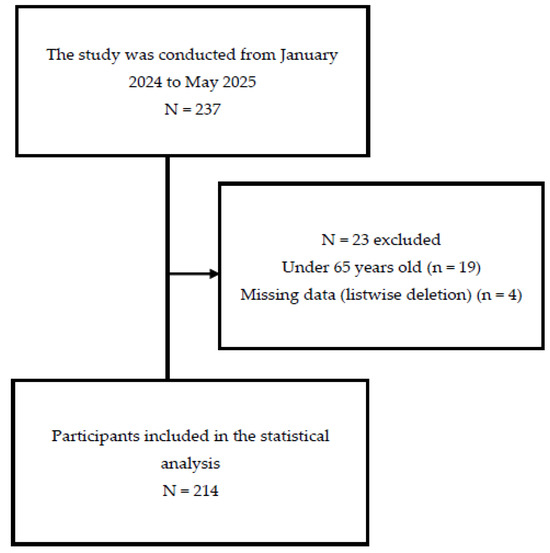
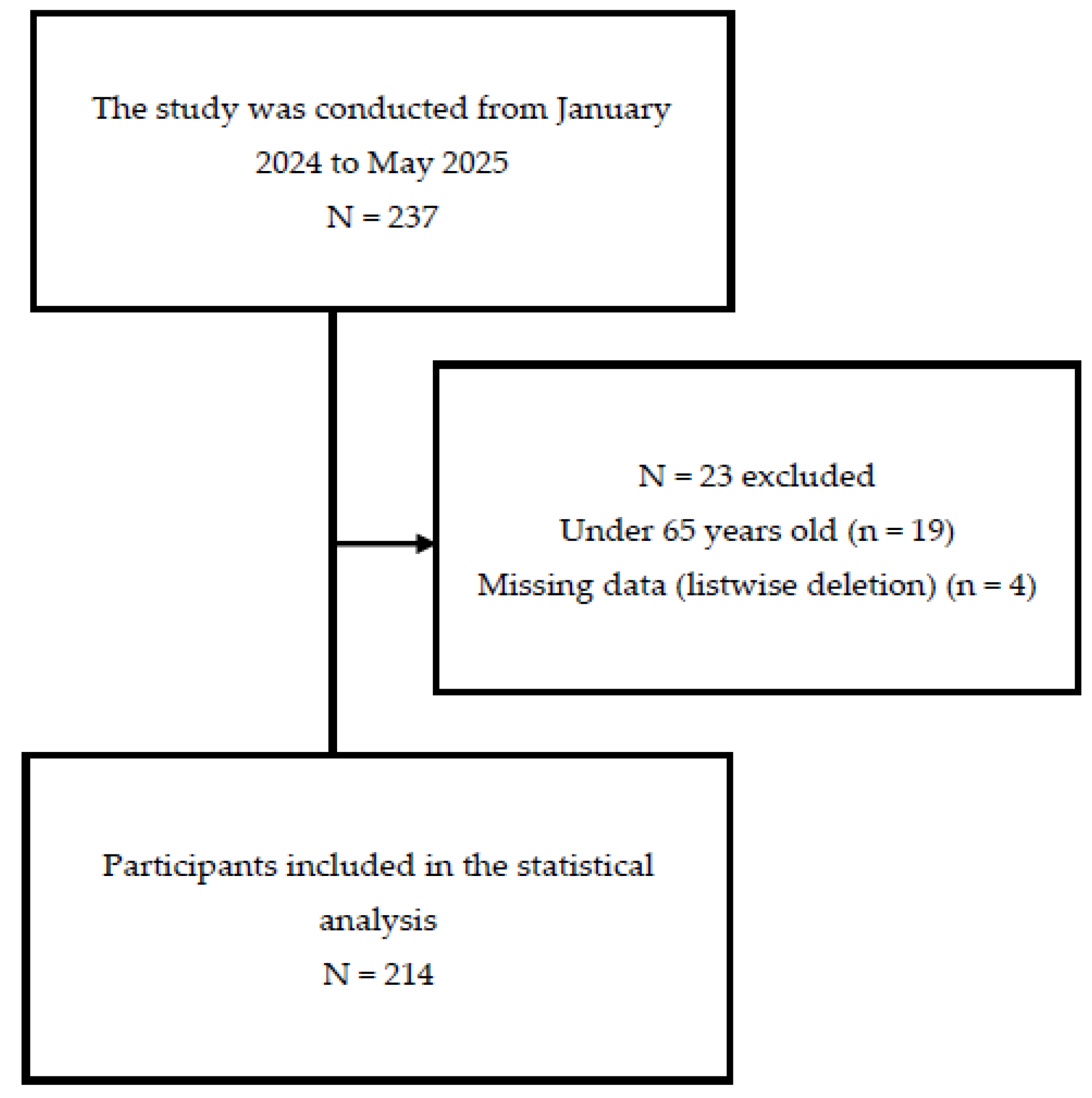
Excluding four participants with missing survey responses (listwise deletion), 214 participants (mean age, 76.9 ± 6.4 years; 61 men and 153 women) were included in the analysis (Figure 1).
Figure 1.
Flowchart of the participant selection process.
The participants were classified into fall (n = 43; 20.1%) and non-fall (n = 171; 79.9%) groups based on the reporting of a fall in the past year. Of the 43 participants in the fall group, 29 reported one fall and 14 reported two or more falls.
The distribution of the study variables in the fall and non-fall groups, respectively, was as follows: age, 79.8 ± 6.2 and 76.2 ± 6.2 years; sex, 31 and 122 women; multiple diseases, 14 and 51 participants; use of long-term care insurance, 2 and 12 participants; RDST score, 9.8 ± 2.6 and 10.2 ± 2.4; Brief-BESTest score, 16.0 ± 4.5 and 18.7 ± 4.2; and CCHL score, 3.2 ± 0.7 and 3.6 ± 0.8 (Table 1).
Table 1.
Basic characteristics of the participants.
Binary logistic regression analysis was performed using the forced entry method on the fall group (n = 43). The reporting of a fall in the past year (falls/non-falls) was used as the dependent variable, and the CCHL score was used as the independent variable. Taking this into consideration, three adjustment variables were prespecified: age, balance function (Brief-BESTest score), and cognitive function (RDST score). Considering the limited size of the fall group and the potential risk of model overfitting, additional established risk factors, including sex, multiple diseases, and long-term care insurance status, were not included in the final model. Binary logistic regression showed that the CCHL score was associated with the dependent variable (odds ratio, 0.61; 95% confidence interval, 0.40–0.93). Furthermore, the Brief-BESTest score, which was included for adjustment, was independently associated with the dependent variable (odds ratio, 0.88; 95% confidence interval: 0.79–0.97). The result of the χ2 test for the model was significant (p < 0.001). The results of the Hosmer–Lemeshow test indicated good model fit (p = 0.894) (Table 2).
Table 2.
Results of the binary logistic regression analysis.
4. Discussion
This study suggests that higher CCHL scores, reflecting better communicative and critical health literacy, are associated with lower odds of reporting a fall. Previous studies [52,53] have recognized the role of health literacy in fall prevention among community-dwelling older adults. Suwannakul et al. [54] found that higher health literacy is associated with important fall prevention behaviors, including regular exercise, safer home hygiene practices such as the use of Western-style toilets, and wearing appropriate footwear. However, the lack of consensus regarding the definition and conceptual framework of health literacy limits measurement and comparison across studies. Therefore, mechanisms underlying the relationship between health literacy and falls remain poorly understood.
In this study, higher CCHL scores, reflecting better communicative and critical health literacy, are associated with lower odds of reporting a fall. Although balance function (Brief-BESTest) was also associated with falls, this relationship has been consistently demonstrated in previous studies and was therefore regarded as an adjustment factor rather than a primary finding. Importantly, the association between communicative and critical health literacy and falls remained after adjustment for age, cognitive function (RDST), and balance function (Brief-BESTest), suggesting that the observed association cannot be fully explained by these established fall-related factors.
The present study exclusively included older adults with the ability to walk indoors unassisted and navigate outdoors independently. Therefore, older adults with mild walking difficulties and a high risk of falls may have been excluded. Accordingly, the results should not be interpreted as applicable to all community-dwelling older adults, but rather as limited to highly independent individuals.
Recent years have seen increased emphasis on comprehensive health promotion addressing the overall lifestyle of community-dwelling older adults, and educational interventions have demonstrated effectiveness [55]. Exercise interventions for fall prevention have been associated with a small-to-moderate reduction in concerns about falls immediately after the intervention among community-dwelling older adults. However, these effects diminish after several months [56]. Considering these findings, a sustainable training program combining expert-supervised outdoor exercise with telecoaching may be effective in improving balance and muscle strength in older adults. This approach may represent a safe, effective, and efficient intervention strategy for increasing physical activity levels and maintaining high adherence to training in older adults [57].
The CCHL is a self-administered questionnaire that can be easily completed. Adding this instrument to existing assessments for community-dwelling older adults is unlikely to substantially increase assessment time or participant burden. Future studies should identify which components of the CCHL most effectively predict falls. The results of the current study may provide alternative options for older adults who have difficulty maintaining exercise programs or are reluctant to engage in exercise initially. However, this interpretation remains speculative, and no clear reports have been published to date. Therefore, further research will be necessary.
This study has some limitations. First, participant selection was not randomized, and sex and age matching based on regional distribution was not possible; therefore, the representativeness of the sample is unclear. However, the number of variables included in the final model was appropriate. Second, although sex, multiple diseases, and long-term care insurance status are recognized risk factors for falls, these variables were not included because of the limited number of fall events and the need to avoid model overfitting. Consequently, residual confounding cannot be ruled out. Furthermore, key determinants influencing health literacy and fall incidence, such as education level, socioeconomic status, living situation, physical activity level, visual impairment, medication use/polypharmacy, and psychological state (including depression), were not considered; thus, residual confounding remains an important concern. Third, the reporting of a fall in the past year was evaluated based on the participants’ self-reports, and therefore, the influence of recall bias cannot be completely ruled out. Previously, recall bias (vague memory or underreporting) when confirming fall history has been identified in community-dwelling older adults [58]. Nonetheless, the participants of the current study were generally able to live independently in the community: the mean RDST score was 10.1 ± 2.4 points, exceeding the cutoff value for suspected MCI [37]. Therefore, the participants’ recall of a fall in the past year was likely sufficiently preserved. However, because the interviews were not conducted on a weekly or monthly basis, there are limitations to understanding the reporting of a fall in the past year. Finally, because this study was preliminary and employed a cross-sectional design, it can only demonstrate associations and cannot establish temporal or causal relationships.
Despite these limitations, we believe this study makes a notable contribution to the current knowledge in this field by supporting the relationship between health literacy and the odds of reporting a fall in the past year among community-dwelling older adults in Japan. Future longitudinal studies with larger sample sizes are needed to clarify the temporal relationship between health literacy and falls, examine whether this association is causal, and investigate whether the relationship is linear or whether clinically meaningful threshold effects exist.
5. Conclusions
This study found a significant association between health literacy and the odds of reporting a recent fall among community-dwelling older adults in Japan. These findings, obtained from community-dwelling older adults in Japan, one of the world’s most rapidly aging societies, may contribute to the development of future international health models for fall prevention. However, given the preliminary cross-sectional nature of this study, future large-scale longitudinal studies are needed to clarify this association. This preliminary study also provides a basis for future investigations into whether a clinically meaningful threshold of health literacy exists for fall prevention and whether the association between health literacy and falls is linear across the full range of health literacy.
Author Contributions
Conceptualization, T.S., K.H. and A.M.; methodology, T.S. and A.M.; acquisition of data, K.H. and T.S.; analysis and interpretation of data, A.M. and T.S.; writing—original draft preparation, A.M.; writing—review and editing, K.H. and T.S. All authors have read and agreed to the published version of the manuscript.
Funding
This work was supported by the Japan Society for the Promotion of Science (JSPS), KAKENHI (grant numbers: JP22K11154, JP26K02722).
Institutional Review Board Statement
This study was approved by the Research Ethics Committee of the Takasaki University of Health and Welfare (approval number 2358 (date of approval: 9 January 2024) and 2457 (date of approval: 9 January 2025)). The study was conducted in accordance with the ethical standards of the 1964 Declaration of Helsinki and its later amendments or comparable ethical standards.
Informed Consent Statement
Informed consent was obtained from all participants in the study.
Data Availability Statement
The datasets generated and analyzed during the current study are not publicly available due to ethical restrictions and participant consent limitations. The study participants did not provide consent for public sharing of individual-level data. Information regarding the study variables, data dictionary, and statistical analysis procedures is available from the corresponding author [A.M.] upon reasonable request and subject to approval by the institutional ethics committee.
Acknowledgments
We would like to express our sincere gratitude to Shizuko Nakajima, Masami Ashikaga, Noriko Takizawa, Kazuhiro Suto, Yoshiko Yamada, Hiroshi Akiyama, Jinko Aoyagi, Akemi Yoshii, and Katsumi Goto for their assistance.
Conflicts of Interest
The authors declare no conflicts of interest.
Abbreviations
The following abbreviations are used in this manuscript:
| Brief-BESTest | Brief-Balance Evaluation Systems Test |
| RDST | Rapid Dementia Screening Test |
| CCHL | Communicative and Critical Health Literacy |
References
- Sun, M.; Liu, J.; Yi, M.; Chen, S.; Huang, Y.; Zhao, Y.I.; Leung, A.Y.M.; Wang, Z. Implementing integrated care for older adults in primary health care: A systematic scoping review. Int. J. Nurs. Stud. 2026, 176, 105342. [Google Scholar] [CrossRef] [Scilit] [PubMed]
- Tricco, A.C.; Thomas, S.M.; Veroniki, A.A.; Hamid, J.S.; Cogo, E.; Strifler, L.; Khan, P.A.; Robson, R.; Sibley, K.M.; MacDonald, H.; et al. Comparisons of interventions for preventing falls in older adults: A systematic review and meta-analysis. JAMA 2017, 318, 1687–1699. [Google Scholar] [CrossRef] [Scilit] [PubMed]
- Lin, C.C.; Meardon, S.; O’Brien, K. The predictive validity and clinical application of stopping elderly accidents, deaths & injuries (STEADI) for fall risk screening. Adv. Geriatr. Med. Res. 2022, 4, e220008. [Google Scholar] [CrossRef] [Scilit] [PubMed] [PubMed Central]
- O’Mahony, D.; O’Sullivan, D.; Byrne, S.; O’Connor, M.N.; Ryan, C.; Gallagher, P. STOPP/START criteria for potentially inappropriate prescribing in older people: Version 2. Age Ageing 2015, 44, 213–218. [Google Scholar] [CrossRef] [Scilit] [PubMed]
- Vos, T.; Lim, S.S.; Abbafati, C.; Abbas, K.M.; Abbasi, M.; Abbasifard, M.; Abbasi-Kangevari, M.; Abbastabar, H.; Abd-Allah, F.; Abdelalim, A.; et al. Diseases and injuries collaborators. Global burden of 369 diseases and injuries in 204 countries and territories, 1990–2019: A systematic analysis for the Global Burden of Disease Study 2019. Lancet 2020, 396, 1204–1222, Erratum in Lancet 2020, 396, 1562. [Google Scholar] [CrossRef]
- Mettananda, K.C.D.; Mettananda, S. Global Incidence, Prevalence, Years Lived with Disability (YLDs), Disability-Adjusted Life-Years (DALYs), and Healthy Life Expectancy (HALE) for 371 Diseases and Injuries in 204 Countries and Territories and 811 Subnational Locations, 1990-2021: A systematic analysis for the global burden of disease Study 2021. Lancet 2024, 403, 2133–2161. [Google Scholar]
- Zhao, X.; Chen, S.; Yu, J. Evaluating the association between anthropometric parameters and successful aging in older adults. Geriatr. Nurs. 2023, 50, 240–246. [Google Scholar] [CrossRef] [Scilit] [PubMed]
- Zhao, X.; Yu, J.; Hu, F.; Chen, S.; Liu, N. Association of body mass index and waist circumference with falls in Chinese older adults. Geriatr. Nurs. 2022, 44, 245–250. [Google Scholar] [CrossRef] [Scilit] [PubMed]
- Nicholson, W.K.; Silverstein, M.; Wong, J.B.; Barry, M.J.; Chelmow, D.; Coker, T.R.; Davis, E.M.; Jaén, C.R.; Krousel-Wood, M.; Lee, S.; et al. Interventions to prevent falls in community-dwelling older adults: US Preventive Services Task Force recommendation statement. JAMA 2024, 332, 51–57. [Google Scholar] [CrossRef] [Scilit] [PubMed]
- Waterval, N.F.J.; Claassen, C.M.; van der Helm, F.C.T.; van der Kruk, E. Predictability of fall risk assessments in community-dwelling older adults: A scoping review. Sensors 2023, 23, 7686. [Google Scholar] [CrossRef] [Scilit] [PubMed]
- Pinheiro, M.B.; Howard, K.; Oliveira, J.S.; Kwok, W.S.; Tiedemann, A.; Wang, B.; Taylor, J.; Bauman, A.; Sherrington, C. Cost-effectiveness of physical activity programs and services for older adults: A scoping review. Age Ageing 2023, 52, afad023. [Google Scholar] [CrossRef] [Scilit] [PubMed]
- Hopewell, S.; Adedire, O.; Copsey, B.J.; Boniface, G.J.; Sherrington, C.; Clemson, L.; Close, J.C.; Lamb, S.E. Multifactorial and multiple component interventions for preventing falls in older people living in the community. Cochrane Database Syst. Rev. 2018, 7, CD012221. [Google Scholar] [CrossRef] [Scilit] [PubMed]
- Murayama, A.; Kobayashi, K.; Yamaguchi, T. Research trends in cost-effectiveness of falls prevention for community-dwelling older adults: A scoping review. J. Shoken Gakuen Gunma Univ. Health Welf. 2025, 13, 123–134. [Google Scholar]
- United Nations Economic and Social Council (ECOSOC). Health literacy and the Millennium Development Goals:United Nations Economic and Social Council (ECOSOC)regional meeting background paper. J. Health Commun. 2010, 15, 211–223. [Google Scholar] [PubMed]
- Bostock, S.; Steptoe, A. Association between low functional health literacy and mortality in older adults: Longitudinal cohort study. BMJ 2012, 344, e1602. [Google Scholar] [CrossRef] [Scilit] [PubMed]
- Adams, R.J.; Piantadosi, C.; Ettridge, K.; Miller, C.; Wilson, C.; Tucker, G.; Hill, C.L. Functional health literacy mediates the relationship between socio-economic status, perceptions and lifestyle behaviors related to cancer risk in an Australian population. Patient Educ. Couns. 2013, 91, 206–212. [Google Scholar] [CrossRef] [Scilit] [PubMed]
- Huang, C.-H.; Talley, P.C.; Lin, C.-W.; Huang, R.-Y.; Liu, I.-T.; Chiang, I.-H.; Lu, I.-C.; Lai, Y.-C.; Kuo, K.-M. Factors associated with low health literacy among community-dwelling women in Taiwan. Women Health 2020, 60, 487–501. [Google Scholar] [CrossRef] [Scilit] [PubMed]
- Chu-Ko, F.; Chong, M.-L.; Chung, C.-J.; Chang, C.-C.; Liu, H.-Y.; Huang, L.-C. Exploring the factors related to adolescent health literacy, health-promoting lifestyle profile, and health status. BMC Public Health 2021, 21, 2196. [Google Scholar] [CrossRef] [Scilit] [PubMed]
- Buja, A.; Rabensteiner, A.; Sperotto, M.; Grotto, G.; Bertoncello, C.; Cocchio, S.; Baldovin, T.; Contu, P.; Lorini, C.; Baldo, V. Health literacy and physical activity: A systematic review. J. Phys. Act. Health 2020, 17, 1259–1274. [Google Scholar] [CrossRef] [Scilit] [PubMed]
- Nakamura, K.; Sasaki, T.; Yokokawa, Y.; Yokouchi, S. Health literacy and frailty: The mediating role of Instrumental Activities of Daily Living. Psychogeriatrics 2025, 25, e70010. [Google Scholar] [CrossRef] [Scilit] [PubMed]
- Myers, A.M.; Powell, L.E.; Maki, B.E.; Holliday, P.J.; Brawley, L.R.; Sherk, W. Psychological indicators of balance confidence: Relationship to actual and perceived abilities. J. Gerontol. A Biol. Sci. Med. Sci. 1996, 51, M37–M43. [Google Scholar] [CrossRef] [Scilit] [PubMed]
- Tinetti, M.E.; Baker, D.I.; McAvay, G.; Claus, E.B.; Garrett, P.; Gottschalk, M.; Koch, M.L.; Trainor, K.; Horwitz, R.I. A multifactorial intervention to reduce the risk of falling among elderly people living in the community. N. Engl. J. Med. 1994, 331, 821–827. [Google Scholar] [CrossRef] [Scilit] [PubMed]
- Park, Y.; Kim, S.R.; Seo, H.J.; Cho, J. Health literacy in fall-prevention strategy: A scoping review. Asian Nurs. Res. (Korean Soc. Nurs. Sci.) 2024, 18, 532–544. [Google Scholar] [CrossRef] [Scilit] [PubMed]
- Ministry of Internal Affairs and Communications Statistics Bureau. Home Page: Statistical Topics No. 146 Japan’s Older Adults Seen from Statistics—In Honor of “Respect for the Aged Day”. Available online: https://www.stat.go.jp/data/topics/pdf/topics146.pdf (accessed on 27 April 2026).
- Ministry of Health, Labor and Welfare. Overview of the 2022 (Reiwa 4) Basic Survey on the Living Conditions of the People. Available online: https://www.mhlw.go.jp/toukei/saikin/hw/k-tyosa/k-tyosa22/index.htm (accessed on 27 April 2026).
- Ministry of Health, Labor and Welfare. Overview of the 2019 (Reiwa 1) Basic Survey on the Living Conditions of the People. Available online: https://www.mhlw.go.jp/toukei/saikin/hw/k-tyosa/k-tyosa19/index.html (accessed on 27 April 2026).
- Ministry of Education, Culture, Sports, Science and Technology. Program for International Adult Competencies (PIAAC). Available online: https://www.mext.go.jp/b_menu/toukei/data/Others/1287165.htm (accessed on 17 June 2026).
- Nakayama, K.; Yonekura, Y.; Danya, H.; Hagiwara, K. Associations between health literacy and information-evaluation and decision-making skills in Japanese adults. BMC Public Health 2022, 22, 1473. [Google Scholar] [CrossRef] [Scilit] [PubMed] [PubMed Central]
- Matsumoto, M.; Nakayama, K. Development of the health literacy on social determinants of health questionnaire in Japanese adults. BMC Public Health 2017, 17, 30. [Google Scholar] [CrossRef] [Scilit] [PubMed] [PubMed Central]
- World Health Organization. Multimorbidity, Technical Series on Safer Primary Care. Available online: https://www.who.int/publications/i/item/9789241511650 (accessed on 27 April 2026).
- Kozinc, Ž.; Löfler, S.; Hofer, C.; Carraro, U.; Šarabon, N. Diagnostic balance tests for assessing risk of falls and distinguishing older adult fallers and non-fallers: A systematic review with meta-analysis. Diagnostics 2020, 10, 667. [Google Scholar] [CrossRef] [Scilit] [PubMed]
- Padgett, P.K.; Jacobs, J.V.; Kasser, S.L. Is the BESTest at its best? A suggested brief version based on interrater reliability, validity, internal consistency, and theoretical construct. Phys. Ther. 2012, 92, 1197–1207. [Google Scholar] [CrossRef] [Scilit] [PubMed]
- Viveiro, L.A.P.; Gomes, G.C.V.; Bacha, J.M.R.; Carvas Junior, N.; Kallas, M.E.; Reis, M.; Jacob Filho, W.; Pompeu, J.E. Reliability, validity, and ability to identity fall status of the berg balance scale, balance evaluation systems test (BESTest), mini-BESTest, and brief-BESTest in older adults who live in nursing homes. J. Geriatr. Phys. Ther. 2019, 42, E45–E54. [Google Scholar] [CrossRef] [Scilit] [PubMed]
- Horak, F.B.; Wrisley, D.M.; Frank, J. The Balance Evaluation Systems Test (BESTest) to differentiate balance deficits. Phys. Ther. 2009, 89, 484–498. [Google Scholar] [CrossRef] [Scilit] [PubMed] [PubMed Central]
- Shinohara, T.; Maruyama, A.; Yabana, Y.; Kamijo, M.; Saito, S. Predictive ability of systems of postural control for 1-year risk of falls and frailty in community-dwelling older adults: A preliminary study. J. Ageing Longev. 2025, 5, 45. [Google Scholar] [CrossRef] [Scilit]
- Rubenstein, L.Z.; Josephson, K.R. The epidemiology of falls and syncope. Clin. Geriatr. Med. 2002, 18, 141–158. [Google Scholar] [CrossRef] [Scilit] [PubMed]
- Kalbe, E.; Calabrese, P.; Schwalen, S.; Kessler, J. The rapid dementia screening test (RDST): A new economical tool for detecting possible patients with dementia. Dement. Geriatr. Cogn. Disord. 2003, 16, 193–199. [Google Scholar] [CrossRef] [Scilit] [PubMed]
- Ishikawa, H.; Nomura, K.; Sato, M.; Yano, E. Developing a measure of communicative and critical health literacy: A pilot study of Japanese office workers. Health Promot. Int. 2008, 23, 269–274. [Google Scholar] [CrossRef] [Scilit] [PubMed]
- Ishikawa, H.; Takeuchi, T.; Yano, E. Measuring functional, communicative, and critical health literacy among diabetic patients. Diabetes Care 2008, 31, 874–879. [Google Scholar] [CrossRef] [Scilit] [PubMed]
- Nutbeam, D. Health literacy as a public health goal; A challenge for contemporary health education and communication strategies into the 21st century. Health Promot. Int. 2000, 15, 259–267. [Google Scholar] [CrossRef] [Scilit]
- Tones, K. Health literacy: New wine in old bottles? Health Educ. Res. 2002, 17, 287–290. [Google Scholar] [CrossRef] [Scilit] [PubMed]
- Chinn, D. Critical health literacy: A review and critical analysis. Soc. Sci. Med. 2011, 73, 60–67. [Google Scholar] [CrossRef] [Scilit] [PubMed]
- Sykes, S.; Wills, J.; Rowlands, G.; Popple, K. Understanding critical health literacy: A concept analysis. BMC Public Health 2013, 13, 150. [Google Scholar] [CrossRef] [Scilit] [PubMed]
- Salari, N.; Darvishi, N.; Ahmadipanah, M.; Shohaimi, S.; Mohammadi, M. Global prevalence of falls in the older adults: A comprehensive systematic review and meta-analysis. J. Orthop. Surg. Res. 2022, 17, 334. [Google Scholar] [CrossRef] [Scilit] [PubMed] [PubMed Central]
- Pillay, J.; Gaudet, L.A.; Saba, S.; Vandermeer, B.; Ashiq, A.R.; Wingert, A.; Hartling, L. Falls prevention interventions for community-dwelling older adults: Systematic review and meta-analysis of benefits, harms, and patient values and preferences. Syst. Rev. 2024, 13, 289. [Google Scholar] [CrossRef] [Scilit] [PubMed] [PubMed Central]
- Cohen, J. Statistical Power Analysis for the Behavioral Sciences, 2nd ed.; Routledge: New York, NY, USA, 2013. [Google Scholar]
- Peduzzi, P.; Concato, J.; Kemper, E.; Holford, T.R.; Feinstein, A.R. A simulation study of the number of events per variable in logistic regression analysis. J. Clin. Epidemiol. 1996, 49, 1373–1379. [Google Scholar] [CrossRef] [Scilit] [PubMed]
- Zabor, E.C.; Reddy, C.A.; Tendulkar, R.D.; Patil, S. Logistic regression in clinical studies. Int. J. Radiat. Oncol. 2022, 112, 271–277. [Google Scholar] [CrossRef] [Scilit] [PubMed]
- Chowdhury, M.Z.I.; Turin, T.C. Variable selection strategies and its importance in clinical prediction modelling. Fam. Med. Community Health 2020, 8, e000262. [Google Scholar] [CrossRef] [Scilit] [PubMed] [PubMed Central]
- Montero-Odasso, M.; van der Velde, N.; Martin, F.C.; Petrovic, M.; Tan, M.P.; Ryg, J.; Aguilar-Navarro, S.; Alexander, N.B.; Becker, C.; Blain, H.; et al. World guidelines for falls prevention and management for older adults: A global initiative. Age Ageing 2022, 51, afac205. [Google Scholar] [CrossRef] [Scilit] [PubMed]
- Kanda, Y. Investigation of the freely available easy-to-use software “EZR” for medical statistics. Bone Marrow Transplant. 2013, 48, 452–458. [Google Scholar] [CrossRef] [Scilit] [PubMed]
- Andrade, I.; Silva, C.; Martins, A.C. Application of the Health Literacy INDEX on the development of a manual for prevention of falls for older adults. Patient Educ. Couns. 2017, 100, 154–159. [Google Scholar] [CrossRef] [Scilit] [PubMed]
- Li, S.; Wang, J.; Ren, L.; Ye, P.; Niu, W.; Yu, M.; Hu, Y.; Jiang, Y.; Wu, Y.; Tian, M.; et al. Health literacy and falls among community-dwelling older people in China: Is there a sex difference? Aging Clin. Exp. Res. 2024, 36, 148. [Google Scholar] [CrossRef] [Scilit] [PubMed] [PubMed Central]
- Suwannakul, B.; Srithawong, A.; Kaewjoho, C.; Ruanjai, T.; Sutalangka, C.; Namkorn, P.; Sitthipornvorakul, E.; Atsawakaewmongkhon, S.; Taniguchi, R.; Ganogpichayagrai, A.; et al. Associations between health literacy, environmental factors, and fall prevention behaviors among community-dwelling older adults in Northern Thailand: A cross-sectional study. Int. J. Environ. Res. Public Health 2026, 23, 281. [Google Scholar] [CrossRef] [Scilit] [PubMed]
- Oh, S.L.; Kim, H.; Woo, S.; Cho, B.-L.; Song, M.; Park, Y.-H.; Lim, J.-Y.; Song, W. Effects of an integrated health education and elastic band resistance training program on physical function and muscle strength in community-dwelling elderly women: Healthy Aging and Happy Aging II study. Geriatr. Gerontol. Int. 2017, 17, 825–833. [Google Scholar] [CrossRef] [Scilit] [PubMed]
- Kendrick, D.; Kumar, A.; Carpenter, H.; Zijlstra, G.A.R.; Skelton, D.A.; Cook, J.R.; Stevens, Z.; Belcher, C.M.; Haworth, D.; Gawler, S.J.; et al. Exercise for reducing fear of falling in older people living in the community. Cochrane Database Syst. Rev. 2014, 2015, 345–352. [Google Scholar] [CrossRef] [Scilit] [PubMed]
- Leale, I.; Giustino, V.; Brusa, J.; Barcellona, M.; Barbagallo, M.; Palma, A.; Messina, G.; Dominguez, L.J.; Battaglia, G. Effectiveness of a sustainable training program combining supervised outdoor exercise with telecoaching on physical performance in elderly people. Sustainability 2024, 16, 3254. [Google Scholar] [CrossRef] [Scilit]
- Cummings, S.R.; Nevitt, M.C.; Kidd, S. Forgetting falls. The limited accuracy of recall of falls in the elderly. J. Am. Geriatr. Soc. 1988, 36, 613–616. [Google Scholar] [CrossRef] [Scilit] [PubMed]

Disclaimer/Publisher’s Note: The statements, opinions and data contained in all publications are solely those of the individual author(s) and contributor(s) and not of MDPI and/or the editor(s). MDPI and/or the editor(s) disclaim responsibility for any injury to people or property resulting from any ideas, methods, instructions or products referred to in the content. |
© 2026 by the authors. Licensee MDPI, Basel, Switzerland. This article is an open access article distributed under the terms and conditions of the Creative Commons Attribution (CC BY) license.