The Relationship Between State Boredom and Sleep–Wake Disruptions: A Mediation Model via Smartphone Addiction and Bedtime Procrastination

Highlights
- This study shows how state boredom affects sleep–wake quality and sleep timing.
- The influence of boredom on sleep–wake quality and sleep timing is mediated by smartphone addiction and bedtime procrastination.
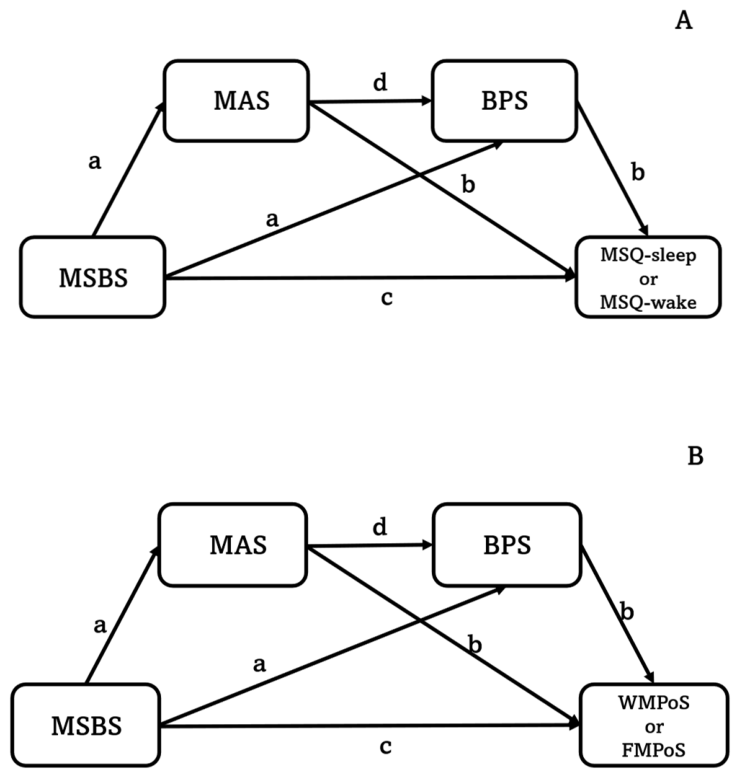
- This study proposes a mediation model linking several constructs relevant to public health, including boredom, smartphone addiction, bedtime procrastination, sleep quality, daytime sleepiness, and sleep timing.
- The model identifies multiple direct and indirect pathways among these variables, consistent with existing theoretical frameworks.
- Findings indicate that state boredom directly predicts sleep–wake problems, extending public health research beyond trait boredom (boredom proneness) and supporting cross-cultural investigation.
- The mediation model highlights potential intervention targets to improve sleep quality and daytime functioning.
Abstract
1. Introduction
2. Materials and Methods
2.1. Participants
2.2. Materials
2.2.1. Mini-Sleep Questionnaire (MSQ)
2.2.2. Midpoint of Sleep (MPoS)
2.2.3. Bedtime Procrastination Scale (BPS)
2.2.4. Mobile Addiction Scale (MAS)
2.2.5. Multidimensional State Boredom Scale (MSBS)
2.3. Procedure
2.4. Data Analysis
3. Results
4. Discussion
5. Conclusions
Author Contributions
Funding
Institutional Review Board Statement
Informed Consent Statement
Data Availability Statement
Conflicts of Interest
References
- Fabbri, M. The mechanisms of sleep function and regulation for health and cognitive performance. Brain Sci. 2023, 13, 1680. [Google Scholar] [CrossRef]
- Lao, X.Q.; Liu, X.; Deng, H.-B.; Chan, T.-C.; Ho, K.F.; Wang, F.; Vermeulen, R.; Tan, T.; Wang, M.C.S.; Tse, L.A.; et al. Sleep quality, sleep duration, and the risk of coronary heart disease: A prospective cohort study with 60,586 adults. J. Clin. Sleep Med. 2018, 14, 109–117. [Google Scholar] [CrossRef]
- Eller, T.; Aluoja, A.; Vasar, V.; Veldi, M. Symptoms of anxiety and depression in Estonian medical students with sleep problems. Depress. Anxiety 2006, 23, 250–256. [Google Scholar] [CrossRef]
- McEwen, B.S. Sleep deprivation as a neurobiologic and physiologic stressor: Allostasis and allostatic load. Metabolism 2006, 55, S20–S23. [Google Scholar] [CrossRef] [PubMed]
- Suardiaz-Muro, M.; Ortega-Moreno, M.; Morante-Ruiz, M.; Menroy, M.; Ruiz, M.A.; Martín-Plasencia, P.; Vela-Bueno, A. Sleep quality and sleep deprivation: Relationship with academic performance in university students during examination period. Sleep Biol. Rhythm. 2023, 21, 377–383. [Google Scholar] [CrossRef] [PubMed]
- Deng, Y.; Cherian, J.; Kumari, K.; Samad, S.; Abbas, J.; Safdar Sial, M.; Popp, J.; Oláh, J. Impact of sleep deprivation on job performance of working mothers: Mediating effect of workplace deviance. Int. J. Environ. Res. Public Health 2022, 19, 3799. [Google Scholar] [CrossRef]
- Haack, M.; Mullington, J.M. Sustained sleep restriction reduces emotional and physical well-being. Pain 2005, 119, 56–64. [Google Scholar] [CrossRef]
- Achermann, P. The two-process model of sleep regulation revisited. Aviat. Space Environ. Med. 2004, 75, A37–A43. [Google Scholar]
- Kim, E.S.; Dimsdale, J.E. The effect of psychosocial stress on sleep: A review of polysomnographic evidence. Behav. Sleep Med. 2007, 5, 256–278. [Google Scholar] [CrossRef] [PubMed]
- Borbély, A.A.; Daan, S.; Wirz-Justice, A.; Deboer, T. The two-process model of sleep regulation: A reappraisal. J. Sleep Res. 2016, 25, 131–143. [Google Scholar] [CrossRef]
- Smith, A. Cognitive fatigue and the wellbeing and academic attainment of university students. J. Educ. Soc. Behav. Sci. 2018, 24, 1–12. [Google Scholar] [CrossRef]
- Connor, J.; Whitlock, G.; Norton, R.; Jackson, R. The role of driver sleepiness in car crashers: A systematic review of epidemiological studies. Accid. Anal. Prev. 2001, 33, 31–41. [Google Scholar] [CrossRef] [PubMed]
- Adachi, M.; Nagaura, Y.; Eto, H.; Kondo, H.; Kato, C. The impact of sleep-wake problems on health-related quality of life among Japanese nursing college students: A cross-sectional study. Health Qual. Life Outcomes 2022, 20, 150. [Google Scholar] [CrossRef] [PubMed]
- Kroese, F.M.; De Ridder, D.T.D.; Evers, C.; Adriaanse, M.A. Bedtime procrastination: Introducing a new area of procrastination. Front. Psychol. 2014, 5, 611. [Google Scholar] [CrossRef] [PubMed]
- Steeel, P. The nature of procrastination: A meta-analytic and theoretical review of quintessential self-regulatory failure. Psychol. Bull. 2007, 133, 65–94. [Google Scholar] [CrossRef]
- Kroese, F.M.; Evers, C.; Adriaanse, M.A.; De Ridder, D.T.D. Bedtime procrastination: A self-regulation perspective on sleep insufficiency in the general population. J. Health Psychol. 2016, 21, 853–862. [Google Scholar] [CrossRef]
- Fabbri, M.; Martoni, M. How chronotype, sleep-wake cycle, subjective time experience influence retrospective, and prospective memory functioning. Front. Cogn. 2025, 4, 1683207. [Google Scholar] [CrossRef]
- Sabanayagam, C.; Shankar, A. Sleep duration and cardiovascular disease: Results from the National Health Interview Survey. Sleep 2010, 33, 1037–1042. [Google Scholar] [CrossRef]
- Nauts, S.; Kamphorst, B.A.; Stut, W.; De Ridder, D.T.D.; Anderson, J.H. The explanations people give for going to bed late: A qualitative study of the varieties of bedtime procrastination. Behav. Sleep Med. 2019, 17, 753–762. [Google Scholar] [CrossRef]
- Zhu, Y.; Huang, J.; Yang, M. Association between chronotype and sleep quality among Chinese college students: The role of bedtime procrastination and sleep hygiene awareness. Int. J. Environ. Res. Public Health 2022, 20, 197. [Google Scholar] [CrossRef]
- Magalhães, P.; Cruz, V.; Teixeira, S.; Fuentes, S.; Rosário, P. An exploratory study on sleep procrastination: Bedtime vs. while-in-bed procrastination. Int. J. Environ. Res. Public Health 2020, 17, 5892. [Google Scholar] [CrossRef]
- Herzog-Krzywoszanska, R.; Krzywoszański, Ł. Bedtime procrastination, sleep-related behaviors, and demographic factors in an online survey on a Polish sample. Front. Neurosci. 2019, 13, 963. [Google Scholar] [CrossRef]
- Magalhães, P.; Pereira, B.; Oliveira, A.; Santos, D.; Núñez, J.C.; Rosário, P. The mediator role of routines on the relationship between general procrastination, academic procrastination and perceived importance of sleep and bedtime procrastination. Int. J. Environ. Res. Public Health 2021, 18, 7796. [Google Scholar] [CrossRef] [PubMed]
- Kroese, F.M.; Nauts, S.; Kamphorst, B.A.; Anderson, J.H.; de Ridder, D.T.D. Bedtime procrastination: A behavioral perspective on sleep insufficiency. In Procrastination, Health, and Well-Being; Sirois, F.M., Pychyl, T.A., Eds.; Elsevier Academic Press: Amsterdam, The Netherlands, 2016; pp. 93–119. [Google Scholar]
- Hill, V.M.; Rebar, A.L.; Ferguson, S.A.; Shriane, A.E.; Vincent, G.E. Go to bed! A systematic review and meta-analysis of bedtime procrastination correlates and sleep outcomes. Sleep Med. Rev. 2022, 66, 101697. [Google Scholar] [CrossRef]
- Kuhnel, J.; Syrek, C.J.; Drehler, A. Why don’t’you go to bed on time? A daily diary study on the relationships between chronotype, self-control resources and the phenomenon of bedtime procrastination. Front. Psychol. 2018, 9, 77. [Google Scholar] [CrossRef] [PubMed]
- Paine, S.-J.; Gander, P.H. Differences in circadian phase and weekday/weekend sleep patterns in a sample of middle-aged morning types and evening types. Chronobiol. Int. 2016, 33, 1009–1017. [Google Scholar] [CrossRef]
- Taillard, J.; Sagaspe, P.; Philip, P.; Bioulac, S. Sleep timing, chronotype and social jetlag: Impact on cognitive abilities and psychiatric disorders. Biochem. Pharmacol. 2021, 191, 114438. [Google Scholar] [CrossRef]
- Li, X.; Buxton, O.M.; Kim, Y.; Haneuse, S.; Kawachi, I. Do procrastinators get worse sleep? Cross-sectional study of US adolescents and young adults. SSM Popul. Health 2020, 10, 106518. [Google Scholar] [CrossRef]
- Pu, Z.; Leong, R.L.F.; Chee, M.W.L.; Massar, S.A.A. Bedtime procrastination and chronotype differentially predict adolescent sleep on school nights and non-school nights. Sleep Health 2022, 8, 640–647. [Google Scholar] [CrossRef] [PubMed]
- Li, Y.; Li, G.; Liu, L.; Wu, H. Correlations between mobile phone addiction and anxiety, depression, impulsivity, and poor sleeo quality among college students: A systematic review and meta-analysis. J. Behav. Addict. 2020, 9, 551–571. [Google Scholar] [CrossRef]
- Wacks, Y.; Weinstein, A.M. Excessive smartphone use is associated with health problems in adolescents and young adults. Front. Psychiatry 2021, 12, 669042. [Google Scholar] [CrossRef]
- Demirci, K.; Akgonul, M.; Akpinar, A. Relationship of smartphone use severity with sleep quality, depression, and anxiety in university students. J. Behav. Addict. 2015, 4, 85–92. [Google Scholar] [CrossRef] [PubMed]
- Lin, Y.H.; Chiang, C.L.; Lin, P.H.; Chang, L.-R.; Ko, G.H.; Lee, Y.-H.; Lin, S.-H. Proposed diagnostic criteria for smartphone addiction. PLoS ONE 2016, 11, e0163010. [Google Scholar] [CrossRef]
- Carter, B.; Rees, P.; Hale, L.; Bhattacharjee, D.; Paradkar, M.S. Association between portable screen-based media device access or use and sleep outcomes: A systematic review and meta-analysis. JAMA Pediatr. 2016, 170, 1202–1208. [Google Scholar] [CrossRef] [PubMed]
- Sohn, S.Y.; Krasnoff, L.; Rees, P.; Kalk, N.J.; Carter, B. The association between smartphone addiction and sleep: A UK cross-sectional study of young adults. Front. Psychiatry 2021, 12, 629407. [Google Scholar] [CrossRef]
- Yang, J.; Fu, X.; Liao, X.; Li, Y. Association of problematic smartphone use with poor sleep quality, depression, and anxiety: A systematic review and meta-analysis. Psychiatry Res. 2020, 284, 112686. [Google Scholar] [CrossRef]
- Chung, J.E.; Choi, S.A.; Kim, K.T.; Yee, J.; Kim, J.H.; Seong, J.W.; Kim, J.Y.; Lee, K.E.; Gwak, H.S. Smartphone addiction risk and daytime sleepiness in Korean adolescents. J. Paediatr. Child Health 2018, 54, 800–806. [Google Scholar] [CrossRef]
- Chindamo, S.; Buja, A.; DeBattisti, E.; Terraneo, A.; Marini, E.; Gomez Perez, L.J.; Marconi, L.; Baldo, V.; Chiamenti, G.; Doria, M.; et al. Sleep and new media usage in toddlers. Eur. J. Pediatr. 2019, 178, 483–490. [Google Scholar] [CrossRef]
- Kim, S.Y.; Han, S.; Park, E.-J.; Yoo, H.J.; Park, D.; Suh, S.; Shin, Y.M. The relationship between smartphone overuse and sleep in younger children: A prospective cohort study. J. Clin. Sleep Med. 2020, 16, 1133–1139. [Google Scholar] [CrossRef] [PubMed]
- Lin, P.H.; Lee, Y.C.; Chen, K.L.; Hsieh, P.L.; Yang, S.Y.; Lin, Y.L. The relationship between sleep quality and internet addiction among female college students. Front. Neurosci. 2019, 13, 599. [Google Scholar] [CrossRef]
- Spagnoli, P.; Balducci, C.; Fabbri, M.; Molinaro, D.; Barbato, G. Workaholism, intensive smartphone use, and the sleep-wake cycle: A multiple mediation analysis. Int. J. Environ. Res. Public Health 2019, 16, 3517. [Google Scholar] [CrossRef]
- Bozkurt, A.; Demirdöğen, E.Y.; Akinci, M.A. The association between bedtime procrastination, sleep quality, and problematic smartphone use in adolescents: A mediation analysis. Eurasian J. Med. 2024, 56, 69–75. [Google Scholar] [CrossRef] [PubMed]
- Arshad, D.; Joyia, U.M.; Fatima, S.; Khalid, N.; Rishi, A.I.; Rahim, N.U.A.; Bukhari, S.F.; Shairwani, G.K.; Salmaan, A. The adverse impact of excessive smartphone scree-time on sleep quality among young adults: A prospective cohort. Sleep Sci. 2021, 14, 337–341. [Google Scholar] [CrossRef]
- Lissak, G. Adverse physiological and psychological effects of screen time on children and adolescents: Literature review and case study. Environ. Res. 2018, 164, 149–157. [Google Scholar] [CrossRef]
- Kheirinejad, S.; Visuri, A.; Ferreira, D.; Hosio, S. “Leave your smartphone out of bed”: Quantitative analysis of smartphone use effect on sleep quality. Pers. Ubiquitous Comput. 2023, 27, 447–466. [Google Scholar] [CrossRef]
- Hill, V.M.; Ferguson, S.A.; Vincent, G.E.; Rebar, A.L. “It’s satisfying but destructive”: A qualitative study on the experience of bedtime procrastination in new career starters. Br. J. Health Psychol. 2023, 29, 185–203. [Google Scholar] [CrossRef]
- An, Y.; Zhang, M.X. Relationship between problematic smartphone use and sleep problems: The roles of sleep-related compensatory health beliefs and bedtime procrastination. Digit. Health 2024, 10, 20552076241283338. [Google Scholar] [CrossRef]
- Cemei, L.; Sriram, S.; Holỳ, O.; Rehman, S. A longitudinal investigation on the reciprocal relationship of problematic smartphone use with bedtime procrastination, sleep quality, and mental health among university students. Psychol. Res. Behav. Manag. 2024, 17, 3355–3367. [Google Scholar] [CrossRef] [PubMed]
- Correa-Iriarte, S.; Hidalgo-Fuentes, S.; Martì-Vilar, M. Relationship between problematic smartphone use, sleep quality and bedtime procrastination: A mediation analysis. Behav. Sci. 2023, 13, 839. [Google Scholar] [CrossRef]
- Zhang, M.X.; Wu, A.M.S. Effects of smartphone addiction on sleep quality among Chinese university students: The mediating role of self-regulation and bedtime procrastination. Addict. Behav. 2020, 111, 106552. [Google Scholar] [CrossRef] [PubMed]
- Geng, Y.; Gu, J.; Wang, J.; Zhang, R. Smartphone addiction and depression, anxiety: The role of bedtime procrastination and self-control. J. Affect. Disord. 2021, 293, 415–421. [Google Scholar] [CrossRef]
- Struk, A.A.; Carriere, J.-S.; Cheyne, J.-A.; Danckert, J. A short boredom proneness scale: Development and psychometric properties. Assessment 2015, 24, 346–359. [Google Scholar] [CrossRef]
- Ksinan, A.J.; Maliŝ, J.; Vazsonyi, A.T. Swiping away the moments that make up a dull day: Narcissism, boredom, and compulsive smartphone use. Curr. Psychol. 2021, 40, 2917–2926. [Google Scholar] [CrossRef]
- Leung, L. Linking psychological attributes to addiction and improper use of the mobile phone among adolescents in Hong Kong. J. Child. Media 2008, 2, 93–113. [Google Scholar] [CrossRef]
- Skues, J.; Williams, B.; Oldmeadow, J.; Wise, L. The effects of boredom, loneliness, and distress tolerance on problem internet use among university students. Int. J. Ment. Health Addict. 2015, 14, 167–180. [Google Scholar] [CrossRef]
- Lin, C.H.; Yu, S.F. Adolescent internet usage in Taiwan: Exploring gender differences. Adolescence 2008, 43, 317–331. [Google Scholar] [PubMed]
- Hong, W.; Liu, R.-D.; Ding, Y.; Zhen, R.; Jiang, R.; Fu, X. Autonomy need dissatisfaction in daily life and problematic mobile phone use: The mediating roles of boredom proneness and mobile phone gaming. Int. J. Environ. Res. Public Health 2020, 17, 5305. [Google Scholar] [CrossRef] [PubMed]
- Flynn, E.A.; Thèriault, É.R.; Williams, S.R. The use of smartphones to cope with stress in university students: Helpful or harmful? J. Technol. Behav. Sci. 2020, 5, 171–177. [Google Scholar] [CrossRef]
- Yang, Y.; Luo, Y.; Chen, M.; Zhai, J. Life events, boredom proneness and mobile phone addiction tendency: A longitudinal mediation analysis based on latent growth modelling (LGM). Psychol. Res. Behav. Manag. 2023, 16, 2407–2416. [Google Scholar] [CrossRef] [PubMed]
- Zhang, L.; Wang, B.; Xu, O.; Fu, C. The role of boredom proneness and self-control in the association between anxiety and smartphone addiction among college students: A multiple mediation model. Front. Public Health 2023, 11, 1201079. [Google Scholar] [CrossRef]
- Martin, M.; Sadlo, G.; Stew, G. Rethinking occupational deprivation and boredom. J. Occup. Sci. 2012, 19, 54–61. [Google Scholar] [CrossRef]
- Tanaka, H.; Shirakawa, S. Sleep health, lifestyle and mental health in the Japanese elderly: Ensuring sleep to promote a healthy brain and mind. J. Psychosom. Res. 2004, 56, 465–477. [Google Scholar] [CrossRef]
- Martin, M.; Sadlo, G.; Stew, G. The phenomenon of boredom. Qual. Res. Psychol. 2006, 3, 193–211. [Google Scholar] [CrossRef]
- Zhang, L.; Yuan, Q.; Wu, Q.; Kwauk, S.; Liao, X.; Wang, C. Sleep quality and sleep disturbing factors of inpatients in a Chinese general hospital. J. Clin. Nurs. 2009, 18, 2521–2529. [Google Scholar] [CrossRef] [PubMed]
- Cellini, N.; Canale, N.; Mioni, G.; Costa, S. Changes in sleep pattern, sense of time and digital media use during COVID-19 lockdown in Italy. J. Sleep Res. 2020, 29, e13074. [Google Scholar] [CrossRef]
- Martinelli, N.; Gil, S.; Bellertier, C.; Chevalère, J.; Dezecache, G.; Huguet, P.; Droit-Volet, S. Time and emotion during lockdown and the COVID-19 epidemic determinants of our experience of time? Front. Psychol. 2021, 11, 616169. [Google Scholar] [CrossRef]
- Droit-Volet, S.; Gil, S.; Martinelli, N.; Andant, N.; Clinchamps, M.; Parreira, L.; Rouffiac, K.; Dambrun, M.; Huguet, P.; Dubuis, B.; et al. Time and COVID-19 stress in the lockdown situation: Time free “dying” of boredom and sadness. PLoS ONE 2020, 15, e0236465. [Google Scholar] [CrossRef] [PubMed]
- Droit-Volet, S.; Martinelli, N.; Chevalère, J.; Belletier, C.; Dezecache, G.; Gil, S.; Huguet, P. The persistence of slowed time experience during the COVID-19 pandemic: Two longitudinal studies in France. Front. Psychol. 2021, 12, 721716. [Google Scholar] [CrossRef]
- Meng, F.; Xuan, B. Boredom proneness on Chinese college students’ phubbing during the COVID-19 outbreak: The mediating effects of self-control and bedtime procrastination. J. Healthc. Eng. 2023, 2023, 4134283. [Google Scholar] [CrossRef]
- Fabbri, M. Mindfulness, subjective cognitive functioning, sleep timing and time expansion during COVID-19 lockdown: A longitudinal study in Italy. Clocks Sleep 2023, 5, 313–332. [Google Scholar] [CrossRef]
- Wessels, M.; Utegaliyev, N.; Bernhard, C.; Welsch, R.; Oberfeld, D.; Thönes, S.; von Castell, C. Adapting to the pandemic: Longitudinal effects of social restrictions on time perception and boredom during the COVID-19 pandemic in Germany. Sci. Rep. 2022, 12, 1863. [Google Scholar] [CrossRef] [PubMed]
- Kosak, F.; Schelhorn, I.; Wittmann, M. The subjective experience of time during the pandemic in Germany: The big slowdown. PLoS ONE 2022, 17, e0267709. [Google Scholar] [CrossRef]
- Ma, X.; Meng, D.; Zhu, L.; Xu, H.; Guo, J.; Yang, L.; Yu, L.; Fu, Y.; Mu, L. Bedtime procrastination predicts the prevalence and severity of poor sleep quality of Chinese undergraduate students. J. Am. Coll. Health 2022, 70, 1104–1111. [Google Scholar] [CrossRef] [PubMed]
- Teoh, A.N.; Wong, J.W.K. Mindfulness is associated with better sleep quality in young adults by reducing boredom and bedtime procrastination. Behav. Sleep Med. 2023, 21, 61–71. [Google Scholar] [CrossRef] [PubMed]
- Fabbri, M.; Pizzini, B.; Beracci, A.; Martoni, M. Time consciousness: Silence, mindfulness, and subjective time perception. Prog. Brain Res. 2024, 287, 191–215. [Google Scholar] [CrossRef] [PubMed]
- Teoh, A.N.; En Ooi, E.Y.; Chan, A.Y. Boredom affects sleep quality: The serial mediation effect of inattention and bedtime procrastination. Personal. Individ. Differ. 2021, 171, 110460. [Google Scholar] [CrossRef]
- Zhu, Y.; Liu, J.; Wang, Q.; Huang, J.; Li, X.; Liu, J. Examining the association between boredom proneness and bedtime procrastination among Chinese college students: A sequential mediation model with mobile phone addiction and negative emotions. Psychol. Res. Behav. Manag. 2023, 16, 4329–4340. [Google Scholar] [CrossRef]
- Miyagawa, S.; Maeda, S. The effect of pre-sleep arousal on bedtime procrastination: A longitudinal study. Behav. Sleep Med. 2026, 24, 189–199. [Google Scholar] [CrossRef]
- Carlson, S.; Johnson, K.; Williams, P. 0197 To delay perchance to sleep: The daily association between pre-sleep arousal and bedtime procrastination. Sleep 2023, 46, A87–A88. [Google Scholar] [CrossRef]
- Todman, M. The dimensions of state boredom: Frequency, duration, unpleasantness, consequences and causal attributions. Educ. Res. Int. 2013, 1, 32–40. [Google Scholar]
- Fahlman, S.A.; Mercer-Lynn, K.B.; Flora, D.B.; Eastwood, J.D. Development and validation of the Multidimensional State Boredom Scale. Assessment 2013, 20, 68–85. [Google Scholar] [CrossRef]
- Cui, G.; Yin, Y.; Li, S.; Chen, L.; Liu, X.; Tang, K.; Li, Y. Longitudinal relationships among problematic mobile phone use, bedtime procrastination, sleep quality and depressive symptoms in Chinese college students: A cross-lagged panel analysis. BMC Psychiatry 2021, 21, 449. [Google Scholar] [CrossRef]
- Wan-Yan, T.; Mei-Yui, L. The cost of midnight scrolling: Smartphone-induced bedtime procrastination as a predictor of daytime sleepiness and life satisfaction. Int. J. Acad. Res. Bus. Soc. Sci. 2025, 15, 1704–1713. [Google Scholar] [CrossRef]
- Olivares-Guido, C.M.; Tafoya, S.A.; Aburto-Arciniega, M.B.; Guerrero-Lòpez, B.; Diaz-Olavarrieta, C. Problematic use of smartphone and social media on sleep quality of high school students in Mexico City. Int. J. Environ. Res. Public Health 2024, 21, 1177. [Google Scholar] [CrossRef]
- Gorday, J.Y.; Bardeen, J.R. Problematic smartphone use influences the relationship between experiential avoidance and anxiety. Cyberpsychol. Behav. Soc. Netw. 2022, 25, 72–76. [Google Scholar] [CrossRef]
- Benedetto, L.; Rollo, S.; Cafeo, A.; Di Rosa, G.; Pino, R.; Gagliano, A.; Germanò, E.; Ingrassia, M. Emotional and behavioural factors predisposing to internet addiction: The smartphone distraction among Italian high school students. Int. J. Environ. Res. Public Health 2024, 21, 386. [Google Scholar] [CrossRef]
- Orsolini, L.; Longo, G.; Volpe, U. The “virtual emptiness”: The interplay role of boredom and loneliness in youth problematic smartphone use. Int. Rev. Psychiatry 2025, 37, 693–705. [Google Scholar] [CrossRef] [PubMed]
- Huang, D.-I.; Chou, T.-H.; Huang, C.-C.; Chang, Y.-H.; Huang, C.-L.; Griffiths, M.D.; Potenza, M.N. Temporal distortion may mediate the association between problematic mobile gaming and delay discounting: An experimental study. J. Behav. Addict. 2025, 14, 1563–1575. [Google Scholar] [CrossRef]
- de Souza, C.M.; Hidalgo, M.P. The midpoint of sleep on working days: A measure for chronodisruption and its association to individuals’ well-being. Chronobiol. Int. 2015, 32, 341–348. [Google Scholar] [CrossRef] [PubMed]
- Natale, V.; Fabbri, M.; Tonetti, L.; Martoni, M. Psychometric goodness of the Mini Sleep Questionnaire. Psychiatry Clin. Neurosci. 2014, 68, 568–573. [Google Scholar] [CrossRef] [PubMed]
- Zavada, A.; Gordijn, M.C.M.; Beersma, D.G.M.; Daan, S.; Roenneberg, T. Comparison of the Munich Chronotype questionnaire with the Horne-Ostberg’s Morningness-Eveningness score. Chronobiol. Int. 2005, 22, 267–278. [Google Scholar] [CrossRef]
- Wittmann, M.; Dinich, J.; Merrow, M.; Roenneberg, T. Social jetlag: Misalignment of biological and social time. Chronobiol. Int. 2006, 23, 497–509. [Google Scholar] [CrossRef]
- Randler, C.; Kretz, S. Associative mating in morningness-eveningness. Int. J. Psychol. 2011, 46, 91–96. [Google Scholar] [CrossRef] [PubMed]
- Fidan, H. Development and validation of the Mobile Addiction Scale: The components model approach. Addicta Turk. J. Addict. 2016, 3, 452–469. [Google Scholar] [CrossRef]
- Griffiths, M.D. Technological addictions. Clin. Psychol. Forum 1995, 76, 14–19. [Google Scholar] [CrossRef]
- Young, K.S. Internet addiction: The emergence of a new clinical disorder. Cyberpsychol. Behav. 1998, 1, 237–244. [Google Scholar] [CrossRef]
- Choliz, M. Mobile-phone addiction in adolescence: The test of mobile phone dependence (TMD). Prog. Health Sci. 2012, 2, 33–44. [Google Scholar]
- Kuss, D.J.; Shorter, G.W.; Rooij, A.J.; Griffiths, M.D.; Schoenmakers, T.M. Assessing internet addiction using the parsimonious internet addiction component model—A preliminary study. Int. J. Ment. Health Addict. 2013, 12, 351–366. [Google Scholar] [CrossRef]
- Kwon, M.; Lee, J.Y.; Won, W.Y.; Park, J.W.; Min, J.A.; Hahn, C. Development and validation of a smartphone addiction scale (SAS). PLoS ONE 2013, 8, e56936. [Google Scholar] [CrossRef]
- Craparo, G.; Faraci, P.; Gori, A.; Hunter, J.A.; Hunter, A.; Pileggu, V.; Costanzo, G.; Lazzaro, A.; Eastowood, J.D. Validation of the Italian version of the Multidimensional State Boredom Scale (MSBS). Clin. Neuropsychiatry 2017, 14, 173–182. [Google Scholar]
- Stoet, G. PsyToolkit: A software package for programming psychological experiments using Linux. Behav. Res. Methods 2010, 42, 1096–1104. [Google Scholar] [CrossRef]
- Stoet, G. PsyToolkit: A novel web-based method for running online questionnaires and reaction-time experiments. Teach. Psychol. 2017, 44, 24–31. [Google Scholar] [CrossRef]
- Hayes, A.F. Introduction to Mediation, Moderation, and Conditional Process Analysis: A Regression-Based Approach; Guilford Press: New York, NY, USA, 2017. [Google Scholar]
- Wen, Z.; Ye, B. Analyses of mediating effects: The development of methods and models. Adv. Psychol. Sci. 2014, 22, 731–745. [Google Scholar] [CrossRef]
- Beracci, A.; Fabbri, M.; Martoni, M. Morningness-eveningness preference, time perspective, and passage of time judgments. Cogn. Sci. 2022, 46, e13109. [Google Scholar] [CrossRef]
- Chinoy, E.D.; Duffy, J.F.; Czeisler, C.A. Unrestricted evening use of light-emitting tablet computers delays self-selected bedtime and disrupts circadian timing and alertness. Physiol. Rep. 2018, 6, e13692. [Google Scholar] [CrossRef]
- Cajochen, C.; Münch, M.; Kobialka, S.; Kräuchi, K.; Steiner, R.; Oelhafen, P.; Orgül, S.; Wirz-Justice, A. High sensitivity of human melatonin, alertness, thermoregulation, and heart rate to short wavelength light. J. Clin. Endocrinol. Metab. 2005, 90, 1311–1316. [Google Scholar] [CrossRef]
- Cajochen, C.; Frey, S.; Anders, D.; Späti, J.; Bues, M.; Pross, A.; Mager, R.; Wirz-Justice, A.; Stefani, O. Evening exposure to a light-emitting diodes (LED)—Backlit computer screen affects circadian physiology and cognitive performance. J. Appl. Physiol. 2011, 110, 1432–1438. [Google Scholar] [CrossRef]
- Danckert, J. Boredom in the COVID-19 pandemic. Behav. Sci. 2022, 12, 428. [Google Scholar] [CrossRef] [PubMed]
- Herzog-Krzywoszanska, R.; Jewula, B.; Krzywoszanski, L. Bedtime procrastination partially mediates the impact of personality characteristics on daytime fatigue resulting from sleep deficiency. Front. Neurosci. 2021, 15, 727440. [Google Scholar] [CrossRef] [PubMed]
- Guarana, C.L.; Ryu, J.W.; O’Boyle, E.H.; Lee, J.; Barnes, C.M. Sleep and self-control: A systematic review and meta-analysis. Sleep Med. Rev. 2021, 59, 101514. [Google Scholar] [CrossRef]
- De Ridder, D.T.D.; Lensvelt-Mulders, G.; Finkenauer, C.; Stok, F.M.; Baumeister, R.F. Taking stock of self-control: A meta-analysis of how trait self-control relates to a wide range of behaviors. Personal. Soc. Psychol. Rev. 2012, 16, 76–99. [Google Scholar] [CrossRef]
- Aeschbach, D.; Matthews, J.R.; Postolache, T.T.; Jackson, M.A.; Giesen, H.A.; Wehr, T.A. Dynamics of the human EEG during prolonged wakefulness: Evidence for frequency-specific circadian and homeostatic influences. Neurosci. Lett. 1997, 239, 121–124. [Google Scholar] [CrossRef]
- Barbato, G.; Ficca, G.; Muscettola, G.; Fichele, M.; Beatrice, M.; Rinaldi, F. Diurnal variation in spontaneous eye-blink rate. Psychiatry Res. 2000, 6, 145–151. [Google Scholar] [CrossRef] [PubMed]
- Barbato, G.; De Padova, V.; Paolillo, A.R.; Arpaia, L.; Russo, E.; Ficca, G. Increased spontaneous eye blink rate following prolonged wakefulness. Physiol. Behav. 2007, 90, 151–154. [Google Scholar] [CrossRef]
- Chaput, J.-P.; Dutil, C.; Featherstone, R.; Ross, R.; Giangregorio, L.; Saunders, T.J.; Janssen, I.; Poitras, V.J.; Kho, M.E.; Ross-White, A.; et al. Sleep timing, sleep consistency, and health in adults: A systematic review. Appl. Physiol. Nutr. Metab. 2020, 45, S232–S247. [Google Scholar] [CrossRef]
- Scott, H.; Woods, H.C. Understanding links between social media use, sleep and mental health: Recent progress and current challenges. Curr. Sleep Med. Rep. 2019, 5, 141–149. [Google Scholar] [CrossRef]
- De Rosa, O.; Baker, F.C.; Barresi, G.; Conte, F.; Ficca, G.; de Zambotti, M. Video gaming and sleep in adults: A systematic review. Sleep Med. 2024, 124, 91–105. [Google Scholar] [CrossRef]
- Huang, T.; Redline, S. Cross-sectional and prospective associations of actigraphy-assessed sleep regularity with metabolic abnormalities: The multi-ethnic study of atherosclerosis. Diabetes Care 2019, 42, 1422–1429. [Google Scholar] [CrossRef]
- Herzog-Krzywoszanska, R.; Krzywoszanski, L.; Kargul, B. General procrastination and bedtime procrastination as serial mediators of the relationship between temporal perspective and sleep outcomes. Sci. Rep. 2024, 14, 31175. [Google Scholar] [CrossRef] [PubMed]
- Smith, T.; Panfil, K.; Bailey, C.; Kirkpatrick, K. Cognitive and behavioral training interventions to promote self-control. J. Exp. Psychol. Anim. Learn. Cogn. 2019, 45, 259–279. [Google Scholar] [CrossRef] [PubMed]
- Busch, P.A.; McCarthy, S. Antecedents and consequences of problematic smartphone use: A systematic literature review of an emerging research area. Comput. Hum. Behav. 2021, 114, 106414. [Google Scholar] [CrossRef]
- Mirolli, M.; Simione, L.; Martoni, M.; Fabbri, M. Accept anxiety to improve sleep: The impact of the COVID-19 lockdown on the relationships between mindfulness, distress and sleep quality. Int. J. Environ. Res. Public Health 2021, 18, 13149. [Google Scholar] [CrossRef]
- Fabbri, M.; Simione, L.; Martoni, M.; Mirolli, M. The relationship between acceptance and sleep-wake quality before, during, and after the first Italian COVID-19 lockdown. Clocks Sleep 2022, 4, 172–184. [Google Scholar] [CrossRef] [PubMed]
- Schwartze, M.M.; Frenzel, A.C.; Goetz, T.; Pekrun, R.; Reck, C.; Marx, A.K.G.; Fiedler, D. Boredom makes me sick: Adolescents’ boredom trajectories and their health-related quality of life. Int. J. Environ. Res. Public Health 2021, 18, 6308. [Google Scholar] [CrossRef] [PubMed]
- Fischer, C.D. Boredom at work: A neglect concept. Hum. Relat. 1993, 46, 395–417. [Google Scholar] [CrossRef]



| Descriptive | Gender | Age | Education | Occupational Status | Marital Status | ||||||||||||||
|---|---|---|---|---|---|---|---|---|---|---|---|---|---|---|---|---|---|---|---|
| M (SD) | M (n = 121) | F (n = 138) | t(257) | p | Cohen’s d | r (and p) | rho (and p) | Work (n = 191) | No Work (n = 68) | t(257) | p | Cohen’s d | Single | With Partner | Previously Married | F(2,256) | p | Ƞ2p | |
| MSQ-sleep | 16.14 (5.94) | 15.73 (5.99) | 16.50 (5.90) | −1.04 | 0.30 | 0.13 | −0.06 (p = 0.34) | −0.06 (p = 0.31) | 16.24 (6.19) | 15.87 (5.22) | 0.44 | 0.66 | −0.062 | 16.47 (6.28) | 16.01 (5.63) | 1318 (3.74) | 1.62 | 0.20 | 0.01 |
| MSQ-wake | 13.93 (5.11) | 12.76 (5.05) | 14.96 (4.95) | −3.53 | 0.0001 | 0.44 | −0.35 (p = 0.0001) | −0.09 (p = 0.14) | 14.14 (4.95) | 13.35 (5.53) | 1.09 | 0.28 | −0.16 | 15.04 (5.03) | 12.78 (4.95) | 11.36 (4.63) | 7.79 | 0.0001 | 0.06 |
| WMPoS | 03:32 (01:08) | 03:30 (01:16) | 03:34 (01:01) | −0.45 | 0.65 | 0.05 | −0.35 (p = 0.0001) | −0.25 (p = 0.0001) | 03:26 (01:08) | 03:49 (01:06 | −2.40 | 0.017 | 0.34 | 03:54 (01:13) | 03:07 (00:53) | 02:59 (00:42) | 17.58 | 0.0001 | 0.12 |
| FMPoS | 04:48 (01:20) | 04:35 (01:22) | 04:59 (01:17) | −2.39 | 0.018 | 0.30 | −0.55 (p = 0.0001) | −0.13 (p = 0.034) | 04:44 (01:19) | 04:59 (01:25) | −1.14 | 0.18 | 0.19 | 05:26 (01:18) | 04:04 (00:56) | 04:01 (01:14) | 45.35 | 0.0001 | 0.26 |
| MSBS | 17.75 (6.66) | 16.92 (7.42) | 18.48 (5.84) | −1.90 | 0.06 | 0.24 | −0.26 (p = 0.0001) | −0.02 (p = 0.77) | 17.50 (6.69) | 18.45 (6.56) | 1.01 | 0.31 | 0.14 | 19.89 (6.34) | 15.47 (6.20) | 13.21 (5.59) | 18.29 | 0.0001 | 0.13 |
| MAS | 18.12 (4.59) | 18.05 (4.80) | 18.18 (4.41) | −0.21 | 0.83 | 0.03 | −0.26 (p = 0.0001) | +0.02 (p = 0.71) | 18.22 (4.73) | 17.84 (4.19) | 0.59 | 0.56 | −0.08 | 19.10 (4.46) | 16.95 (4.51) | 17.35 (4.48) | 7.22 | 0.001 | 0.12 |
| BPS | 27.39 (7.51) | 26.53 (6.89) | 28.15 (7.97) | −1.74 | 0.08 | 0.22 | −0.16 (p = 0.013) | −0.09 (p = 0.14) | 27.24 (7.55) | 27.82 (7.45) | −0.55 | 0.58 | 0.08 | 27.56 (7.75) | 27.06 (7.15) | 28.55 (8.56) | 0.27 | 0.77 | 0.002 |
| MSQ-Sleep | MSQ-Wake | WMPoS | FMPoS | Disengagement | High Arousal | Low Arousal | Inattention | Time Perception | MSBS | MAS | BPS | |
|---|---|---|---|---|---|---|---|---|---|---|---|---|
| MSQ-sleep | 1 | +0.67 * | +0.14 | −0.02 | +0.37 * | +0.37 * | +0.35 * | +0.35 * | +0.33 * | +0.42 * | +0.32 * | +0.29 * |
| MSQ-wake | - | 1 | +0.20 ° | +0.10 | +0.51 * | +0.47 * | +0.48 * | +0.47 * | +0.31 * | +0.53 * | +0.41 * | +0.43 * |
| WMPoS | - | - | 1 | +0.58 * | +0.14 | +0.20 ° | +0.12 | +0.25 * | +0.06 | +0.18 ** | +0.17 ** | +0.20 ° |
| FMPoS | - | - | - | 1 | +0.10 | +0.13 | +0.03 | +0.17 ** | −0.02 | +0.10 | +0.11 | +0.30 * |
| Disengagement | - | - | - | - | 1 | +0.81 * | +0.82 * | +0.76 * | +0.50 * | +0.92 * | +0.48 * | +0.27 * |
| High Arousal | - | - | - | - | - | 1 | +0.81 * | +0.74 * | +0.45 * | +0.91 * | +0.40 * | +0.23 * |
| Low Arousal | - | - | - | - | - | - | 1 | +0.65 * | +0.46 * | +0.89 * | +0.39 * | +0.18 ** |
| Inattention | - | - | - | - | - | - | - | 1 | +0.35 * | +0.83 * | +0.48 * | +0.33 * |
| Time Perception | - | - | - | - | - | - | - | - | 1 | +0.65 * | +0.26 * | +0.05 |
| MSBS | - | - | - | - | - | - | - | - | - | 1 | +0.48 * | +0.25 * |
| MAS | - | - | - | - | - | - | - | - | - | - | 1 | +0.23 * |
| BPS | - | - | - | - | - | - | - | - | - | - | - | 1 |
| β | SE | t | p | 95-CI Low Limit | 95-CI Up Limit | R2 | F | p | |
|---|---|---|---|---|---|---|---|---|---|
| (1a) Mediation Model of the relationship between MSBS and MSQ-sleep Outcome variable: MAS | 0.28 | F(5,253) = 19.54 | 0.00001 | ||||||
| MSBS → MAS | +0.33 | 0.04 | +8.47 | 0.00001 | +0.25 | +0.41 | |||
| Covariate: Gender | −0.03 | 0.25 | −0.11 | 0.92 | −0.51 | +0.46 | |||
| Covariate: Age | −0.05 | 0.02 | −2.56 | 0.011 | −0.09 | −0.01 | |||
| Covariate: Education | +0.15 | 0.19 | +0.76 | 0.45 | −0.23 | +0.52 | |||
| Covariate: Marital Status | +0.15 | 0.24 | +0.61 | 0.54 | −0.33 | +0.62 | |||
| (1b) Mediation Model of the relationship between MSBS and MSQ-sleep Outcome variable: BPS | 0.34 | F(6,252) = 5.67 | 0.00001 | ||||||
| MSBS → BPS | +0.22 | 0.08 | +2.75 | 0.006 | +0.06 | +0.38 | |||
| MAS → BPS | +0.23 | 0.11 | +1.99 | 0.048 | +0.002 | +0.45 | |||
| Covariate: Gender | +0.16 | 0.45 | +0.35 | 0.72 | −0.72 | +1.04 | |||
| Covariate: Age | −0.08 | 0.04 | −2.22 | 0.03 | −0.15 | −0.009 | |||
| Covariate: Education | −0.49 | 0.35 | −1.41 | 0.16 | −1.18 | +0.19 | |||
| Covariate: Marital Status | +1.20 | 0.44 | +2.74 | 0.007 | +0.34 | +2.07 | |||
| (1c) Mediation Model oft he relationship between MSBS and MSQ-sleep Outcome variable: MSQ-sleep | 0.25 | F(7,251) = 11.89 | 0.0001 | ||||||
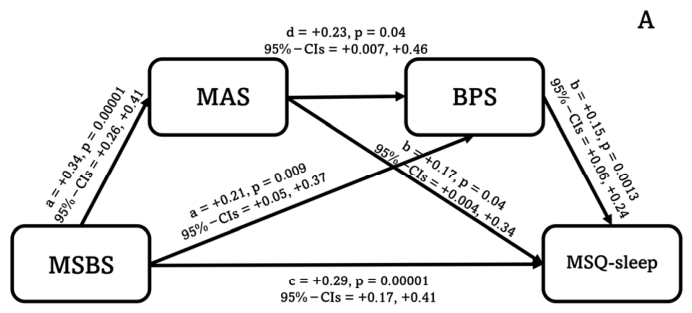
| MSBS → MSQ-sleep | +0.30 | 0.06 | +4.97 | 0.00001 | +0.18 | +0.41 | |||
| MAS → MSQ-sleep | +0.17 | 0.08 | +1.99 | 0.04 | +0.001 | +0.33 | |||
| BPS → MSQ-sleep | +0.15 | 0.05 | +3.33 | 0.001 | +0.06 | +0.24 | |||
| Covariate: Gender | −0.64 | 0.33 | −1.94 | 0.053 | −1.28 | +0.009 | |||
| Covariate: Age | +0.03 | 0.03 | +1.24 | 0.22 | −0.02 | +0.08 | |||
| Covariate: Education | −0.42 | 0.26 | −1.64 | 0.10 | −0.92 | +0.08 | |||
| Covariate: Marital Status | +0.11 | 0.33 | +0.34 | 0.74 | −0.53 | +0.75 | |||
| (1d) Direct Effect: MSBS → MSQ-sleep | +0.29 | 0.06 | +4.97 | 0.00001 | +0.17 | +0.41 | |||
| (1d) Indirect Effect: MSBS → MAS → MSQ-sleep | +0.06 | 0.03 | −0.003 | +0.12 | |||||
| (1d) Indirect Effect: MSBS → BPS → MSQ-sleep | +0.03 | 0.02 | +0.008 | +0.07 | |||||
| (1d) Indirect Effect: MSBS → MAS → BPS → MSQ-sleep | +0.01 | 0.007 | +0.00001 | +0.03 | |||||
| (2a) Mediation Model of the relationship between MSBS and MSQ-wake Outcome variable: MAS | 0.28 | F(5,253) = 19.54 | 0.00001 | ||||||
| MSBS → MAS | +0.33 | 0.04 | +8.47 | 0.00001 | +0.25 | +0.41 | |||
| Covariate: Gender | −0.03 | 0.25 | −0.11 | 0.92 | −0.51 | +0.46 | |||
| Covariate: Age | −0.05 | 0.02 | −2.56 | 0.011 | −0.09 | −0.01 | |||
| Covariate: Education | +0.15 | 0.19 | +0.76 | 0.45 | −0.23 | +0.52 | |||
| Covariate: Marital Status | +0.15 | 0.24 | +0.61 | 0.54 | −0.33 | +0.62 | |||
| (2b) Mediation Model of the relationship between MSBS and MSQ-wake Outcome variable: BPS | 0.34 | F(6,252) = 5.67 | 0.00001 | ||||||
| MSBS → BPS | +0.22 | 0.08 | +2.75 | 0.006 | +0.06 | +0.38 | |||
| MAS → BPS | +0.23 | 0.11 | +1.99 | 0.048 | +0.002 | +0.45 | |||
| Covariate: Gender | +0.16 | 0.45 | +0.35 | 0.72 | −0.72 | +1.04 | |||
| Covariate: Age | −0.08 | 0.04 | −2.22 | 0.03 | −0.15 | −0.009 | |||
| Covariate: Education | −0.49 | 0.35 | −1.41 | 0.16 | −1.18 | +0.19 | |||
| Covariate: Marital Status | +1.20 | 0.44 | +2.74 | 0.007 | +0.34 | +2.07 | |||
| (2c) Mediation Model of the relationship between MSBS and MSQ-wake Outcome variable: MSQ-wake | 0.49 | F(7,251) = 33.97 | 0.00001 | ||||||
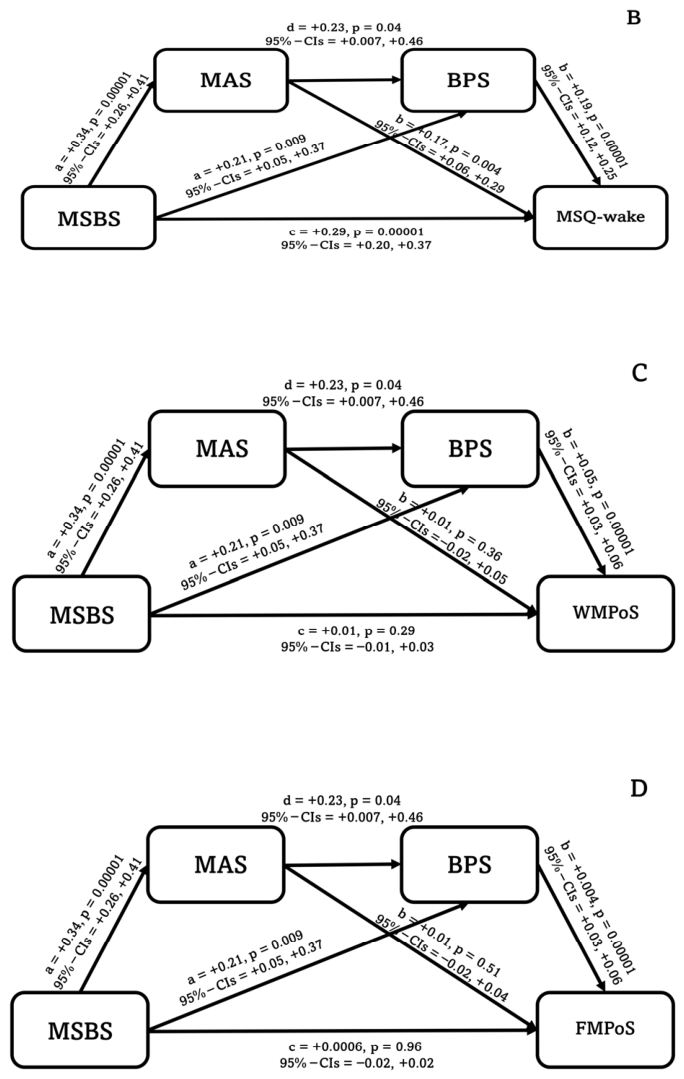
| MSBS → MSQ-wake | +0.30 | 0.04 | +7.08 | 0.00001 | +0.22 | +0.38 | |||
| MAS → MSQ-wake | +0.16 | 0.06 | +2.70 | +0.007 | +0.04 | +0.28 | |||
| BPS → MSQ-wake | +0.19 | 0.03 | 5.87 | 0.00001 | +0.13 | +0.26 | |||
| Covariate: Gender | −0.33 | 0.23 | −1.43 | 0.15 | −0.79 | +0.12 | |||
| Covariate: Age | −0.07 | 0.02 | −3.96 | 0.0001 | −0.11 | −0.04 | |||
| Covariate: Education | −0.35 | 0.18 | −1.91 | 0.06 | −0.71 | +0.01 | |||
| Covariate: Marital Status | +0.44 | 0.23 | 1.90 | 0.06 | −0.02 | +0.90 | |||
| (2d) Direct Effect: MSBS → MSQ-wake | +0.30 | 0.04 | +7.08 | 0.00001 | +0.22 | +0.38 | |||
| (2d) Indirect Effect: MSBS → MAS → MSQ-wake | +0.05 | 0.02 | +0.009 | +0.10 | |||||
| (2d) Indirect Effect: MSBS → BPS → MSQ-wake | +0.04 | 0.02 | +0.01 | +0.08 | |||||
| (2d) Indirect Effect MSBS → MAS → BPS → MSQ-wake | +0.01 | 0.008 | +0.00001 | +0.03 | |||||
| (3a) Mediation Model of the relationship between MSBS and WMPoS Outcome variable: MAS | 0.28 | F(5,253) = 19.54 | 0.00001 | ||||||
| MSBS → MAS | +0.33 | 0.04 | +8.47 | 0.00001 | +0.25 | +0.41 | |||
| Covariate: Gender | −0.03 | 0.25 | −0.11 | 0.92 | −0.51 | +0.46 | |||
| Covariate: Age | −0.05 | 0.02 | −2.56 | 0.011 | −0.09 | −0.01 | |||
| Covariate: Education | +0.15 | 0.19 | +0.76 | 0.45 | −0.23 | +0.52 | |||
| Covariate: Marital Status | +0.15 | 0.24 | +0.61 | 0.54 | −0.33 | +0.62 | |||
| (3b) Mediation Model of the relationship between MSBS and WMPoS Outcome variable: BPS | 0.34 | F(6,252) = 5.67 | 0.00001 | ||||||
| MSBS → BPS | +0.22 | 0.08 | +2.75 | 0.006 | +0.06 | +0.38 | |||
| MAS → BPS | +0.23 | 0.11 | +1.99 | 0.048 | +0.002 | +0.45 | |||
| Covariate: Gender | +0.16 | 0.45 | +0.35 | 0.72 | −0.72 | +1.04 | |||
| Covariate: Age | −0.08 | 0.04 | −2.22 | 0.03 | −0.15 | −0.009 | |||
| Covariate: Education | −0.49 | 0.35 | −1.41 | 0.16 | −1.18 | +0.19 | |||
| Covariate: Marital Status | +1.20 | 0.44 | +2.74 | 0.007 | +0.34 | +2.07 | |||
| (3c) Mediation Model of the relationship between MSBS and WMPoS Outcome: WMPoS | 0.29 | F(7,251) = 14.89 | 0.00001 | ||||||
| MSBS → WMPoS | +0.01 | 0.01 | +0.95 | 0.34 | −0.01 | +0.03 | |||
| MAS → WMPoS | +0.02 | 0.02 | +1.004 | 0.32 | −0.02 | +0.05 | |||
| BPS → WMPoS | +0.05 | 0.009 | +5.51 | 0.00001 | +0.03 | +0.06 | |||
| Covariate: Gender | +0.04 | 0.06 | +0.72 | 0.47 | −0.08 | +0.16 | |||
| Covariate: Age | −0.01 | 0.005 | −2.26 | 0.02 | −0.02 | −0.001 | |||
| Covariate: Education | −0.12 | 0.05 | −2.62 | 0.009 | −0.22 | −0.03 | |||
| Covariate: Marital Status | −0.18 | 0.06 | −2.95 | 0.004 | −0.30 | −0.06 | |||
| (3d) Direct Effect: MSBS → WMPoS | +0.01 | 0.01 | +0.95 | 0.34 | −0.01 | +0.03 | |||
| (3d) Indirect Effect: MSBS → MAS → WMPoS | +0.005 | 0.005 | −0.005 | +0.02 | |||||
| (3d) Indirect Effect: MSBS → BPS → WMPoS | +0.01 | 0.004 | +0.003 | +0.02 | |||||
| (3d) Indirect Effect: MSBS → MAS → BPS → WMPoS | +0.004 | 0.002 | +0.0001 | +0.008 | |||||
| (4a) Mediation Model of the relationship between MSBS and FMPoS Outcome variable: MAS | 0.28 | F(5,253) = 19.54 | 0.00001 | ||||||
| MSBS → MAS | +0.33 | 0.04 | +8.47 | 0.00001 | +0.25 | +0.41 | |||
| Covariate: Gender | −0.03 | 0.25 | −0.11 | 0.92 | −0.51 | +0.46 | |||
| Covariate: Age | −0.05 | 0.02 | −2.56 | 0.011 | −0.09 | −0.01 | |||
| Covariate: Education | +0.15 | 0.19 | +0.76 | 0.45 | −0.23 | +0.52 | |||
| Covariate: Marital Status | +0.15 | 0.24 | +0.61 | 0.54 | −0.33 | +0.62 | |||
| (4b) Mediation Model of the relationship between MSBS and FMPoS Outcome variable: BPS | 0.34 | F(6,252) = 5.67 | 0.00001 | ||||||
| MSBS → BPS | +0.22 | 0.08 | +2.75 | 0.006 | +0.06 | +0.38 | |||
| MAS → BPS | +0.23 | 0.11 | +1.99 | 0.048 | +0.002 | +0.45 | |||
| Covariate: Gender | +0.16 | 0.45 | +0.35 | 0.72 | −0.72 | +1.04 | |||
| Covariate: Age | −0.08 | 0.04 | −2.22 | 0.03 | −0.15 | −0.009 | |||
| Covariate: Education | −0.49 | 0.35 | −1.41 | 0.16 | −1.18 | +0.19 | |||
| Covariate: Marital Status | +1.20 | 0.44 | +2.74 | 0.007 | +0.34 | +2.07 | |||
| (4c) Mediation Model of the relationship between MSBS and FMPoS Outcome variable: FMPoS | 0.40 | F(7,251) = 23.60 | 0.00001 | ||||||
| MSBS → FMPoS | +0.002 | 0.001 | +0.16 | 0.88 | −0.02 | +0.03 | |||
| MAS → FMPoS | +0.01 | 0.02 | +0.59 | 0.56 | −0.02 | +0.04 | |||
| BPS → FMPoS | +0.04 | 0.009 | +4.67 | 0.00001 | +0.03 | +0.06 | |||
| Covariate: Gender | +0.06 | 0.07 | +0.93 | 0.35 | −0.07 | +0.19 | |||
| Covariate: Age | −0.04 | 0.005 | −6.75 | 0.00001 | −0.05 | −0.03 | |||
| Covariate: Education | −0.07 | 0.05 | −1.30 | 0.19 | −0.17 | +0.03 | |||
| Covariate: Marital Status | −0.19 | 0.07 | −2.92 | 0.004 | −0.32 | −0.03 | |||
| (4d) Direct Effect: MSBS → FMPoS | +0.002 | 0.01 | +0.16 | 0.88 | −0.02 | +0.03 | |||
| (4d) Indirect Effect: MSBS → MAS → FMPoS | +0.003 | 0.006 | −0.009 | +0.02 | |||||
| (4d) Indirect Effect: MSBS → BPS → FMPoS | +0.0096 | 0.004 | +0.003 | +0.02 | |||||
| (4d) Indirect Effect: MSBS → MAS → BPS → FMPoS | +0.003 | 0.002 | +0.0001 | +0.007 |
Disclaimer/Publisher’s Note: The statements, opinions and data contained in all publications are solely those of the individual author(s) and contributor(s) and not of MDPI and/or the editor(s). MDPI and/or the editor(s) disclaim responsibility for any injury to people or property resulting from any ideas, methods, instructions or products referred to in the content. |
© 2026 by the authors. Licensee MDPI, Basel, Switzerland. This article is an open access article distributed under the terms and conditions of the Creative Commons Attribution (CC BY) license.
Share and Cite
Fabbri, M.; Martoni, M. The Relationship Between State Boredom and Sleep–Wake Disruptions: A Mediation Model via Smartphone Addiction and Bedtime Procrastination. Int. J. Environ. Res. Public Health 2026, 23, 728. https://doi.org/10.3390/ijerph23060728
Fabbri M, Martoni M. The Relationship Between State Boredom and Sleep–Wake Disruptions: A Mediation Model via Smartphone Addiction and Bedtime Procrastination. International Journal of Environmental Research and Public Health. 2026; 23(6):728. https://doi.org/10.3390/ijerph23060728
Chicago/Turabian StyleFabbri, Marco, and Monica Martoni. 2026. "The Relationship Between State Boredom and Sleep–Wake Disruptions: A Mediation Model via Smartphone Addiction and Bedtime Procrastination" International Journal of Environmental Research and Public Health 23, no. 6: 728. https://doi.org/10.3390/ijerph23060728
APA StyleFabbri, M., & Martoni, M. (2026). The Relationship Between State Boredom and Sleep–Wake Disruptions: A Mediation Model via Smartphone Addiction and Bedtime Procrastination. International Journal of Environmental Research and Public Health, 23(6), 728. https://doi.org/10.3390/ijerph23060728