Preventing Musculoskeletal Strain in Dental Training: Effects of a Movement-Based Intervention

 ,
,  , ,
, ,  ,
,
Highlights
- Work-related musculoskeletal disorders are common among dental professionals and often begin during clinical training.
- This early exposure highlights a gap in preventive approaches within dental education.
- This study examines a movement-based intervention implemented directly within postgraduate dental training.
- Addressing musculoskeletal health at this stage may help reduce cumulative occupational strain over time.
- Integrating movement-based interventions into dental training programmes offers a practical approach to support musculoskeletal health.
- Preventive strategies introduced during training may contribute to more sustainable clinical practice.
Abstract
1. Introduction
2. Materials and Methods
2.1. Study Design and Ethical Considerations
2.2. Participants
2.3. Inclusion Criteria
- Postgraduate student in dentistry.
- Engagement in at least 20 h of clinical practice per week during the month prior to study initiation.
2.4. Exclusion Criteria
- Regular yoga practice for more than one year or within the three months preceding the study.
- Inability to attend scheduled yoga sessions.
- Previous osteomuscular injuries not related to dental practice.
- Medical conditions contraindicating the practice of yoga.
- Previous diagnosis of depression or anxiety, or active treatment for these conditions.
2.5. Participant Allocation
- Participants were allocated using computer-generated random numbers and opaque envelopes to ensure allocation concealment and reduce selection bias. One investigator (D.S.) performed the randomization procedure, and a second investigator (C.O.C.) assigned participants to the study groups.
- Experimental group (n = 20): students who participated in the weekly yoga sessions.
- Control group (n = 20): students who did not participate in the yoga sessions but completed all questionnaires at the three evaluation time points.
- The resulting groups differed in the distribution of dental specialties, with the control group consisting predominantly of orthodontic trainees and the intervention group mainly composed of restorative dentistry trainees.
2.6. Instruments
- -
- Nordic Musculoskeletal Questionnaire (NMQ)
- -
- Perceived Stress Scale (PSS-10)
- -
- Connor–Davidson Resilience Scale (CD-RISC-10, Spanish version)
2.7. Intervention
- 45 min of physical postures (asanas);
- 10 min of meditation;
- 5 min of breathing exercises (pranayama).
2.8. Procedure
- Musculoskeletal outcomes: assessed using the Nordic Musculoskeletal Questionnaire (NMQ);
- Psychological outcomes: assessed using the Perceived Stress Scale (PSS-10) and the Connor–Davidson Resilience Scale (CD-RISC-10).
- -
- Informed consent and verification of eligibility criteria;
- -
- Random allocation to study groups;
- -
- Baseline assessment (week 0);
- -
- Implementation of the 12-week intervention;
- -
- Mid-intervention assessment (week 6);
- -
- Final assessment (week 12).
2.9. Statistical Analysis
3. Results
4. Discussion
5. Conclusions
Author Contributions
Funding
Institutional Review Board Statement
Informed Consent Statement
Data Availability Statement
Acknowledgments
Conflicts of Interest
Abbreviations
| WMSDs | Work-related musculoskeletal disorders |
| NMQ | Nordic Musculoskeletal Questionnaire |
| PSS | Perceived Stress Scale |
| CD-RISC | Connor–Davidson Resilience Scale |
References
- Lee, C.Y.; Wu, J.H.; Du, J.K. Work stress and occupational burnout among dental staff in a medical center. J. Dent. Sci. 2019, 14, 295–301. [Google Scholar] [CrossRef]
- Gandolfi, M.G.; Zamparini, F.; Spinelli, A.; Risi, A.; Prati, C. Musculoskeletal Disorders among Italian Dentists and Dental Hygienists. Int. J. Environ. Res. Public Health 2021, 18, 2705. [Google Scholar] [CrossRef] [PubMed]
- Ohlendorf, D.; Naser, A.; Haas, Y.; Haenel, J.; Fraeulin, L.; Holzgreve, F.; Erbe, C.; Betz, W.; Wanke, E.M.; Brueggmann, D.; et al. Prevalence of Musculoskeletal Disorders among Dentists and Dental Students in Germany. Int. J. Environ. Res. Public Health 2020, 17, 8740. [Google Scholar] [CrossRef] [PubMed]
- Gandolfi, M.G.; Zamparini, F.; Spinelli, A.; Prati, C. Āsana for Neck, Shoulders, and Wrists to Prevent Musculoskeletal Disorders among Dental Professionals: In-Office Yóga Protocol. J. Funct. Morphol. Kinesiol. 2023, 8, 26. [Google Scholar] [CrossRef]
- Alexopoulos, E.C.; Stathi, I.C.; Charizani, F. Prevalence of musculoskeletal disorders in dentists. BMC Musculoskelet. Disord. 2004, 5, 16. [Google Scholar] [CrossRef]
- World Health Organization. Identification and Control of Work Related Diseases: Report of a WHO Expert Committee. World Health Organ. Tech. Rep. Ser. 1985, 714, 1–71. [Google Scholar]
- Benfaida, S.; Hachami, I.; Chafik, R.; Hamza, M.; Bennani, A. Musculoskeletal Disorders among Dentists in the Private Sector. Eur. J. Med. Health Sci. 2024, 6, 41–44. [Google Scholar] [CrossRef]
- Alnaser, M.Z.; Almaqsied, A.M.; Alshatti, S.A. Risk factors for work-related musculoskeletal disorders of dentists in Kuwait and the impact on health and economic status. Work. J. Prev. Assess. Rehabil. 2021, 68, 213–221. [Google Scholar] [CrossRef]
- Al-Rawi, N.H.; Yousef, H.; Khamis, M.; Belkadi, O.; Ahmed, S.; Ali, S. Vertebral malalignment among male dentists with work-related musculoskeletal pain in the United Arab Emirates. J. Contemp. Dent. Pract. 2018, 19, 773–777. [Google Scholar] [CrossRef]
- Younis, U.; Shakoor, A.; Chaudhary, F.A.; Din, S.U.; Sajjad, S.; Younis, M.; Javed, M.Q.; Alam, M.K. Work-related musculoskeletal disorders and their associated risk factors among pakistani dental practitioners: A cross-sectional study. BioMed Res. Int. 2022, 2022, 4099071. [Google Scholar] [CrossRef]
- Nishat, R.; Bhuyan, L.; Nezam, S.; Singh, S.; Jaiswal, M.M.; Singh, R. The precedence and viability of yoga in the lives of D3-dental students, dental practitioners, and dental patients. J. Fam. Med. Prim. Care 2019, 8, 3808–3813. [Google Scholar] [CrossRef]
- Alire, E.; Brems, C.; Bell, K.; Chiswell, A. The Role of Yoga in Treating Stress-Related Symptoms in Dental Hygiene Students. Int. J. Yoga 2020, 13, 213–222. [Google Scholar] [CrossRef] [PubMed]
- Monson, A.L.; Chismark, A.M.; Cooper, B.R.; Krenik-Matejcek, T.M. Effects of Yoga on Musculoskeletal Pain. Am. Dent. Hyg. Assoc. 2017, 91, 15–22. [Google Scholar]
- Ramamoorthy, A.; Jeevakarunyam, S.J.; Janardhanan, S.; Jeddy, N.; Vasan, S.A.; Raja, A.; Ikram, P. Survey on utility of yoga as an alternative therapy for occupational hazards among dental practitioners. J. Nat. Sci. Biol. Med. 2015, 6, 149–152. [Google Scholar] [CrossRef]
- Koneru, S.; Tanikonda, R. Role of yoga and physical activity in work-related musculoskeletal disorders among dentists. J. Int. Soc. Prev. Community Dent. 2015, 5, 199–204. [Google Scholar] [CrossRef]
- Soler, M.I.; Meseguer de Pedro, M.; García Izquierdo, M. Propiedades psicométricas de la versión española de la escala de resiliencia de 10 ítems de Connor-Davidson (CD-RISC 10) en una muestra multiocupacional. Rev. Latinoam. Psicol. 2016, 48, 159–166. [Google Scholar] [CrossRef]
- Pastan, C.D. Mind-Body Wellness: A Complement to Dental Education and Professional Development. Int. J. Yoga 2021, 14, 239–243. [Google Scholar] [CrossRef]
- Deolia, S.G.; Rizhana, A.; George, J.; Ingle, H.; Bonde, R. Effects of yoga as a therapy for physical and psychological hazards in dentists in Wardha region. Yoga Mimamsa 2017, 49, 68–75. [Google Scholar] [CrossRef]
- Maddux, R.E.; Daukantaite, D.; Tellhed, U. The effects of yoga on stress and psychological health among employees: An 8- and 16-week intervention study. Anxiety Stress Coping 2018, 31, 121–134. [Google Scholar] [CrossRef]
- Yoshihara, K.; Hiramoto, T.; Oka, T.; Kubo, C.; Sudo, N. Effect of 12 weeks of yoga training on somatization, psychological symptoms, and stress-related biomarkers of healthy women. BioPsychoSoc. Med. 2014, 8, 1. [Google Scholar] [CrossRef]
- Park, C.L.; Finkelstein-Fox, L.; Sacco, S.J.; Braun, T.D.; Lazar, S. How does yoga reduce stress? A clinical trial testing psychological mechanisms. Stress Health 2021, 37, 116–126. [Google Scholar] [CrossRef]


| Region | Symptoms Last 12 Months—Yes | Symptoms Last 12 Months—No | Impediment for Job—Yes | Impediment for Job—No | Symptoms Last 7 Days—Yes | Symptoms Last 7 Days—No |
|---|---|---|---|---|---|---|
| Neck | 22 (59.5%) | 15 (40.5%) | 0 (0%) | 37 (100%) | 4 (10.8%) | 33 (89.2%) |
| Shoulders | 12 (32.4%) | 25 (67.6%) | 0 (0%) | 37 (100%) | 1 (2.7%) | 36 (97.3%) |
| Upper Back | 13 (35.1%) | 24 (64.9%) | 1 (2.7%) | 36 (97.3%) | 3 (8.1%) | 34 (91.9%) |
| Elbows | 1 (2.7%) | 36 (97.3%) | 0 (0%) | 37 (100%) | 0 (0%) | 37 (100%) |
| Lower Back | 14 (37.8%) | 23 (62.2%) | 1 (2.7%) | 36 (97.3%) | 4 (10.8%) | 33 (89.2%) |
| Wrists | 7 (18.9%) | 30 (81.1%) | 0 (0%) | 37 (100%) | 0 (0%) | 37 (100%) |
| Hands | 9 (24.3%) | 28 (75.7%) | 1 (2.7%) | 36 (97.3%) | 0 (0%) | 37 (100%) |
| Hips | 5 (13.5%) | 32 (86.5%) | 0 (0%) | 37 (100%) | 0 (0%) | 37 (100%) |
| Thighs | 0 (0%) | 37 (100%) | 0 (0%) | 37 (100%) | 0 (0%) | 37 (100%) |
| Knees | 7 (18.9%) | 30 (81.1%) | 2 (5.4%) | 35 (94.6%) | 0 (0%) | 37 (100%) |
| Ankles | 5 (13.5%) | 32 (86.5%) | 2 (5.4%) | 35 (94.6%) | 0 (0%) | 37 (100%) |
| Feet | 3 (8.1%) | 34 (91.9%) | 1 (2.7%) | 36 (97.3%) | 0 (0%) | 37 (100%) |
| Test | Yoga Baseline | Yoga End | Control Baseline | Control End | F-Value | p-Value |
|---|---|---|---|---|---|---|
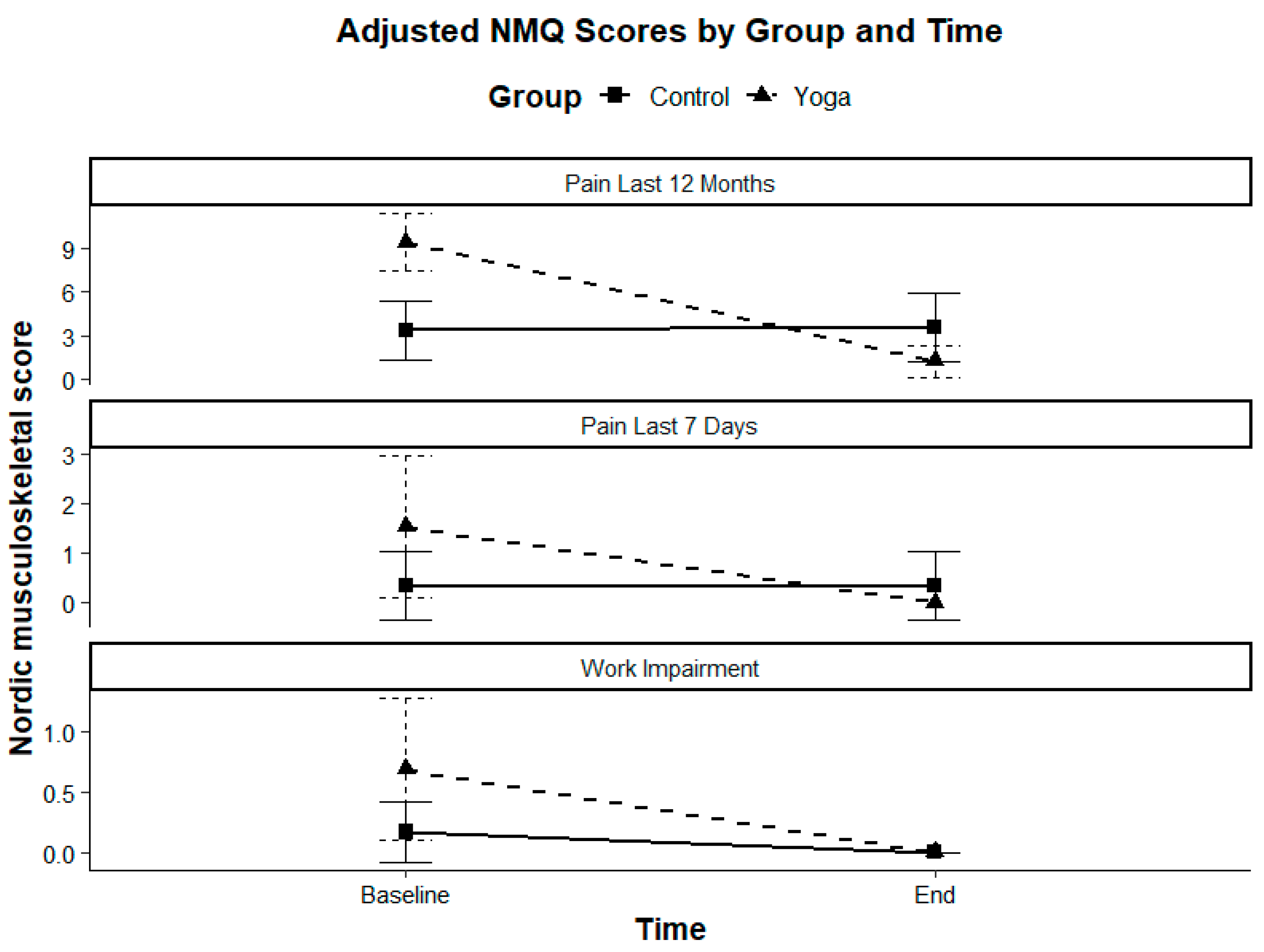
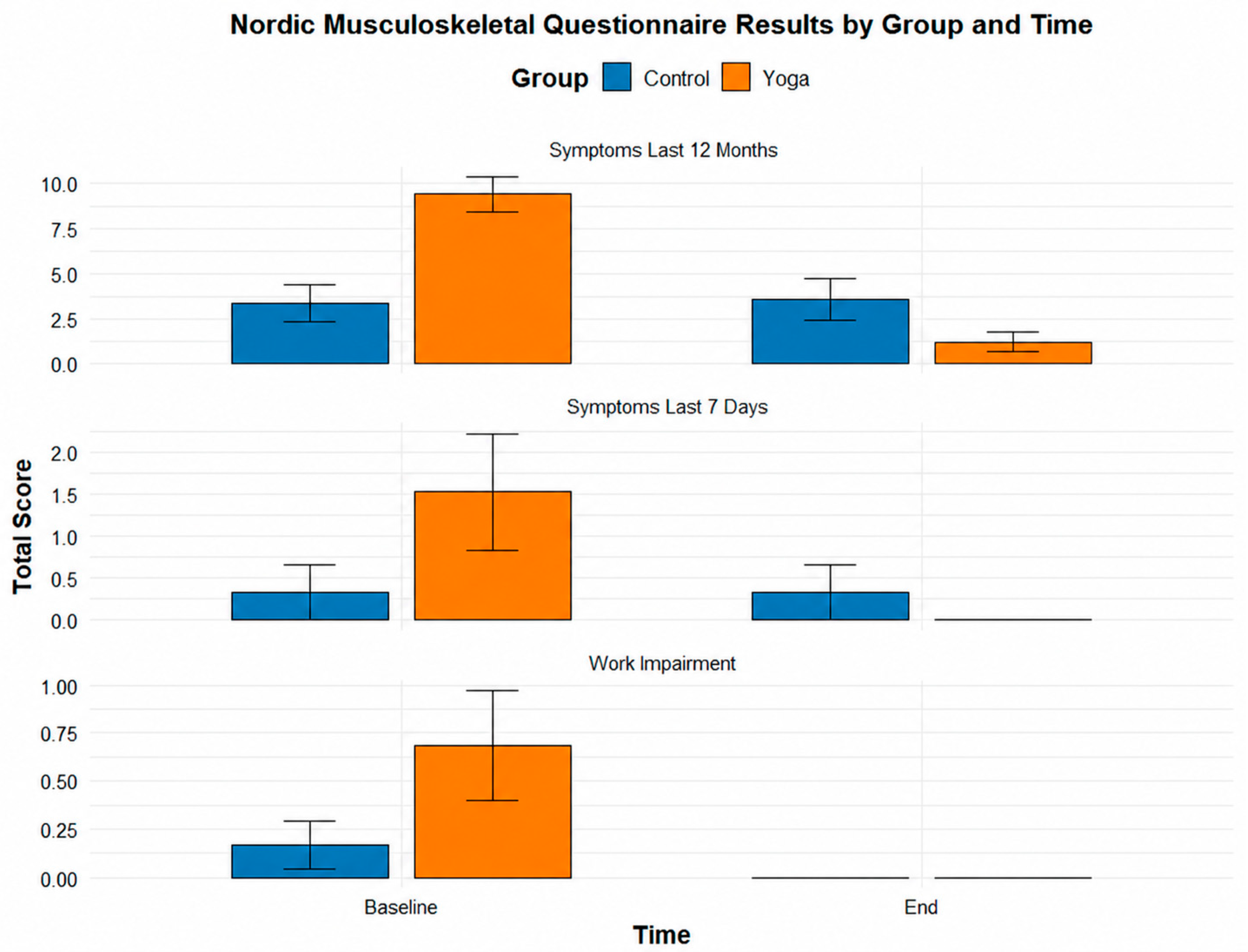
| NMQ symptoms (adapted recall) | 9.42 (4.14) | 1.21 (2.35) | 3.33 (4.26) | 3.56 (4.96) | 26.879 | <1 × 10⁻⁴ |
| Work impairment (NMQ) | 0.68 (1.25) | 0 (0) | 0.17 (0.51) | 0 (0) | 3.889 | 0.05254 |
| Symptoms last 7 days (NMQ) | 1.53 (3.04) | 0 (0) | 0.33 (1.41) | 0.33 (1.41) | 5.598 | 0.02076 |
| Perceived Stress Scale (PSS) | 22.32 (4.19) | 22.11 (3.02) | 21.89 (5.04) | 22.06 (4.81) | 0.035 | 0.8516 |
| Resilience (CD-RISC) | 28.74 (4.03) | 30.53 (3.6) | 32.17 (4.05) | 32.89 (4.07) | 0.340 | 0.5619 |
Disclaimer/Publisher’s Note: The statements, opinions and data contained in all publications are solely those of the individual author(s) and contributor(s) and not of MDPI and/or the editor(s). MDPI and/or the editor(s) disclaim responsibility for any injury to people or property resulting from any ideas, methods, instructions or products referred to in the content. |
© 2026 by the authors. Licensee MDPI, Basel, Switzerland. This article is an open access article distributed under the terms and conditions of the Creative Commons Attribution (CC BY) license.
Share and Cite
Sahli, D.; Oteo-Calatayud, C.; López-Quiles, J.; Madrigal, C.; López-Carriches, C.; Revuelta-Cortés, P.; Oteo-Morilla, C. Preventing Musculoskeletal Strain in Dental Training: Effects of a Movement-Based Intervention. Int. J. Environ. Res. Public Health 2026, 23, 729. https://doi.org/10.3390/ijerph23060729
Sahli D, Oteo-Calatayud C, López-Quiles J, Madrigal C, López-Carriches C, Revuelta-Cortés P, Oteo-Morilla C. Preventing Musculoskeletal Strain in Dental Training: Effects of a Movement-Based Intervention. International Journal of Environmental Research and Public Health. 2026; 23(6):729. https://doi.org/10.3390/ijerph23060729
Chicago/Turabian StyleSahli, Dorsaf, Carlos Oteo-Calatayud, Juan López-Quiles, Cristina Madrigal, Carmen López-Carriches, Pablo Revuelta-Cortés, and Carlos Oteo-Morilla. 2026. "Preventing Musculoskeletal Strain in Dental Training: Effects of a Movement-Based Intervention" International Journal of Environmental Research and Public Health 23, no. 6: 729. https://doi.org/10.3390/ijerph23060729
APA StyleSahli, D., Oteo-Calatayud, C., López-Quiles, J., Madrigal, C., López-Carriches, C., Revuelta-Cortés, P., & Oteo-Morilla, C. (2026). Preventing Musculoskeletal Strain in Dental Training: Effects of a Movement-Based Intervention. International Journal of Environmental Research and Public Health, 23(6), 729. https://doi.org/10.3390/ijerph23060729