Association Between ACE (I/D) Polymorphism and Essential Hypertension (EH): An Updated Systematic Review and Meta-Analysis

 ,
,  , , and
Highlights
- Essential hypertension (EH) is a major global contributor to morbidity and mortality and is a leading risk factor for cardiovascular diseases (CVDs) such as stroke, heart disease, and heart failure.
- Understanding population-specific genetic risk factors is directly relevant to public health because hypertension prevalence varies across ethnic groups, and early detection and prevention strategies depend on accurate risk stratification.
- The meta-analysis identifies a significant association between the ACE D allele and increased risk of EH in several populations (Indian, European, Chinese), highlighting the genetic component in hypertension and its interplay with environmental drivers.
- Since EH is highly prevalent and modifiable, understanding contributing genetic factors can enhance targeted intervention strategies, potentially reducing the burden of CVDs globally.
- For practitioners and researchers: Knowledge of genetic risk may guide personalised risk assessment and preventive counselling, particularly in populations in which stronger associations are observed.
- For policymakers: Findings underscore the need for ethnically tailored public health strategies, including hypertension screening guidelines, culturally and genetically informed prevention programs, and investment in genomic public health infrastructure.
Abstract
1. Introduction
2. Materials and Methods
2.1. Search Strategy
2.2. Study Selection Criteria

| Study Type and Lead Author | ||||||||
|---|---|---|---|---|---|---|---|---|
| Cohort | Representativeness of exposed cohort | Selection of non-exposed cohort | Ascertainment of exposure | Demonstration that outcome of interest was not present at start of study | Comparability of cohorts based on the design or analysis | Assessment of outcome | Was follow up long enough for outcomes to occur? | Adequacy of follow up of cohorts |
| Das, (2008) [22] | - | * | * | * | ** | * | - | - |
| Case–control | Is the case definition adequate? | Representativeness of cases | Selection of controls | Definition of controls | Comparability of cases and controls based on design or analysis | Ascertainment of exposure | Same method of ascertainment for cases and controls | Non-response rate |
| Saab, (2011) [23] | * | - | * | * | ** | * | * | * |
| Badaruddoza, (2009) [24] | * | - | * | * | ** | * | * | * |
| Martinez Cantarin, (2010) [25] | * | - | * | * | ** | * | * | * |
| Patnaik, (2014) [26] | * | - | - | * | ** | * | * | * |
| AbdRaboh, (2012) [27] | * | - | - | * | ** | * | * | * |
| Sousa, (2018) [28] | * | - | * | * | ** | * | * | * |
| Hussein, (2018) [29] | * | - | * | * | ** | * | * | * |
| Tchelougou, (2015) [30] | * | - | * | * | ** | * | * | * |
| Choudhury, (2012) [31] | * | - | - | * | ** | * | * | * |
| Jiang, (2009) [32] | * | - | * | * | ** | * | * | * |
| Amrani, (2015) [33] | * | - | * | * | ** | * | * | * |
| Oscanoa, (2020) [34] | * | - | - | * | ** | * | * | * |
| Hadian, (2022) [35] | * | - | - | * | ** | * | * | * |
| Dhanachandra Singh, (2014) [36] | * | - | * | * | ** | * | * | * |
| Patel, (2022) [37] | - | - | * | * | ** | * | * | * |
| Tsezou, (2008) [38] | * | - | * | * | ** | * | * | * |
| Pacholczyk, (2011) [39] | * | - | * | - | ** | * | * | * |
| Roger, (2018) [40] | * | - | * | * | ** | * | * | * |
| Yang, (2015) [41] | * | - | * | * | ** | * | * | * |
| Starkova, (2022) [42] | * | - | * | * | ** | * | * | * |
| Isordia-Salas, (2023) [43] | * | - | * | * | ** | * | * | * |
| Lead Author (Year) | Study Design | Ethnicity/ Country | Total N | Cases | Control | Results |
|---|---|---|---|---|---|---|
| Das, (2008) [22] | Cohort | Indian | 350 | N = 185, SBP ≥160 mm Hg and/or a DBP ≥ 90 mm Hg or using antihypertensives | N = 165, Normotensive | DD genotype significantly associated with EH (OR = 7.483, p = 0.0007) * in a selected sub-sample |
| Saab, (2011) [23] | C-C | Lebanese | 270 | N = 124, patients taking antihypertensive drugs and/or bp ≥ 140/90 | N = 146, never treated with antihypertensive and BP below 140/90 | Significant difference between both groups across genotypes (p < 0.05) *, but OR for DD not significant (p = 0.08) |
| Badaruddoza, (2009) [24] | C-C | Indian | 100 | N = 50, SBP >140 mm Hg accompanied by DBP > 90 mm Hg | N = 50, BP below 140/90, clinically healthy | The DD genotype is not associated with EH |
| Martinez Cantarin, (2010) [25] | C-C | African American | 412 | N = 173, average of 8 BP readings ≥140 mmHg SBP and/or ≥90 mmHg DBP by trained staff | N = 239, same as case group, but average SBP ≥130 mm Hg and DBP ≥ 80 mm Hg | No association, adjusted p = 0.25 |
| Patnaik, (2014) [26] | C-C | Indian | 520 | N = 246, SBP ≥ 140 or current antihypertensive medication | N = 274, no history of hypertension | Significant association between DD and EH (p < 0.001) after adjustment for confounders |
| AbdRaboh, (2012) [27] | C-C | Egyptian | 203 | N = 110, SBP greater than 140 mmHg and DBP greater than 90 mmHg and taking at least 1 antihypertensive medication | N = 93, not on antihypertensives | Mild increase in risk for EH (OR = 1.2, p > 0.05) |
| Sousa, (2018) [28] | C-C | Portuguese | 1712 | N = 860, diagnosed with high BP (≥140/90) on at least 3 occasions, and/or on one antihypertensive for at least 3 months | N = 852, never treated, and presented with bp < 140/90 mm Hg | DD genotype significantly associated with high blood pressure under recessive (OR = 1.233, p = 0.032) * and multiplicative models (OR = 1.173, p = 0.025) * |
| Hussein, (2018) [29] | C-C | Babylon | 221 | N = 123, diagnosed by specialist physicians with EH | N = 98, apparently healthy according to specialist physicians | DD genotype allied with EH (OR = 2.288, p = 0.024) * |
| Tchelougou, (2015) [30] | C-C | Burkina Faso | 406 | N = 202, BP ≥ 140/90 mmHg | N = 204, no CVDs present | Strong association between the ACE (I/D) polymorphism and the development of hypertension (DD vs. ID+II OR = 3.62, p < 0.00001) * |
| Choudhury, (2012) [31] | C-C | Indian | 182 | N = 101, SBP >140 mm Hg and DBP > 90 mm Hg, according to JNC 7 criteria | N = 81, SBP < 140 mm Hg and DBP < 90 mm Hg. There was no associated illness in these subjects. | Significant association between DD genotype and hypertension (DD vs. II OR = 3.85, CI 1.66–8.93) * and (DD vs. ID OR = 4.32, CI = 2.11–8.84) * |
| Jiang, (2009) [32] | C-C | Chinese | 455 | N = 220, SBP ≥ 140 mm Hg and/or DBP ≥ 90 mm Hg) | N = 235, SBP < 140 mm Hg and DBP < 90 mm Hg and the absence of a history of hypertension | Dominant model associated with EH ID+DD vs. II (OR = 1.171; CI = 1.00–1.37) * |
| Amrani, (2015) [33] | C-C | Algerian | 145 | N = 75, diagnosed with EH and blood pressure ≥ 140/90 | N = 70, normotensives | D allele significantly associated with EH (p = 0.0002) * |
| Oscanoa, (2020) [34] | C-C | Peruvian | 104 | N = 65, diagnosed with EH, verified with clinical history and antihypertensive treatment | N = 39, no clinical EH diagnosis and no history of taking antihypertensives | No significant association between DD vs. ID + II (OR = 0.56, p = 0.34) or II vs. DD + ID (OR = 0.95, p = 0.92) and EH |
| Hadian, (2022) [35] | C-C | Iran | 206 | N = 102, diagnosed with EH | N = 104, no history of EH and clinically healthy | Risk of HTN in individuals with the I allele is lower than in those with the D allele (OR = 0.54; p = 0.005) * |
| Dhanachandra Singh, (2014) [36] | C-C | Indian | 422 | N = 211, SBP of ≥140 mm Hg and/or DBP of ≥90 mm Hg or prior diagnosis of EH by a physician or current use of antihypertensive medication or history of EH | N = 211, SBP ≤ 120 mm Hg and DBP ≤ 80 mm Hg and no disease or medication | Dominant model associated with EH in males (OR = 0.401, p = 0.0009) * but protectively |
| Patel, (2022) [37] | C-C | Indian | 571 | N = 279, based on patient self-report of a prior physician diagnosis and use of antihypertensives for a minimum of one year and patients with at least one parent being hypertensive were selected | N = 292, randomly selected from outpatients, on routine health check-ups and not suffering from EH | Increased odds of EH with DD genotype (OR = 2.2068, p < 0.0001) * |
| Tsezou, (2008) [38] | C-C | Greek | 498 | N = 194, SBP ≤ 120 mm Hg and DBP ≤ 80 mm Hg | N = 304, normotensive individuals and SBP ≤ 120 mm Hg and DBP ≤ 80 mm Hg | No associations found after adjustment for confounders between DD and ID with EH |
| Pacholczyk, (2011) [39] | C-C | Polish | 246 | N = 144, SBP ≥ 140 mmHg and/or DBP ≥ 90 mmHg on at least 2 separate occasions or when they used antihypertensive agents | N = 102, classified as normotensive if they met the following criteria: (1) SBP was <140 mm Hg and/or DBP was <90 mmHg on at least 2 separate occasions; (2) no family history of hypertension; and (3) no current use of antihypertensive drugs. | DD genotype carriers had over 2 times higher risk of hypertension than subjects with ID and II genotype (OR = 2.20, CI = 1.19–4.07) * and DD vs. II (OR = 2.96, CI = 1.52–5.76) * |
| Roger, (2018) [40] | C-C | Gabonese | 132 | N = 95, EH is diagnosed, with SBP ≥ 140 mmHg and/or DBP ≥ 90 mmHg, or being on antihypertensive therapy | N = 37, blood pressure less than or equal to 140/90 mm Hg), with no family history of hypertension (no direct hypertensive relatives | No significant relationship. DD vs. ID+II (OR = 2.02, p = 0.075). |
| Yang, (2015) [41] | C-C | Chinese | 429 | N = 244, SBP ≥ 140 mm Hg or DBP ≥ 90 mm Hg, or use of antihypertensive medication during the previous 2 weeks | N = 185, SBP < 140 mm Hg and DBP < 90 mm Hg. No history of EH or other diseases | No significant association between DD and EH (OR = 1.12, 95% CI = 0.844–1.477) |
| Starkova, (2022) [42] | C-C | Russia | 69 | N = 35, diagnosed with EH as per ICD-10 | N = 34, relatively healthy | D allele associated with EH (OR = 3.16, p = 0.030) * |
| Isordia-Salas, (2023) [43] | C-C | Mexican | 432 | N = 224, previously diagnosed with EH or treated with antihypertensives | N = 208, no history of hypertension | D allele associated with EH (OR = 1.4, p = 0.02) * |
| Study | Ethnicity | Cases | Controls | Control HWE p-Value | ||||
|---|---|---|---|---|---|---|---|---|
| II | ID | DD | II | ID | DD | |||
| Das, (2008) [22] | Indian | 12 | 4 | 19 | 14 | 18 | 3 | 0.40 |
| Saab, (2011) [23] | Middle Eastern | 9 | 37 | 78 | 12 | 58 | 76 | 0.84 |
| Badaruddoza, (2009) [24] | Indian | 11 | 16 | 23 | 13 | 27 | 10 | 0.55 |
| Martinez Cantarin, (2010) [25] | African | 37 | 74 | 59 | 37 | 102 | 84 | 0.52 |
| Patnaik, (2014) [26] | Indian | 87 | 99 | 39 | 88 | 103 | 16 | 0.06 |
| AbdRaboh, (2012) [27] | African | 17 | 59 | 34 | 16 | 52 | 25 | 0.21 |
| Sousa, (2018) [28] | European | 110 | 368 | 382 | 128 | 389 | 335 | 0.39 |
| Hussein, (2018) [29] | Middle Eastern | 33 | 55 | 35 | 41 | 38 | 19 | 0.07 |
| Tchelougou, (2015) [30] | African | 27 | 104 | 73 | 10 | 57 | 135 | 0.22 |
| Choudhury, (2012) [31] | Indian | 17 | 31 | 53 | 21 | 43 | 17 | 0.56 |
| Jiang, (2009) [32] | Chinese | 83 | 108 | 29 | 110 | 112 | 13 | 0.02 * |
| Amrani, (2015) [33] | African | 25 | 40 | 10 | 43 | 25 | 2 | 0.47 |
| Oscanoa, (2020) [34] | Hispanic | 6 | 28 | 31 | 19 | 14 | 6 | 0.23 |
| Hadian, (2022) [35] | Middle Eastern | 11 | 46 | 45 | 4 | 36 | 64 | 0.70 |
| Dhanachandra Singh, (2014) [36] | Indian | 40 | 88 | 83 | 51 | 93 | 67 | 0.10 |
| Patel, (2022) [37] | Indian | 46 | 116 | 117 | 61 | 159 | 72 | 0.12 |
| Tsezou, (2008) [38] | European | 20 | 90 | 80 | 52 | 132 | 116 | 0.18 |
| Pacholczyk, (2011) [39] | European | 28 | 72 | 44 | 32 | 53 | 17 | 0.53 |
| Roger, (2018) [40] | African | 7 | 33 | 55 | 3 | 19 | 15 | 0.37 |
| Yang, (2015) [41] | Chinese | 97 | 106 | 41 | 82 | 73 | 30 | 0.06 |
| Starkova, (2022) [42] | European | 7 | 18 | 10 | 15 | 10 | 9 | 0.02 * |
| Isordia-Salas, (2023) [43] | Hispanic | 68 | 112 | 44 | 83 | 98 | 27 | 0.81 |
2.3. Statistical Analysis
3. Results
3.1. Study Characteristics
3.2. Meta-Analysis
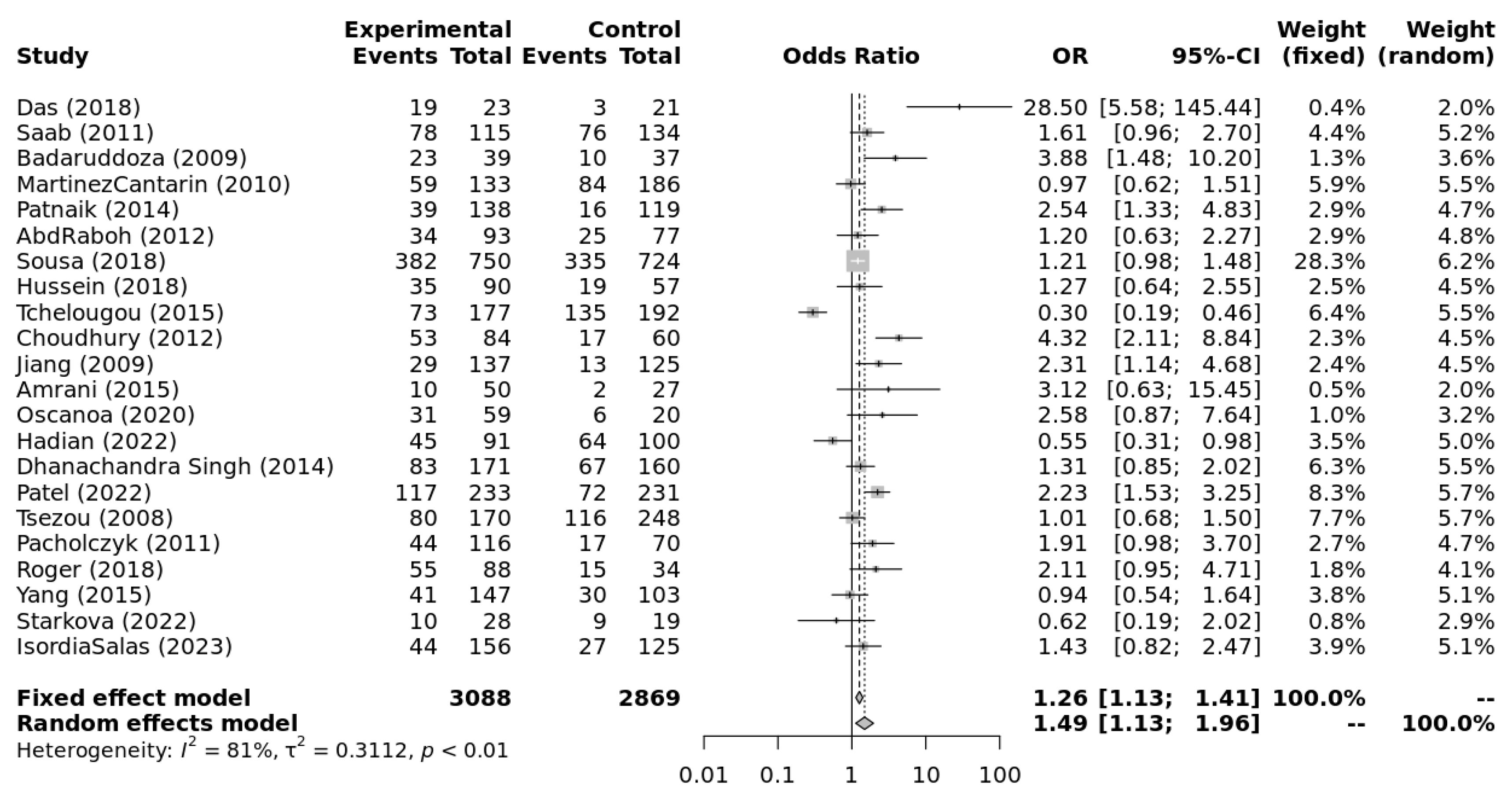
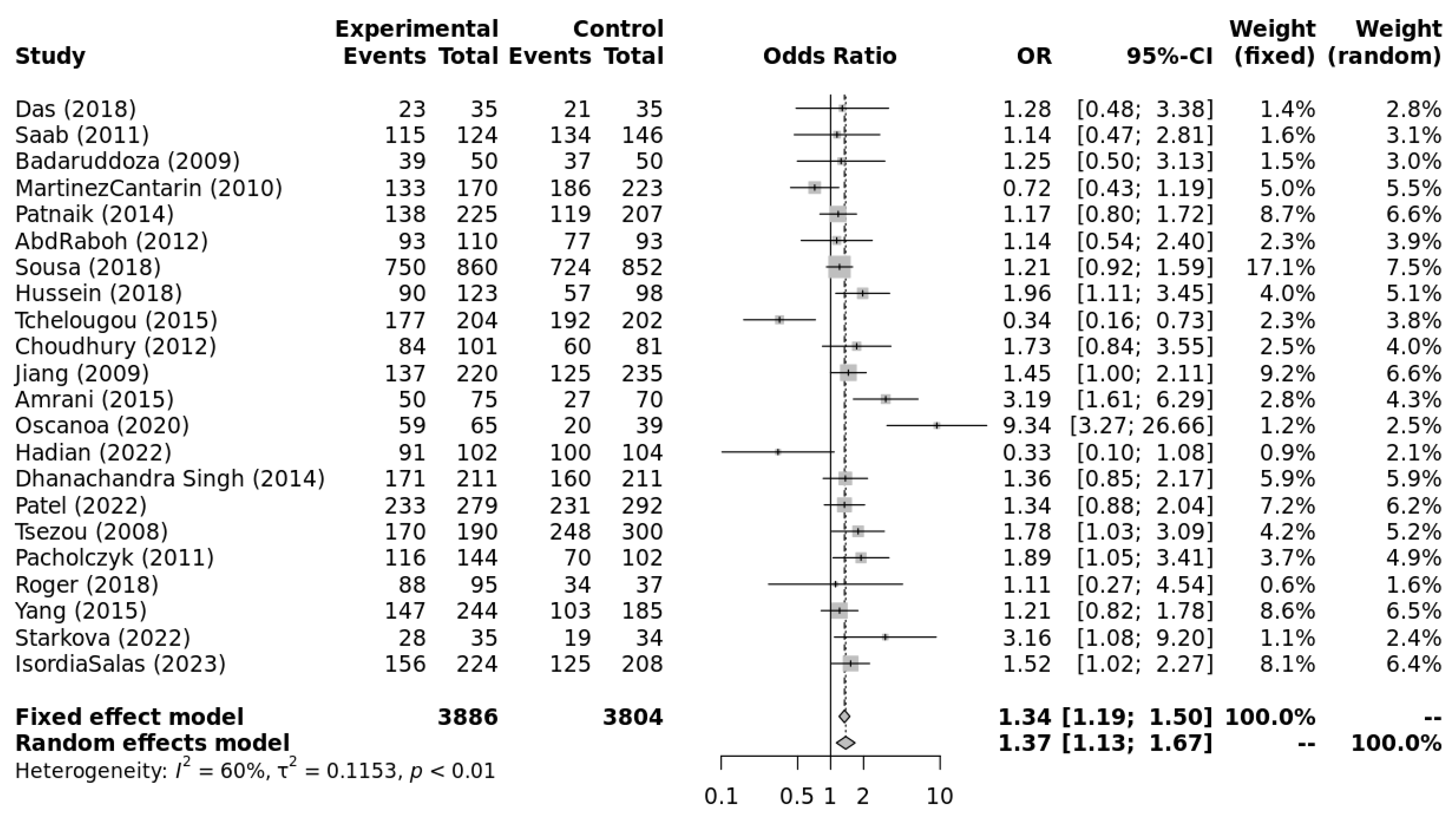
Meta-Analysis of EH in Different Genetic Models




4. Discussion
5. Conclusions
Supplementary Materials
Author Contributions
Funding
Institutional Review Board Statement
Informed Consent Statement
Data Availability Statement
Conflicts of Interest
References
- Yoshida, Y.; Shibata, H. Secondary hypertension. Nihon Rinsho 2015, 73, 1925–1931. [Google Scholar] [PubMed]
- Harris, R.E. Epidemiology of Chronic Disease: Global Perspectives; Jones & Bartlett Learning: Burlington, MA, USA, 2020. [Google Scholar]
- Gillis, E.E.; Sullivan, J.C. Sex differences in hypertension. Hypertension 2016, 68, 1322–1327. [Google Scholar] [CrossRef] [PubMed]
- Mengesha, H.G.; Petrucka, P.; Spence, C.; Tafesse, T.B. Effects of angiotensin converting enzyme gene polymorphism on hypertension in Africa: A meta-analysis and systematic review. PLoS ONE 2019, 14, e0211054. [Google Scholar] [CrossRef] [PubMed]
- World Health Organization. Global Report on Hypertension: The Race Against a Silent Killer; World Health Organization: Geneva, Switzerland, 2023; Available online: https://www.who.int/publications/i/item/9789240081062 (accessed on 16 June 2025).
- Fuchs, F.D.; Whelton, P.K. High blood pressure and cardiovascular disease. Hypertension 2020, 75, 285–292. [Google Scholar] [CrossRef]
- Flint, A.C.; Conell, C.; Ren, X.; Banki, N.M.; Chan, S.L.; Rao, V.A.; Melles, R.B.; Bhatt, D.L. Effect of Systolic and Diastolic Blood Pressure on Cardiovascular Outcomes. N. Engl. J. Med. 2019, 381, 243–251. [Google Scholar] [CrossRef]
- World Health Organization. Cardiovascular Diseases; World Health Organization: Geneva, Switzerland, 2021; Available online: https://www.who.int/news-room/fact-sheets/detail/cardiovascular-diseases-(cvds) (accessed on 16 June 2025).
- Liu, M.; Yi, J.; Tang, W. ACE polymorphism and essential hypertension: Meta-analysis. J. Renin Angiotensin Aldosterone Syst. 2021, 22, 147032032199507. [Google Scholar] [CrossRef]
- Stölting, G.; Tran Vo, K.N.; Haus, J.; Scholl, U.I. The genetics of hypertension. Nat. Rev. Nephrol. 2026, 22, 137–151. [Google Scholar] [CrossRef]
- Doris, P.A. The genetics of blood pressure and hypertension: The role of rare variation. Cardiovasc. Ther. 2011, 29, 37–45. [Google Scholar] [CrossRef]
- Ahn, S.Y.; Gupta, C. Genetic programming of hypertension. Front. Pediatr. 2018, 5, 285. [Google Scholar] [CrossRef]
- Simonyte, S.; Kuciene, R.; Medzioniene, J.; Dulskiene, V.; Lesauskaite, V. Renin-angiotensin system gene polymorphisms and high blood pressure in Lithuanian children and adolescents. BMC Med. Genet. 2017, 18, 100. [Google Scholar] [CrossRef]
- Fountain, J.H.; Kaur, J.; Lappin, S.L. Physiology, renin angiotensin system. In StatPearls; StatPearls Publishing: Treasure Island, FL, USA, 2023. [Google Scholar]
- Huang, Y.; Li, G.; Lan, H.; Zhao, G.; Huang, C. ACE I/D polymorphism and intracerebral hemorrhage risk: A meta-analysis of epidemiologic studies. J. Renin Angiotensin Aldosterone Syst. 2015, 15, 32–38. [Google Scholar] [CrossRef] [PubMed]
- Kitsios, G.; Zintzaras, E. ACE I/D polymorphism and treatment response in coronary artery disease. BMC Med. Genet. 2009, 10, 50. [Google Scholar] [CrossRef] [PubMed]
- Murphey, L.J.; Gainer, J.V.; Vaughan, D.E.; Brown, N.J. Angiotensin-converting enzyme insertion/deletion polymorphism modulates the human in vivo metabolism of bradykinin. Circulation 2000, 102, 829–832. [Google Scholar] [CrossRef] [PubMed]
- Susilo, H.; Pikir, B.S.; Thaha, M.; Alsagaff, M.Y.; Suryantoro, S.D.; Wungu, C.D.K.; Wafa, I.A.; Pakpahan, C.; Oceandy, D. The Effect of Angiotensin Converting Enzyme (ACE) I/D Polymorphism on Atherosclerotic Cardiovascular Disease and Cardiovascular Mortality Risk in Non-Hemodialyzed Chronic Kidney Disease: The Mediating Role of Plasma ACE Level. Genes 2022, 13, 1121. [Google Scholar] [CrossRef]
- Page, M.J.; McKenzie, J.E.; Bossuyt, P.M.; Boutron, I.; Hoffmann, T.C.; Mulrow, C.D.; Shamseer, L.; Tetzlaff, J.M.; Akl, E.A.; Brennan, S.E.; et al. The PRISMA 2020 statement: An updated guideline for reporting systematic reviews. BMJ 2021, 372, n71. [Google Scholar] [CrossRef]
- Tu, W.; Eckert, G.J.; Saha, C.; Pratt, J.H. Synchronization of adolescent blood pressure and pubertal somatic growth. J. Clin. Endocrinol. Metab. 2009, 94, 5019–5022. [Google Scholar] [CrossRef]
- Wells, G.; Shea, B.; O’Connell, J.; Robertson, J.; Peterson, V.; Welch, M.; Losos, M.; Tugwell, P. The Newcastle–Ottawa Scale (NOS) for Assessing the Quality of Nonrandomized Studies in Meta-Analyses. 2000. Available online: https://ohri.ca/en/who-we-are/core-facilities-and-platforms/ottawa-methods-centre/newcastle-ottawa-scale (accessed on 1 May 2025).
- Das, M.; Pal, S.; Ghosh, A. Angiotensin Converting Enzyme Gene Polymorphism (Insertion/Deletion) and Hypertension in Adult Asian Indians: A Population-Based Study from Calcutta, India. Hum. Biol. 2008, 80, 303–312. [Google Scholar] [CrossRef]
- Saab, Y.; Gard, P.; Overall, A. The association of hypertension with renin–angiotensin system gene polymorphisms in the Lebanese population. J. Renin Angiotensin Aldosterone Syst. 2011, 12, 588–594. [Google Scholar] [CrossRef]
- Badaruddoza; Bhanwer, A.J.S.; Sawhney, R.; Randhawa, N.K.; Matharoo, K.; Barna, B. Angiotensin converting enzyme gene polymorphism in essential hypertension among a business community in Punjab. Int. J. Hum. Genet. 2009, 9, 231–234. [Google Scholar] [CrossRef][Green Version]
- Martinez Cantarin, M.P.; Ertel, A.; Deloach, S.; Fortina, P.; Scott, K.; Burns, T.L.; Falkner, B. Variants in Genes Involved in Functional Pathways Associated with Hypertension in African Americans. Clin. Transl. Sci. 2010, 3, 279–286. [Google Scholar] [CrossRef]
- Patnaik, M.; Pati, P.; Swain, S.N.; Mohapatra, M.K.; Dwibedi, B.; Kar, S.K.; Ranjit, M. Association of angiotensin-converting enzyme and angiotensin-converting enzyme-2 gene polymorphisms with essential hypertension in the population of Odisha, India. Ann. Hum. Biol. 2014, 41, 145–152. [Google Scholar] [CrossRef] [PubMed]
- AbdRaboh, N.R.; El Din Hem, N.S.; Louka, M.L.; Bakry, S.E. Association of angiotensin converting enzyme insertion/deletion and angiotensinogen T235 polymorphisms with risk of essential hypertension in Egyptian patients. Int. J. Cancer Res. 2012, 8, 69–82. [Google Scholar] [CrossRef]
- Sousa, A.C.; Reis, R.P.; Pereira, A.; Borges, S.; Freitas, A.I.; Guerra, G.; Gouveia, S.; Góis, T.; Nóbrega, L.; Rodrigues, M.; et al. Polimorfismos Genéticos Associados ao Aparecimento de Hipertensão Arterial Numa População Portuguesa [Genetic Polymorphisms Associated with the Onset of Arterial Hypertension in a Portuguese Population]. Acta Medica Port. 2018, 31, 542–550. [Google Scholar] [CrossRef] [PubMed]
- Hussein, G.M. Involvement of ACE gene polymorphism with hypertension in Babylon Province. J. Pharm. Sci. Res. 2018, 10, 1739–1741. [Google Scholar]
- Tchelougou, D.; Kologo, J.K.; Karou, S.D.; Yaméogo, V.N.; Bisseye, C.; Djigma, F.W.; Ouermi, D.; Compaoré, T.R.; Assih, M.; Pietra, V.; et al. Renin-Angiotensin System Genes Polymorphisms and Essential Hypertension in Burkina Faso, West Africa. Int. J. Hypertens. 2015, 2015, 979631. [Google Scholar] [CrossRef]
- Choudhury, I.; Jothimalar, R.; Patra, A.K. Angiotensin converting enzyme gene polymorphism and its association with hypertension in a South Indian population. Indian J. Clin. Biochem. 2012, 27, 265–269. [Google Scholar] [CrossRef][Green Version]
- Jiang, X.; Sheng, H.; Li, J.; Xun, P.; Cheng, Y.; Huang, J.; Xiao, H.; Zhan, Y. Association between renin-angiotensin system gene polymorphism and essential hypertension: A community-based study. J. Hum. Hypertens. 2009, 23, 176–181. [Google Scholar] [CrossRef][Green Version]
- Amrani, A.; Baba Hamed, M.B.; Mesli Talebbendiab, F. Association study between some renin–angiotensin system gene variants and essential hypertension in an Algerian population: A case–control study. Ann. Biol. Clin. 2015, 73, 557–563. [Google Scholar] [CrossRef]
- Oscanoa, T.J.; Cieza, E.C.; Lizaraso-Soto, F.A.; Guevara, M.L.; Fujita, R.M.; Parodi, J.F.; Runzer-Colmenares, F.M.; Romero-Ortuno, R. Lack of association between angiotensin-converting enzyme genotype and muscle strength in Peruvian older people. Adv. Gerontol. 2020, 33, 686–690. [Google Scholar] [CrossRef]
- Hadian, B.; Zafarmohtashami, A.; Chaghervand, Z.; Nouryazdan, N. Angiotensin-converting enzyme gene insertion/deletion polymorphism and hypertension disease. Arch. Physiol. Biochem. 2022, 128, 1165–1169. [Google Scholar] [CrossRef]
- Dhanachandra Singh, K.; Jajodia, A.; Kaur, H.; Kukreti, R.; Karthikeyan, M. Gender-specific association of RAS gene polymorphism with essential hypertension. Biomed. Res. Int. 2014, 2014, 538053. [Google Scholar] [CrossRef]
- Patel, D.D.; Parchwani, D.N.; Dikshit, N.; Parchwani, T. Analysis of the Pattern, Alliance and Risk of rs1799752 (ACE I/D Polymorphism) with Essential Hypertension. Indian J. Clin. Biochem. IJCB 2022, 37, 18–28. [Google Scholar] [CrossRef]
- Tsezou, A.; Karayannis, G.; Giannatou, E.; Papanikolaou, V.; Triposkiadis, F. Association of renin-angiotensin system and natriuretic peptide receptor A gene polymorphisms with hypertension in a Hellenic population. J. Renin-Angiotensin-Aldosterone Syst. JRAAS 2008, 9, 202–207. [Google Scholar] [CrossRef] [PubMed]
- Pacholczyk, M.; Kowalski, J.; Pawlicki, L.; Stróżyńska, J.; Ferenc, T. The relationship between the insertion-deletion polymorphism of angiotensin-converting enzyme (ACE) gene and hypertension in Polish patients. Clin. Exp. Med. Lett. 2011, 52, 29–39. [Google Scholar]
- Roger, N.; Louis-Clément, O.; Felix, O. Correlation between the insertion/deletion polymorphism of the angiotensin-converting enzyme gene and hypertension among the Gabonese population. Int. J. Biosci. 2018, 12, 44–52. [Google Scholar] [CrossRef]
- Yang, Y.L.; Mo, Y.P.; He, Y.S.; Yang, F.; Xu, Y.; Li, C.C.; Wang, J.; Reng, H.M.; Long, L. Correlation between renin-angiotensin system gene polymorphisms and essential hypertension in the Chinese Yi ethnic group. J. Renin-Angiotensin-Aldosterone Syst. JRAAS 2015, 16, 975–981. [Google Scholar] [CrossRef] [PubMed]
- Starkova, K.G.; Dolgikh, O.V.; Kazakova, O.A.; Legostaeva, T.A. ACE I/D genetic polymorphism as a risk factor of essential hypertension. Health Risk Anal. 2022, 169–175. [Google Scholar] [CrossRef]
- Isordia-Salas, I.; Santiago-Germán, D.; Flores-Arizmendi, A.; Leaños-Miranda, A. Polymorphisms in the Renin-Angiotensin System and eNOS Glu298Asp Genes Are Associated with Increased Risk for Essential Hypertension in a Mexican Population. J. Renin-Angiotensin-Aldosterone Syst. JRAAS 2023, 2023, 4944238. [Google Scholar] [CrossRef]
- Martorell-Marugan, J.; Toro-Dominguez, D.; Alarcon-Riquelme, M.E.; Carmona-Saez, P. MetaGenyo: A web tool for meta-analysis of genetic association studies. BMC Bioinform. 2017, 18, 563. [Google Scholar] [CrossRef]
- Rücker, G.; Schwarzer, G.; Carpenter, J.R.; Schumacher, M. Undue reliance on I(2) in assessing heterogeneity may mislead. BMC Med. Res. Methodol. 2008, 8, 79. [Google Scholar] [CrossRef]
- Deeks, J.J.; Higgins, J.P.T.; Altman, D.G. Analysing data and undertaking meta-analyses. In Cochrane Handbook for Systematic Reviews of Interventions; Cochrane: London, UK, 2019; Available online: https://www.cochrane.org/authors/handbooks-and-manuals/handbook/current/chapter-10 (accessed on 5 February 2025).
- Langan, D. Assessing Heterogeneity in Random-Effects Meta-Analysis. In Meta-Research; Methods in Molecular Biology; Humana: New York, NY, USA, 2022; Volume 2345, pp. 67–89. [Google Scholar] [CrossRef]
- Li, Y. Angiotensin-converting enzyme gene insertion/deletion polymorphism and essential hypertension in the Chinese population: A meta-analysis including 21,058 participants. Intern. Med. J. 2012, 42, 439–444. [Google Scholar] [CrossRef]
- Krishnan, R.; Sekar, D.; Karunanithy, S.; Subramanium, S. Association of angiotensin converting enzyme gene insertion/deletion polymorphism with essential hypertension in south Indian population. Genes Dis. 2016, 3, 159–163. [Google Scholar] [CrossRef]

| Allele/Genotype Model | Ethnicity | No. of Studies | Odds Ratio | 95% CI | p-Value |
|---|---|---|---|---|---|
| D vs. I (allelic) | African | 5 | 1.04 | [0.56–1.92] | 0.893 |
| Chinese | 2 | 1.28 | [1.04–1.56] | 0.015 * | |
| European | 4 | 1.23 | [1.09–1.38] | <0.01 * | |
| Hispanic | 2 | 2.43 | [0.78–7.62] | 0.127 | |
| Indian | 6 | 1.63 | [1.33–1.99] | <0.01 * | |
| Middle Eastern | 3 | 1.07 | [0.56–2.05] | 0.835 | |
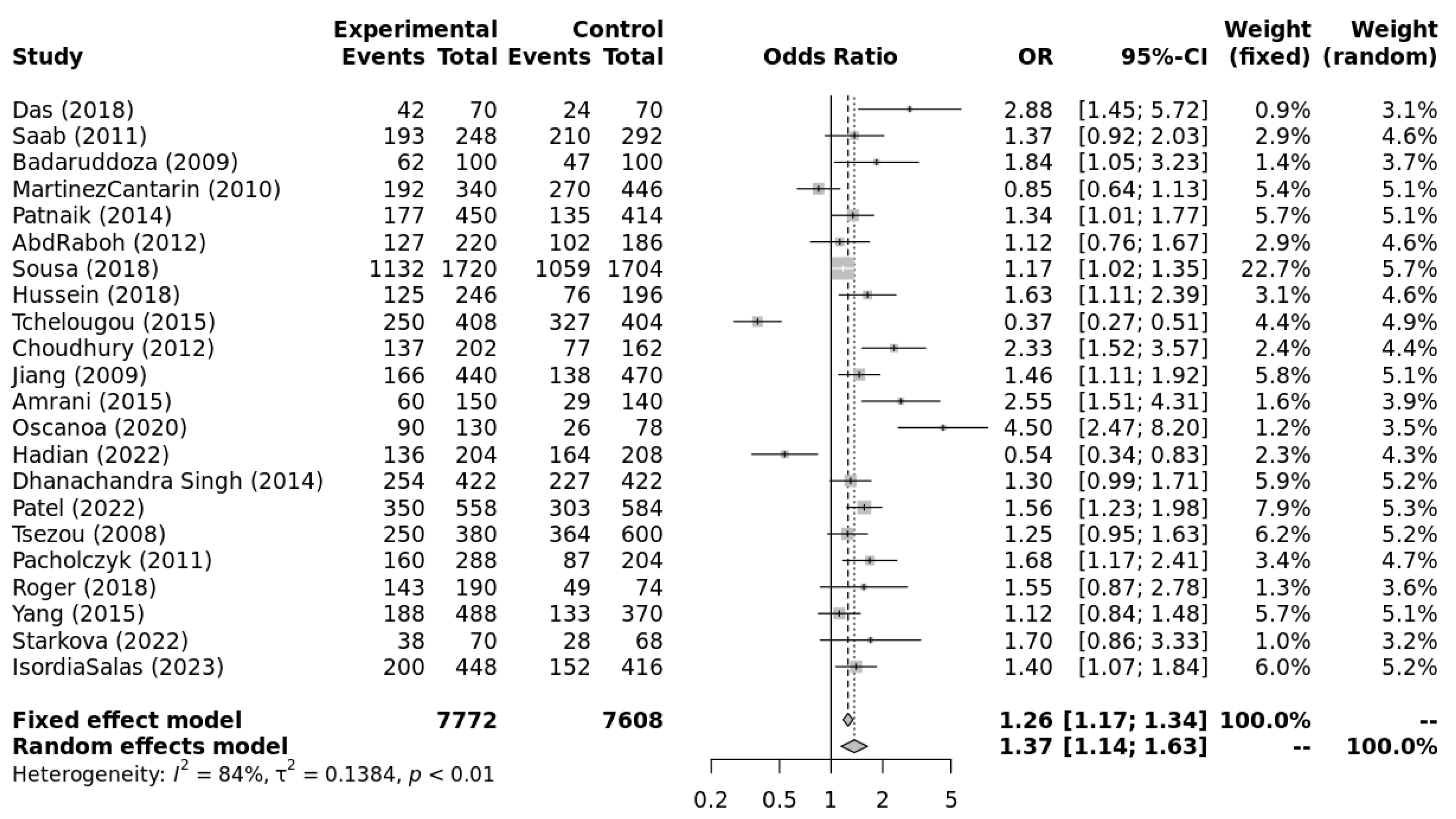
| All | 22 | 1.37 | [1.14–1.64] | <0.01 * | |
| DD vs. DI+II (Recessive) | African | 5 | 1.08 | [0.467–2.48] | 0.857 |
| Chinese | 2 | 1.60 | [0.66–3.89] | 0.302 | |
| European | 4 | 1.27 | [1.07–1.49] | 0.005 * | |
| Hispanic | 2 | 2.64 | [0.89–7.79] | 0.080 | |
| Indian | 6 | 2.74 | [1.76–4.25] | <0.01 * | |
| Middle Eastern | 3 | 1.08 | [0.49–2.34] | 0.842 | |
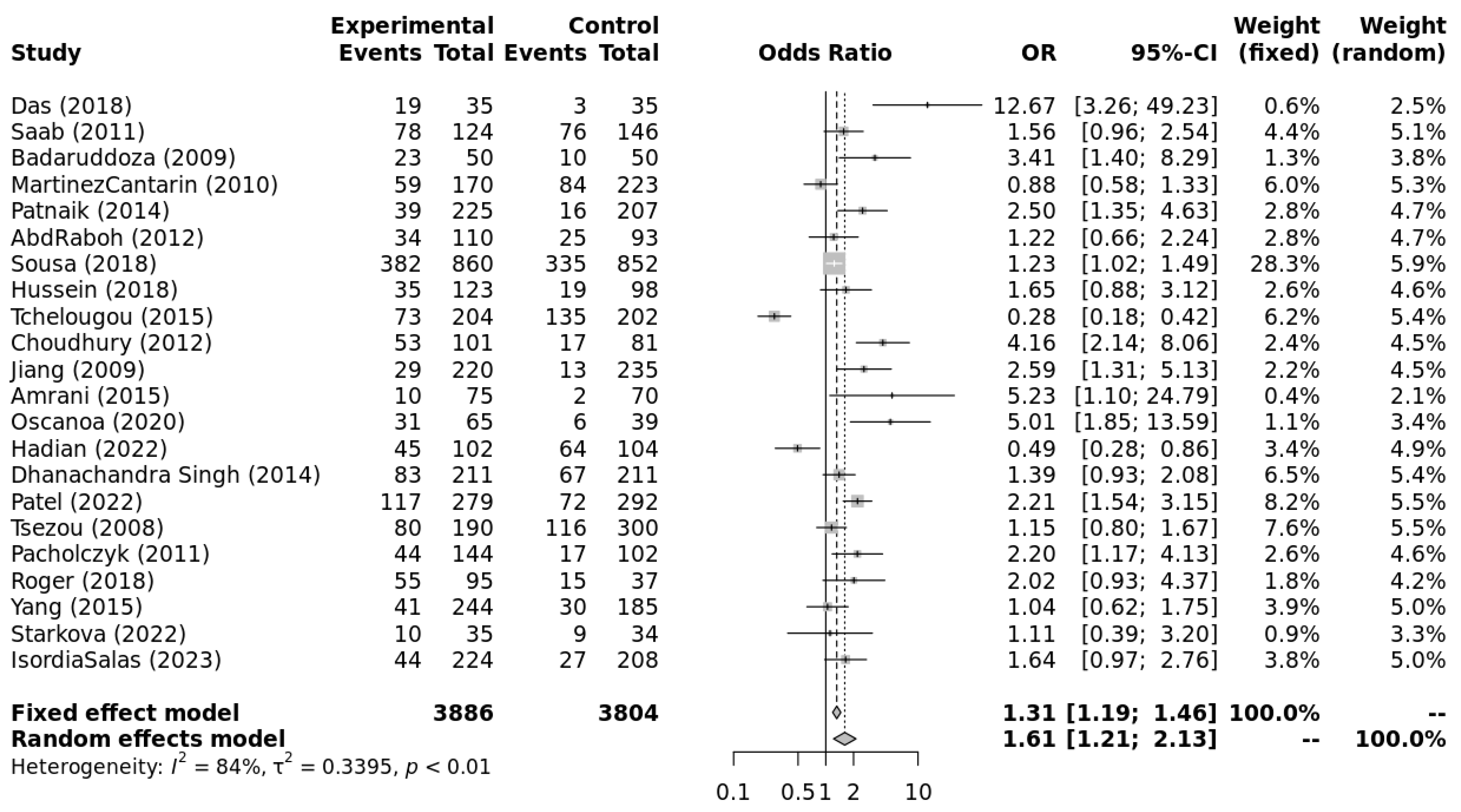
| All | 22 | 1.61 | [1.21–2.13] | <0.01 * | |
| DD+DI vs. II (Dominant) | African | 5 | 0.99 | [0.46–2.12] | 0.979 |
| Chinese | 2 | 1.33 | [1.01–1.74] | 0.039 * | |
| European | 4 | 1.38 | [1.09–1.73] | 0.006 * | |
| Hispanic | 2 | 3.53 | [0.59–20.75] | 0.163 | |
| Indian | 6 | 1.31 | [1.05–1.63] | 0.015 * | |
| Middle Eastern | 3 | 1.02 | [0.39–2.61] | 0.976 | |
| All | 22 | 1.37 | [1.13–1.67] | <0.01 * | |
| DD vs. II (Homozygote) | African | 5 | 1.02 | [0.39–2.74] | 0.972 |
| Chinese | 2 | 1.80 | [0.72–4.51] | 0.211 | |
| European | 4 | 1.53 | [1.19–1.96] | <0.01 * | |
| Hispanic | 2 | 5.27 | [0.67–41.34] | 0.114 | |
| Indian | 6 | 2.29 | [1.74–3.02] | <0.01 * | |
| Middle Eastern | 3 | 1.01 | [0.31–3.24] | 0.986 | |
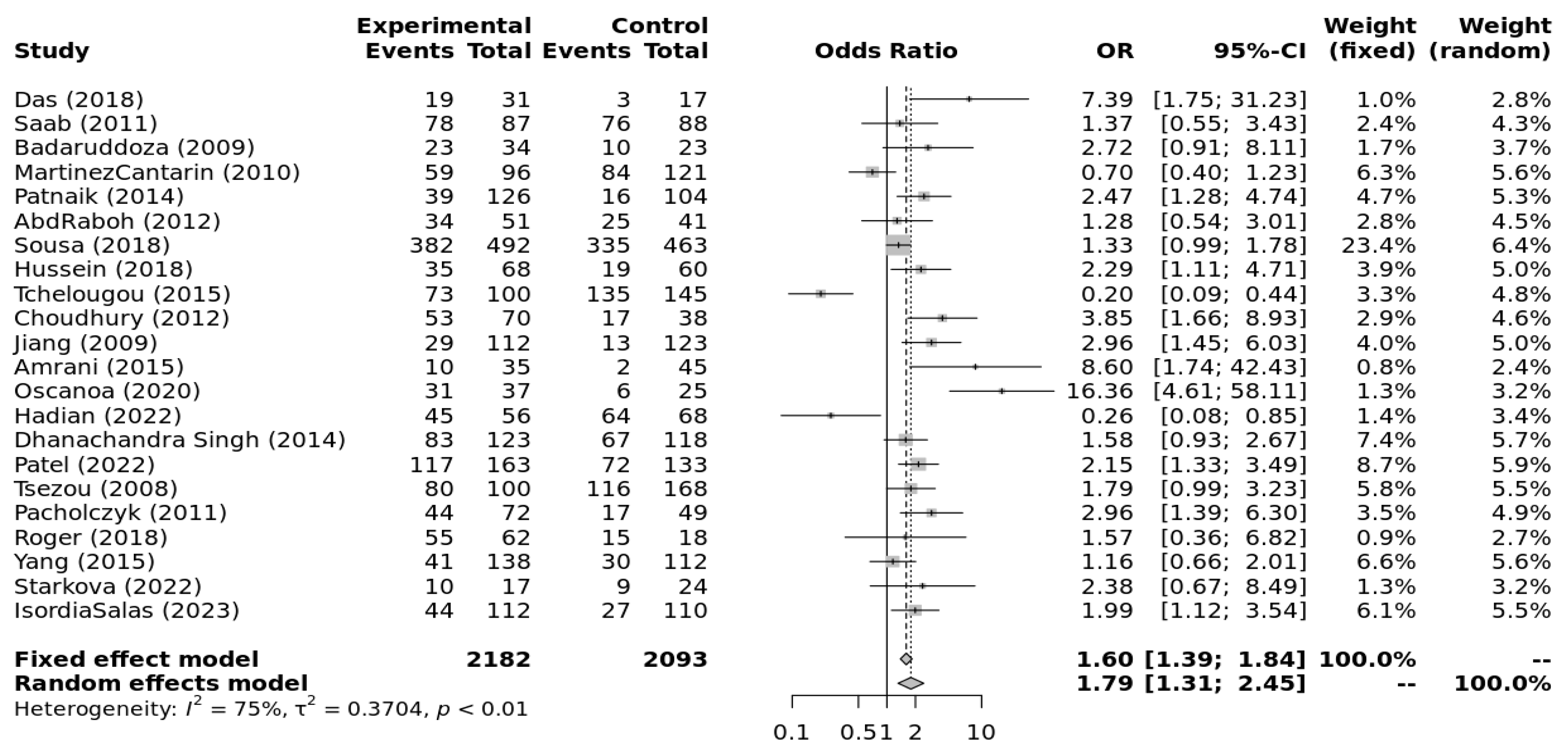
| All | 22 | 1.79 | [1.31–2.45] | <0.01 * | |
| DD vs. DI (Heterozygote) | African | 5 | 1.04 | [0.47–2.29] | 0.924 |
| Chinese | 2 | 1.44 | [0.59–3.46] | 0.420 | |
| European | 4 | 1.20 | [1.01–1.43] | 0.040 * | |
| Hispanic | 2 | 1.61 | [0.98–2.63] | 0.057 | |
| Indian | 6 | 2.97 | [1.75–5.05] | <0.01 * | |
| Middle Eastern | 3 | 1.04 | [0.53–2.04] | 0.906 | |
| All | 22 | 1.49 | [1.13–1.96] | <0.01 |
Disclaimer/Publisher’s Note: The statements, opinions and data contained in all publications are solely those of the individual author(s) and contributor(s) and not of MDPI and/or the editor(s). MDPI and/or the editor(s) disclaim responsibility for any injury to people or property resulting from any ideas, methods, instructions or products referred to in the content. |
© 2026 by the authors. Licensee MDPI, Basel, Switzerland. This article is an open access article distributed under the terms and conditions of the Creative Commons Attribution (CC BY) license.
Share and Cite
Smallwood, A.; Akam, E.; Hunter, D.J.; Singh, M.; Singh, P.; Mastana, S. Association Between ACE (I/D) Polymorphism and Essential Hypertension (EH): An Updated Systematic Review and Meta-Analysis. Int. J. Environ. Res. Public Health 2026, 23, 397. https://doi.org/10.3390/ijerph23030397
Smallwood A, Akam E, Hunter DJ, Singh M, Singh P, Mastana S. Association Between ACE (I/D) Polymorphism and Essential Hypertension (EH): An Updated Systematic Review and Meta-Analysis. International Journal of Environmental Research and Public Health. 2026; 23(3):397. https://doi.org/10.3390/ijerph23030397
Chicago/Turabian StyleSmallwood, Athina, Elizabeth Akam, David John Hunter, Monica Singh, Puneetpal Singh, and Sarabjit Mastana. 2026. "Association Between ACE (I/D) Polymorphism and Essential Hypertension (EH): An Updated Systematic Review and Meta-Analysis" International Journal of Environmental Research and Public Health 23, no. 3: 397. https://doi.org/10.3390/ijerph23030397
APA StyleSmallwood, A., Akam, E., Hunter, D. J., Singh, M., Singh, P., & Mastana, S. (2026). Association Between ACE (I/D) Polymorphism and Essential Hypertension (EH): An Updated Systematic Review and Meta-Analysis. International Journal of Environmental Research and Public Health, 23(3), 397. https://doi.org/10.3390/ijerph23030397