The Use of Positive Psychology in Studies with Healthcare Professionals: Scoping Review and Implications for Professional Support


Highlights
- Work-related illness among healthcare professionals represents a critical public health issue, as it directly affects the quality, continuity, and safety of care provided to populations.
- Addressing this issue also requires the consideration of individual-level factors such as personal resources, coping strategies, and psychological strengths. By incorporating these dimensions into research and intervention design, it becomes possible to develop more effective and comprehensive approaches that integrate both systemic and individual determinants of occupational health.
- This work is significant because it addresses the well-being of healthcare professionals as a key factor in the quality and continuity of care.
- By integrating psychological dimensions into the analysis of occupational stress, the study broadens the scope of public health approaches, supporting interventions that promote emotional well-being, prevent illness, and strengthen the workforce at both individual and systemic levels.
- There is a need to prioritize pre-service and in-service training models that proactively support healthcare workers’ well-being, rather than relying solely on reactive interventions aimed at treating stress after it has developed.
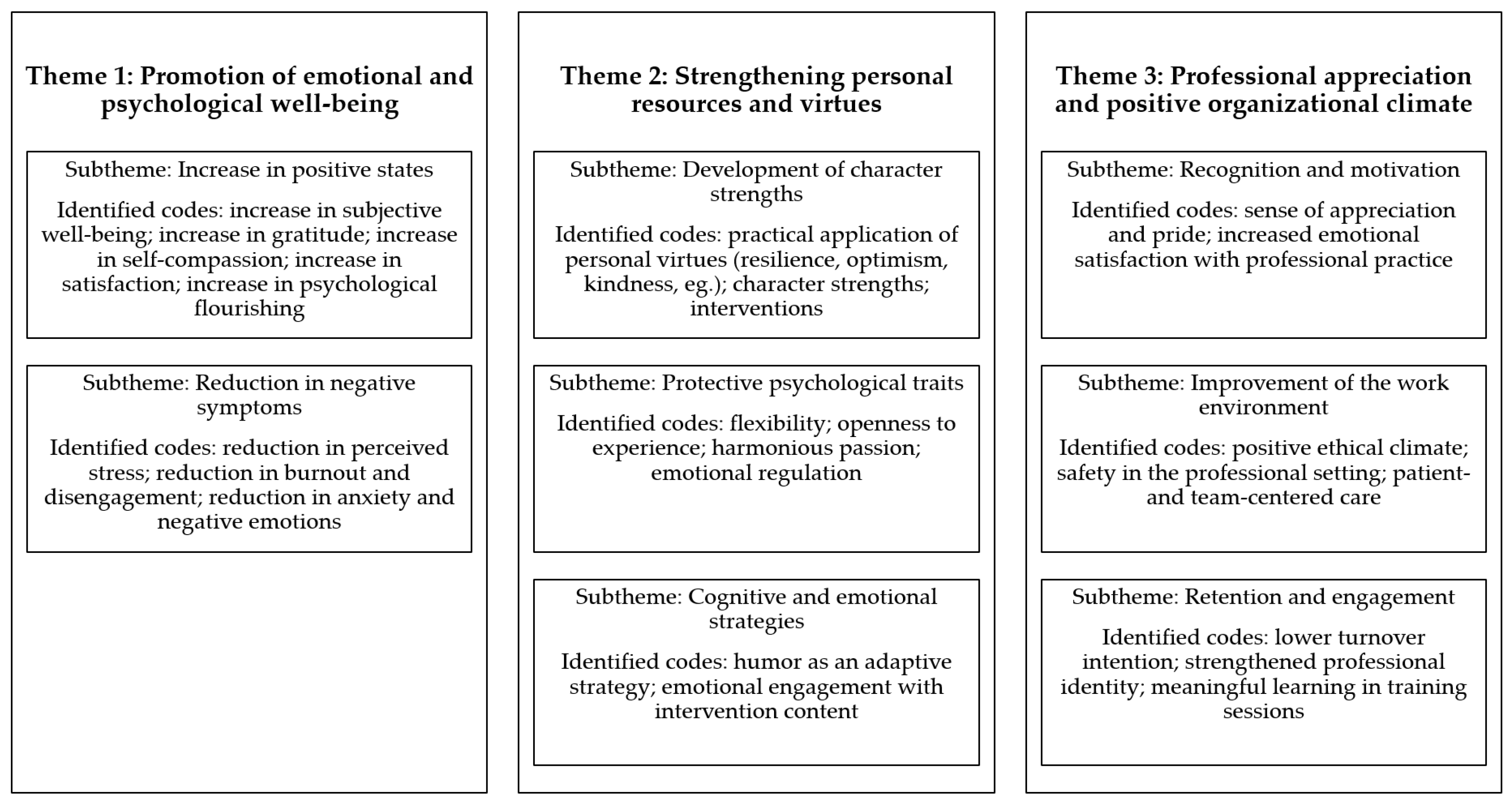
- Findings of the scoping review provide evidence-based insights for policy and practice, highlighting interventions that (a) improve emotional and psychological well-being, (b) strengthen personal resources through reflection, and (c) foster professional respect and a positive organizational climate.
Abstract
1. Introduction
1.1. Positive Psychology in Healthcare
1.2. The Present Study
2. Methods
2.1. Design
2.2. Research Question
2.3. Eligibility Criteria
2.4. Search Strategies
2.5. Screening and Selection of Evidence
2.6. Data Extraction
2.7. Data Analysis and Presentation
3. Results
3.1. Meta-Level Conceptual
3.2. Meta-Level Operational
3.3. Meta-Level Reflective Evaluation
3.4. New Synthesis and Implications for the Field of Health Promotion
4. Discussion
5. Conclusions
Supplementary Materials
Funding
Institutional Review Board Statement
Informed Consent Statement
Data Availability Statement
Acknowledgments
Conflicts of Interest
References
- Koinis, A.; Giannou, V.; Drantaki, V.; Angelaina, S.; Stratou, E.; Saridi, M. The impact of healthcare workers job environment on their mental-emotional health. Coping strategies: The case of a local general hospital. Health Psychol. Res. 2015, 3, 1984. [Google Scholar] [CrossRef] [PubMed]
- Perä, S.; Hellman, T.; Molin, F.; Svartengren, M. Development work in healthcare: What supportive and deterrent factors do employees working in a hospital department experience in an improved work environment? Int. J. Environ. Res. Public Health 2021, 18, 8394. [Google Scholar] [CrossRef] [PubMed]
- Ribeiro, I.A.P.; Rocha, D.M.; Oliveira, A.L.C.B.; Ribeiro, A.A.A.; Guimarães, M.R.; Fernandes, M.A.; Pillon, S.C. Occupational stress and mental health of healthcare workers in the COVID-19 setting: An integrative review. Rev. Eletrônica Enferm. 2022, 24, 70783. [Google Scholar] [CrossRef]
- Endalamaw, A.; Khatri, R.B.; Erku, D.; Zewdie, A.; Wolka, E.; Nigatu, F.; Assefa, Y. Barriers and strategies for primary health care workforce development: Synthesis of evidence. BMC Prim. Care 2024, 25, 99. [Google Scholar] [CrossRef]
- Magnavita, N.; Meraglia, I.; Riccò, M. Anxiety and depression in healthcare workers are associated with work stress and poor work ability. AIMS Public Health 2024, 11, 1223–1246. [Google Scholar] [CrossRef]
- Bayes, A.; Tavella, G.; Parker, G. The biology of burnout: Causes and consequences. World J. Biol. Psychiatry 2021, 22, 686–698. [Google Scholar] [CrossRef]
- Batanda, I. Prevalence of burnout among healthcare professionals: A survey at Fort Portal Regional Referral Hospital. npj Ment. Health Res. 2024, 3, 16. [Google Scholar] [CrossRef]
- Balbinot, M.A.; Bordignon, M. Strategies for management of stress and burnout among healthcare professionals in Brazil. Rev. Bras. Med. Trab. 2023, 20, 487–497. [Google Scholar] [CrossRef]
- Scott, K.; Beckham, S.W.; Gross, M.; Pariyo, G.; Rao, K.D.; Cometto, G.; Perry, H.B. What do we know about community-based health worker programs? A systematic review of existing reviews on community health workers. Hum. Resour. Health 2018, 16, 39. [Google Scholar] [CrossRef]
- Menguer, L.D.S.; Pereira, E.V.; Silva, A.C.R.; Farias, J.M. Burnout syndrome and job satisfaction in community health workers. Rev. Bras. Med. Trab. 2024, 21, e2021903. [Google Scholar] [CrossRef]
- Quesada-Puga, C.; Izquierdo-Espin, F.J.; Membrive-Jiménez, M.J.; Aguayo-Estremera, R.; Cañadas-De La Fuente, G.A.; Romero-Béjar, J.L.; Gómez-Urquiza, J.L. Job satisfaction and burnout syndrome among intensive-care unit nurses: A systematic review and meta-analysis. Intensive Crit. Care Nurs. 2024, 82, 103660. [Google Scholar] [CrossRef] [PubMed]
- Seligman, M.E.P.; Csikszentmihalyi, M. Positive psychology: An introduction. Am. Psychol. 2000, 55, 5–14. [Google Scholar] [CrossRef] [PubMed]
- Phan, H.P.; Ngu, B.H.; Chen, S.C.; Wu, L.; Shi, S.Y.; Lin, R.Y.; Shih, J.H.; Wang, H.W. Advancing the study of positive psychology: The use of a multifaceted structure of mindfulness for development. Front. Psychol. 2020, 11, 1602. [Google Scholar] [CrossRef] [PubMed]
- Joseph, S.; Sagy, S. Positive psychology and its relation to salutogenesis. In The Handbook of Salutogenesis, 2nd ed.; Mittelmark, M.B., Bauer, G.F., Vaandrager, L., Pelikan, J.M., Sagy, S., Eriksson, M., Lindström, B., Magistretti, C.M., Eds.; Springer: Cham, Switzerland, 2022; Chapter 23. Available online: https://www.ncbi.nlm.nih.gov/books/NBK584097/ (accessed on 13 October 2025).
- Niemiec, R.M.; Pearce, R. The practice of character strengths: Unifying definitions, principles, and exploration of what’s soaring, emerging, and ripe with potential in science and in practice. Front. Psychol. 2021, 11, 590220. [Google Scholar] [CrossRef]
- Peterson, C.; Seligman, M.E.P. Character Strengths and Virtues: A Handbook and Classification, 3rd ed.; Oxford University Press: New York, NY, USA; American Psychological Association: New York, NY, USA, 2004; pp. 154–196. [Google Scholar]
- Vazquez, A.C.S.; Hutz, C.S. Trabalho, bem-estar e burnout: Contribuições da Psicologia Positiva. In Psicologia Positiva e Desenvolvimento Humano; Vitti, L.S., Nakano, T.C., Chnaider, J., Camelo de Abreu, I.C., Eds.; Vetor Editora: São Paulo, Brazil, 2023; pp. 221–244. [Google Scholar]
- Mak, S.; Thomas, A. Steps for conducting a scoping review. J. Grad. Med. Educ. 2022, 14, 565–567. [Google Scholar] [CrossRef]
- Tricco, A.C.; Lillie, E.; Zarin, W.; O’Brien, K.K.; Colquhoun, H.; Levac, D.; Moher, D.; Peters, M.D.J.; Horsley, T.; Weeks, L.; et al. PRISMA Extension for Scoping Reviews (PRISMA-ScR): Checklist and explanation. Ann. Intern. Med. 2018, 169, 467–473. [Google Scholar] [CrossRef]
- Ouzzani, M.; Hammady, H.; Fedorowicz, Z.; Elmagarmid, A. Rayyan—A web and mobile app for systematic reviews. Syst. Rev. 2016, 5, 210. [Google Scholar] [CrossRef]
- Frandsen, T.F.; Bruun Nielsen, M.F.; Lindhardt, C.L.; Eriksen, M.B. Using the full PICO model as a search tool for systematic reviews resulted in lower recall for some PICO elements. J. Clin. Epidemiol. 2020, 127, 69–75. [Google Scholar] [CrossRef]
- Azoulay, E.; Barnes, N.K.; Myatra, S.N.; Delgado, M.M.; Arabi, Y.; Boulanger, C.; Mistraletti, G.; Theodorakopoulou, M.; Van Heerden, V.; Paiva, J.A.; et al. HELLO: A protocol for a cluster randomized controlled trial to enhance interpersonal relationships and team cohesion among ICU healthcare professionals. Intensive Care Med. Exp. 2024, 12, 90. [Google Scholar] [CrossRef]
- Bondre, A.P.; Khan, A.; Singh, A.; Singh, S.; Shrivastava, R.; Verma, N.; Ranjan, A.; Agrawal, J.; Mehrotra, S.; Shidhaye, R.; et al. A character-strengths based coaching intervention to improve wellbeing of rural community health workers in Madhya Pradesh, India: Protocol for a single-blind randomized controlled trial. Contemp. Clin. Trials Commun. 2024, 42, 101377. [Google Scholar] [CrossRef]
- Cebolla, A.; Galiana, L.; Navarrete, J.; Alvear, D.; Garrote, E.; Sansó, N.; Carmona, J.V.; Juan, M.; Blasco, M.L. Wellbeing training based on contemplative practices in a sample of intensive care and homecare professionals: A pilot and feasibility non-randomized clinical trial. Int. J. Environ. Res. Public Health 2022, 19, 13137. [Google Scholar] [CrossRef]
- Gil-Almagro, F.; García-Hedrera, F.J.; Carmona-Monge, F.J.; Peñacoba-Puente, C. A study on optimism as a psychological strength in nurses through a prospective study from the outbreak of the COVID-19 pandemic to two years later. Brain Behav. Immun. Health 2024, 38, 100782. [Google Scholar] [CrossRef]
- Khan, A.; Sharma, L.; Agrawal, S.; Nayak, S.R.; Shrivastava, R.; Ahuja, R.; Pandit, P.; Singh, A.; Singh, S.; Naslund, J.A.; et al. Development of a character-strengths based coaching program for rural community health workers to address their work stress in Madhya Pradesh, India. Curr. Psychol. 2024, 43, 5133–5152. [Google Scholar] [CrossRef]
- Kletter, M.; Harris, B.; Connolly, E.; Namathanga, C.; Nhlema, B.; Makungwa, H.; Chabwera, B.; Phiri, B.; Brown, C. Mixed method evaluation of a learning from excellence programme for community health workers in Neno, Malawi. BMC Health Serv. Res. 2024, 24, 355. [Google Scholar] [CrossRef]
- Raecke, J.; Proyer, R.T. Humor as a multifaceted resource in healthcare: An initial qualitative analysis of perceived functions and conditions of medical assistants’ use of humor in their everyday work and education. Int. J. Appl. Posit. Psychol. 2022, 7, 397–418. [Google Scholar] [CrossRef] [PubMed]
- Santos, F.R.M.D.; Lacerda, S.S.; Coelhoso, C.C.; Barrichello, C.R.; Tobo, P.R.; Kozasa, E.H. The integration of meditation and positive psychology practices to relieve stress in women workers (Flourish): Effects in two pilot studies. Behav. Sci. 2021, 11, 43. [Google Scholar] [CrossRef]
- Tully, S.; Tao, H.; Johnson, M.; Lebron, M.; Land, T.; Armendariz, L. Gratitude practice to decrease stress and burnout in acute-care health professionals. OJIN Online J. Issues Nurs. 2023, 28, 03PPT75b. [Google Scholar] [CrossRef]
- Unjai, S.; Forster, E.M.; Mitchell, A.E.; Creedy, D.K. Predictors of compassion satisfaction among healthcare professionals working in intensive care units: A cross-sectional study. Intensive Crit. Care Nurs. 2023, 79, 103509. [Google Scholar] [CrossRef]
- Ahmed, S.K.; Mohammed, R.A.; Nashwan, A.J.; Ibrahim, R.H.; Abdalla, A.Q.; Ameen, B.M.M.; Khdhir, R.M. Using thematic analysis in qualitative research. J. Med. Surg. Public Health 2025, 6, 100198. [Google Scholar] [CrossRef]
- Martins, L.F.; Souza, F.R.; Freitas, J.M. requalify.ai (Version 0.1) [Online Software]. 2024. Available online: https://requalify.ai (accessed on 2 October 2025).
- Lembo, V.M.R.; Oliveira, W.A. Anti-bullying interventions with adolescents: A mapping review. Cienc. Psicol. 2025, 19, e-4658. [Google Scholar] [CrossRef]
- Lembo, V.M.R.; Santos, M.A.; Feijó, M.C.B.; Andrade, A.L.M.; Zequinão, M.A.; Oliveira, W.A. Revisão sobre características de meninos e meninas que praticam bullying escolar. Rev. Psicol. Teoria Prática 2023, 25, ePTPPE15019. [Google Scholar] [CrossRef]
- Lembo, V.M.R.; Santos, M.A.; Silva, M.A.I.S.; Sampaio, J.M.C.; de Oliveira, W.A. Imaginação e sentimentos de estudantes que praticam bullying na escola. In Psicologia Positiva e Desenvolvimento Humano; Vitti, L.S., Nakano, T.C., Chnaider, J., Camelo de Abreu, I.C., Eds.; Vetor Editora: São Paulo, Brazil, 2023; pp. 105–118. [Google Scholar]
- Oliveira, W.A.; Esteca, A.M.N.; Wechsler, S.M.; Menesini, E. Bullying and cyberbullying in school: Rapid review on the roles of gratitude, forgiveness, and self-regulation. Int. J. Environ. Res. Public Health 2024, 21, 839. [Google Scholar] [CrossRef] [PubMed]
- Brignardello-Petersen, R.; Santesso, N.; Guyatt, G.H. Systematic reviews of the literature: An introduction to current methods. Am. J. Epidemiol. 2025, 194, 536–542. [Google Scholar] [CrossRef] [PubMed]
- Dhollande, S.; Taylor, A.; Meyer, S.; Scott, M. Conducting integrative reviews: A guide for novice nursing researchers. J. Res. Nurs. 2021, 26, 427–438. [Google Scholar] [CrossRef]
- Veroniki, A.A.; Hutton, B.; Stevens, A.; McKenzie, J.E.; Page, M.J.; Moher, D.; McGowan, J.; Straus, S.E.; Li, T.; Munn, Z.; et al. Update to the PRISMA guidelines for network meta-analyses and scoping reviews and development of guidelines for rapid reviews: A scoping review protocol. JBI Evid. Synth. 2025, 23, 517–526. [Google Scholar] [CrossRef]
- Peters, M.D.J.; Marnie, C.; Tricco, A.C.; Pollock, D.; Munn, Z.; Alexander, L.; McInerney, P.; Godfrey, C.M.; Khalil, H. Updated methodological guidance for the conduct of scoping reviews. JBI Evid. Synth. 2020, 18, 2119–2126. [Google Scholar] [CrossRef]
- Shea, B.J.; Reeves, B.C.; Wells, G.; Thuku, M.; Hamel, C.; Moran, J.; Moher, D.; Tugwell, P.; Welch, V.; Kristjansson, E.; et al. AMSTAR 2: A critical appraisal tool for systematic reviews that include randomised or non-randomised studies of healthcare interventions, or both. BMJ 2017, 358, j4008. [Google Scholar] [CrossRef]
- Gonçalves, L.; Sala, R.; Navarro, J.B. Resilience and occupational health of health care workers: A moderator analysis of organizational resilience and sociodemographic attributes. Int. Arch. Occup. Environ. Health 2022, 95, 223–232. [Google Scholar] [CrossRef]
- Cherry, J.; Singh, G.; Buck, M. Psychological flexibility as a mediator in the relationship between resilience and academic burnout among Doctor of Physical Therapy students: A structural equation modeling study. Health Sci. Rep. 2024, 7, e2291. [Google Scholar] [CrossRef]
- Martínez-Martínez, K.; Cruz-Ortiz, V.; Llorens, S.; Salanova, M.; Leiva-Bianchi, M. Systematic review and meta-analysis of positive psychology interventions in workplace settings. Soc. Sci. 2025, 14, 481. [Google Scholar] [CrossRef]
- Sułkowska, J.Z.; Kuźmicz, I.; Kawalec-Kajstura, E.; Palmer, S.; Brzostek, T. Positive psychology interventions in professional burnout prevention among nurses: A systematic review. Pielęgniarstwo w Opiece Długoterminowej 2023, 8, 3–11. [Google Scholar] [CrossRef]
- Townsley, A.P.; Leong, L.; Miller, C.; Li, R.; Zhang, X. Healthcare workers’ well-being: A systematic review of positive psychology interentions. Cureus 2023, 15, e34102. [Google Scholar] [CrossRef]
- Alexiou, E.; Kotsoni, A.; Stalikas, A. The effectiveness of an online positive psychology intervention among healthcare professionals with depression, anxiety or stress symptoms and burnout. Psychology 2021, 12, 392–408. [Google Scholar] [CrossRef]
- Larsson, I.; Ahlstrand, I.; Larsson, M.; Pennbrant, S.; Ekman, A.; Hallgren, J. Health-promoting resources and workplace experiences among newly graduated healthcare and social work professionals—A multicentre cross-sectional study. BMC Health Serv. Res. 2025, 25, 617. [Google Scholar] [CrossRef]
- Tal, A.; Kerret, D. Positive psychology as a strategy for promoting sustainable population policies. Heliyon 2020, 6, e03696. [Google Scholar] [CrossRef]



| Analytical Level | Description | Guiding Questions | Data to Be Collected |
|---|---|---|---|
| Conceptual (Meta-theoretical) | Assesses the theoretical, epistemological, and conceptual foundations of the reviewed articles. It seeks to understand which models are mobilized and to what extent. It also considers the context of scientific production, identifying patterns related to authorship, journals, countries, and disciplinary areas. | What theoretical framework is stated? What key concepts are used? How do the authors justify the use of these concepts or their theoretical choices? Who are the authors? What are their institutional affiliations or fields of expertise? In which journals were the articles published? When? In which countries were the studies conducted? | Citations of authors or founders of theories. Adopted conceptual definitions. Referenced theoretical models. Level of theoretical grounding (explicit, implicit, absent). Journal title, year of publication, country of origin of the research. Type of journal (psychology, health, interdisciplinary, etc.). |
| Operational (Meta-methodological) | Analyzes the coherence between the conceptual assumptions and the methods employed, including study design, participants, adopted measures/instruments, and context. Includes assessment of methodological quality when necessary or recommended. | What are the main characteristics of the study’s method? How was the study designed and conducted? What instruments and indicators were used? Is the context (setting, population) well described? | Type of design. Procedures. Measures/instruments used. Description of the context and target population. Type of analysis performed. Use of tools. |
| Reflective-Evaluative (Meta-synthetic) | Examines how the results are interpreted, integrated, and discussed, including study limitations, articulation with the literature, and practical implications. Focuses on the creation of a new synthesis—a new knowledge product. | Are the results discussed in light of the theoretical framework? What are the main findings presented? Are the study’s limitations acknowledged? Are there recommendations for practice and future research? Does the study contribute to consolidating, questioning, or expanding the field? | Synthesis strategy (e.g., categories, themes, metrics). Discussion of limitations. Connection between results and theory. Authors’ conclusions and recommendations. Production of a new synthesis integrating the main findings from all reviewed studies. |
| Reference | Statement of Positive Psychology Use | Highlighted Theoretical Aspects |
|---|---|---|
| [22] | yes |
|
| [23] | yes |
|
| [24] | yes |
|
| [25] | yes |
|
| [26] | yes |
|
| [27] | yes |
|
| [28] | yes |
|
| [29] | yes |
|
| [30] | yes |
|
| [31] | yes |
|
| Reference | Objectives | Methodological Data |
|---|---|---|
| [22] | Evaluate the impact of an intervention on the prevalence of burnout among healthcare professionals working in intensive care units (ICUs); compare burnout rates before and after the intervention |
|
| [23] | Test the effectiveness of a character strengths-based coaching intervention compared to routine supervision in enhancing well-being (“authentic happiness”) |
|
| [24] | Investigate the effectiveness of a contemplative practice-based well-being training program for enhancing psychological functioning |
|
| [25] | Analyze the influence of openness to experience and resilience on the development of optimism |
|
| [26] | Describe a systematic approach to planning and developing a character strengths-based coaching program for community health workers |
|
| [27] | Evaluate the feasibility, outcomes, and impact of a program called “Learning from Excellence” |
|
| [28] | Investigate the potential of humor as a resource for work and professional education |
|
| [29] | Evaluate the effects of a multicomponent intervention based on meditation and Positive Psychology in reducing stress |
|
| [30] | Evaluate the effect of participation in a 21-day therapeutic writing intervention on levels of gratitude |
|
| [31] | Determine the prevalence of compassion satisfaction, identify associated factors, and determine predictors of compassion satisfaction |
|
| Reference | Key Findings Related to the Review Objective and Guiding Question |
|---|---|
| [22] |
|
| [23] |
|
| [24] |
|
| [25] |
|
| [26] |
|
| [27] |
|
| [28] |
|
| [29] |
|
| [30] |
|
| [31] |
|
Disclaimer/Publisher’s Note: The statements, opinions and data contained in all publications are solely those of the individual author(s) and contributor(s) and not of MDPI and/or the editor(s). MDPI and/or the editor(s) disclaim responsibility for any injury to people or property resulting from any ideas, methods, instructions or products referred to in the content. |
© 2026 by the author. Licensee MDPI, Basel, Switzerland. This article is an open access article distributed under the terms and conditions of the Creative Commons Attribution (CC BY) license.
Share and Cite
Oliveira, W.A.d. The Use of Positive Psychology in Studies with Healthcare Professionals: Scoping Review and Implications for Professional Support. Int. J. Environ. Res. Public Health 2026, 23, 296. https://doi.org/10.3390/ijerph23030296
Oliveira WAd. The Use of Positive Psychology in Studies with Healthcare Professionals: Scoping Review and Implications for Professional Support. International Journal of Environmental Research and Public Health. 2026; 23(3):296. https://doi.org/10.3390/ijerph23030296
Chicago/Turabian StyleOliveira, Wanderlei Abadio de. 2026. "The Use of Positive Psychology in Studies with Healthcare Professionals: Scoping Review and Implications for Professional Support" International Journal of Environmental Research and Public Health 23, no. 3: 296. https://doi.org/10.3390/ijerph23030296
APA StyleOliveira, W. A. d. (2026). The Use of Positive Psychology in Studies with Healthcare Professionals: Scoping Review and Implications for Professional Support. International Journal of Environmental Research and Public Health, 23(3), 296. https://doi.org/10.3390/ijerph23030296