


Intersectionality-Informed HIV Cure-Related Research at the End of Life: A Call to Action

 ,
,  , , , , , ,
Highlights
- End-of-life HIV cure-related research can advance discovery while honoring dignity and legacy, but participation remains demographically skewed, reinforcing inequities in who is informed, invited, and supported.
- Drawing on eight years of UC San Diego Last Gift experience, literature review and community engagement, this paper offers a practical approach to embed intersectionality-informed justice, equity, diversity, inclusion, and accessibility throughout end-of-life study design and delivery.
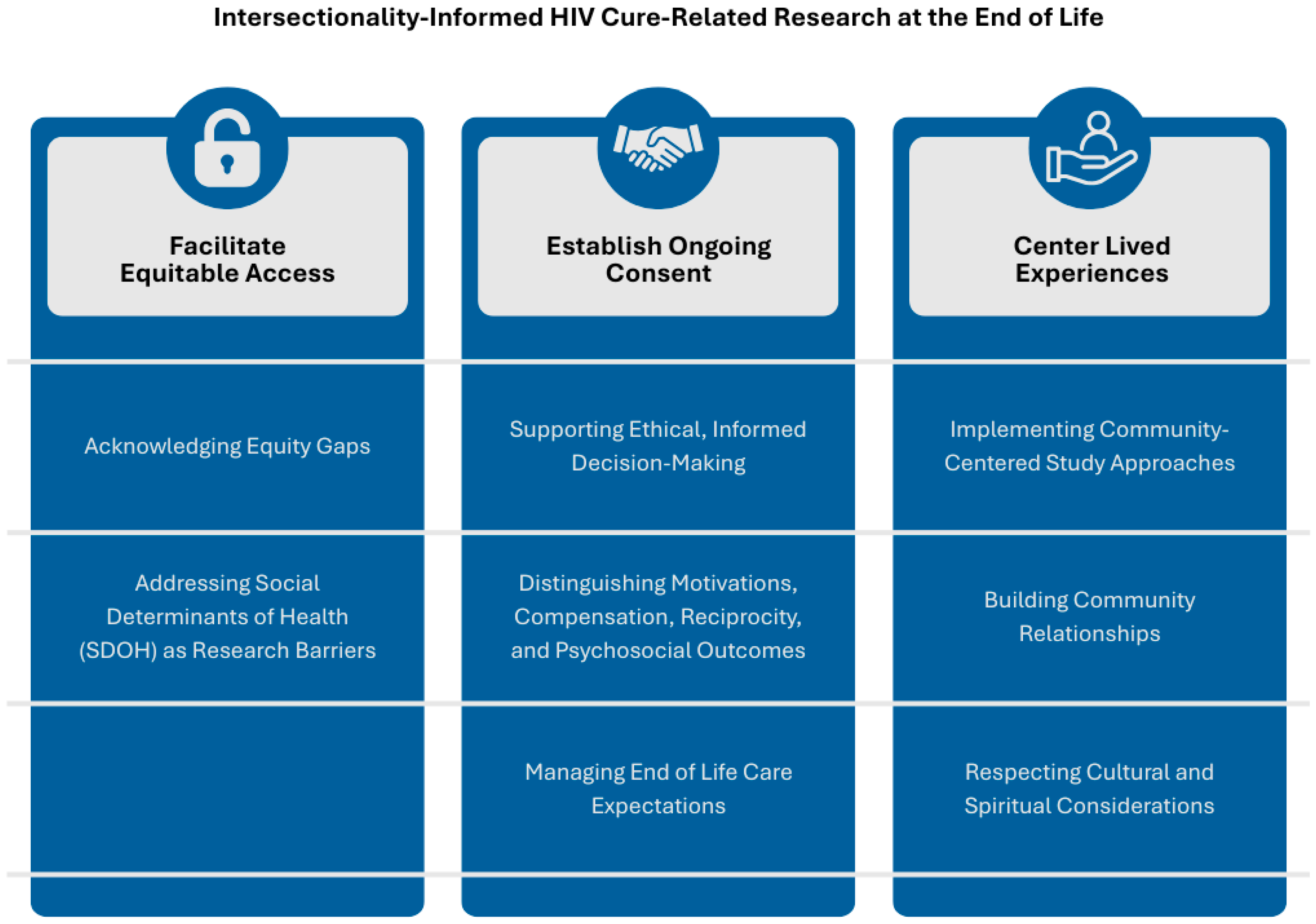
- The paper applies an intersectionality-informed framework to convert ethical guidance into practical procedures organized across three themes and eight domains, designed to be implemented directly or adapted to local capacity.
- We frame equity as integral to methodological rigor that strengthens trust, representation, and the overall validity of HIV cure research findings.
- Practitioners and researchers can help protect participant autonomy by removing study design barriers that limit or pressure participation, using multi-session consent with teach back, establishing transparent proxy pathways, and keeping research separate from clinical care.
- Policymakers and funders can advance accountability by requiring transparent reporting and real-time course correction tools, including enrollment dashboards that track representation and guide corrective action.
Abstract
1. Introduction
2. Discussion
2.1. Facilitate Equitable Access
2.1.1. Acknowledging Equity Gaps
2.1.2. Addressing Social Determinants of Health (SDOH) as Research Barriers
2.2. Establish Ongoing Consent
2.2.1. Supporting Ethical, Informed Decision-Making
2.2.2. Distinguishing Motivations, Compensation, Reciprocity, and Psychosocial Outcomes
2.2.3. Managing End-of-Life Care Expectations
2.3. Center Lived Experiences
2.3.1. Implementing Community-Centered Study Approaches
2.3.2. Building Community Relationships
2.3.3. Respecting Cultural and Spiritual Considerations
2.3.4. Implications Beyond UC San Diego’s Last Gift Program
2.3.5. Limitations and Possible Future Directions
3. Conclusions
Author Contributions
Funding
Institutional Review Board Statement
Informed Consent Statement
Data Availability Statement
Acknowledgments
Conflicts of Interest
Abbreviations
| ART | Antiretroviral therapy |
| PWH | People with HIV |
| IAS | International AIDS Society |
| EOL | End of life |
| HIV | Human Immunodeficiency Virus |
| UCSD | University of California San Diego |
| TAG | Treatment Action Group |
| PWID | People who inject drugs |
| TGD | Transgender and gender-diverse |
| JEDIA | Justice, equity, diversity, inclusion, and accessibility |
| U.S. | United States |
| CAB | Community Advisory Board |
| GPP | Good Participatory Practice |
| UNAIDS | Joint United Nations Programme on HIV/AIDS |
| SDOH | Social determinants of health |
| IRB | Institutional Review Board |
| BIPOC | Black, Indigenous, and other people of color |
| LGBTQIA+ | Lesbian, gay, bisexual, transgender, queer or questioning, intersex, asexual, and related identities |
References
- Ahmed, A.; Taylor, J.; Tran, W.; Swaitch, S.; Ndukwe, S.O.; Lau, R.; Oliveira, K.H.; Solso, S.; Dullano, C.; Kaytes, A.; et al. “This Is How I Give Back”: Long-Term Survivors on Legacy and HIV Cure Research at the End of Life—A Qualitative Inquiry in the United States. Infect. Dis. Rep. 2025, 17, 78. [Google Scholar] [CrossRef]
- Patel, D.; Beer, L.; Yuan, X.; Tie, Y.; Baugher, A.R.; Jeffries, W.L.t.; Dailey, A.; Henny, K.D. Explaining racial and ethnic disparities in antiretroviral therapy adherence and viral suppression among U.S. men who have sex with men. AIDS 2024, 38, 1073–1080. [Google Scholar] [CrossRef] [PubMed]
- Deeks, S.G.; Archin, N.; Cannon, P.; Collins, S.; Jones, R.B.; de Jong, M.; Lambotte, O.; Lamplough, R.; Ndung’u, T.; Sugarman, J.; et al. Research priorities for an HIV cure: International AIDS Society Global Scientific Strategy 2021. Nat. Med. 2021, 27, 2085–2098. [Google Scholar] [CrossRef] [PubMed]
- Kanazawa, J.; Rawlings, S.A.; Hendrickx, S.; Gianella, S.; Concha-Garcia, S.; Taylor, J.; Kaytes, A.; Patel, H.; Ndukwe, S.; Little, S.J.; et al. Lessons learned from the Last Gift study: Ethical and practical challenges faced while conducting HIV cure-related research at the end of life. J. Med. Ethics 2023, 49, 305–310. [Google Scholar] [CrossRef]
- Dubé, K.; Shelton, B.; Patel, H.; Ndukwe, S.O.; Concha-Garcia, S.; Dullano, C.; Solso, S.; Hendrickx, S.; Kaytes, A.; Taylor, J.; et al. Perceived risks and benefits of enrolling people with HIV at the end of life in cure research in Southern California, United States. J. Virus Erad. 2023, 9, 100328. [Google Scholar] [CrossRef]
- Dubé, K.; Gianella, S.; Concha-Garcia, S.; Little, S.J.; Kaytes, A.; Taylor, J.; Mathur, K.; Javadi, S.; Nathan, A.; Patel, H.; et al. Ethical considerations for HIV cure-related research at the end of life. BMC Med. Ethics 2018, 19, 83. [Google Scholar] [CrossRef] [PubMed]
- Kanazawa, J.; Gianella, S.; Concha-Garcia, S.; Taylor, J.; Kaytes, A.; Christensen, C.; Patel, H.; Ndukwe, S.; Rawlings, S.A.; Hendrickx, S.; et al. Ethical and practical considerations for HIV cure-related research at the end-of-life: A qualitative interview and focus group study in the United States. BMC Med. Ethics 2022, 23, 2. [Google Scholar] [CrossRef]
- Rawlings, S.A.; Layman, L.; Smith, D.; Scott, B.; Ignacio, C.; Porrachia, M.; Concha-Garcia, S.; Hendrickx, S.; Kaytes, A.; Taylor, J.; et al. Performing rapid autopsy for the interrogation of HIV reservoirs. AIDS 2020, 34, 1089–1092. [Google Scholar] [CrossRef]
- Perry, K.E.; Taylor, J.; Patel, H.; Javadi, S.S.; Mathur, K.; Kaytes, A.; Concha-Garcia, S.; Little, S.; Smith, D.; Gianella, S.; et al. “[It] is now my responsibility to fulfill that wish:” Clinical and rapid autopsy staff members’ experiences and perceptions of HIV reservoir research at the end of life. PLoS ONE 2020, 15, e0242420. [Google Scholar] [CrossRef]
- Ndukwe, S.O.; Patel, H.; Shelton, B.; Concha-Garcia, S.; Dullano, C.; Solso, S.; Hendrickx, S.; Riggs, P.K.; Villa, T.J.; Kaytes, A.; et al. People with HIV at the end-of-life and their next-of-kin/loved ones are willing to participate in interventional HIV cure-related research. AIDS 2024, 38, 235–243. [Google Scholar] [CrossRef]
- Treatment Action Group Resource on the Demographics of Participation in HIV Cure-Related Clinical Research. 2025. Available online: https://www.treatmentactiongroup.org/cure/resource-on-the-demographics-of-participation-in-hiv-cure-related-clinical-research/ (accessed on 16 September 2025).
- WHO. HIV Statistics, Globally and by WHO Region, 2025; World Health Organization Global HIV, Hepatitis and Sexually Transmitted Infections Programmes: Geneva, Switzerland, 2025; Available online: https://cdn.who.int/media/docs/default-source/hq-hiv-hepatitis-and-stis-library/who-ias-hiv-statistics_2025-new.pdf (accessed on 10 November 2025).
- Baral, S.D.; Poteat, T.; Strömdahl, S.; Wirtz, A.L.; Guadamuz, T.E.; Beyrer, C. Worldwide burden of HIV in transgender women: A systematic review and meta-analysis. Lancet Infect. Dis. 2013, 13, 214–222. [Google Scholar] [CrossRef]
- Minalga, B.; Feuer, C. Addressing Transgender Erasure in HIV Clinical Trials: The Scorecard for Transgender and Gender-Diverse Inclusion. Am. J. Public Health 2025, 115, 1621–1630. [Google Scholar] [CrossRef] [PubMed]
- Barr, L.; Jefferys, R. A landscape analysis of HIV cure-related clinical research in 2019. J. Virus Erad. 2020, 6, 100010. [Google Scholar] [CrossRef] [PubMed]
- UNAIDS. HIV and People Who Inject Drugs: Thematic Briefing Note: 2024 Global AIDS Update The Urgency of Now: AIDS at a Crossroads. 2024. Available online: https://www.unaids.org/en/resources/documents/2024/2024-unaids-global-aids-update-people-who-inject-drugs (accessed on 10 November 2025).
- Sauceda, J.; Korolkova, A.; Rodriguez Garcia, L.; Picou, B.; Ahmed, A.; Dubé, K. Resolving Challenges in HIV Cure-Related Research: Protocol for a Modified Delphi Consensus-Building Process. JMIR Res. Protoc. 2025, 14, e67123. [Google Scholar] [CrossRef]
- Pantelic, M.; Steinert, J.I.; Ayala, G.; Sprague, L.; Chang, J.; Thomas, R.M.; Nininahazwe, C.; Caswell, G.; Bach-Mortensen, A.M.; Bourne, A. Addressing epistemic injustice in HIV research: A call for reporting guidelines on meaningful community engagement. J. Int. AIDS Soc. 2022, 25, e25880. [Google Scholar] [CrossRef] [PubMed]
- Campbell, D.M.; Stockman, J.K. Black women in HIV research: Intersectionality, positionality and our commitment to build a just research enterprise. Women’s Health 2024, 20, 17455057241305071. [Google Scholar] [CrossRef]
- Dubé, K.; Kanazawa, J.; Taylor, J.; Dee, L.; Jones, N.; Roebuck, C.; Sylla, L.; Louella, M.; Kosmyna, J.; Kelly, D.; et al. Ethics of HIV cure research: An unfinished agenda. BMC Med. Ethics 2021, 22, 83. [Google Scholar] [CrossRef]
- Gianella, S.; Rawlings, S.A.; Dobrowolski, C.; Nakazawa, M.; Chaillon, A.; Strain, M.; Layman, L.; Caballero, G.; Scully, E.; Scott, B.; et al. Sex Differences in Human Immunodeficiency Virus Persistence and Reservoir Size During Aging. Clin. Infect. Dis. 2022, 75, 73–80. [Google Scholar] [CrossRef] [PubMed]
- Wilson, Y.; White, A.; Jefferson, A.; Danis, M. Intersectionality in Clinical Medicine: The Need for a Conceptual Framework. Am. J. Bioeth. 2019, 19, 8–19. [Google Scholar] [CrossRef]
- Bauer, G.R. Incorporating intersectionality theory into population health research methodology: Challenges and the potential to advance health equity. Soc. Sci. Med. 2014, 110, 10–17. [Google Scholar] [CrossRef]
- Bowleg, L. The problem with the phrase women and minorities: Intersectionality-an important theoretical framework for public health. Am. J. Public Health 2012, 102, 1267–1273. [Google Scholar] [CrossRef] [PubMed]
- Holman, D.; Salway, S.; Bell, A.; Beach, B.; Adebajo, A.; Ali, N.; Butt, J. Can intersectionality help with understanding and tackling health inequalities? Perspectives of professional stakeholders. Health Res. Policy Syst. 2021, 19, 97. [Google Scholar] [CrossRef] [PubMed]
- Hamad, N. How I approach intersectionality in hematopoietic stem cell transplantation. Blood 2024, 144, 2482–2489. [Google Scholar] [CrossRef] [PubMed]
- Watkins-Hayes, C. Intersectionality and the Sociology of HIV/AIDS: Past, Present, and Future Research Directions. Annu. Rev. Sociol. 2014, 40, 431–457. [Google Scholar] [CrossRef]
- The Last Gift Study: University of California San Diego Research: Tissue Donation for HIV Research. 2025. Available online: https://lastgift.ucsd.edu/ (accessed on 2 October 2025).
- Dubé, K.; Ahmed, A.; Sauceda, J.A. Integrating socio-behavioral, ethics, community, and translational science considerations in HIV cure research. Curr. Opin. HIV AIDS 2025, 20, 565–573. [Google Scholar] [CrossRef]
- Wilkins, C.H.; Miller, S.T.; Richmond, A.N.; Carrasquillo, O. Community-Engaged Research—Essential to Addressing Health Inequities. N. Engl. J. Med. 2023, 389, 1928–1931. [Google Scholar] [CrossRef]
- Feroz, A.; Ibrahim, M.N.; McClure, E.M.; Ali, A.S.; Tikmani, S.S.; Reza, S.; Abbasi, Z.; Raza, J.; Yasmin, H.; Bano, K.; et al. Perceptions of parents and religious leaders regarding minimal invasive tissue sampling to identify the cause of death in stillbirths and neonates: Results from a qualitative study. Reprod. Health 2019, 16, 53. [Google Scholar] [CrossRef]
- Abernethy, A.P.; Capell, W.H.; Aziz, N.M.; Ritchie, C.; Prince-Paul, M.; Bennett, R.E.; Kutner, J.S. Ethical conduct of palliative care research: Enhancing communication between investigators and institutional review boards. J. Pain Symptom. Manag. 2014, 48, 1211–1221. [Google Scholar] [CrossRef]
- Balboni, T.; Balboni, M.; Paulk, M.E.; Phelps, A.; Wright, A.; Peteet, J.; Block, S.; Lathan, C.; Vanderweele, T.; Prigerson, H. Support of cancer patients’ spiritual needs and associations with medical care costs at the end of life. Cancer 2011, 117, 5383–5391. [Google Scholar] [CrossRef]
- Balboni, T.A. Spirituality in advanced cancer: Implications for care in oncologic emergencies. Ann. Palliat. Med. 2024, 13, 568–574. [Google Scholar] [CrossRef]
- Bentley, B.; O’Connor, M. Conducting research interviews with bereaved family carers: When do we ask? J. Palliat. Med. 2015, 18, 241–245. [Google Scholar] [CrossRef]
- Gijsberts, M.H.E.; Liefbroer, A.I.; Otten, R.; Olsman, E. Spiritual Care in Palliative Care: A Systematic Review of the Recent European Literature. Med. Sci. 2019, 7, 25. [Google Scholar] [CrossRef]
- Steinhauser, K.E.; Voils, C.I.; Clipp, E.C.; Bosworth, H.B.; Christakis, N.A.; Tulsky, J.A. “Are you at peace?”: One item to probe spiritual concerns at the end of life. Arch. Intern. Med. 2006, 166, 101–105. [Google Scholar] [CrossRef]
- UNAIDS Terminology Guidelines. Geneva: Joint United Nations Programme on HIV/AIDS. 2024. Available online: https://www.unaids.org/sites/default/files/media_asset/2024-terminology-guidelines_en.pdf (accessed on 2 October 2025).
- Good Participatory Practice (GPP) Guidelines: Ethical and Effective Stakeholder Engagement Throughout Clinical Trials and Research Agendas for HIV Prevention and Beyond. Available online: https://avac.org/project/good-participatory-practice/ (accessed on 29 October 2025).
- County of San Diego Health And Human Services Agency Public Health Services Epidemiology And Immunization Services Branch HIV/Hepatitis C Epidemiology & Surveillance Program. 2025. Available online: https://www.sandiegocounty.gov/content/dam/sdc/hhsa/programs/phs/Epidemiology/HIV%20Surveillance%20Report%202025.pdf (accessed on 29 October 2025).
- Ford, C.L.; Airhihenbuwa, C.O. The public health critical race methodology: Praxis for antiracism research. Soc. Sci. Med. 2010, 71, 1390–1398. [Google Scholar] [CrossRef] [PubMed]
- Muno, B.A.; Islam, J.Y.; Schwartz, R.; Wallace, S.; Camacho-Rivera, M.; Patel, R.C. Structural Racism Conceptualization and Operationalization for Research for the U.S. HIV Epidemic: Findings from a Scoping Review and Implications for Advancing Research for Structural Interventions. AIDS Behav. 2024, 28, 149–165. [Google Scholar] [CrossRef] [PubMed]
- El-Krab, R.; Brousseau, N.; Kalichman, S.C. Medical mistrust as a barrier to HIV prevention and care. J. Behav. Med. 2023, 46, 897–911. [Google Scholar] [CrossRef]
- Korolkova, A.; Nguyen, E.; Ahmed, A.; Rodriguez Garcia, L.; Picou, B.; Dubé, K.; Sauceda, J.A. Consensus Building on Strategies That Address Medical Mistrust to Better Engage Priority Populations in HIV Cure Research. Behav. Med. 2026, 1–10. [Google Scholar] [CrossRef]
- Ford, C.L.; Cook, M.C.; Cross, R.I. Is racism a barrier to HIV care continuum engagement among Black People in the United States? A scoping review to assess the state of the science and inform a research agenda. Epidemiol. Rev. 2024, 46, 1–18. [Google Scholar] [CrossRef]
- Ahmed, A.; Taylor, J.; Lai, J.C.; Lau, R.; Diunugala, S.D.; Louella, M.; Brown, B.; Nguyen, A.L.; Karris, M.; Dee, L.; et al. “It’s not just HIV anymore”: A qualitative exploration of health, research, community and mental health priorities of long-term survivors of HIV in the United States. AIDS Care 2025, 1–15. [Google Scholar] [CrossRef]
- Baguso, G.N.; Aguilar, K.; Sicro, S.; Mañacop, M.; Quintana, J.; Wilson, E.C. “Lost trust in the system”: System barriers to publicly available mental health and substance use services for transgender women in San Francisco. BMC Health Serv. Res. 2022, 22, 930. [Google Scholar] [CrossRef]
- Lacombe-Duncan, A.; Kia, H.; Logie, C.H.; Todd, K.P.; Persad, Y.; Leblanc, G.; Nation, K.; Scheim, A.I.; Lyons, T.; Horemans, C.; et al. A qualitative exploration of barriers to HIV prevention, treatment and support: Perspectives of transgender women and service providers. Health Soc. Care Community 2021, 29, e33–e46. [Google Scholar] [CrossRef]
- Thakarar, K.; Morgan, J.R.; Gaeta, J.M.; Hohl, C.; Drainoni, M.L. Homelessness, HIV, and Incomplete Viral Suppression. J. Health Care Poor Underserved 2016, 27, 145–156. [Google Scholar] [CrossRef]
- Wiewel, E.W.; Zhong, Y.; Xia, Q.; Beattie, C.M.; Brown, P.A.; Farquhar, P.X.; Rojas, J.F. Homelessness and housing assistance among persons with HIV, and associations with HIV care and viral suppression, New York City 2018. PLoS ONE 2023, 18, e0285765. [Google Scholar] [CrossRef]
- Hetrick, A.T.; Young, A.M.; Elman, M.R.; Bielavitz, S.; Alexander, R.L.; Brown, M.; Waddell, E.N.; Korthuis, P.T.; Lancaster, K.E. A cross-sectional survey of potential factors, motivations, and barriers influencing research participation and retention among people who use drugs in the rural USA. Trials 2021, 22, 948. [Google Scholar] [CrossRef]
- Bonevski, B.; Randell, M.; Paul, C.; Chapman, K.; Twyman, L.; Bryant, J.; Brozek, I.; Hughes, C. Reaching the hard-to-reach: A systematic review of strategies for improving health and medical research with socially disadvantaged groups. BMC Med. Res. Methodol. 2014, 14, 42. [Google Scholar] [CrossRef]
- Diamond, L.; Izquierdo, K.; Canfield, D.; Matsoukas, K.; Gany, F. A Systematic Review of the Impact of Patient-Physician Non-English Language Concordance on Quality of Care and Outcomes. J. Gen. Intern. Med. 2019, 34, 1591–1606. [Google Scholar] [CrossRef]
- Ahmed, A.; Taylor, J.; Tran, W.; Swaitch, S.; Ndukwe, S.O.; Lau, R.; Oliveira, K.H.; Solso, S.; Dullano, C.; Kaytes, A.; et al. Motivations, acceptability and ethical considerations for interventional HIV cure research at the end of life: Perspectives from long-term survivors of HIV in the United States. BMC Med. Ethics 2025, 26, 112. [Google Scholar] [CrossRef] [PubMed]
- Ahmed, A.; Taylor, J.; Lau, R.; Lai, J.C.; Deshan Diunugala, S.; Louella, M.; Villa, T.J.; Freshwater, W.; Averitt, D.; Karris, M.; et al. “A cure might help, but it won’t erase it all”: A qualitative study of policy challenges and priorities for long-term survivors of HIV in the United States. J. Int. AIDS Soc. 2025, 28, e70006. [Google Scholar] [CrossRef] [PubMed]
- Corrigan, K.L.; Rooney, M.K.; Kouzy, R.; Manzar, G.; Thomas, C.R., Jr.; Ludmir, E.B. Selection and Prejudice: Addressing Clinical Trial Disparities with a Review of Current Shortcomings and Future Directions. Semin. Radiat. Oncol. 2023, 33, 367–373. [Google Scholar] [CrossRef] [PubMed]
- Mizuno, Y.; Higa, D.H.; Leighton, C.A.; Roland, K.B.; Deluca, J.B.; Koenig, L.J. Is HIV patient navigation associated with HIV care continuum outcomes? AIDS 2018, 32, 2557–2571. [Google Scholar] [CrossRef]
- Hoverd, E.J.; Hawker-Bond, G.; Staniszewska, S.; Dale, J. Factors influencing decisions about whether to participate in health research by people of diverse ethnic and cultural backgrounds: A realist review. BMJ Open 2022, 12, e058380. [Google Scholar] [CrossRef] [PubMed]
- Hoverd, E.; Staniszewska, S.; Dale, J.; Edge, D.; Spencer, R.; Effiom, V.; Gravesande, D.; Hollowood, L.; Johnson, S.; Kelly, T.; et al. Understanding Inclusion and Participation of People From Black African Diaspora Communities in Health and Care Research: A Realist Review. Health Expect. 2025, 28, e70298. [Google Scholar] [CrossRef]
- Dubé, K.; Perry, K.E.; Mathur, K.; Lo, M.; Javadi, S.S.; Patel, H.; Concha-Garcia, S.; Taylor, J.; Kaytes, A.; Dee, L.; et al. Altruism: Scoping review of the literature and future directions for HIV cure-related research. J. Virus Erad. 2020, 6, 100008. [Google Scholar] [CrossRef]
- Gelinas, L.; Largent, E.A.; Cohen, I.G.; Kornetsky, S.; Bierer, B.E.; Fernandez Lynch, H. A Framework for Ethical Payment to Research Participants. N. Engl. J. Med. 2018, 378, 766–771. [Google Scholar] [CrossRef]
- Clark, D.; Samuels, A. Research Handbook on End of Life Care and Society; Edward Elgar Publishing: Cheltenham, UK, 2025. [Google Scholar]
- Gobat, N.; Slack, C.; Hannah, S.; Salzwedel, J.; Bladon, G.; Burgos, J.G.; Purvis, B.; Molony-Oates, B.; Siegfried, N.; Cheah, P.Y.; et al. Better engagement, better evidence: Working in partnership with patients, the public, and communities in clinical trials with involvement and good participatory practice. Lancet Glob. Health 2025, 13, e716–e731. [Google Scholar] [CrossRef] [PubMed]
- Seale, E.; Reaume, M.; Batista, R.; Eddeen, A.B.; Roberts, R.; Rhodes, E.; McIsaac, D.I.; Kendall, C.E.; Sood, M.M.; Prud’homme, D.; et al. Patient-physician language concordance and quality and safety outcomes among frail home care recipients admitted to hospital in Ontario, Canada. Cmaj 2022, 194, E899–E908. [Google Scholar] [CrossRef]
- Simon, C.M.; Klein, D.W.; Schartz, H.A. Interactive multimedia consent for biobanking: A randomized trial. Genet. Med. 2016, 18, 57–64. [Google Scholar] [CrossRef]
- Glyn-Blanco, M.B.; Lucchetti, G.; Badanta, B. How do cultural factors influence the provision of end-of-life care? A narrative review. Appl. Nurs. Res. 2023, 73, 151720. [Google Scholar] [CrossRef] [PubMed]
- Mostafazadeh-Bora, M.; Zarghami, A. The Crucial Role of Cultural and Religious Beliefs on Organ Transplantation. Int. J. Organ Transplant. Med. 2017, 8, 54. [Google Scholar]
- Lacks, H. Science must right a historical wrong. Nature 2020, 585, 7. [Google Scholar] [CrossRef]
- Combs, K.; Stamm, R.; Thienprayoon, R.; Foster, K.A.; Behm, K.; Rozcicha, L. Cultural or Spiritual End-of-Life Practice Preference Assessment and Documentation: Identifying Current Practice in Pediatric Hospice. J. Hosp. Palliat. Nurs. 2025, 27, 74–80. [Google Scholar] [CrossRef]
- Russell, E.S.; Aubrun, E.; Moga, D.C.; Guedes, S.; Camelo Castillo, W.; Hardy, J.R.; Cole, J.A.; Jagun, O. FDA draft guidance to improve clinical trial diversity: Opportunities for pharmacoepidemiology. J. Clin. Transl. Sci. 2023, 7, e101. [Google Scholar] [CrossRef] [PubMed]
- Wilkins, C.H. Effective Engagement Requires Trust and Being Trustworthy. Med. Care 2018, 56, S6–S8. [Google Scholar] [CrossRef] [PubMed]

| Themes | Domains | Aims | Why It Matters | Possible Ways to Implement |
|---|---|---|---|---|
| 1. Facilitate Equitable Access * | Acknowledging equity gaps * | Align participation with who is most affected locally and make course correction accountable | Prevents skewed evidence and focuses action on underrepresented groups with transparency |
|
| Addressing social determinants of health as critical research barriers * | Reduce structural barriers so interest becomes feasible participation | Converts willingness into enrollment and retention by addressing transport, language, caregiving, housing, and confidentiality needs |
| |
| 2. Establish Ongoing Consent | Supporting ethical, informed decision making | Make comprehension verifiable and ongoing through continuing consent | Lowers therapeutic misconception and protects autonomy while accommodating fluctuating capacity |
|
| Distinguishing motivations, compensation, reciprocity, psychosocial outcomes | Maintain ethical clarity while acknowledging contributions | Avoids undue influence and mislabeling of benefits while respecting personhood |
| |
| Managing end-of-life care expectations | Keep research and clinical roles distinct while centering comfort and privacy | Protects dignity and prevents role confusion especially near end of life |
| |
| 3. Center Lived Experiences * | Implementing community-centered study approaches * | Honor dignity, meaning, and legacy while sharing power in decisions | Centers what matters at the end of life and strengthens trust and procedural fit |
|
| Building community relationships * | Build trust before recruitment, throughout participation, and through bereavement | Improves access, retention, and bidirectional accountability |
| |
| Respecting Cultural and Spiritual Considerations * | Align participation with cultural and faith needs using a named point person | Reduces distress and supports goal-concordant participation that honors values |
|
Disclaimer/Publisher’s Note: The statements, opinions and data contained in all publications are solely those of the individual author(s) and contributor(s) and not of MDPI and/or the editor(s). MDPI and/or the editor(s) disclaim responsibility for any injury to people or property resulting from any ideas, methods, instructions or products referred to in the content. |
© 2026 by the authors. Licensee MDPI, Basel, Switzerland. This article is an open access article distributed under the terms and conditions of the Creative Commons Attribution (CC BY) license.
Share and Cite
Ahmed, A.; Shelton, B.; Keo, M.P.; Oliveira, K.H.; Mortlett-Paredes, A.; Tran, W.; Ndukwe, S.O.; Taylor, J.; Villa, T.J.; Picou, B.; et al. Intersectionality-Informed HIV Cure-Related Research at the End of Life: A Call to Action. Int. J. Environ. Res. Public Health 2026, 23, 295. https://doi.org/10.3390/ijerph23030295
Ahmed A, Shelton B, Keo MP, Oliveira KH, Mortlett-Paredes A, Tran W, Ndukwe SO, Taylor J, Villa TJ, Picou B, et al. Intersectionality-Informed HIV Cure-Related Research at the End of Life: A Call to Action. International Journal of Environmental Research and Public Health. 2026; 23(3):295. https://doi.org/10.3390/ijerph23030295
Chicago/Turabian StyleAhmed, Ali, Brittany Shelton, Malachi P. Keo, Kris H. Oliveira, Alejandra Mortlett-Paredes, Whitney Tran, Samuel O. Ndukwe, Jeff Taylor, Thomas J. Villa, Bridgette Picou, and et al. 2026. "Intersectionality-Informed HIV Cure-Related Research at the End of Life: A Call to Action" International Journal of Environmental Research and Public Health 23, no. 3: 295. https://doi.org/10.3390/ijerph23030295
APA StyleAhmed, A., Shelton, B., Keo, M. P., Oliveira, K. H., Mortlett-Paredes, A., Tran, W., Ndukwe, S. O., Taylor, J., Villa, T. J., Picou, B., Matherne, L. D., Bobadilla-Leon, R., Lau, R., Solso, S., Dullano, C., Smith, D., Chaillon, A., Deiss, R., Gianella, S., & Dubé, K. (2026). Intersectionality-Informed HIV Cure-Related Research at the End of Life: A Call to Action. International Journal of Environmental Research and Public Health, 23(3), 295. https://doi.org/10.3390/ijerph23030295

