Review on Cardiorespiratory Complications after SARS-CoV-2 Infection in Young Adult Healthy Athletes





Abstract
1. Introduction
2. Materials and Methods
2.1. Literature Search Strategy
- Athlet *, Sport *;
- * cardi *, respirat *;
- SARS-CoV-2, COVID-19.
2.2. Selection of Studies
- Mean age of the athletes’ population greater than 18 years but lower than 35 years;
- Population of athletes with previous SARS-CoV-2 infection;
- Study on clinical complications after SARS-CoV-2 infection.
2.3. Data Analysis
2.4. Quality Appraisal and Study Limitation Assessment
3. Results
4. Discussion
5. Conclusions
Supplementary Materials
Author Contributions
Funding
Institutional Review Board Statement
Informed Consent Statement
Data Availability Statement
Conflicts of Interest
References
- Timeline: WHO’s COVID-19 Response. Available online: https://www.who.int/emergencies/diseases/novel-coronavirus-2019/interactive-timeline#event-0 (accessed on 26 April 2022).
- Schwellnus, M.; Sewry, N.; Snyders, C.; Kaulback, K.; Wood, P.S.; Seocharan, I.; Derman, W.; Hull, J.H.; Valtonen, M.; Jordaan, E. Symptom cluster is associated with prolonged return-to-play in symptomatic athletes with acute respiratory illness (including COVID-19): A cross-sectional study—AWARE study I. Br. J. Sports Med. 2021, 55, 1144–1152. [Google Scholar] [CrossRef] [Scilit] [PubMed]
- Mulcahey, M.K.; Gianakos, A.L.; Mercurio, A.; Rodeo, S.; Sutton, K.M. Sports Medicine Considerations During the COVID-19 Pandemic. Am. J. Sports Med. 2021, 49, 512–521. [Google Scholar] [CrossRef] [Scilit] [PubMed]
- Halle, M.; Bloch, W.; Niess, A.M.; Predel, H.G.; Reinsberger, C.; Scharhag, J.; Steinacker, J.; Wolfarth, B.; Scherr, J.; Niebauer, J. Exercise and sports after COVID-19-Guidance from a clinical perspective. Transl. Sports Med. 2021, 4, 310–318. [Google Scholar] [CrossRef] [Scilit] [PubMed]
- Wilson, M.G.; Hull, J.H.; Rogers, J.; Pollock, N.; Dodd, M.; Haines, J.; Harris, S.; Loosemore, M.; Malhotra, A.; Pieles, G.; et al. Cardiorespiratory considerations for return-to-play in elite athletes after COVID-19 infection: A practical guide for sport and exercise medicine physicians. Br. J. Sports Med. 2020, 54, 1157–1161. [Google Scholar] [CrossRef] [Scilit] [PubMed]
- Santos-Ferreira, D.; Tomás, R.; Dores, H. TEAM to Defeat COVID-19: A Management Strategy Plan to Address Return to Play in Sports Medicine. Orthop. J. Sports Med. 2020, 8, 2325967120951453. [Google Scholar] [CrossRef] [Scilit]
- Phelan, D.; Kim, J.H.; Elliott, M.D.; Wasfy, M.M.; Cremer, P.; Johri, A.M.; Emery, M.S.; Sengupta, P.P.; Sharma, S.; Martinez, M.W.; et al. Screening of Potential Cardiac Involvement in Competitive Athletes Recovering From COVID-19: An Expert Consensus Statement. JACC Cardiovasc. Imaging 2020, 13, 2635–2652. [Google Scholar] [CrossRef] [Scilit]
- World Health Organization. Basic Documents, 49th ed.; World Health Organization: Geneva, Switzerland, 2020. Available online: https://apps.who.int/gb/bd/ (accessed on 26 April 2022).
- Bhatia, R.T.; Marwaha, S.; Malhotra, A.; Iqbal, Z.; Hughes, C.; Börjesson, M.; Niebauer, J.; Pelliccia, A.; Schmied, C.; Serratosa, L.; et al. Exercise in the Severe Acute Respiratory Syndrome Coronavirus-2 (SARS-CoV-2) era: A Question and Answer session with the experts Endorsed by the section of Sports Cardiology & Exercise of the European Association of Preventive Cardiology (EAPC). Eur. J. Prev. Cardiol. 2020, 27, 1242–1251. [Google Scholar] [CrossRef] [Scilit]
- Fabre, J.; Grelot, L.; Vanbiervielt, W.; Mazerie, J.; Manca, R.; Martin, V. Managing the combined consequences of COVID-19 infection and lock-down policies on athletes: Narrative review and guidelines proposal for a safe return to sport. BMJ Open SEM 2020, 6, e000849. [Google Scholar] [CrossRef] [Scilit]
- Torre, G.; Fossati, C.; Quaranta, F.; Casasco, M.; Papalia, R.; Pigozzi, F. Resumption of sport and exercise during Coronavirus disease 2019 (COVID-19) pandemic. The preparticipation screening and cardiovascular fitness evaluation. Med. Sport 2020, 73, 418–429. [Google Scholar] [CrossRef] [Scilit]
- Aromataris, E.; Munn, Z. JBI Manual for Evidence Synthesis; JBI: Adelaide, Australia, 2020. [Google Scholar] [CrossRef] [Scilit]
- Verwoert, G.C.; de Vries, S.T.; Bijsterveld, N.; Willems, A.R.; Vd Borgh, R.; Jongman, J.K.; Kemps, H.M.C.; Snoek, J.A.; Rienks, R.; Jorstad, H.T. Return to sports after COVID-19: A position paper from the Dutch Sports Cardiology Section of the Netherlands Society of Cardiology. Neth. Heart J. 2020, 28, 391–395. [Google Scholar] [CrossRef] [Scilit]
- Page, M.J.; McKenzie, J.E.; Bossuyt, P.M.; Boutron, I.; Hoffmann, T.C.; Mulrow, C.D.; Shamseer, L.; Tetzlaff, J.M.; Akl, E.A.; Brennan, S.E.; et al. The PRISMA 2020 statement: An updated guideline for reporting systematic reviews. BMJ 2021, 372, 71. [Google Scholar] [CrossRef] [Scilit] [PubMed]
- Małek, Ł.A.; Marczak, M.; Miłosz-Wieczorek, B.; Konopka, M.; Braksator, W.; Drygas, W.; Krzywański, J. Cardiac involvement in consecutive elite athletes recovered from Covid-19: A magnetic resonance study. J. Magn. Reson. Imaging 2021, 53, 1723–1729. [Google Scholar] [CrossRef] [Scilit] [PubMed]
- Martinez, M.W.; Tucker, A.M.; Bloom, O.J.; Green, G.; Di Fiori, J.P.; Solomon, G.; Phelan, D.; Kim, J.H.; Meeuwisse, W.; Sills, A.K.; et al. Prevalence of Inflammatory Heart Disease Among Professional Athletes With Prior COVID-19 Infection Who Received Systematic Return-to-Play Cardiac Screening. JAMA Cardiol. 2021, 6, 745–752. [Google Scholar] [CrossRef] [Scilit] [PubMed]
- Moulson, N.; Petek, B.J.; Drezner, J.A.; Harmon, K.G.; Kliethermes, S.A.; Patel, M.R.; Baggish, A.L. Outcomes Registry for Cardiac Conditions in Athletes Investigators. SARS-CoV-2 Cardiac Involvement in Young Competitive Athletes. Circulation 2021, 144, 256–266. [Google Scholar] [CrossRef] [Scilit]
- Erickson, J.L.; Poterucha, J.T.; Gende, A.; McEleney, M.; Wencl, C.M.; Castaneda, M.; Gran, L.; Luedke, J.; Collum, J.; Fischer, K.M.; et al. Use of Electrocardiographic Screening to Clear Athletes for Return to Sports Following COVID-19 Infection. Mayo Clin. Proc. Innov. Qual. Outcomes 2021, 5, 368–376. [Google Scholar] [CrossRef] [Scilit]
- Vago, H.; Szabo, L.; Dohy, Z.; Merkely, B. Cardiac Magnetic Resonance Findings in Patients Recovered From COVID-19: Initial Experiences in Elite Athletes. JACC Cardiovasc. Imaging 2021, 14, 1279–1281. [Google Scholar] [CrossRef] [Scilit]
- Brito, D.; Meester, S.; Yanamala, N.; Patel, H.B.; Balcik, B.J.; Casaclang-Verzosa, G.; Seetharam, K.; Riveros, D.; Beto, R.J.; Balla, S.; et al. High Prevalence of Pericardial Involvement in College Student Athletes Recovering From COVID-19. JACC Cardiovasc. Imaging 2021, 14, 541–555. [Google Scholar] [CrossRef] [Scilit]
- Starekova, J.; Bluemke, D.A.; Bradham, W.S.; Eckhardt, L.L.; Grist, T.M.; Kusmirek, J.E.; Purtell, C.S.; Schiebler, M.L.; Reeder, S.B. Evaluation for Myocarditis in Competitive Student Athletes Recovering from Coronavirus Disease 2019 With Cardiac Magnetic Resonance Imaging. JAMA Cardiol. 2021, 6, 945–950. [Google Scholar] [CrossRef] [Scilit]
- Clark, D.E.; Parikh, A.; Dendy, J.M.; Diamond, A.B.; George-Durrett, K.; Fish, F.A.; Slaughter, J.C.; Fitch, W.; Hughes, S.G.; Soslow, J.H. COVID-19 Myocardial Pathology Evaluation in Athletes with Cardiac Magnetic Resonance (COMPETE CMR). Circulation 2021, 143, 609–612. [Google Scholar] [CrossRef] [Scilit]
- Rajpal, S.; Tong, M.S.; Borchers, J.; Zareba, K.M.; Obarski, T.P.; Simonetti, O.P.; Daniels, C.J. Cardiovascular Magnetic Resonance Findings in Competitive Athletes Recovering From COVID-19 Infection. JAMA Cardiol. 2021, 6, 116–118. [Google Scholar] [CrossRef] [Scilit]
- Milovancev, A.; Avakumovic, J.; Lakicevic, N.; Stajer, V.; Korovljev, D.; Todorovic, N.; Bianco, A.; Maksimovic, N.; Ostojic, S.; Drid, P. Cardiorespiratory Fitness in Volleyball Athletes Following a COVID-19 Infection: A Cross-Sectional Study. Int. J. Env. Res. Public Health 2021, 18, 4059. [Google Scholar] [CrossRef] [Scilit]
- Gervasi, S.F.; Pengue, L.; Damato, L.; Monti, R.; Pradella, S.; Pirronti, T.; Bartoloni, A.; Epifani, F.; Saggese, A.; Cuccaro, F.; et al. Is extensive cardiopulmonary screening useful in athletes with previous asymptomatic or mild SARS-CoV-2 infection? Br. J. Sports Med. 2021, 55, 54–61. [Google Scholar] [CrossRef] [Scilit] [PubMed]
- Hendrickson, B.S.; Stephens, R.E.; Chang, J.V.; Amburn, J.M.; Pierotti, L.L.; Johnson, J.L.; Hyden, J.C.; Johnson, J.N.; Philip, R.R. Cardiovascular Evaluation After COVID-19 in 137 Collegiate Athletes: Results of an Algorithm-Guided Screening. Circulation 2021, 143, 1926–1928. [Google Scholar] [CrossRef] [Scilit]
- Lakatos, B.K.; Tokodi, M.; Fábián, A.; Ladányi, Z.; Vágó, H.; Szabó, L.; Sydó, N.; Csulak, E.; Kiss, O.; Babity, M.; et al. Frequent Constriction-Like Echocardiographic Findings in Elite Athletes Following Mild COVID-19: A Propensity Score-Matched Analysis. Front. Cardiovasc. Med. 2022, 8, 760651. [Google Scholar] [CrossRef] [Scilit] [PubMed]
- Anastasio, F.; La Macchia, T.; Rossi, G.; D’Abbondanza, M.; Curcio, R.; Vaudo, G.; Pucci, G. Mid-term impact of mild-moderate COVID-19 on cardiorespiratory fitness in élite athletes. J. Sports Med. Phys. Fit. 2021. [Google Scholar] [CrossRef] [Scilit] [PubMed]
- Szabó, L.; Juhász, V.; Dohy, Z.; Fogarasi, C.; Kovács, A.; Lakatos, B.K.; Kiss, O.; Sydó, N.; Csulak, E.; Suhai, F.I.; et al. Is cardiac involvement prevalent in highly trained athletes after SARS-CoV-2 infection? A cardiac magnetic resonance study using sex-matched and age-matched controls. Br. J. Sports Med. 2021, 30, 104576. [Google Scholar] [CrossRef] [Scilit]
- Corrado, D.; Pelliccia, A.; Bjørnstad, H.H.; Vanhees, L.; Biffi, A.; Borjesson, M.; Panhuyzen-Goedkoop, N.; Deligiannis, A.; Solberg, E.; Dugmore, D.; et al. Cardiovascular pre-participation screening of young competitive athletes for prevention of sudden death: Proposal for a common European protocol. Consensus Statement of the Study Group of Sport Cardiology of the Working Group of Cardiac Rehabilitation and Exercise Physiology and the Working Group of Myocardial and Pericardial Diseases of the European Society of Cardiology. Eur. Heart J. 2005, 26, 516–524. [Google Scholar] [CrossRef] [Scilit]
- Corrado, D.; Basso, C.; Thiene, G. Sudden cardiac death in athletes: What is the role of screening? Curr. Opin. Cardiol. 2012, 27, 41–48. [Google Scholar] [CrossRef] [Scilit]
- Borjesson, M.; Urhausen, A.; Kouidi, E.; Dugmore, D.; Sharma, S.; Halle, M.; Heidbüchel, H.; Björnstad, H.H.; Gielen, S.; Mezzani, A.; et al. Cardiovascular evaluation of middle-aged/senior individuals engaged in leisure-time sport activities: Position stand from the sections of exercise physiology and sports cardiology of the European Association of Cardiovascular Prevention and Rehabilitation. Eur. J. Prev. Cardiol. 2011, 18, 446–458. [Google Scholar] [CrossRef] [Scilit]
- Fuller, C.; Scott, C.; Hug-English, C.; Yang, W.; Pasternak, A. Five-year experience with screening electrocardiograms in National Collegiate Athletic Association Division I athletes. Clin. J. Sport Med. 2016, 26, 369–375. [Google Scholar] [CrossRef] [Scilit]
- Conway, J.J.; Krystofiak, J.; Quirolgico, K.; Como, B.; Altobelli, A.; Putukian, M. Evaluation of a preparticipation cardiovascular screening program among 1,686 National Collegiate Athletic Association Division I athletes: Comparison of the Seattle, Refined, and International Electrocardiogram Screening criteria. Clin. J. Sport Med. 2020, 32, 306–312. [Google Scholar] [CrossRef] [Scilit] [PubMed]
- Romagnoli, S.; Sbrollini, A.; Colaneri, M.; Marcantoni, I.; Morettini, M.; Zitti, G.; Brocchini, M.; Pozzi, M.; Burattini, L. Initial investigation of athletes’ electrocardiograms acquired by wearable sensors during the pre-exercise phase. Open Biomed. Eng. J. 2021, 15, 37–44. [Google Scholar] [CrossRef] [Scilit]
- Sbrollini, A.; De Jongh, M.M.; Ter Haar, C.C.; Treskes, R.W.; Man, S.; Burattini, L.; Swenne, C.A. Serial electrocardiography to detect newly emerging or aggravating cardiac pathology: A deep-learning approach. Biomed. Eng. Online 2019, 18, 15. [Google Scholar] [CrossRef] [Scilit] [PubMed]
- Petek, B.J.; Moulson, N.; Baggish, A.L.; Kliethermes, S.A.; Patel, M.R.; Churchill, T.W.; Harmon, K.G.; Drezner, J.A. Prevalence and clinical implications of persistent or exertional cardiopulmonary symptoms following SARS-CoV-2 infection in 3597 collegiate athletes: A study from the Outcomes Registry for Cardiac Conditions in Athletes (ORCCA). Br. J. Sports Med. 2021. [Google Scholar] [CrossRef] [Scilit] [PubMed]
- Pan, D.; Sze, S.; Minhas, J.S.; Bangash, M.N.; Pareek, N.; Divall, P.; Williams, C.M.; Oggioni, M.R.; Squire, I.B.; Nellums, L.B.; et al. The impact of ethnicity on clinical outcomes in COVID-19: A systematic review. EClinicalMedicine 2020, 23, 100404. [Google Scholar] [CrossRef] [Scilit] [PubMed]
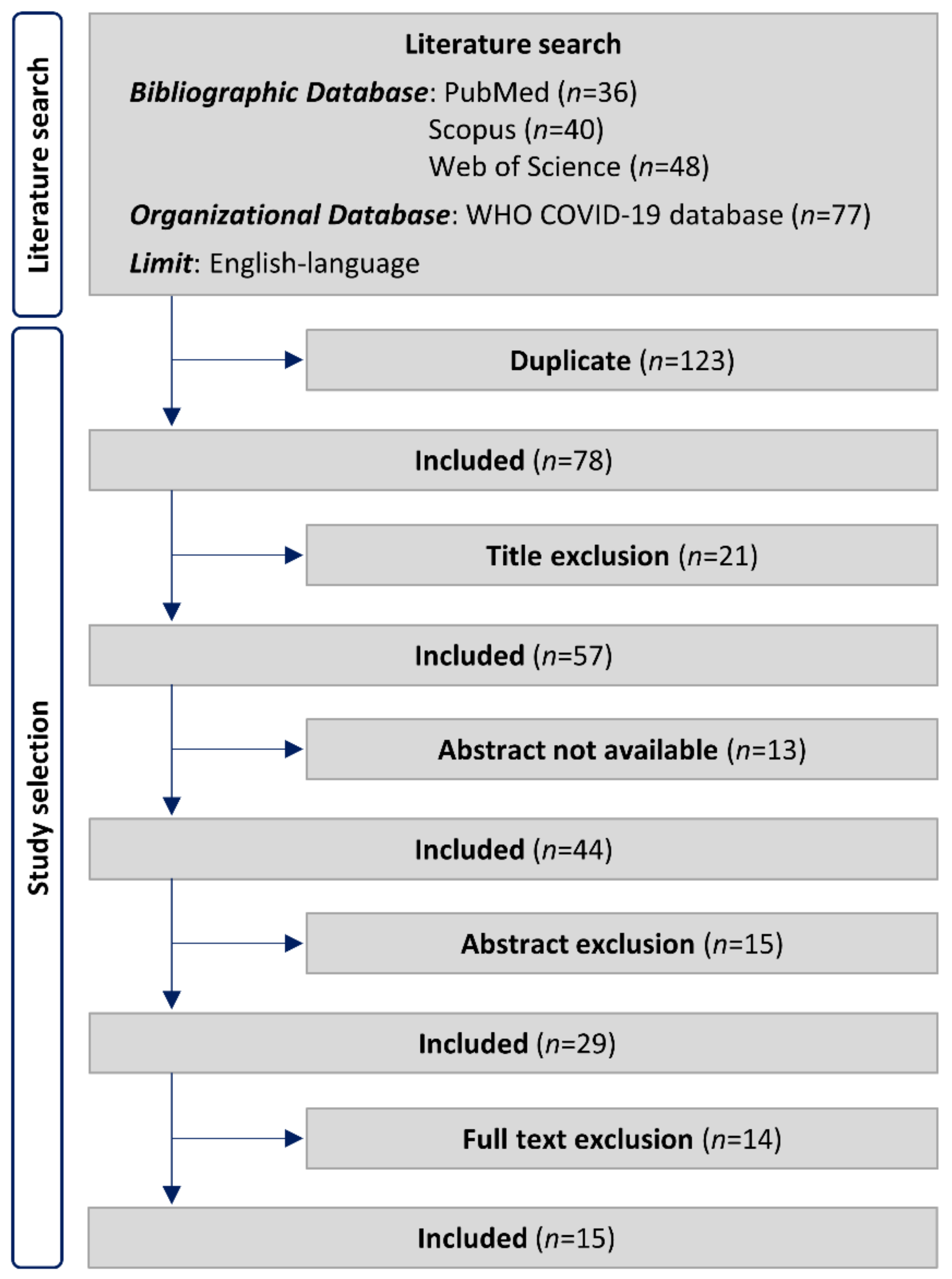
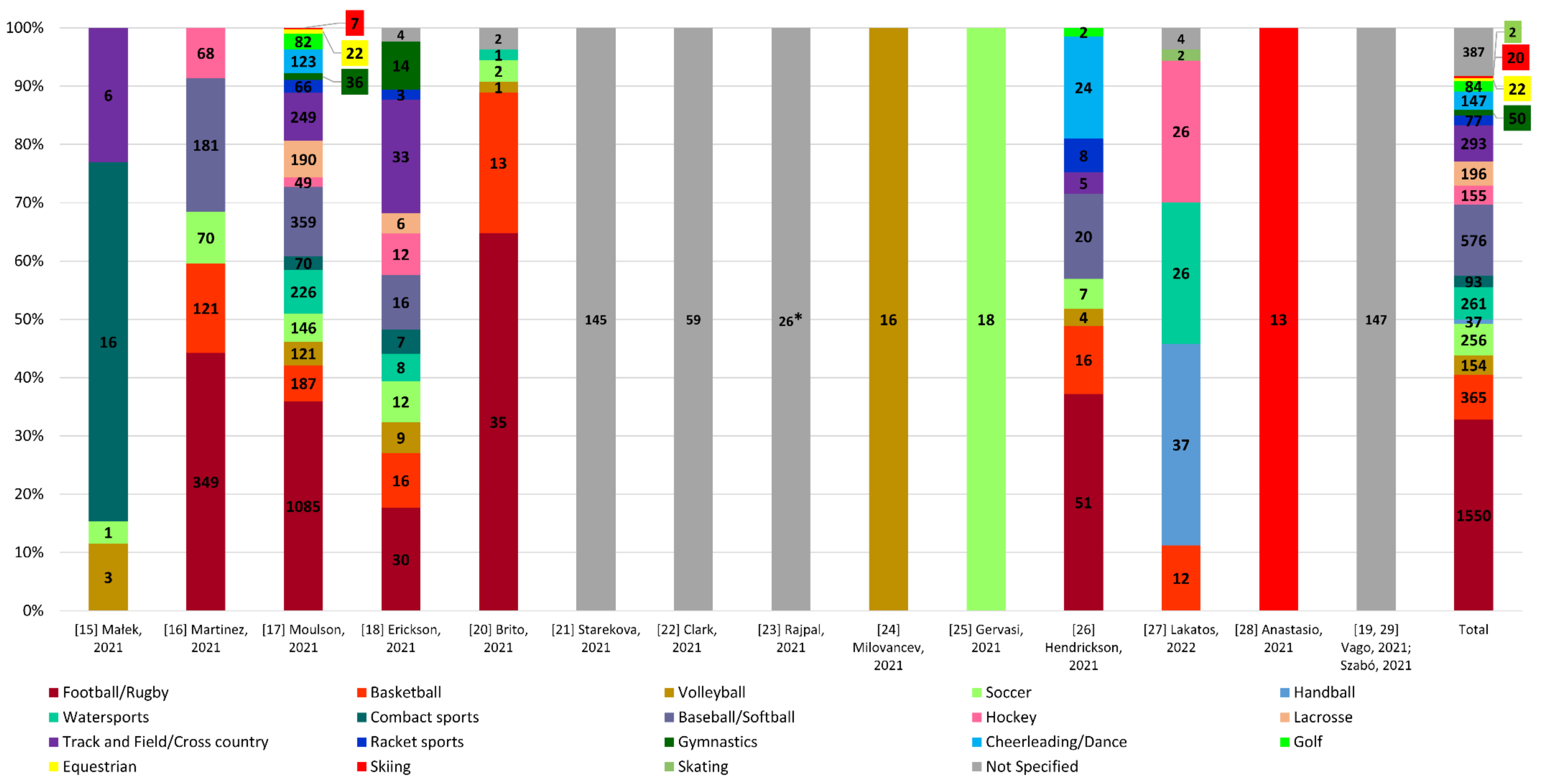

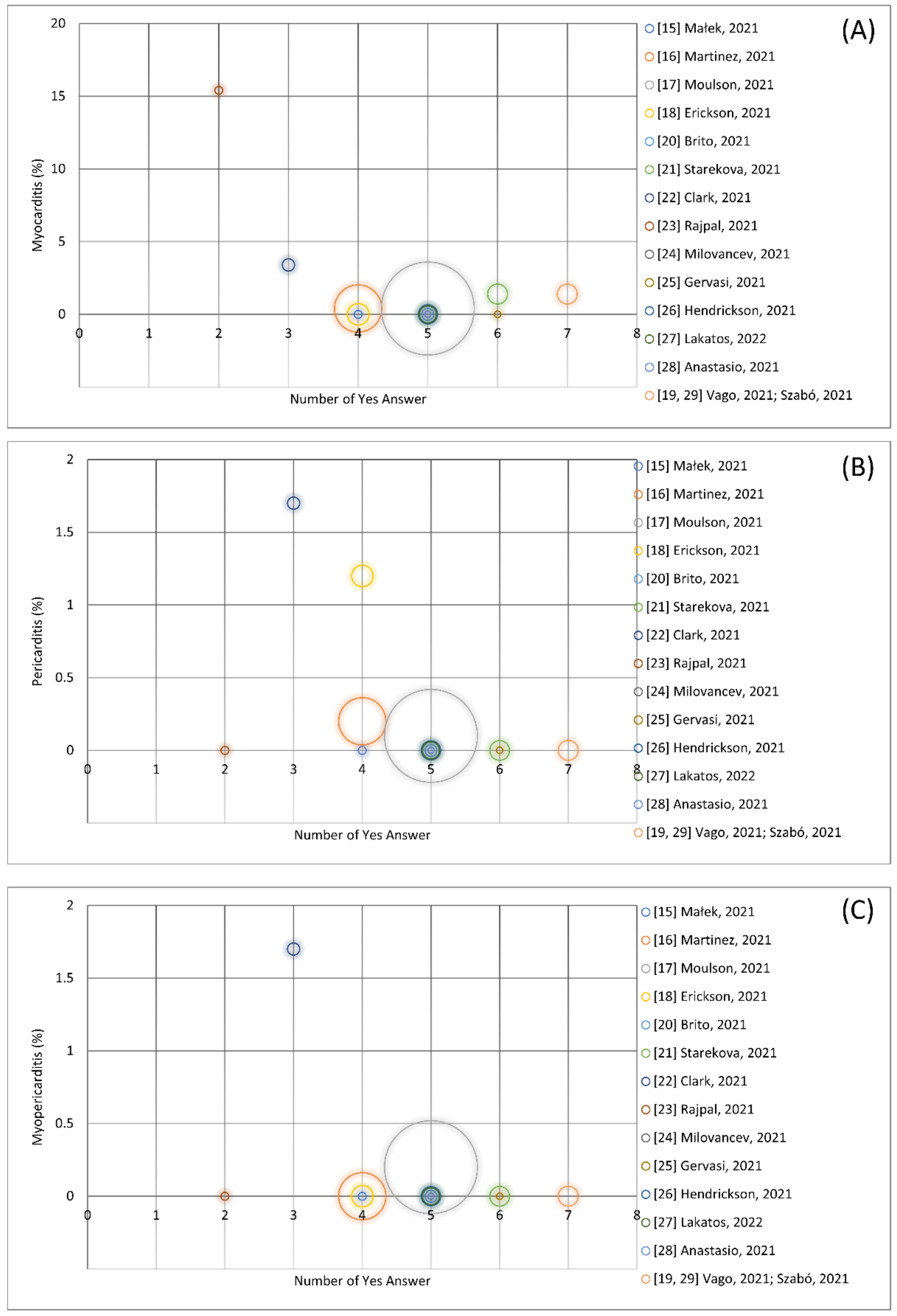

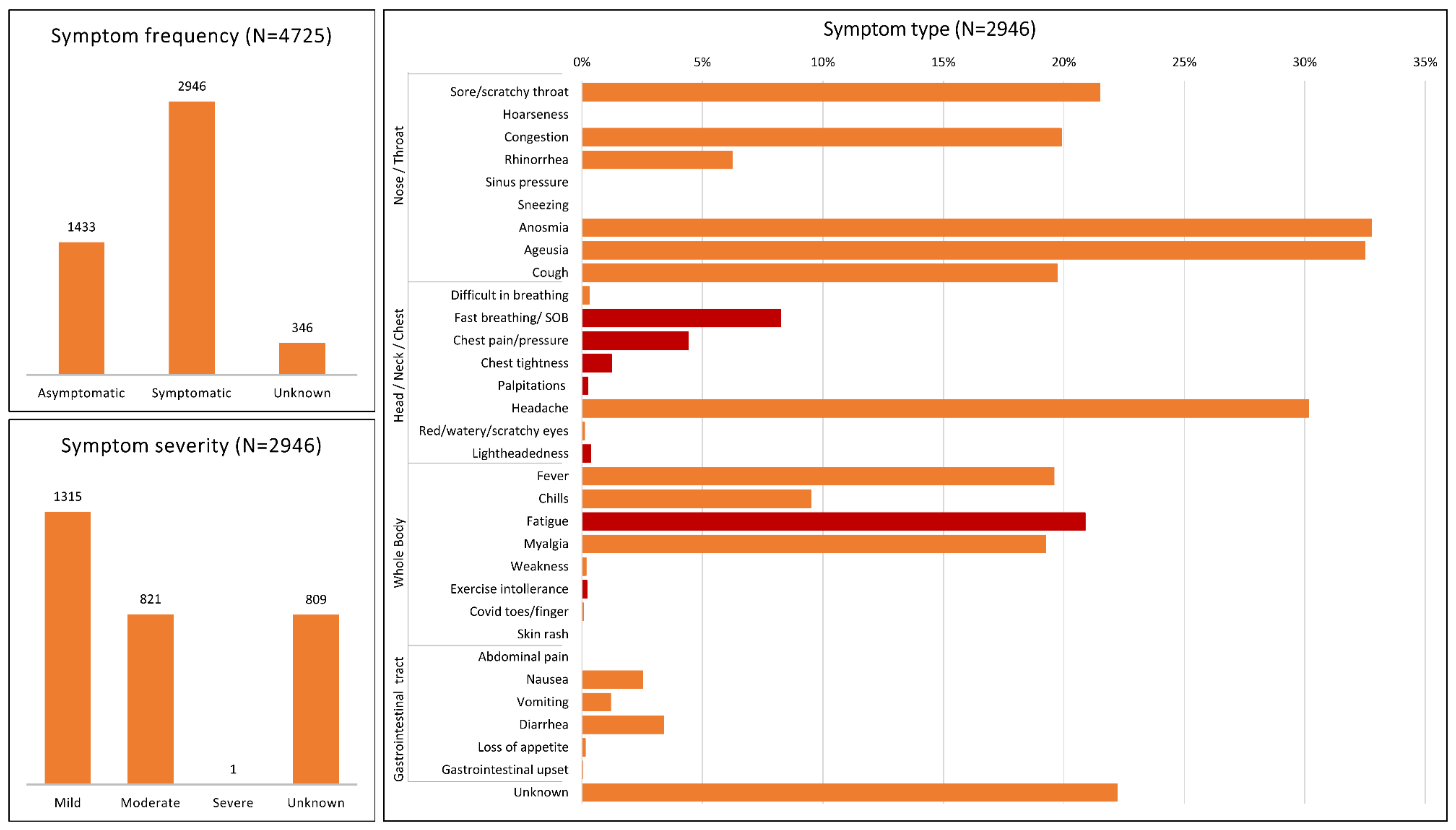
| Ref. | Study Design | Athletes Number and Type | Age (Years) | Sex M/F | Ethnicity | Anthropometric Data | Symptoms | Screening | Time from Infection (Days) |
|---|---|---|---|---|---|---|---|---|---|
| [15] | Retrospective Cohort | 26 Elite | 24[21–27] | 5/21 | Caucasian 26 | BSA (kg/m2) 1.68(1.58–1.81) | Asymptomatic 6 Symptomatic 20 Unknown 0 | Lab test ECG CMR | 32[22–62] |
| [16] | Multicenter Retrospective Cross-sectional | 789 Professional | 25 ± 3 | 777/12 | - | - | Asymptomatic 329 Symptomatic 460 Unknown 0 | Lab test ECG ECHO CMR | 19 ± 17 (3–156) |
| [17] | Prospective Multicenter Observational Cohort | 3018 Competitive Collegiate | 20 ± 1 | 2061/957 | White non-Hispanic 1922 Black 829 White-Hispanic 87 Mixed 62 Other 80 | BMI (kg/m2) Male: 27 ± 5 Female: 23 ± 3 | Asymptomatic 887 Symptomatic 1789 Unknown 342 | Lab test ECG ECHO CMR | Lab test 12[10–17] ECG 12[10–16] CMR 33[18–63] ECHO 15[11–25] |
| [18] | Retrospective | 170 Collegiate | Male: 19.56 ± 1.51 Female: 19.44 ± 1.19 | 91/79 | - | Height (m) Male: 1.84 ± 0.07 Female: 1.67 ± 0.07 Weight (kg) Male: 88.97 ± 18.01 Female: 63.96 ± 9.22 BMI (kg/m2) Male: 26.16 ± 4.47 Female: 22.69 ± 2.49 | Asymptomatic 22 Symptomatic 147 Unknown 1 | ECG | 22.54 ± 14.20 |
| [19] | - | 12 Professional Elite | 23[20–23] | 2/10 | - | - | Asymptomatic 2 Symptomatic 10 Unknown 0 | Lab test CMR | Female: 17[17–19] Male: 67 and 90 |
| [20] | Cross-sectional Observational | 54 Student | 19[19–21] | 46/8 | White 15 African-American 36 Others 3 | BMI (kg/m2) Asymptomatic: 26.6[24.8–28.3] Symptomatic: 26.1[24.7–29.5] | Asymptomatic 16 Symptomatic 38 Unknown 0 | Lab test ECG ECHO CMR | 27[22–33] |
| [21] | Case series Retrospective | 145 Competitive Student | 19.6 ± 1.3 | 108/37 | - | Weight (kg) 92 ± 25 Height (m) 1.84 ± 0.11 BMI (kg/m2) 27.0 ± 5.2 BSA (kg/m2) 2.1 ± 0.3 | Asymptomatic 24 Symptomatic 118 Unknown 3 | Lab test ECG ECHO CMR | Lab test 13[9–184] CMR 15[11–194] |
| [22] | - | 59 Collegiate Tactical | 20[19–21] | 22/37 | Non-white 6 Non-Hispanic 36 | Weight (kg) 69[59–91] Height (cm) 173[164–188] BSA (kg/m2) 1.8[1.6–2.2] | Asymptomatic 13 Symptomatic 46 Unknown 0 | ECHO CMR | 21.5[13–37] |
| [23] | - | 26 Competitive Collegiate | 19.5 ± 1.5 | 15/11 | - | - | Asymptomatic 14 Symptomatic 12 Unknown 0 | Lab test ECG ECHO CMR | (11–53) |
| [24] | Cross-sectional | 16 Professional | 24 ± 4.5 | 16/0 | Serbian 16 | Weight (kg) 90 ± 8.9 Height (cm) 193.4 ± 9.9 BMI (kg/m2) 24.3 ± 2.4 | Asymptomatic 0 Symptomatic 16 Unknown 0 | ECG CPET | 22 ± 7 training cessation 20.1 ± 4.7 training before testing |
| [25] | Cohort | 18 Professional | 22[21–27] | 18/0 | - | - | Asymptomatic 6 Symptomatic 12 Unknown 0 | Lab test ECG ECHO CMR PFT | 15 from recovery |
| [26] | Retrospective | 137 collegiate | 20(18–27) | 93/44 | Black 66 White 65 Hispanic 6 | - | Asymptomatic 25 Symptomatic 112 Unknown 0 | Lab test ECG ECHO CMR | 16(12–34) |
| [27] | Prospective | 107 Elite | 23 ± 6 | 82/25 | - | Height (cm) 182.9 ± 10.0 Weight (kg) 80.2 ± 15.3 BSA (m2) 2.0 ± 0.2 | Asymptomatic 59 Symptomatic 48 Unknown 0 | ECHO | 22(17–25) |
| [28] | Retrospective | 13 Elite | 21 ± 5 | 10/3 | Italian 13 | Weight (kg) 67 | Asymptomatic 13 Symptomatic 0 Unknown 0 | ECHO CPET PFT | (28–42) |
| [29] | Observational | 147 Elite | 23[20–28] | 94/53 | - | BSA (m2) 2.0 ± 0.2 | Asymptomatic 19 Symptomatic 128 Unknown 0 | Lab test ECG CMR | 32 |
| Ref. | Detected Abnormalities | Confirmed Inflammation | |||||||
|---|---|---|---|---|---|---|---|---|---|
| Lab Test | ECG | ECHO | CMR | PFT | CPET | Myocarditis | Pericarditis | Myopericardial | |
| [15] | 0/26 (0.0%) | 0/26 (0.0%) | - | 5/26 (19.2%) | - | - | 0/26 (0.0%) | 0/26 (0.0%) | 0/26 (0.0%) |
| [16] | 6/789 (0.8%) | 10/789 (1.3%) | 20/789 (2.5%) | 9/27 (33.3%) | - | - | 3/789 (0.4%) | 2/789 (0.2%) | 0/789 (0.0%) |
| [17] | 24/2719 (0.9%) | 21/2999 (0.7%) | 24/2556 (0.9%) | 21/317 (6.6%) | - | - | 11/3018 (0.4%) | 4/3018 (0.1%) | 6/3018 (0.2%) |
| [18] | - | 6/170 (3,5%) | - | - | - | - | 0/170 (0.0%) | 2/170 (1.2%) | 0/170 (0.0%) |
| [20] | 1/54 (1.8%) | 1/54 (1.8%) | 27/48 (56.2%) | - | - | 0/54 (0.0%) | 0/54 (0.0%) | 0/54 (0.0%) | |
| [21] | 4/154 (2.6%) | 0/154 (0.0%) * | 0/154 (0.0%) | 42/145 (29.0.%) | - | - | 2/145 (1.4%) | 0/145 (0.0%) | 0/145 (0.0%) |
| [22] | - | - | - | 23/59 (39.0%) | - | - | 2/59 (3.4%) | 1/59 (1.7%) | 1/59 (1.7%) |
| [23] | 0/26 (0.0%) | 0/26 (0.0%) | 0/26 (0.0%) | 12/26 (46.1%) | - | - | 4/26 (15.4%) | 0/26 (0.0%) | 0/26 (0.0%) |
| [24] | - | 0/16 (0.0%) | - | - | - | 0/16 (0.0%) | 0/16 (0.0%) | 0/16 (0.0%) | 0/16 (0.0%) |
| [25] | 1/18 (5.5%) | 0/18 (0.0%) | 0/18 (0.0%) | 0/1 (0.0%) | 2/18 (11.1%) | - | 0/18 (0.0%) | 0/18 (0.0%) | 0/18 (0.0%) |
| [26] | 4/137 (2.9%) | 0/137 (0.0%) | 2/137 (1.5%) | 0/5 (0.0%) | - | - | 0/137 (0.0%) | 0/137 (0.0%) | 0/137 (0.0%) |
| [27] | - | - | 5/107 (4.7%) | 0/5 (0.0%) | - | - | 0/107 (0.0%) | 0/107 (0.0%) | 0/107 (0.0%) |
| [28] | - | - | 0/13 (0.0%) | - | 0/13 (0.0%) | 0/13 (0.0%) | 0/13 (0.0%) | 0/13 (0.0%) | 0/13 (0.0%) |
| [19,29] | 6/133 (4.5%) | - | - | 7/147 (4.7%) | - | - | 2/147 (1.4%) | 0/147 (0.0%) | 0/147 (0.0%) |
| Overall | 46/4056 (1.1%) | 38/4389 (0.9%) | 51/3800 § (1.3%) | 119/758 § (15.7%) | 2/31 (6.4%) | 0/29 (0.0%) | 24/4725 (0.5%) | 9/4725 (0.2%) | 7/4725 (0.1%) |
| Ref. | Athletes with No SARS-CoV-2 Infection | Non-Athletes with No SARS-CoV-2 Infection | Pre SARS-CoV-2 Infection Screening | Screening after Different Respiratory Viruses |
|---|---|---|---|---|
| [15] | No | No | No | No |
| [16] | No | No | No | No |
| [17] | No | No | No | No |
| [18] | No | No | No | No |
| [19] | Yes | Yes | No | No |
| [20] | Yes * | No ** | No | No |
| [21] | No | No | No | No |
| [22] | Yes | Yes | No | No |
| [23] | No | No | No | No |
| [24] | No | No | No | No |
| [25] | Yes | No | Yes | No |
| [26] | No | No | No | No |
| [27] | Yes | No | No | No |
| [28] | Yes | No | No | No |
| [29] | Yes | Yes | Yes | No |
Publisher’s Note: MDPI stays neutral with regard to jurisdictional claims in published maps and institutional affiliations. |
© 2022 by the authors. Licensee MDPI, Basel, Switzerland. This article is an open access article distributed under the terms and conditions of the Creative Commons Attribution (CC BY) license (https://creativecommons.org/licenses/by/4.0/).
Share and Cite
Romagnoli, S.; Sbrollini, A.; Marcantoni, I.; Morettini, M.; Burattini, L. Review on Cardiorespiratory Complications after SARS-CoV-2 Infection in Young Adult Healthy Athletes. Int. J. Environ. Res. Public Health 2022, 19, 5680. https://doi.org/10.3390/ijerph19095680
Romagnoli S, Sbrollini A, Marcantoni I, Morettini M, Burattini L. Review on Cardiorespiratory Complications after SARS-CoV-2 Infection in Young Adult Healthy Athletes. International Journal of Environmental Research and Public Health. 2022; 19(9):5680. https://doi.org/10.3390/ijerph19095680
Chicago/Turabian StyleRomagnoli, Sofia, Agnese Sbrollini, Ilaria Marcantoni, Micaela Morettini, and Laura Burattini. 2022. "Review on Cardiorespiratory Complications after SARS-CoV-2 Infection in Young Adult Healthy Athletes" International Journal of Environmental Research and Public Health 19, no. 9: 5680. https://doi.org/10.3390/ijerph19095680
APA StyleRomagnoli, S., Sbrollini, A., Marcantoni, I., Morettini, M., & Burattini, L. (2022). Review on Cardiorespiratory Complications after SARS-CoV-2 Infection in Young Adult Healthy Athletes. International Journal of Environmental Research and Public Health, 19(9), 5680. https://doi.org/10.3390/ijerph19095680