


Relationships between Volunteering, Neighbourhood Deprivation and Mental Wellbeing across Four British Birth Cohorts: Evidence from 10 Years of the UK Household Longitudinal Study

Abstract
1. Introduction
1.1. Age and Birth Cohort
1.2. Neighbourhoods
2. Data and Methods
2.1. Measures
2.2. Analysis
3. Results
3.1. Descriptive
3.2. Mental Distress (GHQ-12)
3.3. Health-Related Quality of Life (SF-12)
3.4. Sensitivity Analysis
4. Discussion
5. Conclusions
Supplementary Materials
Author Contributions
Funding
Institutional Review Board Statement
Informed Consent Statement
Data Availability Statement
Conflicts of Interest
References
- Volunteering. National Council for Voluntary Organisations. Available online: https://www.ncvo.org.uk/policy-and-research/volunteering-policy (accessed on 22 November 2021).
- The Power of Volunteerism. UN Volunteers. Available online: https://www.unv.org/power-volunteerism (accessed on 26 October 2021).
- Mcgarvey, A.; Jochum, V.; Davies, J.; Dobbs, J.; Hornung, L. Time Well Spent: A National Survey on the Volunteer Experience; NCVO: London, UK, 2019. [Google Scholar]
- Covid-19 Mutual Aid, UK. Find Your Local Group–Covid-19 Mutual Aid 2020. Available online: https://covidmutualaid.org/local-groups/ (accessed on 26 May 2020).
- NHS. Volunteer Responders: 250,000 Target Smashed with Three Quarters of a Million Committing to Volunteer. Available online: https://www.england.nhs.uk/2020/03/250000-nhs-volunteers/ (accessed on 13 May 2020).
- Milbourn, B.; Saraswati, J.; Buchanan, A. The relationship between time spent in volunteering activities and quality of life in adults over the age of 50 years: A systematic review. Br. J. Occup. Ther. 2018, 81, 613–623. [Google Scholar] [CrossRef] [Scilit]
- Isham, J.; Kolodinsky, J.; Kimberly, G. The effects of volunteering for nonprofit organizations on social capital formation: Evidence from a statewide survey. Nonprofit Volunt. Sect. Q. 2006, 35, 367–383. [Google Scholar] [CrossRef] [Scilit]
- Jongenelis, M.I.; Jackson, B.; Newton, R.U.; Pettigrew, S. Longitudinal associations between formal volunteering and well-being among retired older people: Follow-up results from a randomized controlled trial. Aging Ment. Health 2022, 26, 368–375. [Google Scholar] [CrossRef] [Scilit] [PubMed]
- Hong, S.I.; Morrow-Howell, N. Health outcomes of experience corps: A high-commitment volunteer program. Soc. Sci. Med. 2010, 71, 414–420. [Google Scholar] [CrossRef] [Scilit] [PubMed]
- Han, S.H.; Kim, K.; Burr, J.A. Stress-buffering effects of volunteering on salivary cortisol: Results from a daily diary study. Soc. Sci. Med. 2018, 201, 120–126. [Google Scholar] [CrossRef] [Scilit] [PubMed]
- Schreier, H.M.C.; Schonert-Reichl, K.A.; Chen, E. Effect of volunteering on risk factors for cardiovascular disease in adolescents: A randomized controlled trial. JAMA Pediatr. 2013, 167, 327–332. [Google Scholar] [CrossRef] [Scilit] [PubMed]
- Jenkinson, E.C.; Dickens, A.P.; Jones, K.; Thompson-Coon, J.; Taylor, R.S.; Rogers, M.; Bambra, C.L.; Lang, I.; Richards, S.H. Is volunteering a public health intervention? A systematic review and meta-analysis of the health and survival of volunteers. BMC Public Health 2013, 13, 773. [Google Scholar] [CrossRef] [Scilit]
- Pilkington, P.D.; Windsor, T.D.; Crisp, D.A. Volunteering and subjective well-being in midlife and older adults: The role of supportive social networks. J. Gerontol. Ser. B. 2012, 67, 249–260. [Google Scholar] [CrossRef] [Scilit]
- O’Brien, L.; Burls, A.; Townsend, M.; Ebden, M. Volunteering in nature as a way of enabling people to reintegrate into society. Perspect. Public Health 2011, 131, 71–81. [Google Scholar] [CrossRef] [Scilit]
- Stuart, J.; Kamerāde, D.; Connolly, S.; Ellis, A.P.; Nichols, G.; Grotz, J. The Impacts of Volunteering on the Subjective Wellbeing of Volunteers: A Rapid Evidence Assessment; What Works Centre for Wellbeing: London, UK, 2020. [Google Scholar]
- Jang, H.; Tang, F.; Gonzales, E.; Lee, Y.S.; Morrow-Howell, N. Formal volunteering as a protector of health in the context of social 476 losses. J. Gerontol. Soc. Work 2018, 61, 834–848. [Google Scholar] [CrossRef] [Scilit]
- Zaninotto, P.; Breeze, E.; Mcmunn, A.; Nazroo, J. Socially productive activities, reciprocity and well-being in early old age: Gender-specific results from the English Longitudinal Study of Ageing (ELSA). Popul. Ageing 2013, 6, 47–57. [Google Scholar] [CrossRef] [Scilit]
- Yang, J.; Matz, C. A latent deprivation perspective: Mechanisms linking volunteering to mental health in later life. Int. J. Aging Hum. Dev. 2020. [Google Scholar] [CrossRef] [Scilit]
- Russell, A.R.; Nyame-Mensah, A.; de Wit, A.; Handy, F. Volunteering and wellbeing among ageing adults: A longitudinal analysis. Volunt. Int. J. Volunt. Nonprofit Organ. 2019, 30, 115–128. [Google Scholar] [CrossRef] [Scilit]
- Moore, C.W.; Allen, J.P. The effects of volunteering on the young volunteer. J. Prim. Prev. 1996, 17, 231–258. [Google Scholar] [CrossRef] [Scilit] [PubMed]
- Tabassum, F.; Mohan, J.; Smith, P. Association of volunteering with mental well-being: A lifecourse analysis of a national population-based longitudinal study in the U.K. BMJ Open 2016, 6, e011327. [Google Scholar] [CrossRef] [Scilit]
- Elias, J.K.; Sudhir, P.; Mehrotra, S. Long-term engagement in formal volunteering and well-being: An exploratory Indian study. Behav. Sci. 2016, 6, 20. [Google Scholar] [CrossRef] [Scilit]
- Musick, M.; Wilson, J. Volunteers: A Social Profile; Indiana University Press: Bloomington, IN, USA, 2008. [Google Scholar]
- Brewis, G. A Short History of Student Volunteering: Celebrating Ten Years of Student Volunteering Week; The British Library: London, UK, 2011. [Google Scholar]
- Brewis, G. Towards a New Understanding of Volunteering in England before 1960? Institute for Volunteering Research: London, UK, 2011. [Google Scholar]
- Gaskin, K. Young People, Volunteering and Civic Service: A Review of the Literature; Institute for Volunteering Research: London, UK; The British Library: London, UK, 2004. [Google Scholar]
- Smith, J.D. Volunteers: Making a Difference? In Voluntary Organisations and Social Policy in Britain; Harris, M., Rochester, C., Eds.; Palgrave: London, UK, 2001; pp. 185–198. [Google Scholar] [CrossRef] [Scilit]
- Lindsey, R.; Mohan, J.; Bulloch, S.; Metcalfe, E. Continuity and Change in Voluntary Action; Bristol University Press: Bristol, UK; Policy Press: Bristol, UK, 2018. [Google Scholar]
- Layard, R. Can We Be Happier? Evidence and Ethics; Penguin Random House: London, UK, 2021. [Google Scholar]
- Buck, D.; Fwbank, L. What Is Social Prescribing? King’s Fund: London, UK, 2020. [Google Scholar]
- Duncan, D.T.; Kawachi, I. Neighborhoods and Health, 2nd ed.; Oxford University Press: New York, NY, USA, 2018. [Google Scholar]
- Grinshteyn, E.G.; Sugar, J.A. Perceived neighbourhood safety and volunteerism among older adults. Ageing Soc. 2020, 41, 2914–2932. [Google Scholar] [CrossRef] [Scilit]
- Okun, M.A.; Michel, J. Sense of community and being a volunteer among the young-old. J. Appl. Gerontol. 2006, 25, 173–188. [Google Scholar] [CrossRef] [Scilit]
- Dury, S.; Willems, J.; De Witte, N.; De Donder, L.; Buffel, T.; Verté, D. Municipality and neighborhood influences on volunteering in later life. J. Appl. Gerontol. 2016, 35, 601–626. [Google Scholar] [CrossRef] [Scilit]
- Torgerson, M.; Edwards, M.E. Demographic determinants of perceived barriers to community involvement: Examining rural/urban differences. Nonprofit Volunt. Sect. Q. 2012, 42, 371–390. [Google Scholar] [CrossRef] [Scilit]
- Mcculloch, A.; Mohan, J.; Smith, P. Patterns of social capital, voluntary activity, and area deprivation in England. Environ. Plan. A 2012, 44, 1130–1147. [Google Scholar] [CrossRef] [Scilit]
- Clifford, D. Voluntary sector organisations working at the neighbourhood level in England: Patterns by local area deprivation. Environ. Plan A 2012, 44, 1148–1164. [Google Scholar] [CrossRef] [Scilit]
- Buck, N.; Mcfall, S. Understanding Society: Design overview. Longit. Life Course Stud. 2012, 3, 5–17. [Google Scholar]
- Census Geography. Office for National Statistics. Available online: https://www.ons.gov.uk/methodology/geography/ukgeographies/censusgeography#super-output-area-soa (accessed on 1 July 2020).
- Office for National Statistics. Changes to Output Areas and Super Output Areas in England and Wales, 2001 to 2011; Office for National Statistics: London, UK, 2012.
- Department for Communities and Local Government. The English Indices of Deprivation 2015. Available online: https://assets.publishing.service.gov.uk/government/uploads/system/uploads/attachment_data/file/465791/English_Indices_of_Deprivation_2015_-_Statistical_Release.pdf (accessed on 1 November 2021).
- Curtis, S. Space, Place and Mental Health; Routledge: London, UK, 2010. [Google Scholar] [CrossRef] [Scilit]
- Pevalin, D.J. Multiple applications of the GHQ-12 in a general population sample: An investigation of long-term retest effects. Soc. Psychiatry 2000, 35, 508–512. [Google Scholar] [CrossRef] [Scilit] [PubMed]
- Goldberg, D.P.; Williams, P. A User’s Guide to the General Health Questionnaire; NFER-Nelson: Windsor, UK, 1988. [Google Scholar]
- Ware, J.; Kosinksi, M.; Keller, S. A 12-Item short-form health survey: Construction of scales and preliminary tests of reliability and validity. Med. Care 1996, 34, 220–233. [Google Scholar] [CrossRef] [Scilit] [PubMed]
- Allison, P.D. Fixed Effects Regression Models; SAGE Publishing: Thousand Oaks, CA, USA, 2009. [Google Scholar]
- Heo, J.; Chun, S.; Lee, S.; Kim, J. Life satisfaction and psychological well-being of older adults with cancer experience: The role of optimism and volunteering. Int. J. Aging Hum. Dev. 2016, 83, 274–289. [Google Scholar] [CrossRef] [Scilit] [PubMed]
- Chan, W.; Chui, C.H.K.; Cheung, J.C.S.; Lum, T.Y.S.; Lu, S. Associations between Volunteering and Mental Health during COVID-19 among Chinese Older Adults. J. Gerontol. Soc. Work 2021, 64, 599–612. [Google Scholar] [CrossRef] [Scilit] [PubMed]
- Bradley, D.B. A reason to rise each morning: The meaning of volunteering in the lives of older adults. Generations 2000, 23, 45–50. Available online: https://lemosandcrane.co.uk/resources/Generations%20-%20A%20Reason%20to%20Rise%20Each%20Morning%20-%20The%20Meaning%20of%20Volunteering%20in%20the%20Lives%20of%20Older%20Adults.pdf (accessed on 27 November 2021).
- Rochester, C. Trends in Volunteering. Volunteer Now. 2018; Building Change Trust: Belfast, UK, 2018; Available online: https://volunteernow.aw-stage.co.uk/app/uploads/2018/10/Trends-in-Volunteering-Final-Report.pdf (accessed on 27 November 2021).
- Collishaw, S.; Maughan, B.; Goodman, R.; Pickles, A. Time trends in adolescent mental health. J. Child Psychol. Psychiatry Allied Discip. 2004, 45, 1350–1362. [Google Scholar] [CrossRef]
- Vizard, T.; Sadler, K.; Ford, T.; Newlove-Delgado, T.; McManus, S.; Marcheselli, F.; Davis, J.; Williams, T.; Leach, C.; Mandalia, D.; et al. The Mental Health of Children and Young People in England 2020; NHS Digital: Leeds, UK, 2020; Available online: https://files.digital.nhs.uk/AF/AECD6B/mhcyp_2020_rep_v2.pdf (accessed on 27 November 2021).
- Keyes, C.L.M. Mental illness and/or mental health? Investigating axioms of the complete state model of health. J. Consult. Clin. Psychol. 2005, 73, 539–548. [Google Scholar] [CrossRef] [Scilit]
- McDonnell, D.; Mohan, J.; Norman, P. Charity density and social need: A longitudinal perspective. Nonprofit Volunt. Sect. Q. 2020, 49, 1082–1104. [Google Scholar] [CrossRef] [Scilit]
- Clifford, D. Disparities by deprivation: The geographical impact of unprecedented changes in local authority financing on the voluntary sector in England. EPA Econ. Sp. 2021, 53, 2050–2067. [Google Scholar] [CrossRef] [Scilit]
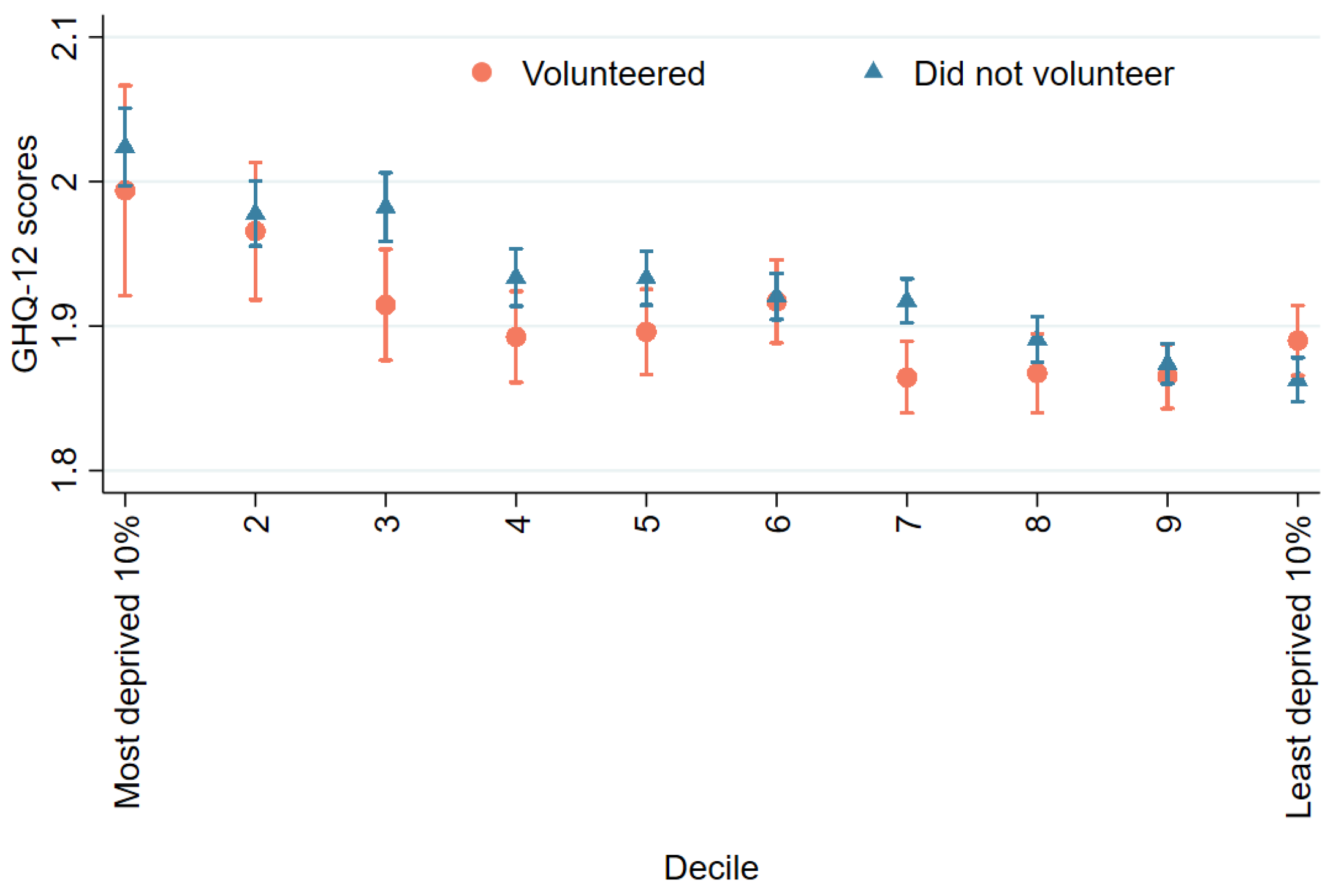
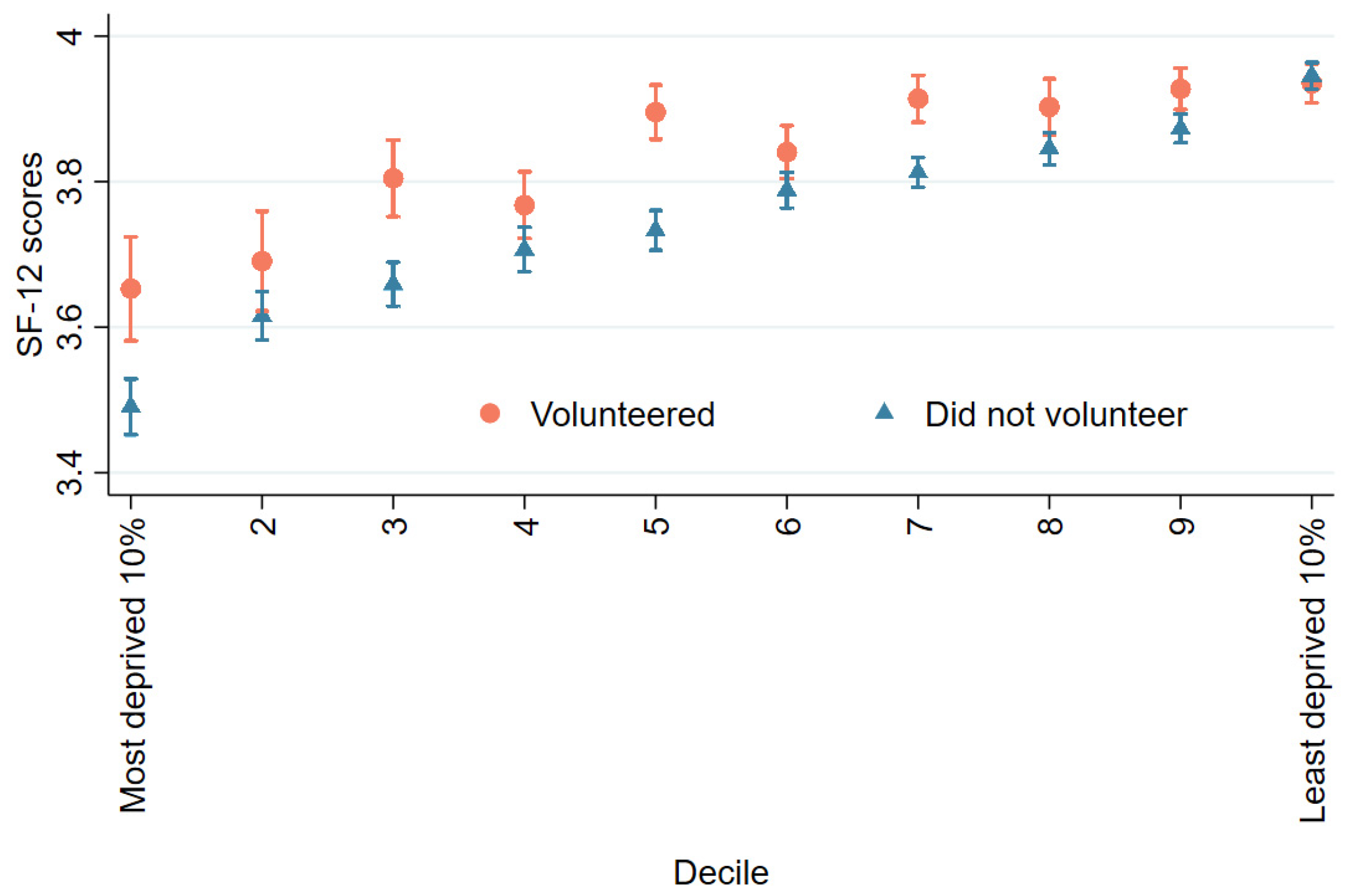
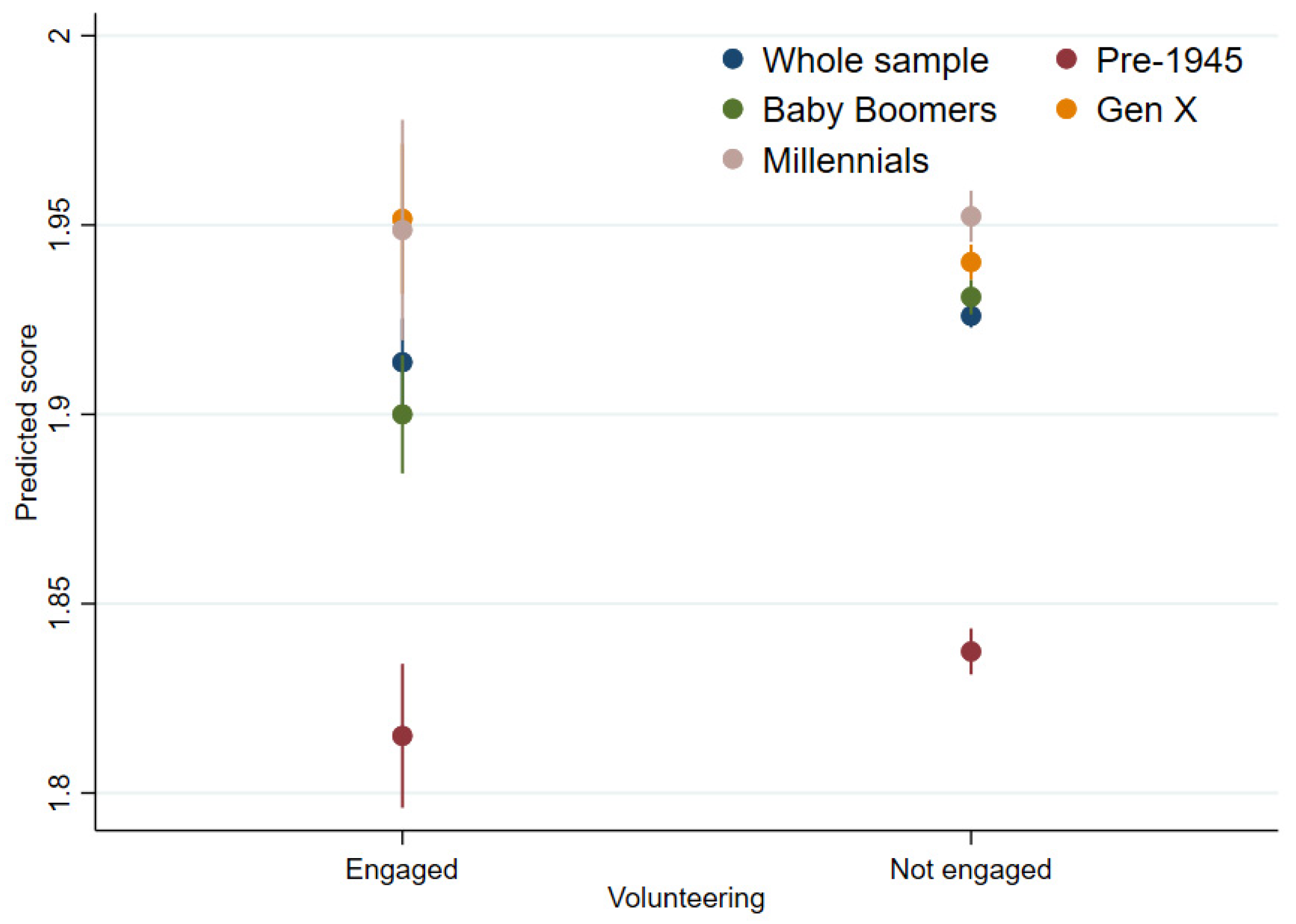
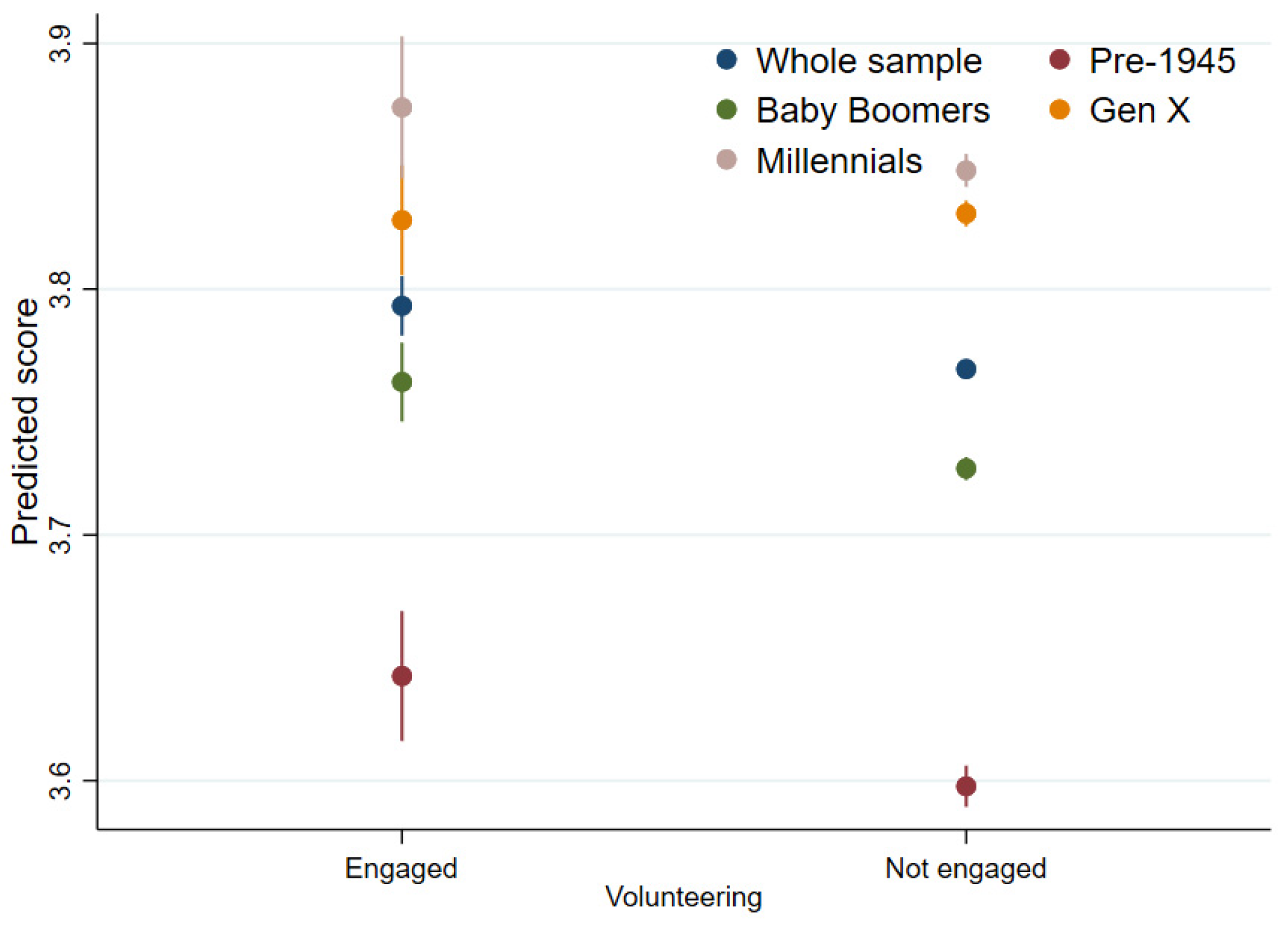

| Descriptive Statistics of Volunteering Frequency and Mental Health/Wellbeing | |||||
|---|---|---|---|---|---|
| Variables of Interest | Whole Sample | Pre-1945 (Born before 1945) | Baby Boomers (Born in 1945–1964) | Gen X (Born in 1965–1979) | Millennials (Born in 1980 or After) |
| Volunteering | |||||
| Overall mean | 0.21 | 0.24 | 0.23 | 0.19 | 0.19 |
| Between-participant SD (σu) | 0.33 | 0.37 | 0.34 | 0.29 | 0.31 |
| Within-participant SD (σe) | 0.30 | 0.28 | 0.29 | 0.31 | 0.33 |
| Intraclass correlation (ρ) | 0.54 | 0.63 | 0.58 | 0.47 | 0.47 |
| Mental distress (GHQ 12) | |||||
| Overall mean | 1.92 | 1.83 | 1.92 | 1.94 | 1.95 |
| Between-participant SD (σu) | 0.34 | 0.27 | 0.34 | 0.33 | 0.38 |
| Within-participant SD (σe) | 0.33 | 0.26 | 0.31 | 0.34 | 0.39 |
| Intraclass correlation (ρ) | 0.51 | 0.52 | 0.55 | 0.48 | 0.49 |
| Health-related quality of life (SF-12) | |||||
| Overall mean | 3.77 | 3.61 | 3.74 | 3.83 | 3.85 |
| Between-participant SD (σu) | 0.55 | 0.56 | 0.60 | 0.51 | 0.47 |
| Within-participant SD (σe) | 0.37 | 0.40 | 0.36 | 0.37 | 0.39 |
| Intraclass correlation (ρ) | 0.68 | 0.66 | 0.74 | 0.65 | 0.59 |
| Number of obs | 51,206 | 7351 | 21,809 | 13,256 | 8790 |
| Number of groups | 10,989 | 1491 | 4431 | 2702 | 2365 |
| Fixed-Effects Analysis Predicting the Associations between Volunteering and Mental Distress (GHQ-12) | |||||||||||
|---|---|---|---|---|---|---|---|---|---|---|---|
| Sample | Model 1 Volunteering | Model 2 = Model 1 + Demography and SEP | Model 3 = Model 2 + IMD | Number of Obs | Number of Groups | ||||||
| Coef | 95%CI | p-Value | Coef | 95%CI | p-Value | Coef | 95%CI | p-Value | |||
| Whole sample | −0.01 | −0.03, 0.00 | 0.121 | −0.01 | −0.03, 0.00 | 0.099 | −0.01 | −0.03, 0.00 | 0.101 | 51,206 | 10,989 |
| Pre-1945 (born before 1945) | −0.03 | −0.05, −0.00 | 0.026 | −0.02 | −0.05, 0.00 | 0.082 | −0.02 | −0.05, 0.00 | 0.082 | 7351 | 1491 |
| Baby Boomers (born in 1945–1964) | −0.03 | −0.05, −0.01 | 0.007 | −0.03 | −0.05, −0.01 | 0.003 | −0.03 | −0.05, −0.01 | 0.003 | 21,809 | 4431 |
| Gen X (born in 1965–1979) | 0.02 | −0.01, 0.04 | 0.213 | 0.01 | −0.01, 0.04 | 0.359 | 0.01 | −0.01, 0.04 | 0.360 | 13,256 | 2702 |
| Millennials (born in 1980 or after) | −0.01 | −0.05, 0.03 | 0.592 | −0.00 | −0.04, 0.03 | 0.833 | −0.00 | −0.04, 0.03 | 0.844 | 8790 | 2365 |
| Fixed-Effects Models Interacting with Index of Multiple Deprivation (IMD) 20% Most Deprived Areas | |||||
|---|---|---|---|---|---|
| Sample | Mental Distress (GHQ-12) | Number of Obs | Number of Groups | ||
| Coef | 95%CI | p-Value | |||
| Whole sample | 51,206 | 10,989 | |||
| Volunteering | −0.01 | −0.03, 0.00 | 0.133 | ||
| IMD 20% most deprived | −0.03 | −0.07, 0.02 | 0.281 | ||
| Volunteering * IMD 20% most deprived | −0.01 | −0.06, 0.04 | 0.788 | ||
| Pre-1945 (born before 1945) | 7351 | 1491 | |||
| Volunteering | −0.02 | −0.05, 0.00 | 0.100 | ||
| IMD 20% most deprived | −0.12 | −0.30, 0.07 | 0.213 | ||
| Volunteering * IMD 20% most deprived | −0.00 | −0.08, 0.08 | 0.999 | ||
| Baby Boomers (born in 1945–1964) | 21,809 | 4431 | |||
| Volunteering | –0.03 | –0.05, –0.01 | 0.001 | ||
| IMD 20% most deprived | −0.02 | −0.11, 0.08 | 0.732 | ||
| Volunteering * IMD 20% most deprived | 0.02 | −0.07, 0.11 | 0.736 | ||
| Gen X (born in 1965–1979) | 13,256 | 2702 | |||
| Volunteering | 0.01 | −0.02, 0.03 | 0.529 | ||
| IMD 20% most deprived | 0.01 | −0.06, 0.08 | 0.807 | ||
| Volunteering * IMD 20% most deprived | 0.02 | −0.06, 0.10 | 0.591 | ||
| Millennials (born in 1980 or after) | 8790 | 2365 | |||
| Volunteering | 0.01 | −0.03, 0.05 | 0.732 | ||
| IMD 20% most deprived | −0.02 | −0.08, 0.05 | 0.674 | ||
| Volunteering * IMD 20% most deprived | −0.05 | −0.14, 0.05 | 0.326 | ||
| Fixed-Effects Analysis Predicting the Associations between Volunteering and Health-Related Quality of Life (SF-12) | |||||||||||
|---|---|---|---|---|---|---|---|---|---|---|---|
| Sample | Model 1 Volunteering | Model 2 = Model 1 + Demography and SEP | Model 3 = Model 2 + IMD | Number of Obs | Number of Groups | ||||||
| Coef | 95%CI | p-Value | Coef | 95%CI | p-Value | Coef | 95%CI | p-Value | |||
| Whole sample | 0.03 | 0.02, 0.05 | 0.000 | 0.03 | 0.01, 0.04 | 0.001 | 0.03 | 0.01, 0.04 | 0.001 | 51,206 | 10,989 |
| Pre-1945 (born before 1945) | 0.09 | 0.05, 0.13 | 0.000 | 0.04 | 0.01, 0.08 | 0.012 | 0.04 | 0.01, 0.08 | 0.012 | 7351 | 1491 |
| Baby Boomers (born in 1945–1964) | 0.03 | 0.01, 0.05 | 0.003 | 0.04 | 0.01, 0.06 | 0.001 | 0.04 | 0.01, 0.06 | 0.001 | 21,809 | 4431 |
| Gen X (born in 1965–1979) | −0.01 | −0.04, 0.02 | 0.611 | −0.00 | −0.03, 0.02 | 0.852 | −0.00 | −0.03, 0.02 | 0.846 | 13,256 | 2702 |
| Millennials (born in 1980 or after) | 0.04 | 0.00, 0.08 | 0.041 | 0.03 | −0.01, 0.06 | 0.157 | 0.03 | −0.01, 0.06 | 0.159 | 8790 | 2365 |
| Fixed-Effects Models Interacting with Index of Multiple Deprivation (IMD) 20% Most Deprived Areas | |||||
|---|---|---|---|---|---|
| Sample | Health-Related Quality of Life (SF-12) | Number of Obs | Number of Groups | ||
| Coef | 95%CI | p-Value | |||
| Whole sample | 51,206 | 10,989 | |||
| Volunteering | 0.02 | 0.01, 0.04 | 0.004 | ||
| IMD 20% most deprived | −0.00 | −0.05, 0.05 | 0.973 | ||
| Volunteering * IMD 20% most deprived | 0.02 | −0.03, 0.08 | 0.375 | ||
| Pre-1945 (born before 1945) | 7351 | 1491 | |||
| Volunteering | 0.04 | 0.00, 0.07 | 0.035 | ||
| IMD 20% most deprived | −0.07 | −0.30, 0.16 | 0.547 | ||
| Volunteering * IMD 20% most deprived | 0.08 | −0.08, 0.23 | 0.335 | ||
| Baby Boomers (born in 1945–1964) | 21,809 | 4431 | |||
| Volunteering | 0.04 | 0.02, 0.06 | 0.000 | ||
| IMD 20% most deprived | −0.08 | −0.19, 0.03 | 0.142 | ||
| Volunteering * IMD 20% most deprived | −0.02 | −0.11, 0.07 | 0.614 | ||
| Gen X (born in 1965–1979) | 13,256 | 2702 | |||
| Volunteering | 0.00 | −0.03, 0.03 | 0.908 | ||
| IMD 20% most deprived | 0.05 | −0.03, 0.13 | 0.193 | ||
| Volunteering * IMD 20% most deprived | −0.03 | −0.11, 0.04 | 0.380 | ||
| Millennials (born in 1980 or after) | 8790 | 2365 | |||
| Volunteering | 0.01 | −0.03, 0.04 | 0.725 | ||
| IMD 20% most deprived | −0.01 | −0.08, 0.07 | 0.888 | ||
| Volunteering * IMD 20% most deprived | 0.09 | −0.01, 0.19 | 0.091 | ||
Publisher’s Note: MDPI stays neutral with regard to jurisdictional claims in published maps and institutional affiliations. |
© 2022 by the authors. Licensee MDPI, Basel, Switzerland. This article is an open access article distributed under the terms and conditions of the Creative Commons Attribution (CC BY) license (https://creativecommons.org/licenses/by/4.0/).
Share and Cite
Mak, H.W.; Coulter, R.; Fancourt, D. Relationships between Volunteering, Neighbourhood Deprivation and Mental Wellbeing across Four British Birth Cohorts: Evidence from 10 Years of the UK Household Longitudinal Study. Int. J. Environ. Res. Public Health 2022, 19, 1531. https://doi.org/10.3390/ijerph19031531
Mak HW, Coulter R, Fancourt D. Relationships between Volunteering, Neighbourhood Deprivation and Mental Wellbeing across Four British Birth Cohorts: Evidence from 10 Years of the UK Household Longitudinal Study. International Journal of Environmental Research and Public Health. 2022; 19(3):1531. https://doi.org/10.3390/ijerph19031531
Chicago/Turabian StyleMak, Hei Wan, Rory Coulter, and Daisy Fancourt. 2022. "Relationships between Volunteering, Neighbourhood Deprivation and Mental Wellbeing across Four British Birth Cohorts: Evidence from 10 Years of the UK Household Longitudinal Study" International Journal of Environmental Research and Public Health 19, no. 3: 1531. https://doi.org/10.3390/ijerph19031531
APA StyleMak, H. W., Coulter, R., & Fancourt, D. (2022). Relationships between Volunteering, Neighbourhood Deprivation and Mental Wellbeing across Four British Birth Cohorts: Evidence from 10 Years of the UK Household Longitudinal Study. International Journal of Environmental Research and Public Health, 19(3), 1531. https://doi.org/10.3390/ijerph19031531

