Article

Proposing a TAM-SDT-Based Model to Examine the User Acceptance of Massively Multiplayer Online Games

1
Systems Engineering Program, Universidad de Lima, Lima 15023, Peru
2
Department of Management and Marketing, Universidad Pablo de Olavide, 41013 Seville, Spain
*
Author to whom correspondence should be addressed.
Int. J. Environ. Res. Public Health 2021, 18(7), 3687; https://doi.org/10.3390/ijerph18073687

Submission received: 12 February 2021 / Revised: 23 March 2021 / Accepted: 30 March 2021 / Published: 1 April 2021

Abstract

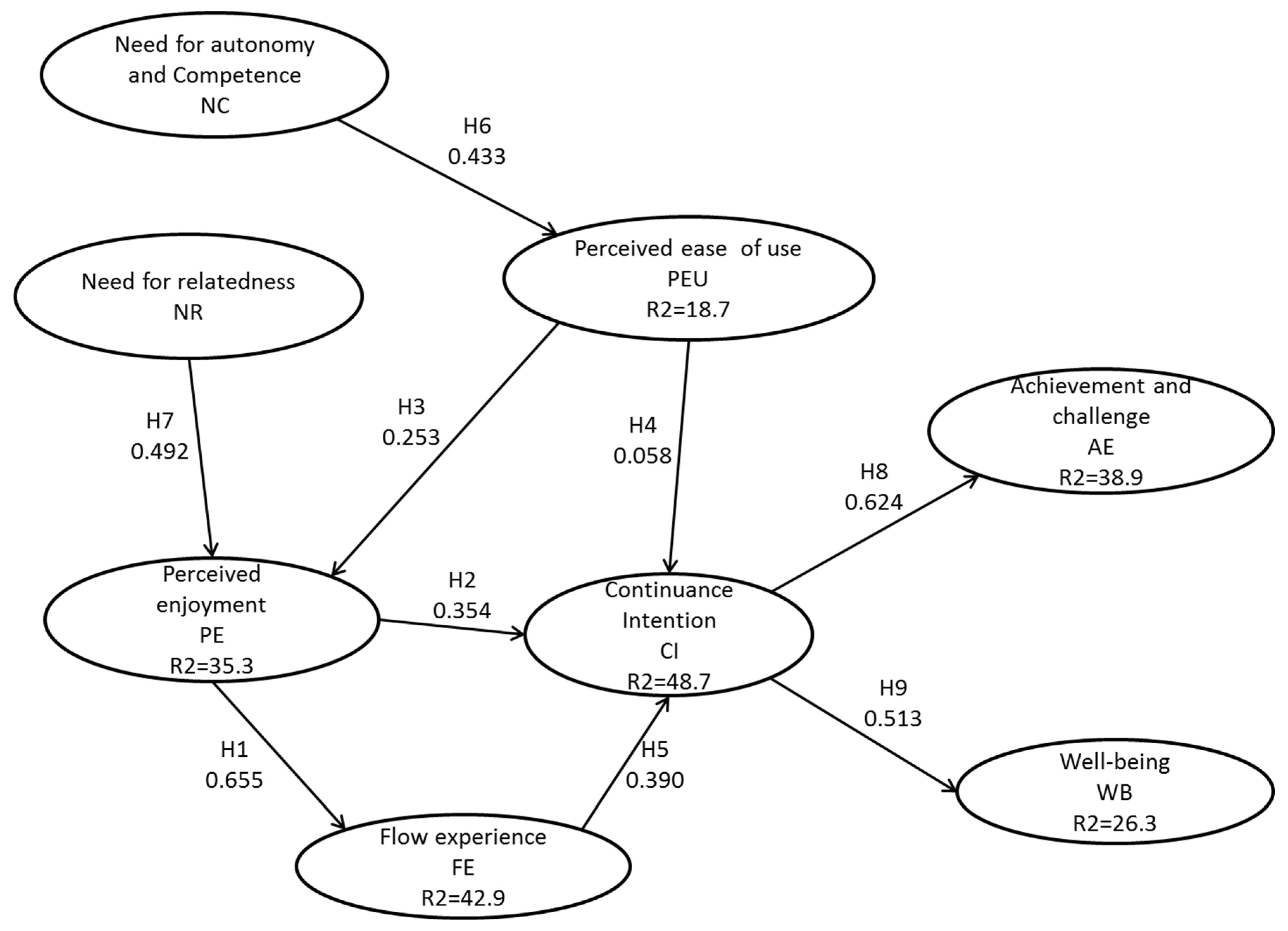
This study is focused on the massively multiplayer online games’ acceptance. In general, while specialized literature reveals that the online gaming industry has grown strongly in recent years, little evidence is identified on its user acceptance. In this manner, the present study is an attempt to fill this gap. Concretely, two aims are defined: (1) proposing an acceptance model to predict the continuance usage of massively multiplayer online games, and (2) knowing how this continuance usage encourages social well-being. The model proposed employing the structural equation modeling with partial least squares (PLS-SEM) methodology. This PLS-SEM model has been defined using a combination of the technology acceptance model (TAM) and the self-determination theory (SDT), comprising eight constructs: (1) autonomy and competence, (2) relatedness, (3) achievement and challenge, (4) flow experience, (5) perceived enjoyment, (6) social well-being, (7) perceived ease of use, and (8) continuance intention. The findings reveal that continuance intention impacts on social well-being. Moreover, the pivotal role of flow experience for continuance intention has been demonstrated. Additionally, continuance intention has been impacted by the perceived enjoyment, showing that it is a key construct for the acceptance of massively multiplayer online games. Thus, two contributions are highlighted. First, these results provide the gaming industry and software developer companies with considerations on gamers’ motivations in the online game design, in order to stimulate and incentivize its use. Second, the present study can be useful for academicians and practitioners to understand the online gamers’ emotions and well-being, showing some light over their psychology and mental health. Finally, limitations and future directions are exposed.
Keywords: online games; massively multiplayer online games (MMOG); e-Sports; technology acceptance model (TAM); self-determination theory (SDT); emotions online games; massively multiplayer online games (MMOG); e-Sports; technology acceptance model (TAM); self-determination theory (SDT); emotions