How Can Bullying Victimisation Lead to Lower Academic Achievement? A Systematic Review and Meta-Analysis of the Mediating Role of Cognitive-Motivational Factors



Abstract
1. Introduction
1.1. Bullying Victimisation, Cognitive-Motivational Factors, and Academic Achievement
1.2. The Present Study
2. Materials and Methods
2.1. Information Sources and Database Search
2.2. Eligibility Criteria and Study Selection
2.2.1. Inclusion Criteria
2.2.2. Exclusion Criteria
2.3. Coding
2.4. Coding of Study Characteristics and Moderators
2.5. Statistical Analysis
2.5.1. Summary Measures
2.5.2. Heterogeneity and Moderators Analysis
2.5.3. Publication Bias
3. Results
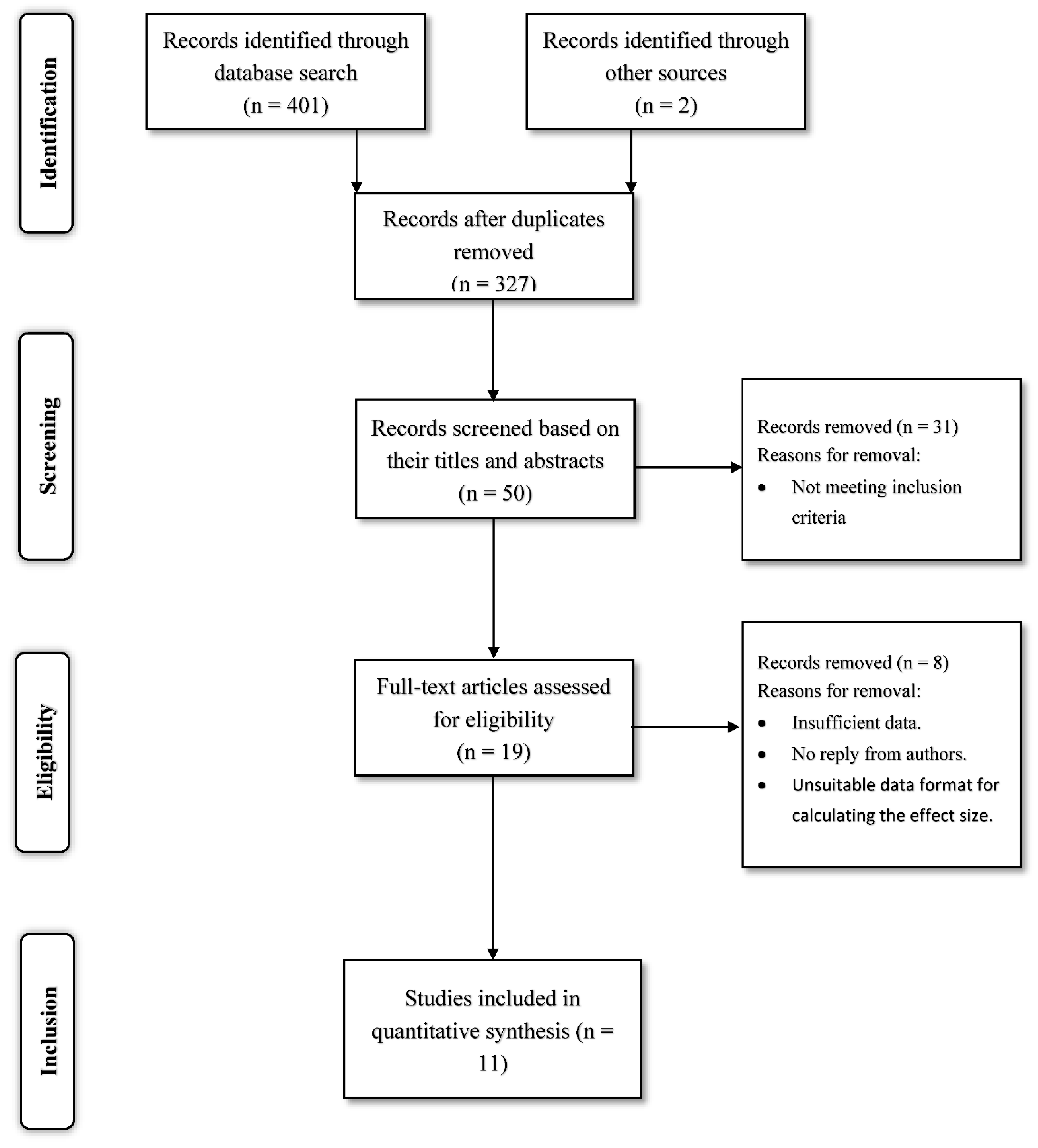
3.1. Search Results
3.2. Study Characteristics
3.3. Bullying and Victimisation as Predictors of Motivational Factors and Academic Achievement: Meta-Analysis
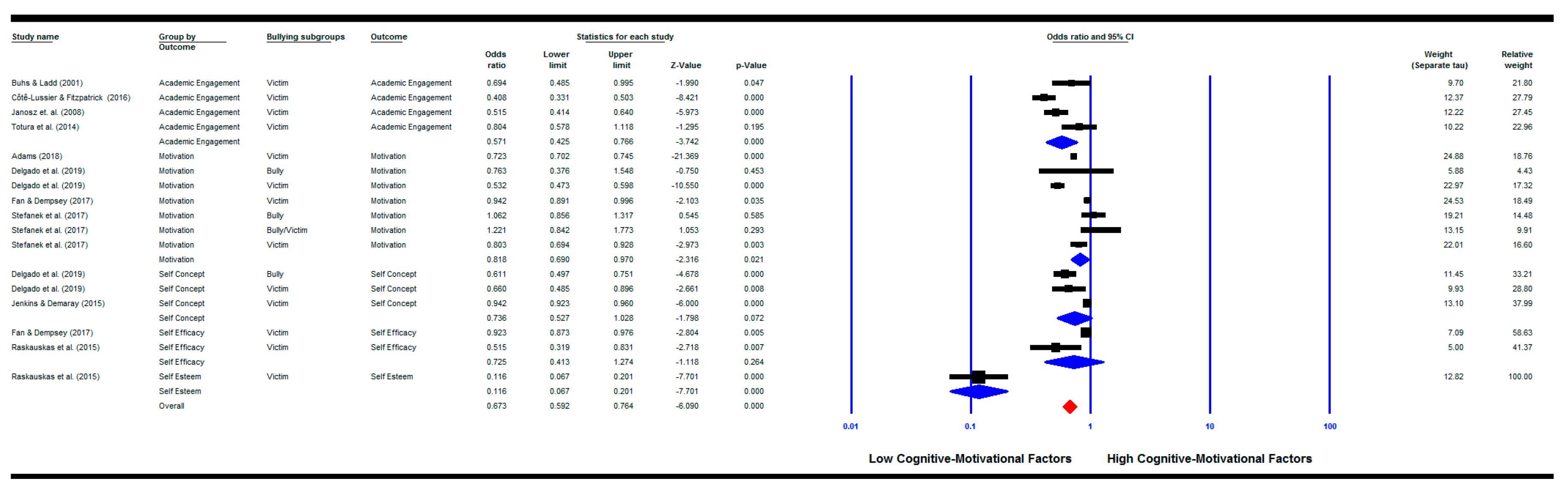
3.3.1. Motivational Factors
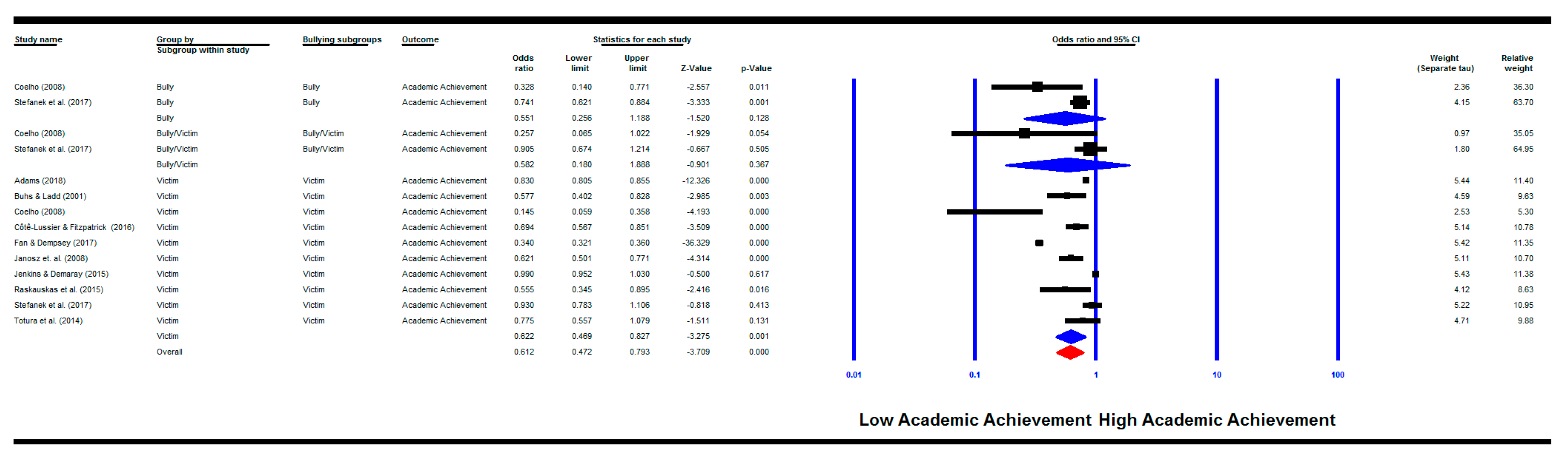
3.3.2. Academic Achievement
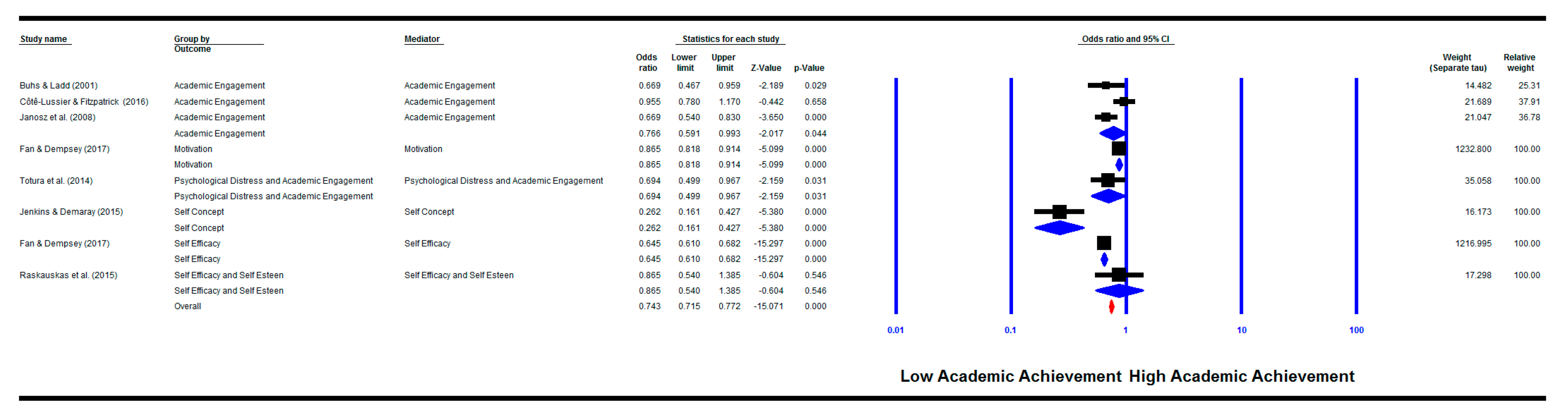
3.4. Mediation Analysis between Victimisation and Academic Achievement Pooled Effect Size
3.5. Moderator Analysis
3.5.1. Moderator Analysis of Motivational Factors
3.5.2. Moderator Analysis for Academic Achievement
3.5.3. Moderator Analysis for Mediation
3.6. Publication and Risk Bias
3.6.1. Cognitive-Motivational Factors as Outcomes of Bullying Involvement
3.6.2. Academic Achievement as an Outcome of Bullying Involvement
3.6.3. Mediation
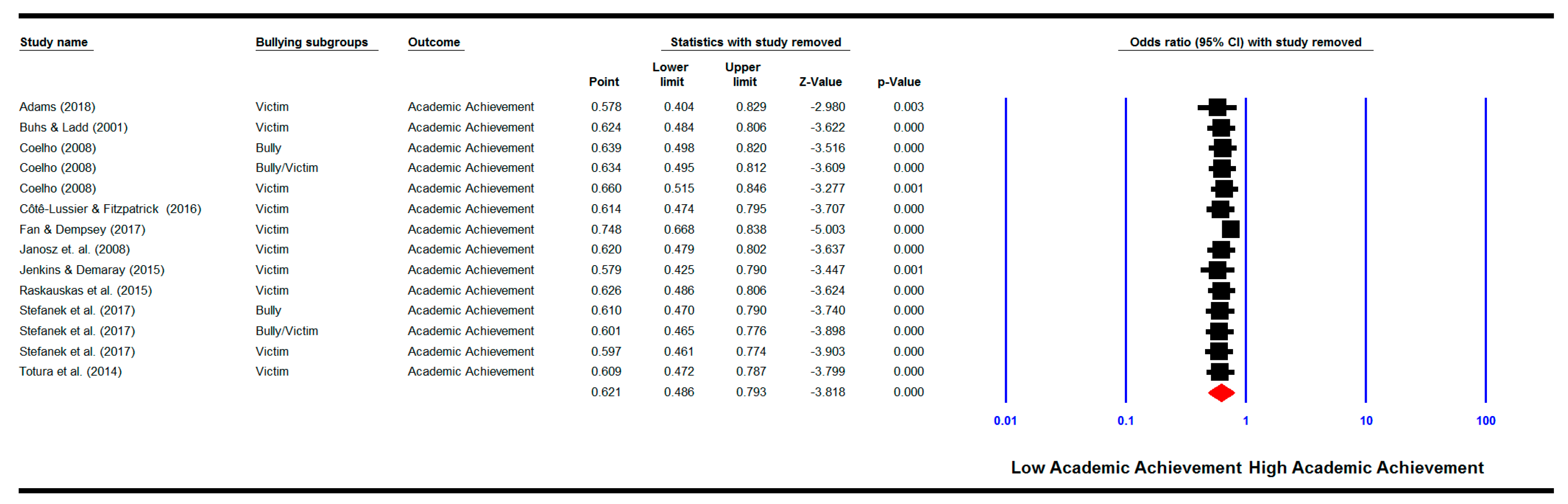
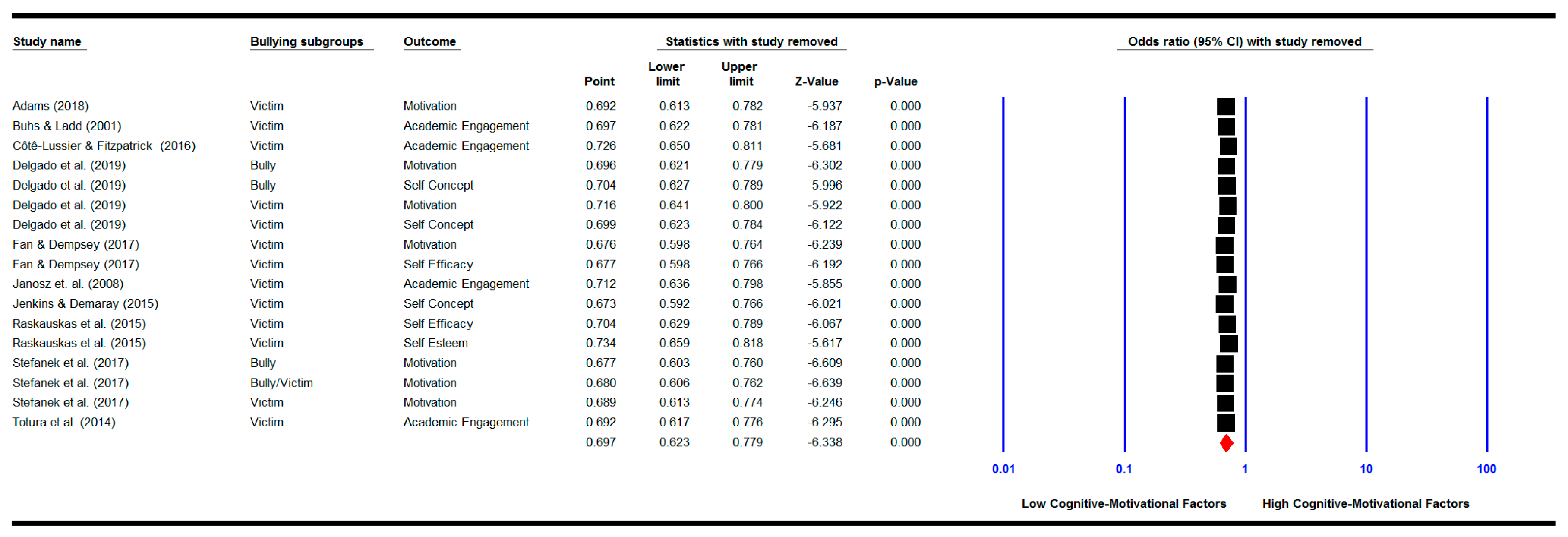
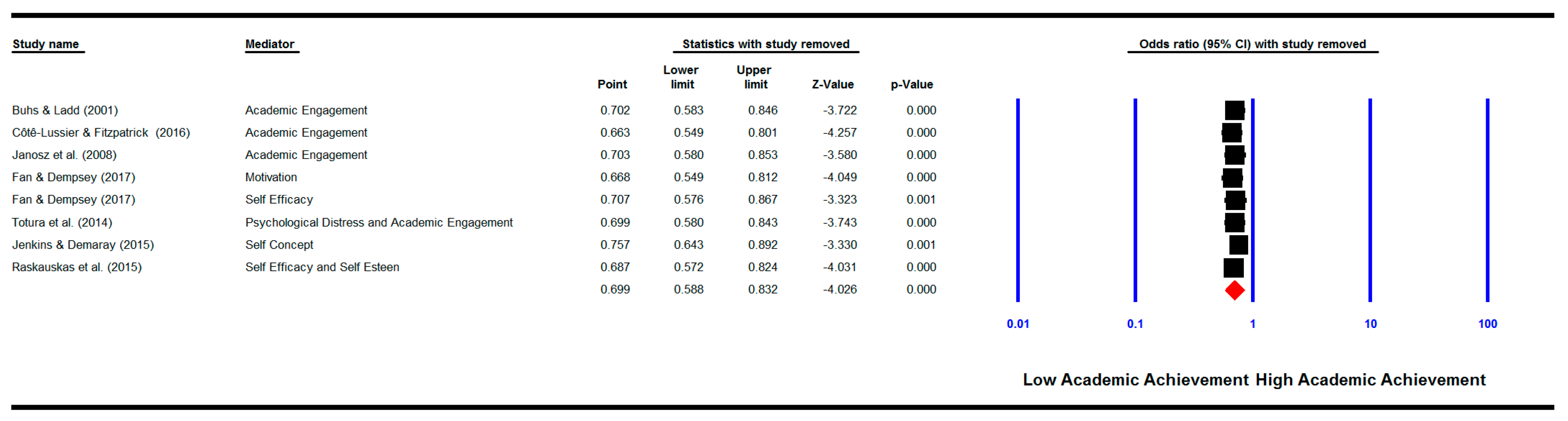
3.6.4. One Study Removed
4. Discussion
4.1. Implications
4.2. Strengths and Limitations
5. Conclusions
Supplementary Materials
Author Contributions
Funding
Institutional Review Board Statement
Informed Consent Statement
Data Availability Statement
Acknowledgments
Conflicts of Interest
References
- Copeland, W.E.; Wolke, D.; Angold, A.; Costello, E.J. Adult psychiatric outcomes of bullying and being bullied by peers in childhood and adolescence. JAMA Psychiatry 2013, 70, 419–426. [Google Scholar] [CrossRef]
- Kelly, E.V.; Newton, N.C.; Stapinski, L.A.; Slade, T.; Barrett, E.L.; Conrod, P.J.; Teesson, M. Concurrent and prospective associations between bullying victimization and substance use among Australian adolescents. Drug Alcohol Depend. 2015, 154, 63–68. [Google Scholar] [CrossRef]
- Pabian, S.; Vandebosch, H. Perceived long-term outcomes of early traditional and Cyberbullying victimization among emerging adults. J. Youth Stud. 2019, 2019, 1–19. [Google Scholar] [CrossRef]
- Cook, C.R.; Williams, K.R.; Guerra, N.G.; Kim, T.E.; Sadek, S. Predictors of bullying and victimization in childhood and ado-lescence: A meta-analytic investigation. Sch. Psychol. Q. 2010, 25, 65–83. [Google Scholar] [CrossRef]
- Luukkonen, A.-H.; Räsänen, P.; Hakko, H.; Riala, K. Bullying behavior in relation to psychiatric disorders and physical health among adolescents: A clinical cohort of 508 underage inpatient adolescents in Northern Finland. Psychiatry Res. 2010, 178, 166–170. [Google Scholar] [CrossRef] [PubMed]
- Burk, L.R.; Armstrong, J.M.; Park, J.-H.; Zahn-Waxler, C.; Klein, M.H.; Essex, M.J. Stability of early identified aggressive victim status in elementary school and associations with later mental health problems and functional impairments. J. Abnorm. Child. Psychol. 2011, 39, 225–238. [Google Scholar] [CrossRef]
- Klomek, A.B.; Kleinman, M.; Altschuler, E.; Marrocco, F.; Amakawa, L.; Gould, M.S. High school bullying as a risk for later depression and suicidality. Suicide Life Threat Behav. 2011, 41, 501–516. [Google Scholar] [CrossRef]
- Nakamoto, J.; Schwartz, D. Is Peer Victimization associated with academic achievement? a meta-analytic review. Soc. Dev. 2010, 19, 221–242. [Google Scholar] [CrossRef]
- Strøm, I.F.; Thoresen, S.; Wentzel-Larsen, T.; Dyb, G. Violence, bullying and academic achievement: A study of 15-year-old adolescents and their school environment. Child. Abus. Negl. 2013, 37, 243–251. [Google Scholar] [CrossRef] [PubMed]
- Lacey, A.; Cornell, D. The impact of teasing and bullying on schoolwide academic performance. J. Appl. Sch. Psychol. 2013, 29, 262–283. [Google Scholar] [CrossRef]
- Liu, J.; Bullock, A.; Coplan, R.J. Predictive relations between peer victimization and academic achievement in Chinese children. Sch. Psychol. Q. 2014, 29, 89–98. [Google Scholar] [CrossRef]
- Juvonen, J.; Wang, Y.; Espinoza, G. Bullying experiences and compromised academic performance across middle school grades. J. Early Adolesc. 2010, 31, 152–173. [Google Scholar] [CrossRef]
- Wang, W.; Vaillancourt, T.; Brittain, H.L.; McDougall, P.; Krygsman, A.; Smith, D.; Cunningham, C.E.; Haltigan, J.D.; Hymel, S. School climate, peer victimization, and academic achievement: Results from a multi-informant study. Sch. Psychol. Q. 2014, 29, 360–377. [Google Scholar] [CrossRef]
- Van der Werf, C. The effects of bullying on academic achievement. Rev. Desarro. Soc. 2014, 74, 275–308. [Google Scholar] [CrossRef]
- Adams, S.E. School Support Protects LGB and Heterosexual Students from Sexual Orientation Victimization: A Latent Moderated Structural Equation Model. Ph.D. Thesis, University of California Santa Barbara, Santa Barbara, CA, USA, 2018. [Google Scholar]
- Park, S.; Lee, Y.; Jang, H.; Jo, M. Violence Victimization in Korean Adolescents: Risk Factors and Psychological Problems. Int. J. Environ. Res. Public Health 2017, 14, 541. [Google Scholar] [CrossRef]
- Brewer, G.; Kerslake, J. Cyberbullying, self-esteem, empathy and loneliness. Comput. Hum. Behav. 2015, 48, 255–260. [Google Scholar] [CrossRef]
- O’Moore, M.; Kirkham, C. Self-esteem and its relationship to bullying behaviour. Aggress. Behav. 2001, 27, 269–283. [Google Scholar] [CrossRef]
- Saint-Georges, Z.; Vaillancourt, T. The temporal sequence of depressive symptoms, peer victimization, and self-esteem across adolescence: Evidence for an integrated self-perception driven model. Dev. Psychopathol. 2020, 32, 975–984. [Google Scholar] [CrossRef] [PubMed]
- van Geel, M.; Goemans, A.; Zwaanswijk, W.; Gini, G.; Vedder, P. Does peer victimization predict low self-esteem, or does low self-esteem predict peer victimization? Meta-analyses on longitudinal studies. Dev. Rev. 2018, 49, 31–40. [Google Scholar] [CrossRef]
- Young-Jones, A.; Fursa, S.; Byrket, J.S.; Sly, J.S. Bullying affects more than feelings: The long-term implications of victimization on academic motivation in higher education. Soc. Psychol. Educ. 2014, 18, 185–200. [Google Scholar] [CrossRef]
- Caputo, A. Psychological correlates of school bullying victimization: Academic self-concept, learning motivation and test anxiety. Int. J. Educ. Psychol. 2014, 3, 69–99. [Google Scholar]
- Kokkinos, C.M.; Kipritsi, E. The relationship between bullying, victimization, trait emotional intelligence, self-efficacy and empathy among preadolescents. Soc. Psychol. Educ. 2012, 15, 41–58. [Google Scholar] [CrossRef]
- Flook, L.; Repetti, R.L.; Ullman, J.B. Classroom social experiences as predictors of academic performance. Dev. Psychol. 2005, 41, 319–327. [Google Scholar] [CrossRef] [PubMed]
- Rueger, S.Y.; Malecki, C.K.; Demaray, M.K. Relationship between multiple sources of perceived social support and psychological and academic adjustment in early adolescence: Comparisons across gender. J. Youth Adolesc. 2010, 39, 47–61. [Google Scholar] [CrossRef]
- Baly, M.W.; Cornell, D.G.; Lovegrove, P. A longitudinal investigation of self- and peer reports of bullying victimization across middle school. Psychol. Sch. 2014, 51, 217–240. [Google Scholar] [CrossRef]
- Li, Q.; Smith, P.K.; Cross, D. Cyberbullying in the Global Playground: Research from International Perspectives; Wiley Blackwell: Oxford, UK, 2012. [Google Scholar]
- Hulleman, C.S.; Barron, K.E.; Kosovich, J.J.; Lazowski, R.A. Student motivation: Current theories, constructs, and interventions within an expectancy-value framework. In Psychosocial Skills and School Systems in the 21st Century: Theory, Research, and Practice; Lipnevich, A., Preckel, F., Roberts, R., Eds.; Springer International Publishing: Cham, Switzerland, 2016; pp. 241–278. [Google Scholar]
- Copestake, J.; Camfield, L. Measuring multidimensional aspiration gaps: A means to understanding cultural aspects of poverty. Dev. Policy Rev. 2010, 28, 617–633. [Google Scholar] [CrossRef]
- Khattab, N. Students’ aspirations, expectations and school achievement: What really matters? Br. Educ. Res. J. 2015, 41, 731–748. [Google Scholar] [CrossRef]
- Shukla, K.; Konold, T.; Cornell, D. Profiles of student perceptions of school climate: Relations with risk behaviors and academic outcomes. Am. J. Community Psychol. 2016, 57, 291–307. [Google Scholar] [CrossRef] [PubMed]
- Atkinson, J.W. An Introduction to Motivation; Van Nostrand: London, UK, 1964. [Google Scholar]
- Wigfield, A.; Eccles, J.S. The development of achievement task values: A theoretical analysis. Dev. Rev. 1992, 12, 265–310. [Google Scholar] [CrossRef]
- Pintrich, P.R. An achievement goal theory perspective on issues in motivation terminology, theory, and research. Contemp. Educ. Psychol. 2000, 25, 92–104. [Google Scholar] [CrossRef] [PubMed]
- Pintrich, P.R.; Schunk, D.H. Motivation in Education: Theory, Research, And Applications; Prentice Hall: Englewood Cliffs, NJ, USA, 1996. [Google Scholar]
- Guay, F.; Ratelle, C.F.; Roy, A.; Litalien, D. Academic self-concept, autonomous academic motivation, and academic achievement: Mediating and additive effects. Learn. Individ. Differ. 2010, 20, 644–653. [Google Scholar] [CrossRef]
- Turner, E.A.; Chandler, M.; Heffer, R.W. The influence of parenting styles, achievement motivation, and self-efficacy on academic performance in college students. J. Coll. Stud. Dev. 2009, 50, 337–346. [Google Scholar] [CrossRef]
- Ryan, R.M.; Deci, E.L. Self-determination theory and the facilitation of intrinsic motivation, social development, and well-being. Am. Psychol. 2000, 55, 68–78. [Google Scholar] [CrossRef] [PubMed]
- Baumeister, R.F.; Leary, M.R. The need to belong: Desire for interpersonal attachments as a fundamental human motivation. Psychol. Bull. 1995, 117, 497–529. [Google Scholar] [CrossRef]
- de Charms, R. Personal Causation: The Internal Affective Determinants of Behavior; Academic Press: New York, NY, USA, 1968. [Google Scholar]
- Foody, M.; Samara, M.; O’Higgins Norman, J. Bullying by siblings and peers: Poly-setting victimization and the association with problem behaviours and depression. Br. J. Educ. Psychol. 2019, 90, 138–157. [Google Scholar] [CrossRef]
- Samara, M.; El Asam, A.; Khadaroo, A.; Hammuda, S. Examining the psychological well-being of refugee children and the role of friendship and bullying. Br. J. Educ. Psychol. 2020, 90, 301–329. [Google Scholar] [CrossRef]
- Huang, S.-T.; Vidourek, R.A. Bullying victimization among asian-american youth: A review of the literature. Int. J. Bullying Prev. 2019, 1, 187–204. [Google Scholar] [CrossRef]
- Goodboy, A.K.; Martin, M.M.; Goldman, Z.W. Students’ experiences of bullying in high school and their adjustment and motivation during the first semester of college. West. J. Commun. 2016, 80, 60–78. [Google Scholar] [CrossRef]
- Totura, C.M.W.; Karver, M.S.; Gesten, E.L. Psychological Distress and Student Engagement as Mediators of the Relationship between Peer Victimization and Achievement in Middle School Youth. J. Youth Adolesc. 2013, 43, 40–52. [Google Scholar] [CrossRef] [PubMed]
- Fan, W.; Dempsey, A.G. The Mediating Role of School motivation in linking student victimization and academic achievement. Can. J. Sch. Psychol. 2017, 32, 162–175. [Google Scholar] [CrossRef]
- Moher, D.; Liberati, A.; Tetzlaff, J.; Altman, D.G.; The PRISMA Group. Preferred reporting items for systematic reviews and meta-analyses: The PRISMA statement. PLoS Med. 2009, 6, e1000097. [Google Scholar] [CrossRef] [PubMed]
- Jenkins, L.N.; Demaray, M.K. Indirect effects in the peer victimization-academic achievement relation: The role of academic self-concept and gender. Psychol. Sch. 2015, 52, 235–247. [Google Scholar] [CrossRef]
- Borenstein, M.; Hedges, L.; Higgins, J.; Rothstein, H. Comprehensive Meta-Analysis Version 2 [Computer Software]; Biostat: Englewood, NJ, USA, 2011. [Google Scholar]
- Janosz, M.; Archambault, I.; Pagani, L.S.; Pascal, S.; Morin, A.J.; Bowen, F. Are there detrimental effects of witnessing school violence in early adolescence? J. Adolesc. Health 2008, 43, 600–608. [Google Scholar] [CrossRef]
- Coelho, J.P. Sucesso ou insucesso na matemática no final da escolaridade obrigatória, eis a questão! Análise Psicológica 2008, 4, 663–678. [Google Scholar] [CrossRef]
- Stefanek, E.; Strohmeier, D.; Yanagida, T. Depression in groups of bullies and victims: Evidence for the differential importance of peer status, reciprocal friends, school liking, academic self-efficacy, school motivation and academic achievement. Int. J. Dev. Sci. 2017, 11, 31–43. [Google Scholar] [CrossRef]
- Gini, G.; Pozzoli, T. Association between bullying and psychosomatic problems: A meta-analysis. Pediatrics 2009, 123, 1059–1065. [Google Scholar] [CrossRef] [PubMed]
- Borenstein, M.; Hedges, L.; Higgins, J.; Rothstein, H. Introduction to Meta-Analysis; Wiley & Sons, Ltd.: Chichester, West Sussex, UK, 2009. [Google Scholar]
- Huedo-Medina, T.B.; Sánchez-Meca, J.; Marín-Martínez, F.; Botella, J. Assessing heterogeneity in meta-analysis: Q statistic or I2 index? Psychol. Methods 2006, 11, 193–206. [Google Scholar] [CrossRef]
- Rosenthal, R. Meta-analysis: A review. Psychosom. Med. 1991, 53, 247–271. [Google Scholar] [CrossRef] [PubMed]
- Rosenthal, R. Writing meta-analytic reviews. Psychol. Bull. 1995, 118, 183–192. [Google Scholar] [CrossRef]
- Begg, C.B.; Mazumdar, M. Operating characteristics of a rank correlation test for publication bias. Biometrics 1994, 50, 1088. [Google Scholar] [CrossRef]
- Rothstein, H.R.; Sutton, A.J.; Borenstein, M. Publication Bias in Meta-Analysis—Prevention, Assessment and Adjustment; Wiley & Sons, Ltd.: Chichester, West Sussex, UK, 2005. [Google Scholar]
- Egger, M.; Smith, G.D.; Schneider, M.; Minder, C. Bias in meta-analysis detected by a simple, graphical test. BMJ 1997, 315, 629–634. [Google Scholar] [CrossRef]
- Duval, S.; Tweedie, R. Trim and fill: A simple funnel-plot-based method of testing and adjusting for publication bias in meta-analysis. Biometrics 2000, 56, 455–463. [Google Scholar] [CrossRef] [PubMed]
- Sutton, A.J.; Duval, S.J.; Tweedie, R.L.; Abrams, K.R.; Jones, D.R. Empirical assessment of effect of publication bias on me-ta-analyses. BMJ 2000, 320, 1574–1577. [Google Scholar] [CrossRef]
- The EndNote Team. EndNote Version X9 [Computer Software]; Clarivate Analytics: Philadelphia, PA, USA, 2013. [Google Scholar]
- Buhs, E.S.; Ladd, G.W. Peer rejection as antecedent of young children’s school adjustment: An examination of mediating processes. Dev. Psychol. 2001, 37, 550–560. [Google Scholar] [CrossRef]
- Raskauskas, J.; Rubiano, S.; Offen, I.; Wayland, A.K. Do social self-efficacy and self-esteem moderate the relationship between peer victimization and academic performance? Soc. Psychol. Educ. 2015, 18, 297–314. [Google Scholar] [CrossRef]
- Côté-Lussier, C.; Fitzpatrick, C. Feelings of safety at school, socioemotional functioning, and classroom engagement. J. Adolesc. Health 2016, 58, 543–550. [Google Scholar] [CrossRef]
- Delgado, B.; Escortell, R.; Martínez-Monteagudo, M.C.; Ferrández-Ferrer, A.; Sanmartín, R. Cyberbullying, self-concept and academic goals in childhood. Span. J. Psychol. 2019, 22, E46. [Google Scholar] [CrossRef]
- Eccles, J.S.; Adler, T.F.; Futterman, R.; Goff, S.B.; Kaczala, C.M.; Meece, J.L.; Midgley, C. Expectancies, values, and academic behaviors. In Achievement and Achievement Motivation; Spence, J.T., Ed.; W. H. Freeman: San Francisco, CA, USA, 1983; pp. 75–146. [Google Scholar]
- Thijs, J.; Verkuyten, M. Peer victimization and academic achievement in a multiethnic sample: The role of perceived academic self-efficacy. J. Educ. Psychol. 2008, 100, 754–764. [Google Scholar] [CrossRef]
- Dunne, M.; Sabates, R.; Bosumtwi-Sam, C.; Owusu, A. Peer relations, violence and school attendance: Analyses of bullying in senior high schools in Ghana. J. Dev. Stud. 2013, 49, 285–300. [Google Scholar] [CrossRef]
- Steiner, R.J.; Rasberry, C.N. Brief report: Associations between in-person and electronic bullying victimization and missing school because of safety concerns among U.S. high school students. J. Adolesc. 2015, 43, 1–4. [Google Scholar] [CrossRef] [PubMed]
- Peguero, A.A. Violence, schools, and dropping out:racial and ethnic disparities in the educational consequence of student victimization. J. Interpers. Violence 2011, 26, 3753–3772. [Google Scholar] [CrossRef]
- Samara, M.; Smith, P. School design, climate and safety: Strategies for anti-bullying interventions and inclusiveness. Int. J. Emot. Educ. 2020, 12, 2–7. [Google Scholar]
- Jan, A.; Husain, S. Bullying in elementary schools: Its causes and effects on students. J. Educ. Pract. 2015, 6, 43–56. [Google Scholar]
- Buhs, E.S.; Ladd, G.W.; Herald, S.L. Peer exclusion and victimization: Processes that mediate the relation between peer group rejection and children’s classroom engagement and achievement? J. Educ. Psychol. 2006, 98, 1–13. [Google Scholar] [CrossRef]
- McDougall, P.; Vaillancourt, T. Long-term adult outcomes of peer victimization in childhood and adolescence: Pathways to adjustment and maladjustment. Am. Psychol. 2015, 70, 300–310. [Google Scholar] [CrossRef] [PubMed]
- Wolke, D.; Samara, M.M. Bullied by siblings: Association with peer victimisation and behaviour problems in Israeli lower secondary school children. J. Child. Psychol. Psychiatry 2004, 45, 1015–1029. [Google Scholar] [CrossRef]
- Kearney, C.A. School absenteeism and school refusal behavior in youth: A contemporary review. Clin. Psychol. Rev. 2008, 28, 451–471. [Google Scholar] [CrossRef]
- Samara, M.; Da Silva Nascimento, B.; El Asam, A.; Smith, P.; Hammuda, S.; Morsi, H.; Al-Muhannadi, H. Practitioners’ perceptions, attitudes, and challenges around bullying and cyberbullying. Int. J. Emot. Educ. 2020, 12, 8–25. [Google Scholar]
- Vaillancourt, T.; Brittain, H.L.; McDougall, P.; Duku, E. Longitudinal links between childhood peer victimization, internalizing and externalizing problems, and academic functioning: Developmental cascades. J. Abnorm. Child. Psychol. 2013, 41, 1203–1215. [Google Scholar] [CrossRef]
- Juvonen, J.; Nishina, A.; Graham, S. Peer harassment, psychological adjustment, and school functioning in early adolescence. J. Educ. Psychol. 2000, 92, 349–359. [Google Scholar] [CrossRef]
- Lundy, S.M.; Silva, G.E.; Kaemingk, K.L.; Goodwin, J.L.; Quan, S.F. Cognitive functioning and academic performance in elementary school children with anxious/depressed and withdrawn symptoms. Open Pediatric Med. J. 2010, 4, 1–9. [Google Scholar] [CrossRef] [PubMed]
- Hutzell, K.L.; Payne, A.A. The impact of bullying victimization on school avoidance. Youth Violence Juv. Justice 2012, 10, 370–385. [Google Scholar] [CrossRef]
- Patton, D.U.; Woolley, M.E.; Hong, J.S. Exposure to violence, student fear, and low academic achievement: African American males in the critical transition to high school. Child. Youth Serv. Rev. 2012, 34, 388–395. [Google Scholar] [CrossRef]
- Sellström, E.; Bremberg, S. Is there a “school effect” on pupil outcomes? A review of multilevel studies. J. Epidemiol. Community Health 2006, 60, 149–155. [Google Scholar] [CrossRef]
- Samara, M.; Smith, P.K. How schools tackle bullying, and the use of whole school policies: Changes over the last decade. Educ. Psychol. 2008, 28, 663–676. [Google Scholar] [CrossRef]
- Foody, M.; Samara, M. Considering mindfulness techniques in school-based anti-bullying programmes. J. New Approaches Educ. Res. 2018, 7, 3–9. [Google Scholar] [CrossRef]
- Rothon, C.; Head, J.; Klineberg, E.; Stansfeld, S. Can social support protect bullied adolescents from adverse outcomes? A prospective study on the effects of bullying on the educational achievement and mental health of adolescents at secondary schools in East London. J. Adolesc. 2011, 34, 579–588. [Google Scholar] [CrossRef] [PubMed]
- Lereya, S.T.; Samara, M.; Wolke, D. Parenting behavior and the risk of becoming a victim and a bully/victim: A meta-analysis study. Child. Abus. Negl. 2013, 37, 1091–1108. [Google Scholar] [CrossRef] [PubMed]
- Hallinan, M.T. Teacher influences on students’ attachment to school. Sociol. Educ. 2008, 81, 271–283. [Google Scholar] [CrossRef]
- Samara, M.; Foody, M.; Göbel, K.; Altawil, M.; Scheithauer, H. Do cross-national and ethnic group bullying comparisons represent reality? testing instruments for structural equivalence and structural isomorphism. Front. Psychol. 2019, 10. [Google Scholar] [CrossRef]
- Scheithauer, H.; Smith, P.K.; Samara, M. Cultural issues in bullying and cyberbullying among children and adolescents: Methodological approaches for comparative research. Int. J. Dev. Sci. 2016, 10, 3–8. [Google Scholar] [CrossRef]
- Samara, M.; Burbidge, V.; El Asam, A.; Foody, M.; Smith, P.K.; Morsi, H. Bullying and cyberbullying: Their legal status and use in psychological assessment. Int. J. Environ. Res. Public Health 2017, 14, 1449. [Google Scholar] [CrossRef] [PubMed]
- Smith, P.K.; Kupferberg, A.; Mora-Merchán, J.A.; Samara, M.; Bosley, S.; Osborn, R. A content analysis of school anti-bullying policies: A follow-up after six years. Educ. Psychol. Pr. 2012, 28, 47–70. [Google Scholar] [CrossRef]
- Smith, P.K.; Smith, C.; Osborn, R.; Samara, M. A content analysis of school anti-bullying policies: Progress and limitations. Educ. Psychol. Pr. 2008, 24, 1–12. [Google Scholar] [CrossRef]




| Study | N | % of Females | Age Range | Country | Design * | Type of Bullying/Victimization † | Bullying Subgroup | Type of Assessment (bullying) ‡ | Type of Assessment (Mediator) | Type of Assessment (Outcome: Academic Achievement) |
|---|---|---|---|---|---|---|---|---|---|---|
| Adams (2018) | 235,064 | - | 10–18 | USA | Cross-sectional | Sexual orientation victimization | Victims | Child self-report | - | Child self-report |
| Buhs & Ladd (2001) | 399 | 49.40 | 5.52 | USA | Longitudinal (Between Fall and the Spring) | Relational bullying | Victims | Mixed (Teacher’s, student’s, and peer’s report) | Teacher-report | Child self-report |
| Coelho (2008) | 355 | 53.70 | 12–17 | Portugal | Longitudinal (Six months) | General bullying | Victims, bullies, bully-victims | Peer nomination | - | School-report |
| Cotê-Lussier & Fitzpatrick (2016) | 1234 | 54 | 13 | Canada | Longitudinal (One year) | Relational bullying | Victims | Child self-report | Teacher-report | Teacher-report |
| Delgado et al. (2019) | 548 | 49.80 | 10–13 | Spain | Cross-sectional | Cyberbullying | Victims, bullies | Child self-report | - | Child self-report |
| Fan & Dempsey (2017) | 16,252 | 50.10 | 15–16 | USA | Longitudinal (Four years) | Traditional bullying | Victims | Child self-report | Child self-report | School-report |
| Janosz et al (2008) | 1104 | 48.40 | 11–15 | Canada | Longitudinal (One year) | Traditional bullying | Victims | Child self-report | Child self-report | Child self-report |
| Jenkins & Demaray (2015) | 140 | 58.60 | 11–14 | USA | Cross-sectional | Traditional bullying | Victims | Child self-report | Child self-report | Teacher-report |
| Raskauskas, Rubiano, Offen, & Wayland (2015) | 231 | 55.90 | 12–15 | USA | Cross-sectional | Traditional bullying | Victims | Child self-report | Child self-report | School-report |
| Stefanek, Strohmeier, & Yanagida (2017) | 1451 | 48.80 | 12–15 | Austria | Cross-sectional | Traditional bullying | Victims, bullies, bully-victims | Child self-report | - | Child self-report |
| Totura, Karver, & Gesten (2014) | 469 | 53.60 | 11–14 | USA | Cross-sectional | Traditional bullying | Victims | Child self-report | Child self-report | School-report |
| Outcome | Predictor | Publication Bias Methods | ||||
|---|---|---|---|---|---|---|
| Motivational factors | Fail Safe Na | ‘5k + 10’ Benchmark | Begg and Mazumdar (Kendall’s Tau) | Egger’s Test (95% CI) | Trim-and-Fill (95% CI) | |
| Any bullying involvement | 1666 | 95 | −0.088 p = 0.621 | β = −2.86 (−6.05, 0.33) p = 0.07 | 0.69 (0.62, 0.78) | |
| Victims only | 1513 | 75 | −0.21 p = 0.328 | β = −4.06 (−8.26, 0.13) p = 0.056 | 0.66 (0.58, 0.75) | |
| Bullies only | 4 | 37 | 0.33 p = 0.601 | β = 0.07 (−67.03, 67.17) p = 0.991 | 0.80 (0.51, 1.24) | |
| Bully/Victims 1 | NA | NA | NA | NA | NA | |
| Academic Achievement | Any bullying involvement | 1546 | 80 | −0.45 p = 0.025 | β = −2.39 (−8.99, 4.21) p = 0.444 | 0.62 (0.49, 0.79) |
| Victims only | 1226 | 60 | −0.42 p = 0.089 | β = −3.24 (−13.88, 7.39) p = 0.501 | 0.62 (0.47, 0.83) | |
| Bullies only 2 | NA | NA | NA | NA | NA | |
| Bully/Victims 2 | NA | NA | NA | NA | NA | |
| Mediation analysis | Victimisation (for all studies) | 308 | 50 | −0.21 p = 0.457 | β = −0.83 (−5.34, 3.69) p = 0.669 | 0.70 (0.59, 0.83) |
| Victimisation (for Academic engagement studies, N:3) | 8 | 25 | −0.33 p = 0.601 | β = −3.10 (−75.86, 69.66) p = 0.684 | 0.79 (0.59–0.99) | |
| Motivational factors | Any bullying involvement | 1666 | 95 | −0.088 p = 0.621 | β = −2.86 (−6.05, 0.33) p = 0.07 | 0.69 (0.62, 0.78) |
| Victims only | 1513 | 75 | −0.21 p = 0.328 | β = −4.06 (−8.26, 0.13) p = 0.056 | 0.66 (0.58, 0.75) | |
| Bullies only | 4 | 37 | 0.33 p = 0.601 | β = 0.07 (−67.03, 67.17) p = 0.991 | 0.80 (0.51, 1.24) | |
| Bully/Victims 1 | NA | NA | NA | NA | NA | |
| Academic Achievement | Any bullying involvement | 1546 | 80 | −0.45 p = 0.025 | β = −2.39 (−8.99, 4.21) p = 0.444 | 0.62 (0.49, 0.79) |
| Victims only | 1226 | 60 | −0.42 p = 0.089 | β = −3.24 (−13.88, 7.39) p = 0.501 | 0.62 (0.47, 0.83) | |
| Bullies only 2 | NA | NA | NA | NA | NA | |
| Bully/Victims 2 | NA | NA | NA | NA | NA | |
| Mediation analysis | Victimisation (for all studies) | 308 | 50 | −0.21 p = 0.457 | β = −0.83 (−5.34, 3.69) p = 0.669 | 0.70 (0.59, 0.83) |
| Victimisation (for Academic engagement studies, N:3) | 8 | 25 | −0.33 p = 0.601 | β = −3.10 (−75.86, 69.66) p = 0.684 | 0.79 (0.59, 0.99) | |
Publisher’s Note: MDPI stays neutral with regard to jurisdictional claims in published maps and institutional affiliations. |
© 2021 by the authors. Licensee MDPI, Basel, Switzerland. This article is an open access article distributed under the terms and conditions of the Creative Commons Attribution (CC BY) license (http://creativecommons.org/licenses/by/4.0/).
Share and Cite
Samara, M.; Da Silva Nascimento, B.; El-Asam, A.; Hammuda, S.; Khattab, N. How Can Bullying Victimisation Lead to Lower Academic Achievement? A Systematic Review and Meta-Analysis of the Mediating Role of Cognitive-Motivational Factors. Int. J. Environ. Res. Public Health 2021, 18, 2209. https://doi.org/10.3390/ijerph18052209
Samara M, Da Silva Nascimento B, El-Asam A, Hammuda S, Khattab N. How Can Bullying Victimisation Lead to Lower Academic Achievement? A Systematic Review and Meta-Analysis of the Mediating Role of Cognitive-Motivational Factors. International Journal of Environmental Research and Public Health. 2021; 18(5):2209. https://doi.org/10.3390/ijerph18052209
Chicago/Turabian StyleSamara, Muthanna, Bruna Da Silva Nascimento, Aiman El-Asam, Sara Hammuda, and Nabil Khattab. 2021. "How Can Bullying Victimisation Lead to Lower Academic Achievement? A Systematic Review and Meta-Analysis of the Mediating Role of Cognitive-Motivational Factors" International Journal of Environmental Research and Public Health 18, no. 5: 2209. https://doi.org/10.3390/ijerph18052209
APA StyleSamara, M., Da Silva Nascimento, B., El-Asam, A., Hammuda, S., & Khattab, N. (2021). How Can Bullying Victimisation Lead to Lower Academic Achievement? A Systematic Review and Meta-Analysis of the Mediating Role of Cognitive-Motivational Factors. International Journal of Environmental Research and Public Health, 18(5), 2209. https://doi.org/10.3390/ijerph18052209