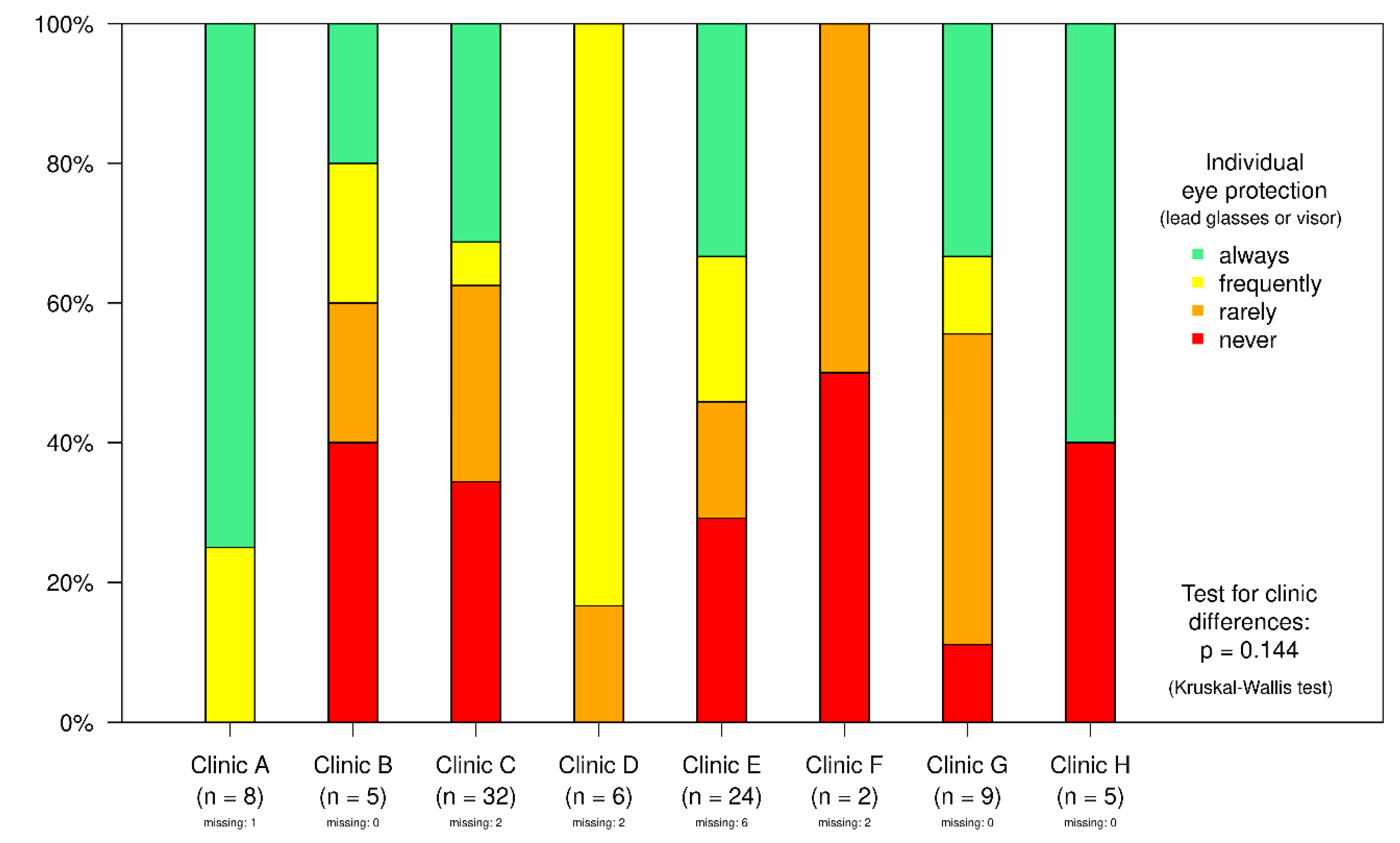
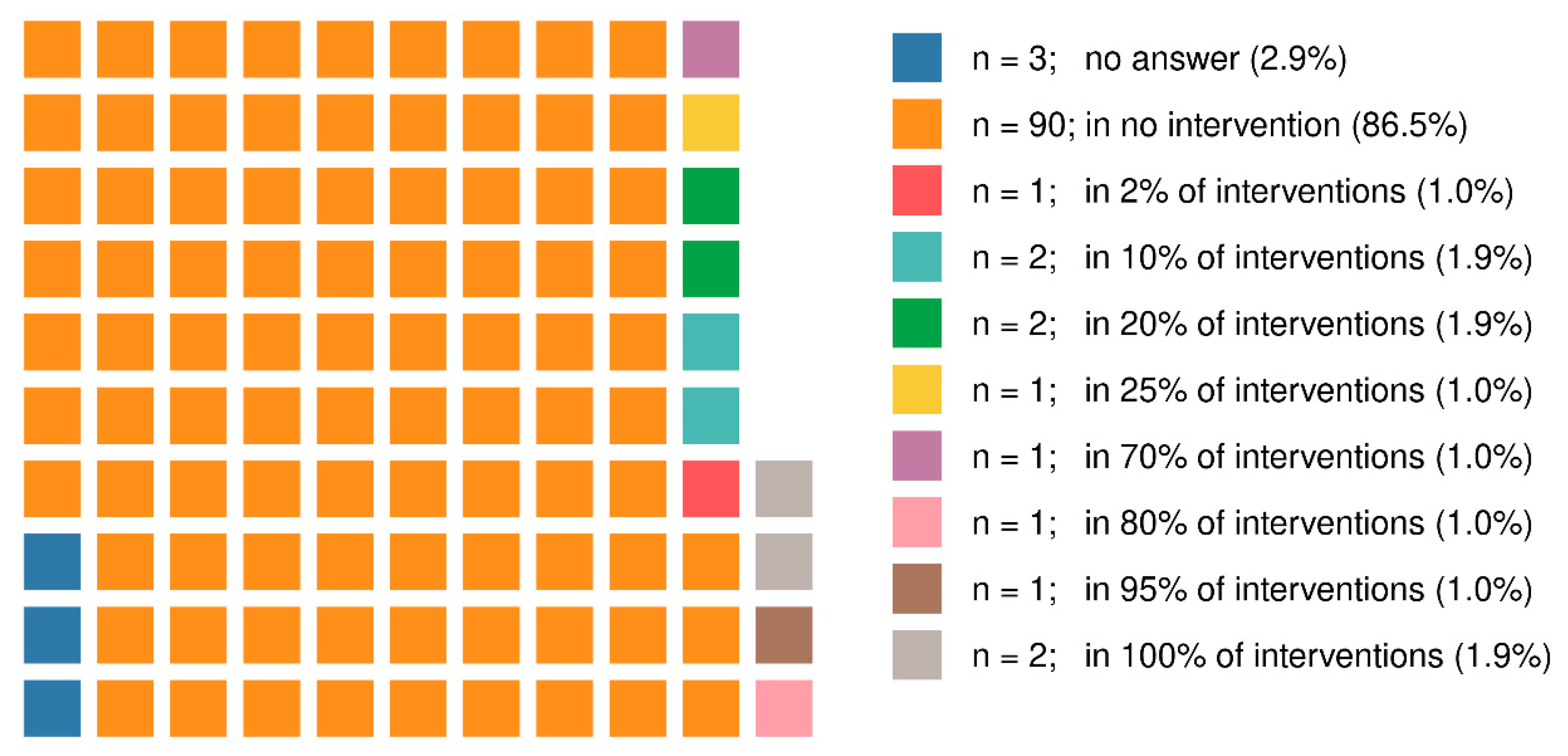
Radiation Protection in Interventional Radiology/Cardiology—Is State-of-the-Art Equipment Used?


Abstract
1. Introduction
2. Materials and Methods
3. Results
4. Discussion
5. Summary
Author Contributions
Funding
Institutional Review Board Statement
Informed Consent Statement
Data Availability Statement
Acknowledgments
Conflicts of Interest
References
- Padovani, R.; Le Heron, J.; Cruz-Suarez, R.; Lefaure, C.; Rehani, M.; Czarwinski, R.; Duran, A.; Miller, D.; Sim, H.; Vano, E. International project on individual monitoring and radiation exposure levels in interventional cardiology. Radiat. Prot. Dosim. 2011, 144, 437–441. [Google Scholar] [CrossRef] [Scilit]
- Kim, K.P.; Miller, D.L. Minimising radiation exposure to physicians performing fluoroscopically guided cardiac catheterisation procedures: A review. Radiat. Prot. Dosim. 2009, 133, 227–233. [Google Scholar] [CrossRef] [Scilit]
- Vañó, E.; Kleimann, N.J.; Duran, A.; Rehani, M.M.; Echeverri, D.; Cabrera, M. Radiation Cataract Risk in Interventional Cardiology Personell. Radiat. Res. 2010, 174, 490–495. [Google Scholar] [CrossRef] [Scilit]
- Vañó, E.; Kleimann, N.J.; Duran, A.; Romano-Miller, M.; Rehani, M.M. Radiation-associated Lens Opacities in Catheterization Personnel: Results of a Survey and Direct Assessments. J. Vasc. Interv. Radiol. 2013, 24, 197–204. [Google Scholar] [CrossRef] [Scilit]
- Ciraj-Bjelac, O.; Rehani, M.M.; Sim, K.H.; Liew, H.B.; Vañó, E.; Kleimann, N.J. Risk for Radiation-Induced Cataract for Staff in Interventional Cardiology: Is There a Reason for Concern? Catheter. Cardiovasc. Interv. 2010, 76, 826–834. [Google Scholar] [CrossRef] [Scilit]
- Rehani, M.M.; Vañó, E.; Ciraj-Bjelac, O.; Kleimann, N.J. Radiation and cataract. Radiat. Prot. Dosim. 2011, 147, 300–304. [Google Scholar] [CrossRef] [Scilit]
- Jacob, S.; Boveda, S.; Bar, O.; Brézin, A.; Maccia, C.; Laurier, D.; Bernier, M.O. Interventional cardiologists and risk of radiation-induced cataract: Results of a French multicenter observational study. Int. J. Cardiol. 2012, 167, 1843–1847. [Google Scholar] [CrossRef] [Scilit]
- ICRP. ICRP Publication139: Occupational Radiological Protection in Interventional Procedures. Ann. ICRP 2018, 47, 1–118. [Google Scholar] [CrossRef] [Scilit]
- Behr-Meenen, C.; von Boetticher, H.; Lynnyk, O.; Langer, C.; Kersten, J.F.; Nienhaus, A. Radiation dose to the lens of the eye in medical staff performing fluoroscopy. Dtsch. Arztebl. Int. 2021, 118, 769–770. [Google Scholar] [CrossRef] [Scilit]
- von Boetticher, H.; Meenen, C.; Lachmund, J.; Hoffmann, W.; Engel, H.-J. Strahlenexposition des Personals im Herzkatheterlabor (Radiation exposure of staff in the cardiac catheter laboratory). Zeitschrift für Medizinische Physik 2003, 13, 251–256. [Google Scholar] [CrossRef] [Scilit]
- ICRP. ICRP Publication120: Radiological Protection in Cardiology. Ann. ICRP 2013, 42, 1–125. [Google Scholar]
- Vañó, E.; Sanchez, R.M.; Fernandez, J.M. Estimation of staff lens doses during interventional procedures. Comparing cardiology, neuroradiology and interventional radiology. Radiat. Prot. Dosim. 2015, 165, 279–283. [Google Scholar] [CrossRef] [Scilit]
- Alazzoni, A.; Gordon, C.L.; Syed, J.; Natarajan, M.K.; Rokoss, M.; Schwalm, J.-D.; Mehta, S.R.; Sheth, T.; Valettas, N.; Velianou, J.; et al. Randomized Controlled Trial of Radiation Protection with a Patient Lead Shield and a Novel, Nonlead Surgical Cap for Operators Performing Coronary Angiography or Intervention. Circ. Cardiovasc. Interv. 2015, 8, e002384. [Google Scholar] [CrossRef] [Scilit]
- Uthoff, H.; Peña, C.; West, J.; Contreras, F.; Benenati, J.F.; Katzen, B.T. Evaluation of novel disposable, light-weight radiation protection devices in an interventional radiology setting: A randomized controlled trial. Am. J. Roentgenol. 2013, 200, 915–920. [Google Scholar] [CrossRef] [Scilit]
- Whitby, M.; Martin, C.J. Radiation doses to the legs of radiologists performing interventional procedures: Are they a cause for concern? Br. J. Radiol. 2003, 76, 321–327. [Google Scholar] [CrossRef] [Scilit]
- Shortt, C.P.; Al-Hashimi, H.; Malone, L.; Lee, M.J. Staff radiation doses to the lower extremities in interventional radiology. Cardiovasc. Interv. Radiol. 2007, 30, 1206–1209. [Google Scholar] [CrossRef] [Scilit]
- Martin, C.J. A review of radiology staff doses and dose monitoring requirements. Radiat. Prot. Dosim. 2009, 136, 140–157. [Google Scholar] [CrossRef] [Scilit]
- Vanhavere, F.; Carionon, E.; Gualdrini, G.; Clairand, I.; Merce, M.S.; Ginjaume, M. Optimisation of Radiation Protection for Medical Staff; 7th EURADOS Report; EURADOS: Braunschweig, Germany, 2012. [Google Scholar]
- King, J.N.; Champlin, A.M.; Kelsey, C.A.; Tripp, D.A. Using a sterile disposable protective surgical drape for reduction of radiation exposure to interventionalists. Am. J. Roentgenol. 2002, 178, 153–157. [Google Scholar] [CrossRef] [Scilit]
- Chodick, G.; Bekiroglu, N.; Hauptmann, M.; Bruce, H.A.; Freedmann, D.M.; Doddy, M.M.; Cheung, L.C.; Simon, S.L.; Weinstock, R.M.; Bouville, A.; et al. Risk of Cataract after Exposure to Low Doses of Ionizing Radiation: A 20-Year Prospective Cohort Study among US Radiologic Technologists. Am. J. Epidemiol. 2008, 168, 620–631. [Google Scholar] [CrossRef] [Scilit]
- Mayer, S.; Baechler, S.; Damet, J.; Elmiger, R.; Frei, D.; Giannini, S.; Leupin, A.; Sarott, F.; Schuh, R. Occupational exposure to external radiation in Switzerland. Radiat. Prot. Dosim. 2016, 170, 433–436. [Google Scholar] [CrossRef] [Scilit]
- Martin, C.J. Eye lens dosimetry for fluorospically guided clinical procedures: Practical approaches to protection and does monitoring. Radiat. Prot. Dosim. 2016, 169, 286–291. [Google Scholar] [CrossRef] [Scilit]
- Behr-Meenen, C.; von Boetticher, H.; Liebmann, M.; Langer, C.; Nienhaus, A. Katarakt durch ionisierende Strahlung (Cataract from ionizing radiation). Arb. Soz. Umw. 2019, 54, 739–742. [Google Scholar]
- Koenig, A.M.; Etzel, R.; Greger, W.; Viniol, S.; Fiebich, M.; Thomas, R.P.; Mahnken, A.H. Protective efficacy of different ocular radiation protection devices: A phantom study. Cardiovasc. Interv. Radiol. 2020, 43, 127–134. [Google Scholar] [CrossRef] [Scilit]
- Fetterly, K.; Schueler, B.; Grams, M.; Sturchio, G.; Bell, M.; Gulati, R. Head and Neck Radiation Dose and Radiation Safety for Interventional Physicians. JACC Cardiovasc. Interv. 2017, 10, 520–528. [Google Scholar] [CrossRef] [Scilit]
- Hu, P.; Kong, Y.; Chen, B.; Liu, Q.; Zhuo, W.; Liu, H. Shielding Effect of Lead Glasses on Radiologists’ Eye Lens Exposure in Interventional Procedures. Radiat. Prot. Dosim. 2017, 174, 136–140. [Google Scholar] [CrossRef] [Scilit]


| Variable | N (%) |
|---|---|
| Gender * | |
| Women | 33 (32.7%) |
| Men | 68 (67.3%) |
| Age in years | |
| Mean ± SD (min.–max.) | 43.1 ± 10.3 (23–65) |
| Specialism | |
| Interventional cardiology | 57 (54.8%) |
| Interventional radiology | 11 (10.6%) |
| Vascular surgery | 4 (3.8%) |
| Assistants (cardiology and vascular medicine) | 32 (30.8%) |
| Number of years working in interventional medicine * | |
| 1 to 9 | 62 (61.4%) |
| 10 to 19 | 20 (19.8%) |
| Over 20 | 19 (18.8%) |
| Question * | Always | Frequently | Rarely | Never | N (%) |
|---|---|---|---|---|---|
| Which radiation protection garments do you wear? | |||||
| Lead equivalence 0.35 mm | 54 (55.7) | ||||
| Lead equivalence 0.5 mm | 43 (44.3) | ||||
| How often do you wear thyroid protection? | 99 (98.0) | 2 (2.0) | |||
| Do you wear lead glasses? | |||||
| Yes, lead equivalence 0.5 mm | 45 (76.3) | ||||
| Yes, lead equivalence 0.75 mm | 14 (23.7) | ||||
| How often do you wear lead glasses? | 30 (34.5) | 15 (17.2) | 19 (21.8) | 23 (26.4) | |
| How often do you wear a visor? | 1 (2.1) | 1 (2.1) | 10 (20.8) | 36 (75.0) | |
| Do you wear a cap? | |||||
| Yes, lead equivalence 0.25 mm | 10 (43.5) | ||||
| Yes, lead equivalence 0.35 mm | 9 (39.1) | ||||
| Yes, lead equivalence 0.5 mm | 4 (17.4) | ||||
| How often do you wear a cap? | 12 (13.2) | 5 (5.5) | 10 (11.0) | 64 (70.3) | |
| Do you wear a headband? | |||||
| Yes, lead equivalence 0.25 mm | - | ||||
| Yes, lead equivalence 0.35 mm | 2 (2.8) | ||||
| Yes, lead equivalence 0.5 mm | - | ||||
| How often do you wear a headband? | 2 (2.8) | - | - | 70 (97.2) |
| Question * | Always | Frequently | Rarely | Never | N (%) |
|---|---|---|---|---|---|
| Is there a ceiling-suspended lead acrylic shield in the examination room? | |||||
| No | 4 (4.0) | ||||
| Yes | 95 (96.0) | ||||
| How often do you use a ceiling-suspended lead acrylic shield? | 78 (78.8) | 18 (18.2) | 1 (1.0) | 2 (2.0) | |
| Is there a drape under the examination table on one side? | |||||
| No | 26 (28.0) | ||||
| Yes | 67 (72.0) | ||||
| Is there a drape under the examination table on both sides? | |||||
| No | 65 (67.7) | ||||
| Yes | 31 (32.3) | ||||
| Is there an over-table shield? | |||||
| No | 15 (15.1) | ||||
| Yes | 84 (84.9) | ||||
| How often is the over-table shield used? | 61 (63.5) | 20 (20.8) | 2 (2.1) | 13 (13.5) |
| Question * | Always | Frequently | Rarely | Never | N (%) |
|---|---|---|---|---|---|
| Is a patient apron used? | |||||
| No | 11 (15.3) | ||||
| Yes, lead equivalence 0.5 mm | 56 (77.8) | ||||
| Yes, lead equivalence 1.0 mm | 5 (6.9) | ||||
| How often is a patient apron used? | 30 (34.1) | 33 (37.5) | 21 (23.9) | 4 (4.5) | |
| Do you use all the technical means of reducing radiation? | 49 (51.6) | 45 (47.4) | 1 (1.0) | - | |
| Working practices that reduce radiation? | |||||
| 3-D mapping, navigation system | 3 (23.1) | ||||
| FORS 1 technology, participation in studies | 2 (15.4) | ||||
| Using a long wire to change catheters | 1 (7.7) | ||||
| Regular image fades | 1 (7.7) | ||||
| Tiger catheter, distance | 5 (38.5) | ||||
| Syringe pump | 1 (7.7) |
| Parameters Affecting Exposure | Average | Standard Error | Standard Deviation | Median | Interquartile Range | Minimum | Maximum | N |
|---|---|---|---|---|---|---|---|---|
| Fluoroscopy time in minutes | 7.36 | 0.95 | 6.53 | 5 | 8 | 1 | 30 | 47 |
| Image frequency per second | 8.24 | 0.41 | 2.93 | 7.5 | 2 | 3 | 15 | 52 |
| Images per examination | 7.93 | 0.56 | 3.88 | 6 | 2 | 1 | 20 | 48 |
Publisher’s Note: MDPI stays neutral with regard to jurisdictional claims in published maps and institutional affiliations. |
© 2021 by the authors. Licensee MDPI, Basel, Switzerland. This article is an open access article distributed under the terms and conditions of the Creative Commons Attribution (CC BY) license (https://creativecommons.org/licenses/by/4.0/).
Share and Cite
Behr-Meenen, C.; von Boetticher, H.; Kersten, J.F.; Nienhaus, A. Radiation Protection in Interventional Radiology/Cardiology—Is State-of-the-Art Equipment Used? Int. J. Environ. Res. Public Health 2021, 18, 13131. https://doi.org/10.3390/ijerph182413131
Behr-Meenen C, von Boetticher H, Kersten JF, Nienhaus A. Radiation Protection in Interventional Radiology/Cardiology—Is State-of-the-Art Equipment Used? International Journal of Environmental Research and Public Health. 2021; 18(24):13131. https://doi.org/10.3390/ijerph182413131
Chicago/Turabian StyleBehr-Meenen, Christiane, Heiner von Boetticher, Jan Felix Kersten, and Albert Nienhaus. 2021. "Radiation Protection in Interventional Radiology/Cardiology—Is State-of-the-Art Equipment Used?" International Journal of Environmental Research and Public Health 18, no. 24: 13131. https://doi.org/10.3390/ijerph182413131
APA StyleBehr-Meenen, C., von Boetticher, H., Kersten, J. F., & Nienhaus, A. (2021). Radiation Protection in Interventional Radiology/Cardiology—Is State-of-the-Art Equipment Used? International Journal of Environmental Research and Public Health, 18(24), 13131. https://doi.org/10.3390/ijerph182413131