


Abstract
Poor mental health contributes significantly to global morbidity. The evidence regarding physical benefits of running are well-established. However, the mental health impacts of running remain unclear. An overview of the relationship between running and mental health has not been published in the last 30 years. The purpose of this study was to review the literature on the relationship between running and mental health. Our scoping review used combinations of running terms (e.g., Run* and Jog*) and mental health terms (general and condition specific). Databases used were Ovid(Medline), Ovid(Embase), ProQuest and SportDiscus. Quantitative study types reporting on the relationships between running and mental health were included. Database searches identified 16,401 studies; 273 full-texts were analysed with 116 studies included. Overall, studies suggest that running bouts of variable lengths and intensities, and running interventions can improve mood and mental health and that the type of running can lead to differential effects. However, lack of controls and diversity in participant demographics are limitations that need to be addressed. Cross-sectional evidence shows not only a range of associations with mental health but also some associations with adverse mental health (such as exercise addiction). This review identified extensive literature on the relationship between running and mental health.
1. Introduction
Poor mental health contributes significantly to the global health burden [1]. The strain of mental health and behavioural disorders is estimated to account for more years of lived disability than any other chronic health ailment [1,2]. The global proportion of disability-adjusted life years caused by mental ill-health has increased from 12.7% to 14% (males) and 13.6% to 14.4% (females) from 2007 to 2017 [3]. Due to the burden and increasing prevalence of mental ill-health, effective management of mental health disorders is vital [4].
There is substantial evidence to support the relationship between physical activity (PA) and various mental health outcomes across the lifespan [5,6,7]. There has been investigation of low-intensity PA on mental health; for example, Kelly et al. (2018) reported the positive relationships between walking and mental health in an earlier scoping review [8]. However, a similar synthesis for higher-intensity PA such as running has not been reported.
While the evidence base for the benefits of running on physical health is well-established, the mental health changes from running remain unclear. Addressing the gap within this knowledge is valuable as running is a form of PA popular among many population groups [9]. Inclusive organisations such as “Couch to 5k” [10], “Girls on the run” [11] and “Parkrun” can support running while promoting well-being and satisfaction with physical health, facilitating socialisation and community connectedness, and reducing loneliness [12,13,14]. In primary care settings, national initiatives such as “Parkrun-Practice” promote well-being through running [15].
In recent years, there has been a transition within healthcare to focus on disease morbidity rather than disease mortality, in particular with a drive to improve global mental health [16]. There is increasing prevalence of mental ill-health; therefore, effective management of mental health disorders is vital [4]. In order to investigate any differences in mental health effects between high and low intensities of running, all genres of running must be considered including jogging, sprinting, marathon running and orienteering.
To the best of the authors’ knowledge, no recent reviews of the relationship between running and mental health are available. The synthesis provided by this review will enable healthcare practitioners, psychologists and policy makers to better advise on running for mental health. It will also identify key gaps in the literature for future research. The aims of this scoping review are the following:
- (1)
- to provide an overview of what is known regarding the relationship between running and mental health outcomes in all age groups and populations
- (2)
- to highlight current knowledge gaps and research priorities
2. Materials and Methods
A scoping review was concluded to be the most appropriate to address the research aims as it provides an overview of the volume and distribution of the evidence base as well as highlights where more research is warranted. The review followed the five-stage scoping review framework proposed by Arksey and O’Malley and was guided by the Preferred Reporting Items for Systematic Reviews and Meta-Analyses (PRISMA) scoping review extension checklist (Appendix A) [17,18].
2.1. Identify Research Question
Research questions were developed to address the research aims: “What is known about the effects of running on mental health outcomes?” and “What are the current knowledge gaps?”. Research question formulation was guided by item 4 in the PRISMA scoping review extension checklist (Appendix A). The definition of running included jogging, sprinting, marathon running, orienteering and treadmill running. A wide range of intensities were included as the aim of the scoping review was to provide an overall picture of the relationship between running (of various intensities) and mental health.
2.2. Identify Relevant Outcomes
Mental health outcomes were informed by Kelly et al. (2018) [8], who reviewed the relationships between walking and mental health (Table 1). Measures or disorders of cognitive dysfunction were considered neurological and thus outside the scope of this review. Eating disorders were included as they significantly impair physical health or psychosocial functioning. Health-related quality-of-life was excluded as it was considered to incorporate physical, social, emotional and mental factors.
Table 1.
Definitions of the mental health outcomes included within the review: the outcomes were informed by Kelly et al. (2018) [8].
2.3. Identify Relevant Studies
Studies were included based on the following criteria:
- Any geographical location
- All years between 1970 and 2019
- Quantitative effects of running on predetermined mental health outcomes
- ○
- Preventive effects (negative)
- ○
- Health promotion effects (positive)
- ○
- Intervention effects
- Any age group or sex
- Human studies
- Designs including primary research (cross-sectional, longitudinal, interventions and natural experiments with pre-post measures with or without non-running comparisons)
- Studies that mentioned walking as well as running were included because it is not possible to differentiate walkers from runners in events such as Parkrun.
Studies were excluded based on the following criteria:
- Specialist groups including elite, professional or competitive athletes.
- General physical or aerobic activity, rather than exclusively running
- Qualitative and ethnographic designs
- Systematic and scoping reviews (individual studies from identified reviews were included if relevant)
- Editorials, opinion pieces, magazine/newspaper articles, case reports and papers without primary data
- Focus on secondary mental health within clinical groups with specific physical or mental conditions that is not the condition being treated with running (e.g., effects on depression in patients with cancer)
- Evidence types including guidelines, unpublished and ongoing trials, annual reports, dissertations and conference proceedings
- Animal studies
- Unavailable in English
- Running intervention was part of a wider study where differentiating the individual effect of running was not possible (e.g., combined with weight management).
- Conference abstracts that were not published as full articles
Search Strategy and Databases
Databases searched were Ovid (Medline), Ovid (Embase), ProQuest and SportDiscus. Databases were searched for titles and abstracts that included at least one running term with one mental health outcome term. Appropriate truncation symbols were used to account for search term variations. Common running terms were combined. Search terms and the full search syntax can be found in Appendix B. Searches were conducted for papers published up to August 2019.
2.4. Study Selection
All identified records were uploaded to Covidence (https://www.covidence.org), and duplicates were automatically removed. Titles and abstracts were screened, with 20% cross-checked early in the process to assess agreement between authors. Full texts were reviewed by 2 authors.
2.5. Charting the Data
Data extraction was completed by the lead author (F.O.) with 5% double screened by a second author (J.R.). The data extraction form was pilot tested with the first 20 studies and informed the following standardised extraction agreed upon by all authors:
- (1)
- Author(s), year of publication and geographical location of study
- (2)
- Mental health conditions examined
- (3)
- Sample size and population details
- (4)
- Study design
- (5)
- Measures used to quantify any change in mental health outcome(s)
- (6)
- Running dose (if applicable) and compliance (if applicable)
- (7)
- Whether running was beneficial and the main findings
In studies that used “Profile of Mood States” (POMS) as a measurement of mood state, total mood disturbance was used in this review if reported by the authors. If the authors only reported one/some of the POMS subdimensions, these data were extracted instead.
2.6. Collating, Summarising and Reporting Results
Included studies were organized into 3 categories: cross-sectional studies, acute (single, double or triple) bouts of running, and long-term running interventions. For each of these 3 categories, the results were presented in two ways: (a) a descriptive numerical analysis to highlight the prevailing domains of research regarding geographical location, mental health outcomes and research methods and (b) a narrative summary of the key findings.
3. Results
3.1. Included Studies
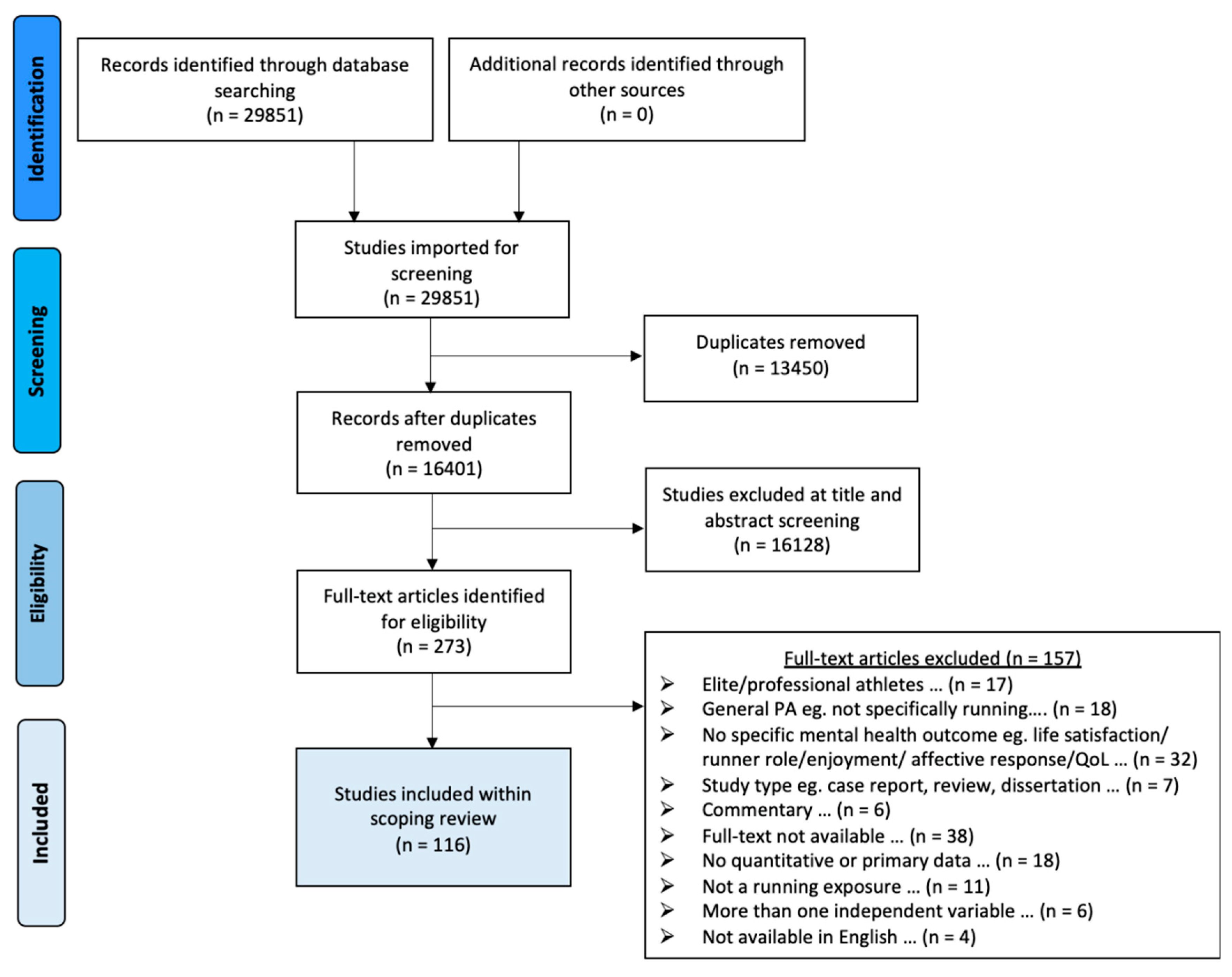
From initial searches, 29,851 papers were identified. Following removal of duplicates, 16,401 were screened at the title and abstract levels and 273 papers were retained for full-text assessments. Ultimately, 116 papers met the inclusion criteria for this review. Figure 1 displays the PRISMA study flowchart. The results are presented in the following 3 categories: cross-sectional studies, acute bouts of running and longer-term interventions.
Figure 1.
Preferred Reporting Items for Systematic Reviews and Meta-Analyses (PRISMA) depicting the identification, screening, eligibility and inclusions of texts within the scoping review.
3.2. Category 1: Cross-Sectional Studies
Forty-seven studies utilised cross-sectional designs (with and without non-running comparison groups) (Table 2) [29,30,31,32,33,34,35,36,37,38,39,40,41,42,43,44,45,46,47,48,49,50,51,52,53,54,55,56,57,58,59,60,61,62,63,64,65,66,67,68,69,70,71,72,73,74,75]. These studies assessed exposure to regular running by questionnaire. Narrative description of findings of the 47 cross-sectional studies are included within Table S1 within the supplementary material.
Table 2.
Summary of data extraction from the 47 cross-sectional studies.
3.2.1. Runners Versus Non-Running Comparisons
Sixteen of the 47 studies directly compared measures of mental health in runners and non-running comparisons [29,33,36,37,40,41,42,45,46,47,57,61,62,63,64,73]. They found that runners had lower depression and anxiety [33,36,37,40,41,45,46,47,62], lower stress [64], higher psychological well-being [63,73], and better mood [29] compared to sedentary controls. In these studies, there was no evidence of increased prevalence of eating psychopathology in non-elite runners [42,57,61].
3.2.2. Runners Only
Nineteen studies only included runners [30,31,34,35,39,44,48,49,51,55,58,65,66,67,70,74,75,76] and compared different levels and types of running. Some studies found a positive association with higher self-identity runners and low levels of depression and high self-efficacy [30,65,66,67,74]. Studies investigating marathon training found a positive relationship of marathon training with self-esteem and psychological coping [55,71]. Two questionnaires of long-distance runners found a correlation between long-distance running and disordered eating behaviours, with obligatory runners (obsessive runners who sacrificed commitments and relationships for running and suffered withdrawal symptoms if they missed a run) exhibiting traits characteristic of anorexia nervosa patients [39] and risk factors for eating disorders identified within male high school cross-country runners [70]. One study of runners training for a marathon suggested that running did not directly impact stress [72]. There were conflicting results from papers investigating negative addiction; one indicated that with more years spent running came a greater risk of negative addiction [34], while another found no relationship between years of running and addiction [58] and another found a sex difference in that commitment to running can occur without addiction in female runners but not in males [49]. Another paper found that five variables significantly predicted risk of exercise addiction in runners: weekly time spent running, childhood PA, lower educational attainment, anxiety and loneliness [75]. The remaining four cross-sectional studies of runners only found that, since participating in running, they had better emotional well-being, relief of tension, self-image and self-confidence, mood, depression, aggression and anger, anxiety and happiness, but not all reported significance or effect size [31,35,44,48,51].
A further eight studies compared groups of runners [32,38,50,53,56,60,68,69]. One paper found that females jogging with greater intensity had significantly less anxiety than those jogging at lower intensities [38]. The results from these studies showed that obligatory runners had significantly higher anxiety [53] and eating disorder measures [60,69] than non-obligatory runners and that female obligatory runners are most at risk of eating pathophysiology [60]. Non-elite marathoners showed significantly higher exercise dependence scores [56] but had more self-sufficient personalities compared to recreational runners who did not run marathons [32]. One paper did not find that exercise dependence was linked to social physique anxiety [68], while another found that runners classified as pain runners (pushed themselves until they felt pain) experienced significantly more death thoughts and death anxiety than non-pain runners [50].
3.2.3. Runners Compared to Individuals with Eating Disorders
Two studies compared runners to individuals with diagnosed eating disorders but neither indicated that habitual running led to development of disordered eating or body-image problems [52,59].
3.2.4. Prevented Runners
One study found that habitual runners prevented from running by illness or injury had significantly greater overall psychological distress, depression and mood disturbance than continuing runners as well as significantly lower self-esteem and body-image [43].
3.2.5. Runners Compared to Gym Exercisers
A study comparing negative addiction in runners versus gym exercisers found significant association between years of participation in running and gym exercise with negative addiction, regardless of activity type [54].
3.2.6. Summary of Cross-Sectional Evidence
Consistent evidence was found for a positive association between positive mental health outcomes and habitual or long-term recreational running compared to non-runners. In contrast, there was evidence that high or extreme levels of running (high frequency and long distance including marathon running) were associated with markers of running ill-health compared to levels of moderate running.
3.3. Category 2: Acute Bouts of Running
Narrative description of findings of the 35 studies with an acute bout of running are included within Tables S2–S4 within the supplementary material.
3.3.1. Single Bouts
Twenty-three studies incorporated a design using a single bout of running to compare pre-post measurements of mood and short-term measures of mental health (Table 3) [77,78,79,80,81,82,83,84,85,86,87,88,89,90,91,92,93,94,95,96,97,98,99]. Twenty-two of these found positive improvement in measures of mental health (including anxiety, depression and mood); however, one found a decrease in self-efficacy of children following participation in gymnasium PACER (progressive aerobic cardiovascular endurance run) running challenge [95].
Table 3.
Summary of data extraction from the 23 single-bout studies.
Eleven studies used a single bout of treadmill running, and all found positive pre-post differences in mental health outcomes [84,85,86,88,89,90,91,92,93,97,99]. Results found significant reductions in state-trait anxiety; total mood disturbance; and POMS subscales of anxiety, depression and confusion. A single bout of treadmill running also significantly improved self-esteem; psychological well-being; children and adolescent self-efficacy; state anxiety, depression and totally mood disturbance; adult self-efficacy; and general affective response. One study found that mood improvements were not evident until 40 min of running [88], while another found that depressed individuals participating in a treadmill run with increasing gradient improved depressed mood immediately post-run but that depressed mood increased at 30-min postexercise [93].
Three studies used a single bout of track running and found significant decreases in anxiety [78,87] and total mood disturbance [81]. Two studies found that a single outdoor run significantly improved depression scores and that even a 10-min jog caused significant mood enhancement [80,94]. Two studies found that a single bout of self-paced running significantly reduced all but one of the POMS subscales and had significant positive changes in all measures of states of affect [82,96].
There were significant improvements for self-esteem, stress and total mood disturbance following a 5-km Parkrun [98], while a 3-mile “fun-run” increased positive mood and decreased negative mood [83]. Two studies used longer runs as exposures: one found that a 1-h run significantly reduced anxiety and nonsignificantly reduced depression [79], while the other found that a 12.5-mile jog significantly improved pleasantness; decreased trait anxiety; nonsignificantly increased activation; and reduced state-anxiety, sadness, anxiety, depression and relaxation subscales [77].
3.3.2. Double Bouts
There were nine studies that had a double-bout design [100,101,102,103,104,105,106,107,108] (Table 4). Eight of the nine studies were primarily designed to compare conditions rather than to compare the impact of running on mental health, including green/park versus urban, solo versus group, different pacing and different durations of running [101,102,103,104,105,106,107,108]. Seven of the eight studies found that markers of mental health improved significantly after running [101,102,103,104,105,106,107]. Only one study was designed to primarily assess the impact of running on mental health, and although there was no control, they found higher mood and feelings of pleasantness post-run but these “did not reach significance” [100].
Table 4.
Summary of data extraction from the 9 double-bout studies.
Four studies compared park/rural versus urban running, and all found measures of mental health including anxiety, depression, mood and self-esteem improved post-run [103,104,105,107]. No paper reported a statistically significant difference in emotional benefit between park and urban conditions. Two studies compared solo versus group running: one found that anxiety reduced following both group and solo running [101], while the other found that children’s anxiety levels increased nonsignificantly following individual and group running [108]. One study compared 10- and 15-min runs and found that they produced similar psychological benefits to mood [102]. Another compared a self-paced versus prescribed-paced run and found higher self-efficacy before the prescribed-paced run compared to the self-paced run [106].
3.3.3. Triple Bouts
Three studies used three bouts of running (Table 5) [109,110,111]. One study found that, while two indoor runs had a positive effect on mood, the outdoor run had an even greater benefit to mood with subjects feeling less anxious, depressed, hostile and fatigued and feeling more invigorated [109]. Another study also used 3 runs of varying intensities and found significant overall mood benefits postexercise but no significant differences between intensities [110]. One study compared 3 intensities of treadmill exercise to a sedentary control condition and found that state anxiety improved following running at 5% below and at the lactate threshold but that anxiety increased after running at 5% above the lactate threshold [111]. Overall, these studies suggest that running improves mood, that outdoor running has a greater benefit to mood and that most intensities of running improve mood, with the exception of an intensity markedly above the lactate threshold. However, only one study included a control condition [111].
Table 5.
Summary of data extraction from the 3 triple-bout studies.
3.3.4. Summary of Acute Bouts
Overall, these studies suggest that acute bouts of running can improve mental health and that the type of running can lead to differential effects. The evidence suggests that acute bouts of treadmill, track, outdoor and social running (2.5–20 km and 10–60 min) all result in improved mental health outcomes. There were few differences between high and low intensities. Studies consistently show that any running improves acute/short-term mood markers, but the lack of inactive comparison conditions is a limitation to the strength of the evidence. Little variation in the demographics of participants and small sample sizes limit generalizability and precision of findings.
3.4. Category 3: Longer-Term Interventions
Thirty-four studies investigated the effects of more than three bouts of running on measures of mental health ranging from 2-week interventions to 1-year marathon training programmes (Table 6) [112,113,114,115,116,117,118,119,120,121,122,123,124,125,126,127,128,129,130,131,132,133,134,135,136,137,138,139,140,141,142,143,144]. Narrative description of 34 studies are available in Table S5 within the supplementary material.
Table 6.
Summary of data extraction from the 34 longer-term intervention studies.
Eight studies used 2–8 week running interventions [121,122,125,127,128,132,137,139]. Male regular runners deprived of running for 2 weeks had increased anxiety and depression symptoms compared to continuing runners [125]. Two 3-week interventions both found that mood improved while amateur runners had lesser anxiety on running days compared to non-running days; perceived stress in adolescents did not significantly change [132,137]. A 4-week intervention of regular treadmill running at set paces in moderately trained male runners found that an increase in intensity of runs was associated with significant increase in total mood disturbance while running at a pace with more economical values was associated with more positive mental health profiles [127]. A 7-week non-controlled intervention of weekly 40-min fixed distance outdoor rural runs increased mood in both male and female regular exercising university students, with faster runners scoring higher than slower runners [128]. An 8-week intervention of a combination of weekly group and solo jogging in middle-aged chronically stressed, sedentary women found lower anxiety and greater self-efficacy than baseline and compared to relaxation group controls [121]. Two studies used a 8-week intervention of walking/running with non-treatment controls and found significant improvements in mood and decrease of depression, including in outpatients diagnosed with mild to severe depression [122,139].
Eleven studies used 10–20 week running interventions [114,115,116,119,123,126,129,130,131,140,143]. Three 10-week walking/jogging interventions found reductions in anxiety measures, improvement of well-being and conflicting results for changes in depression measures compared to controls [115,119,129]. Another 10-week running intervention found that depression, trait anxiety and state anxiety all decreased significantly while mood improved significantly [114]. A further 10-week running intervention found that, although the exercise group was more likely to use exercise to cope with stress, there were no significant differences in stress or coping measurements between the running and comparison group [123]. Three 12-week interventions found significantly reduced stress and improvements in mood in college students compared to controls, with more mood improvement in males and in females with higher masculinity [126,130,143]. One 12-week intervention of self-directed running in recreational runners found that well-being was significantly higher during weeks when individuals ran further and ran more often while self-efficacy was related to distance ran but not to frequency of running [143]. Running interventions of 14–20 weeks improved mood and self-esteem and lowered emotional stress reactivity in college/university students compared with controls [116,131,140].
A number of studies looked at specific populations. One investigated the impact of 10 organised runs on homeless people and found significant positive correlation with perceived self-sufficiency [138]. Two investigated the effects in children and found that running significantly improved creativity and higher self-esteem subscales [117,141]. Three looked at marathon training programmes: one found a positive correlation between the trend in running and self-efficacy but was not significant [136], while another found a significant increase in self-efficacy over the programme [76]. The remaining study used participants who were already self-enrolled in a marathon, and researchers found that, while anxiety decreased initially during training, anxiety increased as marathon day approached [135].
Nine studies used subjects with known psychiatric disorders and found that longer-term interventions generally improved markers of mental health in psychiatric populations, particularly markers of depression [112,113,118,120,124,133,134,142,144]. Running interventions from 2 to 12 weeks all resulted in significant positive effects on mental health [112,118,120,124,133,142,144]. While an anti-depressive effect of exercise was apparent in patients with minor to moderate psychiatric problems, one study found that this was not reflected in patients with major depressive disorder due to issues with compliance and motivation towards the intervention [144].
Summary of Longer-Term Interventions
Overall, running interventions of 2–20 weeks generally show improved markers of a range of mental health outcomes compared to non-running controls, including mental health outcomes in psychiatric and homeless populations. The risk of longer-term running interventions on adverse mental health outcomes remains unclear.
3.5. Summary of Key Findings
The key findings of the each of the three categories of studies are summarised in Table 7.
Table 7.
Summary of key findings within each of the three categories.
3.6. Evidence Gaps
As well as reporting the available evidence, this review also aimed to identify key gaps in the evidence base for running and mental health. Consideration of sample demographics in the n = 116 included studies resulted in the following gaps being identified:
- lack of studies in those aged under 18 (Only four acute bout studies [89,95,107,108] and two longer term interventions [117,141] looked directly at children under age 15, while a further 2 studies looked specifically at adolescents [70,137]);
- lack of studies in those aged over 45;
- lack of gender-specific approaches;
- few studies investigating clinical populations; and
- limited diversity in patient demographics.
4. Discussion
4.1. Principal Findings
There is a growing body of literature exploring the relationships of running on certain mental health outcomes. There were variations in methods and outcomes studied, but there were similar overall beneficial trends. Generally, evidence supported positive effects of a range of lengths and intensities of running on mental health. However, there was limited diversity in participant demographics. Attribution was also compromised by the limited number of studies with comparisons/control groups. Synthesis of quantified effects is made challenging by large variations in reporting methods. Consistency and appropriateness of mental health measures was also varied throughout the literature.
The review identified a smaller evidence-base focused on clinical populations. Behaviour change and compliance can be challenging in populations with clinical depressive disorders [145], and there is limited evidence regarding the long-term impact of PA in the treatment of depression [7,146,147]. Further investigations of the effects of running in populations with prior diagnoses of mental health disorders may help to address the global burden of mental illness.
4.2. Plausible Explanations for Findings
Our findings suggest that, throughout cross-sectional evidence, acute bouts of running and longer-term running interventions are associated with improvements in a range of mental health outcomes. This is likely explained by running supplying a sufficient dose of moderate to vigorous PA to stimulate the known mental health benefits associated with PA. These benefits are thought to be mediated by neurobiological, psychosocial and behavioural mechanisms, all of which an effective running intervention of any genre has the potential to influence [148]. The differential effects of these mechanisms remain unclear and may explain the variation in findings by running duration, intensity, setting, and social or individual participation.
4.3. Comparison to Literature
This review does not present running and mental health as a novel idea. As early as 1979, scholars discussed the relationship between psychotherapy and running [149]. An early review by Vezina et al. (1980) reported that regular running causes positive mood changes, increases self-esteem and decreases anxiety [150]. Another review by Hinkle (1992) found positive psychological effects in both adults and children including reductions in depressive mood and anxiety, and enhanced self-esteem [151]. However, a review by Weinstein et al. (1983) found that the volume of literature examining running and depression was scarce, and while running appeared to improve a sense of well-being, there was minimal evidence to strongly support reductions in depression and anxiety [152].
Studies from 1986 [153] and 1991 [154] warned that long-distance running had the potential to trigger development of eating disorders in people who were psychologically or biologically at risk. Early research also highlighted that runners should be aware of the possibility of addiction [155] and that women may be linked more strongly to negative addiction than men [156].
This review agrees with these earlier findings but is the first to use systematic scoping review methods. This means that it presents a transparent search and inclusion strategy and is less prone to bias in terms of included studies and resulting findings. As such, this review has contributed to the evidence base by demonstrating that the weight of evidence up to 2019 favours positive mental health relationships with running.
4.4. Strengths and Limitations
The authors acknowledge the limitation that this review was designed to assess the behaviour of running but that there are fields of studies including treadmill-based exercise which our review may not have picked up. However, the strength of this review is that the review does not focus on laboratory-based exercise but instead on what a healthcare professional may recommend to a free-living patient or the general public for mental health benefits. However, subjective measures of running intensity were not considered in detail, which may impact the conclusions of the review. The authors acknowledge that the results were not separated by means of running type due to the method of prioritization used to report the results, and thus, this remains a research gap. As with any scoping review, it is possible that the search and inclusion strategy led to omission of some key research.
Synthesis of quantified effects was also made challenging by the large range of reporting methods used within the studies. This scoping review did not attempt to undertake quality appraisal of the included studies. The wide range of study designs and methods included within the review does not allow a statistical synthesis of the effectiveness of the studies.
4.5. Implications
Pharmacological management is often used as a first-line of defence for mental health disorders [157]; however, it is not always effective due to poor adherence and relapse [158]. Ineffective management adds to the global burden of poor mental health [159], With increasing pressures on healthcare budgets, PA offers an augmentative therapeutic option for mental health management [160]. It is likely that using a cost-effective therapy such as running to improve mental health would prove economical as well. An integrated lifestyle intervention (i.e., iterative process) may be more feasible than a single add-on exercise intervention (i.e., addition of an individual behaviour) for patients with major depressive disorder who are deemed suitable for running therapy by clinicians.
This review presents the effects of running on mental health and can inform healthcare professionals and psychologists who advise on management of mental health conditions. The authors’ interpretation of the evidence base is that, with appropriate clinical judgement, practitioners may identify patients with an interest in running or previous history of running as an ideal candidate for running as a form of psychotherapy. Findings from this review indicate that characteristics of running to be recommended may include self-pacing, distance and time feasibility to the individual, and being within the lactate threshold. There were consistent trends within findings despite a variety of running interventions, which suggest that it would be appropriate to recommend track running, outdoor urban and rural running, and treadmill running to improve mental health. However, a large number of studies used healthy, active college-aged participants, which may limit the relevance of these recommendations to other population groups. It is acknowledged that running will not be a suitable recommendation for everyone and that prescription of running is not as simple as just instructing people to run; it will require clinical expertise with regard to mental health in the way it is prescribed [161].
4.6. Future Research
This review identifies research gaps regarding patient demographics, but we have further recommendations about increasing sample sizes, quantitative study design and more coherent mental health outcomes. There was great variability in mental health outcome measures, particularly within the acute bout studies, where short-term measures of mental health could have equally been defined as mood and affect. We recommend that future research seeks more clarity on appropriate outcome measures. A comparison of types, settings and intensities of running is needed to better inform running and mental health recommendations.
Recommendations for future research include addressing the effect of running on mental health of those under 18, those over 50s and clinical populations. A meta-analysis of the subset of study types such as interventions should be carried out. While the appropriateness of running interventions in those over 50 may be questioned, there is evidence that older adults do also benefit from the anti-depressive effect of exercise [162]. We know that children running can be used as a population intervention, for example, in “The Daily Mile” [163], which signifies the importance of addressing this gap around the mental health impact of running in those under 18. Future systematic reviews and meta-analyses are needed to quantify the benefits of running on specific outcomes.
5. Conclusions
This review is the most recent to comprehensively report the breadth of literature on the relationship between running and mental health. We conclude that running has important positive implications for mental health, particularly depression and anxiety disorders, but synthesis of quantified effects is made challenging by variation in reporting methods and remains a gap. This scoping review may have consequences for researchers, practitioners and relevant organisations and may inform the practice of healthcare professionals. Knowledge gaps concerning running on the mental health of children, older adults and clinical populations provide guidance for future research
Supplementary Materials
The following are available online at https://www.mdpi.com/1660-4601/17/21/8059/s1, Table S1: Narrative description of findings of the 47 cross-sectional studies. Table S2–S4: Narrative description of findings of the 35 studies with an acute bout of running. Table S5: Narrative description of findings of the 34 studies with a longer-term intervention of running.
Author Contributions
P.K., J.R. and F.O. conceived the study. P.K., C.W. and F.O. designed the search strategy. F.O. conducted searching of databases. J.C., P.K., F.O. and C.W. screened the records. F.O. and P.K. screened the full texts. F.O. completed all data extraction, and J.R. conducted quality checks. F.O. drafted the full manuscript, and all authors reviewed and approved final submission. All authors have read and agreed to the published version of the manuscript.
Funding
This research received no external funding.
Acknowledgments
The authors would like to thank a number of people for their assistance during the scoping review: Thelma Dugmore for her support and administration help within the Edinburgh University Physical Activity for Health Research Centre (PAHRC), Marshall Dozier for her assistance setting up a Covidence account for the project to run through, all the staff at PAHRC for being so welcoming and interested in the project and, finally, Colin Oswald who was a source of great encouragement and support throughout the project.
Conflicts of Interest
The authors declare no conflict of interest.
Appendix A
Table A1.
Preferred Reporting Items for Systematic reviews and Meta-Analyses extension for Scoping Reviews (PRISMA-ScR) Checklist [18].
Appendix References
- (1)
- Arksey, H.; O’Malley, L. Scoping studies: Towards a methodological framework. Int. J. Soc. Res. Methodol. 2005, 8, 19–32.
- (2)
- Levac, D.; Colquhoun, H; O’Brien, K.K. Scoping studies: Advancing the methodology. Implement Sci. 2010, 5, 69, doi:10.1186/1748-5908-5-69.
- (3)
- Peters, M.D.; Godfrey, C.M.; Khalil, H.; McInerney, P.; Parker, D.; Soares, C.B. Guidance for conducting systematic scoping reviews. Int. J. Evid. Based Healthc. 2015, 13, 141–146, doi:10.1097/XEB.0000000000000050.
- (4)
- Peters, M.D.J.; Godfrey, C.; McInerney, P.; Baldini Soares, C.; Khalil, H.; Parker, D. Scoping reviews. In Joanna Briggs Institute Reviewer’s Manual; Aromataris, E., Munn, Z., Eds.; Joanna Briggs Inst: Adelaide, Australia, 2017.
Appendix B
Table A2.
Details of the search strategy used in all 4 databases.
References
- Whiteford, H.A.; Ferrari, A.J.; Degenhardt, L.; Feigin, V.; Vos, T. The global burden of mental, neurological and substance use disorders: An analysis from the Global Burden of Disease Study 2010. PLoS ONE 2015, 10, e0116820. [Google Scholar] [CrossRef] [Scilit] [PubMed]
- Lopez, A.D.; Murray, C.C.J.L. The global burden of disease, 1990–2020. Nat. Med. 1998, 4, 1241–1243. [Google Scholar] [CrossRef] [Scilit] [PubMed]
- GBD 2017 DALYs and HALE Collaborators. ‘Global, regional, and national disability-adjusted life-years (DALYs) for 359 diseases and injuries and healthy life expectancy (HALE) for 195 countries and territories, 1990-2017: A systematic analysis for the Global Burden of Disease Study 2017. Lancet Lond. Engl. 2018, 392, 1859–1922. [Google Scholar] [CrossRef] [Scilit]
- Demyttenaere, K.; Bruffaerts, R.; Posada-Villa, J.; Gasquet, I.; Kovess, V.; Lepine, J.P.; Angermeyer, M.C.; Bernert, S.; De Girolamo, G.; Morosini, P.; et al. Prevalence, severity, and unmet need for treatment of mental disorders in the World Health Organization World Mental Health Surveys. JAMA 2004, 291, 2581–2590. [Google Scholar] [CrossRef] [Scilit] [PubMed]
- Chan, J.S.Y.; Liu, G.; Liang, D.; Deng, K.; Wu, J.; Yan, J.H. Special Issue-Therapeutic Benefits of Physical Activity for Mood: A Systematic Review on the Effects of Exercise Intensity, Duration, and Modality. J. Psychol. 2019, 153, 102–125. [Google Scholar] [CrossRef] [Scilit]
- Richards, J.; Jiang, X.; Kelly, P.; Chau, J.; Bauman, A.; Ding, D. Don’t worry, be happy: Cross-sectional associations between physical activity and happiness in 15 European countries. BMC Public Health 2015, 15, 53. [Google Scholar] [CrossRef] [Scilit]
- Schuch, F.B.; Vancampfort, D.; Richards, J.; Rosenbaum, S.; Ward, P.B.; Stubbs, B. Exercise as a treatment for depression: A meta-analysis adjusting for publication bias. J. Psychiatr. Res. 2016, 77, 42–51. [Google Scholar] [CrossRef] [Scilit]
- Kelly, P.; Williamson, C.; Niven, A.G.; Hunter, R.; Mutrie, N.; Richards, J. Walking on sunshine: Scoping review of the evidence for walking and mental health. Br. J. Sports Med. 2018, 52, 800–806. [Google Scholar] [CrossRef] [Scilit]
- Active Lives. Sport England. Available online: https://www.sportengland.org/know-your-audience/data/active-lives (accessed on 27 September 2020).
- Couch to 5K: Week by Week-NHS’. Available online: https://www.nhs.uk/live-well/exercise/couch-to-5k-week-by-week/ (accessed on 28 November 2019).
- Nonprofit Girls Empowerment Program | Girls on the Run. GOTR. Available online: https://www.girlsontherun.org/ (accessed on 28 November 2019).
- Parkrun Eases the Loneliness of the Long-Distance Runner | British Journal of General Practice’. Available online: https://bjgp.org/content/64/625/408 (accessed on 28 November 2019).
- Sifers, S.K.; Shea, D.N. Evaluations of Girls on the Run/Girls on Track to Enhance Self-Esteem and Well-Being. J. Clin. Sport Psychol. 2013, 7, 77–85. [Google Scholar] [CrossRef] [Scilit]
- Grunseit, A.; Richards, J.; Merom, D. Running on a high: Parkrun and personal well-being. BMC Public Health 2017, 18, 59. [Google Scholar] [CrossRef] [Scilit]
- Parkrun Practice. Available online: https://elearning.rcgp.org.uk/course/view.php?id=723 (accessed on 28 November 2019).
- Patel, V.; Garrison, P.; Mari, J.D.; Minas, H.; Prince, M.; Saxena, S. The Lancet’s Series on Global Mental Health: 1 year on. Lancet 2008, 372, 1354–1357. [Google Scholar] [CrossRef] [Scilit]
- Scoping Studies: Towards a Methodological Framework: International Journal of Social Research Methodology: Vol 8, No 1’. Available online: https://www.tandfonline.com/doi/full/10.1080/1364557032000119616 (accessed on 27 September 2019).
- Tricco, A.C.; Lillie, E.; Zarin, W.; O’Brien, K.K.; Colquhoun, H.; Levac, D.; Moher, D.; Peters, M.D.; Horsley, T.; Weeks, L.; et al. PRISMA Extension for Scoping Reviews (PRISMA-ScR): Checklist and Explanation. Ann. Intern. Med. 2018, 169, 467. [Google Scholar] [CrossRef] [Scilit]
- American Psychological Association. Diagnostic and Statistical Manual of Mental Disorders (DSM-5®); American Psychiatric Pub: Washington, DC, USA, 2013. [Google Scholar]
- Physical Activity Guidelines Advisory Committee Report, 2008 to the Secretary of Health and Human Services: (525442010-001); American Psychological Association: Worcester, MA, USA, 2008. [CrossRef] [Scilit]
- Zulkosky, K. Self-Efficacy: A Concept Analysis. Nurs. Forum (Auckl.) 2009, 44, 93–102. [Google Scholar] [CrossRef] [Scilit]
- Ridner, S.H. Psychological distress: Concept analysis. J. Adv. Nurs. 2004, 45, 536–545. [Google Scholar] [CrossRef] [Scilit] [PubMed]
- Fairburn, C.G.; Brownell, K.D. Eating Disorders and Obesity: A Comprehensive Handbook; Guilford Press: New York, NY, USA, 2005. [Google Scholar]
- Pressman, S.D.; Cohen, S. Does positive affect influence health? Psychol. Bull. 2005, 131, 925–971. [Google Scholar] [CrossRef] [Scilit]
- Goodman, A. Addiction: Definition and implications. Br. J. Addict. 1990, 85, 1403–1408. [Google Scholar] [CrossRef] [Scilit]
- Ryff, C.D. Eudaimonic well-being and health: Mapping consequences of self-realization. In The Best within Us: Positive Psychology Perspectives on Eudaimonia; American Psychological Association: Washington, DC, USA, 2013; pp. 77–98. [Google Scholar]
- Kinch, J.W. A Formalized Theory of the Self-Concept. Am. J. Sociol. 1963, 68, 481–486. [Google Scholar] [CrossRef] [Scilit]
- Lane, A.M.; Terry, P.C. The Nature of Mood: Development of a Conceptual Model with a Focus on Depression. J. Appl. Sport Psychol. 2000, 12, 16–33. [Google Scholar] [CrossRef] [Scilit]
- Wilson, V.E.; Morley, N.C.; Bird, E.I. Mood profiles of marathon runners, joggers and non-exercisers. Percept. Mot. Skills 1980, 50, 117–118. [Google Scholar] [CrossRef] [Scilit]
- Joesting, J. Running and Depression. Percept. Mot. Skills 1981, 52, 442. [Google Scholar] [CrossRef] [Scilit]
- Jorgenson, D.E.; Jorgenson, C.B. Perceived Effects of Running/Jogging: A Social Survey of Three Clubs. Int. Rev. Sport Sociol. 1981, 16, 75–85. [Google Scholar] [CrossRef] [Scilit]
- Valliant, P.M.; Bennie, F.A.; Valiant, J.J. Do marathoners differ from joggers in personality profile: A sports psychology approach. J. Sports Med. Phys. Fit. 1981, 21, 62–67. [Google Scholar]
- Francis, K.T.; Carter, R. Psychological characteristic of joggers. J. Sports Med. Phys. Fit. 1982, 22, 386–391. [Google Scholar]
- Hailey, B.J.; Bailey, L.A. Negative addiction in runners: A quantitative approach. J. Sport Behav. 1982, 5, 150–154. [Google Scholar]
- Callen, K.E. Mental and emotional aspects of long-distance running. Psychosomatics 1983, 24, 133–134. [Google Scholar] [CrossRef] [Scilit]
- Galle, P.C.; Freeman, E.W.; Galle, M.G.; Huggins, G.R.; Sondheimer, S.J. Physiologic and psychologic profiles in a survey of women runners. Fertil. Steril. 1983, 39, 633–639. [Google Scholar] [CrossRef] [Scilit]
- Lobstein, D.D.; Mosbacher, B.J.; Ismail, A.H. Depression as a powerful discriminator between physically active and sedentary middle-aged men. J. Psychosom. Res. 1983, 27, 69–76. [Google Scholar] [CrossRef] [Scilit]
- Rudy, E.B.; Estok, P.J. Intensity of jogging: Its relationship to selected physical and psychosocial variables in women. West. J. Nurs. Res. 1983, 5, 325–336. [Google Scholar] [CrossRef] [Scilit]
- Goldfarb, L.A.; Plante, T.G. Fear of fat in runners: An examination of the connection between anorexia nervosa and distance running. Psychol. Rep. 1984, 55, 296. [Google Scholar] [CrossRef] [Scilit]
- Guyot, G.W.; Fairchild, L.; Nickens, J. Death concerns of runners and nonrunners. J. Sports Med. Phys. Fit. 1984, 24, 139–143. [Google Scholar]
- Rape, R.N. Running and Depression. Percept. Mot. Skills 1987, 64 (Suppl. 3), 1303–1310. [Google Scholar] [CrossRef] [Scilit]
- Weight, L.M.; Noakes, T.D. Is running an analog of anorexia?: A survey of the incidence of eating disorders in female distance runners. Med. Sci. Sports Exerc. 1987, 19, 213–217. [Google Scholar] [CrossRef] [Scilit] [PubMed]
- Chan, C.S.; Grossman, H.Y. Psychological effects of running loss on consistent runners. Percept. Mot. Skills 1988, 66, 875–883. [Google Scholar] [CrossRef] [Scilit] [PubMed]
- Frazier, S.E. Mood state profiles of chronic exercisers with differing abilities. Int. J. Sport Psychol. 1988, 19, 65–71. [Google Scholar]
- Lobstein, D.D.; Ismail, A.H.; Rasmussen, C.L. Beta-endorphin and components of emotionality discriminate between physically active and sedentary men. Biol. Psychiatry 1989, 26, 3–14. [Google Scholar] [CrossRef] [Scilit]
- Lobstein, D.D.; Rasmussen, C.L.; Dunphy, G.E.; Dunphy, M.J. Beta-endorphin and components of depression as powerful discriminators between joggers and sedentary middle-aged men. J. Psychosom. Res. 1989, 33, 293–305. [Google Scholar] [CrossRef] [Scilit]
- Nouri, S.; Beer, J. Relations of moderate physical exercise to scores on hostility, aggression, and aggression, and trait-anxiety. Percept. Mot. Skills 1989, 68 Pt 2, 1191–1194. [Google Scholar] [CrossRef] [Scilit]
- Chan, D.W.; Lai, B. Psychological aspects of long-distance running among Chinese male runners in Hong Kong. Int. J. Psychosom. Off. Publ. Int. Psychosom. Inst. 1990, 37, 30–34. [Google Scholar]
- Chapman, C.L.; de Castro, J.M. Running addiction: Measurement and associated psychological characteristics. J. Sports Med. Phys. Fit. 1990, 30, 283–290. [Google Scholar]
- Guyot, W.G. Psychological and medical factors associated with pain running. J. Sports Med. Phys. Fit. 1991, 31, 452–460. [Google Scholar]
- Maresh, C.M.; Sheckley, B.G.; Allen, G.J.; Camaione, D.N.; Sinatra, S.T. Middle age male distance runners: Physiological and psychological profiles. J. Sports Med. Phys. Fit. 1991, 31, 461–469. [Google Scholar]
- Gleaves, D.H.; Williamson, D.A.; Fuller, R.D. Bulimia nervosa symptomatology and body image disturbance associated with distance running and weight loss. Br. J. Sports Med. 1992, 26, 157–160. [Google Scholar] [CrossRef] [Scilit] [PubMed]
- Coen, S.P.; Ogles, B.M. Psychological characteristics of the obligatory runner: A critical examination of the anorexia analogue hypothesis. J. Sport Exerc. Psychol. 1993, 15, 338–354. [Google Scholar] [CrossRef] [Scilit]
- Furst, D.M.; Germone, K. Negative addiction in male and female runners and exercisers. Percept. Mot. Skills 1993, 77, 192–194. [Google Scholar] [CrossRef] [Scilit]
- Masters, K.S.; Ogles, B.M.; Jolton, J.A. The development of an instrument to measure motivation for marathon running: The Motivations of Marathoners Scales (MOMS). Res. Q. Exerc. Sport 1993, 64, 134–143. [Google Scholar] [CrossRef] [Scilit]
- Pierce, E.F.; McGowan, R.W.; Lynn, T.D. Exercise dependence in relation to competitive orientation of runners. J. Sports Med. Phys. Fitness 1993, 33, 189–193. [Google Scholar]
- Klock, S.C.; DeSouza, M.J. Eating disorder characteristics and psychiatric symptomatology of eumenorrheic and amenorrheic runners. Int. J. Eat. Disord. 1995, 17, 161–166. [Google Scholar] [CrossRef] [Scilit]
- Thornton, E.W.; Scott, S.E. Motivation in the committed runner: Correlations between self-report scales and behaviour. Health Promot. Int. 1995, 10, 177–184. [Google Scholar] [CrossRef] [Scilit]
- Powers, P.S.; Schocken, D.D.; Boyd, F.R. Comparison of habitual runners and anorexia nervosa patients. Int. J. Eat. Disord. 1998, 23, 133–143. [Google Scholar] [CrossRef]
- Slay, H.A.; Hayaki, J.; Napolitano, M.A.; Brownell, K.D. Motivations for running and eating attitudes in obligatory versus nonobligatory runners. Int. J. Eat. Disord. 1998, 23, 267–275. [Google Scholar] [CrossRef]
- Ryujin, D.H.; Breaux, C.; Marks, A.D. Symptoms of eating disorders among female distance runners: Can the inconsistencies be unraveled? Women Health 1999, 30, 71–83. [Google Scholar] [CrossRef] [Scilit] [PubMed]
- Leedy, G. Commitment to Distance Running: Coping Mechanisms or Addiction. J. Sport Behav. Mob. Ala 2000, 23, 255–270. [Google Scholar]
- Edwards, S.D.; Ngcobo, H.S.; Edwards, D.J.; Palavar, K. Exploring the relationship between physical activity, psychological well-being and physical self- perception in different exercise groups. South Afr. J. Res. Sport Phys. Educ. Recreat. 2005, 27, 59–74. [Google Scholar] [CrossRef] [Scilit]
- Schnohr, P.; Kristensen, T.S.; Prescott, E.; Scharling, H. Stress and life dissatisfaction are inversely associated with jogging and other types of physical activity in leisure time--The Copenhagen City Heart Study. Scand. J. Med. Sci. Sports 2005, 15, 107–112. [Google Scholar] [CrossRef] [Scilit] [PubMed]
- Strachan, S.M.; Woodgate, J.; Brawley, L.R.; Tse, A. The Relationship of Self-Efficacy and Self-Identity to Long-Term Maintenance of Vigorous Physical Activity. J. Appl. Biobehav. Res. 2005, 10, 98–112. [Google Scholar] [CrossRef] [Scilit]
- Galper, D.I.; Trivedi, M.H.; Barlow, C.E.; Dunn, A.L.; Kampert, J.B. Inverse association between physical inactivity and mental health in men and women. Med. Sci. Sports Exerc. 2006, 38, 173–178. [Google Scholar] [CrossRef] [Scilit]
- Luszczynska, A.; Mazurkiewicz, M.; Ziegelmann, J.P.; Schwarzer, R. Recovery self-efficacy and intention as predictors of running or jogging behavior: A cross-lagged panel analysis over a two-year period. Psychol. Sport Exerc. 2007, 8, 247–260. [Google Scholar] [CrossRef] [Scilit]
- Smith, D.; Wright, C.; Winrow, D. Exercise dependence and social physique anxiety in competitive and non-competitive runners. Int. J. Sport Exerc. Psychol. 2010, 8, 61–69. [Google Scholar] [CrossRef] [Scilit]
- Gapin, J.I.; Petruzzello, S.J. Athletic identity and disordered eating in obligatory and non-obligatory runners. J. Sports Sci. 2011, 29, 1001–1010. [Google Scholar] [CrossRef] [Scilit]
- Wadas, G.; DeBeliso, M. Disordered eating, eating attitudes, and reasons for exercise among male high school cross country runners. Sport J. 2014, 17. Available online: https://www.cabdirect.org/cabdirect/abstract/20153072464 (accessed on 15 July 2020).
- Download Citation of The Relationship between Motivations, Perceived Control, and Mental Toughness Among Marathon Runners. ResearchGate. Available online: https://www.researchgate.net/publication/325793259_The_relationship_between_motivations_perceived_control_and_mental_toughness_among_marathon_runners (accessed on 15 July 2020).
- Lucidi, F.; Pica, G.; Mallia, L.; Castrucci, E.; Manganelli, S.; Bélanger, J.J.; Pierro, A. Running away from stress: How regulatory modes prospectively affect athletes’ stress through passion. Scand. J. Med. Sci. Sports 2016, 26, 703–711. [Google Scholar] [CrossRef] [Scilit] [PubMed]
- Batmyagmar, D.; Kundi, M.; Ponocny-Seliger, E.; Lukas, I.; Lehrner, J.; Haslacher, H.; Winker, R. High intensity endurance training is associated with better quality of life, but not with improved cognitive functions in elderly marathon runners. Sci. Rep. 2019, 9, 4629. [Google Scholar] [CrossRef] [Scilit]
- Cleland, V.; Nash, M.; Sharman, M.J.; Claflin, S. Exploring the Health-Promoting Potential of the “parkrun” Phenomenon: What Factors are Associated With Higher Levels of Participation? Am. J. Health Promot. AJHP 2019, 33, 13–23. [Google Scholar] [CrossRef] [Scilit]
- Lukács, A.; Sasvári, P.; Varga, B.; Mayer, K. Exercise addiction and its related factors in amateur runners. J. Behav. Addict. 2019, 8, 343–349. [Google Scholar]
- Solmon, M.; Stewart, L. Changes in self-efficacy and affect during a 15-week marathon training program. Int. J. Sport Psychol. 2013, 44, 55–68. [Google Scholar]
- Nowlis, D.P.; Greenberg, N. Empirical description of effects of exercise on mood. Percept. Mot. Skills 1979, 49, 1001–1002. [Google Scholar] [CrossRef] [Scilit]
- Wilson, V.E.; Berger, B.G.; Bird, E.I. Effects of running and of an exercise class on anxiety. Percept. Mot. Skills 1981, 53, 472–474. [Google Scholar] [CrossRef] [Scilit]
- Markoff, R.A.; Ryan, P.; Young, T. Endorphins and mood changes in long-distance running. Med. Sci. Sports Exerc. 1982, 14, 11–15. [Google Scholar] [CrossRef] [Scilit] [PubMed]
- Thaxton, L. Physiological and Psychological Effects of Short-term Exercise Addiction on Habitual Runners. J. Sport Exerc. Psychol. 1982, 4, 73–80. [Google Scholar] [CrossRef] [Scilit]
- McGowan, R.W.; Pierce, E.F.; Jordan, D. Mood alterations with a single bout of physical activity. Percept. Mot. Skills 1991, 72 Pt 2, 1203–1209. [Google Scholar] [CrossRef]
- Goode, K.T.; Roth, D.L. Factor Analysis of Cognitions during Running: Association with Mood Change. J. Sport Exerc. Psychol. 1993, 15, 375–389. [Google Scholar] [CrossRef] [Scilit]
- Morris, M.; Salmon, P. Qualitative and quantitative effects of running on mood. J. Sports Med. Phys. Fit. 1994, 34, 284–291. [Google Scholar]
- Rudolph, D.L.; Butki, B.D. Self-efficacy and affective responses to short bouts of exercise. J. Appl. Sport Psychol. 1998, 10, 268–280. [Google Scholar] [CrossRef] [Scilit]
- Cox, R.H.; Thomas, T.R.; Davis, J.E. Positive and negative affect associated with an acute bout of aerobic exercise. J. Exerc. Physiol. Online 2001, 4, 13–20. [Google Scholar]
- O’Halloran, P.D.; Murphy, G.C.; Webster, K.E. Measure of beliefs about improvements in mood associated with exercise. Psychol. Rep. 2002, 90 Pt 1, 834–840. [Google Scholar] [CrossRef]
- Szabo, A. The Acute Effects of Humor and Exercise on Mood and Anxiety. J. Leis. Res. 2003, 35, 152–162. [Google Scholar] [CrossRef] [Scilit]
- O’Halloran, P.D.; Murphy, G.C.; Webster, K. Mood during a 60-minute treadmill run: Timing and type of mood change. Int. J. Sport Psychol. 2004, 35, 309–327. [Google Scholar]
- Robbins, L.B.; Pender, N.J.; Ronis, D.L.; Kazanis, A.S.; Pis, M.B. Physical activity, self-efficacy, and perceived exertion among adolescents. Res. Nurs. Health 2004, 27, 435–446. [Google Scholar] [CrossRef] [Scilit] [PubMed]
- Pretty, J.; Peacock, J.; Sellens, M.; Griffin, M. The mental and physical health outcomes of green exercise. Int. J. Environ. Health Res. 2005, 15, 319–337. [Google Scholar] [CrossRef] [Scilit]
- Hoffman, M.D.; Hoffman, D.R. Exercisers achieve greater acute exercise-induced mood enhancement than nonexercisers. Arch. Phys. Med. Rehabil. 2008, 89, 358–363. [Google Scholar] [CrossRef] [Scilit]
- Kwan, B.M.; Bryan, A.D. Affective response to exercise as a component of exercise motivation: Attitudes, norms, self-efficacy, and temporal stability of intentions. Psychol. Sport Exerc. 2010, 11, 71–79. [Google Scholar] [CrossRef] [Scilit] [PubMed]
- Weinstein, A.A.; Deuster, P.A.; Francis, J.L.; Beadling, C.; Kop, W.J. The Role of Depression in Short-Term Mood and Fatigue Responses to Acute Exercise. Int. J. Behav. Med. 2010, 17, 51–57. [Google Scholar] [CrossRef] [Scilit]
- Anderson, R.J.; Brice, S. The mood-enhancing benefits of exercise: Memory biases augment the effect. Psychol. Sport Exerc. 2011, 12, 79–82. [Google Scholar] [CrossRef] [Scilit]
- Kane, I.; Robertson, R.; Fertman, C.; Nagle, E.; McConnaha, W.; Rabin, B. Self-efficacy and enjoyment of middle school children performing the Progressive Aerobic Cardiovascular Endurance Run (PACER). Percept. Mot. Skills 2013, 117, 470–483. [Google Scholar] [CrossRef] [Scilit]
- Szabo, A.; Abrahám, J. The psychological benefits of recreational running: A field study. Psychol. Health Med. 2013, 18, 251–261. [Google Scholar] [CrossRef] [Scilit]
- McDowell, C.P.; Campbell, M.J.; Herring, M.P. Sex-Related Differences in Mood Responses to Acute Aerobic Exercise. Med. Sci. Sports Exerc. 2016, 48, 1798–1802. [Google Scholar] [CrossRef] [Scilit]
- Rogerson, M.; Brown, D.K.; Sandercock, G.; Wooller, J.-J.; Barton, J. A comparison of four typical green exercise environments and prediction of psychological health outcomes. Perspect. Public Health 2016, 136, 171–180. [Google Scholar] [CrossRef] [Scilit]
- Edwards, M.K.; Rhodes, R.E.; Loprinzi, P.D. A Randomized Control Intervention Investigating the Effects of Acute Exercise on Emotional Regulation. Am. J. Health Behav. 2017, 41, 534–543. [Google Scholar] [CrossRef] [Scilit]
- Wildmann, J.; Krüger, A.; Schmole, M.; Niemann, J.; Matthaei, H. Increase of circulating beta-endorphin-like immunoreactivity correlates with the change in feeling of pleasantness after running. Life Sci. 1986, 38, 997–1003. [Google Scholar] [CrossRef] [Scilit]
- O’Connor, P.J.; Carda, R.D.; Graf, B.K. Anxiety and intense running exercise in the presence and absence of interpersonal competition. Int. J. Sports Med. 1991, 12, 423–426. [Google Scholar] [CrossRef] [Scilit]
- Nabetani, T.; Tokunaga, M. The effect of short-term (10- and 15-min) running at self-selected intensity on mood alteration. J. Physiol. Anthropol. Appl. Hum. Sci. 2001, 20, 231–239. [Google Scholar] [CrossRef] [Scilit] [PubMed]
- Bodin, M.; Hartig, T. Does the outdoor environment matter for psychological restoration gained through running? Psychol. Sport Exerc. 2003, 4, 141–153. [Google Scholar] [CrossRef] [Scilit]
- Butryn, T.M.; Furst, D.M. The effects of park and urban settings on the moods and cognitive strategies of female runners. J. Sport Behav. 2003, 26, 335–355. [Google Scholar]
- Kerr, J.H.; Fujiyama, H.; Sugano, A.; Okamura, T.; Chang, M.; Onouha, F. Psychological responses to exercising in laboratory and natural environments. Psychol. Sport Exerc. 2006, 7, 345–359. [Google Scholar] [CrossRef] [Scilit]
- Rose, E.A.; Parfitt, G. Exercise experience influences affective and motivational outcomes of prescribed and self-selected intensity exercise. Scand. J. Med. Sci. Sports 2012, 22, 265–277. [Google Scholar] [CrossRef] [Scilit]
- Reed, K.; Wood, C.; Barton, J.; Pretty, J.N.; Cohen, D.; Sandercock, G.R.H. A repeated measures experiment of green exercise to improve self-esteem in UK school children. PLoS ONE 2013, 8, e69176. [Google Scholar] [CrossRef] [Scilit]
- Krotee, M.L. The Effects of Various Physical Activity Situational Settings on the Anxiety Level of Children. J. Sport Behav. Mob. Ala 1980, 3, 158–164. [Google Scholar]
- Harte, J.L.; Eifert, G.H. The effects of running, environment, and attentional focus on athletes’ catecholamine and cortisol levels and mood. Psychophysiology 1995, 32, 49–54. [Google Scholar] [CrossRef] [Scilit]
- Berger, B.; Owen, D.; Motl, R.; Parks, L. Relationship between expectancy of psychological benefits and mood alteration in joggers. Int. J. Sport Psychol. 1998, 29, 1–16. [Google Scholar]
- Markowitz, S.M.; Arent, S.M. The exercise and affect relationship: Evidence for the dual-mode model and a modified opponent process theory. J. Sport Exerc. Psychol. 2010, 32, 711–730. [Google Scholar] [CrossRef] [Scilit]
- Lion, L.S. Psychological effects of jogging: A preliminary study. Percept. Mot. Skills 1978, 47 Pt 2, 1215–1218. [Google Scholar] [CrossRef] [Scilit]
- Blue, F.R. Aerobic running as a treatment for moderate depression. Percept. Mot. Skills 1979, 48, 228. [Google Scholar] [CrossRef] [Scilit] [PubMed]
- Young, R.J. The effect of regular exercise on cognitive functioning and personality. Br. J. Sports Med. 1979, 13, 110–117. [Google Scholar] [CrossRef] [Scilit]
- Blumenthal, J.A.; Williams, R.S.; Needels, T.L.; Wallace, A.G. Psychological changes accompany aerobic exercise in healthy middle-aged adults. Psychosom. Med. 1982, 44, 529–536. [Google Scholar] [CrossRef] [Scilit] [PubMed]
- Trujillo, C.M. The effect of weight training and running exercise intervention programs on the self-esteem of college women. Int. J. Sport Psychol. 1983, 14, 162–173. [Google Scholar]
- Tuckman, B.W.; Hinkle, J.S. An experimental study of the physical and psychological effects of aerobic exercise on schoolchildren. Health Psychol. Off. J. Div. Health Psychol. Am. Psychol. Assoc. 1986, 5, 197–207. [Google Scholar] [CrossRef]
- Doyne, E.J.; Ossip-Klein, D.J.; Bowman, E.D.; Osborn, K.M.; McDougall-Wilson, I.B.; Neimeyer, R.A. Running versus weight lifting in the treatment of depression. J. Consult. Clin. Psychol. 1987, 55, 748–754. [Google Scholar] [CrossRef] [PubMed]
- Fremont, J.; Craighead, L.W. Aerobic exercise and cognitive therapy in the treatment of dysphoric moods. Cogn. Ther. Res. 1987, 11, 241–251. [Google Scholar] [CrossRef] [Scilit]
- Hannaford, C.P.; Harrell, E.H.; Cox, K. Psychophysiological Effects of a Running Program on Depression and Anxiety in a Psychiatric Population. Psychol. Rec. 1988, 38, 37–48. [Google Scholar] [CrossRef] [Scilit]
- Long, B.C.; Haney, C.J. Long-Term Follow-up of Stressed Working Women: A Comparison of Aerobic Exercise and Progressive Relaxation. J. Sport Exerc. Psychol. 1988, 10, 461–470. [Google Scholar] [CrossRef] [Scilit]
- Simons, C.W.; Birkimer, J.C. An exploration of factors predicting the effects of aerobic conditioning on mood state. J. Psychosom. Res. 1988, 32, 63–75. [Google Scholar] [CrossRef] [Scilit]
- Moses, J.; Steptoe, A.; Mathews, A.; Edwards, S. The effects of exercise training on mental well-being in the normal population: A controlled trial. J. Psychosom. Res. 1989, 33, 47–61. [Google Scholar] [CrossRef] [Scilit]
- Ossip-Klein, D.J.; Doyne, E.J.; Bowman, E.D.; Osborn, K.M.; McDougall-Wilson, I.B.; Neimeyer, R.A. Effects of running or weight lifting on self-concept in clinically depressed women. J. Consult. Clin. Psychol. 1989, 57, 158–161. [Google Scholar] [CrossRef] [PubMed]
- Morris, M.; Steinberg, H.; Sykes, E.A.; Salmon, P. Effects of temporary withdrawal from regular running. J. Psychosom. Res. 1990, 34, 493–500. [Google Scholar] [CrossRef] [Scilit]
- Friedman, E.; Berger, B.G. Influence of gender, masculinity, and femininity on the effectiveness of three stress reduction techniques: Jogging, relaxation response, and group interaction. J. Appl. Sport Psychol. 1991, 3, 61–86. [Google Scholar] [CrossRef] [Scilit]
- Williams, T.J.; Krahenbuhl, G.S.; Morgan, D.W. Mood state and running economy in moderately trained male runners. Med. Sci. Sports Exerc. 1991, 23, 727–731. [Google Scholar] [CrossRef] [Scilit]
- Kerr, J.H.; Vlaswinkel, E.H. Self-reported mood and running under natural conditions. Work Stress 1993, 7, 161–177. [Google Scholar] [CrossRef] [Scilit]
- Long, B.C. Aerobic conditioning (jogging) and stress inoculation interventions: An exploratory study of coping. Int. J. Sport Psychol. 1993, 24, 94–109. [Google Scholar]
- Berger, B.G.; Friedman, E. Comparison of Jogging, the Relaxation Response, and Group Interaction for Stress Reduction. J. Sport Exerc. Psychol. 1988, 10, 431–447. [Google Scholar] [CrossRef] [Scilit]
- Berger, B.G.; Owen, D.R. Relation of low and moderate intensity exercise with acute mood change in college joggers. Percept. Mot. Skills 1998, 87, 611–621. [Google Scholar] [CrossRef] [Scilit]
- Szabo, A.; Frenkl, R.; Janek, G.; Kálmán, L.; Lászay, D. Runners’ anxiety and mood on running and non-running days: An in situ daily monitoring study. Psychol. Health Med. 1998, 3, 193–199. [Google Scholar] [CrossRef] [Scilit]
- Broman-Fulks, J.J.; Berman, M.E.; Rabian, B.A.; Webster, M.J. Effects of aerobic exercise on anxiety sensitivity. Behav. Res. Ther. 2004, 42, 125–136. [Google Scholar] [CrossRef] [Scilit]
- Haffmans, P.M.J.; Kleinsman, A.C.M.; van Weelden, C.; Huijbrechts, I.P.A.M.; Hoencamp, E. Comparing running therapy with physiotraining therapy in the treatment of mood disorders. Acta Neuropsychiatr. 2006, 18, 173–176. [Google Scholar] [CrossRef] [Scilit] [PubMed]
- Thornton, E.; Cronholm, P.; McCray, L.; Webner, D. Does Marathon Training Adversely Affect Baseline Anxiety Levels? AMAA J. 2008, 21, 5–9. [Google Scholar]
- Scholz, U.; Nagy, G.; Schüz, B.; Ziegelmann, J.P. The role of motivational and volitional factors for self-regulated running training: Associations on the between- and within- person level. Br. J. Soc. Psychol. 2008, 47 Pt 3, 421–439. [Google Scholar] [CrossRef] [Scilit]
- Kalak, N.; Gerber, M.; Kirov, R.; Mikoteit, T.; Yordanova, J.; Pühse, U. Daily morning running for 3 weeks improved sleep and psychological functioning in healthy adolescents compared with controls. J. Adolesc. Health Off. Publ. Soc. Adolesc. Med. 2012, 51, 615–622. [Google Scholar] [CrossRef] [Scilit]
- Inoue, Y.; Funk, D.; Jordan, J.S. The role of running involvement in creating self-sufficiency for homeless individuals through a community-based running program. J. Sport Manag. 2013, 27, 439–452. [Google Scholar] [CrossRef] [Scilit]
- Doose, M.; Ziegenbein, M.; Hoos, O.; Reim, D.; Stengert, W.; Hoffer, N.; Vogel, C.; Ziert, Y.; Sieberer, M. Self-selected intensity exercise in the treatment of major depression: A pragmatic RCT. Int. J. Psychiatry Clin. Pract. 2015, 19, 266–275. [Google Scholar] [CrossRef] [Scilit]
- von Haaren, B.; Haertel, S.; Stumpp, J.; Hey, S.; Ebner-Priemer, U. Reduced emotional stress reactivity to a real-life academic examination stressor in students participating in a 20-week aerobic exercise training: A randomised controlled trial using Ambulatory Assessment. Psychol. Sport Exerc. 2015, 20, 67–75. [Google Scholar] [CrossRef] [Scilit]
- Kahan, D.; McKenzie, T.L. Physical Activity and Psychological Correlates During an After-School Running Club. Am. J. Health Educ. 2018, 49, 113–123. [Google Scholar] [CrossRef] [Scilit]
- Keating, L.E.; Becker, S.; McCabe, K.; Whattam, J.; Garrick, L.; Sassi, R.B.; Frey, B.N.; McKinnon, M.C. Effects of a 12-week running programme in youth and adults with complex mood disorders. BMJ Open Sport Exerc. Med. 2018, 4, e000314. [Google Scholar] [CrossRef] [Scilit] [PubMed]
- Nezlek, J.B.; Cypryańska, M.; Cypryański, P.; Chlebosz, K.; Jenczylik, K.; Sztachańska, J.; Zalewska, A.M. Within-Person Relationships Between Recreational Running and Psychological Well-Being. J. Sport Exerc. Psychol. 2018, 40, 146–152. [Google Scholar] [CrossRef] [Scilit] [PubMed]
- Kruisdijk, F.; Hopman-Rock, M.; Beekman, A.T.F.; Hendriksen, I. EFFORT-D: Results of a randomised controlled trial testing the EFFect of running therapy on depression. BMC Psychiatry 2019, 19, 170. [Google Scholar] [CrossRef] [Scilit]
- Kruisdijk, F.; Hendriksen, I.; Tak, E.; Beekman, A.-J.; Hopman-Rock, M. EFFORT-D study process evaluation: Challenges in conducting a trial into the effects of running therapy in patients with major depressive disorder. Ann. Gen. Psychiatry 2018, 17, 10. [Google Scholar] [CrossRef] [Scilit]
- Krogh, J.; Nordentoft, M.; Sterne, J.A.C.; Lawlor, D.A. The effect of exercise in clinically depressed adults: Systematic review and meta-analysis of randomized controlled trials. J. Clin. Psychiatry 2011, 72, 529–538. [Google Scholar] [CrossRef] [Scilit]
- Stanton, R.; Reaburn, P. Exercise and the treatment of depression: A review of the exercise program variables. J. Sci. Med. Sport 2014, 17, 177–182. [Google Scholar] [CrossRef] [Scilit]
- Lubans, D.; Richards, J.; Hillman, C.; Faulkner, G.; Beauchamp, M.; Nilsson, M.; Kelly, P.; Smith, J.; Raine, L.; Biddle, S. Physical Activity for Cognitive and Mental Health in Youth: A Systematic Review of Mechanisms. Pediatrics 2016, 138, e20161642. [Google Scholar] [CrossRef] [Scilit]
- Greist, J.H.; Klein, M.H.; Eischens, R.R.; Faris, J.; Gurman, A.S.; Morgan, W.P. Running as treatment for depression. Compr. Psychiatry 1979, 20, 41–54. [Google Scholar] [CrossRef] [Scilit]
- Vezina, M.L.; Ruegger, R.H. THE PSYCHOLOGY OF RUNNING: Implications for nursing and health. Nurs. Forum (Auckl.) 1980, 19, 108–121. [Google Scholar] [CrossRef] [Scilit] [PubMed]
- Hinkle, J.S. Aerobic running behaviour and psychotherapeutics: Implications for sports counseling and psychology. J. Sport Behav. 1992, 15, 263–277. [Google Scholar]
- Weinstein, W.S.; Meyers, A.W. Running as Treatment for Depression: Is It Worth It? J. Sport Exerc. Psychol. 1983, 5, 288–301. [Google Scholar] [CrossRef] [Scilit]
- Katz, J.L. Long-distance running, anorexia nervosa, and bulimia: A report of two cases. Compr. Psychiatry 1986, 27, 74–78. [Google Scholar] [CrossRef] [Scilit]
- Prussin, R.A.; Harvey, P.D. Depression, dietary restraint, and binge eating in female runners. Addict. Behav. 1991, 16, 295–301. [Google Scholar] [CrossRef] [Scilit]
- Yates, A.; Shisslak, C.M.; Allender, J.; Crago, M.; Leehey, K. Comparing obligatory to nonobligatory runners. Psychosomatics 1992, 33, 180–189. [Google Scholar] [CrossRef] [Scilit]
- Pierce, E.F.; Rohaly, K.A.; Fritchley, B. Sex differences on exercise dependence for men and women in a marathon road race. Percept. Mot. Skills 1997, 84 Pt 1, 991–994. [Google Scholar] [CrossRef] [Scilit]
- Yatham, L.N.; Kennedy, S.H.; Parikh, S.V.; Schaffer, A.; Bond, D.J.; Frey, B.N.; Sharma, V.; Goldstein, B.I.; Rej, S.; Beaulieu, S.; et al. Canadian Network for Mood and Anxiety Treatments (CANMAT) and International Society for Bipolar Disorders (ISBD) 2018 guidelines for the management of patients with bipolar disorder. Bipolar Disord. 2018, 20, 97–170. [Google Scholar] [CrossRef] [Scilit]
- Scott, J.; Pope, M. Nonadherence with mood stabilizers: Prevalence and predictors. J. Clin. Psychiatry 2002, 63, 384–390. [Google Scholar] [CrossRef] [Scilit]
- Keller, M.B.; Lavori, P.W.; Mueller, T.I.; Endicott, J.; Coryell, W.; Hirschfeld, R.M.; Shea, T. Time to recovery, chronicity, and levels of psychopathology in major depression. A 5-year prospective follow-up of 431 subjects. Arch. Gen. Psychiatry 1992, 49, 809–816. [Google Scholar] [CrossRef] [Scilit]
- Kennedy, S.H.; Lam, R.W.; McIntyre, R.S.; Tourjman, S.V.; Bhat, V.; Blier, P.; Hasnain, M.; Jollant, F.; Levitt, A.J.; MacQueen, G.M.; et al. Canadian Network for Mood and Anxiety Treatments (CANMAT) 2016 Clinical Guidelines for the Management of Adults with Major Depressive Disorder: Section 3. Pharmacological Treatments. Can. J. Psychiatry Rev. Can. Psychiatry 2016, 61, 540–560. [Google Scholar] [CrossRef] [Scilit]
- Thomas, J.; Thirlaway, K.; Bowes, N.; Meyers, R. Effects of combining physical activity with psychotherapy on mental health and well-being: A systematic review. J. Affect. Disord. 2020, 265, 475–485. [Google Scholar] [CrossRef] [Scilit]
- Schuch, F.B.; Vancampfort, D.; Rosenbaum, S.; Richards, J.; Ward, P.B.; Veronese, N.; Solmi, M.; Cadore, E.L.; Stubbs, B. Exercise for depression in older adults: A meta-analysis of randomized controlled trials adjusting for publication bias. Rev. Bras. Psiquiatr. 2016, 38, 247–254. [Google Scholar] [CrossRef] [Scilit] [PubMed]
- Children Fit for Life. The Daily Mile. Available online: https://thedailymile.co.uk (accessed on 18 September 2020).

Publisher’s Note: MDPI stays neutral with regard to jurisdictional claims in published maps and institutional affiliations. |
© 2020 by the authors. Licensee MDPI, Basel, Switzerland. This article is an open access article distributed under the terms and conditions of the Creative Commons Attribution (CC BY) license (http://creativecommons.org/licenses/by/4.0/).