Article

Cardiorespiratory Fitness and Diet Quality Profile of the Lithuanian Team of Deaf Women’s Basketball Players


by
Marius Baranauskas
1,*,
Valerija Jablonskienė
1,
Jonas Algis Abaravičius
1 and
Rimantas Stukas
2
1
Department of Physiology, Institute of Biomedical Sciences, Biochemistry, Microbiology and Laboratory Medicine of the Faculty of Medicine, Vilnius University, 01513 Vilnius, Lithuania
2
Department of Public Health, Institute of Health Sciences of the Faculty of Medicine, Vilnius University, 01513 Vilnius, Lithuania
*
Author to whom correspondence should be addressed.
Int. J. Environ. Res. Public Health 2020, 17(18), 6749; https://doi.org/10.3390/ijerph17186749

Submission received: 1 August 2020 / Revised: 11 September 2020 / Accepted: 15 September 2020 / Published: 16 September 2020

Abstract

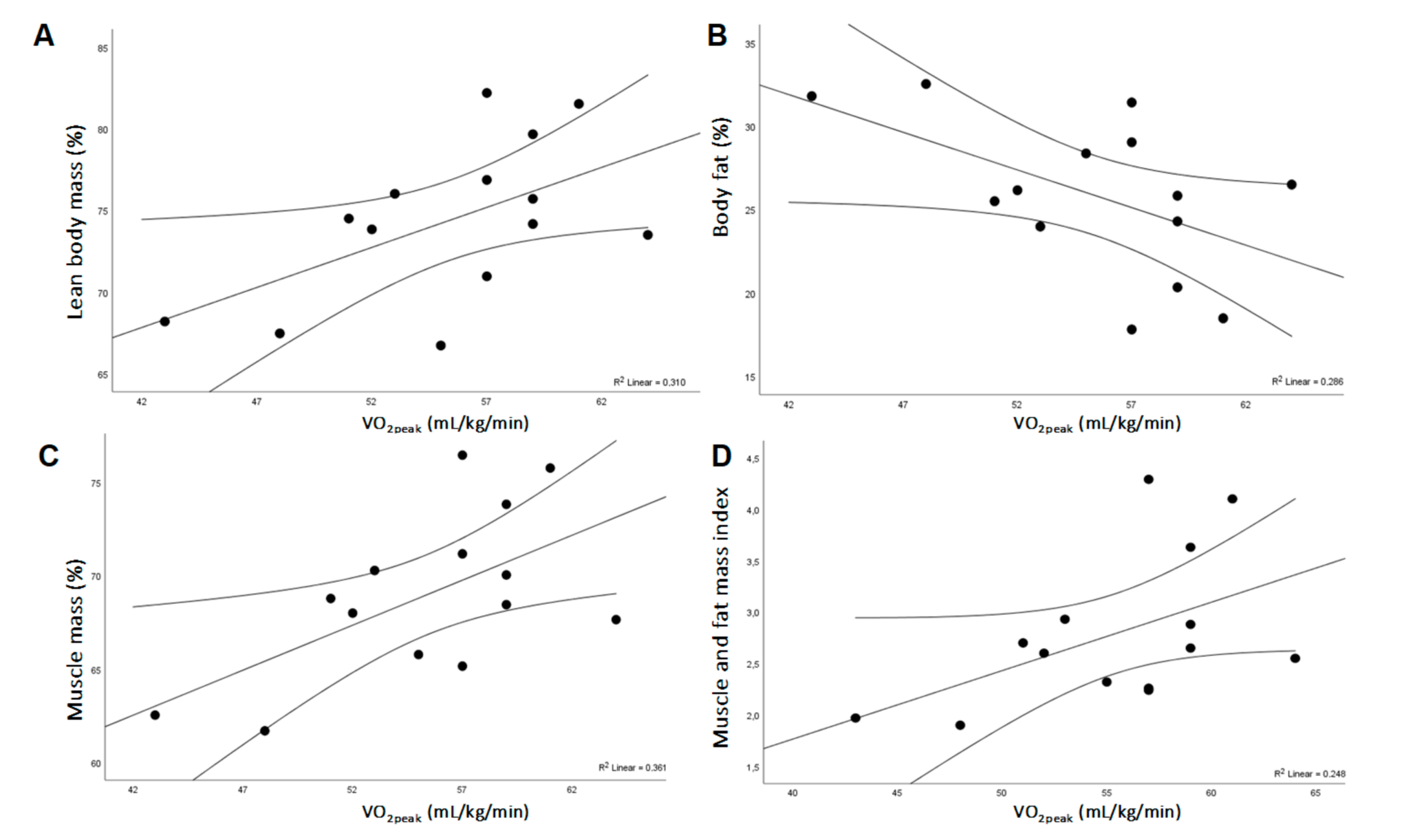
There are about 466 million people with hearing impairments in the world. The scientific literature does not provide sufficient data on the actual nutrition and other variables of professional deaf athletes. The objectives of this study were to investigate and evaluate the body composition, the physical working capacity, the nutrition intake, and the blood parameters of iron and vitamin D in the Lithuanian high-performance deaf women’s basketball team players. The female athletes (n = 14) of the Lithuanian deaf basketball team aged 26.4 ± 4.5 years were recruited for an observational cross-sectional study. A 7-day food recall survey method was used to investigate their actual diet. The measurements of the body composition were performed using the BIA (bioelectrical impedance analysis) tetra-polar electrodes. In order to assess the cardiorespiratory and aerobic fitness levels of athletes, ergo-spirometry (on a cycle ergometer) was used to measure the peak oxygen uptake (VO2peak) and the physical working capacity at a heart rate of 170 beats per minute (PWC170). The athletes’ blood tests were taken to investigate the red blood cells, hemoglobin, 25-hydroxyvitamin D, ferritin, transferrin, iron concentrations, and total iron-binding capacity (TIBC). The consideration of the VO2peak (55.9 ± 6.1 mL/min/kg of body weight, 95% CI: 51.8, 58.9) and the low VO2peak (56–60 mL/min/kg of body weight) (p = 0.966) in the deaf women’s basketball team players revealed no differences. For the deaf female athletes, the PWC170 was equal to 20.3 ± 2.0 kgm/min/kg of body weight and represented only the average aerobic fitness level. The carbohydrate and protein intakes (5.0 ± 1.3 and 1.3 ± 0.3 g/kg of body weight, respectively) met only the minimum levels recommended for athletes. The fat content of the diet (38.1 ± 4.1% of energy intake) exceeded the maximum recommended content (35% of energy intake) (p = 0.012). The mean blood serum concentrations of 25(OH)D and ferritin (24.1 ± 6.6 nmol/L and 11.0 ± 4.1 µg/L, respectively) predicted vitamin D and iron deficits in athletes. Female athletes had an increased risk of vitamin D and iron deficiencies. Regardless of iron deficiency in the body, the better cardiorespiratory fitness of the deaf female athletes was essentially correlated with the higher skeletal muscle mass (in terms of size) (r = 0.61, p = 0.023), the lower percentage of body fat mass (r = −0.53, p = 0.049), and the reduced intake of fat (r = −0.57, p = 0.040).
Keywords: high-performance athletes; deaf athletes; athletes with disabilities; actual nutrition; body composition; cardiorespiratory fitness high-performance athletes; deaf athletes; athletes with disabilities; actual nutrition; body composition; cardiorespiratory fitness