Article

Preventability of Colorectal Cancer in Saudi Arabia: Fraction of Cases Attributable to Modifiable Risk Factors in 2015–2040


by
Abdulmohsen Al-Zalabani
Department of Family and Community Medicine, College of Medicine, Taibah University, Madinah 41541, Saudi Arabia
Int. J. Environ. Res. Public Health 2020, 17(1), 320; https://doi.org/10.3390/ijerph17010320

Submission received: 8 December 2019 / Revised: 25 December 2019 / Accepted: 29 December 2019 / Published: 2 January 2020
(This article belongs to the Section Public Health Statistics and Risk Assessment)

Abstract

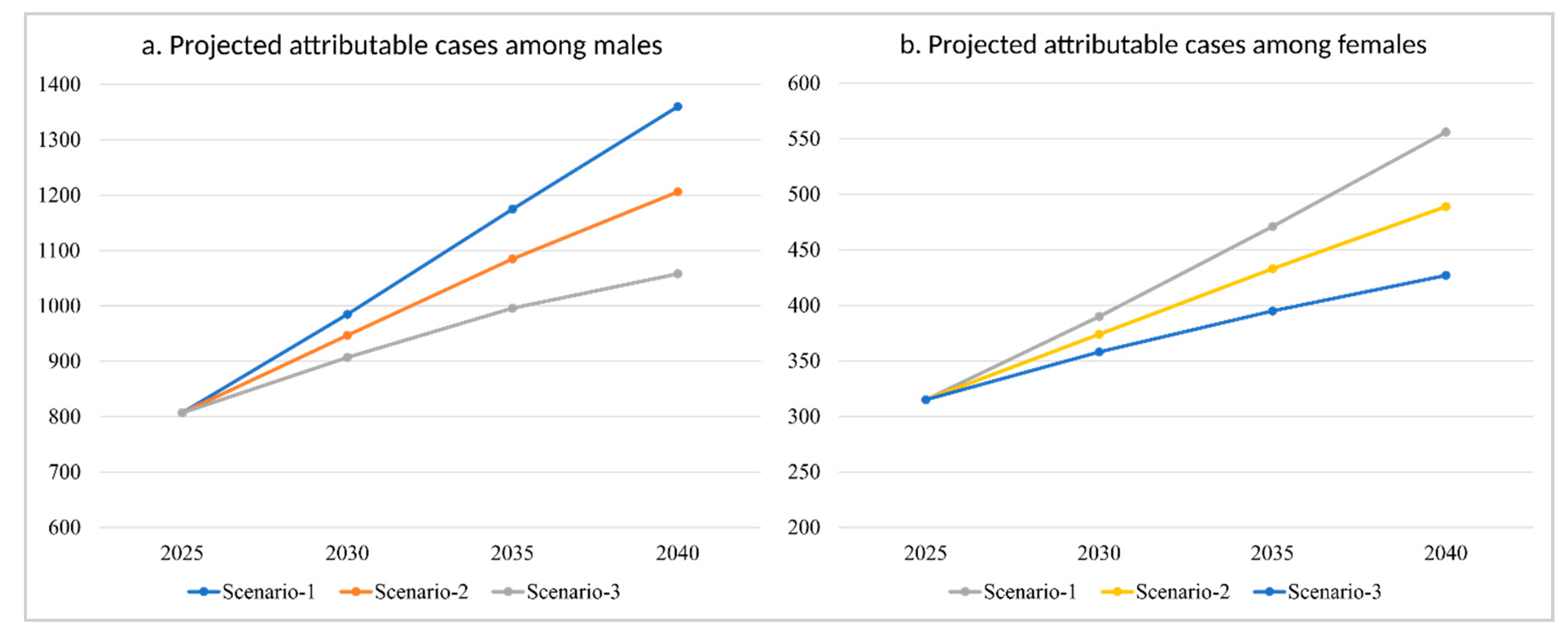
A rise in colorectal cancer (CRC) burden is expected around the globe. This study aimed to determine the population attributable fractions (PAFs) of CRC cases contributed by modifiable risk factors in Saudi Arabia. The PAF was calculated for modifiable risk factors with strong evidences of a causal association with CRC. CRC incidence was obtained from the National Cancer Registry, relative risks were retrieved from recent meta-analysis studies, and the prevalence of exposure to risk factors was obtained from national surveys. Conventional statistical formulas were used to calculate PAFs from registered CRC cases, stratified by sex. Three scenarios were proposed to make projections and present the expected effects of prevention interventions on the number of CRC cases in Saudi Arabia for 2025–2040. The results showed the largest fraction of attributable CRC cases among men and women was contributed by physical inactivity (16.13% and 16.45%), followed by excess weight (obesity: 9.71% and 6.93%; overweight: 6.05% and 1.9%); and tobacco smoking (current smoker: 3.04% and 0.18%; former smoker: 3.29% and 0.12%). We estimated that the number of projected cases attributable to physical inactivity, smoking, and excess weight in men and women would increase from 807 and 315 in 2025 to 1360 and 556 in 2040, respectively. In conclusion, physical inactivity, being overweight or obese, and tobacco smoking are major lifestyle factors affecting the incidence of CRC in Saudi Arabia. Prevention interventions and public health programs to reduce their prevalence are warranted.
Keywords: colorectal neoplasms; population attributable fraction; lifestyle; exercise; tobacco smoking; risk factors; primary prevention; obesity; overweight colorectal neoplasms; population attributable fraction; lifestyle; exercise; tobacco smoking; risk factors; primary prevention; obesity; overweight