

Evaluation of Environmental Contamination and Estimated Radiation Exposure Dose Rates among Residents Immediately after Returning Home to Tomioka Town, Fukushima Prefecture


Abstract
1. Introduction
2. Materials and Methods
2.1. Sampling Points
2.2. Measurement of Air Dose Rates and Radionuclides
2.3. Effective Dose Rate
2.4. Ethics Statement
3. Results
4. Discussion
5. Conclusions
Author Contributions
Funding
Acknowledgments
Conflicts of Interest
References
- International Atomic Energy Agency. The Fukushima Daiichi Accident. In Technical Volume 1. Description and Context of the Accident; International Atomic Energy Agency: Vienna, Austria, 2015; pp. 1–225. [Google Scholar]
- United Nations Scientific Committee on the Effects of Atomic Radiation. Report to the General Assembly, Scientific Annex A: Levels and Effects of Radiation Exposure due to the Nuclear Accident after the 2011 Great East-Japan Earthquake and Tsunami; United Nations: Vienna, Austria, 2013. [Google Scholar]
- Hirose, K. Fukushima Daiichi Nuclear Plant accident: Atmospheric and oceanic impacts over the five years. J. Environ. Radioact. 2016, 157, 113–130. [Google Scholar] [CrossRef] [PubMed]
- Fukushima Prefectural Government, Japan. Fukushima Revitalization Station, The Official Website for Fukushima’s Restoration. Available online: http://www.pref.fukushima.lg.jp/site/portal-english/list385.html (accessed on 1 April 2019).
- The Nuclear Regulation Authority, Japan. Monitoring Information of Environmental Radioactivity Level. Available online: http://radioactivity.nsr.go.jp/en/ (accessed on 1 April 2019).
- Tomioka Town Local Government, Japan. Number of Evacuees in Tomioka Town as of 1 October 2018. Available online: https://www.tomioka-town.jp/oshirase/machi/2029.html (accessed on 1 April 2019). (In Japanese).
- Japan Atomic Energy Agency. Database for Radioactive Substance Monitoring Data. Available online: https://emdb.jaea.go.jp/emdb/en/ (accessed on 1 April 2019).
- The Minisiry of the Environment, Japan. Health & Chemicals. Radiation Health Control Measures. Unified Basic Data on Health Effects by Radiation. Available online: http://www.env.go.jp/chemi/rhm/h29kisoshiryo.html (accessed on 1 April 2019). (In Japanese)
- Naito, W.; Uesaka, M.; Yamada, C.; Kurosawa, T.; Yasutaka, T.; Ishii, H. Relationship between Individual External Doses, Ambient Dose Rates and Individuals’ Activity-Patterns in Affected Areas in Fukushima following the Fukushima Daiichi Nuclear Power Plant Accident. PLoS ONE 2016, 11, e0158879. [Google Scholar] [CrossRef]
- The Minisiry of the Environment, Japan. Environmental Remediation in Japan. Available online: http://josen.env.go.jp/en/pdf/progressseet_progress_on_cleanup_efforts.pdf (accessed on 1 April 2019).
- International Atomic Energy Agency. The Follow-up IAEA International Mission on Remediation of Large Contaminated Areas Off-Site the Fukushima Daiichi Nuclear Power Plant; International Atomic Energy Agency: Vienna, Austria, 2013; pp. 1–57. [Google Scholar]
- International Commission on Radiological Protection. The 2007 Recommendations of the International Commission on Radiological Protection; International Commission on Radiological Protection: Ottawa, Canada, 2007. [Google Scholar]
- Reconstruction Agency, Japan. Basic Guidelines for Reconstruction in Response to the Great East Japan Earthquake in the “Reconstruction and Revitalization Period”. Available online: http://www.reconstruction.go.jp/english/topics/Laws_etc/index.html (accessed on 1 April 2019).
- The Consumer Affairs Agency, Government of Japan. White Paper on Consumer Affairs 2017. Available online: http://www.caa.go.jp/en/publication/annual_report/ (accessed on 1 April 2019).
- Taira, Y.; Hayashida, N.; Yamaguchi, H.; Yamashita, S.; Endo, Y.; Takamura, N. Evaluation of environmental contamination and estimated radiation doses for the return to residents’ homes in Kawauchi Village, Fukushima Prefecture. PLoS ONE 2012, 7, e45816. [Google Scholar] [CrossRef]
- Taira, Y.; Hayashida, N.; Orita, M.; Yamaguchi, H.; Ide, J.; Endo, Y.; Yamashita, S.; Takamura, N. Evaluation of environmental contamination and estimated exposure doses after residents return home in Kawauchi Village, Fukushima Prefecture. Environ. Sci. Technol. 2014, 48, 4556–4563. [Google Scholar] [CrossRef] [PubMed]
- Orita, M.; Hayashida, N.; Taira, Y.; Fukushima, Y.; Ide, J.; Endo, Y.; Kudo, T.; Yamashita, S.; Takamura, N. Measurement of individual doses of radiation by personal dosimeter is important for the return of residents from evacuation order areas after nuclear disaster. PLoS ONE 2015, 10, e0121990. [Google Scholar] [CrossRef] [PubMed]
- Nakashima, K.; Orita, M.; Fukuda, N.; Taira, Y.; Hayashida, N.; Matsuda, N.; Takamura, N. Radiocesium concentrations in wild mushrooms collected in Kawauchi Village after the accident at the Fukushima Daiichi Nuclear Power Plant. PeerJ 2015, 3, e1427. [Google Scholar] [CrossRef]
- Orita, M.; Nakashima, K.; Hayashida, N.; Endo, Y.; Yamashita, S.; Takamura, N. Concentrations of Radiocesium in Local Foods Collected in Kawauchi Village after the Accident at the Fukushima Dai-ichi Nuclear Power Station. Sci. Rep. 2016, 6, 28470. [Google Scholar] [CrossRef] [PubMed]
- The Ministry of Education, Culture, Sports, Science, and Technology, Japan. Environmental Radioactivity and Radiation in Japan. Available online: http://www.kankyo-hoshano.go.jp/en/index.html (accessed on 1 April 2019).
- The International Commission on Radiation Units and Measurements. Gamma-ray Spectrometry in the Environment; International Commission on Radiation Units and Measurements: Bethesda, MD, USA, 1994. [Google Scholar]
- United Nations Scientific Committee on the Effects of Atomic Radiation. Sources and Effects of Ionizing Radiation; UNSCEAR 2000 Report to General Assembly with Scientific Annexes; Annex A: Dose Assessment Methodologies; United Nations: Vienna, Austria, 2000. [Google Scholar]
- International Atomic Energy Agency. Generic Procedures for Assessment and Response during Radiological Emergency; The International Atomic Energy Agency: Vienna, Austria, 2000. [Google Scholar]
- Kanasashi, T.; Sugiura, Y.; Takenaka, C.; Hijii, N.; Umemura, M. Radiocesium distribution in sugi (Cryptomeria japonica) in eastern Japan: Translocation from needles to pollen. J. Environ. Radioact. 2015, 139, 398–406. [Google Scholar] [CrossRef]
- The Ministry of the Environment, Japan. Countermeasures for the Great East Japan Earthquake. Available online: http://www.env.go.jp/en/focus/docs/01_cgeje.html (accessed on 1 April 2019).
- Tagami, K.; Uchida, S.; Uchihori, Y.; Ishii, N.; Kitamura, H.; Shirakawa, Y. Specific activity and activity ratios of radionuclides in soil collected about 20 km from the Fukushima Daiichi Nuclear Power Plant: Radionuclide release to the south and southwest. Sci. Total Environ. 2011, 409, 4885–4888. [Google Scholar] [CrossRef]
- Mück, K.; Pröhl, G.; Likhtarev, I.; Kovgan, L.; Meckbach, R.; Golikov, V. A consistent radionuclide vector after the Chernobyl accident. Health Phys. 2002, 82, 141–156. [Google Scholar] [CrossRef]
- Akama, A.; Kiyono, Y.; Kanazashi, T.; Shinchi, K. Survey of radioactive contamination of sugi (Cryptomeria japonica D. Don) shoots and male flowers in Fukushima prefectures. Jpn. J. For. Environ. 2013, 55, 105–111. [Google Scholar]
- Koizumi, A.; Niisoe, T.; Harada, K.H.; Fujii, Y.; Adachi, A.; Hitomi, T.; Ishikawa, H. (137)Cs trapped by biomass within 20 km of the Fukushima Daiichi Nuclear Power Plant. Environ. Sci. Technol. 2013, 47, 9612–9618. [Google Scholar] [CrossRef]
- Kuroda, K.; Kagawa, A.; Tonosaki, M. Radiocesium concentrations in the bark, sapwood and heartwood of three tree species collected at Fukushima forests half a year after the Fukushima Dai-ichi nuclear accident. J. Environ. Radioact. 2013, 122, 37–42. [Google Scholar] [CrossRef]
- Ohashi, S.; Okada, N.; Tanaka, A.; Nakai, W.; Takano, S. Radial and vertical distributions of radiocesium in tree stems of Pinus densiflora and Quercus serrata 1.5 y after the Fukushima nuclear disaster. J. Environ. Radioact. 2014, 134, 54–60. [Google Scholar] [CrossRef]
- Kato, H.; Onda, Y.; Saidin, Z.H.; Sakashita, W.; Hisadome, K.; Loffredo, N. Six-year monitoring study of radiocesium transfer in forest environments following the Fukushima nuclear power plant accident. J. Environ. Radioact 2018, in press. [Google Scholar] [CrossRef]
- Tsukasaki, A.; Taira, Y.; Orita, M.; Takamura, N. Seven years post-Fukushima: Long-term measurement of exposure doses in Tomioka Town. J. Radiat. Res. 2019, 60, 159–160. [Google Scholar] [CrossRef]
- Fujii, K.; Yamaguchi, N.; Imamura, N.; Kobayashi, M.; Kaneko, S.; Takahashi, M. Effects of radiocesium fixation potentials on 137Cs retention in volcanic soil profiles of Fukushima forests. J. Environ. Radioact. 2019, 198, 126–134. [Google Scholar] [CrossRef]
- The Minisiry of the Environment, Japan. Environmental Remediation. Available online: http://josen.env.go.jp/en/decontamination/ (accessed on 1 April 2019).
- Reconstruction Agency, Japan. Recovery and Reconstruction from the Great East Japan Earthquake. Available online: http://www.reconstruction.go.jp/english/topics/Progress_to_date/index.html (accessed on 1 April 2019).
- Reconstruction Agency, Japan. Press Release on March 9, 2018. The Reconstruction Project in the Area where Return is Difficult in Tomioka Town. Available online: http://www.reconstruction.go.jp/topics/main-cat1/sub-cat1-4/saiseikyoten/material/20180309_kouhyou_tomioka_tokuteifukkosaiseikyotenkuikifukkosaiseikeikaku.pdf (accessed on 1 April 2019). (In Japanese)
- Orita, M.; Fukushima, Y.; Yamashita, S.; Takamura, N. The Need for Forest Decontamination: For the Recovery of Fukushima. Radiat. Prot. Dosim. 2016, 175, 295–296. [Google Scholar] [CrossRef]
- Taira, Y.; Hayashida, N.; Brahmanandhan, G.M.; Nagayama, Y.; Yamashita, S.; Takahashi, J.; Gutevitc, A.; Kazlovsky, A.; Urazalin, M.; Takamura, N. Current concentration of artificial radionuclides and estimated radiation doses from 137Cs around the Chernobyl Nuclear Power Plant, the Semipalatinsk Nuclear Testing Site, and in Nagasaki. J. Radiat. Res. 2011, 52, 88–95. [Google Scholar] [CrossRef]
- The Ministry of Agriculture, Foresty and Fisheres, Japan. The Great East Japan Earthquake. Available online: http://www.maff.go.jp/e/quake/press_110312-1.html (accessed on 1 April 2019).
- Orita, M.; Nakashima, M.; Taira, Y.; Fukuda, T.; Fukushima, Y.; Kudo, T.; Endo, Y.; Yamashita, S.; Takamura, N. Radiocesium concentrations in wild mushrooms after the accident at the Fukushima Daiichi Nuclear Power Station: Follow-up study in Kawauchi village. Sci. Rep. 2017, 7, 6744. [Google Scholar] [CrossRef]
- Tsuchiya, R.; Taira, Y.; Orita, M.; Fukushima, Y.; Endo, Y.; Yamashita, S.; Takamura, N. Radiocesium contamination and estimated internal exposure doses in edible wild plants in Kawauchi Village following the Fukushima nuclear disaster. PLoS ONE 2017, 12, e0189398. [Google Scholar] [CrossRef] [PubMed]
- The World Health Organization. Global Environment Monitoring System (GEMS/Food). Available online: http://www.who.int/foodsafety/areas_work/chemical-risks/gems-food/en/ (accessed on 1 April 2019).
- The Ministry of Health, Labour, and Welfare, Japan. New Standard Limits for Radionuclides in Foods (Provisional Translation); Department of Food Safety, Pharmaceutical & Food Safety Bureau, the Ministry of Health Labour and Welfare. Available online: http://www.mhlw.go.jp/english/topics/2011eq/dl/new_standard.pdf (accessed on 1 April 2019).
- Yoshida, K.; Shinkawa, T.; Urata, H.; Nakashima, K.; Orita, M.; Yasui, K.; Kumagai, A.; Ohtsuru, A.; Yabe, H.; Maeda, M.; et al. Psychological distress of residents in Kawauchi village, Fukushima Prefecture after the accident at Fukushima Daiichi Nuclear Power Station: The Fukushima Health Management Survey. PeerJ 2016, 4, e2353. [Google Scholar] [CrossRef] [PubMed]
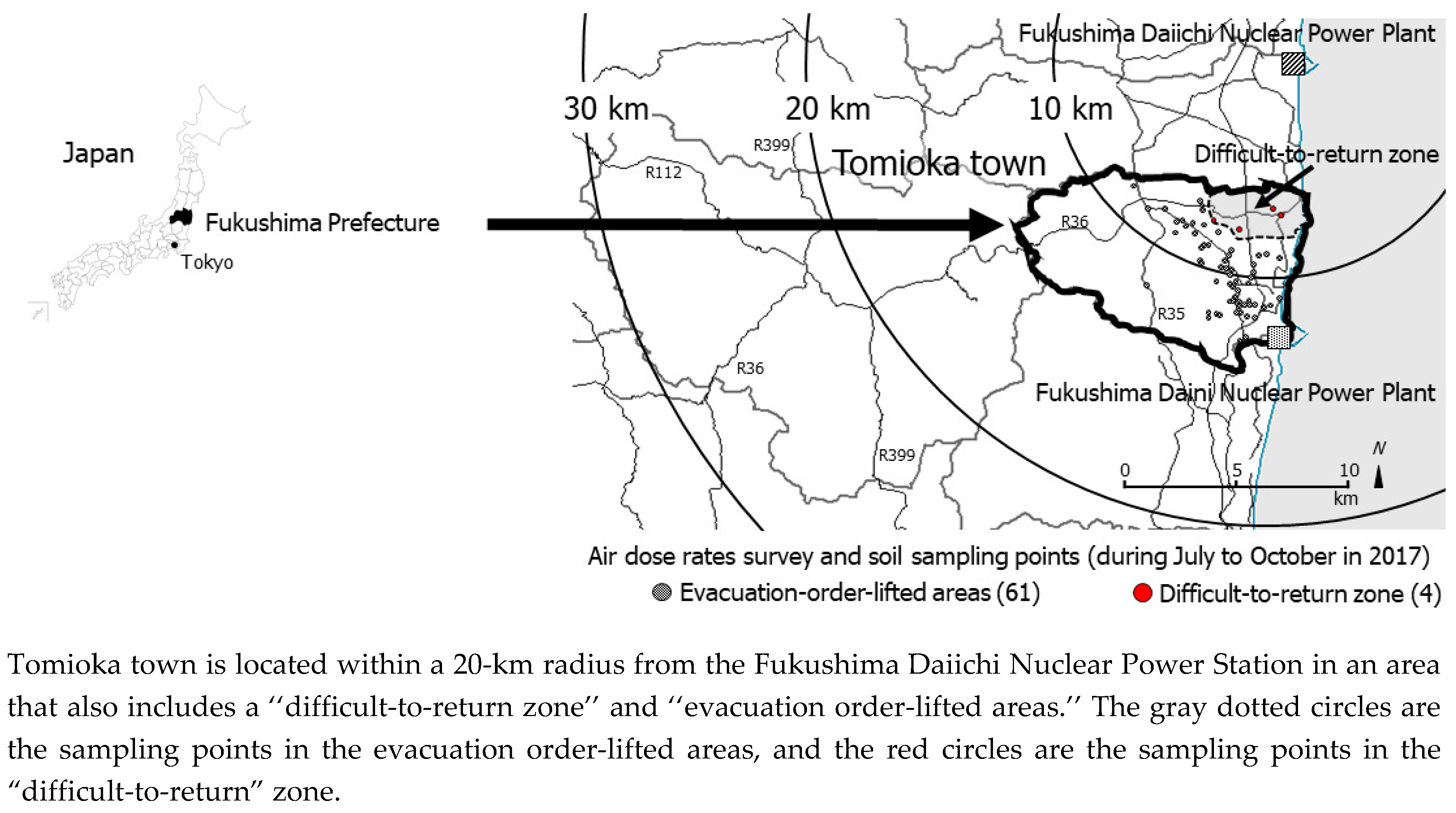
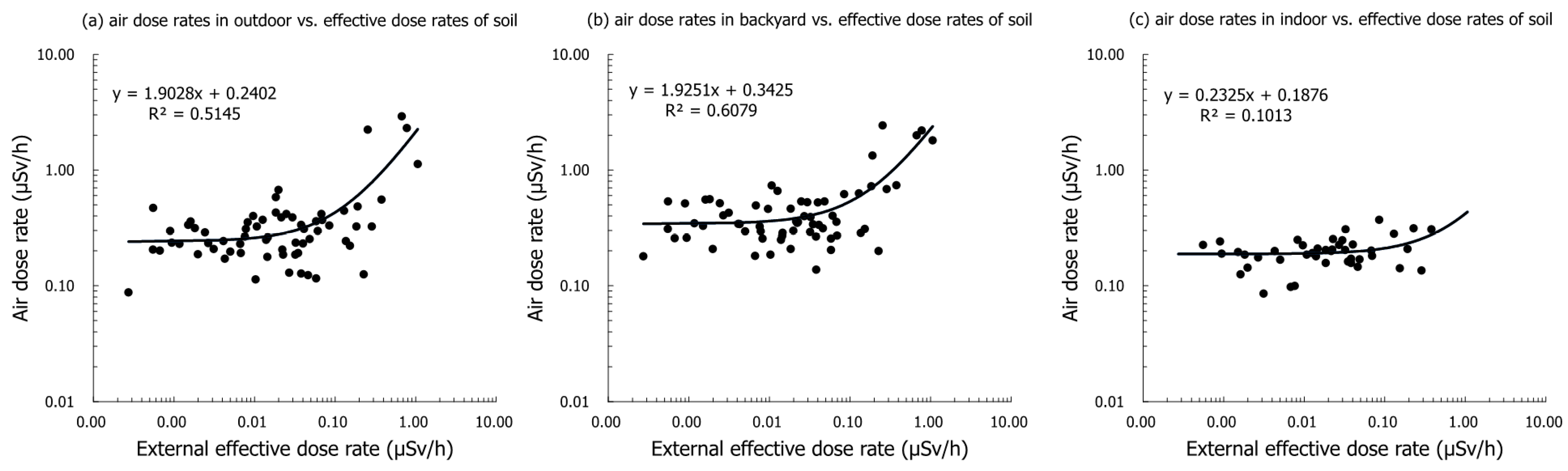
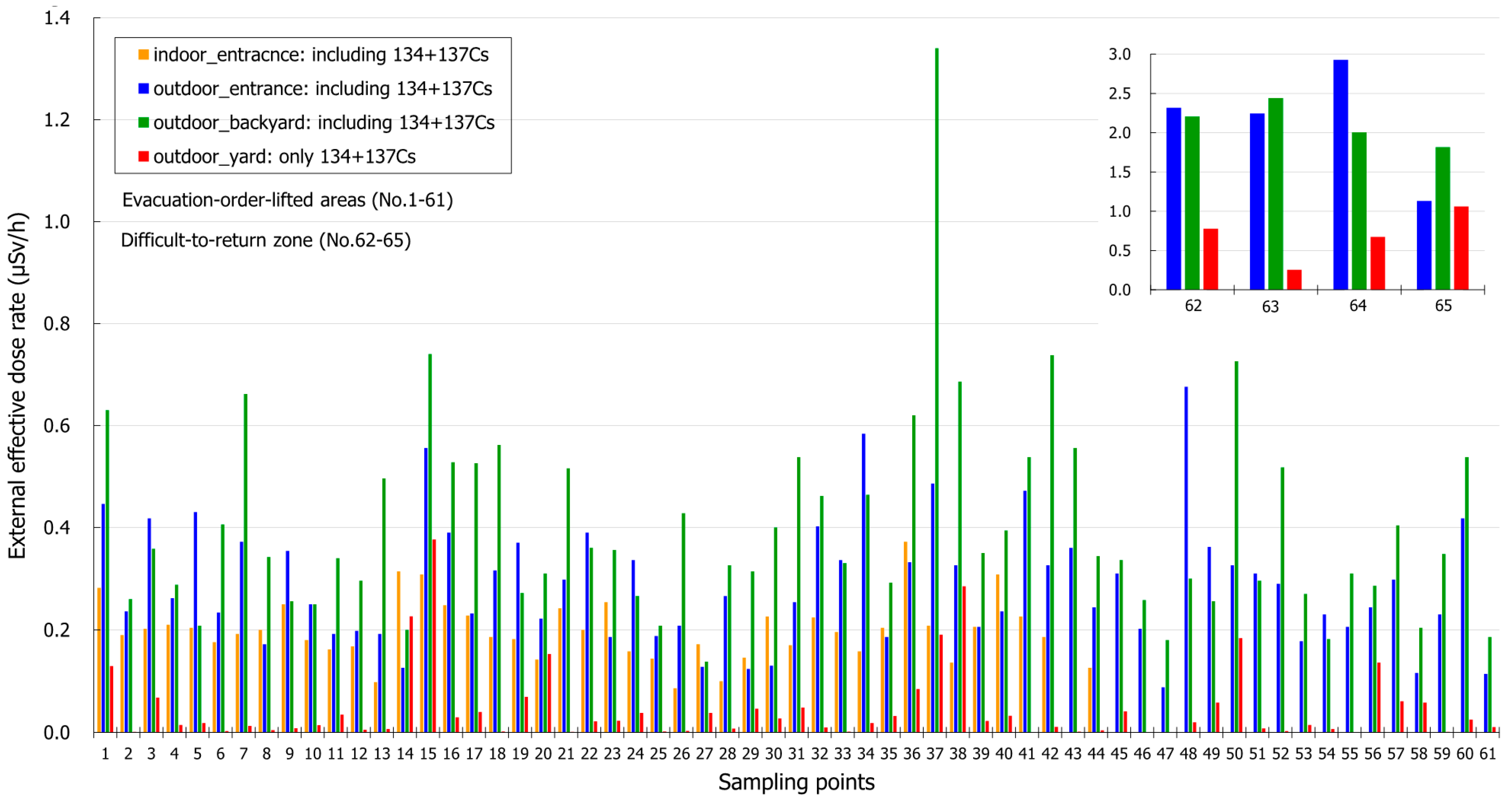

| Points | Air Dose Rate in μSv/h | External Effective Dose Rate in mSv/y | Shielding Factor | |||
|---|---|---|---|---|---|---|
| Average | Range | Median | ||||
| Evacuation order-lifted areas (n = 61) a | Indoors | 0.20 ± 0.058 c | 0.086–0.37 d | 0.20 (0.28) e | 1.7 f | 0.77 g |
| Outdoors | 0.29 ± 0.12 | 0.088–0.68 | 0.26 (0.43) | 2.3 | ||
| Backyard | 0.40 ± 0.19 | 0.14–1.34 | 0.34 (0.63) | 3.0 | ||
| Difficult-to-return zone (n = 4) b | Outdoors | 2.2 ± 0.65 | 1.1–2.9 | 2.3 (2.7) | 20 | |
| Backyard | 2.1 ± 0.23 | 1.8–2.4 | 2.1 (2.4) | 18 | ||
| Points | Radiocesium Concentration in Bq/kg (dry) a | External Effective Dose Rate in mSv/y | Radionuclide Ratio in 134Cs/137Cs | ||||||
|---|---|---|---|---|---|---|---|---|---|
| depth | Average | Range | Median | ||||||
| 134Cs (2.1 y) | 137Cs (30 y) | 134Cs (2.1 y) | 137Cs (30 y) | 134Cs (2.1 y) | 137Cs (30 y) | ||||
| Evacuation-order-lifted areas (n = 61) a | 0–5 cm | 694.3 ± 1137 c | 4996 ± 8421 | 8.0–6063 d | 34–45,331 | 238 (1950) e | 1784 (12,966) | 0.17 f | 0.13 (0.14) g |
| 5–10 cm | 750.0 ± 1035 | 5585 ± 8163 | 3.7–5803 | 28–48,911 | 334 (2016) | 2093 (15,209) | 0.13 (0.14) | ||
| Difficult-to-return zone (n = 4) b | 0–5 cm | 9480 ± 5708 | 72,757 ± 43,211 | 3317–18,552 | 25,559–141,209 | 8025 (15,906) | 62,131 (121,336) | 6.4 | 0.13 (0.13) |
| 5–10 cm | 6739 ± 2067 | 52,343 ± 15,690 | 4654–9034 | 36,317–69,377 | 6633 (8893) | 51,840 (68,551) | 0.13 (0.14) | ||
© 2019 by the authors. Licensee MDPI, Basel, Switzerland. This article is an open access article distributed under the terms and conditions of the Creative Commons Attribution (CC BY) license (http://creativecommons.org/licenses/by/4.0/).
Share and Cite
Matsuo, M.; Taira, Y.; Orita, M.; Yamada, Y.; Ide, J.; Yamashita, S.; Takamura, N. Evaluation of Environmental Contamination and Estimated Radiation Exposure Dose Rates among Residents Immediately after Returning Home to Tomioka Town, Fukushima Prefecture. Int. J. Environ. Res. Public Health 2019, 16, 1481. https://doi.org/10.3390/ijerph16091481
Matsuo M, Taira Y, Orita M, Yamada Y, Ide J, Yamashita S, Takamura N. Evaluation of Environmental Contamination and Estimated Radiation Exposure Dose Rates among Residents Immediately after Returning Home to Tomioka Town, Fukushima Prefecture. International Journal of Environmental Research and Public Health. 2019; 16(9):1481. https://doi.org/10.3390/ijerph16091481
Chicago/Turabian StyleMatsuo, Masahiko, Yasuyuki Taira, Makiko Orita, Yumiko Yamada, Juichi Ide, Shunichi Yamashita, and Noboru Takamura. 2019. "Evaluation of Environmental Contamination and Estimated Radiation Exposure Dose Rates among Residents Immediately after Returning Home to Tomioka Town, Fukushima Prefecture" International Journal of Environmental Research and Public Health 16, no. 9: 1481. https://doi.org/10.3390/ijerph16091481
APA StyleMatsuo, M., Taira, Y., Orita, M., Yamada, Y., Ide, J., Yamashita, S., & Takamura, N. (2019). Evaluation of Environmental Contamination and Estimated Radiation Exposure Dose Rates among Residents Immediately after Returning Home to Tomioka Town, Fukushima Prefecture. International Journal of Environmental Research and Public Health, 16(9), 1481. https://doi.org/10.3390/ijerph16091481

