Article

Identifying Predictors of Changes in Physical Activity Level in Adolescence: A Prospective Analysis in Bosnia and Herzegovina


by
Vesna Miljanovic Damjanovic
1,2,
Lejla Obradovic Salcin
1,2,
Natasa Zenic
3,*,
Nikola Foretic
3 and
Silvester Liposek
4,*
1
Clinic for Physical Medicine and Rehabilitation, University Hospital Mostar, 88000 Mostar, Bosnia and Herzegovina
2
Faculty of Health Sciences, University of Mostar, 88000 Mostar, Bosnia and Herzegovina
3
Faculty of Kinesiology, University of Split, 21000 Split, Croatia
4
University of Maribor, 2000 Maribor, Slovenia
*
Authors to whom correspondence should be addressed.
Int. J. Environ. Res. Public Health 2019, 16(14), 2573; https://doi.org/10.3390/ijerph16142573

Submission received: 1 July 2019 / Revised: 15 July 2019 / Accepted: 17 July 2019 / Published: 18 July 2019
(This article belongs to the Special Issue Physical Activity and Health)

Abstract

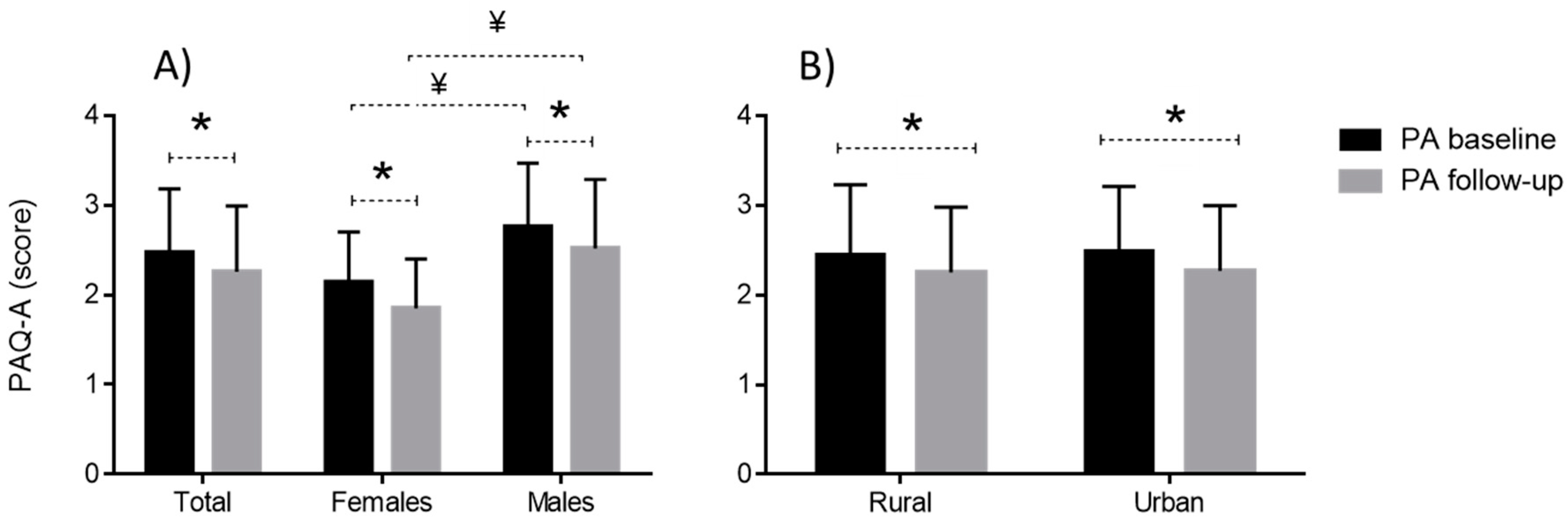
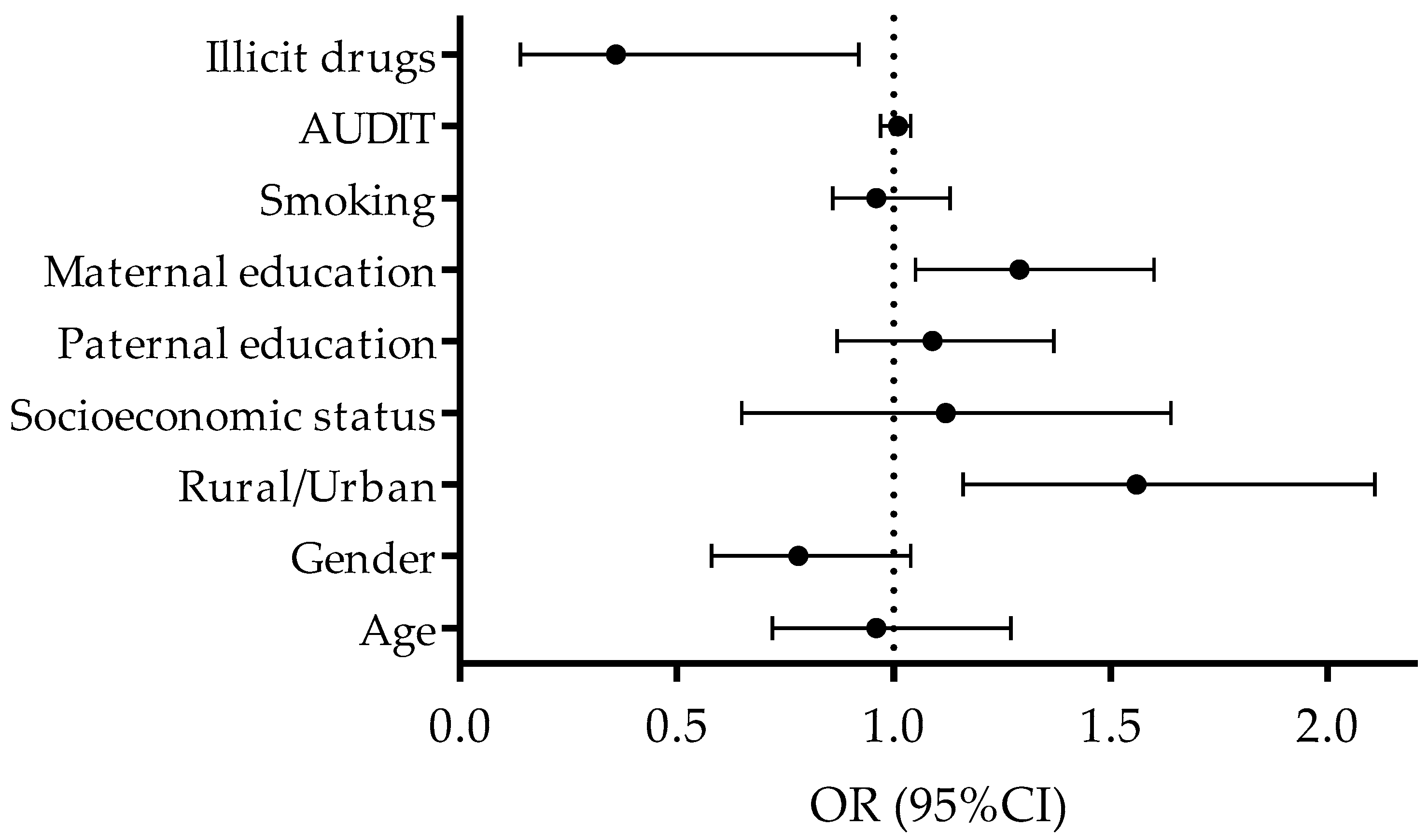
It is known that physical activity levels (PA levels) decline during adolescence, but there is a lack of knowledge on possible predictors of changes in PA levels in this period of life. This study aimed to prospectively investigate the relationship between sociodemographic and behavioral factors (predictors), PA levels and changes in PA levels in older adolescents from Bosnia and Herzegovina. The sample comprised 872 participants (404 females) tested at baseline (16 years of age) and at follow-up (18 years of age). Predictors were sociodemographic characteristics (age, gender, socioeconomic status, urban/rural residence, paternal and maternal education level) and variables of substance misuse (consumption of cigarettes, alcohol and illicit drugs). The PA level, as measured by the Physical Activity Questionnaire for Adolescents (PAQ-A), was observed as a criterion. Boys had higher PAQ-A scores than girls at baseline and follow-up. Paternal education levels were correlated with PAQ-A scores at baseline (Spearman’s R: 0.18, 0.15 and 0.14, p < 0.05, for the total sample, females and males, respectively) and at follow-up (Spearman’s R: 0.12, p < 0.01 for the total sample). Logistic regression, which was used to calculate changes in PA levels between baseline and follow-up as a binomial criterion (PA decline vs. PA incline), evidenced a higher likelihood of PA incline in adolescents whose mothers were more educated (OR: 1.29, 95% CI: 1.05–1.60) and who live in urban communities (OR: 1.56, 95% CI: 1.16–2.10). The consumption of illicit drugs at baseline was evidenced as a factor contributing to the lower likelihood of PA incline (OR: 0.36, 95% CI: 0.14–0.92). The negative relationship between illicit drug consumption and PA decline could be a result of a large number of children who quit competitive sports in this period of life. In achieving appropriate PA-levels, special attention should be placed on children whose mothers are not highly educated, who live in rural communities, and who report the consumption of illicit drugs. The results highlighted the importance of studying correlates of PA levels and changes in PA levels during adolescence.
Keywords: physical activity; substance misuse; puberty; sociodemographic variables physical activity; substance misuse; puberty; sociodemographic variables