


Lunch Salad Bars in New Orleans’ Middle and High Schools: Student Intake of Fruit and Vegetables
 , ,
, ,
Abstract
1. Introduction
2. Materials and Methods
2.1. Study Design
2.2. Participants
2.3. Data Collection
2.4. Data Analysis
3. Results
4. Discussion
5. Conclusions
Acknowledgments
Author Contributions
Conflicts of Interest
References
- Ogden, C.L.; Carroll, M.D.; Kit, B.K.; Flegal, K.M. Prevalence of childhood and adult obesity in the United States, 2011–2012. JAMA 2014, 311, 806–814. [Google Scholar] [CrossRef] [Scilit] [PubMed]
- May, A.L.; Kuklina, E.V.; Yoon, P.W. Prevalence of cardiovascular disease risk factors among US adolescents, 1999–2008. Pediatrics 2012, 129, 1035–1041. [Google Scholar] [CrossRef] [Scilit] [PubMed]
- Sinha, R.; Fisch, G.; Teague, B.; Tamborlane, W.V.; Banyas, B.; Allen, K.; Savoye, M.; Rieger, V.; Taksali, S.; Barbetta, G.; et al. Prevalence of impaired glucose tolerance among children and adolescents with marked obesity. N. Engl. J. Med. 2002, 346, 802–810. [Google Scholar] [CrossRef] [Scilit] [PubMed]
- Sorof, J.M.; Lai, D.; Turner, J.; Poffenbarger, T.; Portman, R.J. Overweight, ethnicity, and the prevalence of hypertension in school-aged children. Pediatrics 2004, 113, 475–482. [Google Scholar] [CrossRef] [Scilit] [PubMed]
- Freedman, D.S.; Khan, L.K.; Serdula, M.K.; Dietz, W.H.; Srinivasan, S.R.; Berenson, G.S. The relation of childhood BMI to adult adiposity: The Bogalusa heart study. Pediatrics 2005, 115, 22–27. [Google Scholar] [CrossRef] [Scilit] [PubMed]
- Freedman, D.S.; Mei, Z.; Srinivasan, S.R.; Berenson, G.S.; Dietz, W.H. Cardiovascular risk factors and excess adiposity among overweight children and adolescents: the Bogalusa Heart Study. J. Pediatr. 2007, 150, 12–17. [Google Scholar] [CrossRef] [Scilit] [PubMed]
- Kelsey, M.M.; Zaepfel, A.; Bjornstad, P.; Nadeau, K.J. Age-related consequences of childhood obesity. Gerontology 2014, 60, 222–228. [Google Scholar] [CrossRef] [Scilit] [PubMed]
- Perez-Escamilla, R.; Obbagy, J.E.; Altman, J.M.; Essery, E.V.; McGrane, M.M.; Wong, Y.P.; Spahn, J.M.; Williams, C.L. Dietary energy density and body weight in adults and children: A systematic review. J. Acad. Nutr. Diet. 2012, 112, 671–684. [Google Scholar] [CrossRef] [Scilit] [PubMed]
- Centers for Disease Control and Prevention. The Health Effects of Overweight and Obesity. Available online: https://www.cdc.gov/healthyweight/effects/ (accessed on 6 April 2017).
- United States Department of Agriculture. Scientific Report of the 2015 Dietary Guidelines Advisory Committee: Advisory Report to the Secretary of Health and Human Services and the Secretary of Agriculture. Available online: https://health.gov/dietaryguidelines/2015-scientific-report/pdfs/scientific-report-of-the-2015-dietary-guidelines-advisory-committee.pdf (accessed on 6 September 2016).
- Kim, S.A.; Moore, L.V.; Galuska, D.; Wright, A.P.; Harris, D.; Grummer-Strawn, L.M.; Merlo, C.L.; Nihiser, A.J.; Rhodes, D.G. Vital signs: Fruit and vegetable intake among children—United States, 2003–2010. Morb. Mortal. Wkly. Rep. 2014, 63, 671–676. [Google Scholar]
- Briefel, R.R.; Wilson, A.; Gleason, P.M. Consumption of low-nutrient, energy-dense foods and beverages at school, home, and other locations among school lunch participants and nonparticipants. J. Am. Diet. Assoc. 2009, 109, S79–S90. [Google Scholar] [CrossRef] [Scilit] [PubMed]
- Cohen, J.F.; Richardson, S.; Parker, E.; Catalano, P.J.; Rimm, E.B. Impact of the new US Department of agriculture school meal standards on food selection, consumption, and waste. Am. J. Prev. Med. 2014, 46, 388–394. [Google Scholar] [CrossRef] [Scilit] [PubMed]
- Institute of Medicine. Local Government Actions to Prevent Childhood Obesity; National Academies Press: Washington, DC, USA, 2009.
- United States Department of Agriculture Food and Nutrition Service. Salad Bars in the National School Lunch Program. Available online: http://www.fns.usda.gov/sites/default/files/SP31-2013os.pdf (accessed on 5 September 2016).
- Model, B.F.L. Solving the Problem of Childhood Obesity within a Generation; White House Task Force on Childhood Obesity: Washington, DC, USA, 2010.
- Government Publishing Office (US). Nutrition Standards in the National School Lunch and School Breakfast Programs. Final Rule. Available online: https://www.gpo.gov/fdsys/pkg/FR-2012-01-26/pdf/2012-1010.pdf (accessed on 26 January 2012).
- Harris, D.M.; Seymour, J.; Grummer-Strawn, L.; Cooper, A.; Collins, B.; DiSogra, L.; Marshall, A.; Evans, N. Let’s move salad bars to schools: A public-private partnership to increase student fruit and vegetable consumption. Child. Obes. 2014, 8, 294–297. [Google Scholar] [CrossRef] [Scilit] [PubMed]
- Slusser, W.M.; Cumberland, W.G.; Browdy, B.L.; Lange, L.; Neumann, C. A school salad bar increases frequency of fruit and vegetable consumption among children living in low-income households. Public Health Nutr. 2007, 10, 1490–1496. [Google Scholar] [CrossRef] [Scilit] [PubMed]
- Adams, M.A.; Pelletier, R.L.; Zive, M.M.; Sallis, J.F. Salad bars and fruit and vegetable consumption in elementary schools: A plate waste study. J. Am. Diet. Assoc. 2005, 105, 1789–1792. [Google Scholar] [CrossRef] [Scilit] [PubMed]
- Terry-McElrath, Y.M.; O’Malley, P.M.; Johnston, L.D. Students Eat More Fruits and Green Vegetables When Schools Have Higher Fruit, Vegetable, and Salad Accessibility. Available online: http://www.bridgingthegapresearch.org/_asset/7qsnlx/BTG_salad_fruit_veg_brief_Jun_14.pdf (accessed on 6 September 2016).
- Andersen, L.; Myers, L.; O’Malley, K.; Mundorf, A.R.; Harris, D.M.; Johnson, C.C. Adolescent student use of school-based salad bars. J. Sch. Health 2015, 85, 722–727. [Google Scholar] [CrossRef] [Scilit] [PubMed]
- Kipnis, V.; Subar, A.F.; Midthune, D.; Freedman, L.S.; Ballard-Barbash, R.; Troiano, R.P.; Bingham, S.; Schoeller, D.A.; Schatzkin, A.; Carroll, R.J. Structure of dietary measurement error: Results of the OPEN biomarker study. Am. J. Epidemiol. 2003, 158, 14–21. [Google Scholar] [CrossRef] [Scilit] [PubMed]
- Kirkpatrick, S.I.; Subar, A.F.; Douglass, D.; Zimmerman, T.P.; Thompson, F.E.; Kahle, L.L.; George, S.M.; Dodd, K.W.; Potischman, N. Performance of the automated self-administered 24-hour recall relative to a measure of true intakes and to an interviewer-administered 24-h recall. Am. J. Clin. Nutr. 2014, 100, 233–240. [Google Scholar] [CrossRef] [Scilit] [PubMed]
- Moshfegh, A.J.; Rhodes, D.G.; Baer, D.J.; Murayi, T.; Clemens, J.C.; Rumpler, W.V.; Sebastian, R.S.; Kuczynski, K.J.; Ingwersen, L.A.; Staples, R.C.; et al. The US department of agriculture automated multiple-pass method reduces bias in the collection of energy intakes. Am. J. Clin. Nutr. 2008, 88, 324–332. [Google Scholar] [PubMed]
- United States Department of Agriculture. Food and Nutrient Database for Dietary Studies; Agricultural Research Service: Beltsville, MD, USA, 2010.
- Bowman, S.A.; Friday, J.E.; Moshfeg, A.J. MyPyramid Equivalents Database, 2.0 for USDA Survey Foods, 2003–2004; Beltsville Human Nutrition Research Center, Agricultural Research Service, US Department of Agriculture: Beltsville, MD, USA, 2008. [Google Scholar]
- SAS Insitute. SAS® 9.3; SAS Institute Inc.: Cary, NC, USA, 2011; Available online: http://support.sas.com/documentation/cdl/en/lestmtsref/63323/PDF/default/lestmtsref.pdf (accessed on 5 September 2016).
- Centers for Disease Control and Prevention. Promoting and Supporting School Salad Bars: An Action Guide for State Health Practitioners; US Department of Health and Human Services: Atlanta, GA, USA, 2015.
- Gosliner, W. School-level factors associated with increased fruit and vegetable consumption among students in California middle and high schools. J. Sch. Health 2014, 84, 559–568. [Google Scholar] [CrossRef] [Scilit] [PubMed]
- Adams, M.A.; Bruening, M.; Ohri-Vachaspati, P. Use of salad bars in schools to increase fruit and vegetable consumption: Where’s the evidence? J. Acad. Nutr. Diet. 2015, 115, 1233–1236. [Google Scholar] [CrossRef] [Scilit] [PubMed]
- Hanks, A.S.; Just, D.R.; Brumberg, A. Marketing vegetables in elementary school cafeterias to increase uptake. Pediatrics 2016, 138, e20151420. [Google Scholar] [CrossRef] [Scilit] [PubMed]
- Huynh, L.M.; Pirie, P.; Klein, E.G.; Kaye, G.; Moore, R. Identifying associations between format and placement of school salad bars and fruit and vegetable selection. J. Child Nutr. Manag. 2015, 39, 1–11. [Google Scholar]
- Thompson, F.E.; Subar, A.F. Dietary Assessment Methodology Nutrition in the Prevention and Treatment of Disease; Academic Press: London, UK, 2013; pp. 5–46. [Google Scholar]
- Jonnalagadda, S.S.; Mitchell, D.C.; Smiciklas-Wright, H.; Meaker, K.B.; Van Heel, N.; Karmally, W.; Ershow, A.G.; Kris-Etherton, P.M. Accuracy of energy intake data estimated by a multiple-pass, 24-hour dietary recall technique. J. Am. Diet. Assoc. 2000, 100, 303–311. [Google Scholar] [CrossRef] [Scilit]
- Kubena, K.S. Accuracy in dietary assessment: On the road to good science. J. Am. Diet. Assoc. 2000, 100, 775–776. [Google Scholar] [CrossRef] [Scilit]
- Schoeller, D.A. Limitations in the assessment of dietary energy intake by self-report. Metabolism 1995, 44, 18–22. [Google Scholar] [CrossRef] [Scilit]
- Diep, C.S.; Hingle, M.; Chen, T.A.; Dadabhoy, H.R.; Beltran, A.; Baranowski, J.; Subar, A.F.; Baranowski, T. The automated self-administered 24-hour dietary recall for children, 2012 version, for youth aged 9 to 11 years: A validation study. J. Acad. Nutr. Diet. 2015, 115, 1591–1598. [Google Scholar] [CrossRef] [Scilit] [PubMed]

| Variable | SB Schools | No SB Schools | All Schools |
|---|---|---|---|
| n (%) | n (%) | n (%) | |
| 447 (67.3) 1 | 271 (50.1) | 718 (100) | |
| Gender | |||
| Female | 287 (64.2) | 174 (64.4) | 461 (64.1) |
| Male | 160 (35.8) | 96 (35.6) | 256 (35.7) |
| Race/ethnicity | |||
| Black | 383 (86.7) | 244 (91.0) | 627 (88.3) |
| Other races | 59 (13.3) | 24 (9.0) | 83 (11.7) |
| Grade level 1 | |||
| 7 | 123 (27.5) | 106 (39.1) | 229 (31.9) |
| 8 | 157 (35.1) | 116 (42.8) | 273 (38.0) |
| High School | 167 (37.4) | 49 (18.1) | 216 (30.1) |
| 9 | 33 (7.4) | 19 (7.0) | 52 (7.2) |
| 10 | 34 (7.6) | 7 (2.6) | 41 (5.7) |
| 11 | 36 (8.1) | 11 (4.1) | 47 (6.6) |
| 12 | 64 (14.3) | 12 (4.4) | 76 (10.6) |
| Mean (standard deviation) | |||
| Age (years) | 14.70 2 (1.93) | 14.00 (1.55) | 14.42 (1.83) |
| Food Groups | Students in All Schools n = 611 | Students in Schools with Salad Bars n = 379 | Students in Schools without Salad Bars n = 232 | p 1 |
|---|---|---|---|---|
| Median (IQR) | Median (IQR) | Median (IQR) | ||
| Total fruit (n) | 524 | 308 | 216 | |
| cup | 0.17 (0.64) | 0.06 (0.48) | 0.25 (0.80) | 0.0061 |
| % from lunch | 17.6 (63.7) | 7.0 (62.2) | 30.5 (67.7) | 0.0357 |
| Total vegetable (n) | 589 | 362 | 227 | |
| cup | 0.25 (0.68) | 0.32 (0.73) | 0.23 (0.55) | 0.6690 |
| % from lunch | 25.0 (56.8) | 26.8 (65.1) | 22.1 (49.5) | 0.4686 |
| Total grain (n) | 610 | 378 | 232 | |
| oz | 1.24 (1.50) | 1.38 (1.75) | 0.98 (1.51) | 0.1267 |
| % from lunch | 22.6 (29.5) | 24.4 (32.6) | 18.5 (25.3) | 0.1037 |
| Total dairy (n) | 582 | 361 | 221 | |
| cup | 0.45 (0.99) | 0.50 (0.97) | 0.30 (1.00) | 0.0737 |
| % from lunch | 31.7 (58.1) | 36.1 (59.7) | 26.6 (51.7) | 0.0628 |
| Total protein (n) | 578 | 357 | 221 | |
| oz | 0.95 (1.92) | 0.99 (1.98) | 0.81 (1.49) | 0.8805 |
| % from lunch | 24.2 (53.1) | 22.9 (52.4) | 26.4 (47.7) | 0.9576 |
| Energy consumed (n) | 611 | 379 | 232 | |
| kcal | 432 (340) | 452 (319) | 395 (358) | 0.0136 |
| % from lunch | 23.9 (18.8) | 25.7 (19.5) | 20.8 (17.3) | 0.0510 |
| % Students not eating lunch | 15.9 | 15.7 | 16.2 | 0.8572 |
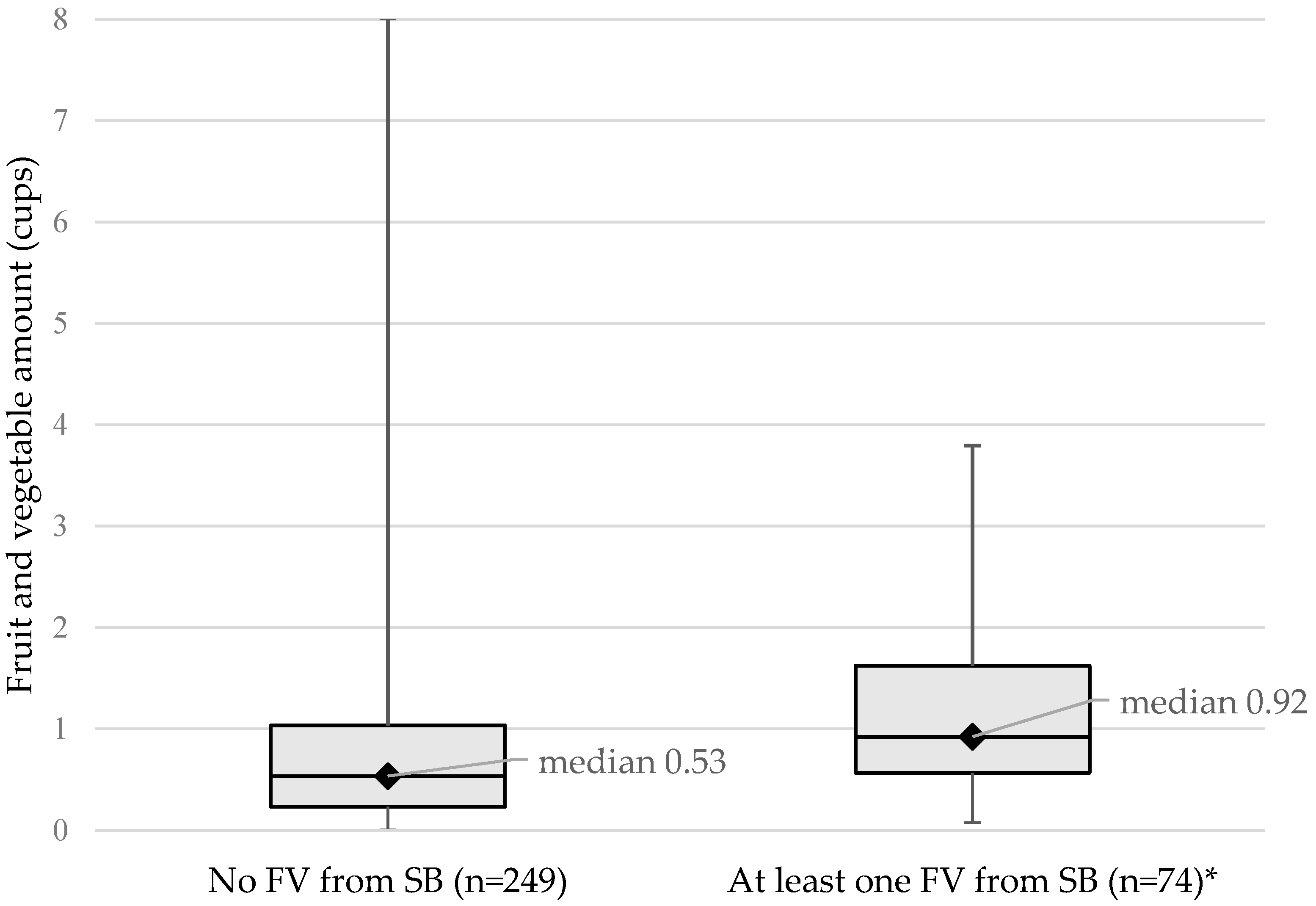
| Food Source | Schools with Salad Bars | Schools without Salad Bars | ||
|---|---|---|---|---|
| n = 323 | n = 213 | |||
| n (%) | Median 1 (IQR) | n (%) | Median 1 (IQR) | |
| Cafeteria main line | 145 (45) | 0.50 (0.74) | 155 (73) | 0.76 (0.90) |
| Cafeteria a la carte line | 4 (1) | 1.10 (0.40) | 5 (2) | 0.64 (0.21) |
| Cafeteria salad bar | 19 (6) | 0.56 (0.64) | - | - |
| School, not in cafeteria | 15 (5) | 0.23 (0.38) | 1 (<1) | 0.15 (0) |
| Home, friends or family | 31 (10) | 0.42 (0.68) | 13 (6) | 0.44 (0.96) |
| Food stores and restaurants | 29 (9) | 0.60 (0.59) | 19 (9) | 0.75 (0.91) |
| Multiple sources | 80 (24) | 0.99 (1.08) | 20 (9) | 1.10 (0.90) |
© 2017 by the authors. Licensee MDPI, Basel, Switzerland. This article is an open access article distributed under the terms and conditions of the Creative Commons Attribution (CC BY) license (http://creativecommons.org/licenses/by/4.0/).
Share and Cite
Johnson, C.C.; Myers, L.; Mundorf, A.R.; O’Malley, K.; Spruance, L.A.; Harris, D.M. Lunch Salad Bars in New Orleans’ Middle and High Schools: Student Intake of Fruit and Vegetables. Int. J. Environ. Res. Public Health 2017, 14, 415. https://doi.org/10.3390/ijerph14040415
Johnson CC, Myers L, Mundorf AR, O’Malley K, Spruance LA, Harris DM. Lunch Salad Bars in New Orleans’ Middle and High Schools: Student Intake of Fruit and Vegetables. International Journal of Environmental Research and Public Health. 2017; 14(4):415. https://doi.org/10.3390/ijerph14040415
Chicago/Turabian StyleJohnson, Carolyn C., Leann Myers, Adrienne R. Mundorf, Keelia O’Malley, Lori Andersen Spruance, and Diane M. Harris. 2017. "Lunch Salad Bars in New Orleans’ Middle and High Schools: Student Intake of Fruit and Vegetables" International Journal of Environmental Research and Public Health 14, no. 4: 415. https://doi.org/10.3390/ijerph14040415
APA StyleJohnson, C. C., Myers, L., Mundorf, A. R., O’Malley, K., Spruance, L. A., & Harris, D. M. (2017). Lunch Salad Bars in New Orleans’ Middle and High Schools: Student Intake of Fruit and Vegetables. International Journal of Environmental Research and Public Health, 14(4), 415. https://doi.org/10.3390/ijerph14040415

