Long-Term Postoperative Patient-Reported Quality of Life After Endoscopic Surgery for Sinonasal Inverted Papilloma: A Longitudinal Cohort Study

 , ,
, ,
Abstract
1. Introduction
2. Materials and Methods
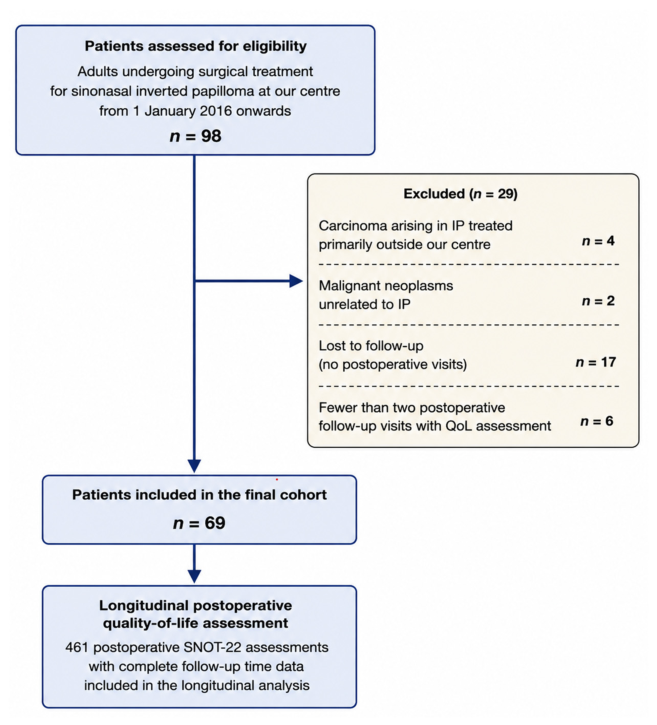
2.1. Study Design and Population
2.2. Follow-Up Protocol and Data Collection
2.3. Quality-of-Life Instruments
2.4. Clinical Variables
2.5. Statistical Analysis
2.6. Ethics
3. Results
3.1. Baseline Characteristics
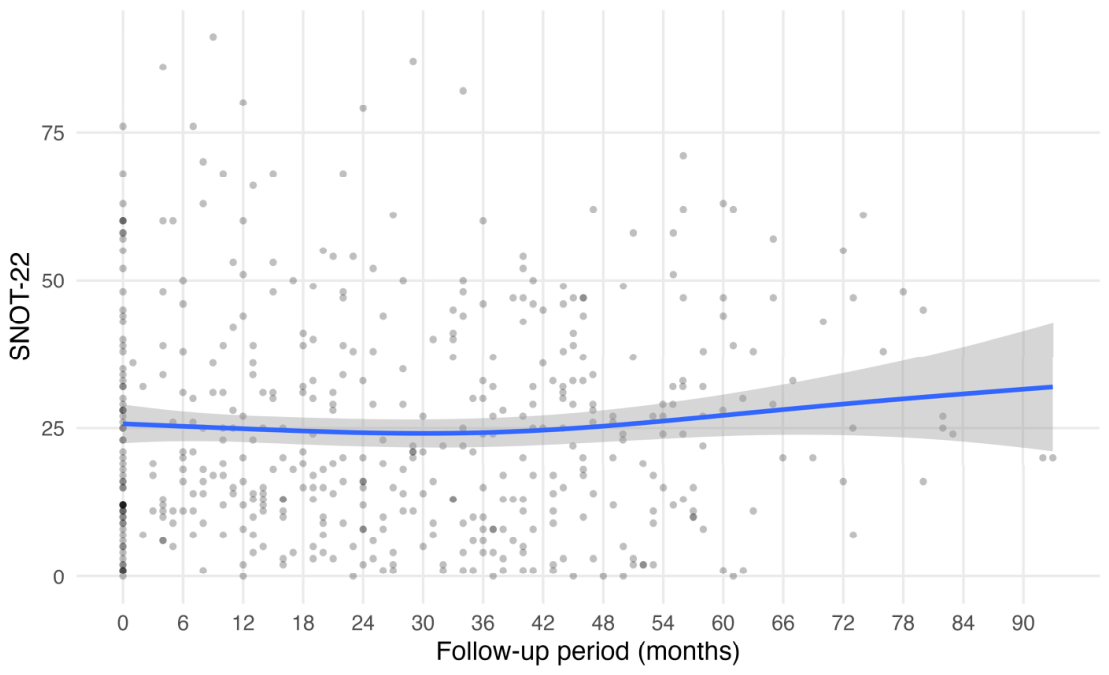
3.2. Longitudinal Course of SNOT-22
3.3. Quality of Life: SNOT-22 and WHOQOL-BREF
4. Discussion
5. Conclusions
Supplementary Materials
Author Contributions
Funding
Institutional Review Board Statement
Informed Consent Statement
Data Availability Statement
Conflicts of Interest
Abbreviations
| CI | Confidence interval |
| CRSwNP | Chronic rhinosinusitis with nasal polyps |
| CT | Computed tomography |
| ENT | Otorhinolaryngology |
| GAM | Generalised additive model |
| HRQoL | Health-related quality of life |
| IP | Inverted papilloma |
| IQR | Interquartile range |
| LMM | Linear mixed-effects model |
| MRI | Magnetic resonance imaging |
| PROM | Patient-reported outcome measure |
| QoL | Quality of life |
| REML | Restricted maximum likelihood |
| SCC | Squamous cell carcinoma |
| SD | Standard deviation |
| SNOT-22 | Sino-Nasal Outcome Test-22 |
| WHO | World Health Organization |
| WHOQOL-BREF | World Health Organization Quality of Life-BREF |
References
- Lisan, Q.; Laccourreye, O.; Bonfils, P. Sinonasal inverted papilloma: From diagnosis to treatment. Eur. Ann. Otorhinolaryngol. Head. Neck Dis. 2016, 133, 337–341. [Google Scholar] [CrossRef] [Scilit] [PubMed]
- Wang, M.J.; Noel, J.E. Etiology of sinonasal inverted papilloma: A narrative review. World J. Otorhinolaryngol. Head. Neck Surg. 2016, 3, 54–58. [Google Scholar] [CrossRef] [Scilit] [PubMed]
- Adriaensen, G.F.; Lim, K.H.; Georgalas, C.; Reinartz, S.M.; Fokkens, W.J. Challenges in the management of inverted papilloma: A review of 72 revision cases. Laryngoscope 2016, 126, 322–328. [Google Scholar] [CrossRef] [Scilit] [PubMed]
- Peng, R.; Thamboo, A.; Choby, G.; Ma, Y.; Zhou, B.; Hwang, P.H. Outcomes of sinonasal inverted papilloma resection by surgical approach: An updated systematic review and meta-analysis. Int. Forum Allergy Rhinol. 2019, 9, 573–581. [Google Scholar] [CrossRef] [Scilit] [PubMed]
- Yu, S.; Grose, E.; Lee, D.J.; Wu, V.; Pellarin, M.; Lee, J.M. Evaluation of inverted papilloma recurrence rates and factors associated with recurrence after endoscopic surgical resection: A retrospective review. J. Otolaryngol. Head. Neck Surg. 2023, 52, 34. [Google Scholar] [CrossRef] [Scilit] [PubMed]
- Eide, J.G.; Welch, K.C.; Adappa, N.D.; Palmer, J.N.; Tong, C.C.L. Sinonasal inverted papilloma and squamous cell carcinoma: Contemporary management and patient outcomes. Cancers 2022, 14, 2195. [Google Scholar] [CrossRef] [Scilit] [PubMed]
- Re, M.; Gioacchini, F.M.; Bajraktari, A.; Tomasetti, M.; Kaleci, S.; Rubini, C.; Bertini, A.; Magliulo, G.; Pasquini, E. Malignant transformation of sinonasal inverted papilloma and related genetic alterations: A systematic review. Eur. Arch. Otorhinolaryngol. 2017, 274, 2991–3000. [Google Scholar] [CrossRef] [Scilit] [PubMed]
- Ambrosini-Spaltro, A.; Querzoli, G.; Leucci, A.C.; Camagni, A.; Farneti, P.; D’Angelo, E.; Donini, E.; Tosoni, A.; Pasquini, E.; Galli, P.; et al. Risk Factors for Malignant Transformation in Inverted Sinonasal Papilloma: A Systematic Review and Meta-Analysis. Cancers 2025, 17, 1798. [Google Scholar] [CrossRef] [Scilit] [PubMed]
- van Zijl, F.V.W.J.; Monserez, D.A.; Korevaar, T.I.M.; Bugter, O.; Wieringa, M.; de Jong, R.B.; Hardillo, J. Postoperative value of serum squamous cell carcinoma antigen as a predictor of recurrence in sinonasal inverted papilloma. Clin. Otolaryngol. 2017, 42, 528–535. [Google Scholar] [CrossRef] [Scilit]
- Higginson, I.J.; Carr, A.J. Using quality of life measures in the clinical setting. BMJ 2001, 322, 1297–1300. [Google Scholar] [CrossRef] [Scilit] [PubMed]
- WHOQOL Group. The World Health Organization Quality of Life assessment (WHOQOL): Position paper from the World Health Organization. Soc. Sci. Med. 1995, 41, 1403–1409. [Google Scholar] [CrossRef] [Scilit] [PubMed]
- Schipper, H. Quality of life: Principles of the clinical paradigm. J. Psychosoc. Oncol. 1990, 8, 171–185. [Google Scholar]
- Georgalas, C.; Badloe, R.; van Furth, W.; Reinartz, S.; Fokkens, W. Quality of life in extended endonasal approaches for skull base tumours. Rhinology 2012, 50, 255–261. [Google Scholar] [CrossRef] [Scilit]
- Jaracz, K.; Kalfoss, M.; Górna, K.; Bączyk, G. Quality of life in Polish respondents: Psychometric properties of the Polish WHOQOL-BREF. Scand. J. Caring Sci. 2006, 20, 251–260. [Google Scholar] [CrossRef] [Scilit] [PubMed]
- Oppermann, P.O.; Rabaioli, L.; Feijó, C.; Pilati, N.P.; Hrisomalos, E.N.; Migliavacca, R.d.O.; Lavinsky-Wolff, M. Overall quality of life impact on candidates for septorhinoplasty according to the WHOQOL-BREF. Braz. J. Otorhinolaryngol. 2022, 88, 570–575. [Google Scholar] [CrossRef] [Scilit] [PubMed]
- DeConde, A.S.; Mace, J.C.; Bodner, T.; Hwang, P.H.; Rudmik, L.; Soler, Z.M.; Smith, T.L. SNOT-22 quality-of-life domains differentially predict treatment modality selection in chronic rhinosinusitis. Int. Forum Allergy Rhinol. 2014, 4, 972–979. [Google Scholar] [CrossRef] [Scilit] [PubMed]
- Chowdhury, N.I.; Mace, J.C.; Smith, T.L.; Rudmik, L. What drives productivity loss in chronic rhinosinusitis? A SNOT-22 subdomain analysis. Laryngoscope 2018, 128, 23–30. [Google Scholar] [CrossRef] [Scilit] [PubMed]
- Hopkins, C.; Gillett, S.; Slack, R.; Lund, V.; Browne, J. Psychometric validity of the 22-item Sinonasal Outcome Test. Clin. Otolaryngol. 2009, 34, 447–454. [Google Scholar] [CrossRef] [Scilit] [PubMed]
- Abiri, A.; Hong, E.M.; Dilley, K.K.; Nguyen, T.V.; Salmon, M.K.; Grose, E.M.; Tripathi, S.H.; Venkatesh, S.; Kim, Y.; Lee, D.J.; et al. Quality-of-life outcomes following endoscopic resection of sinonasal inverted papilloma. Laryngoscope 2025, 135, 579–585. [Google Scholar] [CrossRef] [Scilit] [PubMed]
- van Samkar, A.; Georgalas, C. Long-term quality of life after endoscopic removal of sinonasal inverted papillomas: A 6-year cohort analysis in a tertiary academic hospital. Eur. Arch. Otorhinolaryngol. 2016, 273, 1433–1437. [Google Scholar] [CrossRef] [Scilit] [PubMed]
- den Heijer, M.C.; Joustra, G.E.; Vermeulen, K.M.; Korsten-Meijer, A.G.W.; Feijen, R.A. Sinonasal inverted papilloma and predictors of health-related quality of life after endonasal endoscopic surgery: A prospective cohort study. Clin. Otolaryngol. 2024, 49, 453–461. [Google Scholar] [CrossRef] [Scilit]
- Viitasalo, S.; Sintonen, H.; Lilja, M.; Hytonen, M.; Aaltonen, L.-M. Quality of life after operative treatment of sinonasal inverted papilloma: A prospective study. Rhinology 2023, 61, 71–76. [Google Scholar] [PubMed]
- Chow, V.J.; Tsetsos, N.; Poutoglidis, A.; Georgalas, C. Quality of life in sinonasal tumors: An up-to-date review. Curr. Opin. Otolaryngol. Head. Neck Surg. 2022, 30, 46–57. [Google Scholar] [CrossRef] [Scilit] [PubMed]
- Kuan, E.C.; Wang, E.W.; Adappa, N.D.; Beswick, D.M.; London, N.R.; Su, S.Y.; Wang, M.B.; Abuzeid, W.M.; Alexiev, B.; Alt, J.A.; et al. International consensus statement on allergy and rhinology: Sinonasal tumors. Int. Forum Allergy Rhinol. 2024, 14, 191–274. [Google Scholar] [CrossRef] [Scilit] [PubMed]
- Morawska, J.; Jeruzal-Świątecka, J.; Politański, P.; Pietruszewska, W. Sino-Nasal Outcome Test-22: Translation, cross-cultural adaptation, and validation in Polish-speaking patients. Eur. Arch. Otorhinolaryngol. 2024, 281, 6431–6443. [Google Scholar] [CrossRef] [Scilit] [PubMed]
- Kowalska, M.; Humeniuk, M.; Danso, F.; Kułak, E.; Arasiewicz, H. Quality of life of occupationally active people aged 45–60 living in a Polish industrial region. Med. Pr. 2011, 62, 455–463. [Google Scholar] [PubMed]



| Variable | N = 69 1 |
|---|---|
| Age, years | 61.7 (12.5) |
| Sex | |
| Female | 29/69 (42%) |
| Male | 40/69 (58%) |
| Smoking status | 31/69 (45%) |
| Krouse stage | |
| T1 | 5/69 (7%) |
| T2 | 40/69 (58%) |
| T3 | 22/69 (32%) |
| T4 | 2/69 (3%) |
| Previous sinonasal surgery 2 | 33/69 (48%) |
| Number of previous surgeries | |
| 1 | 21/69 (30%) |
| 2 | 6/69 (9%) |
| 3 | 4/69 (6%) |
| ≥7 3 | 2/69 (3%) |
| Type of previous surgical approach | |
| Endoscopic | 22/69 (32%) |
| Classical polypectomy | 11/69 (16%) |
| Open approach | 3/69 (4.3%) |
| Tumour debulking | 3/69 (4.3%) |
| Hybrid approach | 0/69 (0%) |
| Maxillectomy | 0/69 (0%) |
| Follow-up duration, months | 63.1 (27.8) |
| Recurrence | 21/69 (30%) |
| Postoperative SNOT-22 score | 25.4 (19.8) |
| Side | |
| Left | 28/69 (41%) |
| Right | 41/69 (59%) |
| Tumour location | |
| Maxillary sinus | 41/69 (59%) |
| Ethmoid sinus | 11/69 (17%) |
| Nasal cavity | 9/69 (13%) |
| Frontal sinus | 5/69 (7%) |
| Nasal septum | 2/69 (3%) |
| Sphenoid sinus | 1/69 (1%) |
| Variable | Beta 1 | 95% CI 2 | p-Value |
|---|---|---|---|
| Sex | 0.41 | ||
| Female (ref. male) | 3.6 | −5.0 to 12.0 | |
| Smoking (ref. non-smoker) | 6.5 | −2.0 to 15.0 | 0.18 |
| Krouse stage (ordinal trend T1–T4) | −5.3 | −12.0 to 1.2 | 0.10 |
| Previous sinonasal surgery (ref. none) | −0.38 | −8.9 to 8.1 | 0.93 |
| Number of previous surgeries | 1.9 | −1.2 to 4.9 | 0.23 |
| Previous surgical approach | |||
| Endoscopic | −4.1 | −13.0 to 4.9 | 0.36 |
| Classical polypectomy | 6.0 | −5.5 to 17.0 | 0.30 |
| Side | 0.65 | ||
| Right (ref. left) | 2.0 | −6.7 to 11.0 | |
| Tumour location | |||
| Maxillary sinus | −2.0 | −11.0 to 6.6 | 0.64 |
| Ethmoid sinus | −0.81 | −12.0 to 11.0 | 0.89 |
| Nasal cavity | 7.4 | −4.9 to 20.0 | 0.23 |
| Variable | Preoperative, N = 34 1 | Postoperative, N = 34 1 | p 2 |
|---|---|---|---|
| SNOT-22 | 39.5 (16.5, 50.8) | 24.0 (12.8, 39.8) | 0.037 |
| WHOQOL-BREF Q1: Overall quality of life | 3.0 (3.0, 4.0) | 4.0 (3.0, 4.0) | 0.10 |
| WHOQOL-BREF Q2: General condition | 3.0 (2.0, 4.0) | 3.0 (3.0, 4.0) | 0.18 |
| WHOQOL-BREF: Physical domain | 22.0 (20.3, 24.0) | 23.0 (21.0, 26.0) | 0.024 |
| WHOQOL-BREF: Psychological domain | 20.0 (19.0, 23.0) | 21.5 (19.0, 23.0) | 0.041 |
| WHOQOL-BREF: Social relationships domain | 11.0 (10.0, 12.0) | 11.0 (10.0, 12.0) | 0.99 |
| WHOQOL-BREF: Environmental domain | 29.5 (27.0, 32.0) | 31.0 (28.0, 33.8) | 0.03 |
Disclaimer/Publisher’s Note: The statements, opinions and data contained in all publications are solely those of the individual author(s) and contributor(s) and not of MDPI and/or the editor(s). MDPI and/or the editor(s) disclaim responsibility for any injury to people or property resulting from any ideas, methods, instructions or products referred to in the content. |
© 2026 by the authors. Published by MDPI on behalf of the Lithuanian University of Health Sciences. Licensee MDPI, Basel, Switzerland. This article is an open access article distributed under the terms and conditions of the Creative Commons Attribution (CC BY) license.
Share and Cite
Niemiec-Urbańczyk, M.; Humeniuk-Arasiewicz, M.; Goroszkiewicz, K.; Stryjewska-Makuch, G.; Glück, J. Long-Term Postoperative Patient-Reported Quality of Life After Endoscopic Surgery for Sinonasal Inverted Papilloma: A Longitudinal Cohort Study. Medicina 2026, 62, 1567. https://doi.org/10.3390/medicina62081567
Niemiec-Urbańczyk M, Humeniuk-Arasiewicz M, Goroszkiewicz K, Stryjewska-Makuch G, Glück J. Long-Term Postoperative Patient-Reported Quality of Life After Endoscopic Surgery for Sinonasal Inverted Papilloma: A Longitudinal Cohort Study. Medicina. 2026; 62(8):1567. https://doi.org/10.3390/medicina62081567
Chicago/Turabian StyleNiemiec-Urbańczyk, Marcelina, Maria Humeniuk-Arasiewicz, Karolina Goroszkiewicz, Grażyna Stryjewska-Makuch, and Joanna Glück. 2026. "Long-Term Postoperative Patient-Reported Quality of Life After Endoscopic Surgery for Sinonasal Inverted Papilloma: A Longitudinal Cohort Study" Medicina 62, no. 8: 1567. https://doi.org/10.3390/medicina62081567
APA StyleNiemiec-Urbańczyk, M., Humeniuk-Arasiewicz, M., Goroszkiewicz, K., Stryjewska-Makuch, G., & Glück, J. (2026). Long-Term Postoperative Patient-Reported Quality of Life After Endoscopic Surgery for Sinonasal Inverted Papilloma: A Longitudinal Cohort Study. Medicina, 62(8), 1567. https://doi.org/10.3390/medicina62081567