1. Introduction
Type 2 diabetes mellitus (T2DM) and obesity represent interconnected global health challenges affecting hundreds of millions of individuals worldwide and contributing substantially to cardiovascular morbidity, mortality, and healthcare expenditure. The therapeutic landscape for these metabolic disorders has been revolutionized by glucagon-like peptide-1 receptor agonists (GLP-1 RAs), a class of medications that enhance glucose-dependent insulin secretion, suppress glucagon release, delay gastric emptying, and promote satiety through central nervous system mechanisms [
1]. Among the most potent and widely prescribed agents in this class are semaglutide, a selective GLP-1 RA, and tirzepatide, a novel dual glucose-dependent insulinotropic polypeptide (GIP) and GLP-1 receptor agonist. Both medications offer once-weekly subcutaneous administration, providing a convenient alternative to daily injectable therapies and potentially improving patient acceptance and long-term adherence.
1.1. Pharmacology of Semaglutide and Tirzepatide
Semaglutide is a long-acting GLP-1 RA with approximately 94% structural homology to native human GLP-1. Its extended half-life of approximately 7 days is achieved through albumin binding and fatty acid modification, enabling once-weekly subcutaneous dosing [
2]. In the SUSTAIN clinical trial program, semaglutide demonstrated superior reductions in HbA1c and body weight compared to multiple comparators, including insulin glargine, sitagliptin, dulaglutide, and exenatide once weekly [
1,
3,
4]. Tirzepatide, a dual GIP/GLP-1 receptor agonist with a half-life of approximately 5 days [
5], has demonstrated even greater efficacy in the SURPASS trial series, with HbA1c reductions of up to 2.3% and weight loss exceeding 20% in some patient populations [
6,
7,
8]. The complementary mechanisms of GIP and GLP-1 receptor activation may synergistically enhance insulin secretion, glucagon suppression, and energy expenditure.
Both agents are associated with gastrointestinal adverse events, particularly nausea, vomiting, and diarrhea, which are most pronounced during dose escalation and tend to diminish over time. These adverse effects represent the primary reason for treatment discontinuation and may be influenced by the timing of administration relative to meals, daily activities, and individual physiological rhythms.
1.2. Rationale for Weekly Dosing and Administration Timing
The once-weekly dosing regimen of semaglutide and tirzepatide simplifies treatment and has the potential to enhance medication adherence and persistence compared to daily injectable therapies [
9]. However, an important clinical question remains largely unexplored: does the specific day of the week chosen for administration influence clinical outcomes, adherence, or adverse events? Patients and clinicians often select injection days based on convenience, lifestyle factors, or personal preferences, but there is limited evidence to guide these decisions.
Theoretical considerations suggest that administration timing could affect treatment outcomes through several mechanisms. Weekend dosing might align better with patients’ schedules, potentially improving adherence, while weekday dosing could facilitate closer monitoring and support from healthcare providers. Additionally, the pharmacokinetic profiles of these agents might interact with weekly patterns of diet, physical activity, and stress, potentially influencing glycemic variability and weight loss trajectories.
1.3. Chronopharmacology and Circadian Biology
Circadian rhythms govern numerous physiological processes relevant to the pharmacodynamics of GLP-1 RAs and dual agonists, including insulin secretion, glucose metabolism, appetite regulation, gastric motility, and energy expenditure. The emerging field of chronopharmacology explores how the timing of drug administration relative to endogenous biological rhythms influences therapeutic efficacy and tolerability. While circadian effects have been demonstrated for several antidiabetic agents, including insulin and metformin, the interaction between day-of-week administration and the pharmacodynamics of once-weekly agents such as semaglutide and tirzepatide has not been systematically investigated.
Given the increasing use of these agents in clinical practice and the growing emphasis on personalized medicine, a systematic evaluation of the evidence regarding administration timing is warranted. Understanding whether specific days of the week optimize clinical outcomes or adherence could inform evidence-based recommendations and support shared decision-making between patients and healthcare providers.
1.4. Objectives
The primary objective of this systematic review is to synthesize the available evidence on whether the specific day of the week for administering semaglutide or tirzepatide affects glycemic control, weight loss outcomes, and patient adherence in adults with T2DM or obesity. Secondary objectives include examining the impact of administration timing on adverse events, patient-reported outcomes, and treatment satisfaction. By systematically reviewing the literature, we aim to identify knowledge gaps and provide recommendations for future research and clinical practice.
2. Materials and Methods
2.1. Protocol and Registration
This systematic review was conducted in accordance with the Preferred Reporting Items for Systematic Reviews and Meta-Analyses (PRISMA) 2020 guidelines. The review protocol was not registered prospectively. This absence of prospective registration constitutes a methodological limitation, as it reduces transparency and increases the theoretical risk of selective outcome reporting.
2.2. PICO Framework
The research question was structured using the PICO framework:
Population (P): Adults (≥18 years) diagnosed with type 2 diabetes mellitus (T2DM) or obesity/overweight.
Intervention (I): Specific day of the week chosen for the administration of semaglutide or tirzepatide (subcutaneous or oral formulations).
Comparison (C): Other days of the week or no specific day preference (flexible or patient-chosen dosing schedule).
Outcomes (O): Glycemic control (HbA1c, fasting plasma glucose, time-in-range), body weight and weight loss, medication adherence and persistence, adverse events (particularly gastrointestinal), and patient-reported outcomes.
2.3. Search Strategy
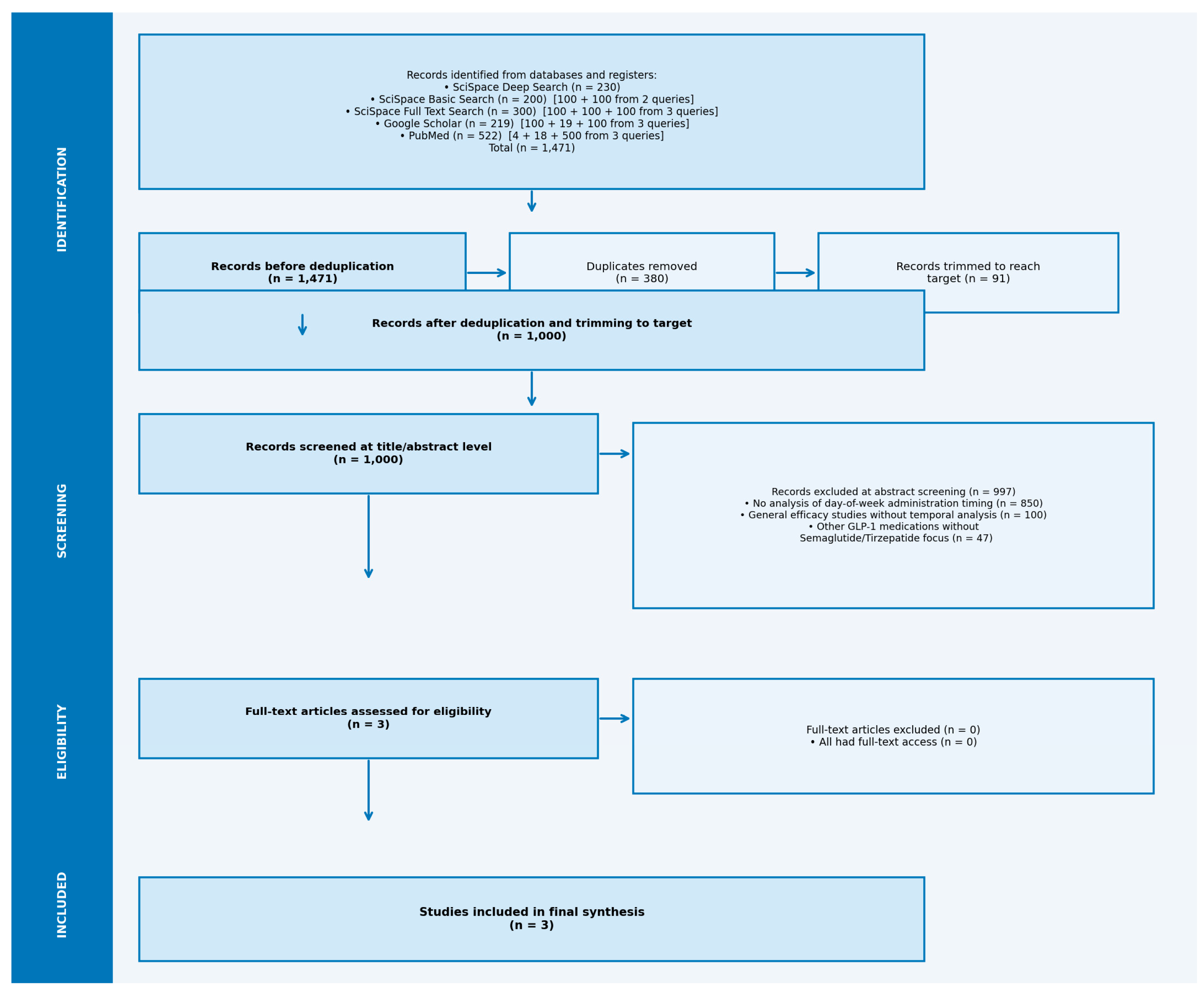
A comprehensive literature search was performed across multiple databases and platforms to ensure maximum coverage of the relevant literature. The search was conducted through 15 June 2026, with no language restrictions. All search queries are documented in the
Supplementary Materials. Clinical trial registries (ClinicalTrials.gov, WHO ICTRP, EU Clinical Trials Register) and grey literature sources were not systematically searched, representing an acknowledged limitation of the search strategy. The following databases were searched:
- •
SciSpace Deep Search: semantic search using natural language queries focused on administration timing, day of the week, and clinical outcomes (n = 230 papers).
- •
SciSpace Basic Search: two structured queries combining GLP-1 RA terminology with dosing schedule and adherence terms (n = 200 papers).
- •
SciSpace Full Text Search: three full-text queries targeting specific terminology related to administration timing and day-of-week effects (n = 300 papers).
- •
Google Scholar: three comprehensive queries with auto-pagination, combining terms including “Semaglutide,” “Tirzepatide,” “GLP-1 receptor agonist,” “administration timing,” “dosing schedule,” “day of week,” “adherence,” “glycemic control,” “weight loss,” “type 2 diabetes,” and “obesity” (n = 219 papers).
- •
PubMed: three advanced queries using Medical Subject Headings (MeSH) terms and Title/Abstract field tags, focusing on semaglutide, tirzepatide, administration timing, clinical outcomes, and target populations (n = 522 papers).
2.4. Eligibility Criteria
Inclusion criteria:
- •
Adult patients (≥18 years) diagnosed with T2DM or obesity/overweight.
- •
Studies investigating semaglutide or tirzepatide (subcutaneous or oral formulations) as the primary intervention.
- •
Studies analyzing or comparing the timing of administration based on specific days of the week, day preferences, or flexible dosing schedules.
- •
Studies reporting on glycemic control, weight loss, medication adherence, adverse events, or patient-reported outcomes.
Exclusion criteria:
- •
Preclinical studies, animal models, cell cultures, or in vitro studies.
- •
Studies focusing primarily on other GLP-1 receptor agonists (e.g., liraglutide, dulaglutide, exenatide) without comparison to semaglutide or tirzepatide.
- •
Studies evaluating general efficacy or safety of semaglutide or tirzepatide without any analysis of day-of-week or administration timing effects.
2.5. Screening Process
Screening was conducted in two stages. In Stage 1 (Abstract Screening), all 1000 unique records (after deduplication) were evaluated against predefined PICO-based criteria using an AI-assisted methodology in which each record was scored against five predefined PICO-based criteria (population appropriateness, intervention relevance, comparison group, outcome reporting, and study design acceptability), with equal weight (1 point each) on a scale of 1 to 5. Papers scoring ≥ 4.0 (scale 1–5) advanced to full-text review. In Stage 2 (Full-Text Screening), retrieved full texts were assessed in detail; a higher threshold (score ≥ 4.5) was applied to ensure inclusion of only clearly relevant studies.
2.6. Data Extraction
Data were extracted systematically from all included studies using a standardized form capturing: study design; population characteristics (sample size, age, sex, diagnosis, baseline HbA1c, body weight, BMI); administration timing details (day of week, fixed vs. flexible schedule); primary outcomes (HbA1c, fasting plasma glucose, weight change); adherence metrics (adherence rates, persistence, patient satisfaction); and adverse events (incidence and severity of gastrointestinal side effects, injection site reactions).
2.7. Quality Assessment
The methodological quality of included studies was assessed using appropriate tools: the Cochrane Risk of Bias tool (RoB 2.0) for the randomized controlled trial, the Newcastle-Ottawa Scale (NOS) for the observational case series, and the AGREE II instrument for the expert panel discussion. Given the small number of included studies and the heterogeneity in study designs, a narrative synthesis was performed rather than a meta-analysis. The AGREE II instrument, applied to the expert panel discussion by Candido et al. (2024), was originally developed and validated for clinical practice guidelines [
10]; its application here represents an acknowledged methodological deviation, adopted as the most appropriate available tool for this type of document.
4. Discussion
4.1. Summary of Findings
This systematic review aimed to synthesize the available evidence on whether the specific day of the week for administering semaglutide or tirzepatide affects glycemic control, weight loss, patient adherence, adverse events, or patient-reported outcomes in adults with T2DM or obesity. Despite a comprehensive search screening 1000 unique records, only three studies met the inclusion criteria, and none directly compared different days of the week for administration. This finding itself constitutes an important result, highlighting a significant and clinically meaningful gap in the literature. This review therefore constitutes primarily an evidence-gap analysis rather than a traditional systematic synthesis of existing direct evidence; any clinical inferences drawn are explicitly grounded in indirect evidence and acknowledged as such.
The pharmacokinetic profiles of semaglutide (half-life ~7 days) and tirzepatide (half-life ~5 days) result in relatively stable plasma concentrations throughout the week after steady state is achieved, theoretically supporting the feasibility of flexible dosing without compromising efficacy. The available evidence, while indirect, is consistent with this pharmacological rationale: flexible dosing schedules appear to maintain glycemic control and may improve tolerability and adherence, based primarily on indirect evidence and expert opinion rather than direct comparative data [
10,
11].
4.2. Chronopharmacology and Clinical Implications
The concept of chronopharmacology—the study of how biological rhythms influence drug pharmacokinetics and pharmacodynamics—is increasingly recognized as relevant to metabolic disease management. Circadian rhythms govern insulin secretion, glucose homeostasis, gastric emptying, and appetite regulation. For once-daily medications, the time of administration relative to these rhythms can significantly influence efficacy and tolerability. However, for once-weekly agents such as semaglutide and tirzepatide, the long half-lives and sustained pharmacodynamic effects may attenuate circadian influences on drug action, making the specific day of the week less critical than the consistency of weekly administration. It should be emphasized that these chronopharmacological considerations are presented as a theoretical scientific framework for future research, not as evidence-based conclusions derived from the included studies; no included study examined circadian influences on semaglutide or tirzepatide pharmacokinetics or pharmacodynamics in relation to day-of-week administration.
Nevertheless, indirect circadian effects may still be relevant. For example, if administration on weekdays is associated with greater dietary control or physical activity compared to weekends—or if weekend dosing allows patients more time to manage gastrointestinal side effects without work-related interference—these behavioral factors could influence treatment outcomes. Future research should explore these potential interactions.
4.3. Implications for Clinical Practice
Based on the available evidence, clinicians should engage patients in shared decision-making when selecting the day of the week for semaglutide or tirzepatide administration. Key considerations include: (1) work and social schedules—patients may prefer to administer on a day when they can manage potential side effects at home; (2) healthcare access—weekday dosing may facilitate closer monitoring; (3) routine and memory aids—selecting a consistent, memorable day (e.g., linked to a weekly routine) supports adherence; and (4) tolerability—patients experiencing gastrointestinal side effects may benefit from adjusting the administration day to align with lower-activity periods.
Based on indirect evidence and expert consensus (approved prescribing information, pharmacokinetic rationale, and expert consensus opinion) rather than direct comparative clinical studies, flexible dosing schedules may support adherence and tolerability. Healthcare providers should emphasize consistency in weekly administration regardless of the specific day chosen, and should proactively counsel patients on the management of gastrointestinal adverse events.
4.4. Limitations
This systematic review has several important limitations. First, only three studies met the inclusion criteria, and none directly compared different days of the week for administration, severely limiting the strength of conclusions. Second, the included studies varied considerably in design (RCT, case series, expert panel), population, and outcomes, precluding meta-analysis. Third, no studies examining tirzepatide administration timing were identified, reflecting the relatively recent introduction of this agent. Fourth, the review relied on published literature and did not include unpublished studies, conference abstracts, or grey literature. Fifth, the search strategy may not have captured all relevant studies addressing dosing flexibility without explicitly mentioning day-of-week effects. Additional limitations include: the review protocol was not prospectively registered, reducing methodological transparency; the AI-assisted abstract screening is not fully reproducible by independent reviewers due to proprietary algorithm parameters; and the search did not include clinical trial registries or grey literature sources. Finally, as the primary conclusion of this review concerns the identification of a significant gap in the existing literature rather than the synthesis of direct comparative evidence, it is important to acknowledge additional inherent limitations. A gap-identification conclusion is subject to potential language bias, as only English-language studies were included; the possibility that relevant studies were conducted but remain unpublished or indexed in databases not searched; and the fundamental constraint that an absence of published evidence cannot be equated with an absence of a clinical effect. These limitations further reinforce the necessity of prospective, specifically designed studies to directly address the impact of day-of-week administration timing on clinical outcomes of semaglutide and tirzepatide.
4.5. Future Research Directions
The findings of this review highlight several important directions for future research. Prospective randomized or observational studies are needed to directly compare different days of the week for semaglutide and tirzepatide administration, assessing glycemic control, weight loss, adherence, adverse events, and patient-reported outcomes over extended follow-up periods. Research should also explore the mechanistic pathways by which administration timing might influence outcomes, including interactions with circadian rhythms, dietary patterns, physical activity, and stress. Real-world evidence studies using large databases or registries could provide valuable insights into patterns of administration timing and their clinical associations. Finally, patient-reported outcomes, including quality of life, treatment satisfaction, and preferences for administration timing, should be systematically assessed to inform patient-centered dosing recommendations. Specifically, proposed study designs include: a prospective randomized crossover trial comparing weekday versus weekend administration of once-weekly semaglutide or tirzepatide; large-scale retrospective registry studies using real-world data; and analyses incorporating continuous glucose monitoring and validated patient-reported adherence measures.
5. Conclusions
This systematic review found no evidence to support a specific optimal day of the week for semaglutide or tirzepatide administration in adults with type 2 diabetes or obesity. The limited available literature, derived primarily from indirect evidence and expert opinion rather than direct comparative clinical studies, suggests that flexible dosing schedules tailored to individual patient preferences and lifestyles may support adherence and treatment persistence, though this has not been confirmed by direct comparative clinical evidence. Clinicians should engage patients in shared decision-making when selecting the day of administration, considering work schedules, social activities, and tolerability of adverse events. The pharmacokinetic profiles of semaglutide and tirzepatide—characterized by long half-lives and sustained pharmacodynamic effects—support the feasibility of flexible dosing without compromising glycemic control or weight loss outcomes. Future prospective studies are urgently needed to systematically evaluate the impact of administration timing on clinical outcomes, adherence, and patient-reported outcomes in real-world settings. It should be noted that the conclusion that no specific optimal day exists is a statement of evidence absence, not evidence of clinical equivalence; future studies may identify clinically meaningful day-of-week effects on outcomes. Importantly, the primary contribution of this systematic review is the identification of a significant gap in the existing literature: to date, no published clinical study has directly examined the effect of the specific day of the week of subcutaneous semaglutide or tirzepatide administration on clinical outcomes in patients with T2DM or obesity. This gap constitutes, in itself, a meaningful and actionable finding that provides a clear rationale and foundation for future prospective research specifically addressing this unresolved clinical question.