1. Introduction
In rheumatic disease, the wrists are almost affected during the disease course. The introduction of biologics and earlier diagnosis confirmation has improved the long-term prognosis, which is also reflected in the increased demands of patients, especially for hand function. Early arthrodesis of the wrist, which was common in the past, significantly limits the ability to use the hand.
If surgical treatment is needed, preservation of residual mobility must be included in planning, with the condition of the bone, reconstructability of the carpal height, soft tissue balance, and kinematics of the hand carefully examined in advance [
1,
2,
3]. Recent developments in wrist arthroplasty have renewed interest in motion-preserving treatment even in advanced rheumatoid destruction, although complication rates and bone quality remain important concerns [
4]. For rheumatoid patients, the precarious bone situation with early-onset osteoporosis and the associated bone mass loss is compounded by concomitant pathologies of the periarticular tissues, especially tendons and ligaments [
5,
6]. With the widespread adoption of biologic agents as first-line therapy, treatments for the rheumatoid hand, which were reserved exclusively for arthritically altered joints, are gaining ground. A question is whether patient satisfaction after surgery for the rheumatoid wrist is determined primarily by pain relief and radiographic stabilization, or whether it depends more strongly on restoration of global hand function, particularly extensor tendon function. This issue is clinically relevant because extensor tendon damage may progress slowly, may be compensated for over long periods, and may be underestimated until partial or complete rupture has occurred [
7,
8]. Once tendon function is lost, improvement in pain alone may not be sufficient to restore useful hand function. Therefore, the primary question of this study was whether postoperative patient satisfaction and functional outcomes after surgical treatment correlate with overall hand function. We hypothesized that patients with preserved or successfully reconstructed wrist and tendon function may report better functional outcomes and higher satisfaction than patients with persistent or progressive tendon dysfunction. The aim of this study was to summarize retrospective studies of stage-adapted rheumatoid wrist surgery, including joint-preserving procedures, partial arthrodesis, and wrist arthroplasty. Because of the heterogeneity of the available studies, this hypothesis was assessed descriptively rather than by formal pooled statistical analysis (
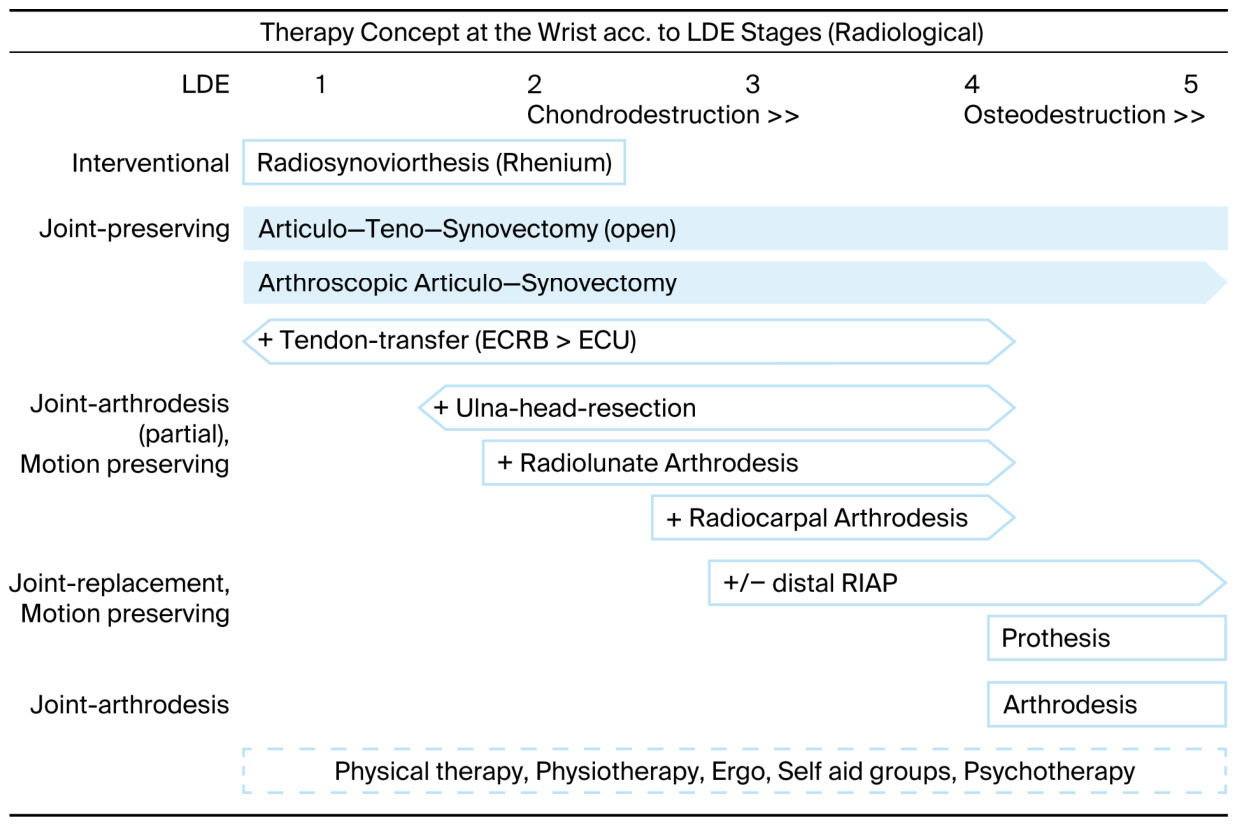
Figure 1).
2. Materials and Methods
More than 1600 operations on rheumatoid wrists were performed at the Center for Orthopedic Rheumatology between 1984 and 2015. The patients included in the studies had developed RA before the year 2000, and even after that, only a small percentage of them received bDMARD therapy. The indications for surgical treatment of the wrist are refractory arthritis and periarticular inflammation with concomitant pathologies and limitations of function. The various surgical procedures were primarily guided by the staging of radiological changes and intraoperative findings in the hand and extensor tendons (
Figure 1).
For this review study, various previously published institutional studies only from the center specializing in rheumaorthopedic surgery, covering a range of surgical techniques according to the Larsen stage of wrist destruction, were re-evaluated and compared with each other. The inclusion criteria for the included studies were defined primarily in terms of long-term follow-up periods of at least 10 years, and patient recruitment was organized accordingly. These studies were summarized regarding functional outcomes and patient satisfaction with therapy. All patients who take place in follow-up provided written informed consent to participate. Ethical approval was not required, with the exception of the study on MPW® prostheses (Waldemar Link GmbH & Co. KG, Hamburg, Germany), as these studies—being designed as retrospective studies—only had to be reported to the ethics committee (Regional Ethics Committee). The study on MPW® prosthesis was approved by the ethics board (Regional Ethical Review Board No. 837.157.14 (9396-F)). The ethics approvals relate to the individual studies; no ethics approval was required for this descriptive synthesis. During the follow-up examinations, the parameters of pain, strength, range of motion, and daily functions were assessed.
The range of scores represents the different aspects of the impairment of function of the affected wrist to the whole extremity (Quick DASH) and the overall situation of the patient (SF-36; FFbH) [
1,
9]. The Clayton score also allows evaluation of extensor tendons by considering the inflammatory alterations at the wrist. This is the only score that provides a physician’s measurement tool for wrist function; the other scores are based on information provided by the patient.
The different grip positions and assessments of grip strength were recorded using the ADL and FFbH scores [
3], which go beyond the pure recording of hand function and focus on self-care and mobility. The widespread DASH score also focuses on the recording of functional limitations, additionally differentiating sensitive limitations (pain, dysesthesias, psychosocial issues) from motor entities, and is limited primarily to the affected extremity. The SF-36 allows comparisons with health surveys [
4]. The radiological controls considered rheumatological staging according to Larsen, Dale, and Eek [
10].
Statistical Analysis
This study is purely descriptive; therefore, no formal meta-analysis of the data was carried out. The comparative analyses were descriptive. Therefore, the focus was placed on discussing the variability in the results of the included studies. Only the descriptive and scoring results from the publications were compared. There was no a priori or post hoc power analysis, because the number of patients included in the studies was determined primarily by the surgical procedure and the average duration of follow-up. Apart from our own work, no statistical analysis had been carried out. In our study, for radio-carpal arthrodesis, we use a two-way ANOVA test and a Mann–Whitney U test for non-parametric samples (see
Section 3.4). If available,
p-values of post hoc tests were adjusted for multiple comparisons. The level of significance therefore was set at <0.05 for all analyses.
4. Discussion
Recommendations for the surgical management of inflammatory wrists are based on data and experience from local centers, which, in turn, are mostly based on older publications from the prebiological era. Publications comparing different surgeries in the context of a syllabus on corresponding changes in the rheumatoid wrist are rare.
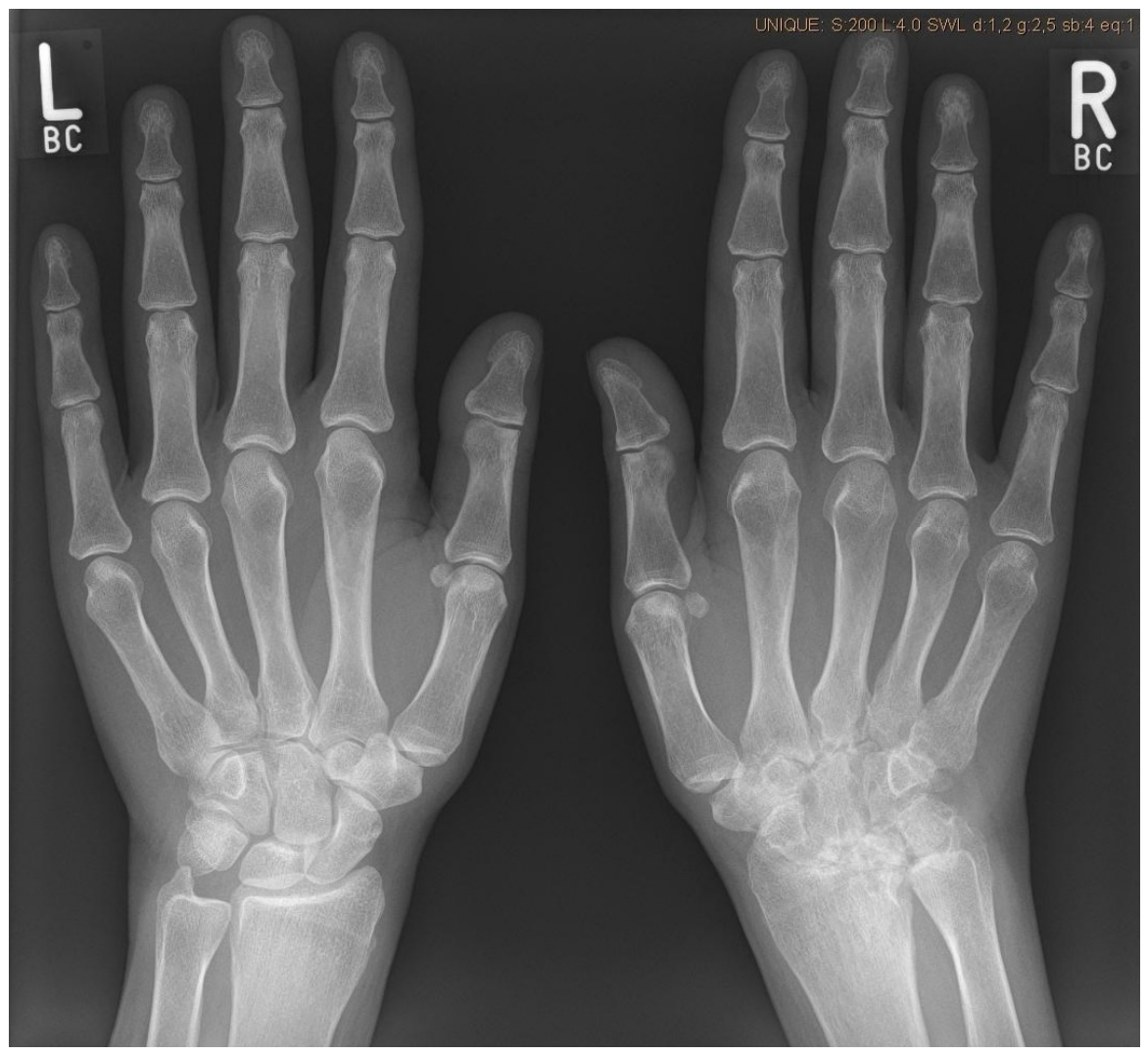
According to the scoring system of Larsen, Dale, and Eek, radiological follow-up is based on staging (
Figure 2) [
8]. It is not helpful for endoprosthetic joints or arthrodesis, because the joint surfaces are not assessed. However, determining carpal height provides more information, as it allows comparisons with joint-preserving interventions [
18]. With the approval of biologics, limitations arise for the clinical statement because clinical progression is no longer directly coupled with radiological changes.
The inconsistent use of different scores and unclean terminology, particularly in Schill et al., complicates the comparability of study results [
9]. In early studies, evaluation was mostly based on subjective assessments, pain indications, and secondary radiological changes, as objective scores were missing. Until the early 2000s, differential therapy and patient recommendations were derived from these evaluations. The introduction of biologics and their increasing use in basic RA therapy have fundamentally changed the situation. Patients’ demands on their joints and overall quality of life increase as systemic disease activity decreases. Currently, mostly isolated tendons are addressed in the hand, and arthroscopic surgery, including assisted (partial) arthrodesis, is increasingly used on the wrist itself, as it is in patients with osteoarthritis. In addition, individual patients continue to present with severe disease as they did 30 years ago. Because of the limited comparability, future studies should collect data using multiple scores. A single score does not adequately reflect the real situation, as not all items can be included in one score. We recommend the use of a combination of Quick DASH, Clayton, ADL and VAS. The individual scores have a certain average weighting, but each has a different emphasis. When assessing radiological changes, the Larsen classification has its limitations when the actual joint line has been altered by prostheses or arthrodesis. Again, radiographic changes should be assessed independently of the joint situation, e.g., using the Youm height index. To improve comparability, it would be useful and desirable to follow all patients in the above trials. However, over the long course of the trials, many patients died or required further hand surgery, so long-term observation with small numbers of patients and limited statistical power must be viewed critically.
However, despite improved early diagnosis and advances in drug therapy, surgical intervention targeting the destroyed articular and periarticular structures may still benefit “rebellious” joints that show persistent inflammation. At an early stage, the inflammatory process can spread to the tendons due to the spatial situation of the periarticular structures, resulting in detectable changes [
19,
20]. Extensor tendon ruptures occur more frequently at mechanically stressed sites, such as the Lister’s tuberosity or over the ulnar styloid. Patients can tolerate long-term articular and tendon pathologies if they occur slowly and with adhesions [
21]. The inflammatory or reactive involvement of tendons in wrist disease has been described as a cause of spontaneous rupture of damaged extensor tendons [
22,
23], which is consistent with the author’s experience.
Most of the included studies were not statistically well analyzed, making it difficult to compare results and place them in a common context. Although the scores were not consistently applied across all studies, the studies were conducted over an extended period, during which new individual scores were introduced. These newer scores primarily assess hand functions but also consider the overall situation of the extremity. Quick DASH and ADL/FFbH evaluate the same subjective parameters related to hand usage in daily life. Importantly, limitations in other joints may obscure positive results. Patient-reported outcome measures (PROMs) are useful for scoring, but they do not provide objective measurements for the affected joint or verify the direct impact of limitations on other joints. Owing to the lack of appropriate scores, it is currently difficult to demonstrate a correlation between subjective patient statements and objective assessments. Joint and tendon destruction in rheumatoid arthritis patients does not occur in isolation, even with sufficient therapy according to guidelines. Therefore, it is crucial to consider the patient’s overall condition. The affected extremity joints are usually the first to be impacted, depending on the duration of the disease. Notably, although biologics may often mask activity, this results in low scores both pre- and postoperatively. To improve scores, it is essential to focus on the baseline value and its relation to the results.
On average, the overall situation of the hand is rated as sufficient, with an overall improvement in pain being observed (a reduction in the VAS score of 4.6 points on average). Improvements in wrist load-bearing capacity are accompanied by improvements in test scores in the individual studies. Patient assessment depends on the course of the underlying disease, postoperative care, and patient demands. The individual evaluation of patients by comparing preoperative and postoperative values of the Clayton score demonstrated this. Partial results were observed in the patients. It is important to consider this concerning the progression of the disease. Partial and complete extensor tendon ruptures and slow destruction of the joints are usually functionally tolerated for a long time and seem to compensate one another; therefore, late presentation and operative treatment are often performed. In the cohorts, the wrists had been diseased for an average of 6.4 years before surgical treatment. Other authors report similar results [
24]. The average values refer to the totality of the study results, with the arithmetic mean having been calculated.
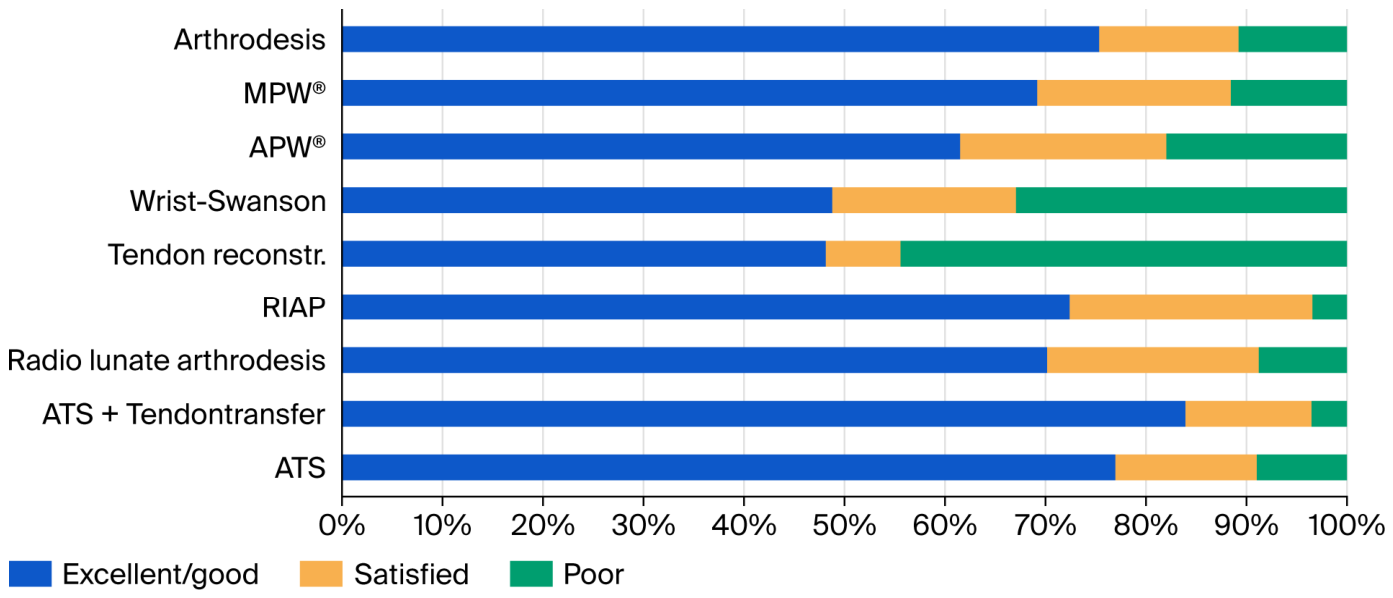
To assess the success of the operation for patients, the focus should be on the global function of the wrist (see
Figure 3). If intraoperative damage to tendons, especially extensor tendons, is detected along with articular changes, it is crucial to prioritize reconstruction and postoperative therapy. The ability to use the hand effectively in daily life is the main criterion for the subjective evaluation of surgical treatment. Patient satisfaction not only depends on sufficient pain reduction but also appears to be associated with the function of the reconstructed tendons. The tendons are evaluated in conjunction with the everyday usability of the entire extremity. Compared with rheumatic patients, nonrheumatic patients have been found to experience fewer limitations and greater retention of strength. Rydholm et al. reported similar results, highlighting a discrepancy between objectively measured strength and subjective patient assessments of hand function [
25].
These observations also support earlier referral for surgical evaluation in patients with persistent synovitis, progressive tendon irritation, ulnar-sided wrist deformity, or loss of active finger extension despite optimized medical treatment. In the biologic era, systemic inflammatory activity may be reduced while local structural damage continues to progress. Consequently, low systemic disease activity scores do not exclude clinically important wrist destruction or tendon compromise. Patient selection is therefore essential. The criteria for indicating surgery for rheumatic wrist conditions remain the same [
14,
15].
One thing that has changed in the era of biologics is the timing of diagnosis and the start of treatment, and consequently, in many cases, the improved prognosis for the individual. Furthermore, there has been a reassessment of the treatment options for rheumatic joints. Improved implants, early diagnosis of inflammatory conditions, and the initiation of guideline-based basic therapy have transformed the treatment options compared with the prebiological era, which we analyzed and discussed in this manuscript. Outcomes for these patients appear to have improved due to shorter periods of immobilization and early functional exercise. Studies with long-term follow-up of 10 years or more are likely to provide reliable findings in the near future.
With or without insufficient medical treatment, RA continues to follow the same course as it did decades ago. Delayed surgery may result in poorer reconstructive options because tendon quality, carpal height, and bone stock deteriorate over time. Some studies also distinguished postoperative outcomes by the duration and stage of joint damage (see
Section 3.4;
Section 3.5 MPW
®). This, together with the clinical implications, forms the basis of the guideline’s recommendation for early surgical intervention in cases of synovitis that persists for more than six weeks despite adequate basic treatment [
26].
Revision surgery and patient satisfaction: All the treatments required revision surgery over time. There was a large variation in the time between initial treatment and revision. The longer it had been since the initial operation, the more willing patients were to undergo further treatment. Satisfaction may be the highest in patients with improved grip strength and tendon function.
Limitations
This study provides valuable information about the results of different treatments for rheumatoid wrist disease. Most of the patients included in the studies had been treated before the introduction of biologics; the results therefore primarily reflect historical treatment strategies. However, some limitations need to be considered. Firstly, the studies summarized here are retrospective, which introduces potential biases such as selection bias. They differ considerably in heterogeneous cohorts and patient characteristics, surgical procedures, follow-up duration, outcome measures, and treatment era. These differences limit direct comparisons and should be discussed more explicitly. It also limits the ability to control for confounding variables, such as differences in postoperative therapies. The main weakness is undoubtedly the lack of statistical comparative analyses and standardized outcome measures used in the different studies. Some of these scores were published after the first trials were conducted and published. A re-examination as part of a new and comprehensive follow-up study is likely to fail because of the limited number of patients, as most of the patients are likely to have died in the meantime.