Article

Effects of Barbell Position and Squat Depth on Trunk and Lower-Extremity Muscle Activation During the Back Squat in Healthy Adult Men


1
Department of Health Science, Gachon University Graduate School, Incheon 21936, Republic of Korea
2
Department of Physical Therapy, Gachon University, Incheon 21936, Republic of Korea
*
Authors to whom correspondence should be addressed.
Medicina 2026, 62(7), 1339; https://doi.org/10.3390/medicina62071339

Submission received: 27 May 2026 / Revised: 5 July 2026 / Accepted: 10 July 2026 / Published: 11 July 2026

Abstract

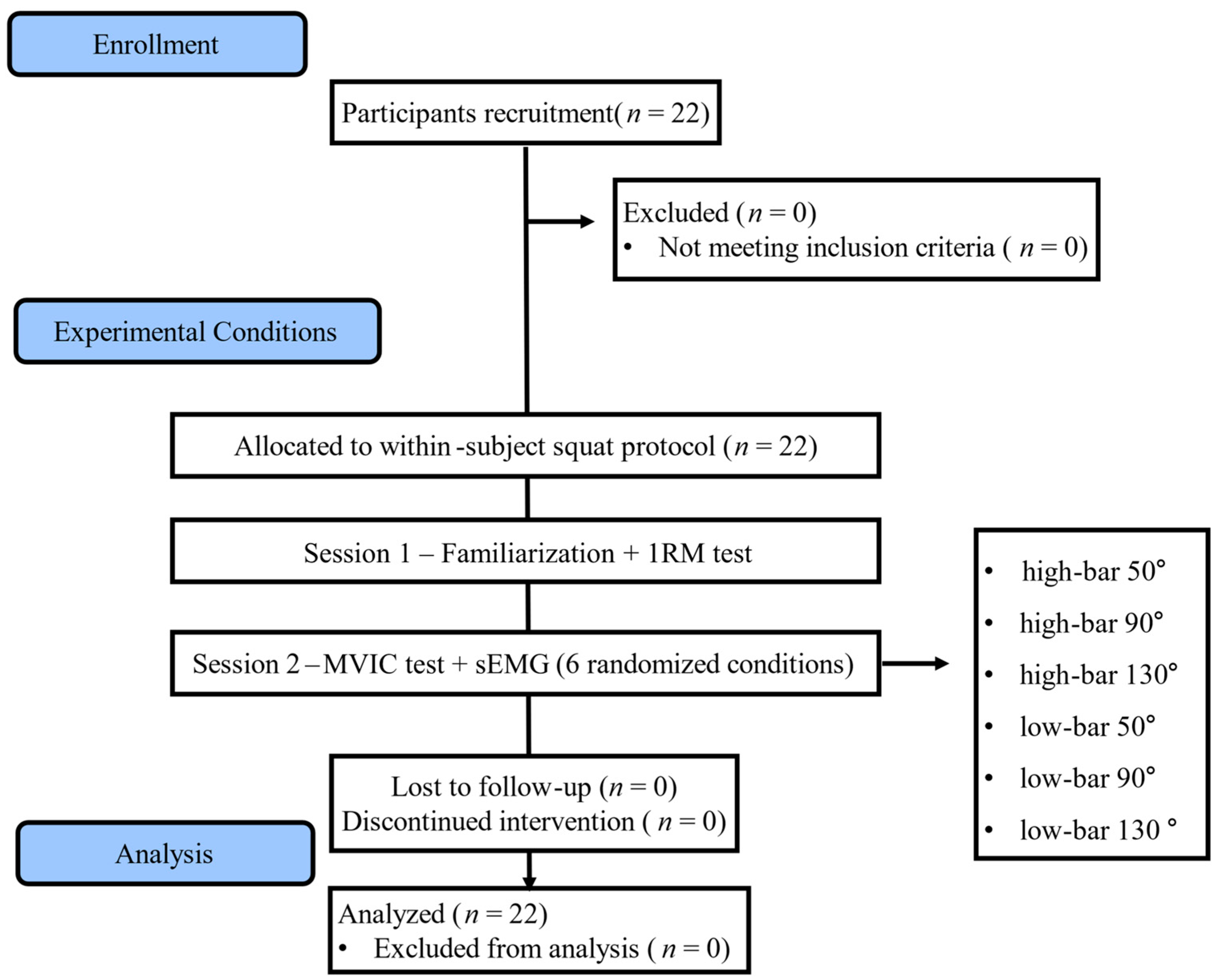
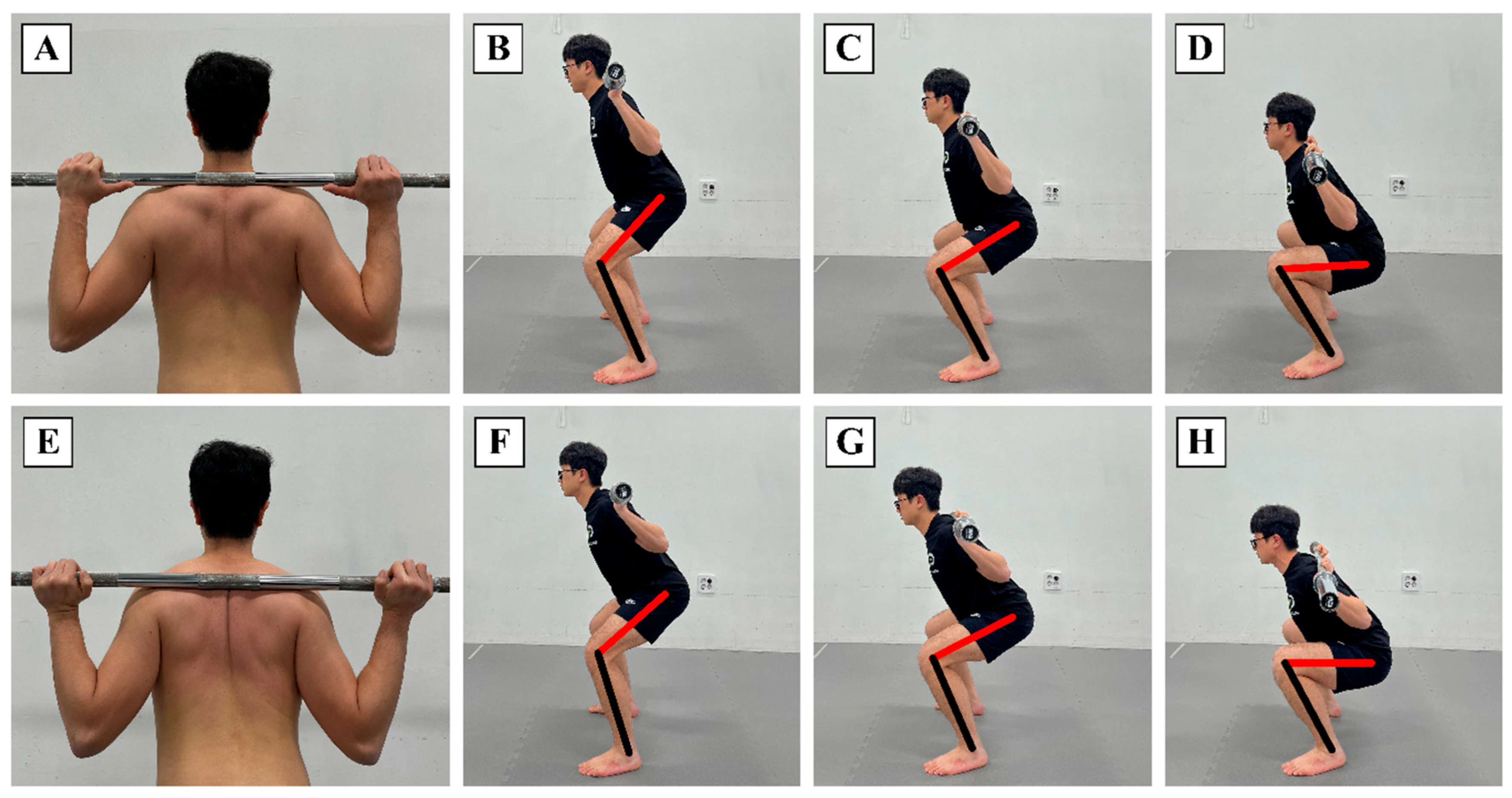
Background and Objectives: The back squat is widely used in resistance training, performance enhancement, and rehabilitation, and barbell position and squat depth are key modifiable variables that may influence neuromuscular demand. This study investigated the effects of barbell position and squat depth on trunk and lower-extremity muscle activation during the back squat. Materials and Methods: Twenty-two adult men with at least 2 years of back-squat experience performed high-bar and low-bar back squats to knee-flexion angles of 50°, 90°, and 130° using a standardized external load corresponding to 80% of each participant’s habitual one-repetition maximum (1RM). Conditions were presented in randomized order. Surface electromyography was used to record the rectus femoris, vastus medialis, vastus lateralis, gluteus maximus, semitendinosus, biceps femoris, rectus abdominis, and erector spinae. Electromyographic activity was analyzed separately for eccentric and concentric phases and normalized to maximal voluntary isometric contraction (%MVIC). Results: Increasing squat depth most consistently increased quadriceps and erector spinae activation, indicating greater knee extensor and trunk extensor demand at deeper positions. Rectus abdominis activation showed a depth-related effect during the concentric phase, with only isolated pairwise differences during the eccentric phase, whereas gluteus maximus activation showed limited modulation. Barbell position produced selective phase- and depth-dependent responses: the low-bar squat showed greater hamstring and erector spinae activation in specific comparisons, whereas the high-bar squat showed greater knee-extensor activation at selected depths, most clearly in the rectus femoris. Conclusions: Barbell position and squat depth modify relative neuromuscular demand during the back squat and may be used to adjust the emphasis on knee extensor, trunk stabilizer, and posterior-chain demands rather than to target a single muscle group in isolation.
Keywords: electromyography; lower extremity; resistance training; back squat; muscle activation electromyography; lower extremity; resistance training; back squat; muscle activation