Thromboprophylaxis After ACL Reconstruction: Controversies and Future Challenges
 , , , , and
Abstract
1. Introduction
2. Materials and Methods
3. Results
- -
- -
- Consensus statements: the International Consensus Meeting on Venous Thromboembolism: Sports (ICM-VTE: Sports) [12], the International Consensus Statement on Venous Thromboembolism (ICS) [13], and the British Orthopaedic Association in collaboration with the British Association for Surgery of the Knee and BOSTAA (BOA/BASK/BOSTAA) [14].
- -
4. Discussion
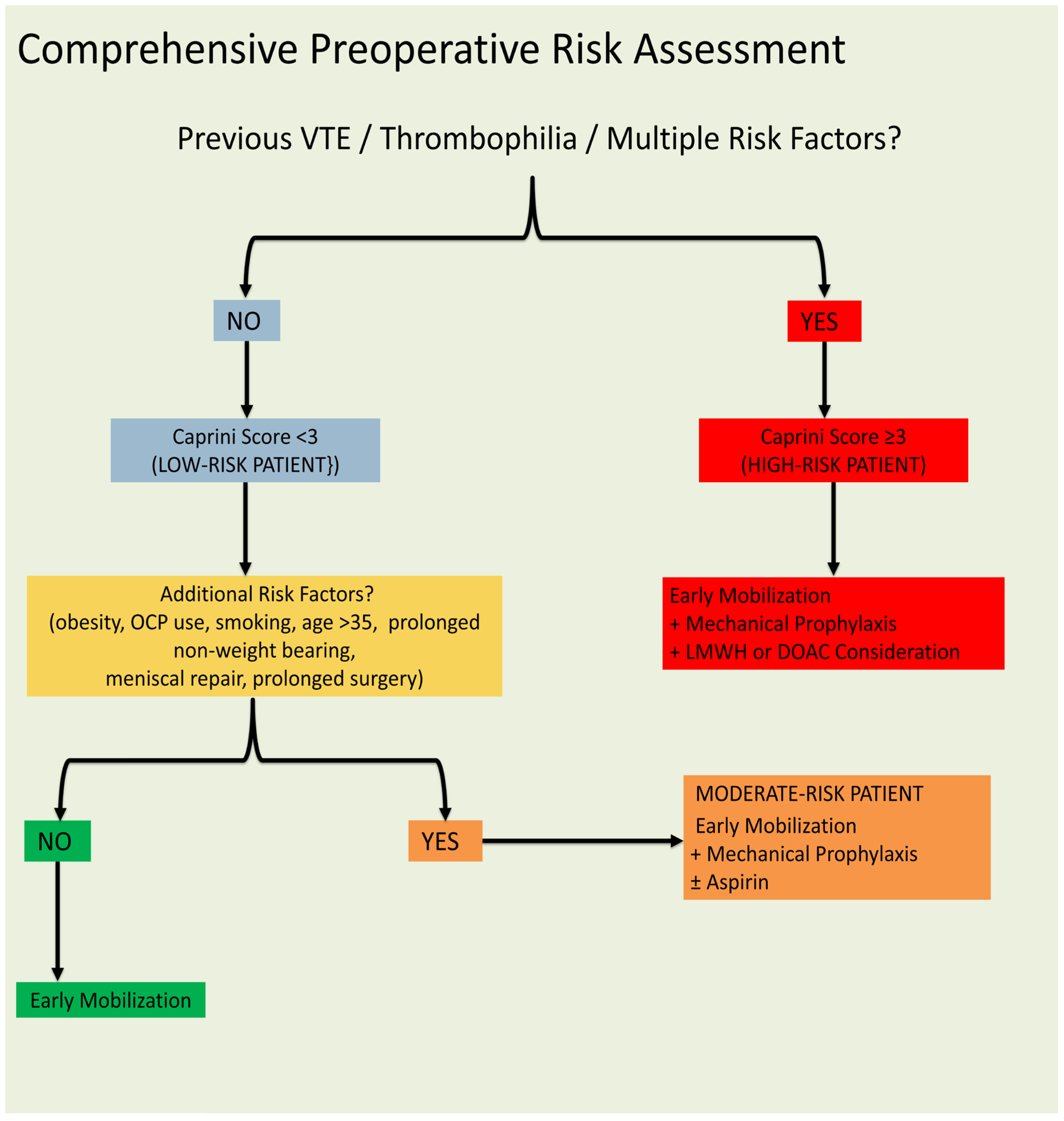
4.1. Proposed Clinical Algorithm Based on Current International Guidelines, Consensus Statements, and Registry-Based Recommendations
4.2. Limitations
5. Conclusions
Author Contributions
Funding
Institutional Review Board Statement
Informed Consent Statement
Data Availability Statement
Conflicts of Interest
Abbreviations
| ACL | Anterior Cruciate Ligament |
| ACLR | Anterior Cruciate Ligament Reconstruction |
| VTE | Venous Thromboembolism |
| DVT | Deep Vein Thrombosis |
| PE | Pulmonary Embolism |
| LMWH | Low-Molecular-Weight Heparin |
| DOAC | Direct Oral Anticoagulant |
| IPC | Intermittent Pneumatic Compression |
| ICS | International Consensus Statement |
| ICM-VTE | International Consensus Meeting on Venous Thromboembolism |
| HAOST | Hellenic Association of Orthopaedic Surgery and Traumatology |
| BOA | British Orthopaedic Association |
| BASK | British Association for Surgery of the Knee |
| BOSTAA | British Orthopaedic Sports Trauma and Arthroscopy Association |
| SFAR | Société Française d’Anesthésie et de Réanimation |
| AAOS | American Academy of Orthopaedic Surgeons |
| NICE | National Institute for Health and Care Excellence |
| CHEST | American College of Chest Physicians |
References
- Falck-Ytter, Y.; Francis, C.W.; Johanson, N.A.; Curley, C.; Dahl, O.E.; Schulman, S.; Ortel, T.L.; Pauker, S.G.; Colwell, C.W., Jr. Prevention of VTE in orthopedic surgery patients: Antithrombotic Therapy and Prevention of Thrombosis, 9th ed: American College of Chest Physicians Evidence-Based Clinical Practice Guidelines. Chest 2012, 141, e278S–e325S. [Google Scholar] [CrossRef] [PubMed]
- Maletis, G.B.; Inacio, M.C.; Reynolds, S.; Funahashi, T.T. Incidence of symptomatic venous thromboembolism after elective knee arthroscopy. J. Bone Jt. Surg. 2012, 94, 714–720. [Google Scholar] [CrossRef] [PubMed]
- Afana, H.B.; Ashokan, S.; Nau, T. Venous thromboembolism prophylaxis after anterior cruciate ligament reconstruction: Retrospective case-control study. SICOT J. 2025, 11, 38. [Google Scholar] [CrossRef] [PubMed]
- Oshiba, H.; Nawata, M.; Morioka, S.; Momose, T.; Maeda, T.; Nakatsuchi, Y. The incidence and risk factor of deep venous thrombosis after arthroscopically assisted anterior cruciate ligament reconstruction. J. Orthop. Sci. 2020, 25, 477–480. [Google Scholar] [CrossRef] [PubMed]
- Qin, C.; Qin, M.M.; Baker, H.; Shi, L.L.; Strelzow, J.; Athiviraham, A. Pharmacologic Thromboprophylaxis Other Than Aspirin Is Associated With Increased Risk for Procedural Intervention for Arthrofibrosis After Anterior Cruciate Ligament Reconstruction. Arthroscopy 2021, 37, 619–623. [Google Scholar] [CrossRef] [PubMed]
- National Institute for Health and Care Excellence (NICE). Venous Thromboembolism in Over 16s: Reducing the Risk of Hospital-Acquired Deep Vein Thrombosis or Pulmonary Embolism; NICE Guideline NG89; NICE: London, UK, 2018; Available online: https://www.nice.org.uk/guidance/ng89 (accessed on 22 August 2022).
- American Academy of Orthopaedic Surgeons (AAOS). Management of Anterior Cruciate Ligament Injuries: Evidence-Based Clinical Practice Guideline; AAOS: Rosemont, IL, USA, 2022; Available online: https://www.aaos.org/aclcpg (accessed on 22 August 2022).
- Gu, A.; Agarwal, A.R.; Malahias, M.A.; Wessel, L.E.; Richardson, S.S.; McDaniel, L.; Knapp, B.; Mathur, A.; Doerre, T.; Sculco, P.K.; et al. Anticoagulant Usage After Anterior Cruciate Ligament Reconstruction Is Associated With Increased Rate of Manipulation Under Anesthesia. J. Am. Acad. Orthop. Surg. 2023, 31, 574–580. [Google Scholar] [CrossRef] [PubMed]
- Guyatt, G.H.; Akl, E.A.; Crowther, M.; Gutterman, D.D.; Schünemann, H.J. Executive Summary: Antithrombotic Therapy and Prevention of Thrombosis, 9th ed: American College of Chest Physicians Evidence-Based Clinical Practice Guidelines. Chest 2012, 141, 7S–47S. [Google Scholar] [CrossRef] [PubMed]
- Brophy, R.H.; Lowry, K.J. American Academy of Orthopaedic Surgeons Clinical Practice Guideline Summary: Management of Anterior Cruciate Ligament Injuries. J. Am. Acad. Orthop. Surg. 2023, 31, 531–537. [Google Scholar] [CrossRef] [PubMed]
- Société Française d’Anesthésie et de Réanimation (SFAR). Actualisation des Recommandations sur la Prévention de la Maladie Thromboembolique Veineuse en Chirurgie Programmée et en Médecine; SFAR: Paris, France, 2011; Available online: https://sfar.org/ (accessed on 22 August 2022).
- Parvizi, J.; Gehrke, T.; Chen, A.F. Recommendations from the ICM-VTE: Sports. J. Bone Jt. Surg. Am. 2022, 104, 267–279. [Google Scholar] [CrossRef] [PubMed]
- Nicolaides, A.N.; Fareed, J.; Spyropoulos, A.C.; Kakkar, R.H.L.; Antignani, P.L.; Avgerinos, E.; Baekgaard, N.; Barber, E.; Bush, R.L.; Caprini, J.A.; et al. Prevention and management of venous thromboembolism. International Consensus Statement. Guidelines according to scientific evidence. Int. Angiol. 2024, 43, 1–222. [Google Scholar] [CrossRef] [PubMed]
- British Orthopaedic Association (BOA); UK Haemophilia Centre Doctors’ Organisation (UKHCDO). Venous Thromboembolism Prophylaxis in Orthopaedic Surgery: A National Guideline; BOA & UKHCDO: London, UK, 2015. [Google Scholar]
- Hellenic Association of Orthopaedic Surgery and Traumatology. Guidelines for the Prevention of Venous Thrombosis in Orthopaedics; HAOST: Athens, Greece, 2009; ISBN 978-960-99005-0-8. [Google Scholar]
- Ekdahl, V.; Stålman, A.; Forssblad, M.; Samuelsson, K.; Edman, G.; Kraus Schmitz, J. There is no general use of thromboprophylaxis and prolonged antibiotic prophylaxis in anterior cruciate ligament reconstruction: A nation-wide survey of ACL surgeons in Sweden. Knee Surg. Sports Traumatol. Arthrosc. 2020, 28, 2535–2542. [Google Scholar] [CrossRef] [PubMed] [PubMed Central]
- Caprini, J.A.; Arcelus, J.I.; Hasty, J.H.; Tamhane, A.C.; Fabrega, F. Clinical Assessment of venous thromboembolic risk in surgical patients. Semin. Thromb. Hemost. 1991, 17, 304–312. [Google Scholar] [CrossRef] [PubMed]
- Bayle-Iniguez, X.; Cassard, X.; Vinciguerra, B.; Murgier, J. Postoperative thromboprophylaxis does not reduce the incidence of thromboembolic events after ACL reconstruction. Orthop. Traumatol. Surg. Res. 2021, 107, 102904. [Google Scholar] [CrossRef] [PubMed]
- Sun, Y.; Chen, D.; Xu, Z.; Shi, D.; Dai, J.; Qin, J.; Qin, J.; Ying, P.; Hou, H.; Sun, W.; et al. The incidence of deep venous thrombosis after arthroscopically assisted anterior cruciate ligament reconstruction. Arthroscopy 2013, 29, 742–747. [Google Scholar] [CrossRef] [PubMed]
- Forlenza, E.M.; Parvaresh, K.C.; Cohn, M.R.; Lavoie-Gagne, O.; Khazi, Z.M.; Lu, Y.; Cregar, W.; Forsythe, B. Incidence and risk factors for symptomatic venous thromboembolism following anterior cruciate ligament reconstruction. Knee Surg. Sports Traumatol. Arthrosc. 2022, 30, 1552–1559. [Google Scholar] [CrossRef] [PubMed]
- Pang, L.; Li, P.; Li, H.; Tang, X.; Zhu, J. Does anterior cruciate ligament reconstruction increase venous thromboembolism risk compared with knee meniscectomy under arthroscopy? BMC Musculoskelet. Disord. 2022, 23, 268. [Google Scholar] [CrossRef] [PubMed]
- Zou, Y.; Zhang, G.; Sun, X. Risk factors for venous thromboembolism following knee arthroscopy: A systematic review and meta-analysis of observational studies. Heliyon 2024, 10, e25939. [Google Scholar] [CrossRef] [PubMed]
- Hopper, H.; Adsit, M.; Reiter, C.R.; Satalich, J.R.; Schmidt, R.C.; Peri, M.I.; Cyrus, J.W.; Vap, A.R. Risk factors for MUA or LOA after ACL reconstruction: A systematic review. Arthroscopy 2024, 40, 276–284. [Google Scholar] [CrossRef] [PubMed]
- Yazdi, H.; Eslami, A.; Torkaman, A.; Elahifar, O.; Kasaeian, A.; Alimoghadam, S.; Alimoghadam, R.; Abolghasemian, M. Aspirin is as effective as low molecular weight heparins in preventing symptomatic venous thromboembolism following arthroscopic anterior cruciate ligament reconstruction. BMC Musculoskelet. Disord. 2024, 25, 154. [Google Scholar] [CrossRef] [PubMed]
- Nimerta, F.; Faisal, S.; Reyaz, N.; Shah, S.U.; Gurajala, S.; Khenhrani, R.R.; Khan, M.W.; Amin, A. Comparison of the Efficacy and Safety of Aspirin and Low-Molecular-Weight Heparin in Patients With a Fracture: A Meta-Analysis. Cureus 2023, 15, e39025. [Google Scholar] [CrossRef] [PubMed] [PubMed Central]
- Zhu, J.; Jiang, H.; Marshall, B.; Li, J.; Tang, X. Low-Molecular-Weight Heparin for the Prevention of Venous Thromboembolism in Patients Undergoing Knee Arthroscopic Surgery and Anterior Cruciate Ligament Reconstruction: A Meta-analysis of Randomized Controlled Trials. Am. J. Sports Med. 2019, 47, 1994–2002. [Google Scholar] [CrossRef] [PubMed]
- Goyal, A.; Hurjkaliani, S.; Alexander, K.M.; Xu, J.; Pareek, M.; Qamar, A. Role of polygenic risk scores in venous thromboembolism: Current state and future directions. Res. Pract. Thromb. Haemost. 2025, 9, 102973. [Google Scholar] [CrossRef] [PubMed]

Disclaimer/Publisher’s Note: The statements, opinions and data contained in all publications are solely those of the individual author(s) and contributor(s) and not of MDPI and/or the editor(s). MDPI and/or the editor(s) disclaim responsibility for any injury to people or property resulting from any ideas, methods, instructions or products referred to in the content. |
© 2026 by the authors. Published by MDPI on behalf of the Lithuanian University of Health Sciences. Licensee MDPI, Basel, Switzerland. This article is an open access article distributed under the terms and conditions of the Creative Commons Attribution (CC BY) license.
Share and Cite
Bouras, T.; Antzoulas, P.; Giannatos, V.; Lianou, I.; Kandilioros, A.V.; Ntourantonis, D.; Chouliaras, V. Thromboprophylaxis After ACL Reconstruction: Controversies and Future Challenges. Medicina 2026, 62, 1315. https://doi.org/10.3390/medicina62071315
Bouras T, Antzoulas P, Giannatos V, Lianou I, Kandilioros AV, Ntourantonis D, Chouliaras V. Thromboprophylaxis After ACL Reconstruction: Controversies and Future Challenges. Medicina. 2026; 62(7):1315. https://doi.org/10.3390/medicina62071315
Chicago/Turabian StyleBouras, Theodoros, Panagiotis Antzoulas, Vasileios Giannatos, Ioanna Lianou, Alexandros Voutsinas Kandilioros, Dimitrios Ntourantonis, and Vasileios Chouliaras. 2026. "Thromboprophylaxis After ACL Reconstruction: Controversies and Future Challenges" Medicina 62, no. 7: 1315. https://doi.org/10.3390/medicina62071315
APA StyleBouras, T., Antzoulas, P., Giannatos, V., Lianou, I., Kandilioros, A. V., Ntourantonis, D., & Chouliaras, V. (2026). Thromboprophylaxis After ACL Reconstruction: Controversies and Future Challenges. Medicina, 62(7), 1315. https://doi.org/10.3390/medicina62071315