Hemostatic Resuscitation in Trauma-Induced Coagulopathy: A Comprehensive Narrative Review
 , ,
, ,  ,
,  and
and 
Abstract
1. Introduction
2. Materials and Methods
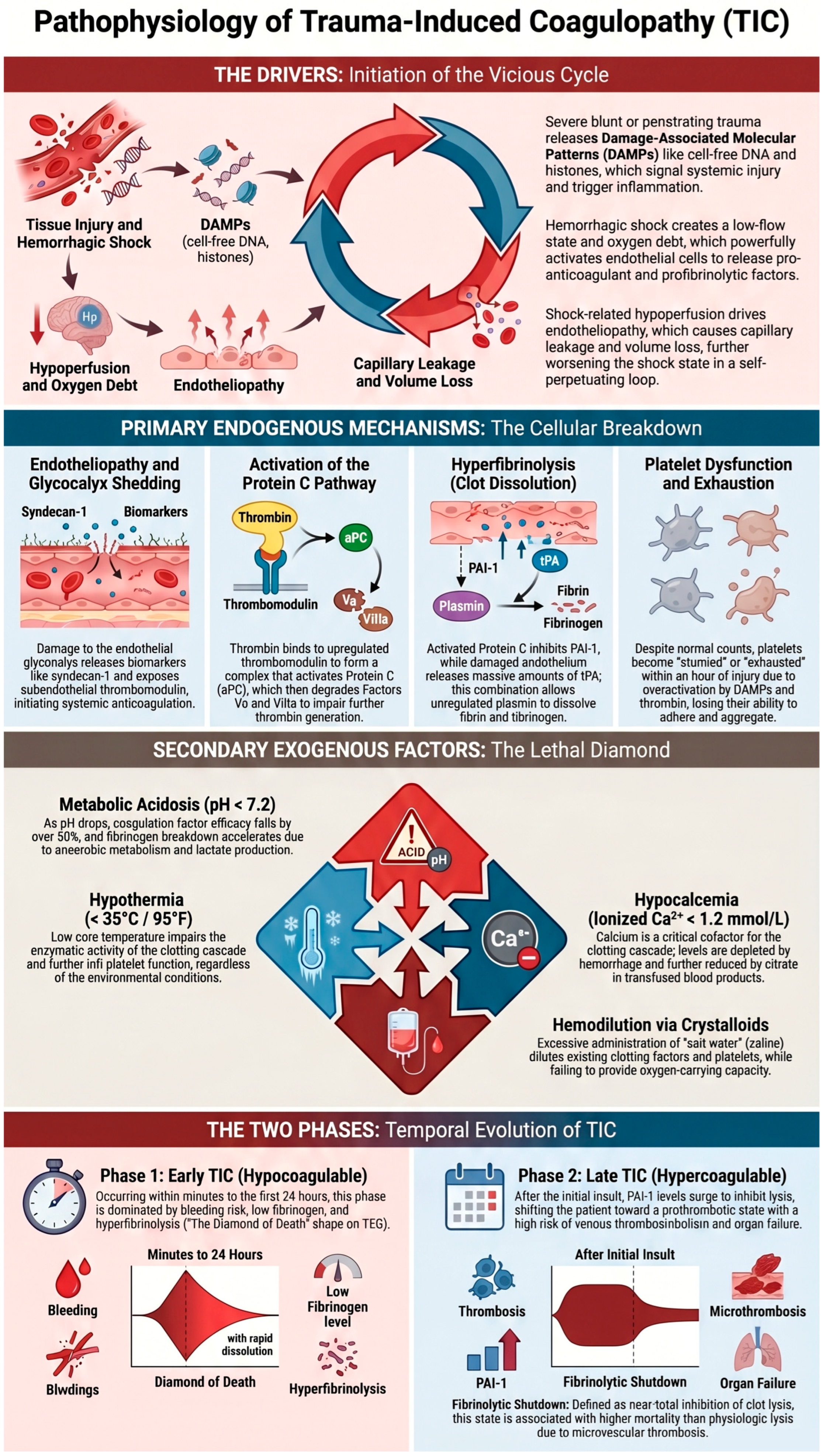
3. Pathophysiology of Trauma-Induced Coagulopathy
4. Clinical Impact and Epidemiology
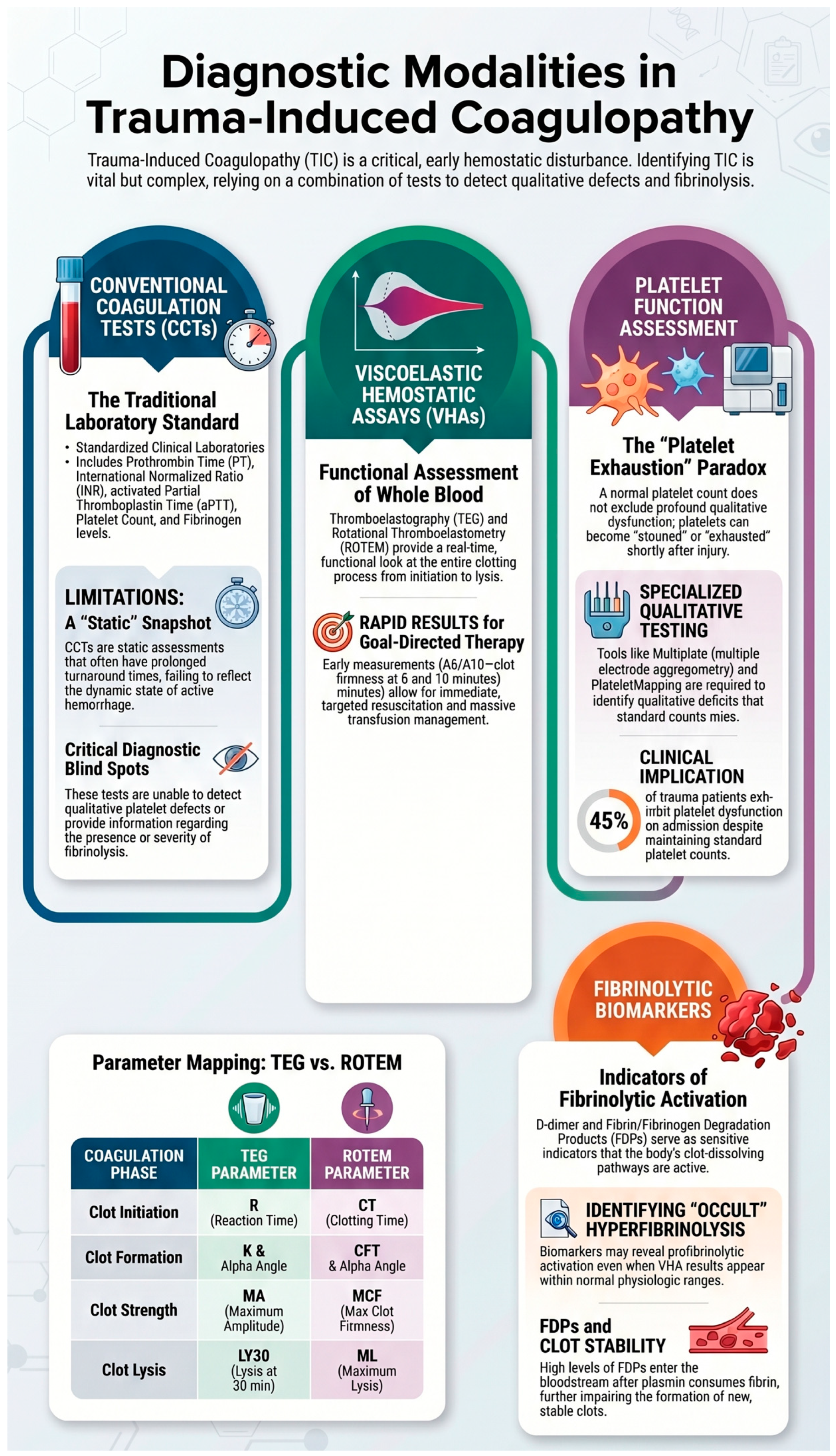
5. Diagnostic Modalities in TIC
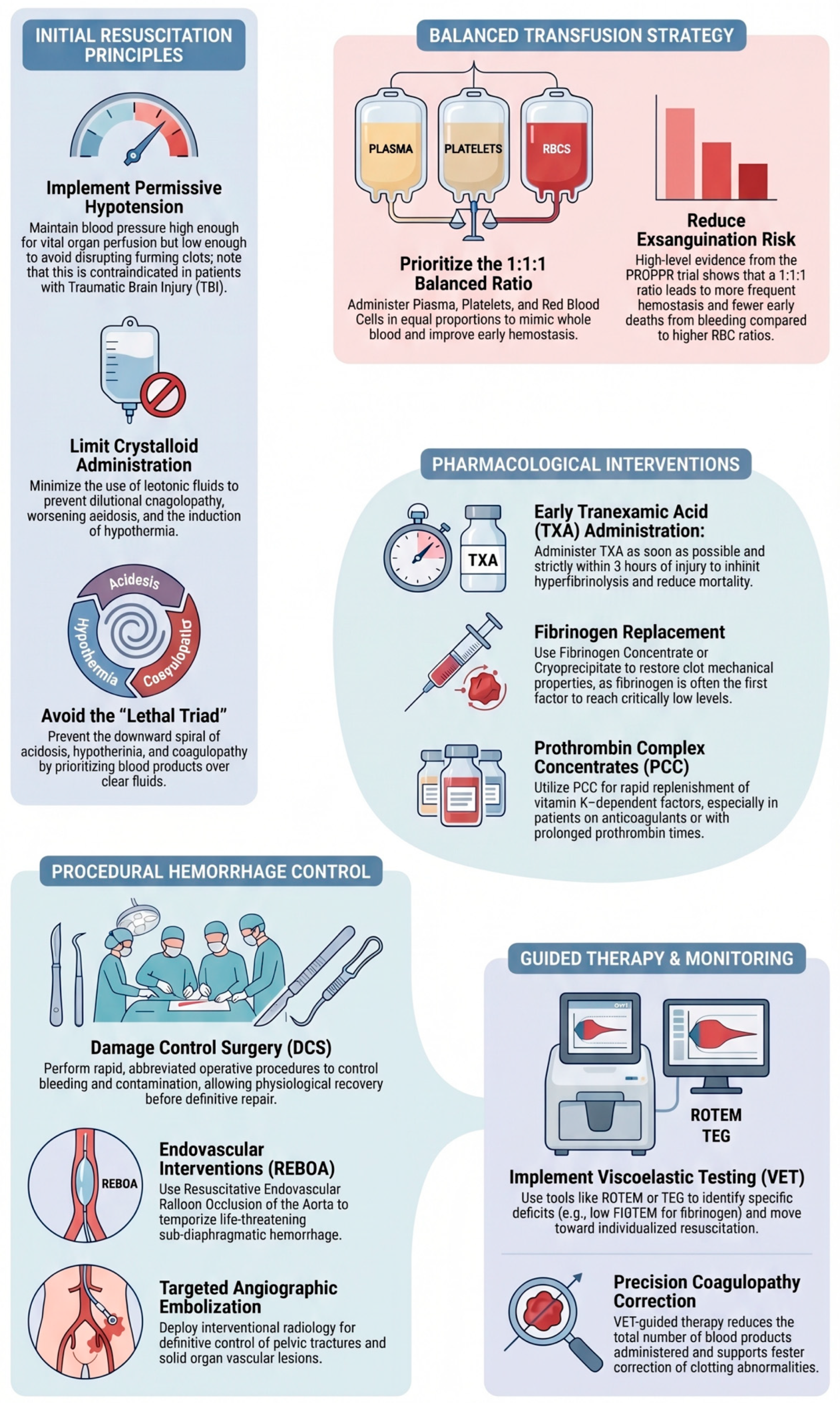
6. Principles of Hemostatic Resuscitation
7. Transfusion Strategies: Early Balanced Transfusion as the Cornerstone of Modern Trauma Resuscitation
8. Fibrinogen Replacement
9. Coagulation Factor Therapy
10. Antifibrinolytic Therapy
11. Damage Control Surgery and Endovascular Approaches
12. Integration of Viscoelastic Diagnostics into Hemostatic Resuscitation
13. Clinical Guidelines and Consensus Recommendations
- •
- European guideline (6th edition): Offers comprehensive recommendations on diagnostics, transfusion ratios, coagulation factor replacement, and integration of procedural interventions, emphasizing proactive management of coagulopathy [8].
- •
- American College of Surgeons—Committee on Trauma (ACS-COT): Recommends early balanced transfusion, massive transfusion protocols, antifibrinolytic therapy, and the incorporation of damage control surgery and hemostatic resuscitation principles into ATLS algorithms [51].
- •
- Eastern Association for the Surgery of Trauma (EAST): Provides evidence-based guidance for transfusion strategies, factor replacement (fibrinogen, PCC), use of rFVIIa as rescue therapy, and VET-guided individualized management [52].
- •
- World Society of Emergency Surgery (WSES): Advocates a global, physiology-driven approach integrating systemic hemostatic resuscitation, procedural hemorrhage control, viscoelastic diagnostics, and stepwise factor replacement [9].
14. Special Considerations in Subpopulations
15. Discussion
16. Conclusions
Author Contributions
Funding
Institutional Review Board Statement
Informed Consent Statement
Data Availability Statement
Conflicts of Interest
References
- Kauvar, D.S.; Lefering, R.; Wade, C.E. Impact of hemorrhage on trauma outcome: An overview of epidemiology, clinical presentations, and therapeutic considerations. J. Trauma Inj. Infect. Crit. Care 2006, 60, S3–S11. [Google Scholar] [CrossRef] [PubMed]
- Brohi, K.; Singh, J.; Heron, M.; Coats, T. Acute traumatic coagulopathy. J. Trauma Inj. Infect. Crit. Care 2003, 54, 1127–1130. [Google Scholar] [CrossRef] [PubMed]
- Brohi, K.; Cohen, M.J.; Davenport, R.A. Acute coagulopathy of trauma: Mechanism, identification and effect. Curr. Opin. Crit. Care 2007, 13, 680–685. [Google Scholar] [CrossRef] [PubMed]
- Hess, J.R.; Brohi, K.; Dutton, R.P.; Hauser, C.J.; Holcomb, J.B.; Kluger, Y.; Mackway-Jones, K.; Parr, M.J.; Rizoli, S.B.; Yukioka, T.; et al. The coagulopathy of trauma: A review of mechanisms. J. Trauma Inj. Infect. Crit. Care 2008, 65, 748–754. [Google Scholar] [CrossRef] [PubMed]
- Davenport, R.; Manson, J.; De’Ath, H.; Platton, S.; Coates, A.; Allard, S.; Hart, D.; Pearse, R.; Pasi, K.J.; MacCallum, P.; et al. Functional definition and characterization of acute traumatic coagulopathy. Crit. Care Med. 2011, 39, 2652–2658. [Google Scholar] [CrossRef] [PubMed] [PubMed Central]
- Nguyen, M.; Pirracchio, R.; Kornblith, L.Z.; Callcut, R.; Fox, E.E.; Wade, C.E.; Schreiber, M.; Holcomb, J.B.; Coyle, J.; Cohen, M.; et al. Dynamic impact of transfusion ratios on outcomes in severely injured patients: Targeted machine learning analysis of the Pragmatic, Randomized Optimal Platelet and Plasma Ratios randomized clinical trial. J. Trauma Acute Care Surg. 2020, 89, 505–513. [Google Scholar] [CrossRef] [PubMed] [PubMed Central]
- CRASH-2 Trial Collaborators; Shakur, H.; Roberts, I.; Bautista, R.; Caballero, J.; Coats, T.; Dewan, Y.; El-Sayed, H.; Gogichaishvili, T.; Gupta, S.; et al. Effects of tranexamic acid on death, vascular occlusive events, and blood transfusion in trauma patients with significant haemorrhage (CRASH-2): A randomised, placebo-controlled trial. Lancet 2010, 376, 23–32. [Google Scholar] [CrossRef] [PubMed]
- Rossaint, R.; Afshari, A.; Bouillon, B.; Cerny, V.; Cimpoesu, D.; Curry, N.; Duranteau, J.; Filipescu, D.; Grottke, O.; Grønlykke, L.; et al. The European guideline on management of major bleeding and coagulopathy following trauma: Sixth edition. Crit. Care 2023, 27, 80. [Google Scholar] [CrossRef] [PubMed] [PubMed Central]
- König, C.; Adam, G.; Well, L. Management von Organblutungen: Leitlinien der American Association for the Surgery of Trauma (AAST) und World Society of Emergency Surgery (WSES) [Management of internal bleeding: Guidelines of the American Association for the Surgery of Trauma (AAST) and World Society of Emergency Surgery (WSES)]. Radiologie 2025, 65, 13–21. [Google Scholar] [CrossRef] [PubMed]
- CRASH-3 Trial Collaborators. Effects of tranexamic acid on death, disability, vascular occlusive events and other morbidities in patients with acute traumatic brain injury (CRASH-3): A randomised, placebo-controlled trial. Lancet 2019, 394, 1713–1723, Erratum in Lancet 2019, 394, 1712. https://doi.org/10.1016/S0140-6736(19)32641-8. [Google Scholar] [CrossRef] [PubMed] [PubMed Central]
- Holcomb, J.B.; Tilley, B.C.; Baraniuk, S.; Fox, E.E.; Wade, C.E.; Podbielski, J.M.; del Junco, D.J.; Brasel, K.J.; Bulger, E.M.; Callcut, R.A.; et al. Transfusion of plasma, platelets, and red blood cells in a 1:1:1 vs a 1:1:2 ratio and mortality in patients with severe trauma: The PROPPR randomized clinical trial. JAMA 2015, 313, 471–482. [Google Scholar] [CrossRef] [PubMed] [PubMed Central]
- Sperry, J.L.; Guyette, F.X.; Brown, J.B.; Yazer, M.H.; Triulzi, D.J.; Early-Young, B.J.; Adams, P.W.; Daley, B.J.; Miller, R.S.; Harbrecht, B.G.; et al. Prehospital Plasma during Air Medical Transport in Trauma Patients at Risk for Hemorrhagic Shock. N. Engl. J. Med. 2018, 379, 315–326. [Google Scholar] [CrossRef] [PubMed]
- Moore, H.B.; Moore, E.E.; Chapman, M.P.; McVaney, K.; Bryskiewicz, G.; Blechar, R.; Chin, T.; Burlew, C.C.; Pieracci, F.; West, F.B.; et al. Plasma-first resuscitation to treat haemorrhagic shock during emergency ground transportation in an urban area: A randomised trial. Lancet 2018, 392, 283–291. [Google Scholar] [CrossRef] [PubMed] [PubMed Central]
- Johansson, P.I.; Stensballe, J.; Ostrowski, S.R. Shock induced endotheliopathy (SHINE) in acute critical illness—A unifying pathophysiologic mechanism. Crit. Care 2017, 21, 25, Erratum in Crit. Care 2017, 21, 187. https://doi.org/10.1186/s13054-017-1756-4. [Google Scholar] [CrossRef] [PubMed] [PubMed Central]
- Moore, H.B.; Moore, E.E.; Gonzalez, E.; Chapman, M.P.; Chin, T.L.; Silliman, C.C.; Banerjee, A.; Sauaia, A. Hyperfibrinolysis, physiologic fibrinolysis, and fibrinolysis shutdown: The spectrum of postinjury fibrinolysis and relevance to antifibrinolytic therapy. J. Trauma Acute Care Surg. 2014, 77, 811–817; discussion 817. [Google Scholar] [CrossRef] [PubMed] [PubMed Central]
- Kutcher, M.E.; Redick, B.J.; McCreery, R.C.; Crane, I.M.; Greenberg, M.D.; Cachola, L.M.; Nelson, M.F.; Cohen, M.J. Characterization of platelet dysfunction after trauma. J. Trauma Acute Care Surg. 2012, 73, 13–19. [Google Scholar] [CrossRef] [PubMed] [PubMed Central]
- MacLeod, J.B.; Lynn, M.; McKenney, M.G.; Cohn, S.M.; Murtha, M. Early coagulopathy predicts mortality in trauma. J. Trauma Acute Care Surg. 2003, 55, 39–44. [Google Scholar] [CrossRef] [PubMed]
- Brohi, K.; Cohen, M.J.; Ganter, M.T.; Schultz, M.J.; Levi, M.; Mackersie, R.C.; Pittet, J.F. Acute coagulopathy of trauma: Hypoperfusion induces systemic anticoagulation and hyperfibrinolysis. J. Trauma Inj. Infect. Crit. Care 2008, 64, 1211–1217; discussion 1217. [Google Scholar] [CrossRef] [PubMed]
- Whiting, D.; DiNardo, J.A. TEG and ROTEM: Technology and clinical applications. Am. J. Hematol. 2014, 89, 228–232. [Google Scholar] [CrossRef] [PubMed]
- Moore, E.E.; Moore, H.B.; Chapman, M.P.; Gonzalez, E.; Sauaia, A. Goal-directed hemostatic resuscitation for trauma induced coagulopathy: Maintaining homeostasis. J. Trauma Acute Care Surg. 2018, 84, S35–S40. [Google Scholar] [CrossRef] [PubMed] [PubMed Central]
- Rotondo, M.F.; Schwab, C.W.; McGonigal, M.D.; Phillips, G.R., 3rd; Fruchterman, T.M.; Kauder, D.R.; Latenser, B.A.; Angood, P.A. ‘Damage control’: An approach for improved survival in exsanguinating penetrating abdominal injury. J. Trauma Acute Care Surg. 1993, 35, 375–382; discussion 382-3. [Google Scholar] [PubMed]
- Holcomb, J.B.; Jenkins, D.; Rhee, P.; Johannigman, J.; Mahoney, P.; Mehta, S.; Cox, E.D.; Gehrke, M.J.; Beilman, G.J.; Schreiber, M.; et al. Damage control resuscitation: Directly addressing the early coagulopathy of trauma. J. Trauma Inj. Infect. Crit. Care 2007, 62, 307–310. [Google Scholar] [CrossRef] [PubMed]
- Bickell, W.H.; Wall, M.J., Jr.; Pepe, P.E.; Martin, R.R.; Ginger, V.F.; Allen, M.K.; Mattox, K.L. Immediate versus delayed fluid resuscitation for hypotensive patients with penetrating torso injuries. N. Engl. J. Med. 1994, 331, 1105–1109. [Google Scholar] [CrossRef] [PubMed]
- Gunter, O.L., Jr.; Au, B.K.; Isbell, J.M.; Mowery, N.T.; Young, P.P.; Cotton, B.A. Optimizing outcomes in damage control resuscitation: Identifying blood product ratios associated with improved survival. J. Trauma Inj. Infect. Crit. Care 2008, 65, 527–534. [Google Scholar] [CrossRef] [PubMed]
- Ibrahim, W.; Meza Monge, K.; Menzel, J.; Morales Ojeda, L.; Dalton, M.; Fuenmayor Lozada, D.A.; Vidal-Gallardo, A.; Fonseca Niño, A.M.; Aragón Conrado, L.E.; Cripps, M.W.; et al. Whole-Blood vs Component Therapy in Adult Trauma: An Updated Systematic Review and Meta-Analysis. JAMA Surg. 2026, 161, 497–506, Erratum in JAMA Surg. 2026, 161, 554. https://doi.org/10.1001/jamasurg.2026.1283. [Google Scholar] [CrossRef] [PubMed] [PubMed Central]
- Meizoso, J.P.; Cotton, B.A.; Lawless, R.A.; Kodadek, L.M.; Lynde, J.M.; Russell, N.; Gaspich, J.; Maung, A.; Anderson, C.; Reynolds, J.M.; et al. Whole blood resuscitation for injured patients requiring transfusion: A systematic review, meta-analysis, and practice management guideline from the Eastern Association for the Surgery of Trauma. J. Trauma Acute Care Surg. 2024, 97, 460–470. [Google Scholar] [CrossRef] [PubMed]
- Fries, D.; Martini, W.Z. Role of fibrinogen in trauma-induced coagulopathy. Br. J. Anaesth. 2010, 105, 116–121. [Google Scholar] [CrossRef] [PubMed]
- Davenport, R.; Curry, N. Fibrinogen replacement in trauma haemorrhage: Essential but not empirical? Emerg. Med. J. 2024, 41, 447–448. [Google Scholar] [CrossRef] [PubMed]
- Burt, T.; Guilliam, A.; Cole, E.; Davenport, R. Effect of early administration of fibrinogen replacement therapy in traumatic haemorrhage: A systematic review and meta-analysis of randomised controlled trials with narrative synthesis of observational studies. Crit. Care 2025, 29, 49. [Google Scholar] [CrossRef] [PubMed] [PubMed Central]
- Curry, N.; Foley, C.; Wong, H.; Mora, A.; Curnow, E.; Zarankaite, A.; Hodge, R.; Hopkins, V.; Deary, A.; Ray, J.; et al. Early fibrinogen concentrate therapy for major haemorrhage in trauma (E-FIT 1): Results from a UK multi-centre, randomised, double blind, placebo-controlled pilot trial. Crit. Care 2018, 22, 164. [Google Scholar] [CrossRef] [PubMed] [PubMed Central]
- Steinmetz, J.; Sørensen, A.M.; Henriksen, H.H.; Lange, T.; Larsen, C.F.; Johansson, P.I.; Stensballe, J. Pilot Randomized trial of Fibrinogen in Trauma Haemorrhage (PRooF-iTH): Study protocol for a randomized controlled trial. Trials 2016, 17, 327. [Google Scholar] [CrossRef] [PubMed] [PubMed Central]
- Baksaas-Aasen, K.; Gall, L.; Eaglestone, S.; Rourke, C.; Juffermans, N.P.; Goslings, J.C.; Naess, P.A.; van Dieren, S.; Ostrowski, S.R.; Stensballe, J.; et al. iTACTIC—Implementing Treatment Algorithms for the Correction of Trauma-Induced Coagulopathy: Study protocol for a multicentre, randomised controlled trial. Trials 2017, 18, 486. [Google Scholar] [CrossRef] [PubMed] [PubMed Central]
- Franchini, M.; Lippi, G. Prothrombin complex concentrates: An update. Blood Transfus. 2010, 8, 149–154. [Google Scholar] [CrossRef] [PubMed] [PubMed Central]
- Grottke, O.; Heubner, L. Restoring hemostasis with prothrombin complex concentrate: Benefits and risks in trauma-induced coagulopathy. Curr. Opin. Anaesthesiol. 2025, 38, 120–128. [Google Scholar] [CrossRef] [PubMed]
- Matsushima, K.; Benjamin, E.; Demetriades, D. Prothrombin complex concentrate in trauma patients. Am. J. Surg. 2015, 209, 413–417. [Google Scholar] [CrossRef] [PubMed]
- Kao, T.W.; Lee, Y.C.; Chang, H.T. Prothrombin Complex Concentrate for Trauma Induced Coagulopathy: A Systematic Review and Meta-Analysis. J. Acute Med. 2021, 11, 81–89. [Google Scholar] [CrossRef] [PubMed] [PubMed Central]
- Hannadjas, I.; James, A.; Davenport, R.; Lindsay, C.; Brohi, K.; Cole, E. Prothrombin complex concentrate (PCC) for treatment of trauma-induced coagulopathy: Systematic review and meta-analyses. Crit. Care 2023, 27, 422. [Google Scholar] [CrossRef] [PubMed] [PubMed Central]
- Dutton, R.P.; Conti, B.M. The role of recombinant-activated factor VII in bleeding trauma patients. Curr. Opin. Anaesthesiol. 2009, 22, 299–304. [Google Scholar] [CrossRef] [PubMed]
- Bartal, C.; Yitzhak, A. The role of thromboelastometry and recombinant factor VIIa in trauma. Curr. Opin. Anaesthesiol. 2009, 22, 281–288. [Google Scholar] [CrossRef] [PubMed]
- Duchesne, J.C.; Mathew, K.A.; Marr, A.B.; Pinsky, M.R.; Barbeau, J.M.; McSwain, N.E. Current evidence based guidelines for factor VIIa use in trauma: The good, the bad, and the ugly. Am. Surg. 2008, 74, 1159–1165. [Google Scholar] [CrossRef]
- Morrison, J.J.; Galgon, R.E.; Jansen, J.O.; Cannon, J.W.; Rasmussen, T.E.; Eliason, J.L. A systematic review of the use of resuscitative endovascular balloon occlusion of the aorta in the management of hemorrhagic shock. J. Trauma Acute Care Surg. 2016, 80, 324–334, Erratum in J. Trauma Acute Care Surg. 2016, 80, 554. [Google Scholar] [CrossRef] [PubMed]
- Borger van der Burg, B.L.S.; van Dongen, T.T.C.F.; Morrison, J.J.; Hedeman Joosten, P.P.A.; DuBose, J.J.; Hörer, T.M.; Hoencamp, R. A systematic review and meta-analysis of the use of resuscitative endovascular balloon occlusion of the aorta in the management of major exsanguination. Eur. J. Trauma Emerg. Surg. 2018, 44, 535–550. [Google Scholar] [CrossRef] [PubMed] [PubMed Central]
- Granieri, S.; Frassini, S.; Cimbanassi, S.; Bonomi, A.; Paleino, S.; Lomaglio, L.; Chierici, A.; Bruno, F.; Biondi, R.; Di Saverio, S.; et al. Impact of resuscitative endovascular balloon occlusion of the aorta (REBOA) in traumatic abdominal and pelvic exsanguination: A systematic review and meta-analysis. Eur. J. Trauma Emerg. Surg. 2022, 48, 3561–3574. [Google Scholar] [CrossRef] [PubMed]
- Brenner, M.; Teeter, W.; Hoehn, M.; Pasley, J.; Hu, P.; Yang, S.; Romagnoli, A.; Diaz, J.; Stein, D.; Scalea, T. Use of Resuscitative Endovascular Balloon Occlusion of the Aorta for Proximal Aortic Control in Patients With Severe Hemorrhage and Arrest. JAMA Surg. 2018, 153, 130–135. [Google Scholar] [CrossRef] [PubMed] [PubMed Central]
- Petrone, P.; Pérez-Jiménez, A.; Rodríguez-Perdomo, M.; Brathwaite, C.E.M.; Joseph, D.K. Resuscitative Endovascular Balloon Occlusion of the Aorta (REBOA) in the Management of Trauma Patients: A Systematic Literature Review. Am. Surg. 2019, 85, 654–662. [Google Scholar] [CrossRef]
- Stensballe, J.; Henriksen, H.H.; Johansson, P.I. Early haemorrhage control and management of trauma-induced coagulopathy: The importance of goal-directed therapy. Curr. Opin. Crit. Care 2017, 23, 503–510. [Google Scholar] [CrossRef] [PubMed]
- Longacre, M.M.; Ibla, J.C. TEG and ROTEM: Technology and Clinical Applications, 2026 Update. Am. J. Hematol. 2025, 100, 2357–2370. [Google Scholar] [CrossRef] [PubMed]
- Whiting, P.; Al, M.; Westwood, M.; Ramos, I.C.; Ryder, S.; Armstrong, N.; Misso, K.; Ross, J.; Severens, J.; Kleijnen, J. Viscoelastic point-of-care testing to assist with the diagnosis, management and monitoring of haemostasis: A systematic review and cost-effectiveness analysis. Health Technol. Assess. 2015, 19, 1–228, v–vi. [Google Scholar] [CrossRef] [PubMed] [PubMed Central]
- Brill, J.B.; Brenner, M.; Duchesne, J.; Roberts, D.; Ferrada, P.; Horer, T.; Kauvar, D.; Khan, M.; Kirkpatrick, A.; Ordonez, C.; et al. The Role of TEG and ROTEM in Damage Control Resuscitation. Shock 2021, 56, 52–61. [Google Scholar] [CrossRef] [PubMed] [PubMed Central]
- Hofmann, N.; Schöchl, H.; Zipperle, J.; Gratz, J.; Schmitt, F.C.F.; Oberladstätter, D. Altered thrombin generation with prothrombin complex concentrate is not detected by viscoelastic testing: An in vitro study. Br. J. Anaesth. 2025, 134, 1392–1401. [Google Scholar] [CrossRef] [PubMed] [PubMed Central]
- Hofmann, N.; Schöchl, H.; Oberladstätter, D.; Zipperle, J.; Schmitt, F.; von der Forst, M.; Martin, C.; Gratz, J. Viscoelastic coagulation testing in bleeding trauma patients: A retrospective analysis and development of a treatment algorithm. Br. J. Anaesth. 2026, 136, 117–125. [Google Scholar] [CrossRef] [PubMed]
- American College of Surgeons Committee on Trauma. Advanced Trauma Life Support (ATLS®) Student Course Manual, 10th ed.; American College of Surgeons: Chicago, IL, USA, 2018. [Google Scholar]
- Cannon, J.W.; Khan, M.A.; Raja, A.S.; Cohen, M.J.; Como, J.J.; Cotton, B.A.; Dubose, J.J.; Fox, E.E.; Inaba, K.; Rodriguez, C.J.; et al. Damage control resuscitation in patients with severe traumatic hemorrhage: A practice management guideline from the Eastern Association for the Surgery of Trauma. J. Trauma Acute Care Surg. 2017, 82, 605–617. [Google Scholar] [CrossRef] [PubMed]
- Rowell, S.E.; Meier, E.N.; McKnight, B.; Kannas, D.; May, S.; Sheehan, K.; Bulger, E.M.; Idris, A.H.; Christenson, J.; Morrison, L.J.; et al. Effect of Out-of-Hospital Tranexamic Acid vs Placebo on 6-Month Functional Neurologic Outcomes in Patients With Moderate or Severe Traumatic Brain Injury. JAMA 2020, 324, 961–974, Erratum in JAMA 2020, 324, 1683. https://doi.org/10.1001/jama.2020.20143. [Google Scholar] [CrossRef] [PubMed] [PubMed Central]
- Sprigg, N.; Flaherty, K.; Appleton, J.P.; Al-Shahi Salman, R.; Bereczki, D.; Beridze, M.; Ciccone, A.; Collins, R.; Dineen, R.A.; Duley, L.; et al. Tranexamic acid to improve functional status in adults with spontaneous intracerebral haemorrhage: The TICH-2 RCT. Health Technol. Assess. 2019, 23, 1–48. [Google Scholar] [CrossRef] [PubMed] [PubMed Central]
- Karl, V.; Thorn, S.; Mathes, T.; Hess, S.; Maegele, M. Association of Tranexamic Acid Administration With Mortality and Thromboembolic Events in Patients with Traumatic Injury: A Systematic Review and Meta-analysis. JAMA Netw. Open 2022, 5, e220625. [Google Scholar] [CrossRef] [PubMed] [PubMed Central]
- Levi, M. Management of bleeding in patients treated with direct oral anticoagulants. Crit. Care. 2016, 20, 249. [Google Scholar] [CrossRef] [PubMed] [PubMed Central][Green Version]
- Kaatz, S.; Mahan, C.E.; Nakhle, A.; Gunasekaran, K.; Ali, M.; Lavender, R.; Paje, D.G. Management of Elective Surgery and Emergent Bleeding with Direct Oral Anticoagulants. Curr. Cardiol. Rep. 2017, 19, 124. [Google Scholar] [CrossRef] [PubMed]
- Perea, L.L.; Moore, K.; Docherty, C.; Nguyen, U.; Seamon, M.J.; Byrne, J.P.; Jenkins, D.H.; Braverman, M.A.; Porter, J.M.; Armento, I.G.; et al. Whole Blood Resuscitation is Safe in Pediatric Trauma Patients: A Multicenter Study. Am. Surg. 2023, 89, 3058–3063. [Google Scholar] [CrossRef] [PubMed]
- Feeney, E.V.; Morgan, K.M.; Spinella, P.C.; Gaines, B.A.; Leeper, C.M. Whole blood: Total blood product ratio impacts survival in injured children. J. Trauma Acute Care Surg. 2024, 97, 546–551. [Google Scholar] [CrossRef] [PubMed]
- Anand, T.; Obaid, O.; Nelson, A.; Chehab, M.; Ditillo, M.; Hammad, A.; Douglas, M.; Bible, L.; Joseph, B. Whole blood hemostatic resuscitation in pediatric trauma: A nationwide propensity-matched analysis. J. Trauma Acute Care Surg. 2021, 91, 573–578. [Google Scholar] [CrossRef] [PubMed]
- Abou Khalil, E.; Morgan, K.M.; Gaines, B.A.; Spinella, P.C.; Leeper, C.M. Use of whole blood in pediatric trauma: A narrative review. Trauma Surg. Acute Care Open 2024, 9, e001127. [Google Scholar] [CrossRef] [PubMed] [PubMed Central]
- Kornelsen, E.; Kuppermann, N.; Nishijima, D.K.; Ren, L.Y.; Rumantir, M.; Gill, P.J.; Finkelstein, Y. Effectiveness and safety of tranexamic acid in pediatric trauma: A systematic review and meta-analysis. Am. J. Emerg. Med. 2022, 55, 103–110. [Google Scholar] [CrossRef] [PubMed]


Disclaimer/Publisher’s Note: The statements, opinions and data contained in all publications are solely those of the individual author(s) and contributor(s) and not of MDPI and/or the editor(s). MDPI and/or the editor(s) disclaim responsibility for any injury to people or property resulting from any ideas, methods, instructions or products referred to in the content. |
© 2026 by the authors. Published by MDPI on behalf of the Lithuanian University of Health Sciences. Licensee MDPI, Basel, Switzerland. This article is an open access article distributed under the terms and conditions of the Creative Commons Attribution (CC BY) license.
Share and Cite
Matteucci, M.; Cirillo, B.; Brucchi, F.; Suadoni, F.; Pesce, A.; Giuliani, D.; Spizzirri, A.; Napolitano, V.; Micheli, M.; Dionigi, G.; et al. Hemostatic Resuscitation in Trauma-Induced Coagulopathy: A Comprehensive Narrative Review. Medicina 2026, 62, 1263. https://doi.org/10.3390/medicina62071263
Matteucci M, Cirillo B, Brucchi F, Suadoni F, Pesce A, Giuliani D, Spizzirri A, Napolitano V, Micheli M, Dionigi G, et al. Hemostatic Resuscitation in Trauma-Induced Coagulopathy: A Comprehensive Narrative Review. Medicina. 2026; 62(7):1263. https://doi.org/10.3390/medicina62071263
Chicago/Turabian StyleMatteucci, Matteo, Bruno Cirillo, Francesco Brucchi, Fabio Suadoni, Antonio Pesce, Daniele Giuliani, Alessandro Spizzirri, Vincenzo Napolitano, Marta Micheli, Gianlorenzo Dionigi, and et al. 2026. "Hemostatic Resuscitation in Trauma-Induced Coagulopathy: A Comprehensive Narrative Review" Medicina 62, no. 7: 1263. https://doi.org/10.3390/medicina62071263
APA StyleMatteucci, M., Cirillo, B., Brucchi, F., Suadoni, F., Pesce, A., Giuliani, D., Spizzirri, A., Napolitano, V., Micheli, M., Dionigi, G., & Cirocchi, R. (2026). Hemostatic Resuscitation in Trauma-Induced Coagulopathy: A Comprehensive Narrative Review. Medicina, 62(7), 1263. https://doi.org/10.3390/medicina62071263