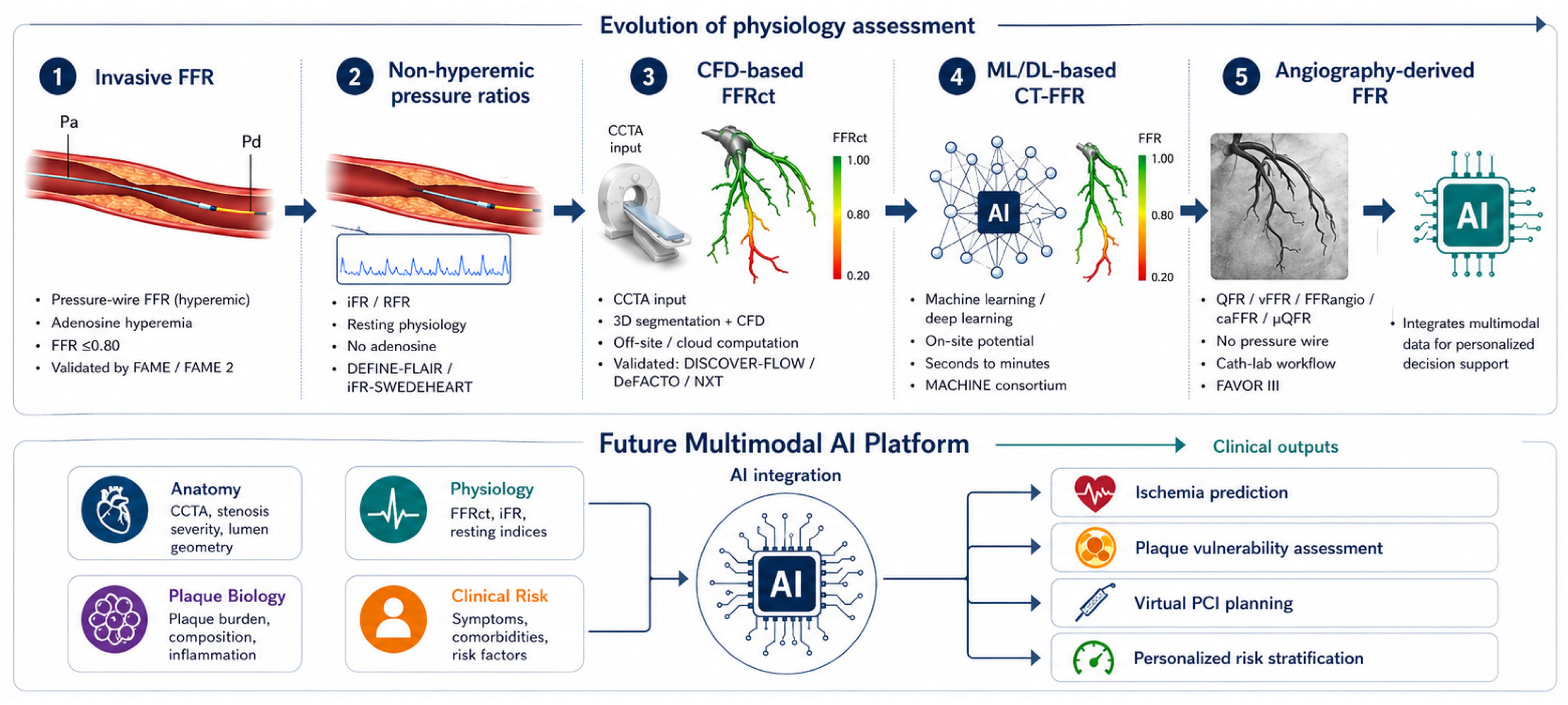
Artificial Intelligence-Driven Fractional Flow Reserve Assessment: Technical Foundations, Clinical Insights, and Future Directions
 , , , , , , , ,
Abstract
1. Introduction
Review Methodology and Scope
2. The First Non-Invasive Frontier: FFR from Computed Tomography (FFRct)
2.1. Principles of CFD-Based FFRct
2.2. Validation and Clinical Utility
2.3. Limitations of the CFD-Based Approach
3. The Paradigm Shift: Artificial Intelligence in FFR Estimation
3.1. Machine Learning Approaches (CT-FFR_ML)
- Intermediate Stenosis: CT-FFR_ML showed significantly improved performance in identifying ischemia-causing lesions in the challenging 30–69% stenosis category compared to CCTA alone (AUC 0.79 vs. 0.53) [36].
- Coronary calcification: Severe coronary calcification remains a major challenge for CCTA because blooming artifacts may obscure the true lumen boundary. In the MACHINE registry, Tesche et al. showed that ML-based CT-FFR maintained superior diagnostic performance compared with CCTA alone across coronary calcium categories, although performance was affected in patients with high calcium burden [37].
- Comorbidities: In patients with diabetes mellitus, CT-derived FFR appears to maintain diagnostic performance, although interpretation may be complicated by diffuse atherosclerosis and microvascular dysfunction. Eftekhari et al. showed that the diagnostic performance of FFRct was independent of hypertension and diabetes, and the MACHINE consortium similarly reported comparable diagnostic performance of ML-based CT-FFR in patients with versus without diabetes [38,39].
- Sex-Specific Performance: The algorithm demonstrated a statistically significant improvement in diagnostic accuracy in men (258 patients, 398 vessels). In contrast, this superiority was not observed in the smaller cohort of women (93 patients, 127 vessels), likely due to limited statistical power [40].
3.2. Deep Learning Approaches
3.3. Integrating Plaque and Radiomics
4. Challenges to Clinical Adoption
4.1. Data Quality Dependency
4.2. The “Black Box” Problem and Explainability
4.3. Generalizability and Robustness
4.4. Regulatory and Reimbursement Landscape
4.5. Seamless Workflow Integration
5. Future Directions
- Virtual Intervention Planning: A major emerging application is the use of AI for “virtual PCI” or treatment planning. After identifying a physiologically significant lesion using AI-FFR, the clinician could use a “CT-FFR Planner” tool to simulate the placement of a virtual stent of a specific length and diameter. The system would then predict the post-intervention FFR, allowing the physician to optimize the revascularization strategy and, importantly, to identify patients with diffuse, non-focal disease who may derive little physiological benefit from stenting a single segment [57].
- Holistic, Multi-Modal Risk Stratification: The ultimate goal is to move beyond a simple binary diagnosis of ischemia towards a comprehensive, personalized risk assessment. Future AI platforms will likely integrate multiple data streams from a single CCTA scan, including anatomical data (stenosis grade), detailed plaque analysis (volume, composition, high-risk features), and functional data (AI-FFR), to generate a single, powerful, and personalized risk score. This score could predict a patient’s long-term risk of MACE with far greater accuracy than any single parameter alone [58].
- Democratization of Functional Assessment: Although AI-FFR may broaden access by reducing computational burden and enabling rapid on-site or cloud-based analysis, democratization is not automatic. If these tools require high-end CT scanners, specialized acquisition protocols, or costly software licenses, they may widen rather than reduce disparities. Equitable implementation will require attention to cost, interoperability, reimbursement, cloud infrastructure, and validation in lower-resource settings.
6. Conclusions
Author Contributions
Funding
Informed Consent Statement
Data Availability Statement
Conflicts of Interest
Abbreviations
| AI | Artificial Intelligence |
| AUC | Area Under the Curve |
| CAC | Coronary Artery Calcium |
| CAD | Coronary Artery Disease |
| CCTA | Coronary Computed Tomography Angiography |
| CFD | Computational Fluid Dynamics |
| CNNs | Convolutional Neural Networks |
| CT | Computed Tomography |
| CT-FFR_ML | Machine Learning-Based CT-Derived Fractional Flow Reserve |
| DL | Deep Learning |
| ESC | European Society of Cardiology |
| EACTS | European Association for Cardio-Thoracic Surgery |
| FAME | Fractional Flow Reserve versus Angiography for Multivessel Evaluation |
| FFR | Fractional Flow Reserve |
| FFRct | CT-Derived Fractional Flow Reserve |
| HR | Hazard Ratio |
| ICA | Invasive Coronary Angiography |
| MACE | Major Adverse Cardiovascular Events |
| MI | Myocardial Infarction |
| ML | Machine Learning |
| NASCI | North American Society for Cardiovascular Imaging |
| NPV | Negative Predictive Value |
| PCI | Percutaneous Coronary Intervention |
| Pd | Distal Coronary Pressure |
| PET | Positron Emission Tomography |
| PROMISE | Prospective Multicenter Imaging Study for Evaluation of Chest Pain |
| SPECT | Single-Photon Emission Computed Tomography |
| SCCT | Society of Cardiovascular Computed Tomography |
References
- Roth, G.A.; Mensah, G.A.; Johnson, C.O.; Addolorato, G.; Ammirati, E.; Baddour, L.M.; Barengo, N.C.; Beaton, A.Z.; Benjamin, E.J.; Benziger, C.P.; et al. Global Burden of Cardiovascular Diseases and Risk Factors, 1990–2019: Update from the GBD 2019 Study. J. Am. Coll. Cardiol. 2020, 76, 2982–3021. [Google Scholar] [CrossRef] [PubMed]
- Global Status Report on Noncommunicable Diseases. 2014. Available online: https://www.who.int/publications/i/item/9789241564854 (accessed on 10 March 2026).
- Toth, G.; Hamilos, M.; Pyxaras, S.; Mangiacapra, F.; Nelis, O.; De Vroey, F.; Di Serafino, L.; Muller, O.; Van Mieghem, C.; Wyffels, E.; et al. Evolving concepts of angiogram: Fractional flow reserve discordances in 4000 coronary stenoses. Eur. Heart J. 2014, 35, 2831–2838. [Google Scholar] [CrossRef] [PubMed]
- Maron, D.J.; Hochman, J.S.; Reynolds, H.R.; Bangalore, S.; O’Brien, S.M.; Boden, W.E.; Chaitman, B.R.; Senior, R.; López-Sendón, J.; Alexander, K.P.; et al. Initial Invasive or Conservative Strategy for Stable Coronary Disease. N. Engl. J. Med. 2020, 382, 1395–1407. [Google Scholar] [CrossRef]
- Van Belle, E.; Rioufol, G.; Pouillot, C.; Cuisset, T.; Bougrini, K.; Teiger, E.; Champagne, S.; Belle, L.; Barreau, D.; Hanssen, M.; et al. Outcome Impact of Coronary Revascularization Strategy Reclassification With Fractional Flow Reserve at Time of Diagnostic Angiography. Circulation 2014, 129, 173–185. [Google Scholar] [CrossRef]
- Neumann, F.-J.; Sousa-Uva, M.; Ahlsson, A.; Alfonso, F.; Banning, A.P.; Benedetto, U.; Byrne, R.A.; Collet, J.-P.; Falk, V.; Head, S.J.; et al. 2018 ESC/EACTS Guidelines on myocardial revascularization. Eur. Heart J. 2019, 40, 87–165. [Google Scholar] [CrossRef]
- Bhatt, D.L. Instantaneous Wave-free Ratio versus Fractional Flow Reserve. N. Engl. J. Med. 2017, 377, 1598–1599. [Google Scholar] [CrossRef]
- Davies, J.E.; Sen, S.; Dehbi, H.-M.; Al-Lamee, R.; Petraco, R.; Nijjer, S.S.; Bhindi, R.; Lehman, S.J.; Walters, D.; Sapontis, J.; et al. Use of the Instantaneous Wave-free Ratio or Fractional Flow Reserve in PCI. N. Engl. J. Med. 2017, 376, 1824–1834. [Google Scholar] [CrossRef]
- Tonino, P.A.L.; De Bruyne, B.; Pijls, N.H.J.; Siebert, U.; Ikeno, F.; van ’t Veer, M.; Klauss, V.; Manoharan, G.; Engstrøm, T.; Oldroyd, K.G.; et al. Fractional Flow Reserve versus Angiography for Guiding Percutaneous Coronary Intervention. N. Engl. J. Med. 2009, 360, 213–224. [Google Scholar] [CrossRef]
- De Bruyne, B.; Pijls, N.H.J.; Kalesan, B.; Barbato, E.; Tonino, P.A.L.; Piroth, Z.; Jagic, N.; Möbius-Winkler, S.; Rioufol, G.; Witt, N.; et al. Fractional Flow Reserve–Guided PCI versus Medical Therapy in Stable Coronary Disease. N. Engl. J. Med. 2012, 367, 991–1001. [Google Scholar] [CrossRef] [PubMed]
- Arefinia, F.; Rabiei, R.; Hosseini, A.; Ghaemian, A.; Roshanpoor, A.; Aria, M.; Khorrami, Z. Artificial intelligence in estimating fractional flow reserve: A systematic literature review of techniques. BMC Cardiovasc. Disord. 2023, 23, 407. [Google Scholar] [CrossRef] [PubMed]
- Koifman, E.; Loevsky, I.; Feld, Y.; Roguin, A. Automated Fractional Flow Reserve Assessment—Artificial Intelligence in the Catheterization Laboratory. Cardiovasc. Revasc. Med. 2022, 38, 127–128. [Google Scholar] [CrossRef]
- Andersen, B.K.; Sejr-Hansen, M.; Maillard, L.; Campo, G.; Råmunddal, T.; Stähli, B.E.; Guiducci, V.; Di Serafino, L.; Escaned, J.; Santos, I.A.; et al. Quantitative flow ratio versus fractional flow reserve for coronary revascularisation guidance (FAVOR III Europe): A multicentre, randomised, non-inferiority trial. Lancet 2024, 404, 1835–1846. [Google Scholar] [CrossRef] [PubMed]
- Xu, B.; Tu, S.; Song, L.; Jin, Z.; Yu, B.; Fu, G.; Zhou, Y.; Wang, J.; Chen, Y.; Pu, J.; et al. Angiographic quantitative flow ratio-guided coronary intervention (FAVOR III China): A multicentre, randomised, sham-controlled trial. Lancet 2021, 398, 2149–2159. [Google Scholar] [CrossRef]
- Collet, C.; Onuma, Y.; Sonck, J.; Asano, T.; Vandeloo, B.; Kornowski, R.; Tu, S.; Westra, J.; Holm, N.R.; Xu, B.; et al. Diagnostic performance of angiography-derived fractional flow reserve: A systematic review and Bayesian meta-analysis. Eur. Heart J. 2018, 39, 3314–3321. [Google Scholar] [CrossRef]
- Rodriguez-Lozano, P.F.; Waheed, A.; Evangelou, S.; Kolossváry, M.; Shaikh, K.; Siddiqui, S.; Stipp, L.; Lakshmanan, S.; Wu, E.-H.; Nurmohamed, N.S.; et al. CT derived fractional flow reserve: Part 2—Critical appraisal of the literature. J. Cardiovasc. Comput. Tomogr. 2025, 19, 397–408. [Google Scholar] [CrossRef]
- Taylor, C.A.; Fonte, T.A.; Min, J.K. Computational Fluid Dynamics Applied to Cardiac Computed Tomography for Noninvasive Quantification of Fractional Flow Reserve: Scientific Basis. J. Am. Coll. Cardiol. 2013, 61, 2233–2241. [Google Scholar] [CrossRef]
- Benton, S.M.; Tesche, C.; De Cecco, C.N.; Duguay, T.M.; Schoepf, U.J.; Bayer, R.R. Noninvasive Derivation of Fractional Flow Reserve from Coronary Computed Tomographic Angiography: A Review. J. Thorac. Imaging 2018, 33, 88–96. [Google Scholar] [CrossRef] [PubMed]
- Koo, B.-K.; Erglis, A.; Doh, J.-H.; Daniels, D.V.; Jegere, S.; Kim, H.-S.; Dunning, A.; Defrance, T.; Lansky, A.; Leipsic, J.; et al. Diagnosis of ischemia-causing coronary stenoses by noninvasive fractional flow reserve computed from coronary computed tomographic angiograms. Results from the prospective multicenter DISCOVER-FLOW (Diagnosis of Ischemia-Causing Stenoses Obtained Via Noninvasive Fractional Flow Reserve) study. J. Am. Coll. Cardiol. 2011, 58, 1989–1997. [Google Scholar] [CrossRef]
- Min, J.K.; Leipsic, J.; Pencina, M.J.; Berman, D.S.; Koo, B.-K.; van Mieghem, C.; Erglis, A.; Lin, F.Y.; Dunning, A.M.; Apruzzese, P.; et al. Diagnostic accuracy of fractional flow reserve from anatomic CT angiography. JAMA 2012, 308, 1237–1245. [Google Scholar] [CrossRef] [PubMed]
- Nørgaard, B.L.; Leipsic, J.; Gaur, S.; Seneviratne, S.; Ko, B.S.; Ito, H.; Jensen, J.M.; Mauri, L.; De Bruyne, B.; Bezerra, H.; et al. Diagnostic performance of noninvasive fractional flow reserve derived from coronary computed tomography angiography in suspected coronary artery disease: The NXT trial (Analysis of Coronary Blood Flow Using CT Angiography: Next Steps). J. Am. Coll. Cardiol. 2014, 63, 1145–1155. [Google Scholar] [CrossRef]
- Cook, C.M.; Petraco, R.; Shun-Shin, M.J.; Ahmad, Y.; Nijjer, S.; Al-Lamee, R.; Kikuta, Y.; Shiono, Y.; Mayet, J.; Francis, D.P.; et al. Diagnostic Accuracy of Computed Tomography-Derived Fractional Flow Reserve: A Systematic Review. JAMA Cardiol. 2017, 2, 803–810. [Google Scholar] [CrossRef]
- Peper, J.; Schaap, J.; Rensing, B.J.W.M.; Kelder, J.C.; Swaans, M.J. Diagnostic accuracy of on-site coronary computed tomography-derived fractional flow reserve in the diagnosis of stable coronary artery disease. Neth. Heart J. 2022, 30, 160–171. [Google Scholar] [CrossRef]
- Xu, P.P.; Li, J.H.; Zhou, F.; Jiang, M.D.; Zhou, C.S.; Lu, M.J.; Tang, C.X.; Zhang, X.L.; Yang, L.; Zhang, Y.X.; et al. The influence of image quality on diagnostic performance of a machine learning-based fractional flow reserve derived from coronary CT angiography. Eur. Radiol. 2020, 30, 2525–2534. [Google Scholar] [CrossRef] [PubMed]
- Douglas, P.S.; De Bruyne, B.; Pontone, G.; Patel, M.R.; Norgaard, B.L.; Byrne, R.A.; Curzen, N.; Purcell, I.; Gutberlet, M.; Rioufol, G.; et al. 1-Year Outcomes of FFRCT-Guided Care in Patients With Suspected Coronary Disease: The PLATFORM Study. J. Am. Coll. Cardiol. 2016, 68, 435–445. [Google Scholar] [CrossRef] [PubMed]
- Lu, M.T.; Ferencik, M.; Roberts, R.S.; Lee, K.L.; Ivanov, A.; Adami, E.; Mark, D.B.; Jaffer, F.A.; Leipsic, J.A.; Douglas, P.S.; et al. Noninvasive FFR Derived From Coronary CT Angiography: Management and Outcomes in the PROMISE Trial. JACC Cardiovasc. Imaging 2017, 10, 1350–1358. [Google Scholar] [CrossRef] [PubMed]
- Fairbairn, T.A.; Nieman, K.; Akasaka, T.; Nørgaard, B.L.; Berman, D.S.; Raff, G.; Hurwitz-Koweek, L.M.; Pontone, G.; Kawasaki, T.; Sand, N.P.; et al. Real-world clinical utility and impact on clinical decision-making of coronary computed tomography angiography-derived fractional flow reserve: Lessons from the ADVANCE Registry. Eur. Heart J. 2018, 39, 3701–3711. [Google Scholar] [CrossRef]
- Patel, M.R.; Nørgaard, B.L.; Fairbairn, T.A.; Nieman, K.; Akasaka, T.; Berman, D.S.; Raff, G.L.; Hurwitz Koweek, L.M.; Pontone, G.; Kawasaki, T.; et al. 1-Year Impact on Medical Practice and Clinical Outcomes of FFRCT: The ADVANCE Registry. JACC Cardiovasc. Imaging 2020, 13, 97–105. [Google Scholar] [CrossRef]
- Gulati, M.; Levy, P.D.; Mukherjee, D.; Amsterdam, E.; Bhatt, D.L.; Birtcher, K.K.; Blankstein, R.; Boyd, J.; Bullock-Palmer, R.P.; Conejo, T.; et al. 2021 AHA/ACC/ASE/CHEST/SAEM/SCCT/SCMR Guideline for the Evaluation and Diagnosis of Chest Pain: A Report of the American College of Cardiology/American Heart Association Joint Committee on Clinical Practice Guidelines. J. Am. Coll. Cardiol. 2021, 78, e187–e285. [Google Scholar] [CrossRef]
- Driessen, R.S.; Danad, I.; Stuijfzand, W.J.; Raijmakers, P.G.; Schumacher, S.P.; van Diemen, P.A.; Leipsic, J.A.; Knuuti, J.; Underwood, S.R.; van de Ven, P.M.; et al. Comparison of Coronary Computed Tomography Angiography, Fractional Flow Reserve, and Perfusion Imaging for Ischemia Diagnosis. J. Am. Coll. Cardiol. 2019, 73, 161–173. [Google Scholar] [CrossRef]
- Sharma, P.; Suehling, M.; Flohr, T.; Comaniciu, D. Artificial Intelligence in Diagnostic Imaging: Status Quo, Challenges, and Future Opportunities. J. Thorac. Imaging 2020, 35, S11–S16. [Google Scholar] [CrossRef]
- Dey, D.; Gaur, S.; Ovrehus, K.A.; Slomka, P.J.; Betancur, J.; Goeller, M.; Hell, M.M.; Gransar, H.; Berman, D.S.; Achenbach, S.; et al. Integrated prediction of lesion-specific ischaemia from quantitative coronary CT angiography using machine learning: A multicentre study. Eur. Radiol. 2018, 28, 2655–2664. [Google Scholar] [CrossRef]
- Tesche, C.; Gray, H.N. Machine Learning and Deep Neural Networks Applications in Coronary Flow Assessment: The Case of Computed Tomography Fractional Flow Reserve. J. Thorac. Imaging 2020, 35, S66–S71. [Google Scholar] [CrossRef] [PubMed]
- Itu, L.; Rapaka, S.; Passerini, T.; Georgescu, B.; Schwemmer, C.; Schoebinger, M.; Flohr, T.; Sharma, P.; Comaniciu, D. A machine-learning approach for computation of fractional flow reserve from coronary computed tomography. J. Appl. Physiol. 2016, 121, 42–52. [Google Scholar] [CrossRef] [PubMed]
- Coenen, A.; Kim, Y.-H.; Kruk, M.; Tesche, C.; De Geer, J.; Kurata, A.; Lubbers, M.; Daemen, J.; Itu, L.; Rapaka, S.; et al. Diagnostic Accuracy of a Machine-Learning Approach to Coronary Computed Tomographic Angiography-Based Fractional Flow Reserve: Result From the MACHINE Consortium. Circ. Cardiovasc. Imaging 2018, 11, e007217. [Google Scholar] [CrossRef] [PubMed]
- Tang, C.X.; Wang, Y.N.; Zhou, F.; Schoepf, U.J.; van Assen, M.; Stroud, R.E.; Li, J.H.; Zhang, X.L.; Lu, M.J.; Zhou, C.S.; et al. Diagnostic performance of fractional flow reserve derived from coronary CT angiography for detection of lesion-specific ischemia: A multi-center study and meta-analysis. Eur. J. Radiol. 2019, 116, 90–97. [Google Scholar] [CrossRef]
- Tesche, C.; Otani, K.; De Cecco, C.N.; Coenen, A.; De Geer, J.; Kruk, M.; Kim, Y.-H.; Albrecht, M.H.; Baumann, S.; Renker, M.; et al. Influence of Coronary Calcium on Diagnostic Performance of Machine Learning CT-FFR: Results From MACHINE Registry. JACC Cardiovasc. Imaging 2020, 13, 760–770. [Google Scholar] [CrossRef]
- Nous, F.M.A.; Coenen, A.; Boersma, E.; Kim, Y.-H.; Kruk, M.B.P.; Tesche, C.; De Geer, J.; Yang, D.H.; Kepka, C.; Schoepf, U.J.; et al. Comparison of the Diagnostic Performance of Coronary Computed Tomography Angiography-Derived Fractional Flow Reserve in Patients with Versus Without Diabetes Mellitus (from the MACHINE Consortium). Am. J. Cardiol. 2019, 123, 537–543. [Google Scholar] [CrossRef]
- Eftekhari, A.; Min, J.; Achenbach, S.; Marwan, M.; Budoff, M.; Leipsic, J.; Gaur, S.; Jensen, J.M.; Ko, B.S.; Christiansen, E.H.; et al. Fractional flow reserve derived from coronary computed tomography angiography: Diagnostic performance in hypertensive and diabetic patients. Eur. Heart J. Cardiovasc. Imaging 2017, 18, 1351–1360. [Google Scholar] [CrossRef]
- Baumann, S.; Renker, M.; Schoepf, U.J.; De Cecco, C.N.; Coenen, A.; De Geer, J.; Kruk, M.; Kim, Y.-H.; Albrecht, M.H.; Duguay, T.M.; et al. Gender differences in the diagnostic performance of machine learning coronary CT angiography-derived fractional flow reserve -results from the MACHINE registry. Eur. J. Radiol. 2019, 119, 108657. [Google Scholar] [CrossRef] [PubMed]
- LeCun, Y.; Bengio, Y.; Hinton, G. Deep learning. Nature 2015, 521, 436–444. [Google Scholar] [CrossRef]
- Kumamaru, K.K.; Fujimoto, S.; Otsuka, Y.; Kawasaki, T.; Kawaguchi, Y.; Kato, E.; Takamura, K.; Aoshima, C.; Kamo, Y.; Kogure, Y.; et al. Diagnostic accuracy of 3D deep-learning-based fully automated estimation of patient-level minimum fractional flow reserve from coronary computed tomography angiography. Eur. Heart J. Cardiovasc. Imaging 2020, 21, 437–445. [Google Scholar] [CrossRef] [PubMed]
- Oikonomou, E.K.; Williams, M.C.; Kotanidis, C.P.; Desai, M.Y.; Marwan, M.; Antonopoulos, A.S.; Thomas, K.E.; Thomas, S.; Akoumianakis, I.; Fan, L.M.; et al. A novel machine learning-derived radiotranscriptomic signature of perivascular fat improves cardiac risk prediction using coronary CT angiography. Eur. Heart J. 2019, 40, 3529–3543. [Google Scholar] [CrossRef] [PubMed]
- Costantini, P.; Groenhoff, L.; Ostillio, E.; Coraducci, F.; Secchi, F.; Carriero, A.; Colarieti, A.; Stecco, A. Advancements in Cardiac CT Imaging: The Era of Artificial Intelligence. Echocardiography 2024, 41, e70042. [Google Scholar] [CrossRef]
- Lambin, P.; Rios-Velazquez, E.; Leijenaar, R.; Carvalho, S.; van Stiphout, R.G.P.M.; Granton, P.; Zegers, C.M.L.; Gillies, R.; Boellaard, R.; Dekker, A.; et al. Radiomics: Extracting more information from medical images using advanced feature analysis. Eur. J. Cancer 2012, 48, 441–446. [Google Scholar] [CrossRef] [PubMed]
- Kolossváry, M.; Karády, J.; Szilveszter, B.; Kitslaar, P.; Hoffmann, U.; Merkely, B.; Maurovich-Horvat, P. Radiomic Features Are Superior to Conventional Quantitative Computed Tomographic Metrics to Identify Coronary Plaques with Napkin-Ring Sign. Circ. Cardiovasc. Imaging 2017, 10, e006843. [Google Scholar] [CrossRef]
- Jiang, B.; Guo, N.; Ge, Y.; Zhang, L.; Oudkerk, M.; Xie, X. Development and application of artificial intelligence in cardiac imaging. Br. J. Radiol. 2020, 93, 20190812. [Google Scholar] [CrossRef]
- Lin, A.; Manral, N.; McElhinney, P.; Killekar, A.; Matsumoto, H.; Kwiecinski, J.; Pieszko, K.; Razipour, A.; Grodecki, K.; Park, C.; et al. Deep learning-enabled coronary CT angiography for plaque and stenosis quantification and cardiac risk prediction: An international multicentre study. Lancet Digit. Health 2022, 4, e256–e265. [Google Scholar] [CrossRef]
- Abbara, S.; Blanke, P.; Maroules, C.D.; Cheezum, M.; Choi, A.D.; Han, B.K.; Marwan, M.; Naoum, C.; Norgaard, B.L.; Rubinshtein, R.; et al. SCCT guidelines for the performance and acquisition of coronary computed tomographic angiography: A report of the society of Cardiovascular Computed Tomography Guidelines Committee: Endorsed by the North American Society for Cardiovascular Imaging (NASCI). J. Cardiovasc. Comput. Tomogr. 2016, 10, 435–449. [Google Scholar] [CrossRef]
- Ghesu, F.C.; Georgescu, B.; Gibson, E.; Guendel, S.; Kalra, M.K.; Singh, R.; Digumarthy, S.R.; Grbic, S.; Comaniciu, D. Quantifying and Leveraging Classification Uncertainty for Chest Radiograph Assessment. In International Conference on Medical Image Computing and Computer-Assisted Intervention; Springer: Cham, Switzerland, 2019. [Google Scholar] [CrossRef]
- Litjens, G.; Kooi, T.; Bejnordi, B.E.; Setio, A.A.A.; Ciompi, F.; Ghafoorian, M.; van der Laak, J.A.W.M.; van Ginneken, B.; Sánchez, C.I. A survey on deep learning in medical image analysis. Med. Image Anal. 2017, 42, 60–88. [Google Scholar] [CrossRef]
- Borys, K.; Schmitt, Y.A.; Nauta, M.; Seifert, C.; Krämer, N.; Friedrich, C.M.; Nensa, F. Explainable AI in medical imaging: An overview for clinical practitioners—Beyond saliency-based XAI approaches. Eur. J. Radiol. 2023, 162, 110786. [Google Scholar] [CrossRef]
- Li, J.; Yang, Z.; Sun, Z.; Zhao, L.; Liu, A.; Wang, X.; Jin, Q.; Zhang, G. CT coronary fractional flow reserve based on artificial intelligence using different software: A repeatability study. BMC Med. Imaging 2024, 24, 288. [Google Scholar] [CrossRef]
- U.S. Food and Drug Administration. Marketing Submission Recommendations for a Predetermined Change Control Plan for Artificial Intelligence-Enabled Device Software Functions: Guidance for Industry and Food and Drug Administration Staff; FDA: Silver Spring, MD, USA, 2024. Available online: https://www.fda.gov/regulatory-information/search-fda-guidance-documents/marketing-submission-recommendations-predetermined-change-control-plan-artificial-intelligence (accessed on 25 April 2026).
- AI Act|Shaping Europe’s Digital Future 2026. Available online: https://digital-strategy.ec.europa.eu/en/policies/regulatory-framework-ai (accessed on 25 April 2026).
- AI Act Enters into Force—European Commission. Available online: https://commission.europa.eu/news-and-media/news/ai-act-enters-force-2024-08-01_en (accessed on 25 April 2026).
- Sonck, J.; Nagumo, S.; Norgaard, B.L.; Otake, H.; Ko, B.; Zhang, J.; Mizukami, T.; Maeng, M.; Andreini, D.; Takahashi, Y.; et al. Clinical Validation of a Virtual Planner for Coronary Interventions Based on Coronary CT Angiography. JACC Cardiovasc. Imaging 2022, 15, 1242–1255. [Google Scholar] [CrossRef] [PubMed]
- Bär, S.; Nabeta, T.; Maaniitty, T.; Saraste, A.; Bax, J.J.; Earls, J.P.; Min, J.K.; Knuuti, J. Prognostic value of a novel artificial intelligence-based coronary computed tomography angiography-derived ischaemia algorithm for patients with suspected coronary artery disease. Eur. Heart J. Cardiovasc. Imaging 2024, 25, 657–667. [Google Scholar] [CrossRef] [PubMed]


| Trial Acronym (Reference) | Study Design | Patient Population (n) | Key Endpoint/Comparison | Key Findings | Clinical Implication |
|---|---|---|---|---|---|
| NXT [21] | Prospective, multicenter, diagnostic accuracy | Suspected CAD referred for ICA (n = 254) | Diagnostic accuracy of FFRct vs. invasive FFR | Per patient: 81% accuracy, 86% sensitivity, 79% specificity, and AUC 0.90. Superior to CCTA alone (AUC 0.81). | Established FFRct as a highly accurate non-invasive alternative to invasive FFR for diagnosing significant CAD. |
| PLATFORM [25] | Prospective, multicenter, comparative | Stable chest pain patients planned for ICA (n = 584) | rate of ICA showing no obstructive CAD | FFRct-guided strategy reduced non-obstructive ICA from 73% to 12%. 61% of planned ICAs were canceled. | Validated FFRct as an effective gatekeeper, reducing unnecessary invasive procedures and associated costs. |
| PROMISE Sub-study [26] | Retrospective analysis of prospective trial data | Symptomatic suspected CAD patients (n = 10,030) | Prognostic value for predicting MACE | FFRct ≤ 0.80 was a stronger predictor of 2-year MACE than severe CCTA stenosis (HR 5.01 vs. 3.75). | Reinforced FFRct’s prognostic value, adding critical risk information beyond anatomical assessment. |
| PACIFIC-1 [30] | Prospective, multicenter, diagnostic accuracy | Suspected CAD referred for ICA (n = 208) | Diagnostic accuracy vs. invasive FFR, PET, and SPECT | FFRct showed superior diagnostic performance (AUC 0.94) vs. CCTA, SPECT, and PET for ischemia detection. | Positioned FFRct as superior to other non-invasive functional tests for CAD evaluation. |
| Study/First Author (Reference) | AI Approach/Innovation | Imaging Modality | Patient Cohort (n) | Key Performance Metrics (vs. Invasive FFR) | Key Conclusion |
|---|---|---|---|---|---|
| Itu et al. ‡ (2016) [34] | ML model trained on 12,000 synthetic coronary anatomies and validated in patient-specific CCTA models | CCTA | 87 patients/125 lesions | Accuracy 83.2%; sensitivity 81.6%; specificity 83.9%; AUC 0.90 vs. invasive FFR | Demonstrated that synthetic-data-trained ML could provide rapid CT-derived FFR estimation with strong agreement against invasive FFR and markedly reduced computation time. |
| Coenen et al. (2018)—MACHINE [35] | On-site ML-based FFR (CT-FFR_ML) | CCTA | 351 patients | Per-vessel: 78% accuracy, 81% sensitivity, 76% specificity, AUC 0.84 | First large multicenter validation of an on-site ML approach; comparable to CFD-based methods. |
| Kumamaru et al. (2020) [42] | Fully automated 3D DL model | CCTA | 1052 vessels | Per-vessel: 76% accuracy, 85% sensitivity, 63% specificity, AUC 0.78 | Demonstrated feasibility of a fully automated, end-to-end DL pipeline for FFR with minimal user input. |
| Koifman et al. (2022) [12] | DL algorithm for real-time FFR estimation | Invasive Coronary Angiography (ICA) | 31 patients | 90% accuracy, 88% sensitivity, 93% specificity | Introduced wire-free, adenosine-free FFR from cath lab angiograms using DL. |
| Lin et al. (2022) [48] | ML model with quantitative plaque analysis | CCTA | 581 vessels | AUC 0.92 for predicting ischemia; outperformed visual assessment (AUC 0.84) | Demonstrated advantage of integrating plaque metrics into ML for improved prediction. |
| Feature | CCTA Stenosis Assessment | CFD-Based FFRct (e.g., HeartFlow) | AI-Based FFR (ML/DL) |
|---|---|---|---|
| Underlying Principle | Anatomical Luminal Narrowing | Physics-Based (Computational Fluid Dynamics) | Data-Driven (Pattern Recognition) |
| Typical Turnaround Time | Minutes | Hours (Requires off-site supercomputing) | Seconds to Minutes (On-site potential) |
| Key Advantages | Fast and widely available; excellent NPV for ruling out CAD | High diagnostic accuracy; guideline-endorsed; proven prognostic value | Extremely fast; fully automated potential; integrates plaque/radiomics; lower computational cost |
| Key Limitations | Poor physiological correlation; high false-positive rate | Slow turnaround time; high cost; requires pristine image quality; off-site data transfer | “Black box” explainability issue; requires large, diverse training data; generalizability concerns; less long-term outcome data |
| Clinical Use Status | Standard of Care | Clinically adopted; guideline-recommended | Emerging, primarily research use, some with regulatory clearance |
Disclaimer/Publisher’s Note: The statements, opinions and data contained in all publications are solely those of the individual author(s) and contributor(s) and not of MDPI and/or the editor(s). MDPI and/or the editor(s) disclaim responsibility for any injury to people or property resulting from any ideas, methods, instructions or products referred to in the content. |
© 2026 by the authors. Published by MDPI on behalf of the Lithuanian University of Health Sciences. Licensee MDPI, Basel, Switzerland. This article is an open access article distributed under the terms and conditions of the Creative Commons Attribution (CC BY) license.
Share and Cite
Hafez, A.; Awad, K.; Farina, J.M.; Nour, M.; Mohamed, M.R.; Scalia, I.G.; Ahmed, S.; Abdelfattah, F.; Razaghi, M.; Chollet, L.; et al. Artificial Intelligence-Driven Fractional Flow Reserve Assessment: Technical Foundations, Clinical Insights, and Future Directions. Medicina 2026, 62, 1157. https://doi.org/10.3390/medicina62061157
Hafez A, Awad K, Farina JM, Nour M, Mohamed MR, Scalia IG, Ahmed S, Abdelfattah F, Razaghi M, Chollet L, et al. Artificial Intelligence-Driven Fractional Flow Reserve Assessment: Technical Foundations, Clinical Insights, and Future Directions. Medicina. 2026; 62(6):1157. https://doi.org/10.3390/medicina62061157
Chicago/Turabian StyleHafez, Abdelrahman, Kamal Awad, Juan M. Farina, Mohamed Nour, Mohamed Reyad Mohamed, Isabel G. Scalia, Sherif Ahmed, Fatmaelzahraa Abdelfattah, Mahshad Razaghi, Laurève Chollet, and et al. 2026. "Artificial Intelligence-Driven Fractional Flow Reserve Assessment: Technical Foundations, Clinical Insights, and Future Directions" Medicina 62, no. 6: 1157. https://doi.org/10.3390/medicina62061157
APA StyleHafez, A., Awad, K., Farina, J. M., Nour, M., Mohamed, M. R., Scalia, I. G., Ahmed, S., Abdelfattah, F., Razaghi, M., Chollet, L., Etchegoyen, C. V., Ibrahim, R., Tamarappoo, B., Stib, M., Ayoub, C., & Arsanjani, R. (2026). Artificial Intelligence-Driven Fractional Flow Reserve Assessment: Technical Foundations, Clinical Insights, and Future Directions. Medicina, 62(6), 1157. https://doi.org/10.3390/medicina62061157