Clinical Outcomes and Re-Splinting in Pediatric Dental Trauma Managed with Titanium Trauma Splints: Insights from a Hospital-Based Retrospective Study
 , , and
Abstract
1. Introduction
2. Materials and Methods
2.1. Design, Patients, and Inclusion/Exclusion Criteria
- -
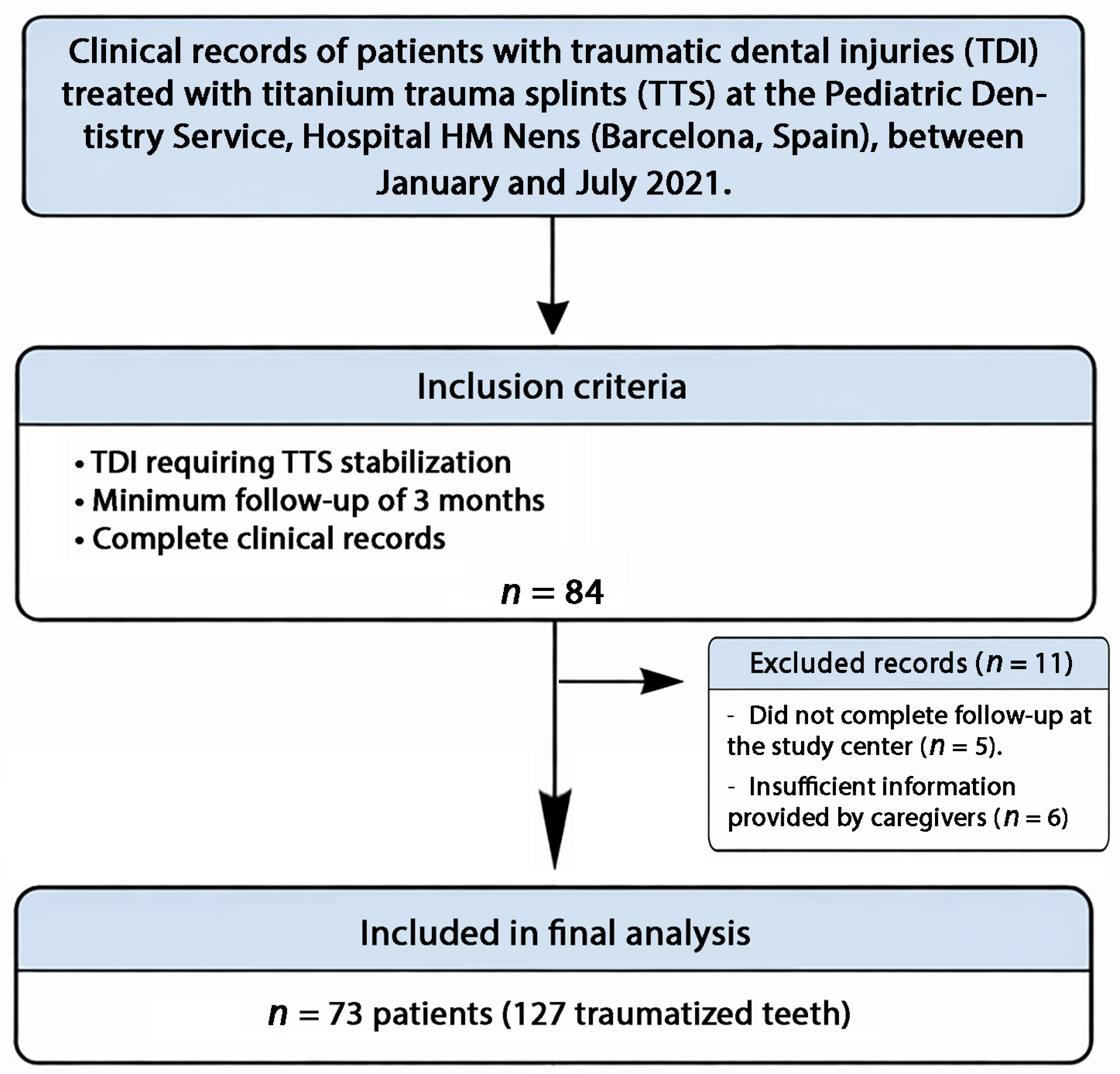
- Clinical records of pediatric patients who sustained TDI and required treatment by means of splinting, with a minimum documented three-month follow-up period.
- -
- Availability of complete and relevant clinical information in the medical records required for data extraction.
- -
- Clinical records of patients with documented special healthcare needs.
- -
- Records indicating the presence of motor disorders.
- -
- Cases in which scheduled follow-up visits were not documented in the clinical records.
- -
- Clinical records of patients with a documented history of TDI in the same treated anatomical region.
2.2. Treatment Selected, Data Processing and Variables Included in the Study
2.3. Outcome Assessment
2.4. Statistical Analysis of the Information
3. Results
3.1. Baseline Demographic and Clinical Characteristics of Pediatric Patients with TDIs Requiring Dental Splinting
3.2. Post-TDI Complications and Related Clinical Variables
3.2.1. Descriptive Overview of Complications
3.2.2. Splint Stability and Need for Re-Intervention
3.2.3. Inferential Analysis of Variables Associated with Complications
3.2.4. Inferential Analysis of Variables Associated with Re-Splinting
4. Discussion
Limitations
5. Conclusions
Author Contributions
Funding
Institutional Review Board Statement
Informed Consent Statement
Data Availability Statement
Acknowledgments
Conflicts of Interest
References
- Petti, S.; Glendor, U.; Andersson, L. World Traumatic Dental Injury Prevalence and Incidence: A Meta-Analysis—One Billion Living People Have Had Traumatic Dental Injuries. Dent. Traumatol. 2018, 34, 71–86. [Google Scholar] [CrossRef]
- Glendor, U. Epidemiology of Traumatic Dental Injuries—A 12-Year Review of the Literature. Dent. Traumatol. 2008, 24, 603–611. [Google Scholar] [CrossRef]
- Glendor, U. Aetiology and Risk Factors Related to Traumatic Dental Injuries—A Review of the Literature. Dent. Traumatol. 2009, 25, 19–31. [Google Scholar] [CrossRef] [PubMed]
- Antipovienė, A.; Narbutaitė, J.; Virtanen, J.I. Traumatic dental injuries, treatment, and complications in children and adolescents: A register-based study. Eur. J. Dent. 2021, 15, 557–562. [Google Scholar] [CrossRef]
- Ferrés-Amat, E.; Guinot-Jimeno, F.; Veloso-Durán, A.; Ñaupari-Pocomucha, J.; Ferrés-Amat, E.; Mareque-Bueno, J.; Prats-Armengol, J.; Ferrés-Padró, E. A Retrospective Analysis of 1311 Oral Surgery Procedures Performed in a Pediatric Hospital in Barcelona: A Study of Their Characteristics and Age-Related Diagnoses. J. Clin. Med. 2024, 13, 5427. [Google Scholar] [CrossRef]
- Tewari, N.; Goel, S.; Rahul, M.; Mathur, V.P.; Ritwik, P.; Haldar, P.; Priya, H.; Pandey, R.M. Global status of knowledge for prevention and emergency management of traumatic dental injuries among school teachers: A systematic review and meta-analysis. Dent. Traumatol. 2020, 36, 568–583. [Google Scholar] [CrossRef]
- Das, P.; Mishra, L.; Jena, D.; Govind, S.; Panda, S.; Lapinska, B. Oral health-related quality of life in children and adolescents with a traumatic injury of permanent teeth and the impact on their families: A systematic review. Int. J. Environ. Res. Public Health 2022, 19, 3087. [Google Scholar] [CrossRef]
- Lin, S.; Moreinos, D.; Wisblech, D.; Rotstein, I. Regenerative endodontic therapy for external inflammatory lateral resorption following traumatic dental injuries: Evidence assessment of best practices. Int. Endod. J. 2022, 55, 1165–1176. [Google Scholar] [CrossRef] [PubMed]
- Andreasen, F.M.; Kahler, B. Pulpal Response after Acute Dental Injury in the Permanent Dentition: Clinical Implications—A Review. J. Endod. 2015, 41, 299–308. [Google Scholar] [CrossRef] [PubMed]
- Andersson, L.; Andreasen, J.O.; Day, P.; Heithersay, G.; Trope, M.; DiAngelis, A.J.; Kenny, D.J.; Sigurdsson, A.; Bourguignon, C.; Flores, M.T.; et al. Guidelines for the Management of Traumatic Dental Injuries: 2. Avulsion of Permanent Teeth. Pediatr. Dent. 2017, 39, 412–419. [Google Scholar] [CrossRef]
- Fouad, A.F.; Abbott, P.V.; Tsilingaridis, G.; Cohenca, N.; Lauridsen, E.; Bourguignon, C.; O’Connell, A.; Flores, M.T.; Day, P.F.; Hicks, L.; et al. International Association of Dental Traumatology Guidelines for the Management of Traumatic Dental Injuries: 2. Avulsion of Permanent Teeth. Dent. Traumatol. 2020, 36, 331–342. [Google Scholar] [CrossRef]
- Panda, P.; Mishra, L.; Govind, S.; Panda, S.; Lapinska, B. Clinical outcome and comparison of regenerative and apexification intervention in young immature necrotic teeth—A systematic review and meta-analysis. J. Clin. Med. 2022, 11, 3909. [Google Scholar] [CrossRef] [PubMed]
- Barutcigil, G.; Oz, E. Evaluation of parental awareness on emergency management of traumatic dental injuries: The role of the ToothSOS application. Dent. Traumatol. 2025, 41, 667–679. [Google Scholar] [CrossRef]
- Ben Hassan, M.W.; Andersson, L.; Lucas, P.W. Stiffness Characteristics of Splints for Fixation of Traumatized Teeth. Dent. Traumatol. 2016, 32, 140–145. [Google Scholar] [CrossRef]
- Goswami, M.; Eranhikkal, A. Management of traumatic dental injuries using different types of splints: A case series. Int. J. Clin. Pediatr. Dent. 2020, 13, 199–202. [Google Scholar] [CrossRef]
- Kahler, B.; Heithersay, G.S. An Evidence-Based Appraisal of Splinting Luxated, Avulsed and Root-Fractured Teeth. Dent. Traumatol. 2008, 24, 2–10. [Google Scholar] [CrossRef] [PubMed]
- von Arx, T.; Filippi, A.; Buser, D. Splinting of Traumatized Teeth with a New Device: TTS (Titanium Trauma Splint). Dent. Traumatol. 2001, 17, 180–184. [Google Scholar] [CrossRef]
- von Arx, T.; Filippi, A.; Lussi, A. Comparison of a New Dental Trauma Splint Device (TTS) with Three Commonly Used Splinting Techniques. Dent. Traumatol. 2001, 17, 266–274. [Google Scholar] [CrossRef] [PubMed]
- Filippi, A.; von Arx, T.; Lussi, A. Comfort and Discomfort of Dental Trauma Splints—A Comparison of a New Device (TTS) with Three Commonly Used Splinting Techniques. Dent. Traumatol. 2002, 18, 275–280. [Google Scholar] [CrossRef]
- Bourguignon, C.; Cohenca, N.; Lauridsen, E.; Flores, M.T.; O’Connell, A.C.; Day, P.F.; Tsilingaridis, G.; Abbott, P.V.; Fouad, A.F.; Hicks, L.; et al. International Association of Dental Traumatology Guidelines for the Management of Traumatic Dental Injuries: 1. Fractures and Luxations. Dent. Traumatol. 2020, 36, 314–330. [Google Scholar] [CrossRef]
- Andreasen, J.; Andreasen, F. Classification, Etiology and Epidemiology. In Textbook and Color Atlas of Traumatic Injuries to the Teeth, 3rd ed.; Munksgaard: Copenhagen, Denmark, 1994; pp. 151–216. [Google Scholar]
- Bastone, E.B.; Freer, T.J.; McNamara, J.R. Epidemiology of Dental Trauma: A Review of the Literature. Aust. Dent. J. 2000, 45, 2–9. [Google Scholar] [CrossRef]
- Patnana, A.K.; Chugh, A.; Chugh, V.K.; Kumar, P.; Vanga, N.R.V.; Singh, S. The prevalence of traumatic dental injuries in primary teeth: A systematic review and meta-analysis. Dent. Traumatol. 2021, 37, 383–399. [Google Scholar] [CrossRef]
- Lembacher, S.; Schneider, S.; Lettner, S.; Bekes, K. Prevalence and Patterns of Traumatic Dental Injuries in Primary Teeth: A 3-Year Retrospective Overview Study in Vienna. Clin. Oral Investig. 2022, 26, 2085–2093. [Google Scholar]
- Dolic, O.; Obradovic, M.; Kojic, Z.; Knezevic, N.; Trtic, N.; Veselinovic, V.; Arapovic-Savic, M.; Umicevic-Davidovic, M.; Krcic, V. Traumatic Dental Injuries in Children and Adolescents from a Major Dental Clinic in Bosnia and Herzegovina: A 5-Year Retrospective Study. Medicina 2024, 60, 1843. [Google Scholar] [CrossRef]
- Ferrés-Amat, E.; Díaz-Martínez, C.; Herrera-Martínez, S.; Galofré-Kessler, N.; Astudillo-Rozas, W.; Aceituno-Antezana, O.; Valdivia-Gandur, I.; Maura-Solivellas, I. Relationships between Clinical and Non-Clinical Variables Concerning Traumatic Dental Injuries in Deciduous Teeth Attended in a Children’s Hospital. Children 2023, 10, 1098. [Google Scholar] [CrossRef]
- Saikiran, K.V.; Gurunathan, D.; Nuvvula, S.; Jadadoddi, R.K.; Kumar, R.H.; Birapu, U.C. Prevalence of dental trauma and their relationship to risk factors among 8–15-year-old school children. Int. J. Dent. 2022, 2022, 3343827. [Google Scholar] [CrossRef]
- Aierken, W.; Ayoufu, A.; Abuduweili, R.; Tang, R.; Kang, W.; Leng, C.; Guo, T.; Anayeti, A. Knowledge and Practice Gaps in the Emergency Management Practices of Children with Dental Trauma. BMC Oral Health 2025, 25, 1480. [Google Scholar] [CrossRef]
- Ozer, S.; Yilmaz, E.I.; Bayrak, S.; Tunc, E.S. Parental knowledge and attitudes regarding the emergency treatment of avulsed permanent teeth. Eur. J. Dent. 2012, 6, 370–375. [Google Scholar] [CrossRef] [PubMed]
- Kahler, B.; Hu, J.Y.; Marriot-Smith, C.S.; Heithersay, G.S. Splinting of Teeth Following Trauma: A Review and a New Splinting Recommendation. Aust. Dent. J. 2016, 61, 59–73. [Google Scholar] [CrossRef] [PubMed]
- Kallel, I.; Douki, N.; Amaidi, S.; Ben Amor, F. The Incidence of Complications of Dental Trauma and Associated Factors: A Retrospective Study. Int. J. Dent. 2020, 2020, 2968174. [Google Scholar] [CrossRef] [PubMed]
- Kowaltschuk, T.C.; Gonçalves, F.M.; Araujo, B.M.d.M.d.; Cruz, N.T.d.S.; Schroder, A.G.D.; Antoniazzi, B.B.; Carneiro, E.; Alencar, M.N.; da Silva-Neto, U.X.; Guariza-Filho, O.; et al. Splinting in Horizontal Root Fractures: A Bayesian Network Meta-Analysis. PLoS ONE 2025, 20, e0326979. [Google Scholar] [CrossRef]
- Isaksson, H.; Koch, G.; Bakland, L.K.; Andreasen, J.O. Effect of Splinting Times on the Healing of Intra-Alveolar Root Fractures in 512 Permanent Teeth in Humans. Dent. Traumatol. 2021, 37, 672–676. [Google Scholar] [PubMed]
- Meier, A.; Connert, T.; Dagassan-Berndt, D.; Filippi, A. Dental Trauma Splint Color Preference of Adults. Swiss Dent. J. 2021, 131, 320–325. [Google Scholar] [CrossRef] [PubMed]
- Pasini, S.; Bardellini, E.; Casula, I.; Flocchini, P.; Majorana, A. Effectiveness of Oral Hygiene Protocol in Patients with Post-Traumatic Splinting. Eur. J. Paediatr. Dent. 2006, 7, 35–38. [Google Scholar] [PubMed]
- Syme, S.E.; Fried, J.L. Maintaining the Oral Health of Splinted Teeth. Dent. Clin. N. Am. 1999, 43, 179–196. [Google Scholar] [CrossRef]
- Mona, M.; Walker, C.; Shaddox, L.M.; Pileggi, R. Bacterial Biofilm Growth on Various Dental Stabilization Systems for Avulsed and Luxated Teeth. Appl. Sci. 2021, 11, 8982. [Google Scholar] [CrossRef]
- McIntosh, M.S.; Konzelmann, J.; Smith, J.; Kalynych, C.J.; Wears, R.L.; Schneider, H.; Wylie, T.; Kaminski, A.; Matar-Joseph, M. Stabilization and Treatment of Dental Avulsions and Fractures by Emergency Physicians Using Just-in-Time Training. Ann. Emerg. Med. 2009, 54, 585–592. [Google Scholar] [PubMed]
- Sobczak-Zagalska, H.; Emerich, K. Best Splinting Methods in Case of Dental Injury—A Literature Review. J. Clin. Pediatr. Dent. 2020, 44, 71–78. [Google Scholar] [CrossRef]
- Vilela, A.B.F.; Soares, P.B.F.; Versluis, A.; Soares, C.J. Dental Trauma Splints for the Mixed Dentition—A Finite Element Analysis. Dent. Traumatol. 2023, 39, 184–194. [Google Scholar] [CrossRef]
- Ebrahim, F.H.; Kulkarni, G. Fixed Orthodontic Appliances in the Management of Severe Dental Trauma in Mixed Dentition: A Case Report. J. Can. Dent. Assoc. 2013, 79, d131. [Google Scholar]



| Variable | Total (n = 73) | Male (n = 47) | Female (n = 26) | p-Value |
|---|---|---|---|---|
| Mean age (min–max) | 10.29 (6–18) | 10.66 (6–17) | 9.62 (7–18) | 0.154 b |
| Mean time elapsed until treatment in days (min–max) a | 0.9 (0–10) | 1.09 (0–10) | 0.62 (0–8) | 0.423 b |
| Mean number of affected teeth (min–max) | 1.74 (1–5) | 1.74 (1–5) | 1.73 (1–5) | 0.708 b |
| Mean number of splinted teeth (min–max) | 3.81 (2–9) | 3.66 (2–8) | 4.08 (2–9) | 0.164 b |
| Most frequent trauma location | School (52.1%) | School (55.3%) | Home (50%) | 0.136 c |
| Home (36.9%) | Home (29.8%) | School (46.2%) | ||
| Sports facilities (10.9%) | Sports facilities (14.9%) | Sports facilities (3.9%) |
| Type of Injury (n/%) | Affected Permanent Teeth According to FDI Notation (n) | Affected Primary Teeth According to FDI Notation (n) | Female Cases | Male Cases | Age Groups | ||||
|---|---|---|---|---|---|---|---|---|---|
| Maxillary | Mandibular | Maxillary | Mandibular | ≤8 Years | >8–11 Years | >11–18 Years | |||
| Avulsion (34/26.6%) | 21 (12), 11 (10), 12 (5), 22 (2) | 31 (1), 41 (1) | 52 (1), 61 (1), 63 (1) | 0 | 18 | 16 | 12 | 13 | 9 |
| Subluxation (49/39.1%) | 21 (18), 11(18), 22 (6), 12(2), | 31 (2), 41 (2), 42 (1) | 0 | 0 | 18 | 31 | 23 | 14 | 12 |
| Extrusion (21/16.4%) | 11 (9), 21 (8), 22 (1), 12 (1) | 31 (2) | 0 | 0 | 3 | 18 | 8 | 6 | 7 |
| Root fracture (6/4.7%) | 21 (3), 11 (3) | 0 | 0 | 0 | 2 | 4 | 2 | 2 | 2 |
| Lateral luxation (13/10.2%) | 11 (6), 21 (5), 12 (1) | 32 (1), | 0 | 0 | 5 | 8 | 2 | 4 | 7 |
| Intrusion (4/3.1%) | 21 (2), 11 (1), 12 (1) | 0 | 0 | 0 | 0 | 4 | 3 | 0 | 1 |
| Complication Type a | Teeth Exhibiting Complications (FDI Notation) | Age (Years) | Gender | Days from TDI to Splint b | Total Teeth Affected by TDI | Injury Type (TDI Classification) | Endodontic Treatment Performed During Follow-Up | Teeth Requiring Extraction | Soft Tissue Involvement |
|---|---|---|---|---|---|---|---|---|---|
| Phlegmon | 12 | 7 | Female | 0 | 1 | Avulsion | No | No | Yes |
| Phlegmon | 11 | 7 | Male | 0 | 1 | Subluxation | No | No | No |
| Phlegmon | 11; 12; 21 | 8 | Male | 0 | 3 | Avulsion | No | No | Yes |
| Necrosis | 21 | 14 | Female | 0 | 1 | Lateral luxation | Yes | No | No |
| Root resorption | 11 | 7 | Female | 8 | 5 | Avulsion | Yes | No | Yes |
| Root resorption | 11 | 7 | Female | 1 | 1 | Avulsion | Yes | No | Yes |
| Phlegmon plus root resorption. | 21 | 8 | Male | 5 | 2 | Avulsion | No | Yes | Yes |
| Root resorption | 21 | 10 | Male | 0 | 2 | Extrusion | No | No | No |
| Root resorption | 21 | 11 | Male | 10 | 4 | Extrusion | No | No | Yes |
| Root resorption | 21 | 18 | Female | 0 | 2 | Avulsion | Yes | No | Yes |
| Splint Outcome | n (%) | Mixed Dentition (n) | Permanent Dentition (n) | p Value | OR (95% CI) | |
|---|---|---|---|---|---|---|
| Completed with a single TTS | 66 (90.4%) * | 13 | 53 | 0.074 a | 12.23 (1.18–126.60) | |
| Required re-splinting prior to removal | Second splinting procedure due to unexplained deterioration or debonding | 4 (5.5%) * | 3 | 1 | ||
| Premature removal due to a new TDI | 1 (1.4%) | 0 | 1 | --- | --- | |
| New splint following extraction of a traumatized tooth due to complications | 2 (2.7%) | 1 | 1 | --- | --- | |
| Variables | Patients with Post-Treatment Complications (n = 10) | Patients Without Post-Treatment Complications (n = 63) c | p-Value | OR (95% IC) |
|---|---|---|---|---|
| Time between TDI and Splint Placement | mean = 2.43 (0–10 days) | mean = 0.68 (0–8 days) | 0.239 a | — |
| Number of teeth affected by TDI | mean = 2.21 (1–5 teeth) | mean = 1.67 (1–5 teeth) | 0.259 a | — |
| Gender | Female = 5 | Female = 21 | 0.314 b | 0.50 (0.13–1.95) |
| Male = 5 | Male = 42 | |||
| Soft tissue injuries | Observed = 7 | Observed = 32 | 0.320 b | 2.26 (0.52– 9.77) |
| Not observed = 3 | Not observed = 31 |
Disclaimer/Publisher’s Note: The statements, opinions and data contained in all publications are solely those of the individual author(s) and contributor(s) and not of MDPI and/or the editor(s). MDPI and/or the editor(s) disclaim responsibility for any injury to people or property resulting from any ideas, methods, instructions or products referred to in the content. |
© 2026 by the authors. Published by MDPI on behalf of the Lithuanian University of Health Sciences. Licensee MDPI, Basel, Switzerland. This article is an open access article distributed under the terms and conditions of the Creative Commons Attribution (CC BY) license.
Share and Cite
Ferrés-Amat, E.; Herrera-Martínez, S.; Díaz-Martínez, C.; Maura-Solivellas, I.; Campillay, M.J.; Valdivia-Gandur, I.; Ferrés-Padró, E. Clinical Outcomes and Re-Splinting in Pediatric Dental Trauma Managed with Titanium Trauma Splints: Insights from a Hospital-Based Retrospective Study. Medicina 2026, 62, 1146. https://doi.org/10.3390/medicina62061146
Ferrés-Amat E, Herrera-Martínez S, Díaz-Martínez C, Maura-Solivellas I, Campillay MJ, Valdivia-Gandur I, Ferrés-Padró E. Clinical Outcomes and Re-Splinting in Pediatric Dental Trauma Managed with Titanium Trauma Splints: Insights from a Hospital-Based Retrospective Study. Medicina. 2026; 62(6):1146. https://doi.org/10.3390/medicina62061146
Chicago/Turabian StyleFerrés-Amat, Elvira, Sira Herrera-Martínez, Cristina Díaz-Martínez, Isabel Maura-Solivellas, Maria Jesus Campillay, Iván Valdivia-Gandur, and Eduard Ferrés-Padró. 2026. "Clinical Outcomes and Re-Splinting in Pediatric Dental Trauma Managed with Titanium Trauma Splints: Insights from a Hospital-Based Retrospective Study" Medicina 62, no. 6: 1146. https://doi.org/10.3390/medicina62061146
APA StyleFerrés-Amat, E., Herrera-Martínez, S., Díaz-Martínez, C., Maura-Solivellas, I., Campillay, M. J., Valdivia-Gandur, I., & Ferrés-Padró, E. (2026). Clinical Outcomes and Re-Splinting in Pediatric Dental Trauma Managed with Titanium Trauma Splints: Insights from a Hospital-Based Retrospective Study. Medicina, 62(6), 1146. https://doi.org/10.3390/medicina62061146