
Benefits of Surgical Management in Ileocecal Crohn’s Disease: A Review of the Past Decade (2020–2026)
 , ,
, ,
Abstract
1. Introduction
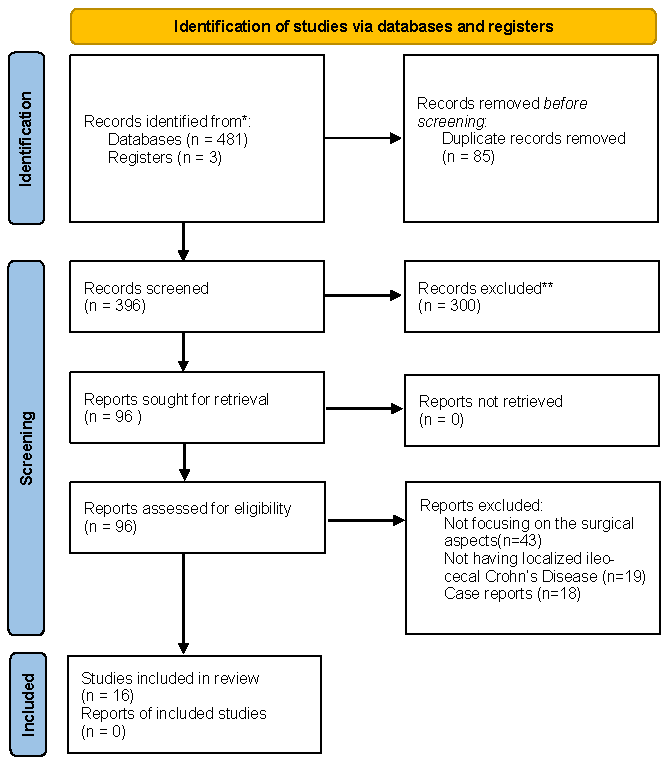
2. Materials and Methods
- •
- Population (P): The study population consists of both adult and pediatric patients diagnosed with localized ileocecal Crohn’s disease (CD).
- •
- Intervention (I): The primary intervention is “early surgery,” which for the purpose of this review is operationally defined as primary ileocecal resection (ICR) performed within 30 days of diagnosis or as a proactive intervention before the development of irreversible structural complications.
- •
- Comparator (C): The intervention is compared against the traditional “step-up” medical approach—including the use of corticosteroids, immunomodulators, and biologic agents—or delayed/salvage surgery performed after medical therapy failure.
- •
- Outcome (O): The primary outcomes measured are clinical and endoscopic recurrence rates and postoperative complication rates. Secondary outcomes include health-related quality of life (HRQoL), long-term healthcare costs, and metabolic/growth improvements in pediatric patients.
- •
- Early surgery: Primary surgical resection performed as a first line or early line of strategy, specifically defined as intervention within 30 days of diagnosis.
- •
- Localized disease: Crohn’s disease limited to the ileocecal area.
- •
- Uncomplicated disease: Absence of fibrostenotic strictures or penetrating complications such as fistulae or intra-abdominal abscesses
2.1. Search Strategy

2.2. Included Studies

| Author et al. | Year | Article Title | Cases | Study Type and Design | Key Results (Outcomes/Safety) |
|---|---|---|---|---|---|
| Oldenburg et al. [13] | 2026 | Ileocaecal resection versus infliximab for ileal Crohn’s disease: 10-year follow-up of the LIR!C trial | 134 | Cohort study; retrospective 10-year follow-up of the LIR!C RCT. | 10-year therapy-free remission: 35.8% vs. 13.2% (p = 0.004). Strong age-dependent benefit. |
| Flaifel et al. [14] | 2025 | The outcomes of robotic ileo-colic resection in Crohn’s disease compared with laparoscopic and open surgery: a meta-analysis and systematic review | 5760 | Meta-analysis; systematic review of RIR vs. LIR/OR. | Robotic approach had longer operative times (226 min) but shorter hospital stays and fewer complications than open surgery. |
| Avellaneda et al. [15] | 2025 | Long-term comparative outcomes after ileocecal resection for inflammatory versus complicated Crohn’s disease. A multicenter, retrospective study (Crohn’s-Urg) | 2013 | Cohort study; international multicenter retrospective (Crohn’s-Urg). | Comparable long-term recurrence between inflammatory and complicated phenotypes. |
| Baloyiannis et al. [16] | 2024 | The Reduction of Anastomosis-Related Morbidity Using the Kono-S Anastomosis in Patients with Crohn’s Disease: A Meta-Analysis | 913 | Meta-analysis; 8 studies evaluating the Kono-S hand-sewn anastomosis. | Reduced leak risk (OR = 0.34) and reoperation (OR = 0.12). No change in overall morbidity. |
| Madaffari et al. [17] | 2024 | Early Surgical Resection in Pediatric Patients with Localized Ileo-Cecal Crohn’s Disease: Results of a Retrospective Multicenter Study | 29 | Pediatric cohort study; evaluating early surgical intervention. | 83.7% clinical remission at 1 yr. Median SES-CD decreased from 12 to 0 (p < 0.0001). |
| Tyrode et al. [18] | 2024 | KONO-S Anastomosis Is Not Superior to Conventional Anastomosis for the Reduction of Postoperative Endoscopic Recurrence in Crohn’s Disease | 366 | Randomized controlled trial; multicenter prospective randomized study. | No significant difference in 12–18 m endoscopic recurrence (31.6% Kono-S vs. 33.3% SSA). |
| Alibert et al. [19] | 2024 | Does Kono-S Anastomosis Reduce Recurrence in Crohn’s Disease Compared with Conventional Ileocolonic Anastomosis? A Nationwide Propensity Score-matched Study from GETAID Chirurgie Group [KoCoRICCO Study] | 433 | Propensity score analysis. | Kono-S did not reduce risk of endoscopic recurrence ≥ i2 compared to SSA (47.5% vs. 44.3%). |
| Agrawal et al. [20] | 2023 | Early ileocecal resection for Crohn’s disease is associated with improved long-term outcomes compared with anti-tumor necrosis factor therapy: A population-based cohort study | 1279 | Retrospective cohort; propensity-weighted Danish register analysis (2003–2018). | ICR associated with 33\% lower risk of composite adverse outcomes vs. anti-TNF (aHR = 0.67). |
| Beelen et al. [21] | 2023 | Impact of timing of primary ileocecal resection on prognosis in patients with Crohn’s disease | 822 | Cohort study; retrospective multicenter assessment. | Postoperative recurrence was not affected by timing of the ileocecal resection. |
| Sarikaya et al. [22] | 2023 | Disease course and treatment outcomes of Crohn’s disease patients with early or late surgery—A Danish nationwide cohort study from 1997 to 2015 | 2483 | Nationwide cohort study. | Early resection had a lower cumulative risk of reoperation and a lower cumulative exposure to immunomodulators. |
| Mineccia et al. [23] | 2022 | Has the Removing of the Mesentery during Ileo-Colic Resection an Impact on Post-Operative Complications and Recurrence in Crohn’s Disease? Results from the Resection of the Mesentery Study (Remedy) | 326 | Retrospective cohort. | Resection of the mesentery does not reduce endoscopic and recurrence rate. |
| Dreznik et al. [24] | 2023 | Recurrence rates following ileo-colic resection in pediatric patients with Crohn’s disease | 35 | Single-center retrospective study. | Lower postoperative recurrence following ileo-colic resection especially in the first years of surgery. |
| Pak et al. [25] | 2021 | Short- and long-term outcomes of laparoscopic versus open ileocecal resection for Crohn’s disease: a propensity score-matched study | 348 | Cohort study; propensity -score-matched comparison of LICR vs. OICR. | LICR reduced complications (14\% vs. 32\%) and hospital stay (8 days vs. 13 days). |
| Kelm et al. [26] | 2021 | Early Ileocecal Resection Is an Effective Therapy in Isolated Crohn’s Disease | 103 | Cohort study; retrospective single-center assessment. | Early ICR reduced the need for postoperative immunosuppressive medication. |
| Luglio et al. [27] | 2020 | Surgical Prevention of Anastomotic Recurrence by Excluding Mesentery in Crohn’s Disease: The SuPREMe-CD Study—A Randomized Clinical Trial | 113 | Randomized controlled trial; Kono-S vs. conventional stapled side-to-side. | Kono-S group showed significantly lower endoscopic recurrence (p < 0.05) and clinical recurrence at 12–18 months. |
| Hirten et al. [28] | 2020 | Anastomotic Ulcers After Ileocolic Resection for Crohn’s Disease Are Common and Predict Recurrence | 182 | Retrospective cohort. | In multivariable analysis, anastomotic ulcers were associated with disease recurrence (adjusted hazard ratio [aHR] 3.64; 95% CI, 1.21–10.95; p = 0.02). Sixty-six subjects with anastomotic ulcers underwent a second colonoscopy, with 31 patients (79.5%) having persistent ulcers independent of medication escalation. |
2.3. Quality Assessment and Certainty of Evidence
3. Results and Discussion
3.1. General Considerations
3.2. Early Surgery Versus Medical Therapy in Ileocecal Crohn’s Disease
3.3. Evaluating the Kono-S Anastomosis in Prevention of Recurrence
3.4. Surgical Modalities in Ileo-Colic Resections in Crohn’s Disease
3.5. Role of Ileocecal Surgery in Pediatric Crohn’s Disease
3.6. Strengths and Limitations
4. Conclusions
Supplementary Materials
Author Contributions
Funding
Institutional Review Board Statement
Informed Consent Statement
Data Availability Statement
Conflicts of Interest
References
- Feuerstein, J.D.; Cheifetz, A.S. Crohn Disease: Epidemiology, Diagnosis, and Management. Mayo Clin. Proc. 2017, 92, 1088–1103. [Google Scholar] [CrossRef] [PubMed]
- Benić, M.S.; Giljača, V.; Belančić, A.; Kadić, A.J.; Vlahović-Palčevski, V. The impact of biological interventions on health-related quality of life in adults with Crohn’s disease: A systematic review with meta-analysis. EClinicalMedicine 2025, 85, 103320. [Google Scholar] [CrossRef] [PubMed] [PubMed Central]
- Eshuis, E.J.; Stokkers, P.C.; Bemelman, W.A. Decision-making in ileocecal Crohn’s disease management: Surgery versus pharmacotherapy. Expert Rev. Gastroenterol. Hepatol. 2010, 4, 181–189. [Google Scholar] [CrossRef] [PubMed]
- Yamamoto, T.; Lightner, A.L.; Spinelli, A.; Kotze, P.G. Perioperative management of ileocecal Crohn’s disease in the current era. Expert Rev. Gastroenterol. Hepatol. 2020, 14, 843–855. [Google Scholar] [CrossRef] [PubMed]
- Hanauer, S.B. Crohn’s disease: Step up or top down therapy. Best Pract. Res. Clin. Gastroenterol. 2003, 17, 131–137. [Google Scholar] [CrossRef] [PubMed]
- Seifarth, C.; Kreis, M.E.; Gröne, J. Indications and Specific Surgical Techniques in Crohn’s Disease. Viszeralmedizin 2015, 31, 273–279. [Google Scholar] [CrossRef] [PubMed] [PubMed Central]
- Li, Y.; Stocchi, L.; Shen, B.; Liu, X.; Remzi, F.H. Salvage surgery after failure of endoscopic balloon dilatation versus surgery first for ileocolonic anastomotic stricture due to recurrent Crohn’s disease. Br. J. Surg. 2015, 102, 1418–1425. [Google Scholar] [CrossRef] [PubMed]
- Garrett, K.A.; Remzi, F.H.; Kirat, H.T.; Fazio, V.W.; Shen, B.; Kiran, R.P. Outcome of salvage surgery for ileal pouches referred with a diagnosis of Crohn’s disease. Dis. Colon Rectum 2009, 52, 1967–1974. [Google Scholar] [CrossRef] [PubMed]
- Meima-van Praag, E.M.; Buskens, C.J.; Hompes, R.; Bemelman, W.A. Surgical management of Crohn’s disease: A state of the art review. Int. J. Color. Dis. 2021, 36, 1133–1145. [Google Scholar] [CrossRef] [PubMed] [PubMed Central]
- Spertino, M.; Gabbiadini, R.; Dal Buono, A.; Busacca, A.; Franchellucci, G.; Migliorisi, G.; Repici, A.; Spinelli, A.; Bezzio, C.; Armuzzi, A. Management of Post-Operative Crohn’s Disease: Knowns and Unknowns. J. Clin. Med. 2024, 13, 2300. [Google Scholar] [CrossRef] [PubMed]
- Zheng, S.; Edmundson, A.; Clark, D.A. Current approaches to the surgical management of Crohn’s disease in Australia and New Zealand. Int. J. Color. Dis. 2025, 40, 4. [Google Scholar] [CrossRef] [PubMed] [PubMed Central]
- Kotze, P.G. The Essential Role of a Multidisciplinary Approach in Inflammatory Bowel Diseases. Clin. Colon Rectal Surg. 2022, 35, 3–4. [Google Scholar] [CrossRef] [PubMed] [PubMed Central]
- Oldenburg, L.; Haanappel, A.E.G.; Ali, M.; Bosman, C.; Buskens, C.J.; Ponsioen, C.Y.; D’Haens, G.R.; Bemelman, W.A. LIR!C Study Group. Ileocaecal resection versus infliximab for ileal Crohn’s disease: Retrospective 10-year follow-up of the LIR!C trial. Lancet Gastroenterol. Hepatol. 2026, 11, 314–322. [Google Scholar] [CrossRef] [PubMed]
- Flaifel, M.; Eichenberg, S.; Mohandes, B.; Taha, E.; Kollmann, L.; Flemming, S.; Haberstroh, A.; Ortlieb, N.; Melling, N.; Neumann, K.; et al. The outcomes of robotic ileocolic resection in Crohn’s disease compared with laparoscopic and open surgery: A meta-analysis and systematic review. Tech. Coloproctol. 2025, 29, 88. [Google Scholar] [CrossRef] [PubMed] [PubMed Central]
- Avellaneda, N.; Maroli, A.; Pellino, G.; Carvello, M.; Tottrup, A.; Bislenghi, G.; Colpaert, J.; D’Hoore, A.; Giorgi, L.; Juachon, P.; et al. Long-term comparative outcomes after ileocecal resection for inflammatory versus complicated Crohn’s disease. A multicenter, retrospective study (Crohn’s-Urg). Dig. Liver Dis. 2025, 57, 1920–1926. [Google Scholar] [CrossRef] [PubMed]
- Baloyiannis, I.; Perivoliotis, K.; Sarakatsianou, C.; Chatzinikolaou, C.; Tzovaras, G. The Reduction of Anastomosis-Related Morbidity Using the Kono-S Anastomosis in Patients with Crohn’s Disease: A Meta-Analysis. J. Clin. Med. 2024, 13, 2461. [Google Scholar] [CrossRef] [PubMed] [PubMed Central]
- Madaffari, I.; Muttillo, E.M.; Franca, A.; Massimi, F.; Castagnola, G.; Coppola, A.; Furio, S.; Piccirillo, M.; Ferretti, A.; Mennini, M.; et al. Early Surgical Resection in Pediatric Patients with Localized Ileo-Cecal Crohn’s Disease: Results of a Retrospective Multicenter Study. J. Clin. Med. 2025, 14, 404. [Google Scholar] [CrossRef] [PubMed] [PubMed Central]
- Tyrode, G.; Lakkis, Z.; Vernerey, D.; Falcoz, A.; Clairet, V.; Alibert, L.; Koch, S.; Vuitton, L. KONO-S Anastomosis Is Not Superior to Conventional Anastomosis for the Reduction of Postoperative Endoscopic Recurrence in Crohn’s Disease. Inflamm. Bowel Dis. 2024, 30, 1670–1677. [Google Scholar] [CrossRef] [PubMed]
- Alibert, L.; Betton, L.; Falcoz, A.; Manceau, G.; Benoist, S.; Zerbib, P.; Podevin, J.; Maggiori, L.; Brouquet, A.; Tyrode, G.; et al. Does Kono-S Anastomosis Reduce Recurrence in Crohn’s Disease Compared with Conventional Ileocolonic Anastomosis? A Nationwide Propensity Score-matched Study from GETAID Chirurgie Group [KoCoRICCO Study]. J. Crohns Colitis 2024, 18, 525–532. [Google Scholar] [CrossRef] [PubMed]
- Agrawal, M.; Ebert, A.C.; Poulsen, G.; Ungaro, R.C.; Faye, A.S.; Jess, T.; Colombel, J.F.; Allin, K.H. Early Ileocecal Resection for Crohn’s Disease Is Associated With Improved Long-term Outcomes Compared With Anti-Tumor Necrosis Factor Therapy: A Population-Based Cohort Study. Gastroenterology 2023, 165, 976–985.e3. [Google Scholar] [CrossRef] [PubMed] [PubMed Central]
- Beelen, E.M.J.; Arkenbosch, J.H.C.; Erler, N.S.; Sleutjes, J.A.M.; Hoentjen, F.; Bodelier, A.G.L.; Dijkstra, G.; Romberg-Camps, M.; de Boer, N.K.; Stassen, L.P.S.; et al. Impact of timing of primary ileocecal resection on prognosis in patients with Crohn’s disease. BJS Open 2023, 7, zrad097. [Google Scholar] [CrossRef] [PubMed] [PubMed Central]
- Sarikaya, M.Z.; Zhao, M.; Lo, B.; Bendtsen, F.; Burisch, J. Disease course and treatment outcomes of Crohn’s disease patients with early or late surgery—A Danish nationwide cohort study from 1997 to 2015. Dig. Liver Dis. 2023, 55, 872–879. [Google Scholar] [CrossRef] [PubMed]
- Mineccia, M.; Maconi, G.; Daperno, M.; Cigognini, M.; Cherubini, V.; Colombo, F.; Perotti, S.; Baldi, C.; Massucco, P.; Ardizzone, S.; et al. Has the Removing of the Mesentery during Ileo-Colic Resection an Impact on Post-Operative Complications and Recurrence in Crohn’s Disease? Results from the Resection of the Mesentery Study (Remedy). J. Clin. Med. 2022, 11, 1961. [Google Scholar] [CrossRef] [PubMed] [PubMed Central]
- Dreznik, Y.; Samuk, I.; Shouval, D.S.; Paran, M.; Matar, M.; Shamir, R.; Totah, M.; Kravarusic, D. Recurrence rates following ileo-colic resection in pediatric patients with Crohn’s disease. Pediatr. Surg. Int. 2023, 39, 83. [Google Scholar] [CrossRef] [PubMed]
- Pak, S.J.; Kim, Y.I.; Yoon, Y.S.; Lee, J.L.; Lee, J.B.; Yu, C.S. Short-term and long-term outcomes of laparoscopic vs. open ileocolic resection in patients with Crohn’s disease: Propensity-score matching analysis. World J. Gastroenterol. 2021, 27, 7159–7172. [Google Scholar] [CrossRef] [PubMed] [PubMed Central]
- Kelm, M.; Anger, F.; Eichlinger, R.; Brand, M.; Kim, M.; Reibetanz, J.; Krajinovic, K.; Germer, C.T.; Schlegel, N.; Flemming, S. Early Ileocecal Resection Is an Effective Therapy in Isolated Crohn’s Disease. J. Clin. Med. 2021, 10, 731. [Google Scholar] [CrossRef] [PubMed] [PubMed Central]
- Luglio, G.; Rispo, A.; Imperatore, N.; Giglio, M.C.; Amendola, A.; Tropeano, F.P.; Peltrini, R.; Castiglione, F.; De Palma, G.D.; Bucci, L. Surgical Prevention of Anastomotic Recurrence by Excluding Mesentery in Crohn’s Disease: The SuPREMe-CD Study—A Randomized Clinical Trial. Ann. Surg. 2020, 272, 210–217. [Google Scholar] [CrossRef] [PubMed]
- Hirten, R.P.; Ungaro, R.C.; Castaneda, D.; Lopatin, S.; Sands, B.E.; Colombel, J.F.; Cohen, B.L. Anastomotic Ulcers After Ileocolic Resection for Crohn’s Disease Are Common and Predict Recurrence. Inflamm. Bowel Dis. 2020, 26, 1050–1058. [Google Scholar] [CrossRef] [PubMed] [PubMed Central]
- Bemelman, W.A.; Warusavitarne, J.; Sampietro, G.M.; Serclova, Z.; Zmora, O.; Luglio, G.; de Buck van Overstraeten, A.; Burke, J.P.; Buskens, C.J.; Colombo, F.; et al. ECCO-ESCP Consensus on Surgery for Crohn’s Disease. J. Crohn’s Colitis 2018, 12, 1–16. [Google Scholar] [CrossRef]
- Ponsioen, C.Y.; de Groof, E.J.; Eshuis, E.J.; Gardenbroek, T.J.; Bossuyt, P.M.M.; Hart, A.; Warusavitarne, J.; Buskens, C.J.; van Bodegraven, A.A.; Brink, M.A.; et al. Laparoscopic ileocaecal resection versus infliximab for terminal ileitis in Crohn’s disease: A randomised controlled, open-label, multicentre trial. Lancet Gastroenterol. Hepatol. 2017, 2, 785–792, Erratum in Lancet Gastroenterol Hepatol. 2017, 2, e7. https://doi.org/10.1016/S2468-1253(17)30301-1. [Google Scholar] [CrossRef] [PubMed]
- De Cruz, P.; Kamm, M.A.; Hamilton, A.L.; Ritchie, K.J.; Krejany, E.O.; Gorelik, A.; Liew, D.; Prideaux, L.; Lawrance, I.C.; Andrews, J.M.; et al. Crohn’s disease management after intestinal resection: A randomised trial. Lancet 2015, 385, 1406–1417. [Google Scholar] [CrossRef] [PubMed]
- Toshniwal, J.; Chawlani, R.; Thawrani, A.; Sharma, R.; Arora, A.; Kotecha, H.L.; Goyal, M.; Kirnake, V.; Jain, P.; Tyagi, P.; et al. All ileo-cecal ulcers are not Crohn’s: Changing perspectives of symptomatic ileocecal ulcers. World J. Gastrointest. Endosc. 2017, 9, 327–333. [Google Scholar] [CrossRef] [PubMed] [PubMed Central]
- Cushing, K.; Higgins, P.D.R. Management of Crohn Disease: A Review. JAMA 2021, 325, 69–80. [Google Scholar] [CrossRef] [PubMed] [PubMed Central]
- Baert, F.; Caprilli, R.; Angelucci, E. Medical therapy for Crohn’s disease: Top-down or step-up? Dig. Dis. 2007, 25, 260–266. [Google Scholar] [CrossRef] [PubMed]
- Janssen, L.M.; Creemers, R.H.; van Bodegraven, A.A.; Pierik, M.J. A Systematic Review on Long-Term Efficacy Outcome Measures in Crohn’s Disease Patients. J. Crohns Colitis 2023, 17, 1528–1536. [Google Scholar] [CrossRef] [PubMed] [PubMed Central]
- Moreira, P.L.; Dignass, A.; Estevinho, M.M.; Portal, F.; Mendes, J.; Santiago, M.; Reinisch, W.; Sands, B.E.; D’Haens, G.; Mantzaris, G.J.; et al. International Organization for the Study of Inflammatory Bowel Diseases (IOIBD) Assessment of outcomes in Crohn’s disease: Asystematic review of randomized clinical trials to inform a multiple outcome framework. United Eur. Gastroenterol. J. 2024, 12, 1280–1291. [Google Scholar] [CrossRef] [PubMed] [PubMed Central]
- Serrano Fernandez, V.; Seldas Palomino, M.; Laredo-Aguilera, J.A.; Pozuelo-Carrascosa, D.P.; Carmona-Torres, J.M. High-Fiber Diet and Crohn’s Disease: Systematic Review and Meta-Analysis. Nutrients 2023, 15, 3114. [Google Scholar] [CrossRef]
- Hupé, M.; Pereira, B.; Buisson, A. Systematic review and network meta-analysis comparing the efficacy of conventional therapy and biologics to prevent endoscopic postoperative recurrence in patients with Crohn’s disease. Ther. Adv. Gastroenterol. 2025, 18, 17562848251374240. [Google Scholar] [CrossRef] [PubMed] [PubMed Central]
- Kono, T.; Fichera, A. Surgical Treatment for Crohn’s Disease: A Role of Kono-S Anastomosis in the West. Clin. Colon Rectal Surg. 2020, 33, 335–343. [Google Scholar] [CrossRef] [PubMed] [PubMed Central]
- Gunnells, D.; Cannon, J. Robotic Surgery in Crohn’s Disease. Clin. Colon Rectal Surg. 2021, 34, 286–291. [Google Scholar] [CrossRef] [PubMed] [PubMed Central]
- Parisio, L.; Del Gaudio, A.; Iaccarino, J.; Puca, P.; Becherucci, G.; Coppola, G.; Covello, C.; Vincenzo, F.D.; Foscarini, E.; Laterza, L.; et al. Clinical Predictive Factors for the Development of Short Bowel Syndrome in a Cohort of Patients with Crohn’s Disease: A Prospective Study. J. Clin. Med. 2025, 14, 6337. [Google Scholar] [CrossRef]
- Aggeletopoulou, I.; Tsounis, E.P.; Mouzaki, A.; Triantos, C. Creeping Fat in Crohn’s Disease-Surgical, Histological, and Radiological Approaches. J. Pers. Med. 2023, 13, 1029. [Google Scholar] [CrossRef] [PubMed] [PubMed Central]
- Coffey, J.C.; Devine, M.L. The Surgical Management of the Mesentery in Crohn’s Disease. Clin. Colon Rectal Surg. 2024, 38, 113–121. [Google Scholar] [CrossRef] [PubMed] [PubMed Central]
- Glenisson, M.; Bonnard, A.; Berrebi, D.; Belarbi, N.; Viala, J.; Martinez-Vinson, C. Complications and Disease Recurrence After Ileocecal Resection in Pediatric Crohn’s Disease: A Retrospective Study. Eur. J. Pediatr. Surg. 2024, 34, 253–260. [Google Scholar] [CrossRef] [PubMed] [PubMed Central]
- Weigl, E.; Schwerd, T.; Lurz, E.; Häberle, B.; Koletzko, S.; Hubertus, J. Children with Localized Crohn’s Disease Benefit from Early Ileocecal Resection and Perioperative Anti-Tumor Necrosis Factor Therapy. Eur. J. Pediatr. Surg. 2024, 34, 236–244. [Google Scholar] [CrossRef] [PubMed]
- Dotlacil, V.; Lerchova, T.; Lengalova, M.; Kucerova, B.; Schwarz, J.; Hradsky, O.; Rygl, M.; Skaba, R. Kono-S anastomosis in Crohn’s disease: Initial experience in pediatric patients. Pediatr. Surg. Int. 2024, 40, 67. [Google Scholar] [CrossRef] [PubMed]
- Dipasquale, V.; Romano, C.; Romeo, C.; Impellizzeri, P.; Montalto, A.S.; Navarra, G. Kono-S Anastomosis in Pediatric Crohn’s Disease: Experience at a Tertiary Referral Center. J. Clin. Med. 2025, 14, 7403. [Google Scholar] [CrossRef]
- Page, M.J.; McKenzie, J.E.; Bossuyt, P.M.; Boutron, I.; Hoffmann, T.C.; Mulrow, C.D.; Shamseer, L.; Tetzlaff, J.M.; Akl, E.A.; Brennan, S.E.; et al. The PRISMA 2020 statement: An updated guideline for reporting systematic reviews. BMJ 2021, 372, n71. [Google Scholar] [CrossRef]
| Study (Year) | Study Design | Assessment Tool | Score/Risk of Bias |
|---|---|---|---|
| Oldenburg (LIR!C) (2026) [13] | RCT | RoB 2 | Low Risk |
| Tyrode et al. (2024) [18] | RCT | RoB 2 | Moderate (Some concerns) |
| Luglio (SuPREMe-CD) (2020) [27] | RCT | RoB 2 | Low Risk |
| Madaffari et al. (2025) [17] | Cohort | NOS | 7/9 (High) |
| Albert et al. (2024) [19] | Cohort | NOS | 7/9 (High) |
| Avellenda et al. (2025) [15] | Cohort | NOS | 9/9 (High) |
| Sarikaya et al. (2023) [22] | Cohort | NOS | 9/9 (High) |
| Beelen et al. (2023) [21] | Cohort | NOS | 8/9 (High) |
| Agrawal et al. (2023) [20] | Cohort | NOS | 8/9 (High) |
| Mineccia et al. (2022) [23] | Cohort | NOS | 7/9 (High) |
| Dreznik et al. (2023) [24] | Cohort | NOS | 6/9 (Fair) |
| Pak et al. (2021) [25] | Cohort | NOS | 7/9 (High) |
| Kelm et al. (2021) [26] | Cohort | NOS | 6/9 (Fair) |
| Hirten et al. (2020) [28] | Cohort | NOS | 7/9 (High) |
| Outcome | No. of Studies (Design) | Certainty (GRADE) | Summary of Clinical Evidence |
|---|---|---|---|
| Therapy-free Remission (Long-term) | 2 (1 RCT, 1 Cohort) | MODERATE | Early ileocecal resection (ICR) provides superior 10-year therapy-free remission compared to biologics (35.8% vs. 13.2%, p = 0.004). Early ICR also reduces the need for postoperative medical escalation. |
| Risk of Reoperation (Surgical Timing) | 3 (Cohort) | HIGH | Surgery within 30 days of diagnosis is associated with a 14% to 33% reduction in long-term reoperation risk compared to delayed intervention. |
| Postoperative Complications (MIS vs. Open) | 2 (1 Meta-analysis, 1 Cohort) | HIGH | Minimally invasive surgery (MIS), specifically robotic and laparoscopic approaches, significantly reduces hospital stay and complications (14% vs. 32%) compared to open surgery. |
| Pediatric Growth and Nutritional Outcomes | 3 (Cohort) | MODERATE | Early resection in children results in significant “catch-up” growth, with marked improvements in Z-scores for weight, BMI, and height (p < 0.001). |
| Endoscopic Recurrence (Kono-S) | 4 (2 RCT, 1 Meta-analysis, 1 Cohort) | LOW | Evidence is inconsistent. While one RCT showed a dramatic reduction in recurrence, larger subsequent trials and cohorts found no significant difference compared to standard side-to-side anastomosis. |
| Impact of Mesenteric Management | 2 (Cohort) | LOW | Current evidence suggests that radical mesenteric resection does not significantly reduce clinical or endoscopic recurrence rates. |
| Anastomotic Ulcer Recurrence Risk | 1 (Cohort) | LOW | The presence of postoperative anastomotic ulcers is a strong predictor of clinical recurrence (aHR 3.64), highlighting the need for early endoscopic monitoring. |
| Recurrence in Inflammatory vs. Complicated CD | 1 (Cohort) | LOW | Long-term recurrence rates are comparable between patients undergoing surgery for purely inflammatory disease versus those with complicated phenotypes. |
| Author et al. | Year | Article Title | Cases | Study Type and Design | Key Results (Outcomes/Safety) |
|---|---|---|---|---|---|
| Oldenburg et al. [13] | 2026 | Ileocaecal resection versus infliximab for ileal Crohn’s disease: 10-year follow-up of the LIR!C trial | 134 | Cohort study; retrospective 10-year follow-up of the LIR!C RCT. | 10-year therapy-free remission: 35.8% vs. 13.2% (p = 0.004). Strong age-dependent benefit. |
| Agrawal et al. [20] | 2023 | Early ileocecal resection for Crohn’s disease is associated with improved long-term outcomes compared with anti-tumor necrosis factor therapy: A population-based cohort study | 1279 | Retrospective cohort; propensity-weighted Danish register analysis (2003–2018). | ICR associated with 33\% lower risk of composite adverse outcomes vs. anti-TNF (aHR = 0.67). |
| Beelen et al. [21] | 2023 | Impact of timing of primary ileocecal resection on prognosis in patients with Crohn’s disease | 822 | Cohort study; retrospective multicenter assessment. | Postoperative recurrence was not affected by timing of the ileocecal resection. |
| Sarikaya et al. [22] | 2023 | Disease course and treatment outcomes of Crohn’s disease patients with early or late surgery—A Danish nationwide cohort study from 1997 to 2015 | 2483 | Nationwide cohort study. | Early resection had a lower cumulative risk of reoperation and a lower cumulative exposure to immunomodulators. |
| Kelm et al. [26] | 2021 | Early Ileocecal Resection Is an Effective Therapy in Isolated Crohn’s disease | 103 | Cohort study; retrospective single-center assessment. | Early ICR reduced the need for postoperative immunosuppressive medication. |
| Author et al. | Year | Article Title | Cases | Study Type and Design | Key Results (Outcomes/Safety) |
|---|---|---|---|---|---|
| Baloyiannis et al. [16] | 2024 | The Reduction in Anastomosis-Related Morbidity Using the Kono-S Anastomosis in Patients with Crohn’s Disease: A Meta-Analysis | 913 | Meta-analysis; 8 studies evaluating the Kono-S hand-sewn anastomosis. | Reduced leak risk (OR = 0.34) and reoperation (OR = 0.12). No change in overall morbidity. |
| Tyrode et al. [18] | 2024 | KONO-S Anastomosis Is Not Superior to Conventional Anastomosis for the Reduction in Postoperative Endoscopic Recurrence in Crohn’s Disease | 366 | Randomized controlled trial; multicenter prospective randomized study. | No significant difference in 12–18 m endoscopic recurrence (31.6% Kono-S vs. 33.3% SSA). |
| Alibert et al. [19] | 2024 | Does Kono-S Anastomosis Reduce Recurrence in Crohn’s Disease Compared with Conventional Ileocolonic Anastomosis? A Nationwide Propensity Score-matched Study from GETAID Chirurgie Group [KoCoRICCO Study] | 433 | Propensity score analysis. | Kono-S did not reduce risk of endoscopic recurrence ≥ i2 compared to SSA (47.5% vs. 44.3%). |
| Luglio et al. [27] | 2020 | Surgical Prevention of Anastomotic Recurrence by Excluding Mesentery in Crohn’s Disease: The SuPREMe-CD Study—A Randomized Clinical Trial | 113 | Randomized controlled trial; Kono-S vs. conventional stapled side-to-side. | Kono-S group showed significantly lower endoscopic recurrence (p < 0.05) and clinical recurrence at 12–18 months. |
| Author | Year | Cases | Study Type and Design | Key Results (Outcomes/Safety) |
|---|---|---|---|---|
| Flaifel et al. [14] | 2025 | 5760 | Meta-analysis; systematic review of RIR vs. LIR/OR | Robotic approach had longer operative times (226 min) but shorter hospital stays and fewer complications than open surgery. |
| Mineccia et al. [23] | 2022 | 326 | Retrospective cohort | Resection of the mesentery does not reduce endoscopic and recurrence rate. |
| Pak et al. [25] | 2021 | 348 | Cohort study; propensity -score-matched comparison of LICR vs. OICR | LICR reduced complications (14\% vs. 32\%) and hospital stay (8 days vs. 13 days). |
| Luglio et al. [27] | 2020 | 113 | Randomized controlled trial; Kono-S vs. conventional stapled side-to-side | Kono-S group showed significantly lower endoscopic recurrence (p < 0.05) and clinical recurrence at 12–18 months. |
| Hirten et al. [28] | 2020 | 182 | Retrospective cohort | Multivariable analysis: anastomotic ulcers were associated with disease recurrence ([aHR] 3.64; 95% CI, 1.21–10.95; p = 0.02); 66 subjects with anastomotic ulcers underwent a second colonoscopy, with 31 patients (79.5%) having persistent ulcers independent of medication escalation. |
Disclaimer/Publisher’s Note: The statements, opinions and data contained in all publications are solely those of the individual author(s) and contributor(s) and not of MDPI and/or the editor(s). MDPI and/or the editor(s) disclaim responsibility for any injury to people or property resulting from any ideas, methods, instructions or products referred to in the content. |
© 2026 by the authors. Published by MDPI on behalf of the Lithuanian University of Health Sciences. Licensee MDPI, Basel, Switzerland. This article is an open access article distributed under the terms and conditions of the Creative Commons Attribution (CC BY) license.
Share and Cite
Balint, I.; Zaharie, R.; Dan, V.; Moiș, E.; Popa, C.; Ciocan, A.; Al-Hajjar, N.; Zaharie, F. Benefits of Surgical Management in Ileocecal Crohn’s Disease: A Review of the Past Decade (2020–2026). Medicina 2026, 62, 949. https://doi.org/10.3390/medicina62050949
Balint I, Zaharie R, Dan V, Moiș E, Popa C, Ciocan A, Al-Hajjar N, Zaharie F. Benefits of Surgical Management in Ileocecal Crohn’s Disease: A Review of the Past Decade (2020–2026). Medicina. 2026; 62(5):949. https://doi.org/10.3390/medicina62050949
Chicago/Turabian StyleBalint, Ion, Roxana Zaharie, Vălean Dan, Emil Moiș, Călin Popa, Andra Ciocan, Nadim Al-Hajjar, and Florin Zaharie. 2026. "Benefits of Surgical Management in Ileocecal Crohn’s Disease: A Review of the Past Decade (2020–2026)" Medicina 62, no. 5: 949. https://doi.org/10.3390/medicina62050949
APA StyleBalint, I., Zaharie, R., Dan, V., Moiș, E., Popa, C., Ciocan, A., Al-Hajjar, N., & Zaharie, F. (2026). Benefits of Surgical Management in Ileocecal Crohn’s Disease: A Review of the Past Decade (2020–2026). Medicina, 62(5), 949. https://doi.org/10.3390/medicina62050949