Predictors of Adverse Outcomes During 30-Day Follow-Up in Patients Aged 75 Years and Older with Acute Coronary Syndrome

 , ,
, ,
Abstract
1. Introduction
2. Materials and Methods
2.1. Study Design and Population
2.2. Variables
2.3. Outcome Variable
2.4. Statistical Analysis
2.5. Ethical Considerations
3. Results
3.1. Baseline Characteristics
3.2. Outcome Variable
3.3. Univariable and Multivariable Analysis
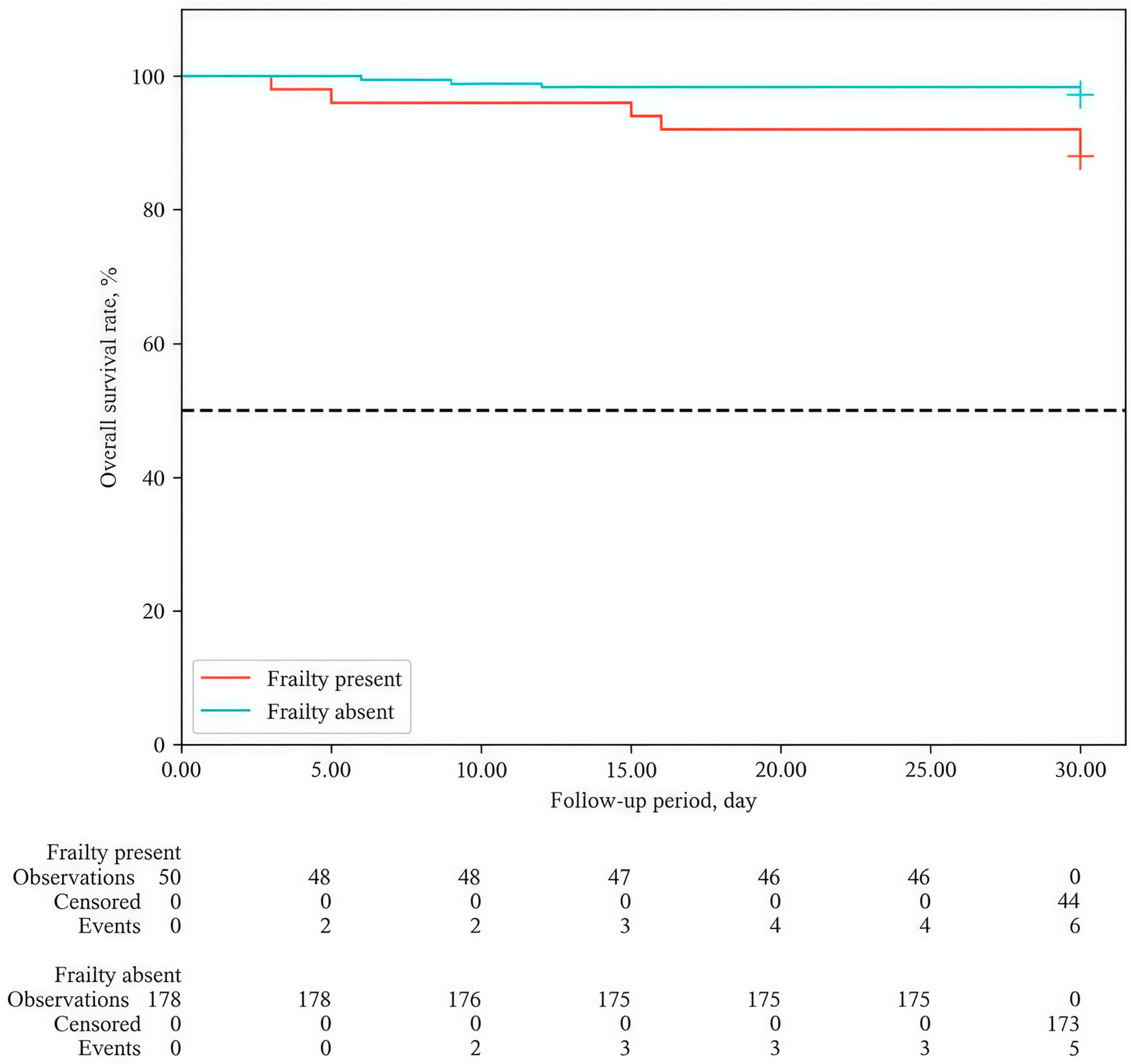
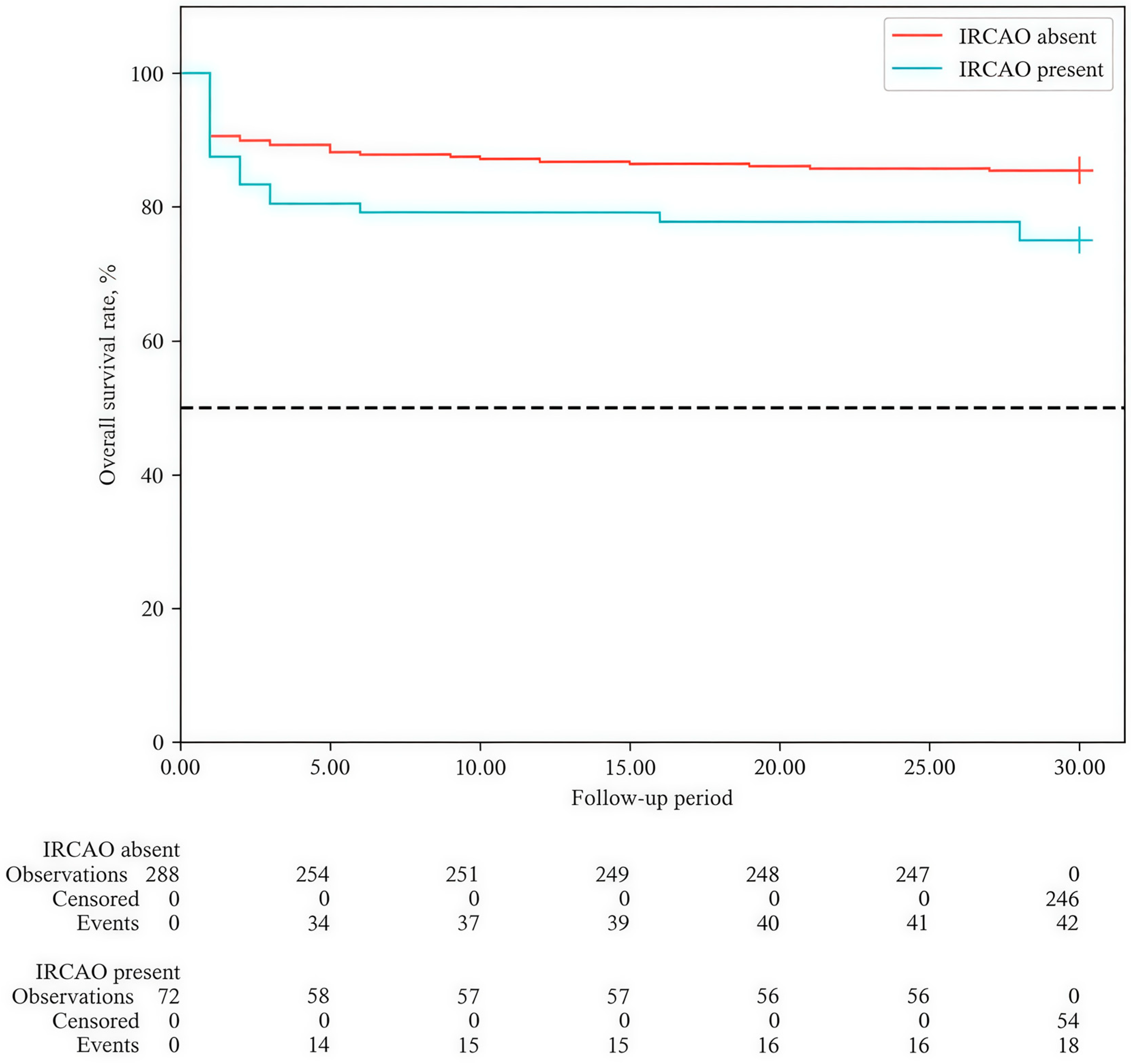
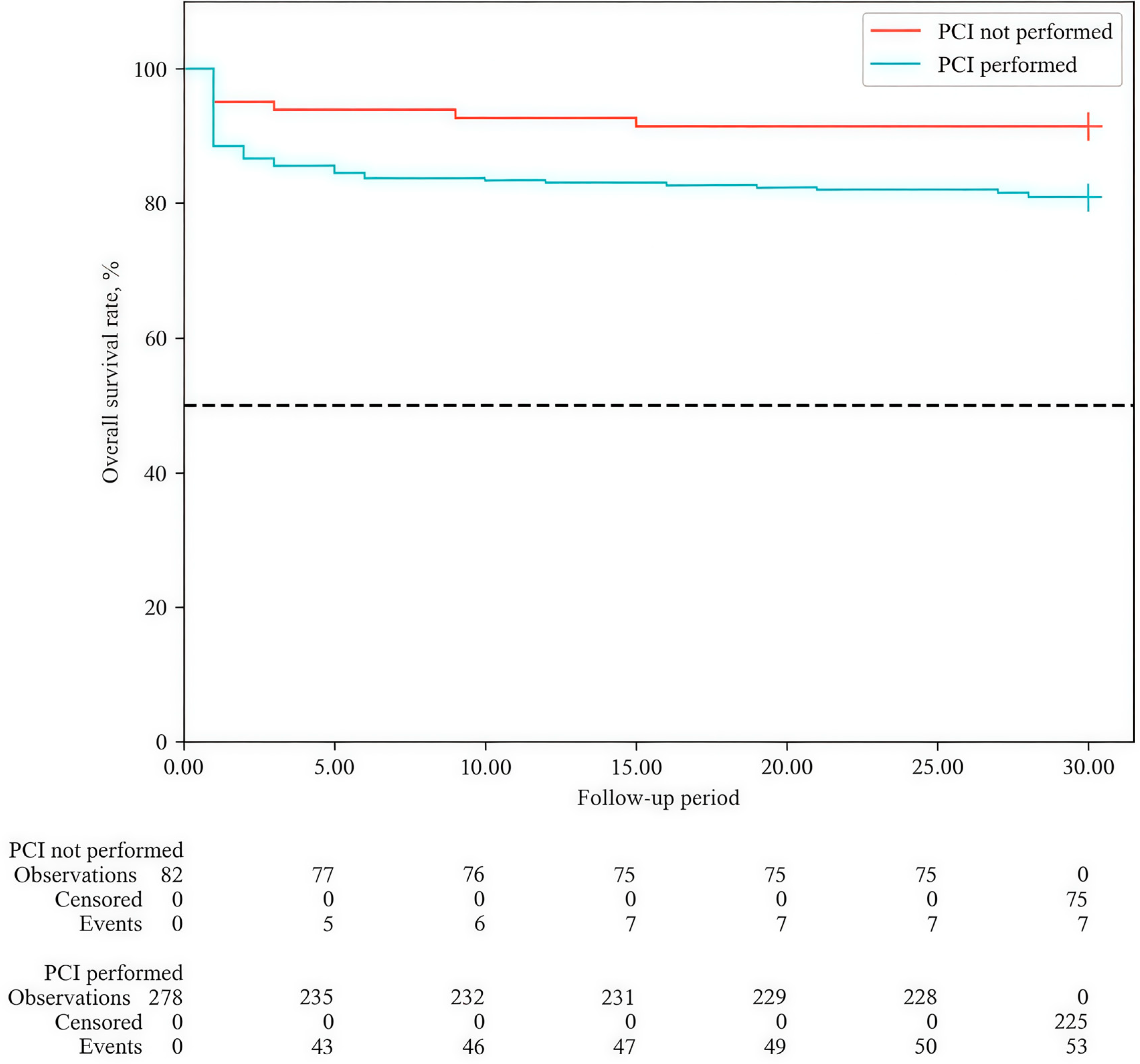
3.4. Survival
3.5. Propensity Score Matching
3.6. Risk on the GRACE Scale
4. Discussion
5. Study Limitations
- •
- The study is observational, not randomised. All revascularisation decisions were made by the treating medical team, leading to potential confounding by indication—more severe patients were more likely to undergo PCI. Despite multivariable adjustment and PSM, residual confounding cannot be completely eliminated.
- •
- Patients who died on the operating table before the start of PCI were assigned to the non-PCI group, which may have biased the comparison.
- •
- No standardised protocol existed for patients with multivessel disease; the choice between PCI and CABG depended on clinical judgment, SYNTAX score, LVEF, and patient preferences.
- •
- In the 37 patients who did not undergo PCI, significant CAD was ruled out solely by coronary angiography, without routine use of intracoronary imaging (optical coherence tomography or intravascular ultrasound) due to lack of equipment, potentially missing non-stenotic lesions.
6. Conclusions
Author Contributions
Funding
Institutional Review Board Statement
Informed Consent Statement
Data Availability Statement
Acknowledgments
Conflicts of Interest
Abbreviations
| ACS | Acute coronary syndrome |
| AMI | Acute myocardial infarction |
| CA | Coronary artery |
| CAD | Coronary artery disease |
| CABG | Coronary artery bypass grafting |
| CHF | Chronic heart failure |
| CI | Confidence interval |
| CK | Creatine phosphokinase |
| ECG | Electrocardiogram |
| GRACE | Global Registry of Acute Coronary Events |
| HR | Hazard ratio |
| IQR | Interquartile range |
| IRCAO | Infarct-related coronary artery occlusion |
| LVEF | Left ventricular ejection fraction |
| M | Mean |
| Me | Median |
| MI | Myocardial infarction |
| NSTEMI | Non-ST-segment elevation myocardial infarction |
| NSTE-ACS | Non-ST-segment elevation acute coronary syndrome |
| PCI | Percutaneous coronary intervention |
| PSM | Propensity score matching |
| SD | Standard deviation |
| SMD | Standardized mean difference |
| STEMI | ST-segment elevation myocardial infarction |
| SYNTAX | Synergy between PCI with TAXus and Cardiac Surgery |
| TIMI | Thrombolysis in Myocardial Infarction |
References
- Averkov, O.V.; Harutyunyan, G.K.; Duplyakov, D.V.; Konstantinova, E.V.; Nikulina, N.N.; Shakhnovich, R.M.; Yavelov, I.S.; Yakovlev, A.N.; Abugov, S.A.; Alekyan, B.G.; et al. 2024 Clinical practice guidelines for Acute myocardial infarction with ST segment elevation electrocardiogram. Russ. J. Cardiol. 2025, 30, 6306. [Google Scholar] [CrossRef]
- Harutyunyan, G.K.; Duplyakov, D.V.; Konstantinova, E.V.; Nikulina, N.N.; Shakhnovich, R.M.; Yavelov, I.S.; Yakovlev, A.N.; Abugov, S.A.; Alekyan, B.G.; Aronov, D.M.; et al. 2024 Clinical practice guidelines for Acute coronary syndrome without ST segment elevation electrocardiogram. Russ. J. Cardiol. 2025, 30, 6319. [Google Scholar] [CrossRef]
- Savonitto, S.; De Luca, G.; De Servi, S. Treatment of non-ST-segment elevation myocardial infarction in the elderly: The SENIOR-RITA trial. Eur. Heart J. Suppl. 2025, 27, iii131–iii136. [Google Scholar] [CrossRef]
- Mandelzweig, L.; Battler, A.; Boyko, V.; Bueno, H.; Danchin, N.; Filippatos, G.; Gitt, A.; Hasdai, D.; Hasin, Y.; Marrugat, J.; et al. The second Euro Heart Survey on acute coronary syndromes: Characteristics, treatment, and outcome of patients with ACS in Europe and the Mediterranean Basin in 2004. Eur. Heart J. 2006, 27, 2285–2293. [Google Scholar] [CrossRef] [PubMed]
- Terkelsen, C.J.; Lassen, J.F.; Nørgaard, B.L.; Gerdes, J.C.; Jensen, T.; Gøtzsche, L.B.; Nielsen, T.T.; Andersen, H.R. Mortality rates in patients with ST-elevation vs. non-ST-elevation acute myocardial infarction: Observations from an unselected cohort. Eur. Heart J. 2005, 26, 18–26. [Google Scholar] [CrossRef] [PubMed]
- Mitsis, A.; Gragnano, F. Myocardial Infarction with and without ST-segment Elevation: A Contemporary Reappraisal of Similarities and Differences. Curr. Cardiol. Rev. 2021, 17, e230421189013. [Google Scholar] [CrossRef]
- Wang, T.-Y.; Zhang, M.; Fu, Y.; Armstrong, P.W.; Newby, L.K.; Gibson, C.M.; Moliterno, D.J.; Van de Werf, F.; White, H.D.; Harrington, R.A.; et al. Incidence, distribution, and prognostic impact of occluded culprit arteries among patients with non-ST-elevation acute coronary syndromes undergoing diagnostic angiography. Am. Heart J. 2009, 157, 716–723. [Google Scholar] [CrossRef]
- Pride, Y.B.; Tung, P.; Mohanavelu, S.; Zorkun, C.; Wiviott, S.D.; Antman, E.M.; Giugliano, R.; Braunwald, E.; Gibson, C.M.; TIMI Study Group. Angiographic and clinical outcomes among patients with acute coronary syndromes presenting with isolated anterior ST-segment depression: A TRITON-TIMI 38 substudy. JACC Cardiovasc. Interv. 2010, 3, 806–811. [Google Scholar] [CrossRef]
- Khan, A.R.; Golwala, H.; Tripathi, A.; Bin Abdulhak, A.A.; Bavishi, C.; Riaz, H.; Mallipedi, V.; Pandey, A.; Bhatt, D.L. Impact of total occlusion of culprit artery in acute non-ST elevation myocardial infarction: A systematic review and meta-analysis. Eur. Heart J. 2017, 38, 3082–3089. [Google Scholar] [CrossRef]
- Hung, C.-S.; Chen, Y.-H.; Huang, C.-C.; Lin, M.-S.; Yeh, C.-F.; Li, H.-Y.; Kao, H.-L. Prevalence and outcome of patients with non-ST segment elevation myocardial infarction with occluded “culprit” artery—A systemic review and meta-analysis. Crit. Care 2018, 22, 34. [Google Scholar] [CrossRef] [PubMed]
- Dou, Q.; Wang, W.; Wang, H.; Ma, Y.; Hai, S.; Lin, X.; Liu, Y.; Zhang, X.; Wu, J.; Dong, B. Prognostic value of frailty in elderly patients with acute coronary syndrome: A systematic review and meta-analysis. BMC Geriatr. 2019, 19, 222. [Google Scholar] [CrossRef]
- Pereverzeva, K.G.; Yakushin, S.S. Prediction of in-hospital mortality in patients aged 75 years and older with acute ST-segment elevation myocardial infarction using logistic regression and classification tree. Cardiovasc. Ther. Prev. 2024, 23, 3896. [Google Scholar] [CrossRef]
- Man, C.; Xiang, S.; Fan, Y. Frailty for predicting all-cause mortality in elderly acute coronary syndrome patients: A meta-analysis. Ageing Res. Rev. 2019, 52, 1–6. [Google Scholar] [CrossRef] [PubMed]
- Ostapenko, V.S. Prevalence and Structure of Geriatric Syndromes in Outpatient Polyclinic Patients in Moscow. Ph.D. Thesis, Federal State Autonomous Educational Institution of Higher Education «N.I. Pirogov Russian National Research Medical University» of the Ministry of Health of the Russian Federation, Moscow, Russia, 2017. [Google Scholar]
- Barbarash, O.L.; Duplyakov, D.V.; Zateischikov, D.A.; Panchenko, E.P.; Shakhnovich, R.M.; Yavelov, I.S.; Yakovlev, A.N.; Abugov, S.A.; Alekyan, B.G.; Arkhipov, M.V.; et al. 2020 Clinical practice guidelines for Acute coronary syndrome without ST segment elevation. Russ. J. Cardiol. 2021, 26, 4449. [Google Scholar] [CrossRef]
- Russian Society of Cardiology. 2020 Clinical practice guidelines for Acute ST-segment elevation myocardial infarction. Russ. J. Cardiol. 2020, 25, 4103. [Google Scholar] [CrossRef]
- Federal State Statistics Service (Rosstat). Number of Men and Women. Available online: https://rosstat.gov.ru/compendium/document/13284 (accessed on 27 April 2026).
- Koukkunen, H.; Salomaa, V.; Lehto, S.; Ketonen, M.; Immonen-Räihä, P.; Lehtonen, A.; Havulinna, A.; Kesäniemi, Y.A.; Pyörälä, K.; FINAMI Study Group. Coronary events in persons aged 75 years or older in Finland from 1995 to 2002: The FINAMI study. Am. J. Geriatr. Cardiol. 2008, 17, 78–86. [Google Scholar]
- Perl, L.; Franzé, A.; D’Ascenzo, F.; Golomb, N.; Levi, A.; Vaknin-Assa, H.; Greenberg, G.; Assali, A.; De Ferrari, G.M.; Kornowski, R. Elderly Suffering from ST-Segment Elevation Myocardial Infarction—Results from a Database Analysis from Two Mediterranean Medical Centers. J. Clin. Med. 2021, 10, 2435. [Google Scholar] [CrossRef]
- Lapostolle, F.; Benamer, H.; Loyeau, A.; Michalak, H.; Petrovic, T.; Bataille, S.; Lambert, Y. Ce que le registre e-MUST dit de l’infarctus de la femme. Ann. Cardiol. Angeiol. 2025, 74, 101925. [Google Scholar] [CrossRef]
- Wang, X.; Jering, K.S.; Cikes, M.; Tokmakova, M.P.; Mehran, R.; Han, Y.; East, C.; Mody, F.V.; Wang, Y.; Lewis, E.F.; et al. Sex Differences in Clinical Characteristics and Outcomes After Myocardial Infarction With Low Ejection Fraction: Insights From PARADISE-MI. J. Am. Heart Assoc. 2023, 12, e028942. [Google Scholar] [CrossRef]
- Canto, J.G.; Goldberg, R.J.; Hand, M.M.; Bonow, R.O.; Sopko, G.; Pepine, C.J.; Long, T. Symptom presentation of women with acute coronary syndromes: Myth vs reality. Arch. Intern. Med. 2007, 167, 2405–2413. [Google Scholar] [CrossRef]
- Kurochkina, O.N.; Sinayskaya, M.A. Retrospektivnyy analiz gendernykh razlichiy techeniya i vedeniya patsientov s ostrym infarktom miokarda v Respublike Komi. Regul. Res. Med. Eval. 2017, 7, 41–46. [Google Scholar]
- El Bassiri, Y.; Azeem, A.; Sharma, A.C.; Hassan, M.; Hassan, M.; Omari, I. Gender Disparities in Ischemic Heart Disease Management: Underdiagnosis in Women and Differences in Treatment. Cureus 2025, 17, e89912. [Google Scholar] [CrossRef]
- Paradies, V.; Masiero, G.; Rubboli, A.; Van Beusekom, H.M.M.; Costa, F.; Capranzano, P.; Degrauwe, S.; Gorog, D.A.; Jorge, C.M.; Buchanan, G.L.; et al. Antithrombotic drugs for acute coronary syndromes in women: Sex-adjusted treatment and female representation in randomised clinical trials. A clinical consensus statement of the European Association of Percutaneous Cardiovascular Interventions (EAPCI) and the ESC Working Group on Thrombosis. Eur. Heart J. 2025, 46, 2730–2741. [Google Scholar] [CrossRef]
- Gopal, A.; Reddy, S.; Kidess, G.G.; Akkawi, M.; Paul, T.K.; Basit, J.; Alraies, M.C. Sex disparities in STEMI pathophysiology: Presentation, treatments, and outcomes. Glob. Cardiol. Sci. Pract. 2026, 2026, e202601. [Google Scholar] [CrossRef] [PubMed]
- Lv, C.; Chen, C.; Huang, C.; Liu, L.; Sun, Y.; Zhu, P.; Chen, Z.; Zhang, L.; Zhang, J.; Yang, J. Endothelial Dysfunction in Sex-Specific Disparities in Cardiovascular Diseases: Biological Mechanisms, Diagnostic-Therapeutic Differences, and Translational Medicine Strategies. Rev. Cardiovasc. Med. 2025, 26, 42766. [Google Scholar] [CrossRef]
- Xing, D.; Nozell, S.; Chen, Y.-F.; Hage, F.; Oparil, S. Estrogen and mechanisms of vascular protection. Arter. Thromb. Vasc. Biol. 2009, 29, 289–295. [Google Scholar] [CrossRef] [PubMed]
- Ranasinghe, I.; Naoum, C.; Aliprandi-Costa, B.; Sindone, A.P.; Steg, P.G.; Elliott, J.; McGarity, B.; Lefkovits, J.; Brieger, D.; Australia–New Zealand GRACE. Management and Outcomes Following an Acute Coronary Event in Patients with Chronic Heart Failure 1999–2007. Eur. J. Heart Fail. 2012, 14, 464–472. [Google Scholar] [CrossRef] [PubMed]



| Parameters | Total Group n = 360 | Status at 30 Days | p | |
|---|---|---|---|---|
| Non-Survivors n = 60 | Survivors n = 300 | |||
| Age, years, Me [IQR] | 80 [77.0; 84.0] | 83.0 [78.0; 85.3] | 79.0 [76.0; 84.0] | <0.001 * |
| Female sex, n (%) | 222 (61.7%) | 41 (68.3%) | 181 (60.3%) | 0.245 |
| History of coronary artery disease, n (%) | 219 (60.8%) | 31 (51.7%) | 188 (62.7%) | 0.111 |
| History of myocardial infarction, n (%) | 145 (40.3%) | 22 (36.7%) | 123 (41.0%) | 0.532 |
| History of hypertension, n (%) | 352 (97.8%) | 59 (98.3%) | 293 (97.7%) | 1.000 |
| History of chronic heart failure, n (%) | 41 (11.4%) | 2 (3.4%) | 39 (13.0%) | 0.041 * |
| History of atrial fibrillation, n (%) | 95 (26.4%) | 12 (20.0%) | 83 (27.7%) | 0.219 |
| History of complete left bundle branch block, n (%) | 8 (2.2%) | 3 (5.1%) | 5 (1.7%) | 0.243 |
| History of cerebrovascular disease, n (%) | 145 (40.3%) | 30 (50.0%) | 115 (38.3%) | 0.093 |
| History of acute stroke, n (%) | 48 (13.3%) | 13 (21.7%) | 35 (11.7%) | 0.058 |
| Type 2 diabetes mellitus, n (%) | 118 (32.8%) | 21 (35.0%) | 97 (32.3%) | 0.688 |
| Parameters | Total Group n = 360 | Status at 30 Days | p | |
|---|---|---|---|---|
| Non-Survivors n = 60 | Survivors n = 300 | |||
| Admission diagnosis NSTE-ACS, n (%) | 196 (54.4%) | 23 (38.3%) | 173 (57.7%) | 0.006 * |
| Admission diagnosis STE-ACS, n (%) | 164 (45.6%) | 37 (61.7%) | 127 (42.3%) | |
| Discharge diagnosis NSTEMI, n (%) | 152 (42.2%) | 25 (42.4%) | 127 (42.3%) | 0.923 |
| Discharge diagnosis STEMI, n (%) | 150 (41.7%) | 34 (56.7%) | 116 (38.7%) | 0.008 * |
| Discharge diagnosis unstable angina stabilized into stable angina, n (%) | 55 (15.3%) | 1 (1.7%) | 54 (18.0%) | 0.007 * |
| Alternative discharge diagnosis, n (%) | 3 (0.8%) | 0 (0.0%) | 3 (1.0%) | 0.579 |
| Troponin I on admission, ng/L, Me [IQR] | 1034.0 [62.0; 8228.0] | 3045.5 [686.5; 19,342.8] | 802.0 [36.6; 6672.0] | 0.002 * |
| Creatine kinase max., U/L, Me [IQR] | 469.3 [179.6; 1127.8] | 864.0 [230.4; 2117.1] | 457.2 [179.6; 1023.5] | 0.023 * |
| Creatine kinase MB fraction max., U/L, Me [IQR] | 59.0 [26.3; 144.0] | 100.1 [41.7; 292.3] | 54.5 [25.7; 129.5] | 0.001 * |
| Creatinine max., µmol/L, Me [IQR] | 111.4 [93.0; 150.0] | 182.8 [113.9; 269.7] | 108.80 [92.07; 139.30] | <0.001 * |
| GFR by CKD-EPI formula, mL/min/1.73 m2, M ± SD | 45.9 ± 19.0 [43.9; 47.9] | 30.0 [15.0; 39.0] | 47.8 [36.5; 61.0] | <0.001 * |
| Aspartate aminotransferase max., U/L, Me [IQR] | 46.6 [26.2; 109.9] | 154.8 [50.9; 307.6] | 43.6 [25.2; 84.3] | <0.001 * |
| Alanine aminotransferase max., U/L, Me [IQR] | 28.3 [17.8; 43.9] | 48.3 [32.0; 117.3] | 27.3 [17.7; 41.1] | <0.001 * |
| Glucose max., mmol/L, Me [IQR] | 8.1 [6.7; 10.8] | 10.7 [8.1; 14.8] | 7.9 [6.6; 10.1] | <0.001 * |
| Urea max., mmol/L, Me [IQR] | 8.7 [6.9; 13.2] | 16.2 [10.6; 21.4] | 8.5 [6.7; 12.1] | <0.001 * |
| Uric acid max., Me [IQR] | 398.3 [317.6; 477.5] | 483.3 [372.0; 622.7] | 390.8 [311.3; 465.7] | <0.001 * |
| Total protein max., g/L, M (SD) | 69.2 ± 6.8 [68.4; 69.9] | 66.9 (7.8) | 69.4 (6.6) | 0.039 * |
| Total cholesterol max., mmol/L, Me [IQR] | 4.9 [4.0; 5.7] | 5.2 [4.1; 6.3] | 4.8 [4.0; 5.7] | 0.226 |
| Low-density lipoproteins max., mmol/L, Me [IQR] | 2.9 [2.2; 3.8] | 3.2 [2.2; 4.3] | 2.8 [2.1; 3.7] | 0.190 |
| High-density lipoproteins max., mmol/L, Me [IQR] | 1.3 [1.1; 1.5] | 1.1 [1.1; 1.5] | 1.3 [1.1; 1.5] | 0.363 |
| Triglycerides max., mmol/L, Me [IQR] | 1.3 [0.9; 1.7] | 1.4 [1.0; 1.7] | 1.3 [0.9; 1.7] | 0.625 |
| Potassium, mmol/L, M ± SD | 4.3 ± 0.7 [4.3; 4.4] | 4.4 (0.9) | 4.3 (0.6) | 0.887 |
| Sodium, mmol/L, Me [IQR] | 142.0 [140.0; 144.0] | 141.4 [138.0; 144.0] | 142.0 [140.0; 144.0] | 0.140 |
| Erythrocytes min., ×1012/L, Me [IQR] | 4.1 [3.8; 4.5] | 4.0 [3.6; 4.4] | 4.1 [3.8; 4.5] | 0.309 |
| Hemoglobin min., g/L, M ± SD | 119.9 ± 18.5 [117.9; 121.8] | 115.6 (20.6) | 120.5 (18.1) | 0.109 |
| Erythrocyte sedimentation rate, mm/h, Me [IQR] | 36.0 [26.0; 49.0] | 32.5 [17.0; 45.5] | 36.0 [26.5; 49.5] | 0.214 |
| Leukocytes max., *109/L, Me [IQR] | 10.7 [8.0; 13.5] | 14.8 [10.8; 19.4] | 10.3 [7.8; 12.6] | <0.001 * |
| Platelets max., *109/L, Me [IQR] | 206.5 [172.0; 241.8] | 228.0 [179.5; 270.5] | 205.0 [172.0; 241.0] | 0.213 |
| Zones of left ventricular hypo- and akinesis, n (%) | 280 (83.8%) | 35 (100.0%) | 245 (81.9%) | 0.003 * |
| Left ventricular ejection fraction on day 1, %, Me [IQR] | 48.0 [44.0; 56.0] | 44.0 [37.0; 48.0] | 50.0 [44.3; 56.0] | <0.001 * |
| IRCAO, n (%) | 72 (20.0%) | 18 (30.0%) | 54 (18.0%) | 0.034 * |
| PCI, n (%) | 278 (77.2%) | 53 (88.3%) | 225 (75.0%) | 0.025 * |
| PCI on IRCAO, n (%) | 64 (88.9%) | 18 (30.0%) | 46 (15.3%) | 0.007 * |
| Parameters | Total Group n = 360 | Frailty Screening | p | |
|---|---|---|---|---|
| Yes n = 228 | No n = 132 | |||
| Creatinine max., µmol/L, Me [IQR] | 111.4 [93.0; 150.0] | 109.5 [92.4; 139.3] | 121.4 [96.2; 165.3] | 0.046 * |
| GFR by CKD-EPI formula, mL/min/1.73 m2, M (SD) | 45.9 ± 19.0 [43.9; 47.9] | 47.4 (18.6) | 43.0 (19.6) | 0.048 * |
| Urea max., mmol/L, Me [IQR] | 8.7 [6.9; 13.2] | 8.5 [6.7; 12.4] | 9.5 [7.3; 14.2] | 0.019 * |
| Erythrocyte sedimentation rate, mm/h, M (SD) | 36.0 [26.0; 49.0] | 37.7 (14.9) | 33.0 (16.9) | 0.009 * |
| In-hospital mortality, n (%) | 55 (15.3%) | 7 (3.1%) | 48 (36.4%) | <0.001 * |
| Status at 30 days, n (%) | 60 (16.7%) | 11 (4.8%) | 49 (37.1%) | <0.001 * |
| History of cerebrovascular disease, n (%) | 145 (40.3%) | 83 (36.4%) | 62 (47.0%) | 0.049 * |
| Variable | Patients not Undergoing PCI (n = 70) | Patients Undergoing PCI (n = 70) | SMD |
|---|---|---|---|
| Age, years | 81.0 ± 4.7 | 80.7 ± 4.9 | 0.05 |
| ST-segment changes on admission, n (%) | 18 (25.7%) | 17 (24.3%) | 0.05 |
| Troponin on admission | 2392.9 ± 7023.1 | 2672.8 ± 7238.3 | 0.04 |
| CK max., U/L | 503.6 ± 1617.5 | 520.9 ± 742.3 | 0.01 |
| Glucose max., mmol/L | 8.2 ± 3.3 | 8.4 ± 3.1 | 0.06 |
| Leukocytes max., ×109/L | 9.8 ± 3.8 | 9.4 ± 3.3 | 0.10 |
| LVEF on day 1, % | 50.6 ± 11.5 | 51.6 ± 8.2 | 0.09 |
| IRCAO, n (%) | 5 (7.1%) | 4 (5.7%) | 0.04 |
| Parameters | Categories | GRACE Risk Score | p | ||
|---|---|---|---|---|---|
| Low | Moderate | High | |||
| PCI performed, n (%) | Yes | 6 (60.0%) | 24 (51.1%) | 248 (81.8%) | <0.001 * phigh–moderate < 0.001 |
| Status at 30 days, n (%) | Deceased | 0 (0.0%) | 2 (4.3%) | 58 (19.1%) | 0.014 * phigh–moderate = 0.035 |
Disclaimer/Publisher’s Note: The statements, opinions and data contained in all publications are solely those of the individual author(s) and contributor(s) and not of MDPI and/or the editor(s). MDPI and/or the editor(s) disclaim responsibility for any injury to people or property resulting from any ideas, methods, instructions or products referred to in the content. |
© 2026 by the authors. Published by MDPI on behalf of the Lithuanian University of Health Sciences. Licensee MDPI, Basel, Switzerland. This article is an open access article distributed under the terms and conditions of the Creative Commons Attribution (CC BY) license.
Share and Cite
Gurbanova, A.A.; Pereverzeva, K.G.; Trofimova, V.V.; Shitova, V.V.; Yakushin, S.S. Predictors of Adverse Outcomes During 30-Day Follow-Up in Patients Aged 75 Years and Older with Acute Coronary Syndrome. Medicina 2026, 62, 923. https://doi.org/10.3390/medicina62050923
Gurbanova AA, Pereverzeva KG, Trofimova VV, Shitova VV, Yakushin SS. Predictors of Adverse Outcomes During 30-Day Follow-Up in Patients Aged 75 Years and Older with Acute Coronary Syndrome. Medicina. 2026; 62(5):923. https://doi.org/10.3390/medicina62050923
Chicago/Turabian StyleGurbanova, Arzu Arifovna, Kristina Gennadievna Pereverzeva, Valeria Vasilievna Trofimova, Valeria Valerievna Shitova, and Sergey Stepanovich Yakushin. 2026. "Predictors of Adverse Outcomes During 30-Day Follow-Up in Patients Aged 75 Years and Older with Acute Coronary Syndrome" Medicina 62, no. 5: 923. https://doi.org/10.3390/medicina62050923
APA StyleGurbanova, A. A., Pereverzeva, K. G., Trofimova, V. V., Shitova, V. V., & Yakushin, S. S. (2026). Predictors of Adverse Outcomes During 30-Day Follow-Up in Patients Aged 75 Years and Older with Acute Coronary Syndrome. Medicina, 62(5), 923. https://doi.org/10.3390/medicina62050923