Systematic Review

Expanding the Therapeutic Landscape of Pericarditis: A Systematic Review of the Use of Conventional Immunosuppressants


by
Andrea Silvio Giordani
1,†,
Caterina Menghi
1,†,
Antonella Risoli
2,
Anna Baritussio
1,
Federico Scognamiglio
1,
Matteo Castegnaro
1,
Elena Pontara
1,
Maria Grazia Cattini
1,
Elisa Bison
1,
Celeste Ambra Murace
3,
Elena Verrecchia
2,
Marco Giuseppe Del Buono
4,
Francesco Landi
2,
Ludovico Luca Sicignano
2 and
Alida Linda Patrizia Caforio
1,*
1
Cardiology, Department of Cardiac Thoracic Vascular Sciences and Public Health, University of Padova, 35128 Padua, Italy
2
Department of Geriatrics, Orthopaedics and Rheumatology, Università Cattolica del Sacro Cuore, Largo F. Vito 1, Fondazione Policlinico Universitario A. Gemelli IRCCS, 00168 Rome, Italy
3
Department of Medical and Surgical Sciences, Università Cattolica Sacro Cuore, Fondazione Policlinico Universitario A. Gemelli IRCCS, 00168 Rome, Italy
4
Department of Cardiovascular Science, Università Cattolica Sacro Cuore, Fondazione Policlinico Universitario A. Gemelli IRCCS, 00168 Rome, Italy
*
Author to whom correspondence should be addressed.
These authors contributed equally to this work.
Medicina 2026, 62(5), 887; https://doi.org/10.3390/medicina62050887
Submission received: 27 March 2026 / Revised: 27 April 2026 / Accepted: 30 April 2026 / Published: 5 May 2026
(This article belongs to the Special Issue Evolving Concepts in Clinical Cardiology)

Abstract

Background and Objectives: While interleukin-1 inhibitors represent the standard of care for refractory idiopathic recurrent acute pericarditis, current guidelines also endorse conventional immunosuppressive (IS) agents as potential alternatives. The use of conventional IS agents is particularly relevant in specific clinical scenarios, such as systemic immune-mediated disease (SID)-associated pericarditis. However, existing evidence regarding their efficacy and safety for pericarditis treatment remains fragmented, deriving exclusively from case reports, case series, and small monocentric observational studies. Our aims are: To characterize the clinical and diagnostic profiles of patients with pericarditis treated with conventional IS agents and to evaluate the therapeutic efficacy and safety of such agents. Materials and Methods: A systematic review was conducted in accordance with PRISMA guidelines. Major electronic databases were searched from January 1970 to March 2026 for case reports, case series, and observational studies detailing the use of conventional IS therapies for pericarditis. Clinical and therapeutic data, including specific IS indications and dosing regimens, were systematically extracted. Results: The final analysis included 39 reports comprising 75 patients (60% female; median age 36.0 years). The underlying pericarditis aetiology was predominantly SID-related (53%, n = 40) or idiopathic/presumed viral recurrent disease (40%, n = 30). The most frequently prescribed first-line IS agents were azathioprine (44%) and methotrexate (25%). Across published reports, IS therapy was described as achieving pericarditis clinical resolution in all cases and facilitated corticosteroid withdrawal in 72% of patients. Overall, pericarditis recurrence while on IS therapy occurred in only 10% of the cohort. Adverse events requiring IS withdrawal were rare (n = 2, 3%). Conclusions: Conventional IS agents appear effective and generally well tolerated in the published literature on SID-associated and isolated recurrent pericarditis. These findings reinforce the clinical utility of conventional IS therapies as a viable, steroid-sparing strategy when targeted biologic therapies lack sufficient investigation.

1. Introduction

Idiopathic recurrent acute pericarditis (IRAP) represents a challenging clinical entity, affecting up to 30% of patients with acute pericarditis and accounting for a disproportionate burden of morbidity, healthcare utilization, and impaired quality of life [1]. Although interleukin-1 (IL-1) inhibition has emerged as the standard of care for colchicine-resistant and/or corticosteroid-dependent forms, real-world practice may encounter clinical scenarios in which biologic therapy is not the primary indication or insufficiently studied, such as IRAP in the context of systemic immune-mediated diseases (SIDs) [2,3,4,5]. In these settings, conventional immunosuppressive (IS) agents—long used empirically before the advent of targeted therapies—retain potential therapeutic value [6]. Despite decades of clinical experience, the evidence base supporting these agents remains fragmented, largely limited to small cohorts, sparse case reports and small monocentric observational studies [7]. Agents such as azathioprine (AZA), methotrexate (MTX), mycophenolate mofetil (MMF), cyclophosphamide (Cyc), and intravenous immunoglobulins (IVIG) have been used in selected patients, often guided by comorbid SID, steroid toxicity, or lack of response to first and/or second line agents. Notably, early observational experiences suggested meaningful steroid-sparing effects and durable remission in selected subsets of patients. Given the evolving therapeutic landscape, a comprehensive synthesis of the role, efficacy, and safety of conventional immunosuppressants is warranted.
This comprehensive review aims to contextualize the use of conventional IS agents within modern pericarditis management, delineate clinical scenarios where they may remain relevant, and highlight knowledge gaps requiring prospective research.

2. Methods

2.1. Study Design and Search Strategy

The systematic review of the literature was undertaken according to the PRISMA (Preferred Reporting Items for Systematic reviews and Meta-Analysis) guidelines for its design, implementation, analysis, and reporting [8] (Supplementary Table S1). A comprehensive literature search was performed across EMBASE, PubMed (MEDLINE), and Web of Science from January 1970 to 10 March 2026. The search strategy combined free-text terms and Medical Subject Headings (MeSH) related to pericarditis and conventional IS agents (details in: Supplementary Materials Section S1). Furthermore, the reference lists of the 2015 and 2025 European Society of Cardiology (ESC) Guidelines on the management of pericardial diseases, as well as all studies previously identified as having met the inclusion criteria, were manually reviewed for additional relevant publications.
Given the nature of the available evidence, true efficacy rates could not be estimated, due to the likely relevant publication bias intrinsic to case reports and small case series, which preferentially describe successful therapeutic experiences.

2.2. Eligibility Criteria

We included case reports, case series, and observational studies reporting clinical and therapeutic data on the use of conventional IS agents (e.g., AZA, MTX, MMF, Cyc) for the treatment of pericarditis. Aggregated data from clinical trials were not considered, in order to ensure methodological consistency with an individual patient data (IPD) approach. Reports detailing cases of serositis without clear pericardial involvement, as well as cases of isolated pericardial effusion without a confirmed diagnosis of pericarditis, were excluded.

2.3. Data Extraction and Management

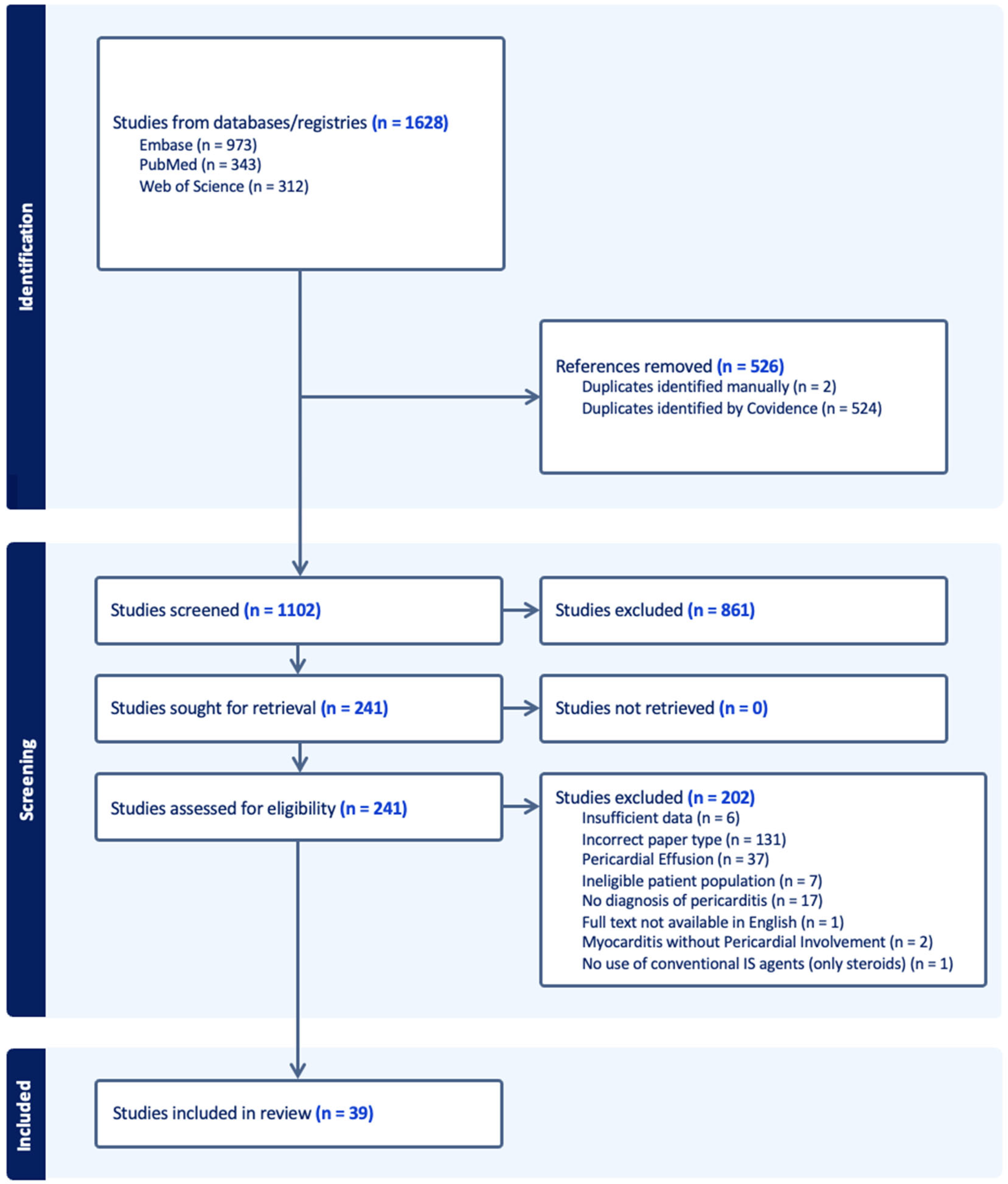
All retrieved citations were imported into Covidence systematic review software (Veritas Health Innovation, Melbourne, Australia) for management and deduplication. Following the removal of 526 duplicates (524 automatically identified by Covidence and 2 manually), a total of 1102 records were screened (Figure 1). Two independent authors (A.S.G. and C.M.) performed the analysis of the titles and abstracts. Subsequently, 861 studies were excluded, and 241 full texts were assessed for final eligibility.
Following full-text evaluation, 202 records were excluded for the following reasons: incorrect paper type (e.g., narrative review, n = 131), pericardial effusion without pericarditis (n = 37), unconfirmed diagnosis of pericarditis (n = 17), ineligible patient population (e.g., no conventional IS used, n = 7), insufficient data (n = 6), myocarditis without pericardial involvement (n = 2), and no use of conventional IS agents (n = 1). Ultimately, 39 reports were included in the final analysis [9,10,11,12,13,14,15,16,17,18,19,20,21,22,23,24,25,26,27,28,29,30,31,32,33,34,35,36,37,38,39,40,41,42,43,44,45,46,47]. Discrepancies between reviewers were resolved by consensus or by a third senior author (A.R.), if necessary.
Clinical, laboratory, imaging, and therapeutic data were extracted from article texts, tables, and figures. Follow-up time was considered as the longest reported. The final dataset predominantly consisted of individual patient data (IPD) derived from case reports and case series, with the inclusion of one retrospective cohort study that provided exclusively aggregated data [17].
Pericarditis resolution was defined as disappearance of the clinical and/or diagnostic features that supported pericarditis diagnosis, specifically chest pain, ECG changes, pericardial effusion and/or friction rubs. When concurrent myocarditis was reported, the diagnosis was accepted if based on established clinical guidelines [1], specifically requiring the presence of characteristic findings on Cardiac Magnetic Resonance (CMR) imaging and/or elevated cardiac troponin.

2.4. Quality Assessment

The methodological quality of the included case reports and case series was independently evaluated by two reviewers using the Murad tool for assessing the methodological quality of case reports and case series [48,49].

2.5. Risk of Bias Assessment

Given the absence of validated tools for the type of evidence included in our study, the risk of bias was assessed using an adapted framework for case reports and case series. Two reviewers (A.S.G. and C.M.) independently evaluated each report with respect to clarity of case selection and inclusion criteria; adequacy of diagnostic criteria for pericarditis; consistency of clinical, laboratory, and imaging data; details of therapeutic interventions; clarity of outcome reporting. Since our review only included uncontrolled case-based studies, the risk of bias assessment was qualitative, intending to contextualize the reliability of the extracted data.

2.6. Statistical Analysis

Summary statistics of variables were expressed as median and interquartile range (Q1–Q3), or absolute number and percentage, as appropriate. Continuous variables were compared using the Mann-Whitney U test; categorical variables were compared using Pearson’s Chi-squared tests or Fisher’s exact tests, depending on the expected frequencies. Categorical variables from the single aggregated study were pooled with the individual-level data to calculate overall frequencies and proportions. Conversely, for continuous numerical variables (specifically time to first recurrence, median oral steroid daily dose, months of IS therapy, duration of follow-up, and months to recurrence on IS), direct IPD pooling was not feasible without the original raw data. Therefore, summary statistics for these continuous variables from the aggregated cohort were not merged but were maintained and reported separately as medians and interquartile ranges (Q1, Q3) within the descriptive tables. Statistical significance was based on a two-sided p-value threshold of <0.05. To account for multiple comparisons, p-values were adjusted using the Benjamini-Hochberg False Discovery Rate (FDR) procedure. The analyses were performed using Jamovi software (version 2.7). Considering the small sample size, the heterogeneity of clinical contexts, and the inclusion of case reports and case series, the statistical comparisons were exploratory and intended to describe patterns within the published data, with no possibility to support inferential conclusions.

3. Results

3.1. Characteristics of the Included Studies

The 39 included studies yielded data on 75 patients, with reports published between 1970 and 2026 (Table 1). The median age at diagnosis was 36.0 years (Q1–Q3, 23.0–50.0), with a female predominance (n = 37, 60%). The cohort was predominantly of Caucasian descent (n = 46, 81%), alongside patients of African (n = 6, 11%), Asian (n = 4, 7%), and Hispanic (n = 1, 2%) ethnicities.
SIDs were the most common underlying etiology (n = 40, 53%), followed by idiopathic/presumed viral pericarditis (n = 30, 40%). Less frequent causes included iatrogenic pericardial injury (n = 3), post-myocardial infarction syndrome (n = 1), and immune-checkpoint inhibitor (ICI)-associated pericarditis (n = 1). Among the 40 SID-related cases, systemic lupus erythematosus (SLE) was the most frequent condition (n = 23), followed by rheumatoid arthritis (n = 7) and eosinophilic granulomatosis with polyangiitis (n = 2). The remaining SID cases (n = 8) were attributed to rarer conditions, including adult-onset Still’s disease (n = 2), Behçet’s disease (n = 1), Chronic Atypical Neutrophilic Dermatosis with Lipodystrophy and Elevated temperature (CANDLE) syndrome (n = 1), Crohn’s disease (n = 1), polymyositis (n = 1), sarcoidosis (n = 1), and granulomatosis with polyangiitis (n = 1).
At the index hospitalization, 66% of patients had a history of recurrent pericarditis, with the index flare occurring relatively soon after the previous episode (median time to recurrence: 3.0 months). Pleuritic chest pain was the hallmark symptom (n = 50, 81%), frequently accompanied by fever (n = 30, 57%) and pericardial friction rubs (n = 17, 33%). Electrocardiography revealed widespread ST-segment elevation and/or PR-segment depression, suggestive of acute pericarditis, in 58% of evaluated cases (n = 26). Systemic in€flammation was prominent, with C-Reactive Protein (CRP) elevated in 91% of tested patients (n = 61; median peak: 69.0 mg/L). Concomitant myocardial involvement (i.e., associated myocarditis) was diagnosed in 20% of the cohort (n = 10), corroborated by elevated troponin levels in 8 cases.
Echocardiography identified pericardial effusion in 89% of patients (n = 42), which was graded as mild (n = 7), moderate (n = 9), or severe (n = 11). Left ventricular ejection fraction (LVEF) was generally preserved (n = 35, 95%). CMR imaging was performed in 12 cases; of these, 8 showed signs of myocardial and/or pericardial inflammation.
Cardiac tamponade complicated the clinical course in 13 cases (22%), mandating pericardiocentesis in all instances; pericardial fluid analysis did not lead to specific etiological diagnosis in any of the reported cases. Signs of pericardial constriction at diagnosis were observed in 5 patients (8%), leading to surgical pericardiectomy in 3 cases.

3.2. Medical Therapy for Pericarditis: First-Line Therapy and Rationale for Immunosuppression

Prior to the initiation of conventional IS, standard-of-care regimens included corticosteroids in 87% of patients (intravenous in 5 cases), NSAIDs in 41% (n = 31), and colchicine in 35% (n = 26) (Table 1).
The primary clinical indications for initiating conventional IS were: refractory pericarditis (n = 39, 52%), exacerbation of the underlying systemic disease (n = 20, 27%), and corticosteroid dependence (n = 16, 21%, i.e., used as a steroid-sparing strategy in the absence of systemic involvement). The most frequently prescribed first-line agents were AZA (n = 33, 44%), MTX (n = 19, 25%), MMF (n = 11, 15%), and Cyc (n = 8, 11%). After failure of first-line medical treatment, a second-line IS agent was required in 13 cases, with 4 patients eventually progressing to a third-line agent and 1 patient to a fourth-line therapy.
In all reported cases, IS therapy resulted in clinical resolution of pericarditis. Furthermore, among patients receiving baseline corticosteroids, the introduction of IS enabled steroid withdrawal in 72% of cases (n = 42). During follow-up, pericarditis recurrence while on active IS therapy occurred in only 10% of patients (n = 6), with a median time to relapse of 2.0 months.
The safety profile was favourable, with only 2 cases of reported adverse events (2.6%) that necessitated treatment discontinuation in both instances (infection on MTX, n = 1 [9]; pancytopenia on AZA, n = 1 [37]).

3.3. IS Treatment for Recurrent Pericarditis

We compared data of patients treated with IS at their first pericarditis episode (n = 25) and patients treated with IS at pericarditis relapse (n = 49) (Table 2). Patients with a history of previous pericarditis events showed a more pronounced inflammatory clinical presentation, with significantly higher frequencies of pericarditic chest pain (97% vs. 56%, p < 0.001), friction rubs (52% vs. 8.3%, p < 0.001), and typical ECG alterations (77% vs. 32%, p = 0.002). Interestingly, all patients (100%) in the recurrent group had elevated CRP, compared to 71% of patients treated at their first episode (p < 0.001). No significant differences were observed between the two groups regarding tamponade (p = 0.056) or constriction (p > 0.999) at diagnosis.
Patients treated with IS agents at their first pericarditis episode were exclusively affected by SIDs (100% vs. 29%, p < 0.001) and required a significantly higher median dose of oral steroids before IS initiation (60.0 mg/day vs. 20.0 mg/day, p = 0.005), whereas patients with previous events more frequently received colchicine (47% vs. 8.0%, p < 0.001) and NSAIDs (51% vs. 20%, p = 0.010).
Conventional IS indications also differed significantly (p < 0.001): first-event patients were primarily treated for SID flares (68% vs. 6.1%), whereas patients with pericarditis recurrence were mainly treated for refractory pericarditis (65% vs. 24%) or steroid dependence (29% vs. 8.0%). Finally, while the recurrent group had a higher success rate in withdrawing steroids (86% vs. 45%, p < 0.001), they also experienced a higher rate of recurrence while on IS therapy (36% vs. 4.0%, p = 0.008).

3.4. IS Treatment for SIDs-Related Pericarditis vs. Isolated Pericarditis

We compared data of patients with SIDs (n = 40) and without SIDs (n = 35) (Table 3). At diagnosis, SIDs patients presented with a less typical inflammatory pericarditic phenotype, showing significantly lower chest pain occurrence (70% vs. 100%, p = 0.005), friction rubs (16% vs. 73%, p < 0.001), and typical ECG alterations (45% vs. 86%, p = 0.011). Nevertheless, SIDs patients experienced significantly higher rates of cardiac tamponade (35% vs. 3.8%, p = 0.003) and more frequently required pericardiocentesis (32% vs. 7.7%, p = 0.022).
Regarding therapeutic management, all (100%) non-SIDs patients had a history of prior recurrences compared to 36% of SIDs patients (p < 0.001). Conventional IS indications also varied significantly between the two groups (p < 0.001): SIDs patients were predominantly treated for a systemic disease flare (50%) or refractory disease (45%), while non-SIDs patients were mostly treated for refractory disease (60%) or steroid dependence (40%). When analysing specific IS agents, MMF was exclusively used in SIDs patients (28% vs. 0%, p < 0.001), while AZA was more frequently prescribed in patients without SIDs (AZA: 69% vs. 23%; p < 0.001). Furthermore, the use of multiple lines of IS was more frequent in SID patients.
Consistent with the findings in the cohort with previous pericarditis episodes, non-SIDs patients showed a higher success rate in progressively withdrawing steroids (90% vs. 55%, p = 0.003) but also experienced a higher rate of pericarditis recurrence while on IS therapy (44% vs. 10%, p = 0.001).
A sensitivity analysis restricted to the 38 reports providing individual patient data (n = 62 patients) showed similar patterns of clinical baseline features and clinical response across all patient’s subgroups, supporting the robustness of the overall findings (Supplementary Tables S3–S5).

3.5. Quality Assessment

Based on the Murad tool, more than half of the studies (24/39, 62%) were rated as good quality (score ≥ 6), while the remaining 15 (15/39, 38%) were of intermediate quality (score 4–5) (Supplementary Table S2) [49].

4. Discussion

The main findings of our study are: first, IS therapy achieved clinical resolution of pericarditis in all reported cases and demonstrated a favourable safety profile, even in complex presentations complicated by cardiac tamponade or pericardial constriction. Despite likely influenced by reporting bias, these findings reinforce the clinical utility of conventional IS therapies, which can have a role even in the present time, in which anti-IL1 agents have become standard of care for recurrent pericarditis.
Second, clinicians primarily prescribed IS therapy for patients with concurrent SIDs, particularly SLE and RA. In this population, IS agents effectively controlled both pericardial involvement and underlying systemic disease, though some patients required multiple lines of therapy. Finally, in the subset of patients with isolated recurrent pericarditis, IS therapy was primarily indicated as a steroid-sparing strategy for steroid-dependent disease, with AZA and MTX being the most frequently chosen agents.

4.1. The Use of IS in the Modern Therapeutic Landscape of Pericarditis

Our systematic review shows that, despite the recent paradigm shift toward targeted IL-1 blockade [50], IS agents may remain clinically relevant across a broad spectrum of pericarditis presentations. This is particularly evident in the real-world scenarios captured by the 75 patients included in our analysis, in whom IS therapy achieved complete clinical resolution and enabled corticosteroid withdrawal in 72% of those receiving baseline steroids. Nevertheless, it should be acknowledged that diagnostic criteria and therapeutic strategies for pericarditis and associated conditions have evolved substantially during these decades. In particular, the introduction of colchicine in the early 2000s [51] and IL-1 inhibitors in the past decade [1] has reshaped the management of recurrent pericarditis, potentially influencing both treatment selection and clinical trajectories.
Notably, IS use was not confined to historical practice: although the reports span several decades (1970–2026), more than half of the cases (53%) involved pericarditis associated with SIDs, a setting in which IL-1 inhibitors remain insufficiently studied and may not adequately address multisystem inflammatory activity. In these patients, IS agents served a dual therapeutic purpose, controlling pericardial inflammation and treating the underlying disease.
Notably, 12 of the 39 included reports (31%) were published prior to the 2015 European Society of Cardiology guidelines [52], which standardized pericarditis management and recommended colchicine from the initial episode to reduce recurrence risk and improve disease control [51] (Supplementary Figure S1). This temporal heterogeneity likely contributed to variability in treatment strategies, including the timing, dosing, and duration of IS therapy. However, even in more contemporary cases, the optimal regimen and duration of IS treatment—particularly in isolated, non-SID associated pericarditis—remain poorly defined. This mirrors the broader uncertainty surrounding long-term medical therapy for idiopathic recurrent pericarditis, where prolonged treatment with IL-1 inhibitors is often required [53]. Prospective studies are needed to define optimal IS dosing strategies and treatment duration in pericarditis.
Moreover, despite IS agents having occasionally been implicated as potential causes of pericarditis—most notably MTX [54], but also AZA [55]—such events appear exceedingly rare. In our review, 33 patients were treated with AZA and 19 with MTX, with a favourable efficacy and safety profile and no reported cases of drug-induced pericarditis. Notably, while IL-1 blockade has demonstrated superior efficacy in randomized trials, with rapid symptom resolution, normalization of inflammatory markers, and markedly reduced recurrence rates compared with historical standards of care, the use of IS in pericarditis derives exclusively from case reports and small observational studies, limiting direct comparability, although many IS agents have decades of real-world experience in autoimmune disease management. Nevertheless, this review highlights the potential role of IS therapy in restricted clinical scenarios, specifically as a steroid-sparing alternative when biologic therapies are unavailable, contraindicated (e.g., due to anaphylaxis), or economically inaccessible.

4.2. Immunosuppressive Agents Across Heterogeneous Pericarditis Clinical Presentations

The role of conventional IS in pericarditis appears to vary substantially across different clinical phenotypes, particularly when comparing SID-associated forms with non-SID presentations. In the context of SID-associated pericarditis, pericardial involvement is generally considered to be a component of a more extensive systemic autoimmune process, as opposed to being an isolated serous manifestation. Pericardial disease is less prevalent, yet adequately documented in RA, with a prevalence of approximately 10–30% in echocardiographic studies, while clinically evident pericarditis is comparatively rare [2].
In this setting, conventional IS such as MMF are primarily utilised as steroid-sparing agents or as background therapies aimed at controlling the underlying disease activity. Consequently, the utilisation of these drugs is frequently driven more by the systemic disease framework than by pericardial inflammation per se, especially in conditions such as SLE or other connective tissue diseases. Conversely, non-SID pericarditis manifests more commonly with a distinctly inflammatory phenotype, characterised by elevated acute-phase reactants, the presence of typical chest pain, electrocardiographic changes, and, in certain instances, fever and serositis extending beyond the pericardium. This clinical profile overlaps with the so-called “autoinflammatory endotype”, which is primarily driven by interleukin-1–mediated pathways [56,57]. In this context, targeted therapies such as anakinra have demonstrated consistent efficacy, suggesting that conventional IS may be less biologically aligned with the dominant pathogenic mechanisms in these patients [58]. Although direct comparative evidence is lacking, these observations support a phenotype-driven therapeutic approach: conventional IS agents are likely less effective than IL-1 blockade for highly inflammatory, non-SID pericarditis.
In more complex clinical scenarios, such as constrictive physiology or cardiac tamponade, the role of conventional IS agents is more limited and context-dependent. In cases of cardiac tamponade, urgent pericardial drainage remains the cornerstone of management, with the consideration of immunosuppressive therapy only after haemodynamic stabilisation and an assessment of the underlying cause, particularly in cases linked to systemic autoimmune disease [52]. In constrictive pericarditis, particularly in its transient or inflammatory forms, immunomodulatory strategies have been shown to contribute to the reversal of inflammation-driven constriction. However, current evidence appears to offer stronger support for the utilisation of targeted anti-IL-1 therapies as opposed to conventional IS in this context [58,59]. Our findings underscore the significance of a phenotype-oriented approach to pericarditis management. Conventional IS agents appear to play a complementary and context-specific role, particularly in cases associated with SID and in cases with myocardial involvement. However, their utility in non-SID, highly inflammatory phenotypes and in acute complicated presentations remains more limited. As visually contextualized in our temporal distribution chart (Supplementary Figure S1), this continued reliance on conventional IS agents in recent years may suggest a potential delay in adopting guideline-recommended stepwise approaches, or difficulties in accessing targeted biologic therapies. Crucially, however, this trend is also largely driven by the high prevalence of SIDs in our cohort, for which IL-1 inhibitors do not currently represent the first-line therapeutic option [2,3,4,5].

4.3. Different Therapeutic Pathways in SID-Related vs. Isolated Recurrent Pericarditis

Our systematic review underscores distinct therapeutic strategies between SIDs-related pericarditis and isolated forms. In patients with SIDs, conventional IS agents were primarily initiated to control systemic disease activity rather than pericardial inflammation per se, although they ultimately led to resolution of pericarditis in all cases. This population frequently required a stepwise intensification strategy, escalating to multiple IS lines due to suboptimal control of the underlying autoimmune condition with first-line therapies. Notably, MMF was used exclusively in the SID cohort. In contrast, among non-SID patients, conventional IS (mainly AZA and MTX) were introduced specifically for the management of isolated, corticosteroid-dependent or refractory pericarditis, with the goal of achieving sustained remission and complete steroid withdrawal.
Consistent with these differing therapeutic aims, the non-SID cohort achieved a significantly higher rate of steroid independence compared with SID patients (90% vs. 55%). However, this apparent advantage was offset by a higher incidence of recurrences during ongoing IS therapy (44% vs. 10%). The challenge of maintaining durable remission in this population is consistent with prior single-center studies [6]. In a retrospective cohort of 46 patients with isolated recurrent pericarditis, AZA enabled sustained remission and corticosteroid discontinuation in over half of cases; nevertheless, approximately 37% of patients experienced relapse during steroid tapering.
Accurate etiological classification remains pivotal for treatment individualization, yet real-world data continue to highlight substantial gaps in guideline adherence. A recent nationwide registry [60] reported unexpectedly low colchicine utilization—17.0% in autoimmune-associated pericarditis and 23.2% in idiopathic cases—despite extensive corticosteroids use. Our review mirrors this trend: prior to the initiation of conventional IS, only 35% of patients had received colchicine and 41% NSAIDs (with no differences between SID-related and isolated pericarditis), while 87% were already corticosteroid-dependent. Thus, while identifying an underlying autoimmune aetiology is pivotal—given that these patients may exhibit a more favourable response to conventional IS therapy—the pharmacological management of pericarditis must still follow a structured stepwise approach: strict adherence to optimized treatment courses with NSAIDs and colchicine remains essential [1], in order to prevent recurrences and reduce the risk of corticosteroid dependence in both SID-related and isolated pericarditis.

5. Limitations

The main limitation of this review is the strong likelihood of publication bias, given that 100% of the included cases reported IS agents as effective in pericarditis control, with no documented instances of medical therapy failure.
Second, despite the dataset spans a large period of time (included reports publication date from 1970 to 2026), given the small number of cases per each time period, meaningful stratified analyses were not feasible.
In addition, hypothesis testing in our study is limited by the small sample size, the heterogeneity of the data, and the case-based nature of included reports; thus, all statistical comparisons are exploratory and purely descriptive.
Another relevant limitation is the nature of the available evidence, which consists exclusively of case reports and small case series with heterogeneous reporting quality; as a result, some clinically relevant variables (such as friction rubs, standardized treatment protocols) may have been inconsistently documented. Notably, the overall utilization of CMR imaging was low, even in patient subgroups with complicated disease courses—such as those with associated myocarditis or constrictive pericarditis—where modern guidelines would indicate its use. This underutilization likely reflects the extended publication time span of the included reports.
Treatment regimens varied widely across decades, leading to high heterogeneity of treatment types and durations; for example, colchicine was approved for recurrent pericarditis treatment after the publication of many of the reports.
Finally, the absence of controlled studies prevents firm conclusions regarding comparative efficacy, optimal dosing, and treatment duration.

6. Conclusions

Conventional IS agents appear to be generally effective and safe for the management of pericarditis, including cases associated with SIDs and isolated recurrent idiopathic forms. These findings support the use of conventional IS for selected cases in which anti-IL1 therapies do not represent the primary indication (e.g., SIDs), or are insufficiently studied, while highlighting the need for prospective studies to define optimal regimens and treatment duration.

Supplementary Materials

The following supporting information can be downloaded at: https://www.mdpi.com/article/10.3390/medicina62050887/s1, Section S1: “Search strategy”; Figure S1: “Temporal trends in the publication of pericarditis case reports and case series stratified by underlying etiology”; Table S1: “PRISMA checklist for systematic literature review items”; Table S2: “Evaluation of methodological quality of the included case reports and case series, evaluated according to the Murad tool”. Table S3: “Baseline Demographics, Clinical Characteristics, and Treatment Outcomes of the Overall Cohort (Excluding the Aggregated Data Study [17])”; Table S4: “Baseline Characteristics, Therapeutic Management, and Clinical Outcomes. Stratified by First-Episode versus Recurrent Pericarditis (Excluding the Aggregated Data Study [17])”; Table S5: “Baseline Characteristics, Therapeutic Management, and Clinical Outcomes in SIDs vs. Non-SIDs patients (Excluding the Aggregated Data Study [17])”.

Author Contributions

Conceptualization, A.S.G.; methodology, C.M. and A.R.; software, C.M. and F.S.; validation, A.B. and A.L.P.C.; resources, E.P., E.B. and M.G.C.; data curation, C.A.M. and E.V.; writing—original draft preparation, A.S.G., C.M. and A.R.; writing—review and editing, M.C., L.L.S., F.L. and M.G.D.B.; visualization, L.L.S., F.L. and M.G.D.B.; supervision, A.B. and A.L.P.C.; project administration, A.L.P.C., L.L.S. and F.L. All authors have read and agreed to the published version of the manuscript.

Funding

This research received no external funding.

Institutional Review Board Statement

Ethical review and approval were waived for this study due to its design as a systematic review of previously published literature.

Informed Consent Statement

Not applicable.

Data Availability Statement

No new data were created or analyzed in this study. Data sharing is not applicable to this article.

Acknowledgments

Not applicable.

Conflicts of Interest

The authors declare no conflict of interest.

References

  1. Schulz-Menger, J.; Collini, V.; Gröschel, J.; Adler, Y.; Brucato, A.; Christian, V.; Ferreira, V.M.; Gandjbakhch, E.; Heidecker, B.; Kerneis, M.; et al. 2025 ESC Guidelines for the Management of Myocarditis and Pericarditis. Eur. Heart J. 2025, 46, 3952–4041. [Google Scholar] [CrossRef] [PubMed]
  2. Kawano, Y.; Pabón, M.A.; Feldman, C.H.; Cuddy, S.; Lilly, L.S.; Garshick, M.S.; Weber, B. Evaluation and Management of Pericarditis in Rheumatic Diseases. J. Cardiovasc. Pharmacol. 2024, 83, 491–502. [Google Scholar] [CrossRef] [PubMed]
  3. Smolen, J.S.; Landewé, R.B.M.; Bergstra, S.A.; Kerschbaumer, A.; Sepriano, A.; Aletaha, D.; Caporali, R.; Edwards, C.J.; Hyrich, K.L.; Pope, J.E.; et al. EULAR Recommendations for the Management of Rheumatoid Arthritis with Synthetic and Biological Disease-Modifying Antirheumatic Drugs: 2022 Update. Ann. Rheum. Dis. 2023, 82, 3–18. [Google Scholar] [CrossRef]
  4. Fanouriakis, A.; Kostopoulou, M.; Andersen, J.; Aringer, M.; Arnaud, L.; Bae, S.-C.; Boletis, J.; Bruce, I.N.; Cervera, R.; Doria, A.; et al. EULAR Recommendations for the Management of Systemic Lupus Erythematosus: 2023 Update. Ann. Rheum. Dis. 2024, 83, 15–29. [Google Scholar] [CrossRef] [PubMed]
  5. Del Galdo, F.; Lescoat, A.; Conaghan, P.G.; Bertoldo, E.; Čolić, J.; Santiago, T.; Suliman, Y.A.; Matucci-Cerinic, M.; Gabrielli, A.; Distler, O.; et al. EULAR Recommendations for the Treatment of Systemic Sclerosis: 2023 Update. Ann. Rheum. Dis. 2024, 84, 29–40. [Google Scholar] [CrossRef]
  6. Vianello, F.; Cinetto, F.; Cavraro, M.; Battisti, A.; Castelli, M.; Imbergamo, S.; Marcolongo, R. Azathioprine in Isolated Recurrent Pericarditis: A Single Centre Experience. Int. J. Cardiol. 2011, 147, 477–478. [Google Scholar] [CrossRef]
  7. Wassif, H.; Ghandakly, E.; Layoun, H.; Bhalla, J.S.; Littlejohn, E.; Wang, T.K.M.; Husni, E.; Klein, A. Autoimmune Pericarditis: Diagnosis and New Therapeutics. Curr. Cardiol. Rep. 2025, 27, 114. [Google Scholar] [CrossRef]
  8. Page, M.J.; McKenzie, J.E.; Bossuyt, P.M.; Boutron, I.; Hoffmann, T.C.; Mulrow, C.D.; Shamseer, L.; Tetzlaff, J.M.; Akl, E.A.; Brennan, S.E.; et al. The PRISMA 2020 Statement: An Updated Guideline for Reporting Systematic Reviews. BMJ 2021, 372, n71. [Google Scholar] [CrossRef]
  9. Balak, W.; Sinkiewicz, W.; Jeka, S.; Banach, J.; Sinkiewicz, A.; Karasek, D.; Błażejewski, J.; Bujak, R. Recurrent Cardiac Tamponade and Sepsis in a Patient with Rheumatoid Arthritis. Pol. Heart J. 2011, 69, 948–950. [Google Scholar] [CrossRef]
  10. Asplen, C.H.; Levine, H.D. Azathioprine Therapy of Steroid-Responsive Pericarditis. Am. Heart J. 1970, 80, 109–111. [Google Scholar] [CrossRef]
  11. Bajraktari, A.A.; Krasniqi, A.; Ymeri, L.; Kryeziu, A.; Zenelaj, K. Pleurisy and Pericarditis—Acute Manifestations of Rheumatoid Arthritis in the Elderly with Rapid Onset. Med. Arch. 2025, 79, 324–327. [Google Scholar] [CrossRef]
  12. Bacconnier, L.; Combe, B.; Canaud, B.; Morel, J. Efficacy of Rituximab in a Patient with Lupus Nephritis despite Low Levels of CD19. Rheumatology 2010, 49, 2452–2453. [Google Scholar] [CrossRef]
  13. Bennett, A.N.; Peterson, P.; Sangle, S.; Hangartner, R.; Abbs, I.C.; Hughes, G.R.V.; D’Cruz, D.P. Adult Onset Still’s Disease and Collapsing Glomerulopathy: Successful Treatment with Intravenous Immunoglobulins and Mycophenolate Mofetil. Rheumatology 2004, 43, 795–799. [Google Scholar] [CrossRef]
  14. Bertelli, M.; Bergamaschi, L.; Armillotta, M.; Angeli, F.; Pizzi, C. A Textured Clinical Mosaic Involving Autoimmune Calcific Constrictive Pericarditis: A Case Report. Eur. Heart J. Case Rep. 2025, 9, ytaf301. [Google Scholar] [CrossRef]
  15. Boever, S.; Bannis, K. A Case Report: Unveiling the Underlying Cause of Recurrent Pericarditis in a Patient with Undifferentiated Connective Tissue Disease. Cureus 2024, 16, e54113. [Google Scholar] [CrossRef]
  16. Boskovic, K.; Savic, A.; Erdeljan, B.; Subin-Teodosijevic, S.; Glavcic, A. Atypical Clinical Presentation of Rheumatoid Arthritis. Srp. Arh. Celok. Lek. 2023, 151, 583–586. [Google Scholar] [CrossRef]
  17. Brown, A.; Liu, X.; Chatterjee, S. Azathioprine May Be an Effective Steroid Sparing Agent in Patients with Isolated Recurrent Pericarditis; ACR Meeting Abstracts. Arthritis Rheumatol. 2015, 67, 1756–1757. [Google Scholar]
  18. Cavalcante, M.P.V.; Brunelli, J.B.; Miranda, C.C.; Novak, G.V.; Malle, L.; Aikawa, N.E.; Jesus, A.A.; Silva, C.A. CANDLE Syndrome: Chronic Atypical Neutrophilic Dermatosis with Lipodystrophy and Elevated Temperature-a Rare Case with a Novel Mutation. Eur. J. Pediatr. 2016, 175, 735–740. [Google Scholar] [CrossRef] [PubMed]
  19. Daumas, A.; Bernard, F.; Jacquier, A.; Rossi, P.; Francès, Y.; Granel, B. Myopéricardite à éosinophiles révélant un syndrome de Churg et Strauss. Rev. Med. Interne 2011, 32, 323–324, author reply 325. [Google Scholar] [CrossRef]
  20. Derector, E.; Gundlapally, M.S.; Young, N.R. Localized ST Elevations and PR Depressions in Systemic Lupus Erythematosus Pericarditis: An Unusual Case Presentation. Case Rep. Med. 2026, 2026, 6633318. [Google Scholar] [CrossRef] [PubMed]
  21. Dey, M.; Nair, J.; Sankaranarayanan, R.; Kanagala, P. Myopericarditis as a Presentation of Eosinophilic Granulomatosus with Polyangiitis (EGPA). BMJ Case Rep. 2019, 12, e230593. [Google Scholar] [CrossRef]
  22. Dubey, S.; Merry, P. Clinical Vignette. Interstitial Granulomatous Dermatitis (Ackerman’s Syndrome) in SLE Presenting with the “Rope Sign”. Rheumatology 2007, 46, 80. [Google Scholar] [CrossRef] [PubMed]
  23. El Sharu, H.; Jain, P.; Singer, B.; Snyder, E.A. A Rare Case of Pericardial Sarcoidosis Presenting as Chest Pain. Clin. Case Rep. 2024, 12, e9160. [Google Scholar] [CrossRef]
  24. Fernández-Codina, A.; Francisco-Pascual, J.; Fonollosa-Plà, V. Tratamiento Exitoso de Un Caso de Pericarditis Crónica Constrictiva Utilizando Micofenolato Sódico En Una Paciente Con Esclerosis Sistémica. Med. Clin. 2017, 148, 574–575. [Google Scholar] [CrossRef] [PubMed]
  25. Gomez-Alvarez, U.; Vargas Torres, C.G.; Sanchez Soberanes, L.; Grajeda Marin, J.M.; Mora Castrejon, J.L. Acute Pericarditis: An Isolated Initial Manifestation of Systemic Lupus Erythematosus (SLE). Cureus 2025, 17, e97005. [Google Scholar] [CrossRef] [PubMed]
  26. Higashioka, K.; Migita, R.; Ota, T.; Uchino, A.; Niiro, H. Successful Treatment of Systemic Sclerosis-Related Pericarditis with Mycophenolate Mofetil and Low-Dose Prednisolone. Intern. Med. 2022, 61, 3125–3130. [Google Scholar] [CrossRef]
  27. Horna, N.M.; Romero, R.; Larrauri, C.; Córdova, F.; Martín Mispireta, J.; Alarcón, J. Myocardiopericarditis in adult still’s disease. Arch. Peru. Cardiol. Cir. Cardiovasc. 2023, 1, 194–197. [Google Scholar] [CrossRef]
  28. Ibrahim, M.; Fattouh, M.; Jacobs, A. Management of Recurrent Pregnancy-Related Pericarditis. Case Rep. Cardiol. 2022, 2022, 5791307. [Google Scholar] [CrossRef]
  29. Imadachi, H.; Imadachi, S.; Koga, T.; Miyashita, T.; Izumi, Y.; Takayama, H.; Nakamichi, C.; Hamawaki, M.; Yamaguchi, H.; Matsukuma, S.; et al. Successful Treatment of Refractory Cardiac Tamponade Due to Rheumatoid Arthritis Using Pericardial Drainage. Rheumatol. Int. 2010, 30, 1103–1106. [Google Scholar] [CrossRef]
  30. Kato, M.; Jimbo, K.; Nagata, M.; Endo, Y.; Kashiwagi, K.; Maruyama, K.; Ito, N.; Tokushima, K.; Arai, N.; Kyodo, R.; et al. Novel Pediatric Granulomatosis with Polyangiitis with a Marked Bloody Pericardial Effusion and Bloody Stool: A Case Report. Allergy Asthma Clin. Immunol. 2021, 17, 124. [Google Scholar] [CrossRef]
  31. Kumar, P.; Ratnjeet, K.; Dharan, B.S.; Poyuran, R.; Gopalakrishnan, A. Pediatric Autoimmune Pancarditis Complicated by Congenital Heart Disease: A Case of Severe Multivalvular Dysfunction and Fibrinous Pericarditis. Indian J. Thorac. Cardiovasc. Surg. 2026, 1–6. [Google Scholar] [CrossRef]
  32. Lambotte, O.; Khellaf, M.; Harmouche, H.; Bader-Meunier, B.; Manceron, V.; Goujard, C.; Amoura, Z.; Godeau, B.; Piette, J.-C.; Delfraissy, J.-F. Characteristics and Long-Term Outcome of 15 Episodes of Systemic Lupus Erythematosus-Associated Hemophagocytic Syndrome. Medicine 2006, 85, 169–182. [Google Scholar] [CrossRef] [PubMed]
  33. Luo, Y.; Wen, Y.; Arevalo Molina, A.B.; Dahal, P.; Leuprecht, L.; Bsrat, M. Macrophage Activation Syndrome, Glomerulonephritis, Pericarditis, and Retinal Vasculitis as Initial Presentation of Systemic Lupus Erythematosus. Case Rep. Med. 2018, 2018, 5979386. [Google Scholar] [CrossRef] [PubMed]
  34. Marcolongo, R.; Russo, R.; Laveder, F.; Noventa, F.; Agostini, C. Immunosuppressive Therapy Prevents Recurrent Pericarditis. J. Am. Coll. Cardiol. 1995, 26, 1276–1279. [Google Scholar] [CrossRef] [PubMed]
  35. Marijanovich, N.; Halalau, A. Hemorrhagic Tamponade as Initial Manifestation of Systemic Lupus with Subsequent Refractory and Progressive Lupus Myocarditis Resulting in Cardiomyopathy and Mitral Regurgitation. Case Rep. Rheumatol. 2018, 2018, 7635982. [Google Scholar] [CrossRef]
  36. Morel, N.; Bonjour, M.; Le Guern, V.; Le Jeunne, C.; Mouthon, L.; Piette, J.-C.; Costedoat-Chalumeau, N. Colchicine: A Simple and Effective Treatment for Pericarditis in Systemic Lupus Erythematosus? A Report of 10 Cases. Lupus 2015, 24, 1479–1485. [Google Scholar] [CrossRef]
  37. Peiffer-Smadja, N.; Domont, F.; Saadoun, D.; Cacoub, P. Corticosteroids and Immunosuppressive Agents for Idiopathic Recurrent Pericarditis. Autoimmun. Rev. 2019, 18, 621–626. [Google Scholar] [CrossRef]
  38. Pieta, A.; Pelechas, E.; Gerolymatou, N.; Voulgari, P.V.; Drosos, A.A. Calcified Constrictive Pericarditis Resulting in Tamponade in a Patient with Systemic Lupus Erythematosus. Rheumatol. Int. 2021, 41, 651–670. [Google Scholar] [CrossRef]
  39. Raatikka, M.; Pelkonen, P.M.; Karjalainen, J.; Jokinen, E.V. Recurrent Pericarditis in Children and Adolescents: Report of 15 Cases. J. Am. Coll. Cardiol. 2003, 42, 759–764. [Google Scholar] [CrossRef]
  40. Reynolds, E.; Garshick, M.; Junarta, J. Effusive-Constrictive Pericarditis in a Patient with Late-Onset Systemic Lupus Erythematosus. J. Cardiol. Cases 2026, 33, 111–114. [Google Scholar] [CrossRef]
  41. Rojas-Cadena, M.; Rodríguez-Arcentales, F.; Narváez-Cajas, J.; Arias-Intriago, M.; Morales Orbe, K.; Izquierdo-Condoy, J.S. Myopericarditis and Pericardial Effusion as the Initial Presentation of Systemic Lupus Erythematosus in a Patient with Sickle Cell Trait: A Case Report. J. Clin. Med. 2025, 14, 920. [Google Scholar] [CrossRef]
  42. Santos, M.E.; Gonçalves, M.J.; Costa, M.; Jorge, A.R.; Vasconcelos, J.F.; Ramos, S.; Branco, J.C.; Sepriano, A. Life-Threatening Hypereosinophilic Syndrome in a Patient with Rheumatoid Arthritis: A Case Report. ARP Rheumatol. 2023, 2, 349–350. [Google Scholar] [PubMed]
  43. Scott, I.C.; Hajela, V.; Hawkins, P.N.; Lachmann, H.J. A Case Series and Systematic Literature Review of Anakinra and Immunosuppression in Idiopathic Recurrent Pericarditis. J. Cardiol. Cases 2011, 4, e93–e97. [Google Scholar] [CrossRef]
  44. Tahir, T. A Case of Acute Constrictive Pericarditis Associated with Behçet’s Disease. Int. J. Rheum. Dis. 2011, 14, e51–e53. [Google Scholar] [CrossRef]
  45. Tan, W.; Dong, B.; Gu, J.; Peng, Y.; Xue, R. Chest Pain in a Mid-Aged Woman, Not Simply Myopericarditis: A Case Report of Anti-Ku Positive Polymyositis. BMC Cardiovasc. Disord. 2021, 21, 380. [Google Scholar] [CrossRef]
  46. Thiriveedi, M.; Steuber, T.D.; Hasan, M.; Baggett, A. Infliximab-Induced Lupus Causing Pericarditis: A Case Report and Review of the Literature. J. Gen. Intern. Med. 2021, 36, 2134–2138. [Google Scholar] [CrossRef]
  47. Verhaert, M.; Mebis, J.; Aspeslagh, S.; von Kemp, B. Steroid-Dependent Pericarditis Following Anti-PD1 Immunotherapy in a Metastatic Melanoma Patient: A Case Report. Eur. Heart J. Case Rep. 2023, 7, ytad112. [Google Scholar] [CrossRef] [PubMed]
  48. Viswanathan, M.; Patnode, C.D.; Berkman, N.D.; Bass, E.B.; Chang, S.; Hartling, L.; Murad, M.H.; Treadwell, J.R.; Kane, R.L. Recommendations for Assessing the Risk of Bias in Systematic Reviews of Health-Care Interventions. J. Clin. Epidemiol. 2018, 97, 26–34. [Google Scholar] [CrossRef] [PubMed]
  49. Murad, M.H.; Sultan, S.; Haffar, S.; Bazerbachi, F. Methodological Quality and Synthesis of Case Series and Case Reports. BMJ Evid. Based Med. 2018, 23, 60–63. [Google Scholar] [CrossRef]
  50. Lazarou, E.; Koutsianas, C.; Theofilis, P.; Lazaros, G.; Vassilopoulos, D.; Vlachopoulos, C.; Tsioufis, C.; Imazio, M.; Brucato, A.; Tousoulis, D. Interleukin-1 Blockers: A Paradigm Shift in the Treatment of Recurrent Pericarditis. Life 2024, 14, 305. [Google Scholar] [CrossRef]
  51. Imazio, M.; Brucato, A.; Cemin, R.; Ferrua, S.; Maggiolini, S.; Beqaraj, F.; Demarie, D.; Forno, D.; Ferro, S.; Maestroni, S.; et al. A Randomized Trial of Colchicine for Acute Pericarditis. N. Engl. J. Med. 2013, 369, 1522–1528. [Google Scholar] [CrossRef] [PubMed]
  52. Adler, Y.; Charron, P.; Imazio, M.; Badano, L.; Barón-Esquivias, G.; Bogaert, J.; Brucato, A.; Gueret, P.; Klingel, K.; Lionis, C.; et al. 2015 ESC Guidelines for the Diagnosis and Management of Pericardial Diseases: The Task Force for the Diagnosis and Management of Pericardial Diseases of the European Society of Cardiology (ESC) Endorsed by: The European Association for Cardio-Thoracic Surgery (EACTS). Eur. Heart J. 2015, 36, 2921–2964. [Google Scholar] [CrossRef]
  53. Ceriani, E.; Agozzino, F.; Berra, S.; Gidaro, A.; Bindi, P.; Pavarani, A.; Macchi, S.; Vena, L.; Moda, F.; Sicignano, L.L.; et al. Duration of Disease and Long-Term Outcomes in Patients with Difficult-To-Treat Recurrent Pericarditis: A Chronic Condition Treated with Nonsteroidal Anti-Inflammatory Drugs, Colchicine, Corticosteroids, and Anti–Interleukin-1 Agents. ACR Open Rheumatol. 2025, 7, e11776. [Google Scholar] [CrossRef]
  54. Mohyuddin, T.; Elyan, M.; Kushner, I. Pericarditis: A Rare Complication of Methotrexate Therapy. Clin. Rheumatol. 2007, 26, 2157–2158. [Google Scholar] [CrossRef]
  55. Simpson, C.D. Azathioprine-Induced Pericarditis in a Patient with Ulcerative Colitis. Can. J. Gastroenterol. Hepatol. 1997, 11, 694167. [Google Scholar] [CrossRef]
  56. Imazio, M.; Gaita, F.; LeWinter, M. Evaluation and Treatment of Pericarditis: A Systematic Review. JAMA 2015, 314, 1498–1506. [Google Scholar] [CrossRef]
  57. Maestroni, S.; Di Corato, P.R.; Cumetti, D.; Chiara, D.B.L.C.; Ghidoni, S.; Prisacaru, L.; Cantarini, L.; Imazio, M.; Penco, S.; Pedrotti, P.; et al. Recurrent Pericarditis: Autoimmune or Autoinflammatory? Autoimmun. Rev. 2012, 12, 60–65. [Google Scholar] [CrossRef]
  58. Buckley, L.F.; Viscusi, M.M.; Van Tassell, B.W.; Abbate, A. Interleukin-1 Blockade for the Treatment of Pericarditis. Eur. Heart J. Cardiovasc. Pharmacother. 2018, 4, 46–53. [Google Scholar] [CrossRef] [PubMed]
  59. Andreis, A.; Imazio, M.; Giustetto, C.; Brucato, A.; Adler, Y.; De Ferrari, G.M. Anakinra for Constrictive Pericarditis Associated with Incessant or Recurrent Pericarditis. Heart 2020, 106, 1561–1565. [Google Scholar] [CrossRef] [PubMed]
  60. Aikawa, H.; Fujino, M.; Nakao, K.; Nakai, M.; Kanaoka, K.; Sumita, Y.; Miyamoto, Y.; Takagi, K.; Otsuka, F.; Kataoka, Y.; et al. Diversity in Acute Autoimmune Pericarditis: Nationwide Analysis of In-Hospital Outcomes and Recurrence. JACC Asia 2024, 4, 721–731. [Google Scholar] [CrossRef]
Figure 1. PRISMA flow diagram: literature search and study selection process.
Medicina 62 00887 g001
Table 1. Baseline Demographics, Clinical Characteristics, and Treatment Outcomes of the Overall Cohort.
CharacteristicOverall Cohort (N = 75) 1Missing (n)
Demographics
Age, years 36.0 (23.0, 50.0)13
Female Sex 37/62 (60%)13
Ethnicity 18
  African6/57 (11%)
  Asian4/57 (7.0%)
  Caucasian46/57 (81%)
  Hispanic1/57 (1.8%)
Pericarditis Etiology 0
  SIDS (Autoimmune)40/75 (53%)
  Idiopathic (presumed viral)30/75 (40%)
  Iatrogenic pericardial injury3/75 (4.0%)
  Post-myocardial infarction (Dressler Syndrome)1/75 (1.3%)
  ICI-associated pericarditis1/75 (1.3%)
Autoimmune Disease 40/75 (53%)0
Underlying Autoimmune Disease
 SLE23/42 (55%)
 RA7/42 (17%)
 Systemic Sclerosis2/42 (4.8%)
 EGPA2/42 (4.8%)
 Other *8/42 (19%)
Clinical Presentation
Prior Recurrences 49/74 (66%)1
Months Since Previous Episode
  Individual Data (n = 22)3.0 (1.0, 7.0)14
  Aggregated Data (n = 13)17.0
Chest Pain 50/62 (81%)13
Friction Rub 17/52 (33%)23
Fever 30/53 (57%)22
ECG suggestive of acute pericarditis26/45 (58%)30
Associated myocarditis 10/49 (20%)26
Pericardial constriction at Diagnosis 5/60 (8.3%)15
Pericardiectomy 3/60 (5.0%)15
Laboratory & Imaging Findings
Elevated CRP 61/67 (91%)8
CRP Peak Value, mg/L69.0 (12.0, 146.0)43
Abnormal Troponin 8/41 (20%)34
LVEF by Echo 38
  Preserved35/37 (95%)
  Mildly Reduced1/37 (2.7%)
  Moderately Reduced1/37 (2.7%)
Pericardial Effusion (present)42/47 (89%)28
Pericardial Effusion Size 15
  Mild7/27 (26%)
  Moderate9/27 (33%)
  Severe11/27 (41%)
Cardiac Tamponade 13/60 (22%)15
Pericardiocentesis 13/60 (22%)15
CMR Performed 12/46 (26%)29
Pericarditis medical therapy
  Prior NSAID 31/75 (41%)0
  Prior Colchicine 26/75 (35%)0
  Prior Steroid 65/75 (87%)0
IV Steroid Dose Pre-IS, mg/day60.0 (60.0, 250.0)
Oral Steroid Dose Pre-IS, mg/day
  Individual Data (n = 35)20.0 (20.0, 60.0)
  Aggregated Data (n = 13)20.0
IS therapy Indication 0
  Refractory disease39/75 (52%)
  Steroid-dependence16/75 (21%)
  Systemic disease flare20/75 (27%)
First IS regimen
  AZA33/75 (44%)
  MTX19/75 (25%)
  MMF11/75 (15%)
  Cyc8/75 (11%)
  Other IS regimens ^4/75 (5.3%)
IS Duration, months 23
  Individual Data (n = 39)6.0 (3.0, 12.0)
  Aggregated Data (n = 13)6.0
Steroid Withdrawal 42/58 (72%)17
Follow-up, months
  Individual Data (n = 39)7.0 (6.0, 18.0)12
  Aggregated Data (n = 13)6.0
Outcomes
Pericarditis Resolved 70/70 (100%)5
Recurrence on Conventional IS6/60 (10%)15
Months to Recurrence2.0 (1.5–2.0)3
Adverse Event 2/75 (2.6%)0
IS Stopped for AE2/75 (2.6%)0
1 Median (Q1, Q3); n/N (%). AE: adverse event; AZA: azathioprine; CMR: cardiovascular magnetic resonance; CRP: C-reactive protein; Cyc: cyclophosphamide; ECG: electrocardiogram; EGPA: eosinophilic granulomatosis with polyangiitis; ICI: immune checkpoint inhibitor; IS: immunosuppression; IV: intravenous; LVEF: left ventricular ejection fraction; MMF: mycophenolate mofetil; MTX: methotrexate; NSAID: non-steroidal anti-inflammatory drug; RA: rheumatoid arthritis; SIDS: systemic immune-mediated diseases; SLE: systemic lupus erythematosus. * Other specific autoimmune diseases include: Adult-onset Still’s disease (n = 2, 4.8%), Behcet’s disease (n = 1, 2.4%), CANDLE (n = 1, 2.4%), Crohn’s disease (n = 1, 2.4%), Polymyositis (n = 1, 2.4%), Sarcoidosis (n = 1, 2.4%), and Granulomatosis with polyangiitis (GPA) (n = 1, 2.4%). ^ The “Other IS” category includes: Cyclosporine A (n = 1, 1.3%), Etanercept (n = 1, 1.3%), Hydroxychloroquine (n = 1, 1.3%) and Infliximab (n = 1, 1.3%).
Table 2. Baseline Characteristics, Therapeutic Management, and Clinical Outcomes Stratified by First-Episode versus Recurrent Pericarditis.
CharacteristicOverall (n = 74) 1First Event (n = 25) 1Recurrence (n = 49) 1p-Value 2q-Value 3Missing (n)
Demographics
Age, years35.0 (23.0, 49.0)34.0 (23.0, 53.0)37.0 (22.5, 48.0)0.6130.84013
Female Sex 36/61 (59%)12/25 (48%)24/36 (67%)0.1450.26813
Ethnicity 0.0030.00818
  Caucasian45/56 (80%)12/20 (60%)33/36 (92%)
  African6/56 (11%)4/20 (20%)2/36 (5.6%)
  Asian4/56 (7.1%)4/20 (20%)0/36 (0%)
  Hispanic1/56 (1.8%)0/20 (0%)1/36 (2.8%)
Clinical Presentation & Etiology
Etiology <0.001<0.0010
  SIDs39/74 (53%)25/25 (100%)14/49 (29%)
  Other35/74 (47%0/25 (0%)35/49 (71%)
Chest Pain 49/61 (80%)14/25 (56%)35/36 (97%)<0.001<0.00113
Friction Rub 16/51 (31%)2/24 (8.3%)14/27 (52%)<0.0010.00323
Fever 29/52 (56%)17/25 (68%)12/27 (44%)0.0870.17022
ECG suggestive of acute pericarditis26/45 (58%)6/19 (32%)20/26 (77%)0.0020.00829
Associated Myocarditis 10/49 (20%)7/24 (29%)3/25 (12%)0.1710.28725
Constriction at Diagnosis4/59 (6.8%)2/25 (8.0%)2/34 (5.9%)>0.999>0.99915
Pericardiocentesis 12/59 (20%)7/25 (28%)5/34 (15%)0.2100.33815
Pericardiectomy 2/59 (3.4%)1/25 (4.0%)1/34 (2.9%)>0.999>0.99915
Laboratory & Imaging Findings
Elevated CRP 60/66 (91%)15/21 (71%)45/45 (100%)<0.0010.0038
CRP Peak Value, mg/L62.0 (11.0, 146.0)12.0 (6.0, 175.0)89.5 (25.0, 146.0)0.2460.37943
Troponin Positive 8/41 (20%)4/18 (22%)4/23 (17%)0.7130.91233
LVEF Preserved 35/37 (95%)16/17 (94%)19/20 (95%)0.7150.91237
Pericardial Effusion Present 41/46 (89%)18/20 (90%)23/26 (88%)>0.999>0.99928
Pericardial Effusion Size 19/26 (73%)12/17 (71%)7/9 (78%)0.7690.92648
Cardiac Tamponade 12/59 (20%)8/25 (32%)4/34 (12%)0.0560.11615
CMR 11/45 (24%)8/19 (42%)3/26 (12%)0.0330.07229
Treatments
  Prior NSAID 30/74 (41%)5/25 (20%)25/49 (51%)0.0100.0250
  Prior Colchicine 25/74 (34%)2/25 (8.0%)23/49 (47%)<0.0010.0030
  Prior Steroid 64/74 (86%)18/25 (72%)46/49 (94%)0.0260.0590
Oral Steroid Pre-IS, mg/die 32.5 (15.0, 60.0)60.0 (47.5, 60.0)20.0 (10.0, 50.0)0.0050.01340
IS Indication <0.001<0.0010
  Refractory disease38/74 (51%)6/25 (24%)32/49 (65%)
  Systemic disease flare20/74 (27%)17/25 (68%)3/49 (6.1%)
  Steroid-dependence16/74 (22%)2/25 (8.0%)14/49 (29%)
IS Duration, months 6.0 (2.0, 15.0)4.5 (2.0, 15.0)6.0 (3.0, 12.0)0.7760.92635
Follow-up, months 9.5 (5.0, 21.0)8.0 (3.0, 18.0)12.0 (6.0, 33.0)0.1580.27824
Outcomes
  Steroid Withdrawal 41/57 (72%)9/20 (45%)32/37 (86%)<0.0010.00317
  Pericarditis Resolved 69/69 (100%)25/25 (100%)44/44 (100%)--5
  Recurrence on IS 18/72 (25%)1/25 (4.0%)17/47 (36%)0.0080.0032
1 Median (Q1, Q3); n/N (%). 2 Wilcoxon rank sum test; Pearson’s Chi-squared test; Fisher’s exact test. 3 False discovery rate correction for multiple testing. Statistically significant p-values (p < 0.05) are shown in bold. For abbreviations see Table 1.
Table 3. Baseline Characteristics, Management, and Outcomes Stratified by SIDS vs. Non-SIDS Etiology.
CharacteristicOverall (N = 75) 1Non-SIDs (N = 35) 1SIDs (N = 40) 1p-Value 2q-Value 3Missing (n)
Demographics
Age, years35.50 (23.00, 50.00)30.00 (15.40, 50.00)37.50 (26.50, 49.50)0.2250.40713
Female Patient 37/62 (60%)12/22 (55%)25/40 (63%)0.5410.76213
Ethnicity 0.0140.04218
  African6/57 (11%)0/22 (0%)6/35 (17%)
  Asian4/57 (7.0%)0/22 (0%)4/35 (11%)
  Caucasian46/57 (81%)21/22 (95%)25/35 (71%)
  Hispanic1/57 (1.8%)1/22 (4.5%)0/35 (0%)
Clinical Presentation & Etiology
Autoimmune Disease40/75 (53%)1/35 (2.9%)39/40 (98%)<0.001<0.0010
Prior Recurrences49/74 (66%)35/35 (100%)14/39 (36%)<0.001<0.0011
Months Since 1st Episode3.00 (1.00, 7.00)3.00 (1.00, 4.00)7.00 (1.00, 24.00)0.5700.77353
Chest Pain50/62 (81%)22/22 (100%)28/40 (70%)0.0050.01813
Friction Rub17/52 (33%)11/15 (73%)6/37 (16%)<0.001<0.00123
Fever30/53 (57%)11/15 (73%)19/38 (50%)0.1230.25122
ECG suggestive of acute pericarditis26/45 (58%)12/14 (86%)14/31 (45%)0.0110.03430
Laboratory & Imaging findings
LVEF Echo >0.999>0.99938
  Preserved35/37 (95%)16/16 (100%)19/21 (90%)
  Mildly Reduced1/37 (2.7%)0/16 (0%)1/21 (4.8%)
  Moderately Reduced1/37 (2.7%)0/16 (0%)1/21 (4.8%)
Pericardial Effusion42/47 (89%)14/15 (93%)28/32 (88%)>0.999>0.99928
Pericardial Effusion Size 0.3270.51748
  Mild7/27 (26%)1/3 (33%)6/24 (25%)
  Moderate9/27 (33%)2/3 (67%)7/24 (29%)
  Severe11/27 (41%)0/3 (0%)11/24 (46%)
Cardiac Tamponade13/60 (22%)1/26 (3.8%)12/34 (35%)0.0030.01415
Pericardiocentesis13/60 (22%)2/26 (7.7%)11/34 (32%)0.0220.05515
Constriction at diagnosis5/60 (8.3%)0/26 (0%)5/34 (15%)0.0630.14115
Pericardiectomy3/60 (5.0%)0/26 (0%)3/34 (8.8%)0.2510.43315
CRP Elevated61/67 (91%)33/33 (100%)28/34 (82%)0.0250.0588
CRP Peak Value68.50 (11.50, 146.00)146.00 (146.00, 146.00)24.00 (7.50, 106.00)0.0200.05343
Troponin Positive8/41 (20%)2/16 (13%)6/25 (24%)0.4480.65434
Associated Myocarditis10/49 (20%)1/17 (5.9%)9/32 (28%)0.1330.25326
CMR 12/46 (26%)1/20 (5.0%)11/26 (42%)0.0040.01629
Treatments
  Prior NSAID31/75 (41%)15/35 (43%)16/40 (40%)0.8020.9830
  Prior Colchicine26/75 (35%)12/35 (34%)14/40 (35%)0.948>0.9990
  Prior Steroid65/75 (87%)32/35 (91%)33/40 (83%)0.3210.5170
Oral Steroid Dose Pre-IS, mg/die30.00 (12.50, 60.00)40.00 (15.00, 60.00)30.00 (12.50, 60.00)0.7080.92840
First IS Drug <0.001<0.001
  AZA33/75 (44%)24/35 (69%)9/40 (23%)
  MTX19/75 (25%)8/35 (23%)11/40 (28%)
  MMF11/75 (15%)011/40 (28%)
  CYP8/75 (11%)1/35 (2.9%)7/40 (18%)
  Other IS ^4/75 (5.3%)2/35 (5.8%)2/40 (0.05%)
IS Indication <0.001<0.0010
  Refractory-disease39/75 (52%)21/35 (60%)18/40 (45%)
  Steroid-dependence16/75 (21%)14/35 (40%)2/40 (5.0%)
  Systemic disease flare20/75 (27%)0/35 (0%)20/40 (50%)
Outcomes
  Steroid Withdrawal42/58 (72%)26/29 (90%)16/29 (55%)0.0030.01417
  Recurrence on IS19/73 (26%)15/34 (44%)4/39 (10%)0.0010.0052
1 Median (Q1, Q3); n/N (%). 2 Wilcoxon rank sum test; Pearson’s Chi-squared test; Fisher’s exact test. 3 False discovery rate correction for multiple testing. Statistically significant p-values (p < 0.05) are shown in bold. For abbreviations see Table 1. ^ The “Other IS” category includes: Cyclosporine A (n = 1, 1.3%), Etanercept (n = 1, 1.3%), Hydroxychloroquine (n = 1, 1.3%) and Infliximab (n = 1, 1.3%).
Disclaimer/Publisher’s Note: The statements, opinions and data contained in all publications are solely those of the individual author(s) and contributor(s) and not of MDPI and/or the editor(s). MDPI and/or the editor(s) disclaim responsibility for any injury to people or property resulting from any ideas, methods, instructions or products referred to in the content.