Capsular Contracture in Implant-Based Breast Reconstruction: A Comprehensive Narrative Review of Pathophysiology, Risk Factors, and Contemporary Controversies

 , , , , and
Abstract
1. Introduction
2. Literature Search Strategy
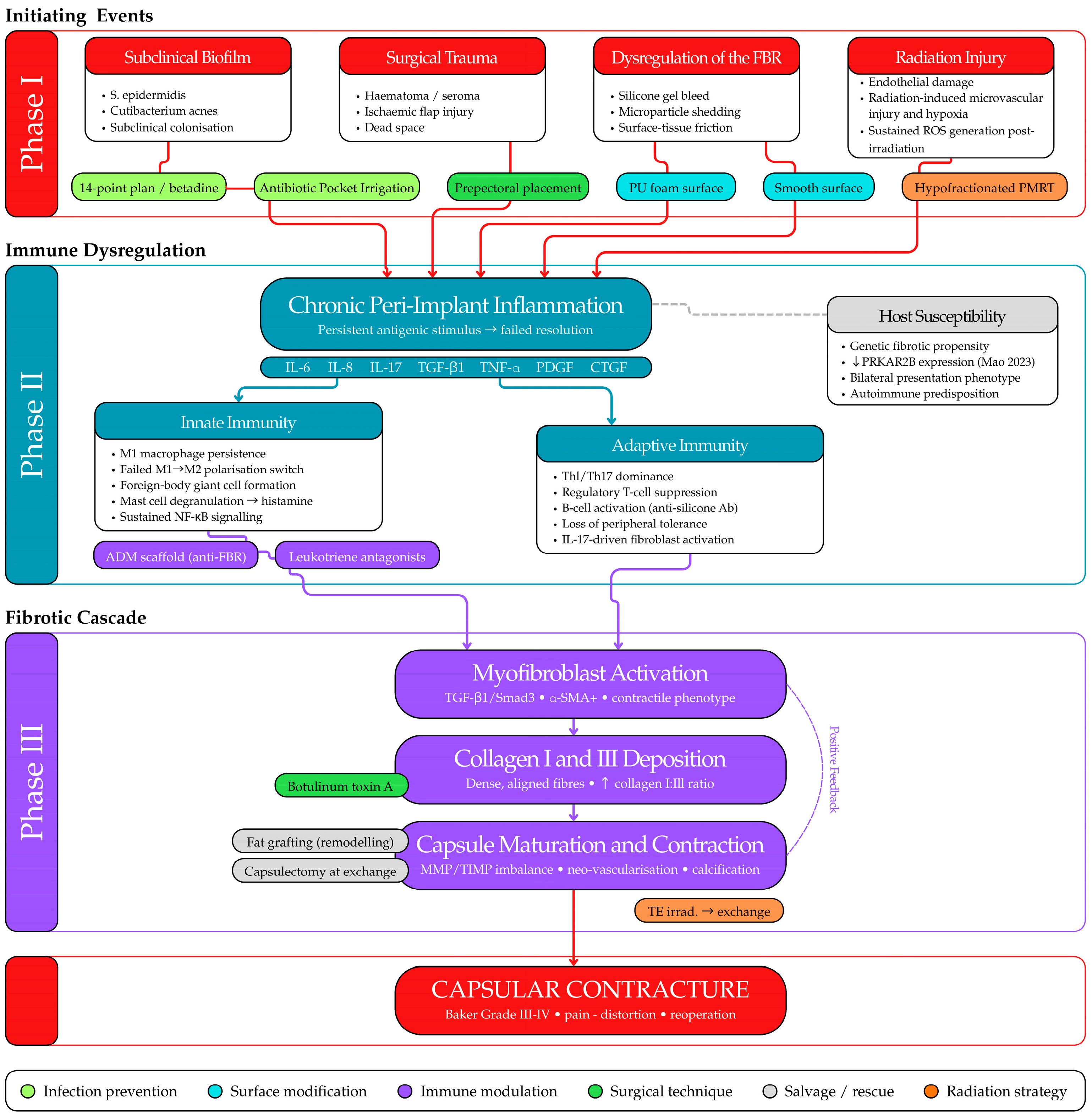
3. Pathophysiology of Capsular Contracture
3.1. The Bacterial Biofilm Hypothesis
3.2. Non-Infectious Inflammation and Foreign Body Response
3.3. Host Immune Response and Fibrotic Propensity
3.4. Radiation-Induced Fibrosis
4. Clinical Assessment and Classification
4.1. The Baker Classification
4.2. The Role of Imaging
4.3. Emerging Objective Measurement Tools
5. Implant-Related Factors and Surgical Adjuncts
5.1. Implant Surface: Smooth, Textured, and Polyurethane-Coated
5.2. Implant Filling: Silicone Versus Saline
5.3. Implant Shape: Round Versus Anatomical
5.4. Acellular Dermal Matrix: Role and Controversies
5.5. Polyurethane-Coated Implants Versus ADM-Covered Implants
6. Surgical Technique and Modifiable Factors
6.1. Mastectomy Incision Type
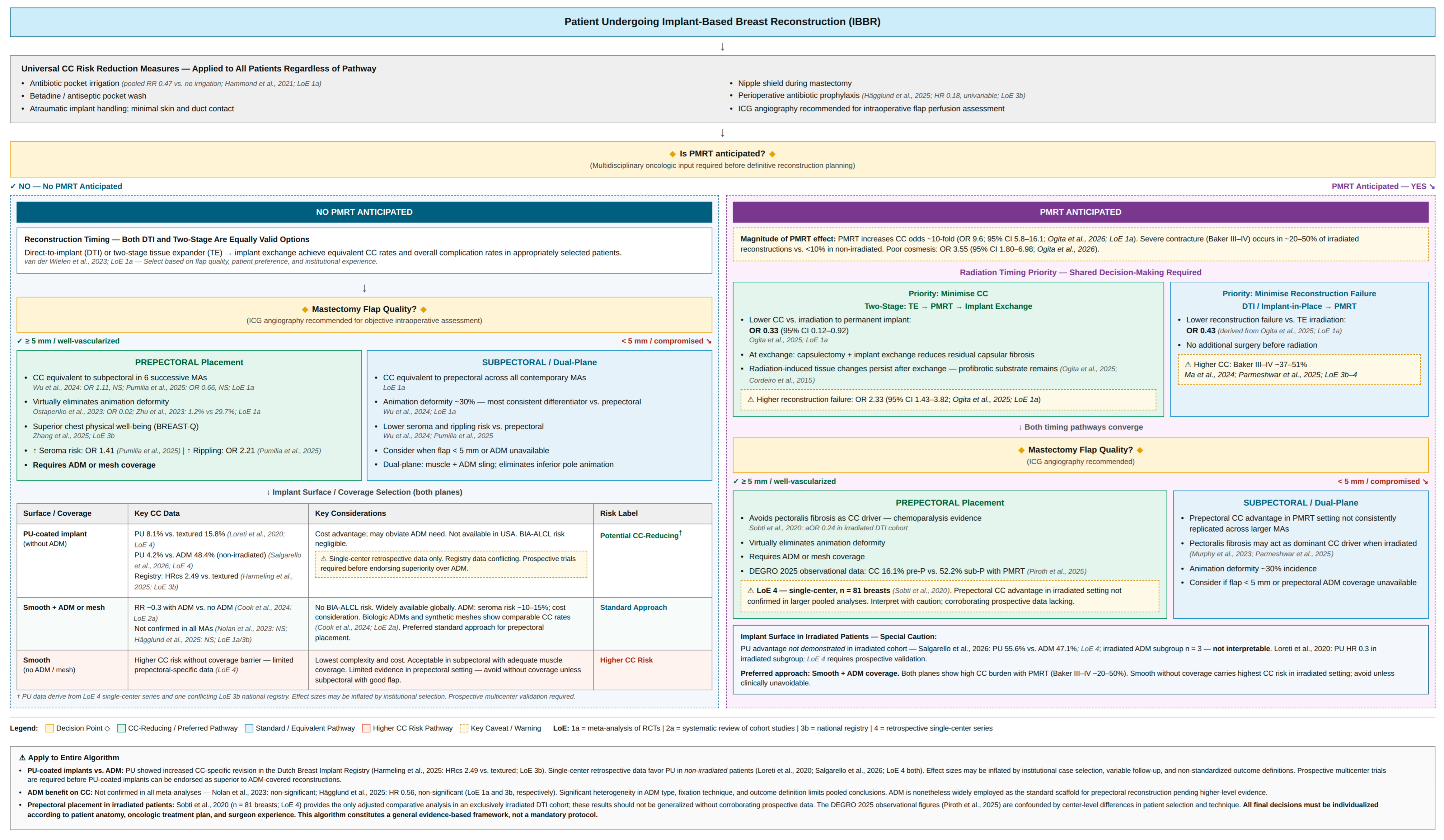
6.2. Implant Placement Plane: Prepectoral Versus Subpectoral
6.3. Direct-to-Implant Versus Two-Stage Reconstruction
6.4. Patient-Related Risk Factors
7. Radiotherapy and Capsular Contracture
7.1. The Impact of Postmastectomy Radiotherapy
7.2. Timing of Radiation: Expander Versus Implant Irradiation
7.3. Radiotherapy Fractionation and Advanced Techniques
7.4. Oncologic Therapy Interactions
8. Clinical Outcomes and Impact of Capsular Contracture
9. Management of Established Capsular Contracture
9.1. Surgical Management
9.2. Autologous Fat Grafting
9.3. Pharmacological Approaches
10. Future Directions
- Pirfenidone—this antifibrotic drug, approved by the FDA for idiopathic pulmonary fibrosis, has shown promise in both preclinical and early clinical studies. Gancedo et al. demonstrated prevention of CC in animal models by modulating TGF-β levels [94], and a subsequent controlled clinical trial by Veras-Castillo et al. showed reduction in contracture in all enrolled patients (n = 17), with effects persisting after medication discontinuation [95].
- Botulinum toxin A (BTX-A)—has been investigated for its potential to inhibit CC through multiple mechanisms: it blocks the TGF-β1/Smad signaling pathway, reduces type I and type III collagen deposition, and inhibits differentiation of fibroblasts into myofibroblasts [96]. A systematic review by Li et al. (2018) evaluated the use of BTX-A in implant-based breast surgery and concluded that it may control postoperative pain, accelerate tissue expansion, and relieve contracture deformities [96]. However, the optimal dose, injection timing, and frequency remain unquantified, and most evidence derives from small non-randomized studies. Larger randomized controlled trials and mechanistic studies are needed before BTX-A can be recommended for routine clinical use in CC prevention [96].
- Other agents—additional pharmacological strategies under investigation include COX-2 inhibitors (diclofenac dermal patches have shown benefit in Baker II–III contracture) [88], cromolyn sodium (a mast cell stabilizer that reduced inflammation and capsular thickness in animal models) [59], and statins (simvastatin has demonstrated reduction in capsular fibrosis around silicone implants in preclinical studies) [96]. While these agents offer biologically plausible mechanisms of action, none has progressed to the stage of high-quality clinical evidence sufficient to support routine use. Future clinical trials should evaluate these pharmacological approaches alongside standardized surgical management to determine their role in a multimodal prevention and treatment strategy. A comprehensive appraisal of the pharmacological evidence for each agent—including dosing protocols, safety profiles, and regulatory status—is beyond the scope of this review; the reader is referred to dedicated reviews by Gorgy et al. [59] and Meshkin et al. [88] for detailed pharmacological guidance.
11. Conclusions
Author Contributions
Funding
Institutional Review Board Statement
Data Availability Statement
Acknowledgments
Conflicts of Interest
Abbreviations
| 2,4-TDA | 2,4-Toluenediamine |
| ADM | Acellular Dermal Matrix |
| BIA-ALCL | Breast Implant–Associated Anaplastic Large-Cell Lymphoma |
| BIA-SCC | Breast Implant–Associated Squamous Cell Carcinoma |
| BMI | Body Mass Index |
| BREAST-Q | Breast Reconstruction Evaluation and Aesthetics Satisfaction Tool–Questionnaire |
| BTX-A | Botulinum Toxin A |
| CC | Capsular Contracture |
| CI | Confidence Interval |
| COX-2 | Cyclooxygenase-2 |
| CT | Computed Tomography |
| DBIR | Dutch Breast Implant Registry |
| DEGRO | Deutsche Gesellschaft für Radioonkologie (German Society for Radiation Oncology) |
| DTI | Direct-to-Implant |
| FABREC | Fractionation After Breast Reconstruction (trial) |
| FBR | Foreign Body Response |
| FDA | U.S. Food and Drug Administration |
| Gy | Gray (unit of absorbed radiation dose) |
| HR | Hazard Ratio |
| HRcs | Cause-Specific Hazard Ratio |
| IBBR | Implant-Based Breast Reconstruction |
| ICG | Indocyanine Green |
| IL-6 | Interleukin-6 |
| IL-17 | Interleukin-17 |
| IMF | Inframammary Fold |
| IMRT | Intensity-Modulated Radiation Therapy |
| ISO | International Organization for Standardization |
| LoE | Level of evidence |
| MA | Meta-Analysis |
| MPC | 2-Methacryloyloxyethyl phosphorylcholine |
| MRI | Magnetic Resonance Imaging |
| MSKCC | Memorial Sloan Kettering Cancer Center |
| NS | Non-Significant |
| NSQIP | National Surgical Quality Improvement Program |
| OR | Odds Ratio |
| PCR | Polymerase Chain Reaction |
| PDMS | Polydimethylsiloxane |
| PMRT | Postmastectomy Radiation Therapy |
| PU | Polyurethane |
| Ra | Roughness Average (surface roughness parameter) |
| RCT | Randomized Controlled Trial |
| ROS | Reactive Oxygen Species |
| RR | Relative Risk |
| RT | Radiotherapy |
| TE | Tissue Expander |
| TGF-β/-β1 | Transforming Growth Factor–Beta / –Beta 1 |
| Th17 | T Helper 17 (cell subset) |
| Treg | Regulatory T Cell |
| US | Ultrasound |
| VMAT | Volumetric Modulated Arc Therapy |
| α-SMA | α-Smooth Muscle Actin |
| κ | Kappa (Cohen’s κ; measure of interobserver agreement) |
Appendix A. Supplementary Data

| Topic | Surface Type | Data/Estimate | Source/Notes |
|---|---|---|---|
| BIA-ALCL risk | Macrotextured | 1:355–1:559 lifetime risk per implanted patient (MSKCC series). All confirmed BIA-ALCL cases globally have had a history of textured implant exposure. Risk is highest with Allergan BIOCELL (recalled globally July 2019) and Siltex devices. | [50]; FDA/WHO surveillance data. |
| Microtextured | Substantially lower than macrotextured; rare case reports only, no population-level incidence estimate established. | FDA device surveillance; [50]. | |
| Smooth | No confirmed cases in patients with exclusive smooth implant history. | FDA/WHO; [50,52]. | |
| Nanotextured (~4–6 µm) | No confirmed cases to date. Long-term surveillance data lacking; cannot exclude very low residual risk. | [60]; manufacturer registry data. | |
| PU-coated (foam) | Negligible; PU foam surface does not generate the type of particulate debris and chronic T-cell stimulation implicated in BIA-ALCL pathogenesis. No confirmed cases reported. | [48,49]; mechanistic review. | |
| BIA-SCC | Macrotextured (and textured generally) | Rare but increasingly recognized; associated with chronic seroma and implant texturing. Exact incidence unknown; case series and systematic reviews ongoing. | [51]. |
| Smooth/PU-coated | Case reports exist but no established causal link to surface type confirmed to date. | [51]. | |
| 2,4-TDA degradation (PU implants) | PU-coated | PU foam degrades in vivo over 1–2 years, releasing 2,4-toluenediamine (2,4-TDA) as a breakdown product. 2,4-TDA is classified as a probable carcinogen (IARC Group 2B) based on animal data. Urine levels of 2,4-TDA have been detected in patients with PU implants, but concentrations are extremely low (parts per trillion range) and no clinical cases of carcinogenesis attributable to PU implant degradation have been reported in over three decades of use (predominantly in Europe and South America). PU implants remain unavailable in the USA largely due to this theoretical concern. | [48,49]; European regulatory assessments. |
References
- Albornoz, C.R.; Bach, P.B.; Mehrara, B.J.; Disa, J.J.; Pusic, A.L.; McCarthy, C.M.; Cordeiro, P.G.; Matros, E. A Paradigm Shift in U.S. Breast Reconstruction: Increasing Implant Rates. Plast. Reconstr. Surg. 2013, 131, 15–23. [Google Scholar] [CrossRef]
- Kamali, P.; Paul, M.A.; Ibrahim, A.M.S.; Koolen, P.G.L.; Wu, W.; Schermerhorn, M.L.; Lee, B.T.; Lin, S.J. National and Regional Differences in 32,248 Postmastectomy Autologous Breast Reconstruction Using the Updated National Inpatient Survey. Ann. Plast. Surg. 2017, 78, 717–722. [Google Scholar] [CrossRef]
- Headon, H.; Kasem, A.; Mokbel, K. Capsular Contracture after Breast Augmentation: An Update for Clinical Practice. Arch. Plast. Surg. 2015, 42, 532–543. [Google Scholar] [CrossRef] [PubMed]
- Susini, P.; Nisi, G.; Pierazzi, D.M.; Giardino, F.R.; Pozzi, M.; Grimaldi, L.; Cuomo, R. Advances on Capsular Contracture—Prevention and Management Strategies: A Narrative Review of the Literature. Plast. Reconstr. Surg. Glob. Open 2023, 11, e5034. [Google Scholar] [CrossRef] [PubMed]
- Hammond, J.B.; Kosiorek, H.E.; Cronin, P.A.; Rebecca, A.M.; Casey, W.J.; Wong, W.W.; Vargas, C.E.; Vern-Gross, T.Z.; McGee, L.A.; Pockaj, B.A. Capsular Contracture in the Modern Era: A Multidisciplinary Look at the Incidence and Risk Factors after Mastectomy and Implant-Based Breast Reconstruction. Am. J. Surg. 2021, 221, 1005–1010. [Google Scholar] [CrossRef] [PubMed]
- Sinnott, C.J.; Persing, S.M.; Pronovost, M.; Hodyl, C.; McConnell, D.; Ott Young, A. Impact of Postmastectomy Radiation Therapy in Prepectoral Versus Subpectoral Implant-Based Breast Reconstruction. Ann. Surg. Oncol. 2018, 25, 2899–2908. [Google Scholar] [CrossRef]
- Hägglund, S.; Svensson, J.; Hansson, E.; Halle, M.; Wiberg, R. Capsular Contractures Following Implant-Based Breast Reconstruction in Women Undergoing Risk-Reducing Mastectomy: National Register-Based Study. BJS Open 2025, 9, zraf080. [Google Scholar] [CrossRef]
- Clark, A.; Shauly, O.; Sherrer, J.; Losken, A. Understanding Capsular Contracture: Mechanisms, Management, and Patient Outcomes in Implant-Based Breast Augmentation and Reconstruction. Plast. Reconstr. Surg. Glob. Open 2026, 14, e7407. [Google Scholar] [CrossRef]
- Christodoulou, N.; Secanho, M.; Kokosis, G.; Malgor, R.D.; Winocour, J.; Yu, J.W.; Mathes, D.W.; Kaoutzanis, C. Capsular Contracture in Breast Reconstruction: A Systematic Review and Meta-Analysis. J. Plast. Reconstr. Aesthet. Surg. 2024, 98, 131–143. [Google Scholar] [CrossRef]
- Harmeling, J.X.; Vrolijk, J.J.; Heeg, E.; Becherer, B.E.; Rakhorst, H.A.; Corten, E.M.L.; Fiocco, M.; Mureau, M.A.M. Comparison of Revision Surgery after Implant-Based Breast Reconstruction between Smooth, Textured, and Polyurethane-Covered Implants: Results from the Dutch Breast Implant Registry. Br. J. Surg. 2025, 112, znaf082. [Google Scholar] [CrossRef]
- Ostapenko, E.; Nixdorf, L.; Devyatko, Y.; Exner, R.; Wimmer, K.; Fitzal, F. Prepectoral Versus Subpectoral Implant-Based Breast Reconstruction: A Systemic Review and Meta-Analysis. Ann. Surg. Oncol. 2023, 30, 126–136. [Google Scholar] [CrossRef] [PubMed]
- Wu, Y.; Yu, L.; Huang, M.; Huang, Y.; Li, C.; Liang, Y.; Liang, W.; Qin, T. Comparative Complications of Prepectoral versus Subpectoral Breast Reconstruction in Patients with Breast Cancer: A Meta-Analysis. Front. Oncol. 2024, 14, 1439293. [Google Scholar] [CrossRef] [PubMed]
- Zhu, L.; Liu, C. Postoperative Complications Following Prepectoral Versus Partial Subpectoral Implant-Based Breast Reconstruction Using ADM: A Systematic Review and Meta-Analysis. Aesthet. Plast. Surg. 2023, 47, 1260–1273. [Google Scholar] [CrossRef] [PubMed]
- Nolan, I.T.; Farajzadeh, M.M.; Boyd, C.J.; Bekisz, J.M.; Gibson, E.G.; Salibian, A.A. Do We Need Acellular Dermal Matrix in Prepectoral Breast Reconstruction? A Systematic Review and Meta-Analysis. J. Plast. Reconstr. Aesthet. Surg. 2023, 86, 251–260. [Google Scholar] [CrossRef]
- Lohmander, F.; Lagergren, J.; Johansson, H.; Roy, P.G.; Brandberg, Y.; Frisell, J. Effect of Immediate Implant-Based Breast Reconstruction After Mastectomy with and Without Acellular Dermal Matrix Among Women with Breast Cancer. JAMA Netw. Open 2021, 4, e2127806. [Google Scholar] [CrossRef]
- Lohmander, F.; Lagergren, J.; Roy, P.G.; Johansson, H.; Brandberg, Y.; Eriksen, C.; Frisell, J. Implant Based Breast Reconstruction with Acellular Dermal Matrix: Safety Data from an Open-Label, Multicenter, Randomized, Controlled Trial in the Setting of Breast Cancer Treatment. Ann. Surg. 2019, 269, 836–841. [Google Scholar] [CrossRef]
- Ogita, M.; Sawayanagi, S.; Jinnouchi, H.; Yoshimura, M.; Yamauchi, C.; Sanuki, N.; Hamamoto, Y.; Hirata, K.; Kawamura, M.; Yamamoto, Y.; et al. Timing of Postmastectomy Radiation Therapy in Two-Stage Expander/Implant-Based Breast Reconstruction: A Systematic Review and Meta-Analysis for the 2022 Japanese Breast Cancer Society Clinical Practice Guideline. Breast Cancer 2025, 32, 1159–1168. [Google Scholar] [CrossRef]
- Ogita, M.; Sawayanagi, S.; Jinnouchi, H.; Yoshimura, M.; Yamauchi, C.; Sanuki, N.; Hamamoto, Y.; Hirata, K.; Kawamura, M.; Yamamoto, Y.; et al. Postmastectomy Radiation Therapy for Autologous Breast Reconstruction: A Systematic Review and Meta-Analysis for the 2022 Japanese Breast Cancer Society Clinical Practice Guideline. Breast Cancer 2026, 33, 1–9. [Google Scholar] [CrossRef]
- Van der Wielen, A.; Negenborn, V.; Burchell, G.L.; Remmelzwaal, S.; Lapid, O.; Driessen, C. Less Is More? One-Stage versus Two-Stage Implant-Based Breast Reconstruction: A Systematic Review and Meta-Analysis of Comparative Studies. J. Plast. Reconstr. Aesthet. Surg. 2023, 86, 109–127. [Google Scholar] [CrossRef]
- Cordeiro, P.G.; Albornoz, C.R.; McCormick, B.; Hudis, C.A.; Hu, Q.; Heerdt, A.; Matros, E. What Is the Optimum Timing of Postmastectomy Radiotherapy in Two-Stage Prosthetic Reconstruction: Radiation to the Tissue Expander or Permanent Implant? Plast. Reconstr. Surg. 2015, 135, 1509. [Google Scholar] [CrossRef]
- de Bakker, E.; Rots, M.; Buncamper, M.E.; Niessen, F.B.; Smit, J.M.; Winters, H.A.H.; Özer, M.; de Vet, H.C.W.; Mullender, M.G. The Baker Classification for Capsular Contracture in Breast Implant Surgery Is Unreliable as a Diagnostic Tool. Plast. Reconstr. Surg. 2020, 146, 956. [Google Scholar] [CrossRef] [PubMed]
- Malahias, M.; Jordan, D.J.; Hughes, L.C.; Hindocha, S.; Juma, A. A Literature Review and Summary of Capsular Contracture: An Ongoing Challenge to Breast Surgeons and Their Patients. Int. J. Surg. Open 2016, 3, 1–7. [Google Scholar] [CrossRef]
- Ajdic, D.; Zoghbi, Y.; Gerth, D.; Panthaki, Z.J.; Thaller, S. The Relationship of Bacterial Biofilms and Capsular Contracture in Breast Implants. Aesthet. Surg. J. 2016, 36, 297–309. [Google Scholar] [CrossRef] [PubMed]
- Virden, C.P.; Dobke, M.K.; Stein, P.; Lowell Parsons, C.; Frank, D.H. Subclinical Infection of the Silicone Breast Implant Surface as a Possible Cause of Capsular Contracture. Aesthet. Plast. Surg. 2020, 44, 1141–1147. [Google Scholar] [CrossRef]
- Galdiero, M.; Larocca, F.; Iovene, M.R.; Francesca, M.; Pieretti, G.; D’Oriano, V.; Franci, G.; Ferraro, G.; d’Andrea, F.; Nicoletti, G.F. Microbial Evaluation in Capsular Contracture of Breast Implants. Plast. Reconstr. Surg. 2018, 141, 23. [Google Scholar] [CrossRef]
- Bachour, Y.; Poort, L.; Verweij, S.P.; van Selms, G.; Winters, H.A.H.; Ritt, M.J.P.F.; Niessen, F.B.; Budding, A.E. PCR Characterization of Microbiota on Contracted and Non-Contracted Breast Capsules. Aesthet. Plast. Surg. 2019, 43, 918–926. [Google Scholar] [CrossRef]
- Park, T.H.; Kim, M.-J.; Lee, Y.; Lee, J.S.; Lee, J.; Park, H.Y.; Shin, J.-H.; Yang, J.D. Comparative Microbiome Analysis of Contracted Breast Capsules: A Cross-Sectional Study. BMC Microbiol. 2025, 25, 379. [Google Scholar] [CrossRef]
- Wixtrom, R.N.; Stutman, R.L.; Burke, R.M.; Mahoney, A.K.; Codner, M.A. Risk of Breast Implant Bacterial Contamination from Endogenous Breast Flora, Prevention with Nipple Shields, and Implications for Biofilm Formation. Aesthet. Surg. J. 2012, 32, 956–963. [Google Scholar] [CrossRef]
- Adams, W.P.J.; Culbertson, E.J.; Deva, A.K.; Magnusson, M.R.; Layt, C.; Jewell, M.L.; Mallucci, P.; Hedén, P. Macrotextured Breast Implants with Defined Steps to Minimize Bacterial Contamination around the Device: Experience in 42,000 Implants. Plast. Reconstr. Surg. 2017, 140, 427. [Google Scholar] [CrossRef]
- Wiener, T.C. Relationship of Incision Choice to Capsular Contracture. Aesthet. Plast. Surg. 2008, 32, 303–306. [Google Scholar] [CrossRef]
- Moyer, H.R.; Ghazi, B.H.; Losken, A. The Effect of Silicone Gel Bleed on Capsular Contracture: A Generational Study. Plast. Reconstr. Surg. 2012, 130, 793–800. [Google Scholar] [CrossRef]
- Safran, T.; Nepon, H.; Chu, C.K.; Winocour, S.; Murphy, A.M.; Davison, P.G.; Dionisopolos, T.; Vorstenbosch, J. Current Concepts in Capsular Contracture: Pathophysiology, Prevention, and Management. Semin. Plast. Surg. 2021, 35, 189–197. [Google Scholar] [CrossRef]
- Barnsley, G.P.; Sigurdson, L.J.; Barnsley, S.E. Textured Surface Breast Implants in the Prevention of Capsular Contracture among Breast Augmentation Patients: A Meta-Analysis of Randomized Controlled Trials. Plast. Reconstr. Surg. 2006, 117, 2182–2190. [Google Scholar] [CrossRef]
- Chung, L.; Maestas, D.R.; Lebid, A.; Mageau, A.; Rosson, G.D.; Wu, X.; Wolf, M.T.; Tam, A.J.; Vanderzee, I.; Wang, X.; et al. Interleukin 17 and Senescent Cells Regulate the Foreign Body Response to Synthetic Material Implants in Mice and Humans. Sci. Transl. Med. 2020, 12, eaax3799. [Google Scholar] [CrossRef] [PubMed]
- Wolfram, D.; Rabensteiner, E.; Grundtman, C.; Böck, G.; Mayerl, C.; Parson, W.; Almanzar, G.; Hasenöhrl, C.; Piza-Katzer, H.; Wick, G. T Regulatory Cells and TH17 Cells in Peri-Silicone Implant Capsular Fibrosis. Plast. Reconstr. Surg. 2012, 129, 327e–337e. [Google Scholar] [CrossRef] [PubMed]
- Mao, Y.; Hou, X.; Fu, S.; Luan, J. Transcriptomic and Machine Learning Analyses Identify Hub Genes of Metabolism and Host Immune Response That Are Associated with the Progression of Breast Capsular Contracture. Genes. Dis. 2024, 11, 101087. [Google Scholar] [CrossRef]
- Larsen, A.; Rasmussen, L.E.; Rasmussen, L.F.; Weltz, T.K.; Hemmingsen, M.N.; Poulsen, S.S.; Jacobsen, J.C.B.; Vester-Glowinski, P.; Herly, M. Histological Analyses of Capsular Contracture and Associated Risk Factors: A Systematic Review. Aesthet. Plast. Surg. 2021, 45, 2714–2728. [Google Scholar] [CrossRef] [PubMed]
- Piroth, M.D.; Krug, D.; Baumann, R.; Strnad, V.; Borm, K.; Combs, S.; Corradini, S.; Duma, M.N.; Dunst, J.; Fastner, G.; et al. Implant-Based Reconstruction and Adjuvant Radiotherapy in Breast Cancer Patients—Current Status and DEGRO Recommendations. Strahlenther. Onkol. 2025, 201, 353–367. [Google Scholar] [CrossRef]
- Baker, J.L., Jr. Augmentation Mammaplasty. In Symposium on Aesthetic Surgery of the Breast; Owsley, J.Q., Jr., Peterson, R.A., Eds.; Mosby: St. Louis, MO, USA, 1978; pp. 256–263. [Google Scholar]
- Spear, S.L.; Baker, J.L., Jr. Classification of Capsular Contracture after Prosthetic Breast Reconstruction. Plast. Reconstr. Surg. 1995, 96, 1119–1123. [Google Scholar] [CrossRef]
- Kim, J.H.; Nam, S.E.; Sung, J.Y.; Song, K.Y.; Bang, B.S.; Lee, E.K. The Value of Capsule Thickness on Breast Ultrasound as an Indicator of the Severity of Capsular Contracture and Its Correlation with the Baker Classification. Aesthet. Plast. Surg. 2022, 46, 621–629. [Google Scholar] [CrossRef] [PubMed]
- U.S. Food and Drug Administration. Update on the Safety of Silicone Gel-Filled Breast Implants (2011)—Executive Summary. Available online: https://www.fda.gov/medical-devices/breast-implants/update-safety-silicone-gel-filled-breast-implants-2011-executive-summary (accessed on 21 February 2026).
- Mohan, A.S.; Sullivan, J.; Tenenbaum, M.M.; Broderick, K.B.; Myckatyn, T.M. Toward a Consensus Approach for Assessing Capsular Contracture Severity and Progression: A Systematic Review. Plast. Reconstr. Surg. 2024, 153, 7. [Google Scholar] [CrossRef]
- Oh, W.S.; Lee, S.H.; Lee, J.W.; Seo, J.Y.; Kim, C.R.; Nam, S.B. Assessment of Capsular Contracture Based on Morphological Change of Breast Implant Using Computed Tomography. Arch. Plast. Surg. 2025, 52, 217–224. [Google Scholar] [CrossRef] [PubMed]
- Secasan, C.C.; Onchis, D.; Bardan, R.; Cumpanas, A.; Novacescu, D.; Botoca, C.; Dema, A.; Sporea, I. Artificial Intelligence System for Predicting Prostate Cancer Lesions from Shear Wave Elastography Measurements. Curr. Oncol. 2022, 29, 4212–4223. [Google Scholar] [CrossRef] [PubMed]
- Pasecinic, V.; Novacescu, D.; Zara, F.; Dumitru, C.-S.; Dema, V.; Latcu, S.; Bardan, R.; Cumpanas, A.A.; Dumache, R.; Cut, T.G.; et al. Predictors of ISUP Grade Group Discrepancies Between Biopsy and Radical Prostatectomy: A Single-Center Analysis of Clinical, Imaging, and Histopathological Parameters. Cancers 2025, 17, 2595. [Google Scholar] [CrossRef]
- Nesiu, A.; Novacescu, D.; Latcu, S.; Bardan, R.; Cumpanas, A.; Zara, F.; Buciu, V.; Caprariu, R.; Cut, T.G.; Stana, A.H. Diagnostic Performance and Interobserver Agreement of the Vesical Imaging–Reporting and Data System (VI-RADS) in Bladder Cancer Staging: A Systematic Review. Medicina 2025, 61, 469. [Google Scholar] [CrossRef]
- Duxbury, P.J.; Harvey, J.R. Systematic Review of the Effectiveness of Polyurethane-Coated Compared with Textured Silicone Implants in Breast Surgery. J. Plast. Reconstr. Aesthet. Surg. 2016, 69, 452–460. [Google Scholar] [CrossRef]
- Pompei, S.; Arelli, F.; Labardi, L.; Marcasciano, F.; Evangelidou, D.; Ferrante, G. Polyurethane Implants in 2-Stage Breast Reconstruction: 9-Year Clinical Experience. Aesthet. Surg. J. 2017, 37, 171–176. [Google Scholar] [CrossRef]
- Doren, E.L.; Miranda, R.N.; Selber, J.C.; Garvey, P.B.; Liu, J.; Medeiros, L.J.; Butler, C.E.; Clemens, M.W.U.S. Epidemiology of Breast Implant-Associated Anaplastic Large Cell Lymphoma. Plast. Reconstr. Surg. 2017, 139, 1042–1050. [Google Scholar] [CrossRef]
- Niraula, S.; Katel, A.; Barua, A.; Weiss, A.; Strawderman, M.S.; Zhang, H.; Manrique, O.; O’Connell, A.; Pandey, S.R.; Dhakal, A. A Systematic Review of Breast Implant-Associated Squamous Cell Carcinoma. Cancers 2023, 15, 4516. [Google Scholar] [CrossRef]
- Frey, J.D.; Salibian, A.A.; Karp, N.S.; Choi, M. Implant-Based Breast Reconstruction: Hot Topics, Controversies, and New Directions. Plast. Reconstr. Surg. 2019, 143, 404e–416e. [Google Scholar] [CrossRef]
- Loreti, A.; Siri, G.; De Carli, M.; Fanelli, B.; Arelli, F.; Spallone, D.; Abate, O.; La Pinta, M.; Manna, E.; Meli, E.Z.; et al. Immediate Breast Reconstruction after Mastectomy with Polyurethane Implants versus Textured Implants: A Retrospective Study with Focus on Capsular Contracture. Breast 2020, 54, 127–132. [Google Scholar] [CrossRef]
- Salgarello, M.; Barbera, M.; Visconti, G.; Scardina, L.; Franceschini, G.; Di Leone, A.; Barone Adesi, L.; Lentini, N.; Pastorino, R. Prepectoral Breast Reconstruction: Early and Long-Term Complications and Outcomes of Total Coverage Acellular Dermal Matrix and Implants Vs Polyurethane-Coated Implants Without Use of Acellular Dermal Matrix. Aesthet. Surg. J. 2026, 46, 38–48. [Google Scholar] [CrossRef]
- Haas, E.; Christodoulou, N.; Secanho, M.; Kokosis, G.; Malgor, R.D.; Winocour, J.; Yu, J.W.; Mathes, D.W.; Kaoutzanis, C. Capsular Contracture After Breast Augmentation: A Systematic Review and Meta-Analysis. Aesthet. Surg. J. Open Forum 2025, 7, ojaf003. [Google Scholar] [CrossRef] [PubMed]
- Tanner, B. Low Rate of Capsular Contracture in a Series of 214 Consecutive Primary and Revision Breast Augmentations Using Microtextured Implants. JPRAS Open 2018, 15, 66–73. [Google Scholar] [CrossRef] [PubMed]
- Luvsannyam, E.; Patel, D.; Hassan, Z.; Nukala, S.; Somagutta, M.R.; Hamid, P. Overview of Risk Factors and Prevention of Capsular Contracture Following Implant-Based Breast Reconstruction and Cosmetic Surgery: A Systematic Review. Cureus 2020, 12, e10341. [Google Scholar] [CrossRef]
- Han, S.-E.; Lee, K.-T.; Bang, S. Comprehensive Comparison Between Shaped Versus Round Implants for Breast Reconstruction: A Systematic Review and Meta-Analysis. Aesthet. Surg. J. 2021, 41, 34–44. [Google Scholar] [CrossRef] [PubMed]
- Gorgy, A.; Barone, N.; Nepon, H.; Dalfen, J.; Efanov, J.I.; Davison, P.; Vorstenbosch, J. Implant-Based Breast Surgery and Capsular Formation: When, How and Why?—A Narrative Review. Ann. Transl. Med. 2023, 11, 385. [Google Scholar] [CrossRef]
- Catic, A.; Weinzierl, A.; Heimer, J.; Pompei, B.; Harder, Y. Smooth Operator: Nanotextured Breast Tissue Expanders Are Associated with Lower Rates of Capsular Contracture. J. Clin. Med. 2024, 13, 5803. [Google Scholar] [CrossRef]
- Kidd, T.; Mccabe, G.; Tait, J.; Kulkarni, D. Implant Reconstruction after Mastectomy–A Review and Summary of Current Literature. Cancer Treat. Res. Commun. 2024, 40, 100821. [Google Scholar] [CrossRef]
- Khavanin, N.; Clemens, M.W.; Pusic, A.L.; Fine, N.A.; Hamill, J.B.; Kim, H.M.; Qi, J.; Wilkins, E.G.; Kim, J.Y.S. Shaped versus Round Implants in Breast Reconstruction: A Multi-Institutional Comparison of Surgical and Patient-Reported Outcomes. Plast. Reconstr. Surg. 2017, 139, 1063. [Google Scholar] [CrossRef]
- Cook, H.I.; Glynou, S.P.; Sousi, S.; Zargaran, D.; Hamilton, S.; Mosahebi, A. Does the Use of Acellular Dermal Matrices (ADM) in Women Undergoing Pre-Pectoral Implant-Based Breast Reconstruction Increase Operative Success versus Non-Use of ADM in the Same Setting? A Systematic Review. BMC Cancer 2024, 24, 1186. [Google Scholar] [CrossRef] [PubMed]
- Sobti, N.; Weitzman, R.E.; Nealon, K.P.; Jimenez, R.B.; Gfrerer, L.; Mattos, D.; Ehrlichman, R.J.; Gadd, M.; Specht, M.; Austen, W.G.; et al. Evaluation of Capsular Contracture Following Immediate Prepectoral versus Subpectoral Direct-to-Implant Breast Reconstruction. Sci. Rep. 2020, 10, 1137. [Google Scholar] [CrossRef] [PubMed]
- Barber, A.; Ramamurthi, A.; Ebert, M.; Rodriguez-Unda, N. Revisiting Low Complications of VICRYL Mesh in Breast Reconstruction: Insights from an Updated Systematic Review. JPRAS Open 2025, 44, 354–363. [Google Scholar] [CrossRef] [PubMed]
- Zhang, T.; Ye, J.; Tian, T. Implant Based Breast Reconstruction Using a Titanium-Coated Polypropylene Mesh (TiLOOP® Bra): A Systematic Review and Meta-Analysis. Aesthet. Plast. Surg. 2024, 48, 925–935. [Google Scholar] [CrossRef]
- Murphy, D.; O’Donnell, J.P.; Ryan, É.J.; Lane O’Neill, B.; Boland, M.R.; Lowery, A.J.; Kerin, M.J.; McInerney, N.M. Immediate Breast Cancer Reconstruction with or without Dermal Matrix or Synthetic Mesh Support: A Review and Network Meta-Analysis. Plast. Reconstr. Surg. 2023, 151, 563e–574e. [Google Scholar] [CrossRef]
- Li, Y.; Xu, G.; Yu, N.; Huang, J.; Long, X. Prepectoral Versus Subpectoral Implant-Based Breast Reconstruction: A Meta-Analysis. Ann. Plast. Surg. 2020, 85, 437–447. [Google Scholar] [CrossRef]
- Pumilia, A.; Le, P.B.; Bian, J.; Becker, M.E.; Friedman, H.I. Implant-Based Breast Reconstruction—A Systematic Review and Meta-Analysis of Prepectoral versus Submuscular Implant Placement. Ann. Breast Surg. 2025, 9, 11. [Google Scholar] [CrossRef]
- Parmeshwar, N.; Knox, J.A.; Piper, M.L. Evaluation of Pre-Pectoral Direct-to-Implant Breast Reconstruction with Post-Mastectomy Radiation: A Systematic Review and Meta-Analysis. J. Clin. Med. 2025, 14, 5004. [Google Scholar] [CrossRef]
- Nolan, I.T.; Farajzadeh, M.M.; Bekisz, J.M.; Boyd, C.J.; Gibson, E.G.; Salibian, A.A. Prepectoral versus Subpectoral Breast Reconstruction after Nipple-Sparing Mastectomy: A Systematic Review and Meta-Analysis. Plast. Reconstr. Surg. Glob. Open 2024, 12, e5808. [Google Scholar] [CrossRef]
- Zhang, J.; An, R.; Yu, Z.-H.; Zhang, L. Comparison of Outcomes Following Prepectoral and Subpectoral Implants for Breast Reconstruction in Patients with Breast Cancer. Front. Oncol. 2025, 14, 1499710. [Google Scholar] [CrossRef]
- Li, S.; Mu, D.; Liu, C.; Xin, M.; Fu, S.; Xu, B.; Li, Z.; Qi, J.; Luan, J. Complications Following Subpectoral Versus Prepectoral Breast Augmentation: A Meta-Analysis. Aesthet. Plast. Surg. 2019, 43, 890–898. [Google Scholar] [CrossRef]
- Ali, A.; Picado, O.; Mathew, P.J.; Ovadia, S.; Thaller, S.R. Risk Factors for Capsular Contracture in Alloplastic Reconstructive and Augmentation Mammaplasty: Analysis of the National Surgical Quality Improvement Program (NSQIP) Database. Aesthet. Plast. Surg. 2023, 47, 1678–1682. [Google Scholar] [CrossRef] [PubMed]
- Awadeen, A.; Fareed, M.; Elameen, A.M. The Impact of Postmastectomy Radiation Therapy on the Outcomes of Prepectoral Implant-Based Breast Reconstruction: A Systematic Review and Meta-Analysis. Aesthet. Plast. Surg. 2023, 47, 81–91. [Google Scholar] [CrossRef] [PubMed]
- Ma, T.; Ma, T.; Li, X.; Sun, X.; Cao, W.; Niu, Z.; Wang, H. Complications and Patient-Reported Outcomes after Radiotherapy in Breast Cancer Patients Undergoing Implant-Based Breast Reconstruction: A Retrospective Study from a Large Chinese Breast Disease Center. World J. Surg. Oncol. 2024, 22, 347. [Google Scholar] [CrossRef] [PubMed]
- Iwahira, Y.; Nakagami, G.; Morita, K.; Sanada, H. Effect of Radiation Timing on the Capsular Contracture of Implant-Based Breast Reconstruction: A Retrospective Cohort Study. Medicine 2025, 104, e41438. [Google Scholar] [CrossRef]
- Campbell, A.R.; Didier, A.J.; Sheikh, T.M.; Ansari, S.; Watkins, D.E.; Fahoury, A.M.; Nandwani, S.V.; Rashid, M. The Effects of Radiotherapy on the Sequence and Eligibility of Breast Reconstruction: Current Evidence and Controversy. Cancers 2024, 16, 2939. [Google Scholar] [CrossRef]
- Falick Michaeli, T.; Hatoom, F.; Skripai, A.; Wajnryt, E.; Allweis, T.M.; Paluch-Shimon, S.; Shachar, Y.; Popovtzer, A.; Wygoda, M.; Blumenfeld, P. Complication Rates After Mastectomy and Reconstruction in Breast Cancer Patients Treated with Hypofractionated Radiation Therapy Compared to Conventional Fractionation: A Single Institutional Analysis. Cancers 2025, 17, 106. [Google Scholar] [CrossRef]
- Wong, J.S.; Uno, H.; Tramontano, A.C.; Fisher, L.; Pellegrini, C.V.; Abel, G.A.; Burstein, H.J.; Chun, Y.S.; King, T.A.; Schrag, D.; et al. Hypofractionated vs Conventionally Fractionated Postmastectomy Radiation After Implant-Based Reconstruction. JAMA Oncol. 2024, 10, 1370–1378. [Google Scholar] [CrossRef]
- Zhang, Y.; Ye, F.; Teng, Y.; Zheng, J.; Li, C.; Ma, R.; Zhang, H. Radiotherapy Dosimetry and Radiotherapy Related Complications of Immediate Implant-Based Reconstruction after Breast Cancer Surgery. Front. Oncol. 2023, 13, 1207896. [Google Scholar] [CrossRef]
- Gao, R.W.; Harmsen, W.S.; Smith, N.L.; Mullikin, T.C.; Amundson, A.C.; Abraha, F.; Gergelis, K.G.; Afzal, A.; Harless, C.A.; Vijayasekaran, A.; et al. Immediate 2-Stage Breast Reconstruction Outcomes after Proton or Photon Postmastectomy Radiotherapy. Clin. Transl. Radiat. Oncol. 2025, 54, 101015. [Google Scholar] [CrossRef]
- Li, D.-D.; Lan, N.; Zhao, P.; Tang, Y.-Y. Advances in Etiology and Prevention of Capsular Contracture After Breast Implantation. Aesthet. Plast. Surg. 2025, 49, 1915–1926. [Google Scholar] [CrossRef] [PubMed]
- Christensen, B.O.; Overgaard, J.; Kettner, L.O.; Damsgaard, T.E. Long-Term Evaluation of Postmastectomy Breast Reconstruction. Acta Oncol. 2011, 50, 1053–1061. [Google Scholar] [CrossRef] [PubMed]
- Bascone, C.M.; McGraw, J.R.; Couto, J.A.; Sulkar, R.S.; Broach, R.B.; Butler, P.D.; Kovach, S.J.I. Exploring Factors Associated with Implant Removal Satisfaction in Breast Implant Illness Patients: A PRO BREAST-Q Study. Plast. Reconstr. Surg. Glob. Open 2023, 11, e5273. [Google Scholar] [CrossRef] [PubMed]
- Ibraheem, M.H.; Essawy, O.M.M.; Moaz, I.; Osman, Z.S.M.; Omara, Y.S.; Farouk, A.; Amin, A.; Elzohery, Y.H.A.M.; Awad, M.G.A. Single Stage Direct -to- Implant Breast Reconstruction Following Mastectomy (The Use of Ultrapro® Mesh). World J. Surg. Oncol. 2024, 22, 297. [Google Scholar] [CrossRef] [PubMed]
- Basta, M.N.; Gerety, P.A.; Serletti, J.M.; Kovach, S.J.; Fischer, J.P. A Systematic Review and Head-to-Head Meta-Analysis of Outcomes Following Direct-to-Implant versus Conventional Two-Stage Implant Reconstruction. Plast. Reconstr. Surg. 2015, 136, 1135. [Google Scholar] [CrossRef]
- Meshkin, D.H.; Firriolo, J.M.; Karp, N.S.; Salibian, A.A. Management of Complications Following Implant-Based Breast Reconstruction: A Narrative Review. Ann. Transl. Med. 2023, 11, 416. [Google Scholar] [CrossRef]
- Seth, A.K.; Cordeiro, P.G. Stability of Long-Term Outcomes in Implant-Based Breast Reconstruction: An Evaluation of 12-Year Surgeon- and Patient-Reported Outcomes in 3489 Nonirradiated and Irradiated Implants. Plast. Reconstr. Surg. 2020, 146, 474. [Google Scholar] [CrossRef]
- Wan, D.; Rohrich, R.J. Revisiting the Management of Capsular Contracture in Breast Augmentation: A Systematic Review. Plast. Reconstr. Surg. 2016, 137, 826. [Google Scholar] [CrossRef]
- Hidalgo, D.A.; Weinstein, A.L. Surgical Treatment for Capsular Contracture: A New Paradigm and Algorithm. Plast. Reconstr. Surg. 2020, 146, 516–525. [Google Scholar] [CrossRef]
- Papadopoulos, S.; Vidovic, G.; Neid, M.; Abdallah, A. Using Fat Grafting to Treat Breast Implant Capsular Contracture. Plast. Reconstr. Surg. Glob. Open 2018, 6, e1969. [Google Scholar] [CrossRef]
- Wang, Y.; Tian, J.; Liu, J. Suppressive Effect of Leukotriene Antagonists on Capsular Contracture in Patients Who Underwent Breast Surgery with Prosthesis: A Meta-Analysis. Plast. Reconstr. Surg. 2020, 145, 901–911. [Google Scholar] [CrossRef]
- Gancedo, M.; Ruiz-Corro, L.; Salazar-Montes, A.; Rincón, A.R.; Armendáriz-Borunda, J. Pirfenidone Prevents Capsular Contracture after Mammary Implantation. Aesthet. Plast. Surg. 2008, 32, 32–40. [Google Scholar] [CrossRef]
- Veras-Castillo, E.R.; Cardenas-Camarena, L.; Lyra-Gonzalez, I.; Muñoz-Valle, J.F.; Lucano-Landeros, S.; Guerrerosantos, J.; Gonzalez-Ulloa, B.; Mercado-Barajas, J.L.; Sanchez-Parada, M.G.; Azabache-Wennceslao, R.; et al. Controlled Clinical Trial with Pirfenidone in the Treatment of Breast Capsular Contracture: Association of TGF-β Polymorphisms. Ann. Plast. Surg. 2013, 70, 16–22. [Google Scholar] [CrossRef]
- Li, T.; Liu, Y.; Zhang, W. Botulinum Toxin A Plays an Important Role in the Placement of Implants Deep Within the Pectoralis Major Muscle for Mammaplasty: A Systematic Review and Meta-Analysis. Aesthet. Plast. Surg. 2018, 42, 1519–1530. [Google Scholar] [CrossRef]


| Grade | Clinical Findings | Description |
|---|---|---|
| IA | Soft, natural feel. | The augmented/reconstructed breast feels as soft as an unoperated breast; implant not palpable. |
| IB | Implant palpable, no firmness. | Breast slightly firmer; implant palpable but not visible; no deformity. |
| II | Mild firmness. | Breast somewhat firm; implant palpable and possibly visible; no symptoms. |
| III | Moderate firmness, deformity. | Breast firm; implant easily palpable and often visible; breast distortion present; may or may not have discomfort. |
| IV | Hard, painful, deformed. | Breast hard, tender, and cold to touch; marked distortion and displacement; pain common. |
| Surface Type ([Ra] Range) | Tissue–Implant Interaction | CC Rate in Reconstruction | Key Considerations |
|---|---|---|---|
| Smooth (<10 µm) | Polished shell; minimal tissue adherence. Fibroblasts align parallel to implant surface in planar arrangement, facilitating circumferential contraction. |
| |
| Microtxd. (10–50 µm) | Fine surface irregularities; moderate tissue ingrowth. Disrupts planar fibroblast alignment while limiting bacterial colonization surface area. |
|
|
| Macrotxd. (>50 µm) | Deep, aggressive surface architecture; strong tissue ingrowth via mechanical interlock. Disrupts circumferential collagen orientation, but ↑ surface area = ↑ biofilm vulnerability. |
| |
| Nanotextured (~4–6 µm) | Fine-scale surface nanopatterning; promotes controlled cellular adhesion without deep tissue ingrowth. Intermediate interaction between smooth and conventional texturing. |
|
|
| PU-coated (N/A; foam coating) | PU foam gradually degrades in vivo over 1–2 years, promoting disorganized collagen deposition. Creates “double capsule” (inner PU remnant + outer fibrotic layer), preventing circumferential alignment. |
|
| Study | Design (N; Follow-Up) | Comparator | Plane | PMRT Rate | CC Rate: PU vs. Comparator | Key Findings | Limitations |
|---|---|---|---|---|---|---|---|
| Loreti et al. 2020 [53] | Retrospective, single-center; 358 breasts DTI; median 2.3-year follow-up. | Textured | Mixed (sub-P + pre-P) | NR (high—strongest predictor). | Overall, Baker III–IV (clinical): PU (8.1%) vs. Textured (15.8%); p = 0.009. | PU HR 0.3 vs. textured (p = 0.003); PMRT strongest predictor (HR 12.5); PU advantage amplified in irradiated patients. | LoE 4. PMRT rate NR. Mixed placement planes. No ADM comparator arm. |
| Salgarello et al. 2025 [54] | Retrospective, single-center, 135 breasts DTI; 5-year follow-up. | ADM + Textured | Pre-P (both groups) | 26.7% overall | Overall, Baker III–IV (clinical): PU—24.3% vs. ADM—47.7%; p < 0.001. | PU: lower seroma (2.9% vs. 33.8%, p < 0.001); superior symmetry and global aesthetic scores. ADM: lower rippling and implant visibility. | LoE 4. Non-randomized. |
| Non-irradiated: 4.2% vs. 48.4%; Irradiated: 55.6% vs. 47.1%. | PU advantage driven entirely by non-irradiated subgroup; no meaningful difference in irradiated patients. | Very small irradiated subgroup; conclusions on irradiated patients are unreliable. | |||||
| Harmeling et al. 2025 [10] (DBIR) | National registry, 3996 implants; Post-mastectomy reconstructions; 4-year follow-up. | Textured (mainly) + Smooth | Mixed (sub-P + pre-P) | 8.6% (low) | Revision-requiring CC only: PU—5.1% vs. Textured—2.4% vs. Smooth—4.7%. | Overall adjusted: HRcs = 1.08 (95% CI 0.51–2.29, NS). CC-specific subgroup: HRcs = 2.49 (PU vs. textured, p < 0.05). | LoE 3b. Captures only revision-requiring CC—substantially underestimates true Baker III–IV incidence. Low PMRT rate (8.6%) limits applicability to oncologic population. Macrotextured device dominant comparator in NL. |
| Pompei et al. 2017 [49] | Retrospective, single-center, 228 breasts; Two-stage PU reconstructions; 9-year follow-up. | None (PU-only series) | NR | NR | Baker III–IV (clinical): 1.8% (PU only). | Lowest reported CC rate for any PU series. Long follow-up (9 years) is a methodological strength. | LoE 4. No comparator arm; data are descriptive only. Two-stage approach may contribute to low CC rate independently of surface type. |
| Study | Comparison | Effect Size (OR/RR/HR) | Key Finding |
|---|---|---|---|
| Implant Surface and Fill | |||
| Christodoulou 2024 [9] | Smooth vs. textured (23 studies) | OR 0.99 p = 0.97 | No CC difference between implant surfaces in the reconstruction setting; parity may be confounded by concurrent ADM use. |
| Saline vs. silicone (23 studies) | OR 0.19 95% CI: 0.08–0.43 | 81% lower CC odds with saline; based on only 2 reconstruction studies with limited power. Not replicated in augmentation data *. | |
| Barnsley et al. 2006 [33] | Textured vs. smooth (augmentation; meta-analysis of RCTs) | Pooled OR 0.19; 95% CI 0.07–0.52 | Textured implants significantly reduce CC vs. smooth in augmentation; effect not replicated in reconstruction setting [9], likely confounded by ADM use. Included for mechanistic context only †. |
| Implant Placement Plane | |||
| Li et al. 2020 [68] | Prepectoral vs. subpectoral (15 studies; 1868 patients) | OR 0.45 95% CI: 0.27–0.73 | Earliest MA to report significant CC advantage for prepectoral; not replicated in subsequent larger analyses. |
| Ostapenko et al. 2023 [11] | Prepectoral vs. subpectoral (15 studies; 3101 patients) | OR 0.54 95% CI: 0.32–0.92 | PP significantly lower CC (10 studies; I2 = 53%); also, lower prosthesis failure (OR 0.61) and animation deformity (OR 0.02). Mean follow-up 19 months; no ADM stratification. |
| Christodoulou 2024 [9] | Subpectoral vs. prepectoral (16 studies) | OR 1.21 95% CI: 0.75–1.95 | No CC difference by placement plane; ADM subgroup analyses also NS in all strata. |
| Wu et al. 2024 [12] | Prepectoral vs. subpectoral (40 studies; 12,943 breasts) | OR 1.11 95% CI: 0.65–1.92 | No CC difference; PP associated with higher seroma (OR 1.55) and rippling (OR 2.39) but lower animation deformity (OR 0.37). |
| Zhu et al. 2023 [13] | Prepectoral vs. partial subpectoral (ADM) (10 studies; 2667 reconstructions) | RR 0.939 95% CI: 0.68–1.30 | Equivalent CC rates when both planes use ADM; animation deformity dramatically lower with prepectoral (1.2% vs. 29.7%). |
| Pumilia et al. 2025 [69] | Prepectoral vs. submuscular (47 studies; 12,074 breasts) | OR 0.66 95% CI: 0.43–1.01 | Largest MA; NS trend favoring PP (p = 0.06). PP had higher seroma (OR 1.41) and rippling (OR 2.21) but markedly lower animation deformity (OR 0.09). |
| Sobti et al. 2020 [64] | Prepectoral vs. subpectoral DTI (Single institution; 47 pts, 81 breasts; irradiated cohort) | aOR 0.24 95% CI: 0.08–0.64 | PP significantly reduced CC in irradiated DTI cohort (30% vs. 52%); ADM type NS (OR 1.08). Muscle fibrosis identified as primary contracture driver via chemoparalysis evidence. |
| Radiotherapy | |||
| Ogita et al. 2025 [17] | PMRT to TE vs. PMRT to implant (11 studies; 1628 cases) | OR 0.33 95% CI: 0.12–0.92 | TE irradiation significantly lowers CC. The trade-off is higher reconstruction failure (OR 2.33, 95% CI: 1.43–3.82). No difference in overall major complications |
| Ogita et al. 2026 [18] | PMRT vs. no PMRT (Updated meta-analysis) | OR 9.6 95% CI: 5.8–16.1 | PMRT increases CC risk nearly 10-fold; poor cosmesis OR 3.55 (95% CI: 1.80–6.98). Strongest single risk factor identified herein. |
| Parmeshwar et al. 2025 [70] | PMRT vs. no PMRT (DTI prepectoral cohort) | OR 8.9 p < 0.001 | Confirms high CC risk with RT in the DTI prepectoral setting. |
| Device Characteristics and ADM | |||
| Hägglund et al. 2025 [7] | Permanent TE vs. fixed-volume implant (1095 breasts; Swedish registry) | HR 19.3 95% CI: 3.9–95.4 | Permanent TE (combined expander-implant) dramatically increases CC; device type outweighs reconstruction timing or placement plane effects. |
| Cook et al. 2024 [63] | ADM vs. no ADM (Prepectoral systematic review) | RR 0.3 | ADM may reduce CC by 60–70% in prepectoral reconstruction; not confirmed in all MAs ** |
Disclaimer/Publisher’s Note: The statements, opinions and data contained in all publications are solely those of the individual author(s) and contributor(s) and not of MDPI and/or the editor(s). MDPI and/or the editor(s) disclaim responsibility for any injury to people or property resulting from any ideas, methods, instructions or products referred to in the content. |
© 2026 by the authors. Published by MDPI on behalf of the Lithuanian University of Health Sciences. Licensee MDPI, Basel, Switzerland. This article is an open access article distributed under the terms and conditions of the Creative Commons Attribution (CC BY) license.
Share and Cite
Iliescu-Glaja, M.; Simion, F.; Stoian, D.; Grujic, D.; Tarta, C.; Bogdan, R.; Crainiceanu, Z.; Hoinoiu, T.; Motoc, A. Capsular Contracture in Implant-Based Breast Reconstruction: A Comprehensive Narrative Review of Pathophysiology, Risk Factors, and Contemporary Controversies. Medicina 2026, 62, 831. https://doi.org/10.3390/medicina62050831
Iliescu-Glaja M, Simion F, Stoian D, Grujic D, Tarta C, Bogdan R, Crainiceanu Z, Hoinoiu T, Motoc A. Capsular Contracture in Implant-Based Breast Reconstruction: A Comprehensive Narrative Review of Pathophysiology, Risk Factors, and Contemporary Controversies. Medicina. 2026; 62(5):831. https://doi.org/10.3390/medicina62050831
Chicago/Turabian StyleIliescu-Glaja, Mihai, Fabiana Simion, Dana Stoian, Daciana Grujic, Cristi Tarta, Razvan Bogdan, Zorin Crainiceanu, Teodora Hoinoiu, and Andrei Motoc. 2026. "Capsular Contracture in Implant-Based Breast Reconstruction: A Comprehensive Narrative Review of Pathophysiology, Risk Factors, and Contemporary Controversies" Medicina 62, no. 5: 831. https://doi.org/10.3390/medicina62050831
APA StyleIliescu-Glaja, M., Simion, F., Stoian, D., Grujic, D., Tarta, C., Bogdan, R., Crainiceanu, Z., Hoinoiu, T., & Motoc, A. (2026). Capsular Contracture in Implant-Based Breast Reconstruction: A Comprehensive Narrative Review of Pathophysiology, Risk Factors, and Contemporary Controversies. Medicina, 62(5), 831. https://doi.org/10.3390/medicina62050831