1. Introduction
Healthcare-associated infections (HAIs) remain a major threat to patient safety worldwide, leading to longer hospital stays, increased healthcare costs, and significant increases in morbidity and mortality [
1,
2,
3]. The burden of HAIs is particularly pronounced in intensive care units (ICUs), where critically ill patients are exposed to invasive medical devices, broad-spectrum antibiotic treatment, and severe immune dysregulation. Candida was the most common fungal HAI. Invasive candidiasis primarily affects immunocompromised or critically ill patients [
4]. In recent years, invasive candidiasis has increased among HAIs during and after the COVID-19 pandemic [
5,
6].
Candida albicans is a common component of the human gut microbiota and a commensal species in the skin and genitourinary system. It is dependent on numerous interactions between different cells between different species of the same genus and pathogen–host interactions [
7]. Among various human HAIs, fungal infections, especially those involving Candida species, have shown a gradual upward trend in recent years. Candida spp. is also more likely to colonize and infect severely ill patients because of invasive treatments and broad-spectrum antibiotic use; it is associated with immunodeficiency, such as systemic lupus erythematosus [
8]. Higher biofilm production and metabolic activity have been noted in invasive candidiasis [
9]. Candida infection increased with increasing mortality during the COVID-19 era [
10,
11,
12]. An older age, ICU stay, more severe disease, and the use of steroids are related to mortality in the COVID-19 era [
13]. Non-
albicans Candida species (NACs) have reduced sensitivity to azole drugs, and resistance to echinocandins has emerged in some regions [
14]. Antibiotic use, prolonged ICU stay, bacterial-fungal co-infection are considered important risk factors for Candida infections, but their relationship from nationwide surveillance data in ICUs in Taiwan has not yet been fully explored.
Given the aforementioned knowledge gap, we utilized nationwide surveillance data on HAIs in Taiwan from 2018 to 2023 from the HAI Surveillance System to explore the changes in the proportions of different Candida species in HAIs of ICUs. We attempted to determine the temporal trends of the overall proportion and specific species proportions of Candida in HAIs. We also assessed the associations among Candida epidemiology, systemic antimicrobial drug consumption, length of stay in the ICU, and other bacterial microorganisms.
By integrating nationwide surveillance data and antimicrobial drug use indicators, we aimed to elucidate the broader ecological factors influencing fungal epidemiology in the ICU environment and provide information for population-level antimicrobial drug management and infection prevention strategies. Moreover, we also examined the potential association between Candida and bacterial infection to enhance the understanding of the co-changing trends of fungi and bacteria. Through this analysis, we aimed to provide empirical references for clinical and infection control personnel in antimicrobial management, ICU infection prevention and control, and fungal infection surveillance.
2. Materials and Methods
Since 2007, the HAI Surveillance System has published an annual report on HAIs reported in ICUs of medical centers and regional hospitals in the Taiwan Centers for Disease Control (CDC). The reports of bacterial or fungal culture provided by participated hospitals reported through web-based entry. Surveillance data adopting voluntary reporting included HAI cases reported in the ICUs of 24 general hospitals (MCs) and 82 regional hospitals (RHs) since 2022; the participating hospitals showed no change in the study period from 2018 to 2023. The definition of an HAI followed that of the Taiwan CDC. HAI generally refers to infections that patients acquire while receiving medical or surgical treatments developed in a hospital or other healthcare facilities that first appear 48 h or more after hospital admission, or within 30 days after having received healthcare [
15].
HAIs are defined on the basis of the type of infection, including bloodstream infections (BSIs), urinary tract infections (UTIs), hospital-acquired pneumonia, surgical site infections, and infections in other parts of the body [
15]. We analyzed antibiotic consumption during hospitalization in Taiwan from 2018 to 2023, and considered the Anatomical Therapeutic Chemistry Classification (ATC) code J01 for all antibiotics and J01D for other beta-lactam antibiotics [
16]. We also collected the mean length of hospital stay in the ICU [
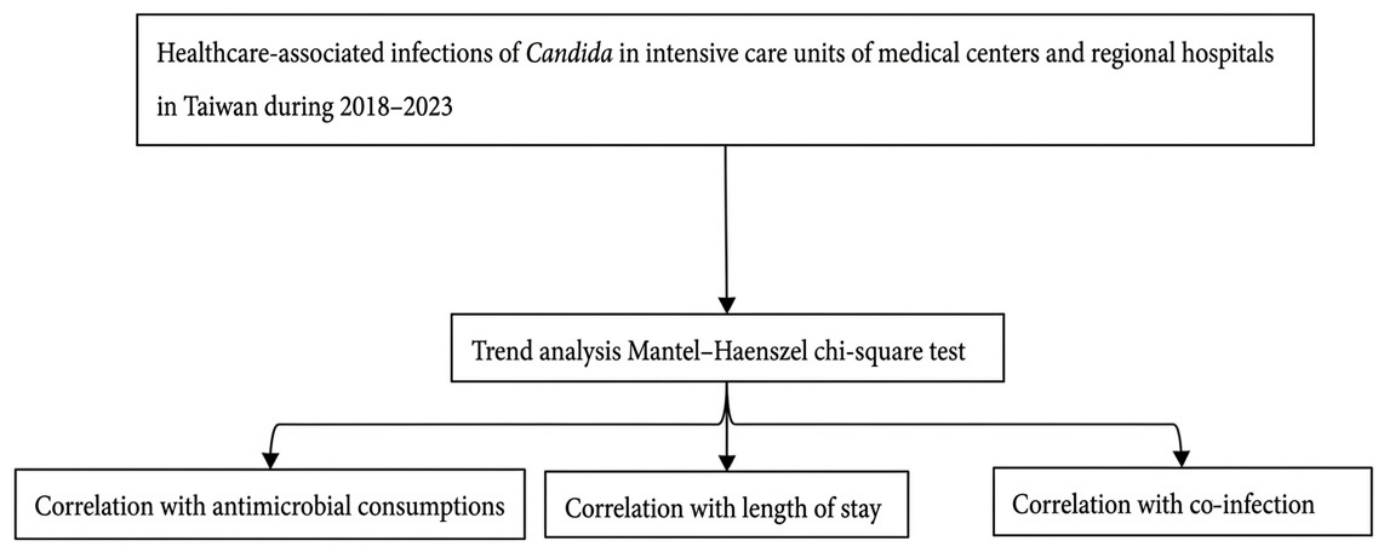
17]. This study was approved by the Ethics Committee of Tri-Service General Hospital, approval number TSGH-C202305039. The flowchart is shown in
Figure 1.
The linear trend of the proportions of Candida and bacteria from 2018 to 2023 was analyzed using the Mantel–Haenszel chi-square test. The minimal clinically important difference (MCID) was estimated using a distribution-based method. Spearman’s correlation coefficients were used to analyze the correlations between different types of Candida and antibiotic consumption or length of hospital stay. The changes in microorganisms were compared between 2018 and 2023 using crude odds ratios (ORs) for Candida and other bacteria. The relative risk of antimicrobial consumption, length of ICU stays, and bacterial microorganisms in Candida HAIs were analyzed with general linear regression. Statistical analyses were performed using SPSS version 21 (Asia Analytics, Taipei, Taiwan).
3. Results
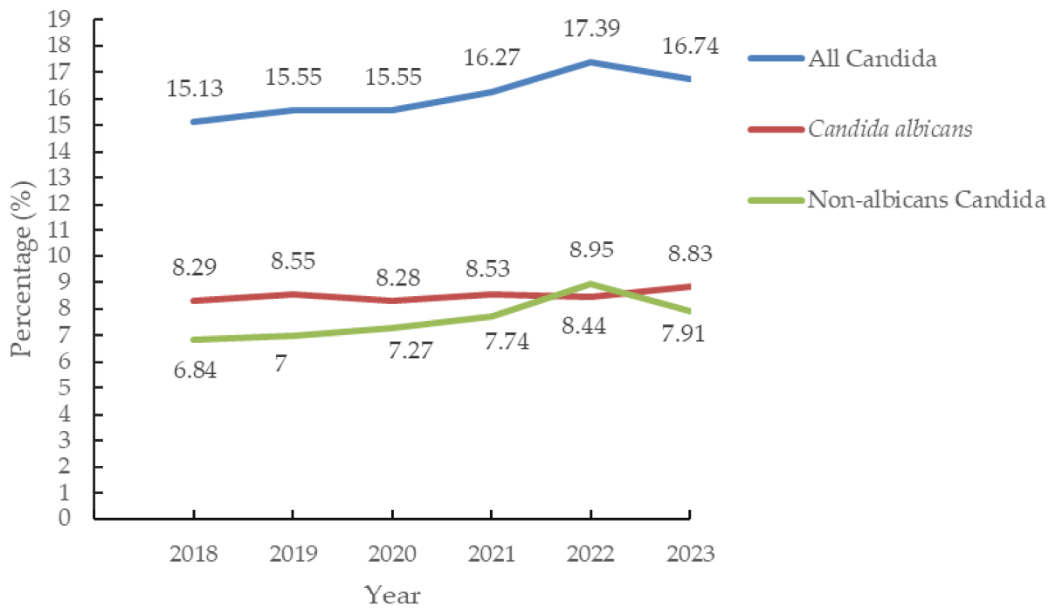
The proportion of all Candida species increased from 15.13%to 16.74% (
p < 0.001), with an OR of 1.128 (95% confidence interval (C.I.): 1.048–1.215;
p = 0.001) in 2023 compared with that in 2018. The proportion of NACs increased from 6.84% to 7.91% (
p < 0.001), with an OR of 1.17 (95% C.I.:1.055–1.299,
p = 0.003) in 2023 compared with 2018; and the proportion of
Enterococcus faecium (Efm) increased from 7.7% to 11.11% (
p < 0.001), with an OR of 1.498 (95% C.I.: 1.363–1.647,
p < 0.001) (
Table 1) (
Figure 2).The MCID of annual proportion changes in total Candida HAI was 0.347%,
Candida albicans HAI was 0.14%, and NAC HAI was 0.4% (
Supplementary Table S1 shows the temporal change in the proportion of HAIs attributable to Candida species).
With respect to UTIs, the proportion of all Candida species increased from 24.63%to 28.13% (
p < 0.001), the proportion of NACs increased from 10.13%to 11.96% (
p < 0.001), and the proportion of Efm changed from 9.47% to 15.32% (
p < 0.001) (
Table 2).
The proportions of NACs and all Candida species in HAIs and UTIs were positively correlated with antibiotic consumption;
Candida albicans in UTIs was positively correlated with antibiotic consumption (
Table 3). NACs and all Candida species were positively correlated with the length of ICU stay among patients with HAIs or UTIs (
Table 3).
All Candida species and NACs were positively correlated with Efm in both HAIs and UTIs.
Candida albicans in UTIs was positively correlated with Efm in UTIs (
Table 4). The RR of NACs in HAIs showed an adjusted RR of 1.048 (95% C.I.: 1.036–1.061,
p < 0.001) for length of ICU stay and adjusted RR of 10.545 (95% C.I.: 2.665–41.726,
p = 0.001) for Efm. The RR of NACs in UTIs showed an adjusted RR of 1.045 (95% C.I.: 1.033–1.056,
p < 0.001) for length of ICU stay and adjusted RR of 7.347 (95% C.I.: 1.522–35.465,
p = 0.013) for Efm of UTIs (
Table 5).
4. Discussion
In this nationwide surveillance analysis covering the period from 2018 to 2023, we reported a significant increase in the proportion of patients with Candida HAIs, predominantly NACs, in the ICUs of Taiwan. This upward trend is associated with increased antibiotic consumption, prolonged ICU stays, and a corresponding increase in the prevalence of Efm. In conclusion, our findings suggest that the epidemiology of Candida in ICUs is not an isolated fungal phenomenon but rather reflects a broader ecological disturbance related to antibiotic stress and the device-associated biofilm environment.
4.1. Epidemiological Trends Shift to Non-Albicans Candida Species
While
C. albicans remains the dominant pathogen, our data show a disproportionate increase in the infection rate of HAIs with NACs.
C. glabrata and
C. parapsilosis are common in Western countries. In the Asia-Pacific region, antifungal drug resistance to Candida is widespread and increasing [
18].
C. tropicalis is the second most virulent Candida species and can also form true hyphae and complex biofilms in vitro and secrete proteases, phospholipases, and hemolysins [
19].
C. tropicalis is related to one-month mortality with an odds ratio (OR) of 2 in patients with NAC infection [
20]. It exhibits reduced susceptibility to azoles, and the resistance to fluconazole increased from 8.5% to 10.8% in
C. tropicalis from 2014 to 2022 in Taiwan [
21]. There is a higher risk of mortality with
C. tropicalis in patients with NACs [
20].
C. tropicalis is the most common species isolated from the surface of fruits in Taiwan, and approximately 18.6% were resistant to fluconazole from the environment [
22]. Evidence suggests that fungal resistance likely develops after exposure to azole fungicides in environmental or agricultural settings [
23]. The standard dosage of antifungal drugs does not consider pharmacokinetic differences in critically ill patients, which may lead to insufficient drug exposure [
18]. Our findings extend these concerns regarding the increase in NACs to the national level in the ICU setting and correlation with antifungal use. But the special species of NACs and azole resistance were not supported by annual survey data that do not fully consider the influence of different NACs in HAIs. The delay in treatment worsens outcomes; NAC therapy is more expensive because of the need to use of echinocandins. However it has a higher cost-effectiveness becuause it improve the prognosis [
18].
4.2. Antimicrobial Stress as a Driver of Fungal Proliferation
A key finding of this study is the positive correlation between systemic antimicrobial consumption and the prevalence of
C. albicans and NACs in UTIs. These findings support the ecological hypothesis that broad-spectrum antimicrobial therapy disrupts symbiotic microbiota, leading to fungal overgrowth and mucosal invasion. Researchers have confirms that antibiotics impaired antifungal immunity and induced dysbiosis of the microbiome, promoting fungal translocation and organ dissemination [
24,
25]. Traditional antimicrobial management indicators primarily target bacterial treatment; however, our findings suggest that antibiotic intensity may indirectly influence fungal epidemiology within the ICU ecosystem.
4.3. Candida–Enterococcus Ecological Convergence
Bacteria related to invasive Candida infection [
26]. Mixed BSIs involving Candida/bacteria accounted for 25.2% of all Candidemia cases with higher mortality [
27]. Notably, in animal models, antibiotic stress-induced proliferation of Enterococcus was associated with enhanced fungal dissemination [
28]. The mortality rate associated with co-infection with vancomycin-resistant enterococci is significantly higher than that associated with Candidemia alone [
27]. The synchronous growth of Candida and
Enterococcus faecalis warrants special attention. Enterococcus is a major multidrug-resistant hospital-acquired pathogen that often cocolonizes mucosal surfaces with Candida. Mechanistic studies of
Enterococcus faecalis have shown that virulence factors such as gelatinase (GelE), serine protease (SprE), and enterococcal surface proteins (Esps) can increase biofilm formation and tissue invasion [
29]. Candida/bacteria mixed infections show higher rates of septic shock, prolonged ICU stays, longer mechanical ventilation, and potentially higher mortality [
30]. Septic shock in Candidemia increased mortality [
31].
The prevalence of NACs and Efm increased synchronously over time, suggesting fungal–bacterial synergy in high-risk healthcare settings. Although the decrease in the VREfm was associated with infection prevention protocols during the COVID-19 era, Efm has increased in recent years, with more than sixty percent of VRE remaining. Candida should engage participants in a multimicrobial pathogenic network.
4.4. Device-Associated Multimicrobial Biofilms and UTIs
A significant increase in the proportion of Candida species has been observed among UTIs, and the proportion of catheter-associated infections (CAUTIs) remains persistent at approximately 89% in Taiwan [
15]. Indwelling catheters provide an ideal substrate for the formation of multimicrobial biofilms. The pathogenesis of CAUTIs involves the formation of biofilms on the catheter surface, which hinders standard antimicrobial therapy [
32]. Under shear stress conditions, multimicrobial communities can maintain structural integrity and increase metabolic activity. Common Gram-negative pathogens associated with CAUTIs frequently coexist with Candida species in biofilms [
33]. This multimicrobial structure may lead to antibiotic resistance and persistent colonization, thereby increasing the risk of secondary BSIs. Foley catheter use was related to one-month mortality with an OR of 1.7 in a patient with an NAC infection [
20]. Therefore, our findings show that NACs increased in UTIs and highlight the need for proactive device management strategies, early catheter removal, and comprehensive fungal surveillance in CAUTI prevention programs.
4.5. Relationship Between Candidiasis and Hospital Stay
Compared with patients in Western countries, patients in Asia have a shorter mean duration from ICU admission to the onset of Candidemia [
34]. Patients infected with Candida have a longer duration of hospitalization. Patients with severe disease who are hospitalized in ICUs with weakened conditions or bacterial infections need antimicrobial treatment. Our study revealed that Candida infection was correlated with longer hospitalization, indicating that patients had more severe conditions. Healthcare staffs need to quickly manage infections as well as the physical management of ICU patients so that they can then easily transfer these patients to general wards to reduce fungal infections.
This study utilizes nationwide surveillance data provided by the Taiwanese CDC, thus enhancing the representativeness and external validity of this study. The six-year longitudinal study design allows for a robust assessment of sustained time trends. Combining Candida epidemiology with antibiotic consumption and length of stay in the ICU provides a rare population ecology perspective. The simultaneous analysis of Candida and other bacteria offers new insights into the potential fungal–bacterial fusion in an ICU setting.
This study has several limitations. First, the annual database lacks patient-level clinical variables, such as age, disease severity, duration of device use, complications, comorbidities, prior antifungal drug exposure, lack of radiological or microbiological data on fulminant forms and antifungal drug susceptibility profiles, and time of observation, which limits adjustments for potential confounding factors. The surveillance dataset did not include information distinguishing primary from secondary infections, thereby precluding robust inference regarding the causal relationship between bacterial and Candida infections. Second, as an ecological analysis based on nationwide surveillance data from the Taiwanese CDC, causal relationships cannot be established. The observed correlations between antibiotic consumption, duration in the ICU, and increased Candida prevalence may reflect common temporal trends rather than direct causation. Registered studies need to establish the cause–effect relationship. Third, Candida is categorized only as
C. albicans or NACs and lacks detailed species-level stratification, which limits the interpretation of resistance patterns and clinical significance.
Candida tropicalis is the dominant species in Taiwan, and resistance to fluconazole has increased in recent years [
21]. These factors influence the resistance to antifungal agents of different species and are require an in-depth clinical explaination. Finally, antimicrobial use is analyzed as a summary of the overall dose during hospitalization, preventing the assessment of exposure at the category or individual level. Therefore, specific antibiotic drivers leading to fungal proliferation cannot be identified. Future studies need to analyze antimicrobial consumption at the patient level.
5. Conclusions
This nationwide ICU surveillance analysis revealed a sustained increase in the prevalence of Candida (especially NACs) and Efm, which was positively correlated with antibiotic consumption and length of ICU stay. The distributional shifts among Candida species were most prominently observed in UTIs and concurrently associated with a rise in Efm infections. This suggests a transition toward more resistant fungal pathogens and underscores the imperative for coordinated antimicrobial stewardship and enhanced surveillance strategies in ICUs. These findings support a model in which antibiotic-driven ecological disruption, device-associated biofilm formation, and fungal–bacterial synergy reshape pathogen patterns in ICUs. Future research integrating metagenomics, antibiotic resistance phenotyping, and patient antibiotic exposure data is urgently needed to clarify the causal relationships and provide a basis for precise infection control strategies.
Author Contributions
Conceptualization, C.-A.C.; Data curation, C.-G.C.; Formal analysis, C.-A.C.; Funding acquisition, C.-C.H.; Investigation, Y.-H.C.; Project administration, Y.-H.C. and C.-G.C.; Supervision, C.-A.C.; Validation, C.-C.H. and C.-G.C.; Visualization, C.-G.C.; Writing—original draft preparation, C.-C.H. and Y.-H.C.; Writing—review and editing, C.-G.C. and C.-A.C. All authors have read and agreed to the published version of the manuscript.
Funding
This research received no external funding.
Institutional Review Board Statement
This study received approval from the Institutional Review Board of Tri-Service General Hospital under number TSGH-C202305039 on 27 May 2023.
Informed Consent Statement
Since this study adopted a retrospective observational design and was non-invasive (only involving a chart review), patient consent was not required.
Data Availability Statement
Acknowledgments
The authors are thankful for the grant from the Taoyuan Armed Forces General Hospital, TYAFGH-E-115048 and TYAFGH-E-115049, and from the Cheng Hsin General Hospital, CHGH115-N01, for this study.
Conflicts of Interest
The authors declare no conflicts of interest.
References
- Stewart, S.; Robertson, C.; Pan, J.; Kennedy, S.; Haahr, L.; Manoukian, S.; Mason, H.; Kavanagh, K.; Graves, N.; Dancer, S.J.; et al. Impact of healthcare-associated infection on length of stay. J. Hosp. Infect. 2021, 114, 23–31. [Google Scholar] [CrossRef]
- Liu, X.; Shrestha, R.; Koju, P.; Maharjan, B.; Shah, P.; Thapa, P.; Li, H. The direct medical economic burden of healthcare-associated infections and antimicrobial resistance: A preliminary study in a teaching hospital of Nepal. J. Glob. Antimicrob. Resist. 2022, 29, 299–303. [Google Scholar] [CrossRef] [PubMed]
- Liu, X.; Spencer, A.; Long, Y.; Greenhalgh, C.; Steeg, S.; Verma, A. A systematic review and meta-analysis of disease burden of healthcare-associated infections in China: An economic burden perspective from general hospitals. J. Hosp. Infect. 2022, 123, 1–11. [Google Scholar] [CrossRef]
- de Almeida, B.L.; Agnelli, C.; Guimarães, T.; Sukiennik, T.; Lima, P.R.P.; Salles, M.J.C.; Breda, G.L.; Queiroz-Telles, F.; Mendes, A.V.A.; Camargo, L.F.A.; et al. Candidemia in ICU Patients: What Are the Real Game-Changers for Survival? J. Fungi 2025, 11, 152. [Google Scholar] [CrossRef]
- Tsai, C.S.; Lee, S.S.; Chen, W.C.; Tseng, C.H.; Lee, N.Y.; Chen, P.L.; Li, M.C.; Syue, L.S.; Lo, C.L.; Ko, W.C.; et al. COVID-19-associated candidiasis and the emerging concern of Candida auris infections. J. Microbiol. Immunol. Infect. 2023, 56, 672–679. [Google Scholar] [CrossRef]
- Hoenigl, M.; Seidel, D.; Sprute, R.; Cunha, C.; Oliverio, M.; Goldman, G.H.; Ibrahim, A.S.; Carvalho, A. COVID-19-associated fungal infections. Nat. Microbiol. 2022, 7, 1127–1140. [Google Scholar] [CrossRef]
- Ciurea, C.N.; Kosovski, I.B.; Mare, A.D.; Toma, F.; Pintea-Simon, I.A.; Man, A. Candida and Candidiasis-Opportunism Versus Pathogenicity: A Review of the Virulence Traits. Microorganisms 2020, 8, 857. [Google Scholar] [CrossRef] [PubMed]
- Su, C.F.; Lai, C.C.; Li, T.H.; Chang, Y.F.; Lin, Y.T.; Chen, W.S.; Tsao, Y.P.; Wang, W.H.; Chang, Y.S.; Tsai, C.Y. Epidemiology and risk of invasive fungal infections in systemic lupus erythematosus: A nationwide population-based cohort study. Ther. Adv. Musculoskelet. Dis. 2021, 13, 1759720X211058502. [Google Scholar] [CrossRef] [PubMed]
- Zamora, B.; Salazar, L.; Grijalva, M.; Lara, T.; Jiménez, P.; José Vallejo-López, M. Comparison of virulence factors between invasive and non-invasive clinical isolates of Candida spp. Curr. Med. Mycol. 2025, 11, 1628. [Google Scholar]
- Mulet Bayona, J.V.; TormoPalop, N.; Salvador García, C.; Fuster Escrivá, B.; ChanzáAviñó, M.; Ortega García, P.; Gimeno Cardona, C. Impact of the SARS-CoV-2 Pandemic in Candidaemia, Invasive Aspergillosis and Antifungal Consumption in a Tertiary Hospital. J. Fungi 2021, 7, 440. [Google Scholar] [CrossRef]
- Valencia-Ledezma, O.E.; Reyes-Montes, M.D.R.; Acosta-Altamirano, G.; Frías-De-León, M.G.; García-Salazar, E.; Duarte-Escalante, E.; Santiago-Abundio, J.; González-Miguel, Z.; García-Hernández, M.L.; Martínez-Quezada, R.; et al. Invasive Candidiasis Coinfection in Patients with Severe COVID-19 Disease: Scoping Review. Pathogens 2025, 14, 466. [Google Scholar] [CrossRef]
- Lu, D.E.; Hung, S.H.; Su, Y.S.; Lee, W.S. Analysis of Fungal and Bacterial Co-Infections in Mortality Cases among Hospitalized Patients with COVID-19 in Taipei, Taiwan. J. Fungi 2022, 8, 91. [Google Scholar] [CrossRef]
- Lin, G.L.; Chang, P.H.; Lee, I.K.; Chen, Y.C.; Lee, C.H. Clinical characteristics and outcomes of patients with candidemia during the COVID-19 pandemic: Insights from experience in the Omicron era. J. Microbiol. Immunol. Infect. 2024, 57, 812–821. [Google Scholar] [CrossRef]
- Szekely, J.; Rakchang, W.; Rattanaphan, P.; Kositpantawong, N. Fluconazole and echinocandin resistance of Candida species in invasive candidiasis at a university hospital during pre-COVID-19 and the COVID-19 outbreak. Epidemiol. Infect. 2023, 151, e146. [Google Scholar] [CrossRef] [PubMed]
- Taiwan Centers of Disease Control. The Healthcare-Associated of Intensive Care Units in Taiwan. 2022. Available online: https://www.cdc.gov.tw/En/Category/Page/J63NmsvevBg2u3I2qYBenw (accessed on 1 January 2026).
- Taiwan Centers of Disease Control. The Antimicrobial Consumptions of Taiwan in 2023. 2023. Available online: https://www.cdc.gov.tw/Category/MPage/4G8HuDdUN1k4xaBJhbPzKQ (accessed on 1 January 2026).
- Taiwan Ministry of Health and Welfare. Survey on Service Volume of Medical Institutions in 2022. Available online: https://www.gender.ey.gov.tw/gecdb/Stat_Statistics_Category.aspx?fs=fTQP3HmkUvd1PbnmtSP3rw%40%40&cs1=aPi33EfnEATKPKjm9jJFBA%40%40&cs2=FuWFCi3De1SSQR5qlMyr0g%40%40 (accessed on 1 January 2026).
- Chen, Y.C.; Dhillon, S.; Adomakoh, N.; Roberts, J.A. The changing epidemiology of Candida species in Asia Pacific and evidence for optimizing antifungal dosing in challenging clinical scenarios. Expert Rev. Anti Infect. Ther. 2025, 23, 969–983. [Google Scholar] [CrossRef] [PubMed]
- Zuza-Alves, D.L.; Silva-Rocha, W.P.; Chaves, G.M. An Update on Candida tropicalis Based on Basic and Clinical Approaches. Front. Microbiol. 2017, 8, 1927. [Google Scholar] [CrossRef] [PubMed]
- Lee, Y.C.; Chen, Y.C.; Wang, J.T.; Wang, F.D.; Hsieh, M.H.; Hii, I.M.; Lee, Y.L.; Ho, M.W.; Liu, C.E.; Chen, Y.H.; et al. Impact of Nutritional Assessment on the Clinical Outcomes of Patients with Non-albicans Candidemia: A Multicenter Study. Nutrients 2021, 13, 3218. [Google Scholar] [CrossRef]
- Zhou, Z.L.; Tseng, K.Y.; Chen, Y.Z.; Tsai, D.J.; Wu, C.J.; Chen, Y.C.; Peng, H.L.; Yang, Y.L.; Hsieh, L.Y.; Chen, C.H.; et al. Genetic relatedness among azole-resistant Candida tropicalis clinical strains in Taiwan from 2014 to 2018. Int. J. Antimicrob. Agents 2022, 59, 106592. [Google Scholar] [CrossRef]
- Tseng, K.Y.; Chen, Y.Z.; Zhou, Z.L.; Tsai, J.N.; Tseng, M.N.; Liu, H.L.; Wu, C.J.; Liao, Y.C.; Lin, C.C.; Tsai, D.J.; et al. Detection in Orchards of Predominant Azole-Resistant Candida tropicalis Genotype Causing Human Candidemia, Taiwan. Emerg. Infect. Dis. 2024, 30, 2323–2332. [Google Scholar] [CrossRef]
- Chen, P.Y.; Chuang, Y.C.; Wu, U.I.; Sun, H.Y.; Wang, J.T.; Sheng, W.H.; Lo, H.J.; Wang, H.Y.; Chen, Y.C.; Chang, S.C. Clonality of Fluconazole-Nonsusceptible Candida tropicalis in Bloodstream Infections, Taiwan, 2011–2017. Emerg. Infect. Dis. 2019, 25, 1660–1667. [Google Scholar] [CrossRef]
- Drummond, R.A.; Desai, J.V.; Ricotta, E.E.; Swamydas, M.; Deming, C.; Conlan, S.; Quinones, M.; Matei-Rascu, V.; Sherif, L.; Lecky, D.; et al. Long-term antibiotic exposure promotes mortality after systemic fungal infection by driving lymphocyte dysfunction and systemic escape of commensal bacteria. Cell Host Microbe 2022, 30, 1020–1033.e6. [Google Scholar] [CrossRef] [PubMed]
- He, S.; Sun, Y.; Yu, J.; Tang, M.; Zhang, Q.; Meng, B.; Fan, R.; Liu, Z.; Liu, Y.; Hu, L.; et al. Dysbiotic gut fungi exacerbate Klebsiella pneumoniae lung infection via Dectin-1-mediated alveolar macrophage hyperactivation. ISME J. 2025, 19, wraf181. [Google Scholar] [CrossRef] [PubMed]
- Yan, J.Y.; Lin, T.H.; Jong, Y.T.; Hsueh, J.W.; Wu, S.H.; Lo, H.J.; Chen, Y.C.; Pan, C.H. Microbiota signatures associated with invasive Candida albicans infection in the gastrointestinal tract of immunodeficient mice. Front. Cell Infect. Microbiol. 2024, 13, 1278600. [Google Scholar] [CrossRef]
- Huang, H.-Y.; Lin, Y.-C.; Lu, P.-L.; Wang, Y.-L.; Chen, T.-C.; Chang, K.; Lin, S.-Y. Clinical insights into mixed Candida and bacterial bloodstream infections: A retrospective cohort study. Microbiol. Spectr. 2025, 13, e0168425. [Google Scholar] [CrossRef] [PubMed]
- Nogueira, F.; Sharghi, S.; Kuchler, K.; Lion, T. Pathogenetic Impact of Bacterial-Fungal Interactions. Microorganisms 2019, 7, 459. [Google Scholar] [CrossRef]
- Ali, L.; Goraya, M.U.; Arafat, Y.; Ajmal, M.; Chen, J.L.; Yu, D. Molecular Mechanism of Quorum-Sensing in Enterococcus faecalis: Its Role in Virulence and Therapeutic Approaches. Int. J. Mol. Sci. 2017, 18, 960. [Google Scholar] [CrossRef]
- Zhong, L.; Zhang, S.; Tang, K.; Zhou, F.; Zheng, C.; Zhang, K.; Cai, J.; Zhou, H.; Wang, Y.; Tian, B.; et al. Clinical characteristics, risk factors and outcomes of mixed Candida albicans/bacterial bloodstream infections. BMC Infect. Dis. 2020, 20, 810. [Google Scholar] [CrossRef]
- Guzman, J.A.; Tchokonte, R.; Sobel, J.D. Septic shock due to candidemia: Outcomes and predictors of shock development. J. Clin. Med. Res. 2011, 3, 65–71. [Google Scholar] [CrossRef]
- Tegegne, D.T.; Abbott, I.J.; Poźniak, B. Catheter-Associated Urinary Tract Infections: Understanding the Interplay Between Bacterial Biofilm and Antimicrobial Resistance. Int. J. Mol. Sci. 2025, 26, 9193. [Google Scholar] [CrossRef]
- Joshi, P.; Bhattacharjee, R.; Sahu, M.; Gajjar, D. Insights into urinary catheter colonisation and polymicrobial biofilms of Candida- bacteria under flow condition. Sci. Rep. 2025, 15, 15375. [Google Scholar] [CrossRef] [PubMed]
- Zhang, Z.; Zhu, R.; Luan, Z.; Ma, X. Risk of invasive candidiasis with prolonged duration of ICU stay: A systematic review and meta-analysis. BMJ Open. 2020, 10, e036452. [Google Scholar] [CrossRef] [PubMed]
| Disclaimer/Publisher’s Note: The statements, opinions and data contained in all publications are solely those of the individual author(s) and contributor(s) and not of MDPI and/or the editor(s). MDPI and/or the editor(s) disclaim responsibility for any injury to people or property resulting from any ideas, methods, instructions or products referred to in the content. |
© 2026 by the authors. Published by MDPI on behalf of the Lithuanian University of Health Sciences. Licensee MDPI, Basel, Switzerland. This article is an open access article distributed under the terms and conditions of the Creative Commons Attribution (CC BY) license.