Patient Satisfaction with Anticoagulation for Venous Thromboembolic Disease: A Systematic Review of Oral and Parenteral Regiments
 , ,
, ,  and
and
Abstract
1. Introduction
2. Materials and Methods
2.1. Literature Search
2.2. Inclusion and Exclusion Criteria
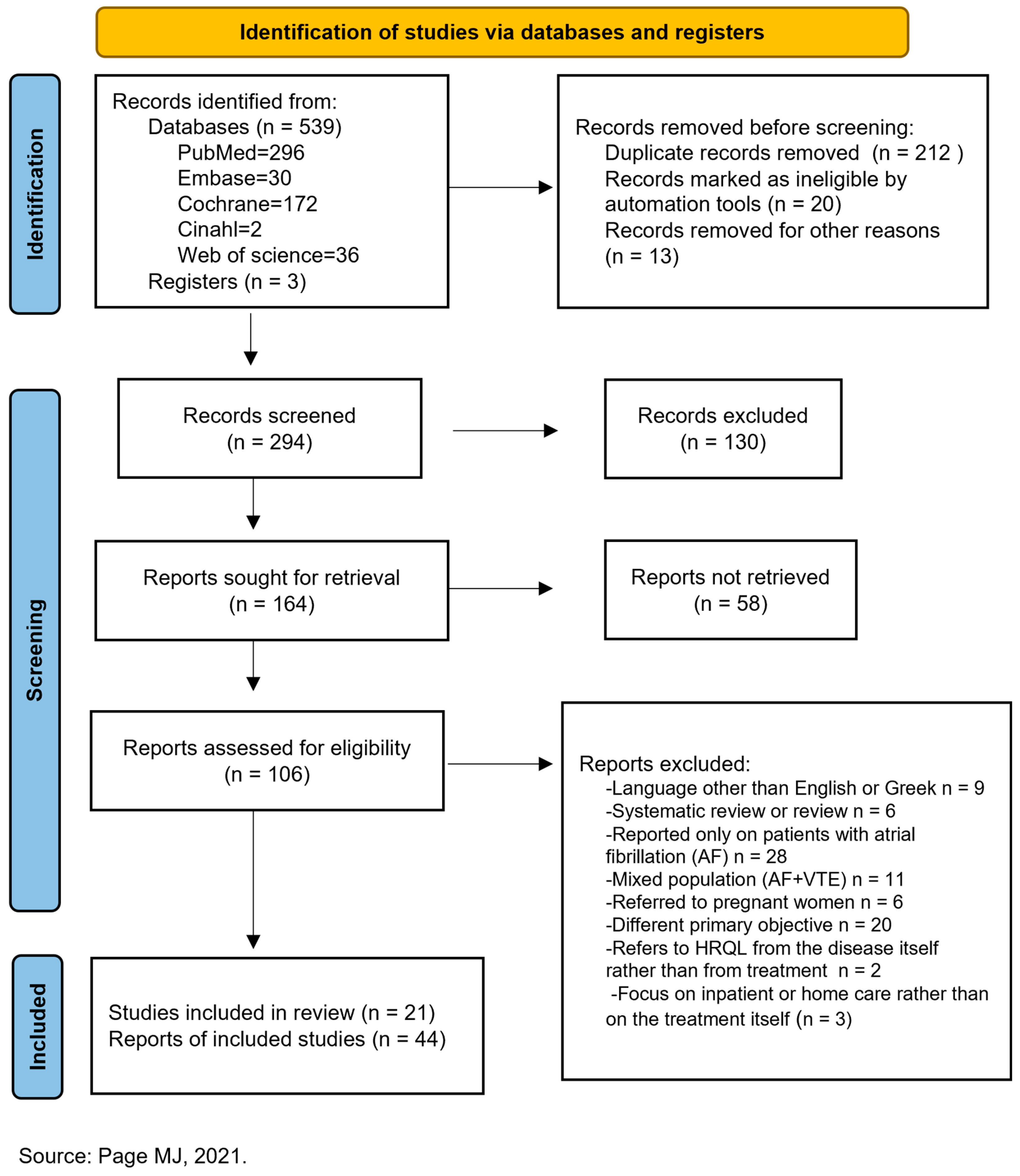
2.3. Study Selection and PRISMA Flow Diagram
2.4. Data Extraction
2.5. Quality Assessment
- -
- The Cochrane Risk of Bias (RoB) tool for randomised clinical trials.
- -
- The Newcastle–Ottawa Scale (NOS; range 1–9) for cohort and other observational studies.
- -
- The ROBINS-I tool for non-randomised interventional and observational studies.
2.6. Data Synthesis
- -
- Type of anticoagulant (e.g., DOACs, VKAs, LMWH).
- -
- Study design (randomised vs. observational).
- -
- Specific patient populations (e.g., cancer-associated VTE vs. non-cancer VTE), where applicable.
- -
- Type of measurement instrument (e.g., ACTS, PACT-Q, generic QoL tools).
2.7. Patient Demographics
2.8. Measurement Tools for Patient Satisfaction
3. Results of the Systematic Review of Patient Satisfaction with Anticoagulation Therapy for VTE
3.1. Comparison Between Treatments
3.2. Key Factors and Patient Preferences
4. Discussion
4.1. Main Findings
4.2. Patient Satisfaction with Anticoagulation
- Ease of use and convenience: Once- or twice-daily oral administration, fixed dosing, and the absence of routine INR monitoring were repeatedly cited as key advantages of DOACs.
- Reduced treatment burden: Compared with VKAs, DOACs were perceived as less intrusive in daily life, with fewer dietary restrictions and less need for frequent healthcare visits.
- Cano et al., (2018) [15] reported a lower “treatment burden” with rivaroxaban compared with traditional regimens.
4.3. Health-Related Quality of Life (QoL) and Its Distinction from Satisfaction
4.4. Adherence and Its Relationship with Satisfaction and QoL
4.5. Clinical Implications and Patient-Centred Care
4.6. Limitations
5. Conclusions
Supplementary Materials
Author Contributions
Funding
Institutional Review Board Statement
Informed Consent Statement
Data Availability Statement
Acknowledgments
Conflicts of Interest
References
- Khan, F.; Tritschler, T.; Kimpton, M.; Wells, P.S.; Kearon, C.; Weitz, J.I.; Büller, H.R.; Raskob, G.E.; Ageno, W.; Couturaud, F.; et al. Long-term risk of recurrent venous thromboembolism among patients receiving extended oral anticoagulant therapy for first unprovoked venous thromboembolism: A systematic review and meta-analysis. J. Thromb. Haemost. 2021, 19, 2801–2813. [Google Scholar] [CrossRef] [PubMed]
- Fernandez, M.M.; Hogue, S.; Preblick, R.; Kwong, W.J. Review of the cost of venous thromboembolism. Clinicoecon. Outcomes Res. 2015, 7, 451–462. [Google Scholar] [CrossRef] [PubMed]
- Raskob, G.; Angchaisuksiri, P.; Blanco, A.; Büller, H.; Gallus, A.; Hunt, B.J.; Hylek, E.M.; Kakkar, A.; Konstantinides, S.V.; McCumber, M.; et al. Thrombosis: A major contributor to global disease burden. Thromb. Res. 2014, 134, 931–938. [Google Scholar] [CrossRef] [PubMed] [PubMed Central]
- Heit, J.A.; Spencer, F.A.; White, R.H. The Epidemiology of Venous Thromboembolism. J. Thromb. Thrombolysis 2016, 41, 3–14. [Google Scholar] [CrossRef]
- Klok, F.A.; Couturaud, F.; Delcroix, M.; Humbert, M. Diagnosis of chronic thromboembolic pulmonary hypertension after acute pulmonary embolism. Eur. Respir. J. 2020, 55, 2000189. [Google Scholar] [CrossRef] [PubMed]
- Kahn, S.R.; Shbaklo, H.; Lamping, D.L.; Holcroft, C.A.; Shrier, I.; Miron, M.J.; Roussin, A.; Desmarais, S.; Joyal, F.; Kassis, J.; et al. Determinants of health-related quality of life during the 2 years following deep vein thrombosis. J. Thromb. Haemost. 2008, 6, 1105–1112. [Google Scholar] [CrossRef] [PubMed]
- Kahn, S.R.; M’Lan, C.E.; Lamping, D.L.; Kurz, X.; Bérard, A.; L. Abenhaim for the Veines Study Group. The influence of venous thromboembolism on quality of life and severity of chronic venous disease. J. Thromb. Haemost. 2004, 2, 2146–2151. [Google Scholar] [CrossRef]
- Ferreira, D.C.; Vieira, I.; Pedro, M.I.; Caldas, P.; Varela, M. Patient satisfaction with healthcare services and the techniques used for its assessment: A systematic literature review and a bibliometric analysis. Healthcare 2023, 11, 639. [Google Scholar] [CrossRef]
- Page, M.J.; McKenzie, J.E.; Bossuyt, P.M.; Boutron, I.; Hoffmann, T.C.; Mulrow, C.D.; Shamseer, L.; Tetzlaff, J.M.; Akl, E.A.; Brennan, S.E.; et al. The PRISMA 2020 statement: An updated guideline for reporting systematic reviews. BMJ 2021, 372, n71. [Google Scholar] [CrossRef]
- Wong, P.; Baglin, T. Epidemiology, risk factors and sequelae of venous thromboembolism. Phlebology 2012, 27, 2–11. [Google Scholar] [CrossRef]
- Bamber, L.; Wang, M.Y.; Prins, M.H.; Ciniglio, C.; Bauersachs, R.; Lensing, A.W.; Cano, S.J. Patient-reported treatment satisfaction with oral rivaroxaban versus standard therapy in the treatment of acute symptomatic deep-vein thrombosis. Thromb. Haemost. 2013, 110, 732–741. [Google Scholar] [CrossRef]
- Bartoli-Abdou, J.K.; Patel, J.P.; Xie, R.; Dzahini, O.; Vadher, B.; Brown, A.; Roberts, L.N.; Patel, R.K.; Arya, R.; Auyeung, V. Associations between illness beliefs, medication beliefs, anticoagulation-related quality of life, and INR control: Insights from the Switching Study. Res. Pract. Thromb. Haemost. 2018, 2, 497–507. [Google Scholar] [CrossRef] [PubMed]
- Brekelmans, M.P.; Kappelhof, M.; Nieuwkerk, P.T.; Nierman, M.; Buller, H.R.; Coppens, M. Preference for direct oral anticoagulants in patients treated with vitamin K antagonists for venous thromboembolism. Neth. J. Med. 2017, 75, 50–55. [Google Scholar] [PubMed]
- Cajfinger, F.; Debourdeau, P.; Lamblin, A.; Benatar, V.; Falvo, N.; Benhamou, Y.; Sevestre, M.A.; Farge-Bancel, D. Low-molecular-weight heparins for cancer-associated thrombosis: Adherence to clinical practice guidelines and patient perception in TROPIQUE, a 409-patient prospective observational study. Thromb. Res. 2016, 144, 85–92. [Google Scholar] [CrossRef] [PubMed]
- Cano, S.; Mantovani, L.; Folkerts, K.; Gebel, M.; Sahin, K.; Zell, E.; Monje, D.; Schneider, J.; Eickels, M.V.; Haas, S.; et al. Patient-reported treatment experience with oral rivaroxaban: Results from the noninterventional XALIA study of deep-vein thrombosis. TH Open 2018, 2, e139–e146. [Google Scholar] [CrossRef]
- Dault, R.; Blais, L.; Vanasse, A.; Farand, P.; Perreault, S.; Letemplier, G.; Beauchesne, M.F. Patients’ satisfaction with anticoagulant treatment for venous thromboembolism. Can. J. Gen. Intern. Med. 2018, 13, 13–19. [Google Scholar] [CrossRef]
- Fang, M.C.; Go, A.S.; Prasad, P.A.; Zhou, H.X.; Parks, A.L.; Fan, D.; Portugal, C.; Sung, S.H.; Reynolds, K. Health-related quality of life associated with warfarin and direct oral anticoagulants in venous thromboembolism. Thromb. Res. 2022, 216, 97–102. [Google Scholar] [CrossRef]
- Farge, D.; Frere, C.; Connors, J.M.; Ay, C.; Khorana, A.A.; Munoz, A.; Brenner, B.; Kakkar, A.; Rafii, H.; Solymoss, S.; et al. 2019 international clinical practice guidelines for the treatment and prophylaxis of venous thromboembolism in patients with cancer. Lancet Oncol. 2019, 20, e566–e581. [Google Scholar] [CrossRef] [PubMed]
- Font, C.; Gomez-Mesa, J.E.; López-Núñez, J.J.; Calderón, C.; Galindo-Coral, S.; Wu, C.C.; Ma, J.; Kroll, M.H.; Rojas-Hernandez, C.M. Measurement of adherence and health-related quality of life during anticoagulation therapy in cancer-associated venous thromboembolism (VTE): A multicenter quantitative study. Support. Care Cancer 2023, 31, 615. [Google Scholar] [CrossRef] [PubMed]
- Haac, B.E.; O’Hara, N.N.; Mullins, C.D.; Stein, D.M.; Manson, T.T.; Johal, H.; Castillo, R.; O’TOole, R.V.; Slobogean, G.P. Patient preferences for venous thromboembolism prophylaxis after injury: A discrete choice experiment. BMJ Open 2017, 7, e016676, Correction in BMJ Open 2017, 7, e016676corr1. https://doi.org/10.1136/bmjopen-2017-016676corr1. [Google Scholar] [CrossRef]
- Hendriks, T.; McGregor, S.; Rakesh, S.; Robinson, J.; Ho, K.M.; Baker, R. Patient satisfaction after conversion from warfarin to direct oral anticoagulants for patients on extended duration of anticoagulation for venous thromboembolism—The SWAN Study. PLoS ONE 2020, 15, e0234048. [Google Scholar] [CrossRef]
- Hull, R.D.; Pineo, G.F.; Brant, R.; Liang, J.; Cook, R.; Solymoss, S.; Poon, M.C.; Raskob, G.; LITE Trial Investigators. Home therapy of venous thrombosis with long-term LMWH versus usual care: Patient satisfaction and post-thrombotic syndrome. Am. J. Med. 2009, 122, 762–769.e3. [Google Scholar] [CrossRef] [PubMed]
- Keita, I.; Aubin-Auger, I.; Lalanne, C.; Aubert, J.P.; Chassany, O.; Duracinsky, M.; Mahé, I. Assessment of quality of life, satisfaction with anticoagulation therapy, and adherence to treatment in patients receiving long-course vitamin K antagonists or direct oral anticoagulants for venous thromboembolism. Patient Prefer. Adherence 2017, 11, 1625–1634. [Google Scholar] [CrossRef] [PubMed]
- Lutsey, P.L.; Zakai, N.A. Epidemiology and prevention of venous thromboembolism. Nat. Rev. Cardiol. 2023, 20, 248–262. [Google Scholar] [CrossRef] [PubMed] [PubMed Central]
- Maraveyas, A. Latest advances in preventing thromboembolic disease in the ambulatory oncology patient. Thromb. Res. 2020, 191, S91–S98. [Google Scholar] [CrossRef] [PubMed]
- Noble, S.; Banerjee, S.; Pease, N.J. Management of venous thromboembolism in far-advanced cancer: Current practice. BMJ Support. Palliat. Care 2022, 12, e834–e837. [Google Scholar] [CrossRef] [PubMed]
- Picker, N.; Lee, A.Y.; Cohen, A.T.; Maraveyas, A.; Beyer-Westendorf, J.; Mantovani, L.G.; Abdelgawwad, K.; Fatoba, S.; Thate-Waschke, I.M.; Bach, M.; et al. Anticoagulation Treatment in Cancer-Associated Venous Thromboembolism: Assessment of Patient Preferences Using a Discrete Choice Experiment (COSIMO Study). Thromb. Haemost. 2021, 121, 206–215. [Google Scholar] [CrossRef] [PubMed] [PubMed Central]
- Prins, M.; Lensing, A.W.A.; Prandoni, P.; Wells, P.S.; Verhamme, P.; Beyer-Westendorf, J.; Bauersachs, R.; Bounameaux, H.; Brighton, T.A.; Cohen, A.T.; et al. Risk of recurrent venous thromboembolism according to baseline risk factor profiles. Blood Adv. 2018, 2, 788–796. [Google Scholar] [CrossRef]
- Schulman, S.; Singer, D.; Ageno, W.; Casella, I.B.; Desch, M.; Goldhaber, S.Z. NOACs for treatment of venous thromboembolism in clinical practice. Thromb. Haemost. 2017, 117, 1317–1325. [Google Scholar] [CrossRef] [PubMed]
- Webb, D.; Kim, K.; Tak, C.R.; Witt, D.M.; Feehan, M.; Munger, M.A. Patient Satisfaction With Venous Thromboembolism Treatment. Clin. Appl. Thromb. Hemost. 2019, 25, 1076029619864663. [Google Scholar] [CrossRef] [PubMed] [PubMed Central]
- Arteaga Morales, J.A.; Font, C.; Rojas-Hernandez, C.M. Quality of life in oncological patients with venous thromboembolic disease. Res. Pract. Thromb. Haemost. 2024, 8, e102510. [Google Scholar] [CrossRef] [PubMed]
- Marini, B.L.; Funk, K.; Kraft, M.D.; Fong, J.M.; Naanos, R.; Stout, S.M.; Wagner, D. The effects of an informational video on patient knowledge, satisfaction and compliance with venous thromboembolism prophylaxis: A pilot study. Patient Educ. Couns. 2014, 96, 264–267. [Google Scholar] [CrossRef] [PubMed]
- Barry, M.J.; Edgman-Levitan, S. Shared decision making--pinnacle of patient-centered care. N. Engl. J. Med. 2012, 366, 780–781. [Google Scholar] [CrossRef] [PubMed]
- Coulter, A. Patient engagement—What works? J. Ambul. Care Manag. 2012, 35, 80–89. [Google Scholar] [CrossRef]
- Prins, M.H.; Marrel, A.; Carita, P.; Anderson, D.; Bousser, M.G.; Crijns, H.; Consoli, S.; Arnould, B. Multinational development of a questionnaire assessing patient satisfaction with anticoagulant treatment: The ‘Perception of Anticoagulant Treatment Questionnaire’ (PACT-Q). Health Qual. Life Outcomes 2009, 7, 9. [Google Scholar] [CrossRef] [PubMed] [PubMed Central]
- Caro, J.J.; Ishak, K.J.; Huybrechts, K.F.; Raggio, G.; Naujoks, C. The impact of compliance with osteoporosis therapy on fracture rates in actual practice. Osteoporos. Int. 2004, 15, 1003–1008. [Google Scholar] [CrossRef]
- Epstein, R.M.; Street, R.L., Jr. The values and value of patient-centered care. Ann. Fam. Med. 2011, 9, 100–103. [Google Scholar] [CrossRef] [PubMed] [PubMed Central]
- Iyer, G.S.; Tesfaye, H.; Khan, N.F.; Zakoul, H.; Bykov, K. Trends in the Use of Oral Anticoagulants for Adults With Venous Thromboembolism in the US, 2010-2020. JAMA Netw. Open 2023, 6, e234059. [Google Scholar] [CrossRef] [PubMed] [PubMed Central]
- Coons, J.C.; Wang, A.; Latremouille-Viau, D.; Russ, C.; Cheng, D.; Stellhorn, R.; Dai, F.; Steffen, D.R.; Zion, A.; Deeba, S.; et al. Oral anticoagulant use among Medicare patients newly diagnosed with venous thromboembolism (VTE): Factors associated with treatment status. PLoS ONE 2025, 20, e0321106. [Google Scholar] [CrossRef] [PubMed] [PubMed Central]
- EuroQol Group. EuroQol—A new facility for the measurement of health-related quality of life. Health Policy 1990, 16, 199–208. [Google Scholar] [CrossRef]
- Ware, J.E.; Sherbourne, C.D. The MOS 36-item short-form health survey (SF-36): I. Conceptual framework and item selection. Med. Care 1992, 30, 473–483. [Google Scholar] [CrossRef]
- Morisky, D.E.; Green, L.W.; Levine, D.M. Concurrent and predictive validity of a self-reported measure of medication adherence. Med. Care 1986, 24, 67–74. [Google Scholar] [CrossRef]
- Brugman, I.M.; van Eikenhorst, L.; Schlinkert, C.; Wagner, C. Patient Preferences in Anticoagulation Treatment: A Review of Discrete Choice Experiments. Patient 2025. ahead of print. [Google Scholar] [CrossRef] [PubMed]
- Zigmond, A.S.; Snaith, R.P. The Hospital Anxiety and Depression Scale. Acta Psychiatr. Scand. 1983, 67, 361–370. [Google Scholar] [CrossRef]
- Mahajan, A.; Parekh, A.; Dodge, L.E.; Chan, A.; Cermak, A.; Filho, C.M.d.O.; Li, A.; Parks, A.L.; Schaefer, J.K.; Bernal, A.G.; et al. Surveying patients’ experiences and perspectives on venous thromboembolism: Gaps and opportunities in health delivery. Blood Vessel Thromb. Hemost. 2025, 2, 100081. [Google Scholar] [CrossRef]


| Study | Number of Patients | Sex (% Men) | Mean Age (Years) | Type of Condition | Treatment |
|---|---|---|---|---|---|
| Wong et al., 2012 [10] | 227 | 55 | 50 | VTE | POs vs. parenteral anticoagulant |
| Bamber et al., 2013 [11] | 1472 | 52 | 58 | DVT | Rivaroxaban vs. VKA |
| Bartoli-Abdou et al., 2018 [12] | 525 | 45 | 65 | VTE | Warfarin |
| Brekelmans et al., 2017 [13] | 200 | 50 | 62 | VTE | DOACs vs. VKA |
| Cajfinger et al., 2016 [14] | 409 | 50 | 65 | Cancer-related VTE | LMWH |
| Cano et al., 2018 [15] | 892 | 48 | 63 | VTE | Rivaroxaban vs. standard therapy |
| Dault et al., 2018 [16] | 140 | 46 | 60 | VTE | DOACs vs. VKA |
| Fang et al., 2022 [17] | 2230 | 43 | 63 | VTE | DOACs vs. warfarin |
| Farge et al., 2019 [18] | 400 | 50 | 57 | Cancer-related VTE | LMWH |
| Font et al., 2023 [19] | 74 | 51 | 64 | Cancer-related VTE | LMWH |
| Haac et al., 2017 [20] | 232 | 60 | 48 | VTE related to orthopaedic trauma | LMWH vs. aspirin |
| Hendriks et al., 2020 [21] | 126 | 45 | 60 | VTE | DOACs vs. warfarin |
| Hull et al., 2009 [22] | 480 | 58 | 62 | DVT | LMWH vs. warfarin |
| Keita et al., 2017 [23] | 100 | 46 | 61 | VTE | DOACs vs. VKA |
| Lutsey et al., 2023 [24] | 519 | 17 | 46 | VTE | DOACs vs. warfarin |
| Maraveyas et al., 2020 [25] | 505 | 45 | 64 | Cancer-related VTE | Rivaroxaban |
| Noble et al., 2022 [26] | 100 | 30 | 57 | Cancer-related VTE | LMWH vs. warfarin |
| Picker et al., 2021 [27] | 163 | 49 | 64 | Cancer-related VTE | Rivaroxaban |
| Prins et al., 2018 [28] | 2397 | 51 | 59 | PE | Rivaroxaban vs. VKA |
| Schulman et al., 2017 [29] | 5142 | 53% | 60 | VTE | DOACs vs. VKA |
| Webb et al., 2019 [30] | 907 | 48% | 52 | VTE | Multiple |
| Measurement Tool | Uses/Studies | Characteristics |
|---|---|---|
| Custom survey | Wong et al., 2012 [10]; Haac et al., 2017 [20]; Noble et al., 2022 [26]; Lutsey et al., 2023 [24]; Schulman et al., 2017 [29] | Study-specific questionnaires focusing on particular preferences or experiences (e.g., convenience, injection burden, monitoring). |
| ACTS (Anti-Clot Treatment Scale) | Bamber et al., 2013 [11]; Cano et al., 2018 [15]; Hendriks et al., 2020 [21]; Maraveyas et al., 2020 [25]; Prins et al., 2018 [28] | Evaluates the balance between perceived benefits and burdens of anticoagulant therapy (treatment burden and benefits domains). |
| PACT-Q (Perception of Anticoagulant Treatment Questionnaire) | Brekelmans et al., 2017 [13]; Cajfinger et al., 2016 [14]; Dault et al., 2018 [16] | Assesses patient expectations, convenience, and satisfaction with anticoagulant treatment. |
| EQ-5D | Bartoli-Abdou et al., 2018 [12] | Generic health-related quality of life instrument covering mobility, self-care, usual activities, pain/discomfort, and anxiety/depression. |
| SF-36 | Fang et al., 2022 [17]; Farge et al., 2019 [18] | Measures multiple domains of health-related quality of life, including physical functioning, role limitations, bodily pain, general health, vitality, social functioning, and mental health. |
| MOS SF-36 | Farge et al., 2019 [18] | Shorter form of the SF-36 focusing on key dimensions of health-related quality of life relevant to patients with chronic conditions. |
| Therapy Type | Qualitative Level of Satisfaction | Key Comments |
|---|---|---|
| DOACs | Generally high | Convenience of once- or twice-daily oral dosing, absence of routine INR monitoring, fewer dietary restrictions, and perceived improvement in daily functioning and QoL. |
| VKAs | Moderate | Requirement for frequent INR monitoring, dose adjustments, and dietary restrictions may negatively impact convenience and perceived QoL, despite proven efficacy. |
| LMWH | Moderate | Effective and often preferred in specific clinical contexts (e.g., cancer-associated thrombosis), but daily or twice-daily subcutaneous injections are perceived as burdensome and may reduce convenience and comfort. |
| Factor | Association with Satisfaction | Key Study |
|---|---|---|
| Route of administration | In the COSIMO study, 73.8% of overall treatment satisfaction was attributed to the route of administration, with a clear preference for oral therapy over injections [27]. | COSIMO Study (Picker, 2021) [27] |
| Ease of use/monitoring | In a cross-sectional study, 97.8% of patients reported higher satisfaction with regimens that did not require frequent laboratory monitoring [23]. | Keita, 2017 [23] |
| Safety/effectiveness in complex patients | In patients with cancer-associated thrombosis, 39% of patients indicated that non-interference with other treatments (e.g., chemotherapy) and perceived safety were major reasons for their satisfaction with LMWH [26]. | Noble, 2022 [26] |
| Quality of life (QoL) | Studies using SF-36 and other QoL instruments reported that patients on DOACs had better QoL scores and less treatment-related anxiety compared with those on VKAs, attributed to simpler regimens and fewer lifestyle constraints [17,19]. | Fang, 2022 [17]; Font, 2023 [19] |
Disclaimer/Publisher’s Note: The statements, opinions and data contained in all publications are solely those of the individual author(s) and contributor(s) and not of MDPI and/or the editor(s). MDPI and/or the editor(s) disclaim responsibility for any injury to people or property resulting from any ideas, methods, instructions or products referred to in the content. |
© 2026 by the authors. Published by MDPI on behalf of the Lithuanian University of Health Sciences. Licensee MDPI, Basel, Switzerland. This article is an open access article distributed under the terms and conditions of the Creative Commons Attribution (CC BY) license.
Share and Cite
Lefkou, E.E.; Fragkaki, A.; Miliori, M.M.; Latsou, D.; Panagiotopoulou, K.; Kotsi, P.; Gerotziafas, G.; Geitona, M. Patient Satisfaction with Anticoagulation for Venous Thromboembolic Disease: A Systematic Review of Oral and Parenteral Regiments. Medicina 2026, 62, 783. https://doi.org/10.3390/medicina62040783
Lefkou EE, Fragkaki A, Miliori MM, Latsou D, Panagiotopoulou K, Kotsi P, Gerotziafas G, Geitona M. Patient Satisfaction with Anticoagulation for Venous Thromboembolic Disease: A Systematic Review of Oral and Parenteral Regiments. Medicina. 2026; 62(4):783. https://doi.org/10.3390/medicina62040783
Chicago/Turabian StyleLefkou, Eleftheria Elmina, Anastasia Fragkaki, Maria Mirsini Miliori, Dimitra Latsou, Kalliopi Panagiotopoulou, Paraskevi Kotsi, Grigorios Gerotziafas, and Maria Geitona. 2026. "Patient Satisfaction with Anticoagulation for Venous Thromboembolic Disease: A Systematic Review of Oral and Parenteral Regiments" Medicina 62, no. 4: 783. https://doi.org/10.3390/medicina62040783
APA StyleLefkou, E. E., Fragkaki, A., Miliori, M. M., Latsou, D., Panagiotopoulou, K., Kotsi, P., Gerotziafas, G., & Geitona, M. (2026). Patient Satisfaction with Anticoagulation for Venous Thromboembolic Disease: A Systematic Review of Oral and Parenteral Regiments. Medicina, 62(4), 783. https://doi.org/10.3390/medicina62040783