Optimal Skin Incision for the Surgical Treatment of De Quervain Tenosynovitis: A Systematic Review and Meta-Analysis

 , , ,
, , ,
Abstract
1. Introduction
2. Methods
2.1. Inclusion and Exclusion Criteria
- •
- Studies including patients with DQT treated surgically after failure of conservative management.
- •
- Studies reporting separate clinical outcomes for transverse and longitudinal incisions for DQT.
- •
- Studies including at least 10 patients to ensure sufficient data for analysis.
- •
- Studies including patients 18 years or older.
- •
- Studies not reporting clinical outcomes (i.e., reviews, cadaveric or biomechanical studies, letters to the editor, conference abstracts).
- •
- Studies reporting incomplete or mixed results without distinction between incision types.
- •
- To achieve homogeneity in the treatment arms, studies considering adjuvant procedures (such as procedures for tendon subluxation or procedures for additional pathologies) were also excluded.
2.2. Data Sources and Search Process
- •
- Medline: (tendin* OR teno* OR tendo* OR bursitis OR parateno*) AND (quervain OR dequervain);
- •
- Scopus: (tendin* OR teno* OR tendo* OR bursitis OR parateno*) AND (quervain OR dequervain);
- •
- Cochrane Central Register of Controlled Trials (CENTRAL): (tendin* OR teno* OR tendo* OR bursitis OR parateno*) in All Text AND (quervain OR dequervain) in All Text.
2.3. Data Extraction
- •
- Study characteristics (study design, year of publication, and the country in which each trial was conducted).
- •
- Intervention details (type of incision, surgical technique).
- •
- The number of participants enrolled, the patient demographics, as well as the follow-up completion.
- •
- All outcome measures, follow-up time points and observations.
- •
- All details used for the assessment of risk of bias and the study quality were recorded.
2.4. Study Outcomes
2.5. Assessment of Methodological Quality
2.6. Statistical Analysis
3. Results
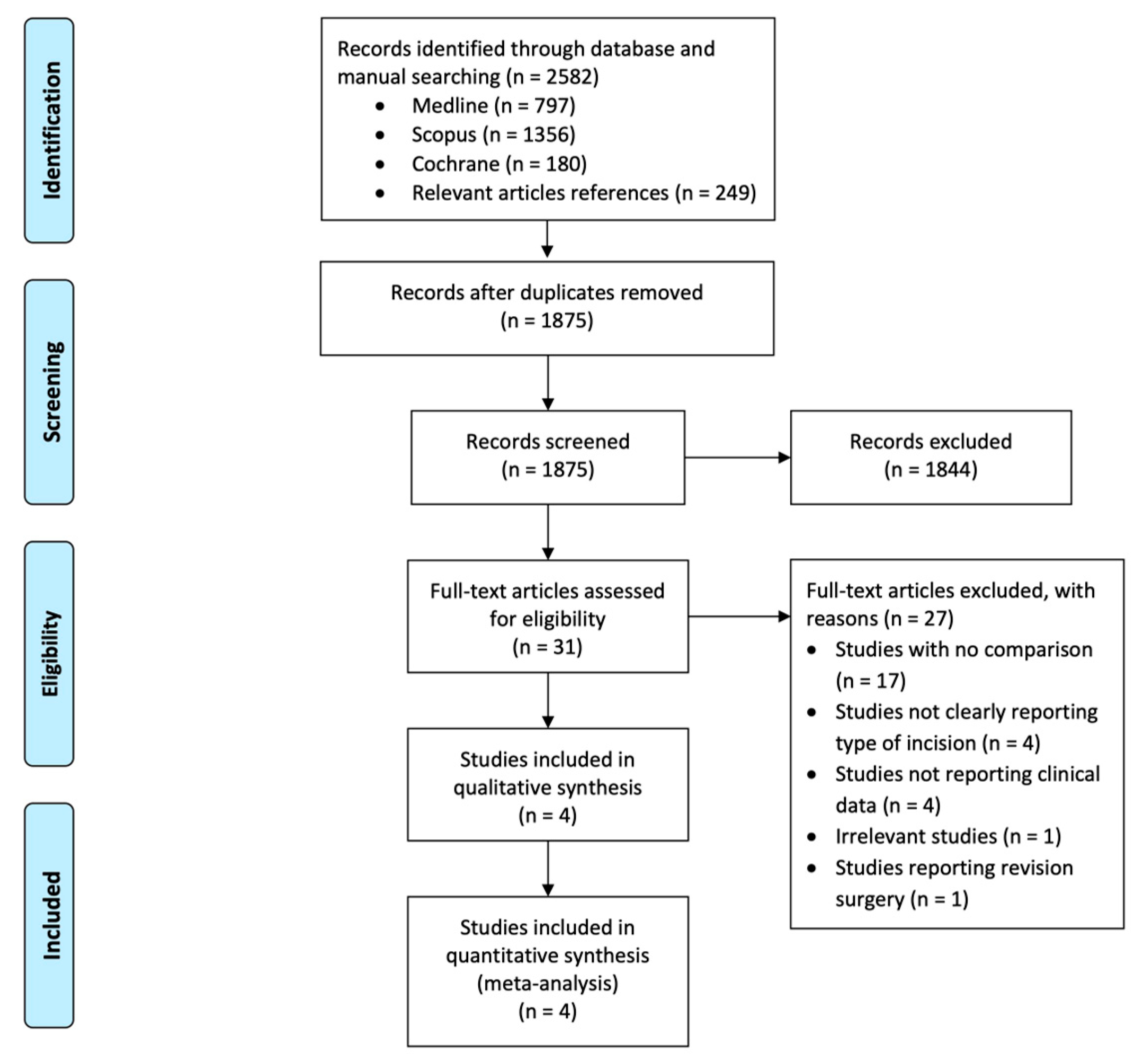
3.1. Study Selection and Study Characteristics
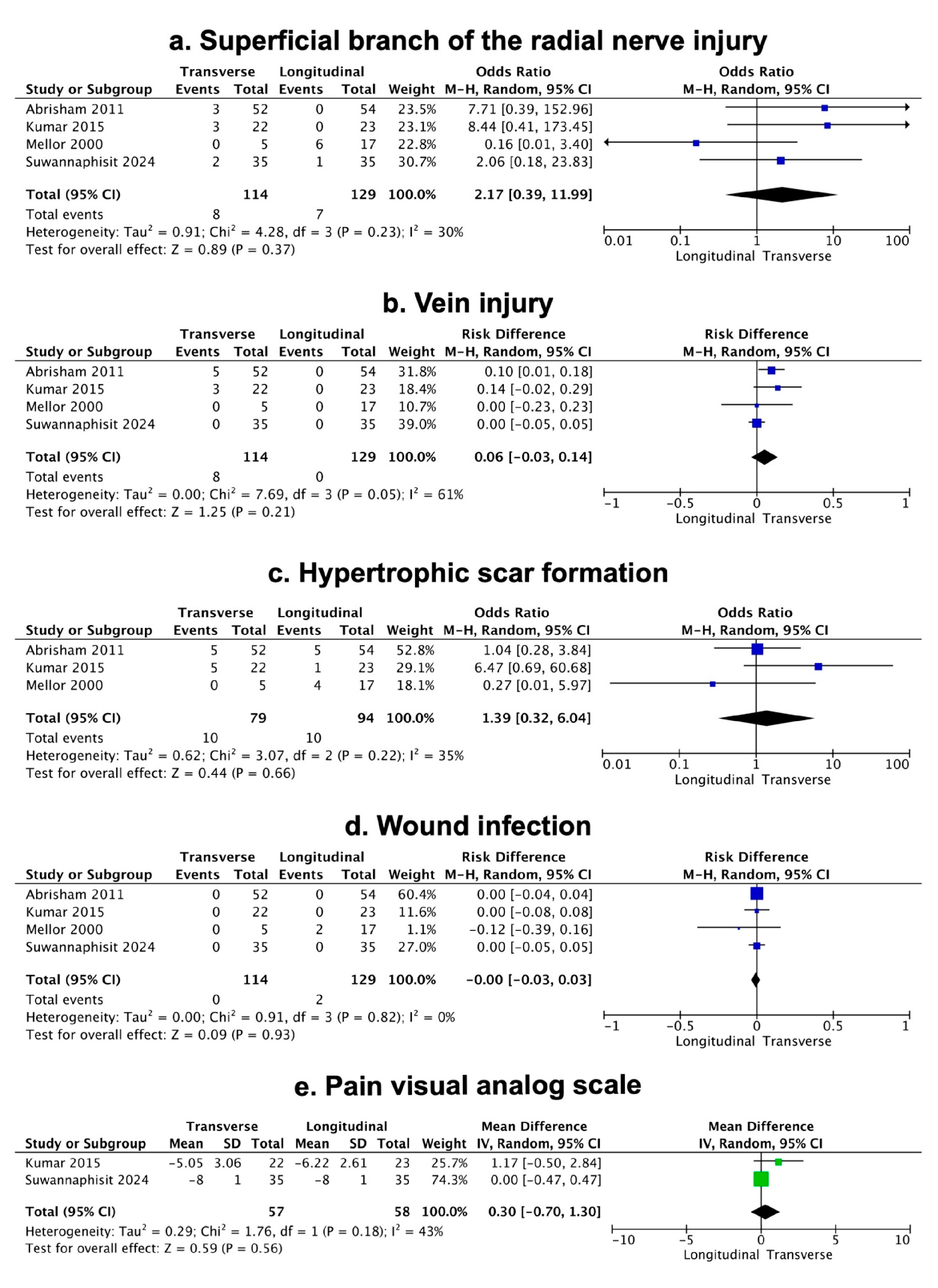
3.2. Comparison of Outcomes
3.3. Heterogeneity Analysis
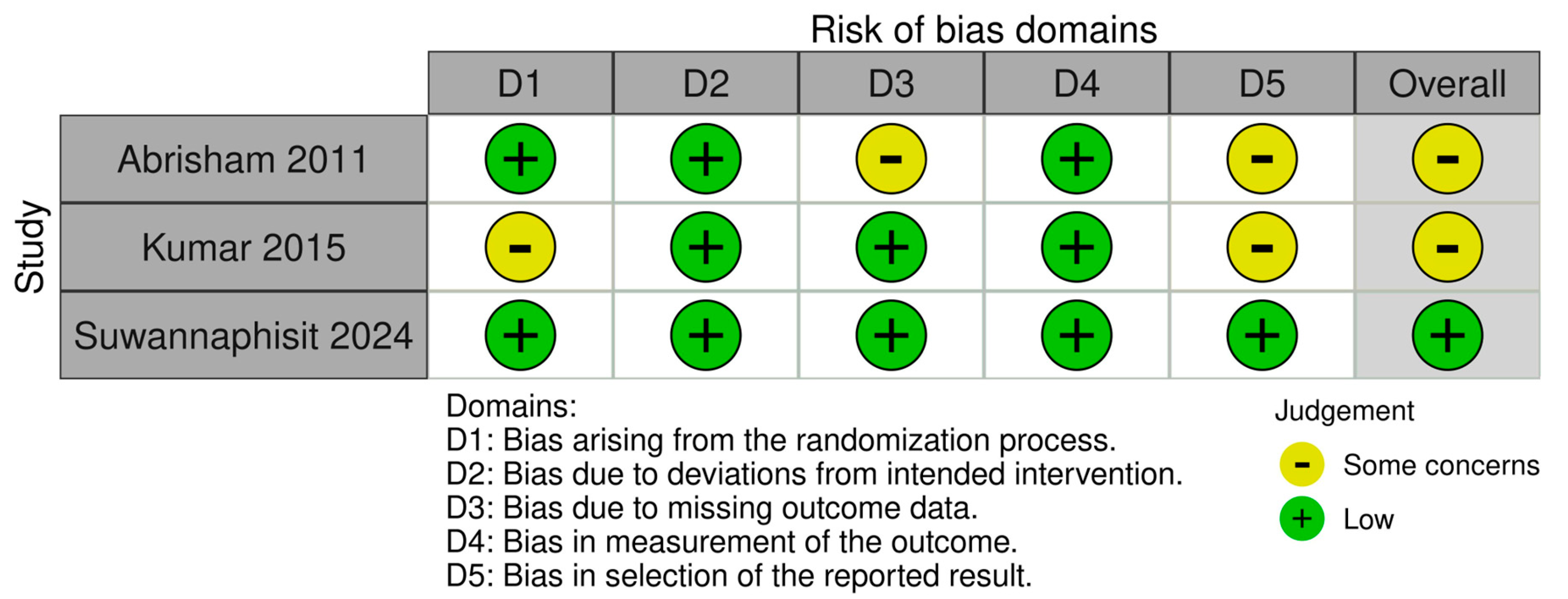
3.4. Methodological Quality Assessment
4. Discussion
4.1. Limitations
4.2. Implications for Future Research
5. Conclusions
Supplementary Materials
Author Contributions
Funding
Conflicts of Interest
References
- Finkelstein, H. Stenosing tendovaginitis at the radial styloid process. J. Bone Jt. Surg. Am. 1930, 12, 509–540. [Google Scholar]
- Challoumas, D.; Ramasubbu, R.; Rooney, E.; Seymour-Jackson, E.; Putti, A.; Millar, N.L. Management of de Quervain Tenosynovitis: A Systematic Review and Network Meta-Analysis. JAMA Netw. Open 2023, 6, e2337001. [Google Scholar] [CrossRef]
- Abi-Rafeh, J.; Kazan, R.; Safran, T.; Thibaudeau, S. Conservative Management of de Quervain Stenosing Tenosynovitis: Review and Presentation of Treatment Algorithm. Plast. Reconstr. Surg. 2020, 146, 105–126. [Google Scholar] [CrossRef] [PubMed]
- Poublon, A.R.; Kleinrensink, G.-J.; Kerver, A.L.A.; Coert, J.H.; Walbeehm, E.T. Optimal surgical approach for the treatment of Quervains disease: A surgical-anatomical study. World J. Orthop. 2018, 9, 7–13. [Google Scholar] [CrossRef] [PubMed]
- Kitridis, D.; Perdikakis, E.; Potoupnis, M.; Pavlidis, L.; Karagergou, E.; Givissis, P. De Quervain Tendinopathy: Anatomical Prognostic Indicators of Corticosteroid Injection Success. J. Pers. Med. 2024, 14, 928. [Google Scholar] [CrossRef] [PubMed]
- Pensak, M.J.; Bayron, J.; Wolf, J.M. Current treatment of de Quervain tendinopathy. J. Hand Surg. Am. 2013, 38, 2247–2249. [Google Scholar] [CrossRef]
- Bruner, J.M. Optimum skin incisions for the surgical relief of stenosing tenosynovitis in the hand. Plast. Reconstr. Surg. 1966, 38, 197–201. [Google Scholar] [CrossRef]
- Ilyas, A.M.; Ast, M.; Schaffer, A.A.; Thoder, J. De quervain tenosynovitis of the wrist. J. Am. Acad. Orthop. Surg. 2007, 15, 757–764. [Google Scholar] [CrossRef]
- Gundes, H.; Tosun, B. Longitudinal incision in surgical release of De Quervain disease. Tech. Hand Up. Extrem. Surg. 2005, 9, 149–152. [Google Scholar] [CrossRef]
- Abrisham, S.J.; Karbasi, M.H.A.; Zare, J.; Behnamfar, Z.; Tafti, A.D.; Shishesaz, B. De qeurvian tenosynovitis: Clinical outcomes of surgical treatment with longitudinal and transverse incision. Oman Med. J. 2011, 26, 91–93. [Google Scholar] [CrossRef]
- Moher, D.; Liberati, A.; Tetzlaff, J.; Altman, D.G. Preferred reporting items for systematic reviews and meta-analyses: The PRISMA statement. BMJ 2009, 339, b2535. [Google Scholar] [CrossRef]
- Salaffi, F.; Stancati, A.; Silvestri, C.A.; Ciapetti, A.; Grassi, W. Minimal clinically important changes in chronic musculoskeletal pain intensity measured on a numerical rating scale. Eur. J. Pain. 2004, 8, 283–291. [Google Scholar] [CrossRef]
- Sterne, J.A.C.; Savović, J.; Page, M.J.; Elbers, R.G.; Blencowe, N.S.; Boutron, I.; Cates, C.J.; Cheng, H.Y.; Corbett, M.S.; Eldridge, S.M.; et al. RoB 2: A revised tool for assessing risk of bias in randomised trials. BMJ 2019, 366, l4898. [Google Scholar] [CrossRef]
- Coleman, B.D.; Khan, K.M.; Maffulli, N.; Cook, J.L.; Wark, J.D. Studies of surgical outcome after patellar tendinopathy: Clinical significance of methodological deficiencies and guidelines for future studies. Scand. J. Med. Sci. Sports 2000, 10, 2–11. [Google Scholar] [CrossRef]
- Guyatt, G.H.; Oxman, A.D.; Vist, G.E.; Kunz, R.; Falck-Ytter, Y.; Alonso-Coello, P.; Schünemann, H.J. GRADE: An emerging consensus on rating quality of evidence and strength of recommendations. BMJ 2008, 336, 924–926. [Google Scholar] [CrossRef] [PubMed]
- Chaimani, A.; Higgins, J.P.T.; Mavridis, D.; Spyridonos, P.; Salanti, G. Graphical tools for network meta-analysis in STATA. PLoS ONE 2013, 8, e76654. [Google Scholar] [CrossRef]
- Mantel, N.; Haenszel, W. Statistical aspects of the analysis of data from retrospective studies of disease. J. Natl. Cancer Inst. 1959, 22, 719–748. [Google Scholar]
- Higgins, J.; Deeks, J. Chapter 9: Analysing data and undertaking meta-analyses. In Cochrane Handbook for Systematic Reviews of Interventions; Higgins, J., Green, S., Eds.; John Willey & Sons: Chichester, UK, 2008; pp. 243–296. [Google Scholar]
- Suwannaphisit, S.; Panichnantho, N.; Fongsri, W.; Suwanno, P. Transverse versus longitudinal skin incision in first extensor tendon release for radial styloid tenosynovitis: A randomized controlled trial. BMC Musculoskelet. Disord. 2024, 25, 969. [Google Scholar] [CrossRef] [PubMed]
- Kumar, K. Outcome of longitudinal versus transverse incision in de Quervain’s disease and its implications in Indian population. Musculoskelet. Surg. 2015, 100, 49–52. [Google Scholar] [CrossRef] [PubMed]
- Mellor, S.J.; Ferris, B.D. Complications of a simple procedure: De Quervain’s disease revisited. Int. J. Clin. Pract. 2000, 54, 76–77. [Google Scholar] [CrossRef]
- Kang, H.J.; Hahn, S.B.; Kim, S.H.; Choi, Y.R. Does endoscopic release of the first extensor compartment have benefits over open release in de Quervain’s disease? J. Plast. Reconstr. Aesthet. Surg. 2011, 64, 1306–1311. [Google Scholar] [CrossRef]
- Suwannaphisit, S.; Chuaychoosakoon, C. Effectiveness of surgical interventions for treating de Quervain’s disease: A systematic review and meta-analysis. Ann. Med. Surg. 2022, 77, 103620. [Google Scholar] [CrossRef]
- Le Viet, D.; Lantieri, L. De Quervain’s tenosynovitis. Transversal scar and fixation of the capsular flap. Rev. Chir. Orthop. Reparatrice Appar. Mot. 1992, 78, 101–106. [Google Scholar] [PubMed]
- Altay, M.A.; Erturk, C.; Isikan, U.E. De Quervain’s disease treatment using partial resection of the extensor retinaculum: A short-term results survey. Orthop. Traumatol. Surg. Res. 2011, 97, 489–493. [Google Scholar] [CrossRef] [PubMed]
- Scheller, A.; Schuh, R.; Hönle, W.; Schuh, A.; Honle, W.; Schuh, A. Long-term results of surgical release of de Quervain’s stenosing tenosynovitis. Int. Orthop. 2009, 33, 1301–1303. [Google Scholar] [CrossRef]
- Bosman, R.; Duraku, L.S.; van der Oest, M.J.W.; Hundepool, C.A.; Rajaratnam, V.; Power, D.M.; Selles, R.W.; Zuidam, J.M. Surgical Treatment Outcome of de Quervain’s Disease: A Systematic Review and Meta-analysis. Plast. Reconstr. Surg. Glob. Open 2022, 10, e4305. [Google Scholar] [CrossRef] [PubMed]
- Garçon, J.J.; Charruau, B.; Marteau, E.; Laulan, J.; Bacle, G. Results of surgical treatment of De Quervain’s tenosynovitis: 80 cases with a mean follow-up of 9.5 years. Orthop. Traumatol. Surg. Res. 2018, 104, 893–896. [Google Scholar] [CrossRef]



| Study | Type of Study | Number of Patients Enrolled (Males/Females) | Losses to Follow-Up | Age, Years | Anesthesia Type | Tourniquet Use | Follow-Up | ||
|---|---|---|---|---|---|---|---|---|---|
| Transverse | Longitudinal | Transverse | Longitudinal | ||||||
| Abrisham et al. [10], 2011 | RCT | 60 (12/48) | 60 (12/48) | 14 | 46.5 | 44 | General | Yes | 3 months |
| Kumar [20], 2015 | RCT | 24 (4/20) | 24 (2/22) | 3 | 36.3 (SD 6.6) | 37.9 (SD 7.4) | Brachial plexus block | Yes | 6 months |
| Mellor et al. [21], 2000 | Retrospective clinical study | 21 (4/17)—1 bilateral | None | 45 (range 30–78) | 14 local, 8 general | Yes | 34 (4–78) months | ||
| Suwannaphisit et al. [19], 2024 | RCT | 35 (4/31) | 35 (3/32) | None | 64 | 63 | Local | Yes | 2, 6, 12 weeks |
Disclaimer/Publisher’s Note: The statements, opinions and data contained in all publications are solely those of the individual author(s) and contributor(s) and not of MDPI and/or the editor(s). MDPI and/or the editor(s) disclaim responsibility for any injury to people or property resulting from any ideas, methods, instructions or products referred to in the content. |
© 2026 by the authors. Published by MDPI on behalf of the Lithuanian University of Health Sciences. Licensee MDPI, Basel, Switzerland. This article is an open access article distributed under the terms and conditions of the Creative Commons Attribution (CC BY) license.
Share and Cite
Kitridis, D.; Karagergou, E.; Givissis, A.; Tsikopoulos, K.; Pavlidis, L.; Potoupnis, M.; Givissis, P. Optimal Skin Incision for the Surgical Treatment of De Quervain Tenosynovitis: A Systematic Review and Meta-Analysis. Medicina 2026, 62, 590. https://doi.org/10.3390/medicina62030590
Kitridis D, Karagergou E, Givissis A, Tsikopoulos K, Pavlidis L, Potoupnis M, Givissis P. Optimal Skin Incision for the Surgical Treatment of De Quervain Tenosynovitis: A Systematic Review and Meta-Analysis. Medicina. 2026; 62(3):590. https://doi.org/10.3390/medicina62030590
Chicago/Turabian StyleKitridis, Dimitrios, Eleni Karagergou, Alexandros Givissis, Konstantinos Tsikopoulos, Leonidas Pavlidis, Michael Potoupnis, and Panagiotis Givissis. 2026. "Optimal Skin Incision for the Surgical Treatment of De Quervain Tenosynovitis: A Systematic Review and Meta-Analysis" Medicina 62, no. 3: 590. https://doi.org/10.3390/medicina62030590
APA StyleKitridis, D., Karagergou, E., Givissis, A., Tsikopoulos, K., Pavlidis, L., Potoupnis, M., & Givissis, P. (2026). Optimal Skin Incision for the Surgical Treatment of De Quervain Tenosynovitis: A Systematic Review and Meta-Analysis. Medicina, 62(3), 590. https://doi.org/10.3390/medicina62030590