Older Adults’ Experiences of Commercial Virtual Reality for Stroke Rehabilitation: A Mixed-Methods Study


Abstract
1. Introduction
2. Materials and Methods
2.1. Design and Setting
2.2. Participants
2.3. VR Exposure: MOVE FAST on a Commercial Wearable VR System (Meta Quest 3, Meta Platforms Inc., Menlo Park, CA, USA)
2.4. Measures
2.4.1. Technology Acceptance Model Questionnaire
2.4.2. Simulator Sickness Questionnaire
2.4.3. Semi-Structured Interviews
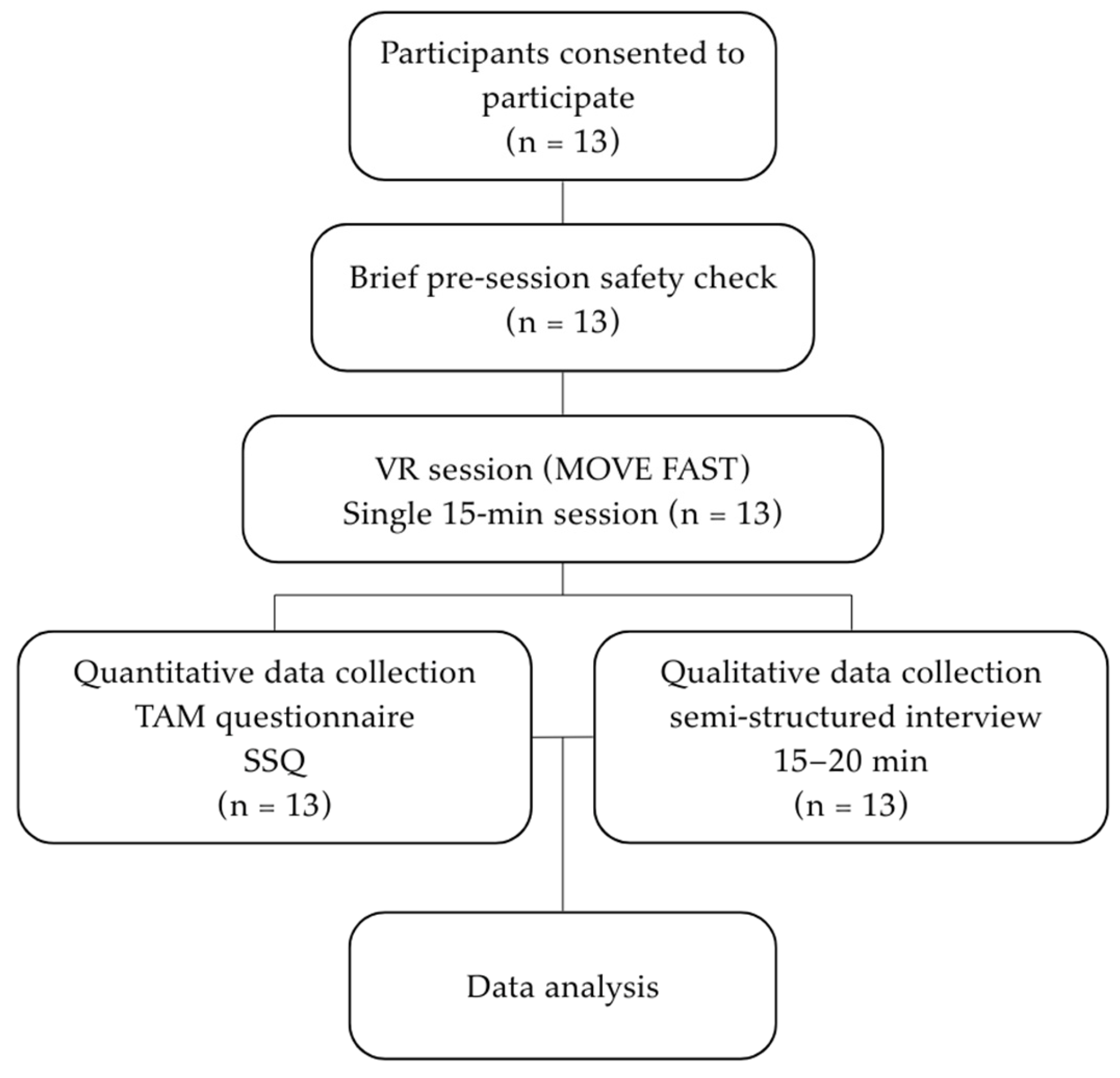
2.5. Procedure
2.6. Data Analysis
3. Results
3.1. Quantitative Results
3.1.1. Demographic Data
3.1.2. Acceptance of VR
3.1.3. Simulator Sickness
3.1.4. Correlation Analyses
3.2. Qualitative Results
3.2.1. Perceived Usability and Accessibility
“It was easy to use. The instructions were simple enough, and I didn’t have to make a huge effort to understand what to do. I could follow along without any confusion.”(P3)
“I gave it a five on the questionnaire because I really thought it was easy. I didn’t feel confused or worried during the experience. I just did what I was told, and it worked fine.”(P4)
“I wasn’t sure what to expect because it was my first time. The colours showed up, and I didn’t know what they meant at first. I got used to it after a while, but in the beginning, I felt a little lost.”(P10)
“It was a bit difficult for me to follow, probably because of my age. I’ve never used anything like this before, and it’s not easy to understand something completely new at this stage in life.”(P9)
3.2.2. Therapeutic Value and Clinical Perception
“I think it will help in the future, especially with how I move my arms. It’s not just playing a game—it’s real movement that requires coordination. That’s important for rehab, I think.”(P11)
“Being able to see the numbers and the feedback was helpful. In regular rehab, it’s not always clear how well you’re doing, but this gave me something I could understand directly.”(P1)
“I guess it was okay, maybe a four out of five. But honestly, I don’t know how useful it was. It didn’t feel like real therapy. It was just punching at things, like a game.”(P3)
“I don’t think this can really help with daily life skills. It’s too different from what I actually need to do every day.”(P9)
3.2.3. Engagement, Motivation, and Enjoyment
“It was fun, really. I don’t usually look forward to rehab, but with this, I kind of wanted to try it again. It felt like something different—not just doing exercises, but playing while moving. That makes a big difference.”(P5)
“It was a fun kind of therapy. I wasn’t just sitting there doing the usual things; I had to focus and respond. I liked that part. I think if more therapies were like this, I’d probably want to keep going.”(P10)
“If I had the opportunity, I’d like to do it again. But I’m not sure I’d choose it over other methods unless it was really shown to be better. I guess it depends on what options I have.”(P4)
“I didn’t dislike it, but I also didn’t feel strongly that I wanted to do it again. It was just okay.”(P11)
3.2.4. Social and Clinical Support
“I haven’t really talked to my family about it, but I think they would be supportive. They usually are. I imagine they’d say something like ‘give it a try.’”(P4)
“I think the rehab staff would recommend it. They seemed positive about it when they explained it to me, though it wasn’t a strong push either way.”(P2)
“I don’t think my doctor or therapists would really recommend this. It seems too new, too experimental. They didn’t say much, so maybe they’re not sure either.”(P11)
3.2.5. Physical and Cognitive Demands
“It was hard to concentrate at times. The things moved quickly on the screen, and I had to react fast. That was a bit stressful, even though it was just a simulation.”(P5)
“The colors and shapes came quickly, and I couldn’t always tell what to do. My reflexes aren’t what they used to be, so it was harder for me to keep up.”(P11)
“I had trouble seeing things clearly. My vision isn’t great anymore, and with the headset on, some parts looked blurry or hard to focus on.”(P9)
“I think it helped with my reaction time. I had to think and move quickly, which I don’t usually do anymore. That’s good practice for me.”(P1)
“Some parts were too fast, but I think that depends on the person. The system should adjust based on the user, because everyone’s reaction time is different.”(P1)
4. Discussion
5. Conclusions
Author Contributions
Funding
Institutional Review Board Statement
Informed Consent Statement
Data Availability Statement
Acknowledgments
Conflicts of Interest
Abbreviations
| FIM | Functional Independence Measure |
| IOC | Index of Item-Objective Congruence |
| MMSE | Mini-Mental State Examination |
| SSQ | Simulator Sickness Questionnaire |
| TAM | Technology Acceptance Model |
| VR | Virtual Reality |
| PEOU | Perceived Ease of Use |
| PU | Perceived Usefulness |
| SI | Social Influence |
| IU | Intention to Use |
| BI | Behavioral Intention |
References
- Feigin, V.L.; Brainin, M.; Norrving, B.; Martins, S.; Sacco, R.L.; Hacke, W.; Fisher, M.; Pandian, J.; Lindsay, P. World Stroke Organization (WSO): Global Stroke Fact Sheet 2022. Int. J. Stroke 2022, 17, 18–29. [Google Scholar] [CrossRef]
- Gittins, M.; Lugo-Palacios, D.; Vail, A.; Bowen, A.; Paley, L.; Bray, B.; Tyson, S. Stroke impairment categories: A new way to classify the effects of stroke based on stroke-related impairments. Clin. Rehabil. 2021, 35, 446–458. [Google Scholar] [CrossRef] [PubMed]
- Palstam, A.; Sjödin, A.; Sunnerhagen, K.S. Participation and autonomy five years after stroke: A longitudinal observational study. PLoS ONE 2019, 14, e0219513. [Google Scholar] [CrossRef] [PubMed]
- Ribeiro de Souza, F.; Sales, M.; Rabelo Laporte, L.; Melo, A.; Manoel da Silva Ribeiro, N. Body structure/function impairments and activity limitations of post-stroke that predict social participation: A systematic review. Top. Stroke Rehabil. 2023, 30, 589–602. [Google Scholar] [CrossRef] [PubMed]
- Alcântara, L.; Figueiredo, T.; Costa, E. Exploring the perceptions and self-perceptions of therapeutic adherence in older adults with chronic conditions: A scoping review. Patient Prefer. Adherence 2025, 19, 503–526. [Google Scholar] [CrossRef]
- Forgea, M.C.; Lyons, A.G.; Lorenz, R.A. Barriers and facilitators to engagement in rehabilitation among stroke survivors: An integrative review. Rehabil. Nurs. 2021, 46, 340–347. [Google Scholar] [CrossRef]
- Xing, F.; Liu, J.; Mei, C.; Chen, J.; Wen, Y.; Zhou, J.; Xie, S. Adherence to rehabilitation exercise and influencing factors among people with acute stroke: A cross-sectional study. Front. Neurol. 2025, 16, 1554949. [Google Scholar] [CrossRef]
- Gwynne-Mayer, N.; Drummond, A.E.; Hancox, J.; Alrubaia, W.; Taylor, I.M. Adherence to exercise rehabilitation programmes in stroke survivors: A scoping review. BMJ Open Sport Exerc. Med. 2025, 11, e002102. [Google Scholar] [CrossRef]
- Laver, K.E.; Lange, B.; George, S.; Deutsch, J.E.; Saposnik, G.; Chapman, M.; Crotty, M. Virtual reality for stroke rehabilitation. Cochrane Database Syst. Rev. 2025, 6, CD008349. [Google Scholar]
- Aderinto, N.; Olatunji, G.; Abdulbasit, M.O.; Edun, M.; Aboderin, G.; Egbunu, E. Exploring the efficacy of virtual reality-based rehabilitation in stroke: A narrative review of current evidence. Ann. Med. 2023, 55, 2285907. [Google Scholar] [CrossRef]
- Khan, A.; Imam, Y.Z.; Muneer, M.; Al Jerdi, S.; Gill, S.K. Virtual reality in stroke recovery: A meta-review of systematic reviews. Bioelectron. Med. 2024, 10, 23. [Google Scholar] [CrossRef]
- Kim, M.; Thawisuk, C.; Kaneko, F.; Kim, H.-D. Effectiveness of VR intervention coupled with treadmill training on gait function for stroke patients: A systematic review. NeuroRehabilitation 2025, 57, 3–13. [Google Scholar] [CrossRef] [PubMed]
- Patsaki, I.; Dimitriadi, N.; Despoti, A.; Tzoumi, D.; Leventakis, N.; Roussou, G.; Papathanasiou, A.; Nanas, S.; Karatzanos, E. The effectiveness of immersive virtual reality in physical recovery of stroke patients: A systematic review. Front. Syst. Neurosci. 2022, 16, 880447. [Google Scholar] [CrossRef] [PubMed]
- Campo-Prieto, P.; Cancela, J.M.; Rodríguez-Fuentes, G. Immersive virtual reality as physical therapy in older adults: Present or future? A systematic review. Virtual Real. 2021, 25, 801–817. [Google Scholar] [CrossRef]
- Ion, L.-A.; Săndulescu, M.I.; Potcovaru, C.-G.; Poenaru, D.; Comișel, A.D.; Ștefureac, Ș.; Lambru, A.C.; Moldoveanu, A.; Anghel, A.M.; Cinteză, D. Immersive Virtual Reality for Stroke Rehabilitation: Linking Clinical and Digital Measures of Motor Recovery—A Pilot Study. Bioengineering 2026, 13, 59. [Google Scholar] [CrossRef]
- Maier, M.; Ballester, B.R.; Verschure, P. Principles of neurorehabilitation after stroke based on motor learning and brain plasticity mechanisms. Front. Syst. Neurosci. 2019, 13, 74. [Google Scholar] [CrossRef]
- Palidis, D.J.; Gardiner, Z.; Stephenson, A.; Zhang, K.; Boruff, J.; Fellows, L.K. The use of extrinsic performance feedback and reward to enhance upper limb motor behavior and recovery post-stroke: A scoping review. Neurorehabil. Neural Repair. 2025, 39, 157–173. [Google Scholar] [CrossRef]
- Maden, T.; Ergen, H.İ.; Pancar, Z.; Buglione, A.; Padulo, J.; Migliaccio, G.M.; Russo, L. The effects of virtual reality-based task-oriented movement on upper extremity function in healthy individuals: A crossover study. Medicina 2025, 61, 668. [Google Scholar] [CrossRef]
- Schaumburg, M.; Imtiaz, A.; Zhou, R.; Bernard, M.; Wolbers, T.; Segen, V. Immersive virtual reality for older adults: Challenges and solutions in basic research and clinical applications. Ageing Res. Rev. 2025, 109, 102771. [Google Scholar] [CrossRef]
- Voinescu, A.; Sui, J.; Stanton Fraser, D. Virtual reality in neurorehabilitation: An umbrella review of meta-analyses. J. Clin. Med. 2021, 10, 1478. [Google Scholar] [CrossRef]
- Kitaria, D.; Mwadulo, M. Adoption of augmented reality (AR) and virtual reality (VR) in healthcare systems. Afr. J. Sci. Technol. Soc. Sci. 2022, 1, 1. [Google Scholar] [CrossRef]
- Prajapati, M.; Kumar, S. Virtual reality revolution in healthcare: A systematic review. Health Technol. 2025, 15, 231–242. [Google Scholar]
- Gustavsson, M.; Kjörk, E.K.; Erhardsson, M.; Alt Murphy, M. Virtual reality gaming in rehabilitation after stroke—User experiences and perceptions. Disabil. Rehabil. 2022, 44, 6759–6765. [Google Scholar] [CrossRef] [PubMed]
- Kim, W.-S.; Cho, S.; Ku, J.; Kim, Y.; Lee, K.; Hwang, H.-J.; Paik, N.-J. Clinical application of virtual reality for upper limb motor rehabilitation in stroke: Review of technologies and clinical evidence. J. Clin. Med. 2020, 9, 3369. [Google Scholar] [CrossRef] [PubMed]
- Cai, J.; Liu, B.; Song, M.; Wang, Q.; Zhou, L. Virtual reality-based rehabilitation experience of stroke survivors: A meta-synthesis of qualitative studies. Front. Public Health 2025, 13, 1538056. [Google Scholar]
- Chen, J.; Or, C.K.; Li, Z.; Yeung, E.H.K.; Chen, T. Perceptions of patients with stroke regarding an immersive virtual reality-based exercise system for upper limb rehabilitation: Questionnaire and interview study. JMIR Serious Games 2025, 13, e49847. [Google Scholar]
- Creswell, J.W.; Clark, V.L.P. Designing and Conducting Mixed Methods Research, 3rd ed.; SAGE Publications: Thousand Oaks, CA, USA, 2018; pp. 53–106. [Google Scholar]
- AlQudah, A.A.; Al-Emran, M.; Shaalan, K. Technology acceptance in healthcare: A systematic review. Appl. Sci. 2021, 11, 10537. [Google Scholar] [CrossRef]
- Shintaro, I.; Tetsuaki, O. Consideration on the accepting factors of digital therapeutics—Analysis of questionnaire surveys using technology acceptance model. Jpn. Soc. Insur. Health Healthc. J. 2022, 4, 2–14. [Google Scholar]
- Kennedy, R.S.; Lane, N.E.; Berbaum, K.S.; Lilienthal, M.G. Simulator Sickness Questionnaire: An enhanced method for quantifying simulator sickness. Int. J. Aviat. Psychol. 1993, 3, 203–220. [Google Scholar] [CrossRef]
- Gauthier, T.D. Detecting trends using Spearman’s rank correlation coefficient. Environ. Forensics 2001, 2, 359–362. [Google Scholar] [CrossRef]
- Proudfoot, K. Inductive/deductive hybrid thematic analysis in mixed methods research. J. Mix. Methods Res. 2023, 17, 308–326. [Google Scholar]
- Fetters, M.D.; Curry, L.A.; Creswell, J.W. Achieving integration in mixed methods designs—Principles and practices. Health Serv. Res. 2013, 48, 2134–2156. [Google Scholar] [CrossRef]
- Kraśnik, W.; Jankowska, O.; Kurzeja, J.; Piotrowicz, K.; Piotrowicz, H.; Bajkacz, A.; Rogala, A.; Osmólska, J. The benefits and challenges of virtual reality application in rehabilitation for chronic conditions. J. Educ. Health Sport 2024, 75, 56379. [Google Scholar] [CrossRef]
- Banikova, S.; Najsrova, A.; Szegedi, I.; Vitova, K.; Fiedorova, I.; Trda, J.; Volny, O. Patient satisfaction and tolerance of virtual reality rehabilitation in subacute ischemic stroke: A pilot study. Front. Rehabil. Sci. 2025, 6, 1538056. [Google Scholar] [CrossRef]
- Appel, L.; Appel, E.; Bogler, O.; Wiseman, M.; Cohen, L.; Ein, N.; Abrams, H.B.; Campos, J.L. Older adults with cognitive and/or physical impairments can benefit from immersive virtual reality experiences: A feasibility study. Front. Med. 2019, 6, 329. [Google Scholar] [CrossRef]
- Bargeri, S.; Scalea, S.; Agosta, F.; Banfi, G.; Corbetta, D.; Filippi, M.; Sarasso, E.; Turolla, A.; Castellini, G.; Gianola, S. Effectiveness and safety of virtual reality rehabilitation after stroke: An overview of systematic reviews. EClinicalMedicine 2023, 64, 102220. [Google Scholar] [CrossRef]
- Li, X.; Nakagawa, T.; Ren, X.; Gondo, Y. The design of visual, cognitive, and physical modalities in VR games for older adults: A systematic review. Int. J. Hum. Comput. Interact. 2025, 41, 10940–10965. [Google Scholar] [CrossRef]
- Zhang, C.; Yu, S. The technology to enhance patient motivation in virtual reality rehabilitation: A review. Games Health J. 2024, 13, 215–233. [Google Scholar] [PubMed]
- Moan, M.E.; Vonstad, E.K.; Su, X.; Vereijken, B.; Solbjør, M.; Skjæret-Maroni, N. Experiences of stroke survivors and clinicians with a fully immersive virtual reality treadmill exergame for stroke rehabilitation: A qualitative pilot study. Front. Aging Neurosci. 2021, 13, 735251. [Google Scholar] [CrossRef]
- Lohse, K.; Shirzad, N.; Verster, A.; Hodges, N.; Van der Loos, H.F.M. Video games and rehabilitation: Using design principles to enhance engagement in physical therapy. J. Neurol. Phys. Ther. 2013, 37, 166–175. [Google Scholar] [CrossRef] [PubMed]
- Mubin, O.; Alnajjar, F.; Al Mahmud, A.; Jishtu, N.; Alsinglawi, B. Exploring serious games for stroke rehabilitation: A scoping review. Disabil. Rehabil. Assist. Technol. 2022, 17, 159–165. [Google Scholar] [CrossRef]
- Rich, T.L.; Truty, T.; Muschler, K.; Gravely, A.; Marth, L.A.; Barrett, B.; Mortimer, D.; Hansen, A.H. Virtual reality game selection for traumatic brain injury rehabilitation: A therapist’s wish list for game developers. Games Health J. 2023, 12, 445–449. [Google Scholar] [CrossRef] [PubMed]
- Kho, M.E.; Thabane, L. Pilot and feasibility studies in rehabilitation: Moving into the next decade. Physiother. Can. 2020, 72, 225–227. [Google Scholar] [CrossRef] [PubMed]


| Participant | Sex | Diagnosis | Age | Level of Education | MMSE | FIM |
|---|---|---|---|---|---|---|
| P1 | Man | Hemorrhagic | 74 | Advanced Diploma | 30 | 118 |
| P2 | Man | Hemorrhagic | 94 | Bachelor | 30 | 93 |
| P3 | Man | Ischemic | 71 | High School | 30 | 116 |
| P4 | Woman | Hemorrhagic | 81 | High School | 29 | 96 |
| P5 | Man | Hemorrhagic | 82 | High School | 29 | 71 |
| P6 | Man | Ischemic | 74 | High School | 30 | 125 |
| P7 | Man | Hemorrhagic | 90 | High School | 24 | 74 |
| P8 | Man | Hemorrhagic | 81 | High School | 25 | 53 |
| P9 | Woman | Ischemic | 76 | High School | 29 | 122 |
| P10 | Man | Hemorrhagic | 81 | High School | 25 | 53 |
| P11 | Woman | Hemorrhagic | 70 | High School | 28 | 105 |
| P12 | Woman | Hemorrhagic | 71 | High School | 26 | 80 |
| P13 | Man | Ischemic | 84 | High School | 28 | 98 |
| Domain | Item | M | SD |
|---|---|---|---|
| Perceived Ease of Use | VR is easy to understand and easy to use. | 4.54 | 0.75 |
| VR can be mastered without much effort. | 4.23 | 0.97 | |
| VR helps in therapy. | 4.46 | 0.50 | |
| Domain average | 4.41 | 0.78 | |
| Perceived Usefulness | VR improves performance in daily living activities. | 4.15 | 0.77 |
| Social Influence | Family/friends support VR use. | 4.31 | 0.91 |
| Healthcare team recommends VR. | 4.38 | 0.84 | |
| Domain average | 4.35 | 0.88 | |
| Intention to Use | VR therapy is enjoyable. | 4.77 | 0.42 |
| Behavioral Intention | I plan to continue using VR in therapy. | 4.38 | 0.84 |
| I will continue to use VR even if other options are available. | 4.08 | 0.83 | |
| I will continue to use VR in therapy even if it requires effort. | 4.15 | 0.66 | |
| Domain average | 4.21 | 0.79 |
| Symptom | No Symptom | Mild | Moderate | Severe |
|---|---|---|---|---|
| General discomfort | - | 13 | - | - |
| Fatigue | - | 10 | 2 | 1 |
| Headache | - | 13 | - | - |
| Eyestrain | - | 11 | 2 | - |
| Difficulty focusing | - | 12 | - | 1 |
| Increased salivation | - | 11 | 2 | - |
| Sweating | - | 11 | 2 | - |
| Nausea | - | 13 | - | - |
| Difficulty concentrating | - | 9 | 4 | - |
| Fullness of head | - | 13 | - | - |
| Blurred vision | - | 11 | 2 | - |
| Dizziness (eyes open) | - | 13 | - | - |
| Dizziness (eyes closed) | - | 13 | - | - |
| Vertigo | - | 13 | - | - |
| Stomach awareness | - | 13 | - | - |
| Burping | - | 13 | - | - |
| Predictor | Outcome | rs | p-Value |
|---|---|---|---|
| Age (years) | PEOU | 0.082 | 0.790 |
| PU | −0.015 | 0.962 | |
| SI | 0.404 | 0.171 | |
| IU | −0.049 | 0.873 | |
| BI | 0.119 | 0.699 | |
| SSQ | 0.568 * | 0.043 * | |
| MMSE score | PEOU | 0.364 | 0.222 |
| PU | −0.072 | 0.816 | |
| SI | 0.074 | 0.810 | |
| IU | −0.025 | 0.936 | |
| BI | −0.286 | 0.344 | |
| SSQ | +0.052 | 0.867 |
| Theme | Sub-Theme |
|---|---|
| 1. Perceived Usability and Accessibility | Ease of Use and Interface Clarity |
| First-Time Confusion and Learning Curve | |
| Age-Related Accessibility Barriers | |
| 2. Therapeutic Value and Clinical Perception | Perceived Contribution to Physical Recovery |
| Usefulness of Measurable Feedback | |
| Skepticism Toward Clinical Impact | |
| 3. Engagement, Motivation, and Enjoyment | Enjoyment and Positive Emotional Response |
| Increased Willingness to Participate in Rehabilitation | |
| Conditional or Moderate Motivation | |
| 4. Social and Clinical Support | Perceived Support from Family or Friends |
| Ambiguity in Clinical Endorsement | |
| 5. Physical and Cognitive Demands | Sensory and Cognitive Load |
| Positive Challenge and Cognitive Stimulation | |
| Need for Individualised Calibration |
Disclaimer/Publisher’s Note: The statements, opinions and data contained in all publications are solely those of the individual author(s) and contributor(s) and not of MDPI and/or the editor(s). MDPI and/or the editor(s) disclaim responsibility for any injury to people or property resulting from any ideas, methods, instructions or products referred to in the content. |
© 2026 by the authors. Published by MDPI on behalf of the Lithuanian University of Health Sciences. Licensee MDPI, Basel, Switzerland. This article is an open access article distributed under the terms and conditions of the Creative Commons Attribution (CC BY) license.
Share and Cite
Kim, M.; Thawisuk, C.; Uetake, S.; Kim, H.-D. Older Adults’ Experiences of Commercial Virtual Reality for Stroke Rehabilitation: A Mixed-Methods Study. Medicina 2026, 62, 577. https://doi.org/10.3390/medicina62030577
Kim M, Thawisuk C, Uetake S, Kim H-D. Older Adults’ Experiences of Commercial Virtual Reality for Stroke Rehabilitation: A Mixed-Methods Study. Medicina. 2026; 62(3):577. https://doi.org/10.3390/medicina62030577
Chicago/Turabian StyleKim, Minjoon, Chirathip Thawisuk, Shunichi Uetake, and Hyeong-Dong Kim. 2026. "Older Adults’ Experiences of Commercial Virtual Reality for Stroke Rehabilitation: A Mixed-Methods Study" Medicina 62, no. 3: 577. https://doi.org/10.3390/medicina62030577
APA StyleKim, M., Thawisuk, C., Uetake, S., & Kim, H.-D. (2026). Older Adults’ Experiences of Commercial Virtual Reality for Stroke Rehabilitation: A Mixed-Methods Study. Medicina, 62(3), 577. https://doi.org/10.3390/medicina62030577