
Immersive Virtual Reality Exercise: Effects on Cortisol, Quality of Life, Cognitive Function, and Psychological Symptoms in Fibromyalgia
 , , , , ,
  ,
,  , and
, and
Abstract
1. Introduction
2. Materials and Methods
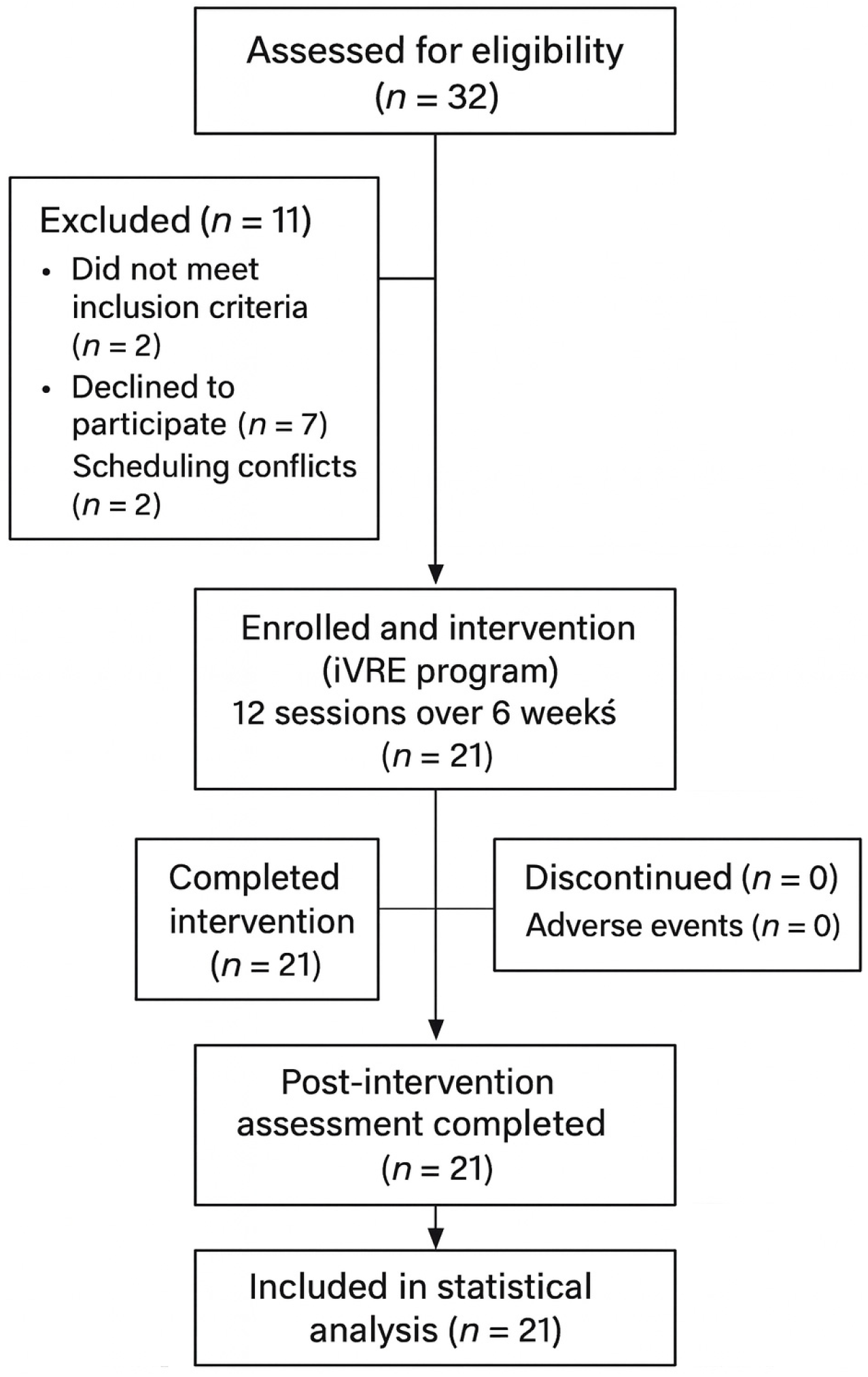
2.1. Design and Subjects
- (i)
- Inclusion: Individuals over 18 years of age diagnosed with FM, with the diagnosis previously established by a medical professional according to the updated diagnostic criteria for FM [25].
- (ii)
- Exclusion: Pregnant or breastfeeding women, as well as individuals with cancer-related pain, uncontrolled metabolic disorders, vertigo, or other conditions that could interfere with the intervention. Participants with physical or cognitive limitations that hindered effective communication with the research team or prevented the proper execution of the sessions were also excluded.
2.2. Intervention (iVRE)
- Phase 1: During the first five minutes, general mobility exercises were performed targeting the upper and lower limbs as well as the spine. The aim of this stage was to prepare the body for the main activity, promoting progressive joint and muscle activation. Guidance was provided by a virtual avatar, which instructed participants through clear verbal cues and real-time visual demonstrations, thereby ensuring safe and technically correct execution of each movement. This interactive interface helped maintain attention, facilitated understanding of motor sequences, and promoted autonomy throughout the session.
- Phase 2: The second phase corresponded to the main activity within the virtual environment. In this stage, participants performed the exercise standing and could choose among three available modalities: aerobox, dance fitness, or zumba. Each option offered a distinct focus in terms of rhythm, coordination, and physical effort, allowing the experience to be adapted to individual interests and capabilities while maintaining a common therapeutic goal. During the activity, participants were guided by a virtual trainer who appeared through video and voice instructions. This trainer provided clear, sequential guidance combined with motivational prompts aimed at sustaining engagement and concentration throughout the session. The digital environment also delivered immediate feedback through auditory and visual stimuli, including floating targets indicating the required movements. These elements facilitated motor synchronization, sequence tracking, and real-time performance perception, reinforcing both the playful and therapeutic components of the experience.
- Phase 3: The final phase of each session was devoted to a cool-down period lasting approximately five minutes. During this stage, participants performed gentle joint mobility exercises focused on the spine and extremities, aimed at promoting progressive recovery after the main activity. This phase was complemented with a series of muscle stretches designed to reduce accumulated tension and prevent post-exercise discomfort. In addition, conscious breathing exercises were incorporated to foster participant relaxation.
2.3. Assessment of Outcomes
2.3.1. Impact of FM on Quality of Life
2.3.2. Stress, Anxiety and Depression
2.3.3. Cortisol
2.3.4. Adverse Events
2.4. Statistical Analysis
3. Results
4. Discussion
5. Conclusions
Author Contributions
Funding
Institutional Review Board Statement
Informed Consent Statement
Data Availability Statement
Acknowledgments
Conflicts of Interest
Abbreviations
| FM | Fibromyalgia |
| iVRE | Immersive virtual reality exercise |
| IVR | Immersive virtual reality |
| HPA | Hypothalamic–pituitary–adrenal (axis) |
| FIQ-R | Revised Fibromyalgia Impact Questionnaire |
| DASS-21 | Depression Anxiety Stress Scales–21 items |
| MoCA | Montreal Cognitive Assessment |
| SD | Standard deviation |
| n | Sample |
| % | Percentage |
| NSAIDs | Nonsteroidal Anti-Inflammatory Drugs |
| 4PL | Four-parameter logistic |
| TMB | Tetramethylbenzidine |
| VCM | Vice-Rector’s Office for University Outreach |
References
- Di Carlo, M.; Bianchi, B.; Salaffi, F.; Pellegrino, G.; Iannuccelli, C.; Giorgi, V.; Sarzi-Puttini, P. Fibromyalgia: One year in review 2024. Clin. Exp. Rheumatol. 2024, 42, 1141–1149. [Google Scholar] [CrossRef]
- Brill, S.; Ablin, J.N.; Goor-Aryeh, I.; Hyat, K.; Slefer, A.; Buskila, D. Prevalence of fibromyalgia syndrome in patients referred to a tertiary pain clinic. J. Investig. Med. 2012, 60, 685–688. [Google Scholar] [CrossRef] [PubMed]
- Fors, E.A.; Wensaas, K.A.; Helvik, A.S. Prevalence and characteristics of fibromyalgia according to three fibromyalgia diagnostic criteria: A secondary analysis study. Scand. J. Pain 2024, 24, 20230143. [Google Scholar] [CrossRef]
- Cojocaru, C.M.; Popa, C.O.; Schenk, A.; Suciu, B.A.; Szasz, S. Cognitive-behavioral therapy and acceptance and commitment therapy for anxiety and depression in patients with fibromyalgia: A systematic review and meta-analysis. Med. Pharm. Rep. 2024, 97, 26–34. [Google Scholar] [CrossRef] [PubMed]
- Bair, M.J.; Krebs, E.E. Fibromyalgia. Ann. Intern. Med. 2020, 172, ITC33. [Google Scholar] [CrossRef]
- Aghbelaghi, D.T.; Jalali, M.; Tayim, N.; Kiyani, R. A Network Analysis of Depression and Cognitive Impairments in Fibromyalgia: A Secondary Analysis Study. Psychiatr. Q. 2025, 96, 39–57. [Google Scholar] [CrossRef]
- Kravitz, H.M.; Katz, R.S. Fibrofog and fibromyalgia: A narrative review and implications for clinical practice. Rheumatol. Int. 2015, 35, 1115–1125. [Google Scholar] [CrossRef]
- Karper, W.B.; Letvak, S.A. Fibromyalgia, Fibro Fog, and Exercise. Holist. Nurs. Pract. 2015, 29, 190–193. [Google Scholar] [CrossRef]
- Fernandez-Feijoo, F.; Samartin-Veiga, N.; Carrillo-de-la-Peña, M.T. Quality of life in patients with fibromyalgia: Contributions of disease symptoms, lifestyle and multi-medication. Front. Psychol. 2022, 13, 924405. [Google Scholar] [CrossRef] [PubMed]
- Al Sharie, S.; Varga, S.J.; Al-Husinat, L.; Sarzi-Puttini, P.; Araydah, M.; Bal’awi, B.R.; Varrassi, G. Unraveling the Complex Web of Fibromyalgia: A Narrative Review. Medicina 2024, 60, 272. [Google Scholar] [CrossRef]
- Barceló-Martinez, E.; Gelves-Ospina, M.; Navarro Lechuga, E.; Allegri, R.F.; Orozco-Acosta, E.; Benítez-Agudelo, J.C.; Leon-Jacobus, A.; Roman, N.F. Serum cortisol levels and neuropsychological impairments in patients diagnosed with Fibromyalgia. Actas Esp. Psiquiatr. 2018, 46, 1–11. [Google Scholar]
- Beiner, E.; Lucas, V.; Reichert, J.; Buhai, D.V.; Jesinghaus, M.; Vock, S.; Drusko, A.; Baumeister, D.; Eich, W.; Friederich, H.-C.; et al. Stress biomarkers in individuals with fibromyalgia syndrome: A systematic review with meta-analysis. Pain 2023, 164, 1416–1427. [Google Scholar] [CrossRef] [PubMed]
- Becker, S.; Schweinhardt, P. Dysfunctional neurotransmitter systems in fibromyalgia, their role in central stress circuitry and pharmacological actions on these systems. Pain Res. Treat. 2012, 2012, 741746. [Google Scholar] [CrossRef]
- Jones, E.A.; Asaad, F.; Patel, N.; Jain, E.; Abd-Elsayed, A. Management of Fibromyalgia: An Update. Biomedicines 2024, 12, 1266. [Google Scholar] [CrossRef]
- Häuser, W.; Fitzcharles, M.A. Adherence to Clinical Guidelines for Fibromyalgia: Help or Hindrance? Can. J. Pain 2023, 7, 2255070. [Google Scholar] [CrossRef] [PubMed]
- Climent-Sanz, C.; Hamilton, K.R.; Martínez-Navarro, O.; Briones-Vozmediano, E.; Gracia-Lasheras, M.; Fernández-Lago, H.; Valenzuela-Pascual, F.; Finan, P.H. Fibromyalgia pain management effectiveness from the patient perspective: A qualitative evidence synthesis. Disabil. Rehabil. 2024, 46, 4595–4610. [Google Scholar] [CrossRef]
- Cardenas-Rojas, A.; Pacheco-Barrios, K.; Castelo-Branco, L.; Giannoni-Luza, S.; Balbuena-Pareja, A.; Luna-Cuadros, M.A.; Felippe, L.V.; Uygur-Kucukseymen, E.; Gonzalez-Mego, P.; Gunduz, M.E.; et al. Barriers and facilitators for clinical trial participation of underrepresented and non-underrepresented fibromyalgia patients: A cross-sectional internet survey. Heliyon 2021, 7, e07475. [Google Scholar] [CrossRef] [PubMed]
- Emmelkamp, P.M.G.; Meyerbröker, K. Virtual Reality Therapy in Mental Health. Annual Review of Clinical Psychology. Annu. Rev. 2021, 17, 495–519. [Google Scholar]
- Bargeri, S.; Scalea, S.; Agosta, F.; Banfi, G.; Corbetta, D.; Filippi, M.; Sarasso, E.; Turolla, A.; Castellini, G.; Gianola, S. Effectiveness and safety of virtual reality rehabilitation after stroke: An overview of systematic reviews. eClinicalMedicine 2023, 64, 102220. [Google Scholar] [CrossRef]
- García-Bravo, S.; Cuesta-Gómez, A.; Campuzano-Ruiz, R.; López-Navas, M.J.; Domínguez-Paniagua, J.; Araújo-Narváez, A.; Barreñada-Copete, E.; García-Bravo, C.; Flórez-García, M.T.; Botas-Rodríguez, J.; et al. Virtual reality and video games in cardiac rehabilitation programs. A systematic review. Disabil. Rehabil. 2021, 43, 448–457. [Google Scholar] [CrossRef] [PubMed]
- Brea-Gómez, B.; Pérez-Gisbert, L.; Fernández-Castro, I.; Valenza, M.C.; Torres-Sánchez, I. Effects of Virtual Reality-Based Rehabilitation in the Treatment of Patients with Fibromyalgia Syndrome: A Systematic Review and Meta-Analysis of Randomized Clinical Trials. Games Health J. 2025, 14, 79–102. [Google Scholar] [CrossRef]
- Gulsen, C.; Soke, F.; Eldemir, K.; Apaydin, Y.; Ozkul, C.; Guclu-Gunduz, A.; Akcali, D.T. Effect of fully immersive virtual reality treatment combined with exercise in fibromyalgia patients: A randomized controlled trial. Assist. Technol. 2022, 34, 256–263. [Google Scholar] [CrossRef] [PubMed]
- Cortés-Pérez, I.; Zagalaz-Anula, N.; Ibancos-Losada, M.D.; Nieto-Escámez, F.A.; Obrero-Gaitán, E.; Osuna-Pérez, M.C. Virtual Reality-Based Therapy Reduces the Disabling Impact of Fibromyalgia Syndrome in Women: Systematic Review with Meta-Analysis of Randomized Controlled Trials. J. Pers. Med. 2021, 11, 1167. [Google Scholar] [CrossRef] [PubMed]
- World Medical Association. World Medical Association Declaration of Helsinki: Ethical principles for medical research involving human subjects. JAMA 2013, 310, 2191–2194. [Google Scholar] [CrossRef]
- Wolfe, F.; Clauw, D.J.; Fitzcharles, M.A.; Goldenberg, D.L.; Häuser, W.; Katz, R.L.; Mease, P.J.; Russell, A.S.; Russell, I.J.; Walitt, B. 2016 Revisions to the 2010/2011 fibromyalgia diagnostic criteria. Semin. Arthritis Rheum. 2016, 46, 319–329. [Google Scholar] [CrossRef]
- Goudman, L.; Jansen, J.; Billot, M.; Vets, N.; De Smedt, A.; Roulaud, M.; Rigoard, P.; Moens, M. Virtual reality applications in chronic pain management: Systematic review and meta-analysis. JMIR Serious Games 2022, 10, e34402. [Google Scholar] [CrossRef]
- Huang, Q.; Lin, J.; Han, R.; Peng, C.; Huang, A. Using Virtual Reality Exposure Therapy in Pain Management: A Systematic Review and Meta-Analysis of Randomized Controlled Trials. Value Health 2022, 25, 288–301. [Google Scholar] [CrossRef] [PubMed]
- Joo, Y.; Kim, E.K.; Song, H.G.; Jung, H.; Park, H.; Moon, J.Y. Effectiveness of virtual reality immersion on procedure-related pain and anxiety in outpatient pain clinic: An exploratory randomized controlled trial. Korean J. Pain 2021, 34, 304–314. [Google Scholar] [CrossRef]
- Bennett, R.M.; Friend, R.; Jones, K.D.; Ward, R.; Han, B.K.; Ross, R.L. The Revised Fibromyalgia Impact Questionnaire (FIQR): Validation and psychometric properties. Arthritis Res. Ther. 2009, 11, R120. [Google Scholar] [CrossRef]
- Salgueiro, M.; García-Leiva, J.M.; Ballesteros, J.; Hidalgo, J.; Molina, R.; Calandre, E.P. Validation of a Spanish version of the Revised Fibromyalgia Impact Questionnaire (FIQR). Health Qual. Life Outcomes 2013, 11, 132. [Google Scholar] [CrossRef]
- Medvedev, O.N. Depression Anxiety Stress Scales (DASS-21) in International Contexts. In International Handbook of Behavioral Health Assessment [Internet]; Krägeloh, C.U., Alyami, M., Medvedev, O.N., Eds.; Springer International Publishing: Cham, Switzerland, 2023; pp. 1–15. [Google Scholar] [CrossRef]
- Olano, M.O.V.; Ojeda, S.P.C.; Delgado, C.H. Un recurso para atención primaria de la salud mental. DASS-21, propiedades psicométricas. Rev. Peru. Investig. Salud 2022, 6, 141–148. [Google Scholar] [CrossRef]
- Lee, A.; Jang, S.; Lee, S.; Park, H.K.; Kim, I.Y.; Ahn, R.; Seok, J.-H.; Lee, K.-R. Comparative analysis of salivary cortisol measurements using different assay methods in relation to serum-free cortisol measurement. Pract. Lab. Med. 2024, 40, e00393. [Google Scholar] [CrossRef] [PubMed]
- Pandit, P.; Crewther, B.; Cook, C.; Punyadeera, C.; Pandey, A.K. Sensing methods for stress biomarker detection in human saliva: A new frontier for wearable electronics and biosensing. Mater. Adv. 2024, 5, 5339–5350. [Google Scholar] [CrossRef]
- Simón-Vicente, L.; Rodríguez-Cano, S.; Delgado-Benito, V.; Ausín-Villaverde, V.; Cubo Delgado, E. Cybersickness. A systematic literature review of adverse effects related to virtual reality. Neurología 2024, 39, 701–709. [Google Scholar] [CrossRef]
- Jørgensen, L.B.; Bricca, A.; Bernhardt, A.; Juhl, C.B.; Tang, L.H.; Mortensen, S.R.; Eriksen, J.A.; Walløe, S.; Skou, S.T. Objectively measured physical activity levels and adherence to physical activity guidelines in people with multimorbidity-A systematic review and meta-analysis. PLoS ONE 2022, 17, e0274846. [Google Scholar] [CrossRef]
- Polat, M.; Kahveci, A.; Muci, B.; Günendi, Z.; Kaymak Karataş, G. The effect of virtual reality exercises on pain, functionality, cardiopulmonary capacity, and quality of life in fibromyalgia syndrome: A randomized controlled study. Games Health 2021, 10, 165–173. [Google Scholar] [CrossRef]
- Garcia-Palacios, A.; Herrero, R.; Vizcaíno, Y.; Belmonte, M.A.; Castilla, D.; Molinari, G.; Baños, R.M.; Botella, C. Integrating virtual reality with activity management for the treatment of fibromyalgia: Acceptability and preliminary efficacy. Clin. J. Pain 2015, 31, 564–572. [Google Scholar] [CrossRef]
- Bardelli, C.L.; Chittaro, L.; Longhino, S.; Quartuccio, L. An immersive virtual reality exergame as a patient education approach in fibromyalgia: Pilot study. Digit. Health 2025, 11, 20552076241304904. [Google Scholar] [CrossRef] [PubMed]
- Morris, L.D.; Louw, Q.A.; Grimmer, K.A.; Meintjes, E. Targeting pain catastrophization in patients with fibromyalgia using virtual reality exposure therapy: A proof-of-concept study. J. Phys. Ther. Sci. 2015, 27, 3461–3467. [Google Scholar] [CrossRef] [PubMed]
- Herrero, R.; García-Palacios, A.; Castilla, D.; Molinari, G.; Botella, C. Virtual Reality for the Induction of Positive Emotions in the Treatment of Fibromyalgia: A Pilot Study over Acceptability, Satisfaction, and the Effect of Virtual Reality on Mood. Cyberpsychology Behav. Soc. Netw. 2014, 17, 379–384. [Google Scholar] [CrossRef]
- Chittaro, L.; Longhino, S.; Serafini, M.; Cacioppo, S.; Quartuccio, L. Efficacy of Immersive Virtual Reality Combined with Multisensor Biofeedback on Chronic Pain in Fibromyalgia: A Pilot Randomized Controlled Trial. ACR Open Rheumatol. 2025, 7, e70048. [Google Scholar] [CrossRef]
- Gupta, A.; Scott, K.; Dukewich, M. Innovative Technology Using Virtual Reality in the Treatment of Pain: Does It Reduce Pain via Distraction, or Is There More to It? Pain Med. 2018, 19, 151–159. [Google Scholar] [CrossRef] [PubMed]
- Brown, P.; Powell, W.; Dansey, N.; Al-Abbadey, M.; Stevens, B.; Powell, V. Virtual Reality as a Pain Distraction Modality for Experimentally Induced Pain in a Chronic Pain Population: An Exploratory Study. Cyberpsychology Behav. Soc. Netw. 2022, 25, 66–71. [Google Scholar] [CrossRef] [PubMed]
- Rubio-Zarapuz, A.; Apolo-Arenas, M.D.; Tomas-Carus, P.; Tornero-Aguilera, J.F.; Clemente-Suárez, V.J.; Parraca, J.A. Comparative Analysis of Psychophysiological Responses in Fibromyalgia Patients: Evaluating Neuromodulation Alone, Neuromodulation Combined with Virtual Reality, and Exercise Interventions. Medicina 2024, 60, 404. [Google Scholar] [CrossRef] [PubMed]
- Drigas, A.; Sideraki, A. Brain Neuroplasticity Leveraging Virtual Reality and Brain–Computer Interface Technologies. Sensors 2024, 24, 5725. [Google Scholar] [CrossRef]
- Čeko, M.; Baeuerle, T.; Webster, L.; Wager, T.D.; Lumley, M.A. The effects of virtual reality neuroscience-based therapy on clinical and neuroimaging outcomes in patients with chronic back pain: A randomized clinical trial. Pain 2024, 165, 1860–1874. [Google Scholar] [CrossRef]
- Yu, M.; Xiao, S.; Hua, M.; Wang, H.; Chen, X.; Tian, F.; Li, Y. EEG-based emotion recognition in an immersive virtual reality environment: From local activity to brain network features. Biomed. Signal Process. Control. 2022, 72, 103349. [Google Scholar] [CrossRef]
- Enriquez-Geppert, S.; Huster, R.J.; Herrmann, C.S. EEG-Neurofeedback as a Tool to Modulate Cognition and Behavior: A Review Tutorial. Front. Hum. Neurosci. 2017, 11, 51. [Google Scholar] [CrossRef]
- Daly, J.J.; Wolpaw, J.R. Brain–computer interfaces in neurological rehabilitation. Lancet Neurol. 2008, 7, 1032–1043. [Google Scholar] [CrossRef]
- Teicher, M.H.; Samson, J.A.; Anderson, C.M.; Ohashi, K. The effects of childhood maltreatment on brain structure, function and connectivity. Nat. Rev. Neurosci. 2016, 17, 652–666. [Google Scholar] [CrossRef] [PubMed]
- Anilkumar, A.S.; Veerabathiran, R. Harnessing Neuroplasticity for Disability Rehabilitation: Scientific Insights and Practical Applications. In The Palgrave Encyclopedia of Disability; Bennett, G., Goodall, E., Eds.; Springer Nature: Cham, Switzerland, 2025; pp. 1–18. [Google Scholar] [CrossRef]
- Marzola, P.; Melzer, T.; Pavesi, E.; Gil-Mohapel, J.; Brocardo, P.S. Exploring the Role of Neuroplasticity in Development, Aging, and Neurodegeneration. Brain Sci. 2023, 1, 1610. [Google Scholar] [CrossRef] [PubMed]
- Murillo-Garcia, A.; Leon-Llamas, J.L.; Villafaina, S.; Rohlfs-Dominguez, P.; Gusi, N. MoCA vs. MMSE of Fibromyalgia Patients: The Possible Role of Dual-Task Tests in Detecting Cognitive Impairment. J. Clin. Med. 2021, 10, 125. [Google Scholar] [CrossRef] [PubMed]
- Long, Y.; Xie, X.; Wang, Y.; Xu, J.; Gao, Z.; Fang, X.; Xu, T.; Zhang, N.; Lv, D.; Wu, T. Atrophy patterns in hippocampal subregions and their relationship with cognitive function in fibromyalgia patients with mild cognitive impairment. Front. Neurosci. 2024, 18, 1380121. [Google Scholar] [CrossRef]
- Serrano, P.V.; Zortea, M.; Alves, R.L.; Beltran, G.; Deliberali, C.B.; Maule, A.; Torres, I.L.S.; Fregni, F.; Caumo, W. Association between descending pain modulatory system and cognitive impairment in fibromyalgia: A cross-sectional exploratory study. Front. Behav. Neurosci. 2022, 16, 917554. [Google Scholar] [CrossRef] [PubMed]


| Age (Years) | Mean | SD |
| 48.1 | 10.7 | |
| Sex | n | % |
| Women | 21 | 100 |
| Men | 0 | 0 |
| Employment status | n | % |
| Employed | 7 | 33.3 |
| Freelance | 3 | 14.4 |
| Homeowner | 10 | 47.6 |
| Unemployed | 1 | 4.7 |
| Physical activity | n | % |
| Sedentary | 16 | 76.2 |
| Low intensity | 4 | 19.0 |
| Moderate intensity | 1 | 4.8 |
| High intensity | 0 | 0 |
| Drugs | n | % |
| NSAIDs | 21 | 100 |
| Opioids | 10 | 47.5 |
| GABAergics | 15 | 71.4 |
| Antidepressants | 15 | 71.4 |
| Outcome | Pre-Test Media | SD | Post-Test 1 Media | SD | p-Value | Cohen’s d |
|---|---|---|---|---|---|---|
| FIQR | 70.48 | 22.95 | 41.66 | 19.49 | <0.001 | 3.54 |
| DASS-21 depression | 11.23 | 5.58 | 6.90 | 2.96 | <0.001 | 1.19 |
| DASS-21 anxiety | 12.19 | 5.85 | 7.19 | 3.69 | <0.001 | 1.39 |
| DASS-21 stress | 14.23 | 5.53 | 7.42 | 3.26 | <0.001 | 2.28 |
| MoCA | 21.85 | 3.77 | 26.04 | 2.08 | <0.001 | 1.52 |
| Outcome | Pre-Test Media | SD | Post-Test 1 Media | SD | W | Z | p-Value | r |
|---|---|---|---|---|---|---|---|---|
| Cortisol | 0.22 | 0.33 | 0.14 | 0.07 | 45.0 | −0.03 | 1.00 | −0.01 |
| MoCA Subscales | ||||||||
| Visuospatial | 2.76 | 1.75 | 3.95 | 0.86 | 10.5 | −2.63 | <0.00 | −0.80 |
| Naming | 2.95 | 0.21 | 2.90 | 0.30 | 1.0 | 1.00 | 1.00 | 1.00 |
| Attention | 4.47 | 1.50 | 4.85 | 0.85 | 25.0 | −1.43 | 0.14 | −0.45 |
| Language | 2.14 | 0.79 | 3.00 | 0.54 | 0 | −2.93 | <0.00 | −1.00 |
| Delayed recall | 1.95 | 1.11 | 3.38 | 1.11 | 11.5 | −3.22 | <0.01 | −0.86 |
| Orientation | 5.76 | 0.43 | 5.95 | 0.21 | 0 | −1.82 | 0.07 | −1.00 |
Disclaimer/Publisher’s Note: The statements, opinions and data contained in all publications are solely those of the individual author(s) and contributor(s) and not of MDPI and/or the editor(s). MDPI and/or the editor(s) disclaim responsibility for any injury to people or property resulting from any ideas, methods, instructions or products referred to in the content. |
© 2026 by the authors. Published by MDPI on behalf of the Lithuanian University of Health Sciences. Licensee MDPI, Basel, Switzerland. This article is an open access article distributed under the terms and conditions of the Creative Commons Attribution (CC BY) license.
Share and Cite
Arias-Álvarez, G.; Santamera-Lastras, M.; Guzmán-Oyarzo, D.; Osorio-Torres, W.; Parada-Norambuena, B.; Pecos-Martín, D.; González, J.G.P.; Gómez-Pulido, J.; Carvajal-Parodi, C. Immersive Virtual Reality Exercise: Effects on Cortisol, Quality of Life, Cognitive Function, and Psychological Symptoms in Fibromyalgia. Medicina 2026, 62, 446. https://doi.org/10.3390/medicina62030446
Arias-Álvarez G, Santamera-Lastras M, Guzmán-Oyarzo D, Osorio-Torres W, Parada-Norambuena B, Pecos-Martín D, González JGP, Gómez-Pulido J, Carvajal-Parodi C. Immersive Virtual Reality Exercise: Effects on Cortisol, Quality of Life, Cognitive Function, and Psychological Symptoms in Fibromyalgia. Medicina. 2026; 62(3):446. https://doi.org/10.3390/medicina62030446
Chicago/Turabian StyleArias-Álvarez, Gonzalo, María Santamera-Lastras, Dina Guzmán-Oyarzo, Waldo Osorio-Torres, Benjamín Parada-Norambuena, Daniel Pecos-Martín, Jesús G. Ponce González, José Gómez-Pulido, and Claudio Carvajal-Parodi. 2026. "Immersive Virtual Reality Exercise: Effects on Cortisol, Quality of Life, Cognitive Function, and Psychological Symptoms in Fibromyalgia" Medicina 62, no. 3: 446. https://doi.org/10.3390/medicina62030446
APA StyleArias-Álvarez, G., Santamera-Lastras, M., Guzmán-Oyarzo, D., Osorio-Torres, W., Parada-Norambuena, B., Pecos-Martín, D., González, J. G. P., Gómez-Pulido, J., & Carvajal-Parodi, C. (2026). Immersive Virtual Reality Exercise: Effects on Cortisol, Quality of Life, Cognitive Function, and Psychological Symptoms in Fibromyalgia. Medicina, 62(3), 446. https://doi.org/10.3390/medicina62030446